• 검색 결과가 없습니다.

Co-infection of Toxoplasma gondii and porcine reproductive and respiratory syndrome virus in suckling piglets in Jeju, Korea

N/A
N/A
Protected

Academic year: 2021

Share "Co-infection of Toxoplasma gondii and porcine reproductive and respiratory syndrome virus in suckling piglets in Jeju, Korea"

Copied!
6
0
0

로드 중.... (전체 텍스트 보기)

전체 글

(1)

ISSN 1225-6552, eISSN 2287-7630 https://doi.org/10.7853/kjvs.2020.43.4.251

< Case Report >

Veterinary Service

Available online at http://kjves.org

*Corresponding author: Jae-Hoon Kim, E-mail. [email protected] ORCID https://orcid.org/0000-0002-4410-9126

Co-infection of Toxoplasma gondii and porcine reproductive and respiratory syndrome virus in suckling piglets in Jeju, Korea

Young-Min Choi

1

, Hyoung-Seok Yang

2

, Jae-Hoon Kim

3

*

1

Jeju Animal Pharm Hospital, Jeju 63069, Korea

2

Jeju Self-Governing Provincial Veterinary Research Institute, Jeju 63344, Korea

3

College of Veterinary Medicine and Veterinary Medical Research Institute, Jeju National University, Jeju 63243, Korea

(Received 16 September 2020; revised 15 December 2020; accepted 15 December 2020)

Abstract

Two suckling piglets, 4 days and 10 days of age, showed lethargy and dyspnea after birth and mortality had been increased after incoming gilts from breeding farm. At necropsy, the lungs showed diffuse fail to collapse with rubbery consistency, edematous dilatation of interlobular septa, and lobular consolida- tion with purple red color. Heart was diffuse pale in color and had several irregular linear-shaped mac- ules or patches. Histopathologically, diffuse interstitial pneumonia with the proliferation of type II pneu- mocytes was present in the lungs of 2 piglets. Alveolar lumens contained necrotic cellular debris derived from neutrophils and macrophages. Multifocal hemorrhage and necrotizing pneumonia with protozoan tachyzoites were observed in the lungs. Severe multifocal to confluent necrotic myocarditis, necrotic en- cephalitis, and necrotic adrenalitis with intralesional protozoan tachyzoites were observed in piglets.

According to immunohistochemical analysis (IHC), Toxoplasma (T.) gondii tachyzoites antigens were confirmed in lung, heart, brain, and adrenal gland. And porcine reproductive and respiratory syndrome virus (PRRSV) antigens were also detected in the cytoplasm of macrophages in lungs using IHC. Based on the gross, histopathologic and immunohistochemical features, two suckling piglets were diagnosed as co-infection of T. gondii and PRRSV.

Key words : Congenital infection, Interstitial pneumonia, Necrotic encephalitis, PRRSV, Toxoplasma gondii

INTRODUCTION

Toxoplasmosis is a parasitic disease caused by in- fection with Toxoplasma (T.) gondii (Dubey, 1986, 1998).

This disease can occur in all mammals, rodents, birds, and humans. Cats are the only definitive host which can spread oocysts through their feces. Humans can be in- fected by ingesting water, vegetables and meats conta- minated with T. gondii oocysts. In many countries, the pork is considered a source of T. gondii infection for humans (Lindsay et al, 2012). Therefore, it is important to rapidly diagnosis and control toxoplasmosis in pigs.

In most case, infections of T. gondii do not show clin-

ical sign and may develop the latent infection for years (Dubey, 1986). Infection occurs in sow during preg- nancy by ingesting oocysts or tachyzoites, which can be transmitted to fetus through placenta. Although abortions due to T. gondii are uncommon, postnatal pigs may be born premature or die soon after birth (Lindsay et al, 2012).

Porcine reproductive respiratory syndrome (PRRS) is commonly considered of major wasting disease in pigs and so it is affecting economically severe damage to the global pig industry. According to recent study, annual losses in the United States of America were reported at

$560.32 million and ₩100 billion was estimated in Korea

(Neumann et al, 2005; Holtkamp et al, 2013). The sow

infected with PRRS virus (PRRSV) show clinical sign

(2)

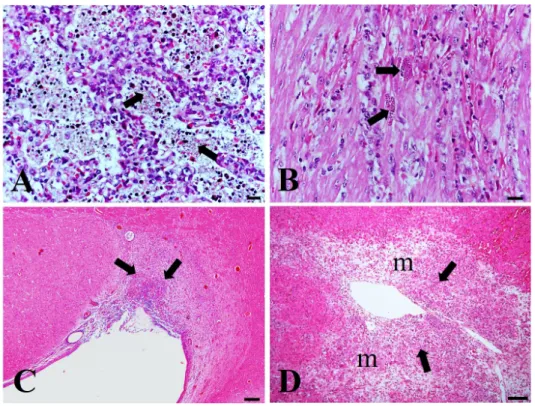
Fig. 1. Histopathologic findings in piglets. (A) The alveolar wall is lined by type II pneumocytes and the lumen contained with necrotic macrophages and cell debris (ar- rows). Bar=20 µm. (B) Note my- ocardial muscular degeneration with intra-lesional tachyzoites (arrows) of T. gondii. Bar=20 µm. (C) Note focal necrotic encephalitis (arrows) around para-ventricular area of ce- rebrum. Bar=200 µm. (D) Note ne- crotic adrenalitis (arrows) in adre- nal medulla (m). Bar=100 µm. H&E.

such as abortion, stillborn, mummification and weak born piglets and also respiratory sign can distress to pigs of all ages. Porcine abortion associated with T.

gondii and toxoplasmosis in piglets were previously re- ported in Korea (Roh et al, 1997; Kim et al, 2009).

This study reports congenital co-infection of T. gondii and PRRSV in suckling piglets in Jeju, Korea.

CASE

At a pig farm with a scale of 600 pigs in Jeju, the sudden death of suckling piglets had been increased af- ter incoming 40 ∼50 gilts from breeding farms. The dead piglets were delivered from these newly introduced gilts, and showed clinical signs such as dyspnea, anorexia and lethargy before death. Two suckling piglets with 4 days and 10 days of age were referred to the Pathology Laboratory at the College of Veterinary Medicine in Jeju National University. After the necropsy, collected tissue was fixed in 10% buffered formalin, embedded in paraffin, sectioned at 3 µm and stained with hematox- ylin & eosin (H&E).

At necropsy, piglets were mild emaciated. The lungs

showed diffuse fail to collapse with rubbery consistency, edematous dilatation of interlobular septa, and lobular consolidation with purple red color. Heart was diffuse pale in color and had several irregular linear-shaped macules or patches. Histopathologically, diffuse inter- stitial pneumonia was present in the lungs of 2 piglets.

Most alveolar walls were thickened due to the pro- liferation of type II pneumocytes, and alveolar lumens contained necrotic cellular debris derived from neutro- phils and macrophages (Fig. 1A). As mentioned in pre- vious literature (Dubey, 1986), multifocal necrotizing in- flammations suspected protozoal infection were observed in various internal organs. Multifocal hemorrhage and necrotizing pneumonia with protozoan tachyzoites char- acterized by round, ovoid or crescent shape were ob- served in the lungs. Severe multifocal to confluent ne- crotic myocarditis with intralesional protozoan tachy- zoites were observed throughout the heart (Fig. 1B). In the brain, necrotic encephalitis with intralesional proto- zoan tachyzoites was present at the adjacent area of lat- eral ventricle (Fig. 1C). Focal necrotic lesion with many tachyzoites also noted in the medulla of adrenal gland (Fig. 1D).

To confirm the protozoal tachyzoites, replicate sec-

(3)

Fig. 2. Immunohistochemistry for T. gondii and PRRSV in the lungs of piglets. (A) Positive re- actions for tachyzoites of T. gondii (arrow) in the lungs. (B) Antigens of PRRSV (arrows) were detected in the lungs. IHC, Bar=20 µm.

Fig. 3. Immunohistochemistry for T. gondii in piglets. (A) The heart. Note brown tachyzoites of T. gondii (arrows) in cardiac muscle. (B) Note dif- fuse positive reactions for tachyzoites of T. gondii (arrows) in necrotic foci of brain. (C) The adrenal gland. Note brown tachyzoites of T. gondii (arrows) in the medulla of adrenal gland. Bar=20 µm. IHC.
tions of internal organs were used for immunohisto- chemical analysis (IHC). Commercially available anti- bodies including T. gondii antiserum (VMRD

, Pullman, USA) at a 1:5,000 dilution and mouse anti-PRRSV (SDOW17) antibody (South Dakota State University, USA) at a 1:1,000 dilution were applied for IHC (Ramos-Vara

& Beissenherz, 2000). The standard streptavidin-biotin- peroxidase method with 3, 3-diaminobenzidine as the chromogen was used to identify the antigens according to the manufacturer’s protocol (LSAB2 kit; Dako, USA).

According to IHC, T. gondii tachyzoites and PRRSV antigens were confirmed in the lungs of piglets. Oval shaped T. gondii tachyzoites as a pathogen in pig farms were reported elsewhere (Kim et al, 2009) were noted in multifocal necrotic lesions in lungs (Fig. 2A). And PRRSV antigens were observed in the cytoplasms of al- veolar macrophage and mononuclear cells in lungs (Fig.

2B). In addition, protozoan antigens, T. gondii tachyzoites, were nicely demonstrated in heart, brain and adrenal gland (Fig. 3). The positive reactions for T. gondii ta- chyzoites were present as fine brownish granules in the necrotic parenchyma or in the cytoplasm of macro- phages. Based on the gross, histopathologic and im- munohistochemical features, two suckling piglets were diagnosed as the co-infection of T. gondii and PRRSV.

DISCUSSION

Kim et al (2009) reported about porcine abortion as-

sociated with T. gondii in Jeju, Korea. Grossly, hep-

atomegaly and splenomegaly were observed, and multi-

ple necrotic foci were scattered in the lungs, liver,

spleen, and lymph nodes in affected sows. Microscopi-

(4)

cally, multifocal necrotizing lesions and protozoan ta- chyzoites were present in the lesions. In this study, his- topathologic examination of two suckling piglets re- vealed multifocal necrosis of organs such as brain, heart, lung and adrenal gland. In addition, a lot of ta- chyzoites were found beside or interior of the lesions and multiple tachyzoites of T. gondii were observed around blood vessels. So this finding was expected that tachyzoites of T. gondii had affinity to endothelial cells.

Using IHC method, presence of tachyzoites was demon- strated in two suckling piglets.

In histopathology of the lung of piglets, the alveoli were lined by type II pneumocytes and filled with cell debris, serous fluid and macrophages that often contain pyknotic nucleus or karyorrhexis. These findings would be considered typical morphology of PRRSV infection (Zimmerman et al, 2012). In order to prove these find- ings, we applied IHC staining using PRRSV specific antibody. The lungs of two piglets showed strong pos- itive reactions for PRRSV. Therefore, these two piglets were diagnosed as co-infection of T. gondii and PRRSV.

PRRSV is endemic in most country to produce pigs and make a lot of problems due to immunosuppression which bring an opportunistic infection to host (Zimmerman et al, 2012). Recently, Wang et al (2015) reported about T. gondii co-infections with PRRSV, classical swine fe- ver virus (CSFV), porcine circovirus type 2 in 372 pigs, in China. The results revealed that PRRSV were the most common pathogens co-existing (6.7%) with porcine toxoplasmosis, and could increase the chance of T. gon- dii infection. Generally speaking, the incubation period for PRRS is 14 days (OIE, 2016). Pigs are usually in- fective between days 3 and 40 post-infection, but can remain so for several months. The serological test about PRRSV in sows wasn’t performed in this study, when considering various conditions such as age and clinical sign of suckling piglets, the transplacental infection was strongly suspected.

In domestic pigs, the infection routes of T. gondii are 1) to ingest oocysts through feeds and water contamin- ated with the feces of infected cat, 2) to ingest tissue cysts by cannibalism for dead pigs, the tails or ears of infected pigs, or infected rodents, 3) to spread tachy- zoites to fetuses via placenta of infected sow (Shin,

2007). In USA, Illinois, field studies to identify sources and reservoirs of T. gondii infection were conducted on 47 pig farms (Dubey et al, 1995). In that study, anti- bodies to T. gondii were found in trapped wildlife such as cats (68.3%), raccoons (67.0%), skunks (38.9%), opos- sums (22.7%), rats (6.3%), white-footed mice (4.9%) and house mice (2.1%). In addition, T. gondii oocysts were detected in feed samples (0.4%), soil samples (1.3%), and fecal samples (1.8%) of cats. Hence, possibility of transmission of T. gondii to pigs via consumption of ro- dents, feed, and soil was confirmed. On the other hand, the prevalence of congenital T. gondii infection in pigs is less than 0.01% (Lindsay et al, 2012). Based on the review of porcine toxoplasmosis, transplacental infection appeared to be less common than post-natal infection (Dubey, 1986). Several sporadic neonatal and perinatal toxoplasmosis in piglets were reported in many countries.

Infected piglets were born dead, sick, or became sick within 3 months of birth, although some remained clin- ically normal.

In the laboratory experiment of mice, a kind of inter- mediate host, after the ingestion of oocysts, it took about 12 to 18 hours to convert oocysts to tachyzoites in in- testinal lamina propria according to reviewed article (Dubey, 1998). The enterocytes became infected 48 to 72 h post-inoculation (PI). Parasitaemia was detected at 48 h p.i., and several extra-intestinal organs were infected by 3 days post-inoculation (DPI). But parasites appeared in mice brains at 6 DPI. Compared with oocyst-induced infections, T. gondii bradyzoites in tissue cysts were less infective and less pathogenic to mice orally infected.

Invasion of parasites in lung, brains and other organs

took over 4 DPI (Dubey, 1998). Age resistance of por-

cine toxoplasmosis was described in some experimental

infections (Dubey, 1986). Work et al (1970) found that

disease in congenitally infected pigs was more severe

than in young piglets infected after birth and mildest in

sows. Comparison for the pathogenicity of T. gondii was

performed in 3 groups of piglets, 1 (group A), 8 (group

B), and 10 (group C) days old (Beverley & Henry,

1978). The infecting dose was 100 tissue cysts given sub-

cutaneously. Piglets in group A became sick by 7 DPI

and 4 died between 9 and 14 days. Overall histopatho-

logic lesions in group A were more severe than those in

(5)

group B; they were mild in group C. Multifocal ence- phalitis without and with tissue cysts of T. gondii were observed in the brains of piglets at 10 and 7 DPI, respectively. One piglet found dead at 2 DPI did not show any lesions in the brain. Hence, it takes at least 7 days for the production of brain lesions in suckling piglets. Ingestion of oocysts is more likely to give rise to intestinal lesions than is ingestion of tissue cysts. In the present case, there were no typical lesions and para- sitic organisms in the intestine of 2 suckling piglets.

And, epidemiological research to clarify the source of T.

gondii infection was not conducted but considering above histopathologic result of studies and age (4 and 10 days) of suckling piglets, two piglets were suspected to be transplacental infection than post-natal infection of T. gondii. Severe neurological lesions in central nervous system were a common condition associated with con- genital T. gondii infection in human (Shehu et al, 2019).

In addition, necrotic encephalitis and necrotic pneumonia were also observed in the stillborn piglets with con- genital toxoplasmosis (Haritani et al, 1988).

Although epidemiological differences between domes- tic and foreign was recognized, ingestion of oocysts in contaminated feed, water, soil, and living animals was considered of the main sources of T. gondii infection in pigs (Dubey, 1986; Lehmann et al, 2003). It is very hard to recognize the infection of T. gondii at pig farm, therefore circulating antigen will rapidly progress through horizontal or vertical infection. In Jeju, there is no pro- vincial screening system for individual pigs at slaughter house before human consumption. According to recently study, residents in Jeju showed higher positive rates for T. gondii than other regions in Korea (Hong et al, 2011).

Sero-positive rates for Korean against T. gondii were ranged from 1.9 to 7.7%. On the other hand, the resi- dent in Jeju showed very high sero-positivity about 13.2% (309/2,348 sera). Regional environment and con- vention such as eating uncooked pork and deer meat were responsible for higher positive rate of T. gondii in Jeju. To prevent infection of T. gondii, it is necessary to eradicate residual rodents in farm and control wild ani- mals or stray cats. Also completely cooked pork for hu- man meal is very important to block the infection of T.

gondii to human.

ACKNOWLEDGMENTS

This work was supported by the 2020 education, re- search and student guidance grant funded by Jeju National University.

CONFLICT OF INTEREST

No potential conflict of interest relevant to this article was reported.

ORCID

Young-Min Choi, https://orcid.org/0000-0002-6357-5237 Hyoung-Seok Yang, https://orcid.org/0000-0003-4500-8826 Jae-Hoon Kim, https://orcid.org/0000-0002-4410-9126

REFERENCES

Beverley JKA, Henry L. 1978. Experimental toxoplasmosis in young piglets. Res Vet Sci 24: 139-146.

Dubey JP, Weigel RM, Siegel AM, Thulliez P, Kitron UD, Mitchell MA, Mannelli A, Mateus-Pinilla NE, Shen SK, Kwok OC, Todd KS. 1995. Sources and reservoirs of Toxoplasma gondii infection on 47 swine farms in Illinois.

J Parasitol 81: 723-729.

Dubey JP. 1986. A review of toxoplasmosis in pigs. Vet Parasitol 19: 181-223.

Dubey JP. 1998. Advances in the life cycle of Toxoplasma gondii.

Int J Parasitol 28: 1019-1024.

Haritani M, Shimura K, Iwabuchi I, Kobayashi M, Narita M.

1988. Demonstration of Toxoplasma gondii antigen in stillborn piglets using immunoperoxidase technique Jpn J Vet Sci 50: 954-956.

Holtkamp DJ, Kliebenstein JB, Neumann EJ, Zimmerman JJ, Rotto HF, Yoder TK, Wang C, Yeske PE, Mowrer CL, Haley CA. 2013. Assessment of the economic impact of porcine reproductive and respiratory syndrome virus on United States pork producers. J Swine Health Prod 21:

72-84.

Hong SJ, Chong CK, Lee K, Kim TS, Hong YP, Ahn HJ, Kim HY, Ko AR, Kim YJ, Nam HW. 2011. Maintained Seroprevalence of Toxoplasmosis among the Residents of Jeju Island, Korea. Korean J Parasitol 49: 309-311.

Kim JH, Kang KI, Kang WC, Sohn HJ, Jean YH, Park BK, Kim

Y, Kim DY. 2009. Porcine abortion outbreak associated

(6)

with Toxoplasma gondii in Jeju Island, Korea. J Vet Sci 10: 147-151.

Lehmann T, Graham DH, Dahl E, Sreekumar C, Launer F, Corn JL, Gamble HR, Dubey JP. 2003. Transmission dynam- ics of Toxoplasma gondii on a pig farm. Infect Genetic Evol 3: 135-141.

Lindsay DS, Dubey JP, Santín-Durán M, Fayer R. 2012. Coccidia and Other Protozoa. pp. 895-907. In: Zimmerman JJ, Karriker LA, Ramirez A, Schwartz KJ, Stevenson GW (eds), Diseases of Swine, 10th ed. Wiley-Blackwell Pub- lishing, Ames, USA.

Neumann E, Kliebenstein JB, Johnson CD, Mabry JW, Bush EJ, Seitzinger AH, Zimmerman JJ. 2005. Assessment of the economic impact of porcine reproductive and 2 respira- tory syndrome von swine production in the United States.

J Am Vet Med Assoc 227: 385-392.

OIE (World Organisation for Animal Health), online a. Report of the Meeting of the OIE Terrestrial Animal Health Standards Commission, Paris, 8-19 February 2016. Available on- line: http://www.oie.int/fileadmin/Home/eng/Internationa_

Standard_ Setting/docs/pdf/A_TAHSC_Feb_2016_Part_B.pdf Ramos-Vara JA, Beissenherz ME. 2000. Optimization of immuno- histochemical methods using two different antigen re- trieval methods on formalin- fixed, paraffin-embedded tis- sues: experience with 63 markers. J Vet Diagn Invest

12: 307-311.

Roh IS, Han JH, Kim JH, Ahn BW. 1997. Toxoplasmosis in piglets. Korean J Vet Res 37: 817-823.

Shehu NU, Sale KA, Mohammed K, Garba MK, Bunza N, Ganau AM, Fumilayo AO. 2019. Congenital Toxoplasmosis: pre- sent and future challenges: a review. South Asian J Parasitol 2: 1-10.

Shin SS. 2007. Pathogenicity and prevention of swine toxoplasmosis.

Kor J Vet Publ Hlth 31: 173-181.

Wang S, Zhang M, Liu XC, Lin T, Yang HC, Yuan SS, Zhao GW, Ia H, Yan RF, Song XK, Xu LX, Li XR. 2015.

Investigation on the co-infections of Toxoplasma gondii with PRRSV, CSFV or PCV-2 in swine in part of China.

J Integr Agric 14: 1838-1844.

Work K, Eriksen L, Fennestad KL, Møller T, Siim JC. 1970.

Experimental tosoplasmosis in pregnant sows. I. Clinical, parasitological and serological observations. Acta Pathol Microbiolo Scand Sect B 78: 129-139.

Zimmerman J, Benfield DA, Dee SA, Murtaugh MP, Stadejek T, Stevenson GW, Torremorell M. 2012. Porcine Reproduc- tive and Respiratory Syndrome Virus (Porcine Arterivirus).

pp. 461-486. In: Zimmerman JJ, Karriker LA, Ramirez

A, Schwartz KJ, Stevenson GW (eds), Diseases of Swine,

10th ed. Wiley-Blackwell Publishing, Ames, USA.

수치

Fig. 1. Histopathologic findings  in piglets. (A) The alveolar wall is  lined by type II pneumocytes and  the lumen contained with necrotic  macrophages and cell debris  (ar-rows)
Fig. 2. Immunohistochemistry  for  T. gondii and PRRSV in the  lungs of piglets. (A) Positive  re-actions for tachyzoites of T

참조

관련 문서