Korean J Vet Res(2018) 58(1) : 9~16 https://doi.org/10.14405/kjvr.2018.58.1.9
9
<Original Article>
Preliminary assessment of correlation between T-lymphocyte responses and control of porcine reproductive and respiratory syndrome virus (PRRSV)
in piglets born after in-utero infection of a type 2 PRRSV
Sang-Ho Cha
1, Carey Bandaranayaka-Mudiyanselage
2, Chandima B. Bandaranayaka-Mudiyanselage
2, Dharani Ajiththos
3, Kyoung-Jin Yoon
4, Kathleen A. Gibson
4, Ji-Eun Yu
1, In-Soo Cho
1,
Stephen S. Lee
5, Chungwon J. Chung
2,3,*
,†1
Animal and Plant Quarantine Agency, Gimcheon 39660, Korea
2
VMRD Inc., Pullman, WA 99163, USA
3
Department of Veterinary Microbiology and Pathology, Washington State University, Pullman, WA 99163, USA
4
Department of Veterinary Diagnostic and Production Animal Medicine, College of Veterinary Medicine, Iowa State University, Ames, IA 50011, USA
5
University of Idaho, Moscow, ID 83843, USA
(Received: November 11, 2017; Revised: February 10, 2018; Accepted: February 14, 2018)
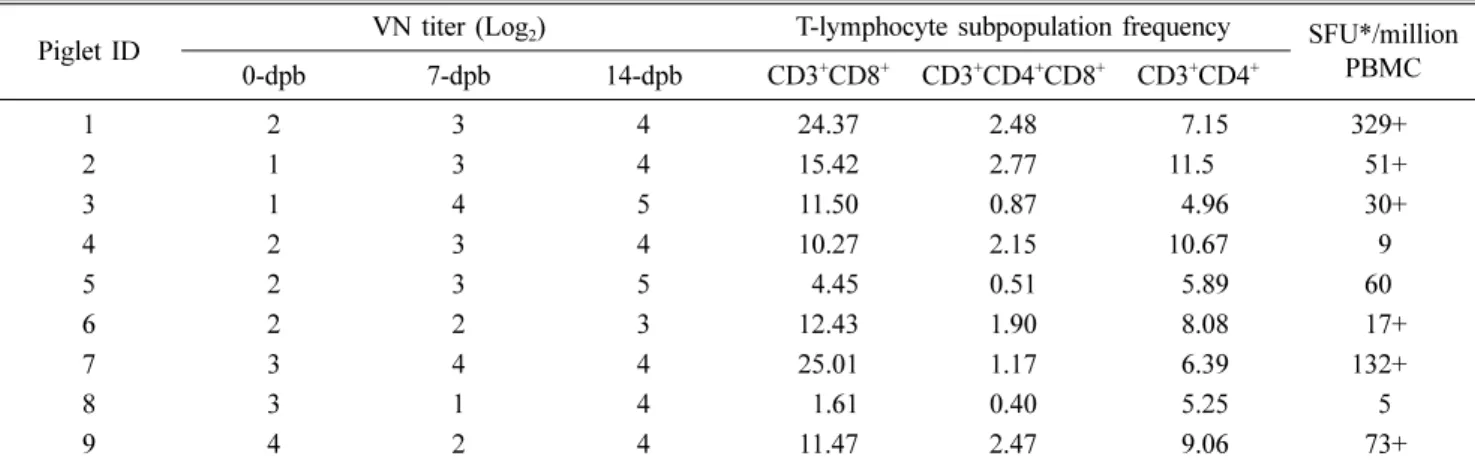
Abstract: A preliminary study into the protective mechanisms of adaptive immunity against porcine reproductive and respiratory syndrome virus (PRRSV) in piglets (n = 9) born to a gilt challenged intranasally with a type-2 PRRSV.
Immune parameters (neutralizing antibodies, CD3
+CD4
+, CD3
+CD8
+, CD3
+CD4
+CD8
+T-lymphocytes, and PRRSV- specific interferon (IFN)- γ secreting T-lymphocytes) were compared with infection parameters (macro- and microscopic lung lesion, and PRRSV-infected porcine alveolar macrophages (CD172α
+PRRSV-N
+PAM) as well as with plasma and lymphoid tissue viral loads. Percentages of three T-lymphocyte phenotypes in 14-days post-birth (dpb) peripheral blood mononuclear cell (PBMC) had significant negative correlations with percentages of CD172 α
+PRRSV-N
+PAM ( p < 0.05) as well as with macroscopic lung lesion (p < 0.01). Plasma and tissue viral loads had significant (p < 0.05) negative correlations with CD3
+CD4
+CD8
+T-lymphocyte percentage in PBMC. Frequencies of CD3
+CD8
+and CD3
+CD4
+T-lymphocytes in 14-dpb PBMC had significant negative correlations with of lymph node (p = 0.04) and lung ( p = 0.002) viral loads. IFN-γ-secreting T-lymphocytes frequency had a significant negative correlation with gross lung lesion severity ( p = 0.002). However, neutralizing antibody titers had no significant negative correlation (p > 0.1) with infection parameters. The results indicate that T-lymphocytes contribute to controlling PRRSV replication in young piglets born after in-utero infection.
Keywords: T-lymphocyte, neutralizing antibodies, porcine reproductive and respiratory syndrome virus
Introduction
Porcine reproductive and respiratory syndrome (PRRS) was first recognized in the United States and Europe as
‘Mystery Swine Disease’ in mid-1980s. The disease charac- terized by manifestation of reproductive failure and respira- tory distress in swine herds had been subsequently reported from Asia and other pig-producing areas between the late 1980s and early 1990s [7, 31]. The causative agent of this globally epidemic, economically important porcine disease was then identified as a member of the Arteriviridae family, which contains a single-stranded positive-sense RNA genome
of approximately 15 Kb in the order of Nidovirales. Porcine reproductive and respiratory syndrome virus (PRRSV) is divided into two major genotypes: type-1 PRRSV (European type) and type-2 PRRSV (North American type).
Vaccination with attenuated live viruses has been used to control clinical PRRS in many countries [2, 26]. However, this conventional vaccine formulation using a few selected PRRSV isolates has not been satisfactory to protect swine herds affected with various PRRSV isolates, possibly due to induction of ineffective immune response, high antigenic variation among isolates and a possible reversion to viru- lence of attenuated vaccine strains [1, 24]. Up to date, neu-
*Corresponding author
Tel: +1-631-323-3429, Fax: +1-631-323-3097 E-mail: [email protected]
†