363
Serological and genetic characterization of the European strain of the porcine reproductive and respiratory
syndrome virus isolated in Korea
June-Youp Kim, Seung-Yoon Lee, Jung-Hyang Sur, Young S. Lyoo*
College of Veterinary Medicine, Konkuk University, Seoul 143-701, Korea
(Accepted: November 23, 2006)
Abstract : Porcine reproductive and respiratory syndrome (PRRS) is an economically important disease of swine that occurs all over the swine industry worldwide. It was first observed in the Unite States in 1987 then in Europe in 1990. It has been described in Japan and in Korea in 1993. PRRS virus is divided into two distinct types, North American and European, genetically. Based on our limited knowledge there has been no report on the existence of European PRRSV. But according to the government's Korea Customs Service there has been many importations of breeding pigs from Europe.
These seem to make an estimate that European PRRSV could be introduced in Korea by inflow of European breeding pigs. We first detected the European PRRSV could be introduced in Korean pig farms by using polymerase chain reaction (PCR). Further, it is also identified that there are not only North American PRRSV antibody but also a European PRRSV antibody. According to the genetical and serological experiment results, the presence of established North American PRRSV in Korea is due to the use of live vaccines made of North American PRRSV strain as well field virus infection, and the European PRRSV is possibly introduced from imported breeding stock.
Key words : European PRRSV, homology, PCR (Polymerase Chain Reaction)
Introduction
Porcine reproductive and respiratory syndrome (PRRS) is an economically important disease of swine that occurs all over the world. It was first observed in the Unite States in 1987 then in Europe in 1990 [6]. It has been described in Japan and in Korea in 1993 [10].
In the 1980s an unrecognized disease syndrome caused heavy production losses in pig herds in North America.
Surprisingly, this disease syndrome was relatively unknown until reports have been made several outbreaks of the disease in Indiana swine herds [27, 28]. For the next 4-5 years the disease was to become popularized by “Mystery Disease” or “Mystery Swine Disease” [11]. The predominant reproductive and respiratory clinical signs associated with this syndrome have resulted in descriptive term “Swine Infertility and Respiratory Syndrome” (SIRS), which has become the most commonly used name for mystery swine disease
in the United States [29]. The disease described in Europe is clinically similar to SIRS in the United States, except disease has spread much more rapidly through out the European swine industry, and cutaneous cyanosis of the ears, vulva, and abdomen is more frequently observed as a clinical sign of affected pigs in Europe.
Hence, the European veterinary community has given various names to this syndrome: new pig disease, blue ear disease, porcine epidemic abortion and respiratory syndrome (PEARS), and the official names porcine reproductive and respiratory syndrome (PRRS).
At a meeting in April 1991 European Community Veterinarians agreed on the name of “Porcine Repro- ductive and Respiratory Syndrome”-PRRS. In 1992, the ‘First International Symposium on PRRS’ in Minnesota adopted this term. Clinical manifestations are characterized by anorexia and respiratory distress in pigs of all ages; high mortality in neonatal and weaned pigs; poor conception in breeding herds; and
*Corresponding author: Young S. Lyoo
Department of Veterinary Medicine, Konkuk University, Seoul 143-701, Korea
[Tel: +82-2-450-3719, Fax: +82-2-450-5966, E-mail: [email protected]]
reproductive disorders such as late-term abortions, premature farrowings, stillborns, mummifications, and weak live born pigs [5, 30]. PRRS virus (PRRSV), the causative agent of PRRS, is a single-stranded, positive- sense, enveloped RNA virus [1]. It belongs to the Arteriviridaefamily that also includes the equine arteritis virus (EAV), the lactate dehydrogenase-elevating virus (LDV) and the simian hemorrhagic fever virus (SHFV) [2, 19, 20]. The genome of PRRSV is about 15 kb in length and identified eight overlapping open reading frames (ORFs). ORFs 1a and 1b, which are expressed from genomic RNA, occupy more than two-thirds of the genome and encode the viral RNA polymerase [20].
Six putative structural proteins have been identified and assigned to distinct smaller ORFs. ORFs 2 to 7, respec- tively, encoded three major structural proteins, a 25 kDa envelope glycoprotein (GP5), an 18-19 kDa unglycosylated membrane protein (M), and a 15 kDa nucleocapsid (N) protein. Also, the translation products of ORFs 2, 3 and 4, with respective apparent molecular masses of 30, 45 and 31 kDa, have characteristics of membrane-associated glycoproteins [16, 21]. Antigenic and subsequent genetic analyses of PRRS viruses isolated from North America and Europe have revealed clear differences between viruses originating on the two continents [3, 7, 9, 13, 15-18, 22-24, 29]. PRRS virus is divided into two types, North American and European, genetically. According to data of the National Veterinary Research and Quarantine Service (NVRQS) in Korea (Table 5), there have been many importations of breeding pigs in Europe. The fact became a basis to make an estimate that there is an European PRRSV in Korea by inflow of European breeding pigs, and in the work we have detected the European PRRSV in Korean pig farms using polymerase chain reaction (PCR). And serologically, it also confirmed that there is not only North American PRRSV antibody but also a European PRRSV antibody.
Materials and Methods
Cells
A permissive clone (MARC-145) [8] derived from an African green monkey kidney (MA-104) cell line was used for virus propagation and the IFA test. The MARC-145 cells were propagated in growth medium (GM) was Dulbecco's modified eagle's medium (DMEM, Gibco-BRL, USA) supplemented with 10% fetal bovine
serum (FBS), 1% antibiotics and antimycotics (Gibco- BRL, USA) was used for the propagation of cells.
Maintenance medium (MM) consists of DMEM with 2% FBS, 1% antibiotics and antimycotics, and the cells were kept at 37
oC in a humidified atmosphere containing 5% CO
2. The cells were obtained from NVRQS in Korea.
Viruses
North American type of the PRRSV (PL96-1) and EU prototype Leystad strains were used for serological assay.
To isolate field viruses the lung tissues obtained from aborted piglets in Korea pig farms were homo- genized with phosphate buffered saline (PBS). PRRS virus infections were represented in the contents of porcine alveolar macrophages by reverse transcriptase polymerase chain reaction (RT-PCR). The homogenized lung tissues were centrifuged and the resulting superna- tants were passed through a 0.2
µm membrane filter to remove contaminated bacteria. The filtered sample was used as a virus stock for cell culture inoculation.
Reverse transcriptase polymerase chain reaction (RT-PCR)
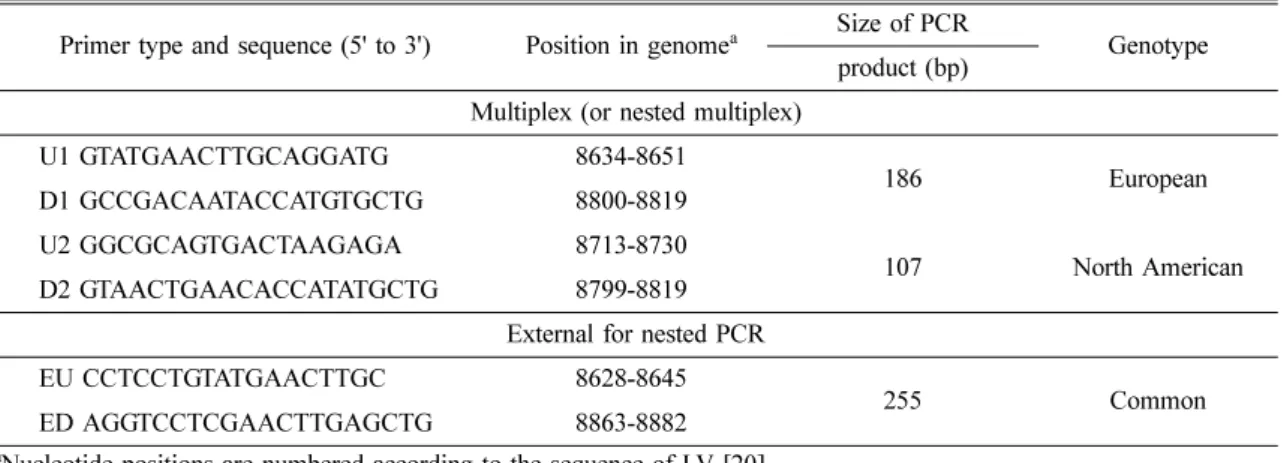
Common PCR primers were designed on the basis of ORF1b sequence. Type-specific (North America;
NA and European; EU genotype) and type-common primers for multiplex or nested multiplex PCR (Table 1) were designed based on the sequence data of ORF 1b from two NA strains of PRRS virus: Minnesota MN-1b [9, 31] and Quebec LHVA-93-3 [14] isolates [4]. Viral RNA was extracted by acid guanidium thiocyanate phenol-chloroform method of Chomezynski and Sacchi. Mixture for the RT-PCR was prepared by following previously described protocols [4]. The primers predicted the amplification of 186 bp product for EU genotype and a 107 bp product for NA genotype (Table 1), respectively. A total of 21 PRRS virus strains and isolates propagated in cell culture were tested in the multiplex PCR assay. The multiplex PCR assay produced prominent DNA products for different PRRS viruses with titers that ranged from 1
×10
4to 3
×10
5TCID
50/100
µl. The limit of detection for the assay using RNA extracted from 10-fold dilutions of the MN-1b strain was 1
×10
3TCID
50[4].
Sequencing and genetic analysis
The PCR products of 186 bp (EU genotype) were
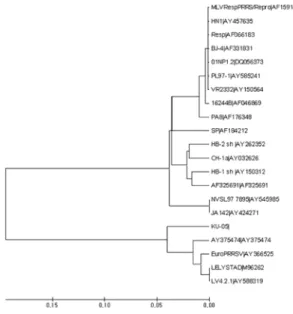
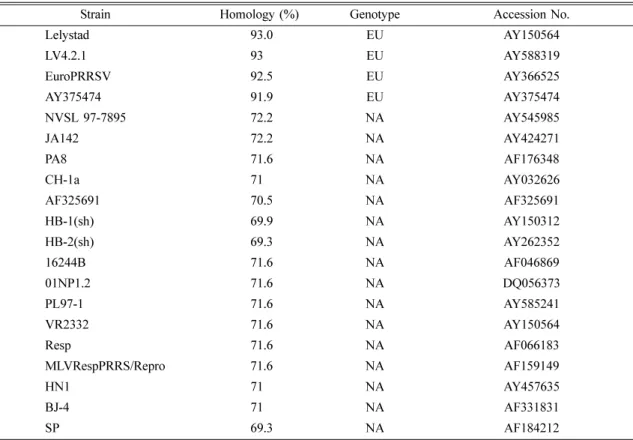
purified for sequencing from agarose gel and purified using the GENECLEAN KIT (Bio 101, USA) according to the manufacturer's recommendations. Sequencing was carried out by using Dye Terminator (ABI type Seq.) sequencing type by automated sequencing analyzer (Bionex, Korea). Sequencing data was analyzed using computer software program Align, Basic Local Alignment Search Tool (BLAST, National Center for Biotechnology Information, USA). Comparisons of 154 bp nucleotides were carried out using the DNASIS-DB (Hitachi Software Engineering Co., Ltd. DNASIS-DB for Window version 1.1). Information obtained by sequence analysis was used for comparing with other strains.
Serological tests by indirect fluorescence assay (IFA)
Antibody responses to the different strains were analyzed by IFA test as previously described [12].
Antibodies specific to NA (PL96-1) and EU (LELY STAD) genotype PRRSV were compared in serum samples collected from Korean swine herds. IFA test was carried out by following previously described protocol [25].
Results
RT-PCR
Detection of European type of PRRSV from the lung Table 1. Oligonucleotide primers for PCR amplification and typing of PRRS viruses
Primer type and sequence (5' to 3') Position in genome
aSize of PCR Genotype product (bp)
Multiplex (or nested multiplex)
U1 GTATGAACTTGCAGGATG 8634-8651 186 European
D1 GCCGACAATACCATGTGCTG 8800-8819
U2 GGCGCAGTGACTAAGAGA 8713-8730 107 North American
D2 GTAACTGAACACCATATGCTG 8799-8819
External for nested PCR
EU CCTCCTGTATGAACTTGC 8628-8645 255 Common
ED AGGTCCTCGAACTTGAGCTG 8863-8882
a