Received:September 25, 2019 Revised: February 26, 2020 Accepted: April 2, 2020
OPEN ACCESS
HORTICULTURAL SCIENCE and TECHNOLOGY 38(3):385-393, 2020
URL: http://www.hst-j.org pISSN : 1226-8763 eISSN : 2465-8588
This is an Open Access article distributed under the terms of the Creative Commons Attribution Non-Commercial License which permits unrestricted non-commercial use, distribution, and reproduction in any medium, provided the original work is properly cited.
Copyrightⓒ2020 Korean Society for Horticultural Science.
This work was supported by Korea Institute of Planning and Evaluation for Technology in Food, Agriculture, Forestry (iPET) through Agri-Bio industry Technology Development Program (or Project), funded by Ministry of Agriculture, Food and Rural Affairs (MAFRA; grant number. iPET 116160-2).
Author Contributions Statement
Su-Jin Bae, and Islam designed and conducted the experiments and performed the com- putations. Hong-Yul Kim, and Ki-Byung Lim verified the analytical methods. Ki-Byung Lim encouraged and supervised the findings of this work. All authors discussed the results and contributed to the final manuscript.
Compliance with Ethical Standards The research being report in this publication was supported by Ministry of Agriculture, Food and Rural Affairs. I hereby disclose all of my conflicts of interest and other potentially conflicting interests, including specific financial interests and relationships and affiliations relevant to HST.
Induction of Tetraploidy in Watermelon with Oryzalin Treatments
Su-Jin Bae1, Md Mazharul Islam1, Hong-Yul Kim1,2, and Ki-Byung Lim1,2*
1Department of Horticultural Science, Kyungpook National University, Daegu 41566, Korea
2Institute of Agricultural Science and Technology, Kyungpook National University, Daegu 41566, Korea
*Corresponding author: [email protected]
Abstract
This study evaluated the effect of different concentrations and methods of oryzalin treatment on polyploidization in watermelon (Citrullus lanatus). The first method involved different concentration of oryzalin (0, 5, 10, 15, 20, and 25 mg∙L-1) applied to the shoot apex of watermelon seedlings.
Polyploidy was not induced by concentrations of 10 mg∙L-1 or lower. In contrast, mixoploidy was observed with concentrations of 15 and 20 mg∙L-1 and 84% of the plants were tetraploid in the 25 mg∙L-1 concentration. The addition of the surfactant tween 20 in oryzalin was less effective for tetraploid induction than oryzalin alone. The second method involved soaking the seeds in different concentrations of oryzalin (0, 30, and 35 mg∙L-1). With this method, the 30 mg∙L-1 oryzalin concentration did not induce polyploidy and the 35 mg∙L-1 concentration only induced tetraploidy in 25% of the plants.
The morphological features of the second true leaf of a tetraploid plant showed a small, thick, and wrinkled leaf unlike that of the diploid plant. In addition, the number of stomata per unit area decreased and stomata doubled in size in the tetraploid plants. Tetraploid plants (2n = 4x = 44) were confirmed by counting the number of chromosomes of the treated plants. We concluded that the shoot apex treatment with 25 mg∙L-1 oryzalin was the most effective method for inducing tetraploid watermelon.
Additional key words: chromosome doubling, leaf shape, seed soaking, shoot apex treatment, stomata size
Introduction
Watermelon (Citrullus lanatus L., 2n = 2x = 22), originated in South Africa, and is an economically important fruit crop, like cucumber (Cucumis sativus L.), melon (Cucumis melo L.), and pumpkin (Cucurbita moschata) (Anonymous, 2012). In Korea, watermelon is grown over an area of 2,726 hectares with an annual production of 92,736 tons. Watermelon is the third largest consumed fruit crop in Korea after strawberries and dried peppers (MAFRA, 2017). Desired characteristics of horticultural crops include plant size, disease resistance, environmental stresses tolerance and seedless fruits introduced through breeding and polyploidization (Lapins, 1975; Cockerham and Galletta, 1976; Ranney, 2006). Polyploidization is an important way in desired plant development which is often associated with introduction of novel traits (Levin, 2002). Polyploidy in gymnosperms is rare,
while 70% of naturally occurring angiosperms are polyploid (Khoshoo, 1959; Koshoo, 1961; Goldblatt, 1980; Masterson, 1994; Ahuja, 2005). Usually, polyploid organisms exhibit heterosis, increased vigor, higher yield, produce higher quality products and are more tolerant to both biotic and abiotic stresses than their diploid counterparts (Fawcett et al., 2009;
Sattler et al., 2016).
Seedlessness is one of the major goals of modern watermelon breeding, and seedless watermelon is preferred by consumers due to higher sugar content (Marr and Gast, 1991), superior quality, and higher yield (Henderson, 1977). Many techniques are used to develop seedless watermelons, with the most commonly used antimitotic alkali agent being colchicine, which prevents spindle formation (Eigsti, 1971; Henderson, 1977; Miguel and Leonhardt, 2011), and prevent nuclear cell division (Ganga and Chezhiyan, 2002). Lower concentrations (0.5 mM) of colchicine inhibit microtubule formation, resulting in reducing fertility, while higher concentrations (5 mM) induce microtubule polymerization to develop spindle in c-metaphase cells (Caperta et al., 2006). Though efficient in inducing polyploids, colchicine is a highly toxic, carcinogenic compound which is not only harmful to humans but can also cause infertility and chimeras due to abnormal cell division in crops (Morejohn et al., 1984; Wan et al., 1989). In recent studies, oryzalin, trifluralin, amiprophos-methy1 (APM), and caffeine have been used as herbicides as well as substitutes for colchicine (Dhooghe et al., 2011; Miguel and Leonhardt, 2011). Moreover, oryzalin is comparatively more effective in inducing stable polyploids in plants with, an increased survival rate, and is less toxic to animals due to a greater affinity to bind with plant tubulin (Morejohn et al., 1987). Lower concentrations of oryzalin (1/100) compared to colchicine strongly bind to tubulin during cell division (Morejohn et al., 1987; Ramulu et al., 1991). Tetraploid watermelon induced by oryzalin had larger leaves, and flowers, and a thicker rind as compared to diploids (Jaskani et al., 2004; Contreras et al., 2007). Therefore, oryzalin is preferred over colchicine, and has been shown to be more effective to induce polyploidy than other substances in lily (Lilium sp.) (Chung et al., 2004), chrysanthemum (Chrysanthemum morifolium) (Viehmannovã et al., 2009), and cymbidium (Cymbidium sp.) (Hwang et al., 2015).
The objective of this study was to examine the effects of different concentrations and treatment methods of oryzalin in the polyploidization of watermelons.
Materials and Methods Application to Shoot Apexes
Diploid watermelon seeds (‘Nuneichan’, The Dream Co., Ltd.) were sown in a tray. Oryzalin was dissolved in 0.1%
dimethyl sulfoxide (DMSO) and diluted with distilled water to prepare a 1% stock solution. The treatment concentrations were 0, 5, 10, 15, 20, and 25 mg·L-1, and 10 µL of each concentration was added to shoot apexes of the watermelon seedlings when cotyledons were developed using pipettes. To increase the absorption of oryzalin (Fig. 1), cotyledons were fixed with a clip for 7 days, after which the clip was removed. After oryzalin treatment, the second true leaf was collected and ploidy was analyzed by flow cytometry (Partec PA, Ploidy Analylzer, Germany). The leaf tissue (0.5 cm2) was chopped with a sharp razor blade in a 50 × 12 mm plastic Petri dish with 500 µL of nucleus isolation buffer. The standard peak was programmed to appear at about channel 50 of relative fluorescent intensity. This setting was kept constant and was readjusted for every measurement.
A B
Fig. 1. The drop treatment of oryzalin in watermelon. A: Drop treatment to watermelon shoot apex using a pipette. B: After treatment, the cotyledon was closed with a clip.
Application to Shoot Apexes with Oryzalin + Tween20
To enhance the effectiveness, the surfactant Tween 20 was added to the oryzalin solution. Oryzalin treatment concen- trations for this method were 0, 25, and 30 mg·L-1, and 30 µL Tween 20 was added to 50 mL of each concentration of oryzalin. The solutions were applied in the same manner and polyploidy was analyzed by flow cytometry as described above.
Seed Soaking
A total of 50 seeds were sown per Petri dish on top of absorbent cotton measuring 9 cm in diameter. Following this, 0, 30, and 35 mg·L-1 solutions of oryzalin were added to soak the cotton and submerge the seeds. The Petri-dishes were placed in a 25°C incubator for 3 days. The seeds were germinated, and managed in a greenhouse with 50 implanted trays.
Polyploidy was analyzed using flow cytometry using the second true leaf.
Stomata Observation
To observe the morphological changes of oryzalin-treated seedlings, the epidermis was separated using forceps. The separated epidermis was placed on a glass slide and covered with cover glass. The slides were observed under an optical microscope (BX61, Olympus, Japan) at a magnification of 400×.
Chromosome Observations
For chromosome observations, watermelon root tips were collected at 8:00 a.m. from the greenhouse. Following this, the root tips were prefixed with 8-hydroxyquinoline at 20°C for 3 h and then fixed overnight in ethanol: acetic acid solution (3:1, v/v) at room temperature. The root tips were then placed in an ethanol solution (70%) and stored in a refrigerator (Kwon et al., 2017; Cuyacot et al., 2017). The root tips were then washed with double-distilled water and treated with an enzyme mixture containing 0.3% cytohelicase, 0.3% pectolyase, and 0.3% cellulase at 37°C for 40 min.
Following this, the root tips were squashed with 17 µL of acetic acid (70%), and air-dried. The chromosomes were counterstained with 2 µL·mL-1 of 4',6-diamino-2-phynylindole (DAPI) in VECTASHIELDmedium and observed under a fluorescent microscope (BX61, Olympus, Japan).
Results and Discussion Application to Shoot Apexes
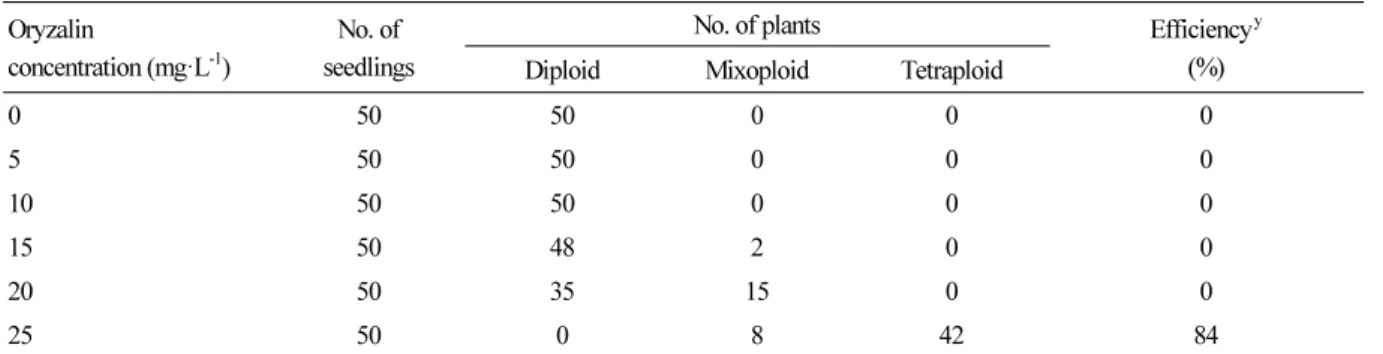
DNA contents of diploid, mixoploid, and tetraploid plants were analyzed by flow cytometry. For diploid plants, peaks were observed at 50 and 100 (Fig. 2A). In the mixoploid plants, peaks were observed at 50, 100, and 200 (Fig. 2B). However, the tetraploid peaks were observed at 100 and 200 (Fig. 2C). The results of watermelon polyploidy depending on the concentration of oryzalin treatment are shown in Table 1. Oryzalin treatments with 5 and 10 mg·L-1 concentrations did not result in polyploidy. In case the of the 15 mg·L-1 treatment, 48 seedlings were diploids and the remaining 2 were mixoploids. Further, the 20 mg·L-1 treatment resulted in 35 diploids and 15 mixoploids. Thus, treatments with 20 mg·L-1 or lower concentrations did not result in tetraploids. In the case of the 25 mg·L-1 treatment, 8 mixoploids, and 42 tetraploids were observed, with an 84% polyploidy rate. In a study by Raza et al. (2003), in watermelon, the highest number of tetraploids was found with 0.01% colchicine. The highest survival rate and ploidy level of Watsonia lepida was observed in plants treated with 60 µM of oryzalin for 24h (Gao et al., 1996; Ganga and Chezhiyan, 2002).
Oh et al. (2015) found that a 1% colchicine treatment in watermelon had the same efficacy as 1% oryzalin with a tetraploidy rate of 86%. The oryzalin concentration used in our experiment was 25 mg·L-1, which was 400 times lower than the colchicine concentration in the study mentioned above. Thus, oryzalin is considered to be an effective substitute for colchicine considering that it is less harmful to humans and more affordable than colchicine. In Watsonia lepida, 0.25 µM colchicine was effective at inducing polyploidization, while 2.5 µM oryzalin resulted in the highest polyploidization
A B C
Fig. 2. Flow cytometry analysis of watermelon treated with oryzalin. (A) diploid, (B) mixoploid, (C) tetraploid.
Table 1. Effect of oryzalin drop treatmentz on ploidy level in watermelon Oryzalin
concentration (mg·L-1)
No. of seedlings
No. of plants Efficiencyy
Diploid Mixoploid Tetraploid (%)
0 50 50 0 0 0
5 50 50 0 0 0
10 50 50 0 0 0
15 50 48 2 0 0
20 50 35 15 0 0
25 50 0 8 42 84
z10 µL of oryzalin was dropped onto the shoot apex using a pipette.
yNo. of tetraploid plants/50 × 100.
rate (Ganga and Chezhiyan, 2002; Zlesak et al., 2005). Similarly, a higher survival rate of explants was found with 100 to 1,000 times lower oryzalin concentration than colchicine (Yemets and Blume, 2008; Miguel and Leonhardt, 2011).
Application to Shoot Apexes with Oryzalin + Tween20
The results of adding the surfactant Tween 20 to oryzalin are as shown in Table 2. For the treatment with o 25 mg·L-1 oryzalin + Tween 20, 30 out of 50 plants were mixoploid, while 10 plants were tetraploid, with a tetraploidy rate of 20%.
The treatment with 30 mg·L-1 oryzalin + Tween 20, resulted in 35 mixoploids and 15 tetraploids, with a 40% tetraploidy rate. Thus, the addition of Tween 20 resulted in a lower percentage of tetraploids than the 25 mg·L-1 treatment of oryzalin alone.
Seed Soaking
Table 3 shows the results of soaking seeds in oryzalin. In the case of the 30 mg·L-1 treatment, all seeds remained diploid.
For the 35 mg·L-1 treatment, 5 out of 20 seeds were tetraploids with a treatment efficiency of 25% (Table 3). Kwack and Lee (1999) reported, the highest efficiency of 22.5% when watermelon seeds were treated with a colchicine concentration of 0.1%, although there was a difference in the tetraploidy rate among cultivars. According to Contreras et al. (2010), oryzalin-treated tetraploid Cryptomeria japonica exhibited thickened and twisted leaves with an otherwise wild-type phenotype. In our study, soaking the seeds in oryzalin resultrd in lower polyploidization than that observed with the treatment where oryzalin was placed on the shoot apex (84%).
Morphological Changes in Leaves
The morphological changes observed in leaves after oryzalin treatment are shown in Fig. 3. Oryzalin treatment caused the leaves to become small, thick, and crumpled. In general, with regard to polyploidy, the stem becomes thicker and
Table 2. Effect of oryzalin + tween 20 drop treatmentz on ploidy level in watermelon Oryzalin
concentration (mg·L-1)
No. of seedlings
No. of plants Efficiencyy
Diploid Mixoploid Tetraploid (%)
0 + Tween 20 50 50 0 0 0
25 + T ween 20 50 10 30 10 20
30 + Tween 20 50 - 35 15 40
z10 µL oryzalin was dropped onto the shoot apex using a pipette.
yNo. of tetraploid plants/50 × 100.
Table 3. Effect of oryzalin seed soaking treatment on ploidy level in watermelon Oryzalin
concentration (mg·L-1)
No. of seeds
No. of plants Efficiencyz
Diploid Mixoploid Tetraploid (%)
0 20 20 0 0 0
30 20 20 0 0 0
35 20 15 0 5 25
zNo. of tetraploid plants/50 ×100.
leaves and flowers enlarged because of tissue expansion (Cockerham and Galletta, 1976; Kim et al., 2003). In watermelons, treated with colchicine, the tetraploid leaf is not deeper green and wider than the diploid leaf (Koh, 2003). In the case of tetraploids, leaf size have been reported to increase (Koh, 2003). In the case of our treatment with 35 mg·L-1 oryzalin, the same effect was observed at a concentration 25 times lower than that of colchicine at the efficiency of 25%. In our experiment, the tetraploid leaves were small and malformed. This difference was observed in the second true leaf after the first treatment, and the leaf was judged to be weakened by oryzalin treatment. Thus, we believe that whether or not polyploidization has occurred after oryzalin treatment can be judged based on the weakness of the true leaf.
Characteristics of Stomata
Polyploidy can be easily assessed via visualizing guard cells because the stomata in tetraploids become larger than those of diploids (Kadota and Niimi, 2002; Zlesak et al., 2005; Chen, 2010). Morphological changes of the stomata of diploid
Fig. 3. Morphological changes of watermelon leaves by oryzalin treatment.
A B
Fig. 4. Change in stomata of watermelon leaves treated by oryzalin. A: diploid (2n = 2x = 24), B: tetraploid (2n = 4x = 48).
Size bar = 10 µm.
Table 4. Comparison of stomata distribution and size in diploid and tetraploid watermelon
Ploidy level Stomata
Density (cell/mm2) Length (µm) Width (µm)
Diploid 34.67 ± 0.57z 3.91 ± 0.07 2.93 ± 0.05
Tetraploid 18.00 ± 1.00 6.15 ± 0.05 3.46 ± 0.05
zMean ± SE (n = 3).
and tetraploid leaves are shown in Table 4 and Fig. 4. In the case of diploid leaves, the number of stomata per unit area was 34.67, whereas the number of stomata per unit area for tetraploid leaves was reduced to 18. The length of the diploid stomata was 3.91 µm, but that of the tetraploid stomata was 6.15 µm, which was twice as long as the length of the diploid stomata. The width of the diploid stomata was 2.93 µm and that of the tetraploid stomata was 3.46 µm (Fig. 4). Use of white manganese also results larger stomatal size of tetraploids than that of diploids (Yang et al., 2006; Kwon et al., 2014), and stomata decreased in density, similar to the results observed in our experiment.
Chromosome Observations
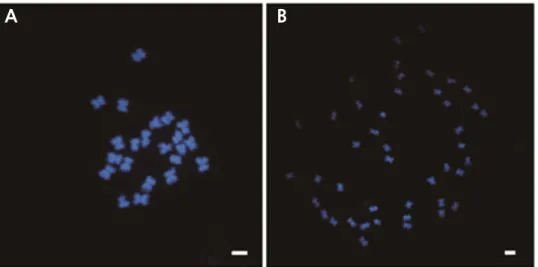
Observing the number of chromosomes is another method to determine ploidy (Sari et al., 1999). The number of chromosomes in the root tip cells were investigated by flow cytometric analysis to confirm the ploidy level. The chromosomes were examined and we found 2n = 2x = 22 chromosomes in diploid plants and 2n = 4x = 44 chromosomes in tetraploid plants (Fig. 5). Moreover, our chromosomal observations were consistent with flow cytometric analysis results. We found that it was more effective to apply 25 mg·L-1 oryzalin directly to the shot apex of watermelon seedlings than to immerse the seeds in oryzalin solution. Thus, oryzalin was found to be effective in polyploidization of watermelon and can be used as a substitute for colchicine.
We predict, that this treatment method and concentration of oryzalin can be effective to induce polyploidy in other plants. Therefore, we intend to repeat this experiment in other species to induce stable polyploids.
Literature Cited
Ahuja MR (2005) Polyploidy in gymnosperms: revisited. Silvae Geneti 54:59-69. doi:10.1515/sg-2005-0010 Anonymous (2012) Annula world statistics. (http://stat.fao.org)
Caperta A, Delgado M, Ressurreição F, Meister A, Jones RN, Viegas W, Houben A (2006) Colchicine-induced polyploidization depends on tubulin polymerization in c-metaphase cells. Protoplasma 227:147-153. doi:10.1007/s00709-005-0137-z
Chen ZJ (2010) Molecular mechanisms of polyploidy and hybrid vigor. Trends in plant science 15:57-71. doi:10.1016/j.tplants.2009.12.003
A B
Fig. 5. Chromosome analyses of a diploid (A, 2n = 2x = 22) and tetraploid (B, 2n = 4x = 44) treated with oryzalin in watermelon. Size bar = 1 µm. A: × 1000, B: × 600.
Chung M-Y, Chung J-D, VanTuyl JM, Lim K-B (2004) In vitro mitotic chromosome doubling by chemical treatments in Lilium longiflorum.
J Plant Biotechnol 31:73-78. doi:10.5010/JPB.2004.31.1.073
Cockerham LE, Galletta GJ (1976) A survey of pollen characteristics in certain Vaccinium species. J Am Soc Hortic Sci 101:671-676 Contreras RN, Ranney TG, Tallury SP (2007) Reproductive behavior of diploid and allotetraploid Rhododendron L ‘Fragrant Affinity’.
HortScience 42:31-34. doi:10.21273/HORTSCI.42.1.31
Contreras RN, Ruter JM, Schwartz BM (2010) Oryzalin-induced tetraploidy in Cryptomeria japonica (Cupressaceae). HortScience 45:316-319. doi:10.21273/HORTSCI.45.2.316
Cuyacot AR, Lim K-B, Kim HH, Hwang Y-J (2017) Chromosomal characterization based on repetitive DNA distribution in a tetraploid cytotype of Chrysanthemum zawadskii. Hortic Environ Biotechnol 58:488-494. doi:10.1007/s13580-017-0280-4
Dhooghe E, Van Laere K, Eeckhaut T, Leus L, Van Huylenbroeck J (2011) Mitotic chromosome doubling of plant tissues in vitro. Plant Cell Tissue Organ Cult 104:359-373. doi:10.1007/s11240-010-9786-5
Eigsti O (1971) Seedless triploid. HortScience 6:1-2
Fawcett JA, Maere S, Van De Peer Y (2009) Plants with double genomes might have had a better chance to survive the Cretaceous-Tertiary extinction event. Proceedings of the National Academy of Sciences 106:5737-5742. doi:10.1073/pnas.0900906106
Ganga M, Chezhiyan N (2002) Influence of the antimitotic agents colchicine and oryzalin on in vitro regeneration and chromosome doubling of diploid bananas (Musa spp.). J Hortic Sci Biotechnol 77:572-575. doi:10.1080/14620316.2002.11511540
Gao S, Zhu D, Cai Z, Xu D (1996) Autotetraploid plants from colchicine-treated bud culture of Salvia miltiorrhiza Bge. Plant Cell Tissue Organ Cult 47:73-77. doi:10.1007/BF02318968
Goldblatt P (1980) Polyploidy in angiosperms: monocotyledons. In WH Lewis (ed), Polyploidy: Biological Relevance. Plenum Press, NY USA, pp 219-239. doi:10.1007/978-1-4613-3069-1_13
Henderson WR (1977) Effect of cultivar, polyploidy and reciprocal hybridization on characters important in breeding triploid seedless watermelon hybrids. J Am Soc Hortic Sci 102:293-297
Hwang S-H, Kim M-S, Park SY (2015) Improvement of chromosome doubling efficiency in Cymbidium hybrids by colchicine and oryzalin treatment. Korean J Hortic Sci Technol 33:900-910. doi:10.7235/hort.2015.15063
Jaskani MJ, Kwon SW, Koh GC, Huh YC, KO BR (2004) Induction and characterization of tetraploid watermelon. Hortic Environ Biotechnol 45:60-65
Kadota M, Niimi Y (2002) In vitro induction of tetraploid plants from a diploid Japanese pear cultivar (Pyrus pyrifolia N. cv. Hosui). Plant Cell Rep 21:282-286. doi:10.1007/s00299-002-0509-1
Khoshoo T (1959) Polyploidy in gymnosperms. Evolution 13:24-39. doi:10.1111/j.1558-5646.1959.tb02991.x
Kim IH, Kim HH, Hong EY, Yoon JK, Lee CH (2003) Breeding of tetraploid in Platycodon grandiflorum (Jacq.) A. DC. by colchicine treatment. Korean J Plant Res 6:188-194
Koh GC (2003) Tetraploid production of Moodeungsan watermelon. J Kor Soc Hortic Sci 43:671-676 Koshoo T (1961) Chromosome numbers in gymnosperms. Silvae Geneti 10:1-9
Kwack SN, Lee SJ (1999) Induction of tetraploid with colchicine treatments in watermelon. Korean J Hortic Sci Technol 17:650 Kwon M-J, Ramzan F, Ahn Y-J, Hwang Y-J, Kang Y-I, Kim C-K, Younis A, Lim K-B (2017) Chromosomal analysis of Lilium longiflorum ×
Asiatic hybrids using GISH (genomic in situ hybridization). Hortic Environ Biotechnol 58:591-600. doi:10.1007/s13580-017-0019-2 Kwon SJ, Roy SK, Cho KY, Moon YJ, Woo SH, Kim HH (2014) Tetraploid induction approach induced by colchicine of Prunella vulgaris for.
albiflora Nakai. Int J Sci Res Publ 4:1-7. doi:10.7740/kjcs.2014.60.1.107
Lapins KO (1975) Polyploidy and mutations induced in apricot by colchicine treatment. Can J Genet Cytol 17:591-599. doi:10.1139/g75- 073
Levin DA (2002) The role of chromosomal change in plant evolution. Oxford University Press, NY, USA
Marr CW, Gast KL (1991) Reactions by consumers in a farmers market to prices for seedless watermelon and ratings of eating quality.
HortTechnology 1:105-106. doi:10.21273/HORTTECH.1.1.105
Masterson J (1994) Stomatal size in fossil plants: evidence for polyploidy in majority of angiosperms. Science 264:421-424. doi:10.1126/
science.264.5157.421
Miguel TP, Leonhardt KW (2011) In vitro polyploid induction of orchids using oryzalin. Sci Hortic 130:314-319. doi:10.1016/j.scienta.201 1.07.002
Ministry for Agriculture, Food and Rural Affairs (MAFRA) (2017) 2017 Production of special crops. Ministry for Agriculture, Food and Rural Affairs (MAFRA), Sejong, Korea
Morejohn L, Bureau T, Mole-Bajer J, Bajer A, Fosket D (1987) Oryzalin, a dinitroaniline herbicide, binds to plant tubulin and inhibits microtubule polymerization in vitro. Planta 172:252-264. doi:10.1007/BF00394595
Morejohn LC, Bureau TE, Tocchi LP, Fosket DE (1984) Tubulins from different higher plant species are immunologically nonidentical and bind colchicine differentially. Proc Nat Acad Sci 81:1440-1444. doi:10.1073/pnas.81.5.1440
Oh SA, Min KH, Choi YS, Park SB, Kim YC, Cho SM (2015) Development of tetraploid watermelon using chromosome doubling reagent treatments. Korean J Plant Resour 28:656-664. doi:10.7732/kjpr.2015.28.5.656
Ramulu KS, Verhoeven H, Dijkhuis P (1991) Mitotic blocking, micronucleation, and chromosome doubling by oryzalin, amiprophos- methyl, and colchicine in potato. Protoplasma 160:65-71. doi:10.1007/BF01539957
Ranney TG (2006) Polyploidy: from evolution to new plant development. Comb Proc Int Plant Propagators’ Soci 56:137-142
Raza H, Jaskani MJ, Khan MM, Malik TA (2003) In vitro induction of polyploids in watermelon and estimation based on DNA content. Int J Agric Biol 5:298-302
Sari N, Abak K, Pitrat M (1999) Comparison of ploidy level screening methods in watermelon: Citrullus lanatus (Thunb.) Sci Hortic 82:265-277. doi:10.1016/S0304-4238(99)00077-1
Sattler MC, Carvalho CR, Clarindo WR (2016) The polyploidy and its key role in plant breeding. Planta 243:281-296. doi:10.1007/s00425 -015-2450-x
Viehmannovã I, Cusimamani EF, Bechyne M, Vyvadilovã M, Greplovã M (2009) In vitro induction of polyploidy in yacon (Smallanthus sonchifolius). J Plant cell Tissue Organ Cult 97:21-25. doi:10.1007/s11240-008-9494-6
Wan Y, Petolino J, Widholm J (1989) Efficient production of doubled haploid plants through colchicine treatment of anther-derived maize callus. Theore Appl genet 77:889-892. doi:10.1007/BF00268344
Yang X, Cao Z, An L, Wang Y, Fang XJ (2006) In vitro tetraploid induction via colchicine treatment from diploid somatic embryos in grapevine (Vitis vinifera L.). Euphytica 152:217. doi:10.1007/s10681-006-9203-7
Yemets A, Blume YB (2008) Progress in plant polyploidization based on antimicrotubular drugs. Open Hortic J 1:15-20. doi:10.2174/187 4840600801010015
Zlesak DC, Thill CA, Anderson NO (2005) Trifluralin-mediated polyploidization of Rosa chinensis minima (Sims) Voss seedlings. Euphytica 141:281-290. doi:10.1007/s10681-005-7512-x