
IEG 환경지질연구정보센터
4
0
0
전체 글
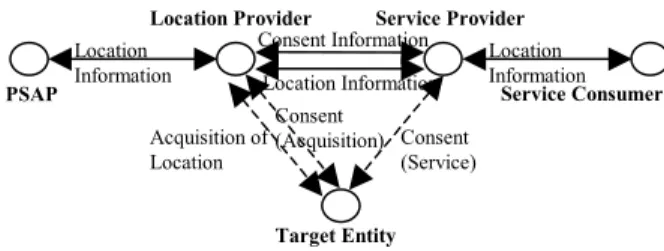
(2) 2.1 Differences between Personal Information and Location Information. In a broad sense, the personal information includes the personal location information. However, the location information has different characteristics from the personal information like name, phone number, medical record and address. The personal information is static but the location information is dynamic since it changes as the time passes. There are more possibilities that the location information is disseminated to unwanted people since LBS are composed of many steps: (i) acquisition, (ii) storage, (iii) management, (iv) service, (v) utilization. 2.2 Protection of Location Information in Public and Commercial Service. If it is seen carefully, the law related to the protection of the location information discriminates between the public and commercial use of the information. For the public purpose, the location information is collected without the consent from the target entity since the emergency situation is more important than the privacy concern. For the commercial purpose, the consent is essential. One thing to consider is whether to allow governmental agencies such as police to track the target entity without the consent. 2.3 Trade-off between Ease of Use and Privacy. To protect the location information, the additional steps to check the privacy are necessary. However, the additional steps are barriers to the deployment of the service. In general, more steps leads to the decrease of the use. Thus, it is necessary to develop a service and system that copes with the reluctance. 2.4 Authorization and Consent. The important thing in the protection of privacies is to obtain consent for the service in advance. When obtaining the consent, the entities involved in the service and the purpose of the service should be specified. In the service, the authorization and checking of the privacy settings should be performed before providing location information. 2.5 Other Issues. There can be confusion in the target to be protected. Recent location based services are mostly provided by wireless carriers. In this case, if the subscriber and actual user of the cellular phone are different, there can be confusion for the target of the protection. In other case, if the owner of things and the carrier are different, there can be still confusion. Which one is outweighs the other? Personality or ownership? The accuracy of location information is also one of the concerns. The requirements of accuracies are different among the location based services. The more accurate location information does not imply good service. It. depends on the user’s decision. The policy setting for privacy control can include the QoS (Quality of Service) as a parameter. 3. PRIVACY CONTROL IN ALL STEPS OF LBS. Location based service is composed of several steps. Thus, there are possibilities of intrusion in processing the steps. In this section, we present privacy control in all steps of LBS. 3.1 Entities and Relationships in LBS. We first define entities and their relationships based on the model in the law that is promulgated in Korea. Figure 1 shows the entities and their relationships.. PSAP. Location Provider Service Provider Consent Information Location Information Location Information Service Consumer Consent Acquisition of (Acquisition) Consent Location (Service). Location Information. Target Entity. Figure 1. Entities and Relationships in LBS - Location Provider: Entity acquiring location information of the target entity and supplying location information for the service provider. The examples of location provider are wireless carriers and companies that collect location information using GPS (Global Positioning System). - Service Provider: Entity providing location based services to the service consumer using the location information collected by the location provider. For instance, contents providers correspond to this entity. Usually, wireless carriers serve both as the location provider and the service provider. - Service Consumer: Entity using location based. - Target Entity: Entity whose location information will be required to deliver service. - PSAP (Public Safety Access Point): Entity receiving emergency call and giving an emergency service. This entity uses location information for public purposes. The following explains sequence of the typical location based service (e.g. buddy finder) and the relationships of the entities. - The service consumer requests a location based service to service provider with the identity of the target entity. - The service provider receives an approval (consent information) about the service from the target entity. If 2.
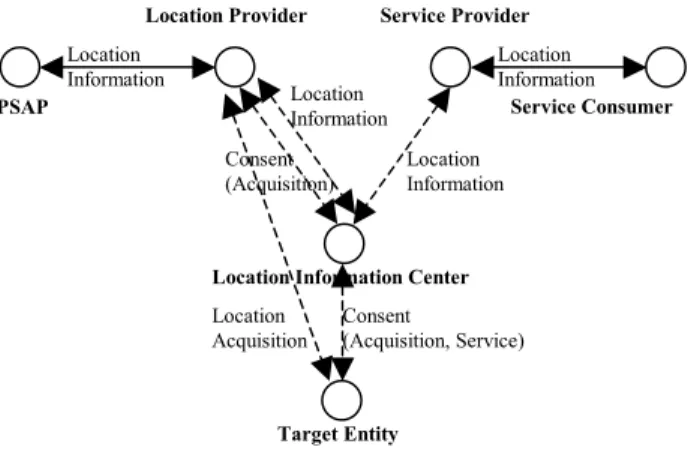
(3) the target entity agrees to the service, the service provider requests location information to the location provider. - The location provider requests an approval about the acquisition of the location from the target entity (This step can be omitted). The location provider collects the location information from the target entity and provides it to the requesting service provider. - Finally, the service provider combines the location information and content and then sends them to the service consumer. The PSAP is different from the service provider. It is operated by government and can collect the location information without the grant of the target entity in case of the emergency call. The figure 1 is the basic model for LBS. However, it has several problems. First, it is hard to manage consent information. The consent information is needed by both the service provider and the location provider. In this case, the responsibility for the management of the consent is ambiguous. If the location provider does not trust the service provider, the location provider should check the approval again. To the view point of the target entity, it is very bothersome checking approval twice. Second, the target entities are hard to control their privacy settings. It is very hard to remember which companies are using their location information since there can be many location providers and service providers. Location Provider Location Information PSAP. Service Provider Location Information Service Consumer. Location Information Consent (Acquisition). Location Information. Location Information Center Location Acquisition. Consent (Acquisition, Service). Target Entity. Figure 2 New Entities and Relationships in LBS The figure 2 shows the new model for LBS. It has additional entities called Location Information Center. The center manages both the consent information and the location information. All consent information and location information is provided though the trusted center (It can be managed by the governmental agency or reliable company). In this case, the all the entities can easily check the consent information and the location information can be transmitted safely to the service consumer. In this paper, our suggesting platform can be installed in the location information center.. 3.2 Privacy Control. In this section, we explain privacy control that we have to consider in the steps of LBS. Key factors for privacy control are preservation of control and awareness of dissemination of the location information [4]. If someone believes that he knows his environment well and is in control of his environment, then LBS should be perceived as less of a threat to his privacy. In the following steps, above two principles are considered in the policy. In all steps, the automated operation is necessary to exclude the interception of the location information. Figure 3 shows the steps of the LBS. Opening Business. Acquisition. Storage & Managemen. Service & Utilization. Remova l. Closing Business. Figure 3 Steps of LBS - Opening Business: To open Business, a company should acquire a license. This prevents the company from a misuse or abuse of the location information. - Acquisition: To acquire the location information, anyone should obtain target entity’s consent. If a location measurement unit is attached to something, the fact should be noticed to the person carrying it. The target entity should be able to control one’ s own personal information. One should be able to browse or withdraw or suspend the consent. The important thing is the location provider should store the log about the acquisition (the time, requestor, purpose, and the identity of the target entity). This log can be served to the target entity when the target entity wants to know them. - Storage & Management: If the service needs the location to be stored, there should be some technical and administrative methods to protect the stored location information. The location information should be deleted when the service has been completed and the access should be restricted by unauthorized people. - Service & Utilization: The service provider should not use the location information beyond the scope of the contraction with the target entity and the service consumer. To help the awareness of the dissemination of the location information, the message should be sent to the target entity. The method of sending the message can be either by SMS or e-mail, and etc. The service provider also should store the log about the service (the time, requestor, and purpose) to facilitate resolution of security violations. The location information should be provided in a secure and reliable manner that ensures the information is neither lost nor corrupt. The HTTPS protocol can be a solution to the need. - Removal: The location information should be removed when the purpose of the service has been achieved or the target entity withdraws or suspends the consent. - Closing Business: If the location provider or the service provider closes their businesses, the location information and the logs should be deleted. 3.
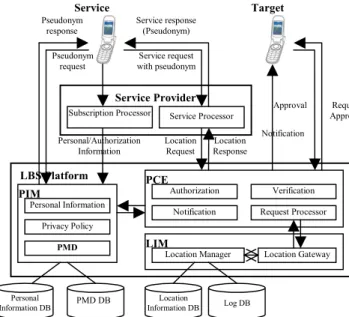
(4) 4. PLATFORM FOR PRIVACY CONTROL. In this section, we suggest the architecture of the open platform for privacy control. Service Pseudonym response Pseudonym request. Target Service response (Pseudonym) Service request with pseudonym. Service Provider Subscription Processor Personal/Authorization Information. LBS Platform. Approval. Service Processor Location Request. PCE. PIM. Personal Information. Location Response. Request Approval. Notification. 5. CONCLUSION Authorization. Verification. Notification. Request Processor. Privacy Policy PMD. Personal Information DB. PMD DB. The above mentioned policy is stored into subscription profile. The subscription profile is well defined in the standard specification of 3GPP [7]. The profile may include privacy exception list, settings of privacy check related actions, and etc. The target entity may be positioned only if the service consumer is included in the exception list of the target entity. The target entity can select one of the following settings of privacy check related actions: (i) positioning not allowed, (ii) positioning allowed without notifying the target entity, (iii) positioning allowed with notification to the target entity, (iv) positioning requires notification and verification by the target entity; positioning is allowed only if granted by the target entity or if there is no response to the notification.. LIM. Location Manager. Location Information DB. Location Gateway. Log DB. Figure 4 Architecture of the LBS Platform for Privacy Control The platform for privacy control is composed of PIM (Personal Information Management), PCE (Privacy Control Entity), and LIM (Location Information Management). The functionalities of the modules are explained below. - PIM: When the service consumer subscribes to the service, personal information and polices for controlling the location information are managed by this module. The contents of the policy are explained at the end of this section. PMD (Pseudonym Mediation Device) generate and manage pseudonym. It also translate pseudonym to verinym. The pseudonym is a virtual identity to conceal the user’s identity and the verinym is a real identity such MSISDN, SIP URL, and IMSI[7]. - PCE: When the location is requested, the verification component examines the privacy policies. If the privacy policy is to allow the positioning, the request processor retrieves the location information from the LIM. If the policy needs a notification, the notification components send the message to the target entity. - LIM: If the location information is requested, the location gateway acquires the location by its own positioning technology. After return the location information, the location manager stores a log. The location information can also be stored in the location information DB to retrieve it later.. In this paper, we presented issues of privacies in LBS and explained privacy control in all steps of LBS. Since the location information is different from the personal information, we suggested several methods to protect location information. To support technical protection of the location information, we proposed a platform for privacy control. The platform reflects lawful aspects and technical aspects, supporting standard specification. The future work is to incorporate policy file written in accordance with P3P format standardized in W3C into the platform. REFERENCES. [1]C. Hauser, and M. Kabatnik, “Towards Privacy Support in a Global Location Service,” Proceedings of the IFIP Workshop on IP and ATM Traffic Management (WATM/EUNICE 2001), pp. 81-89, 2001. [2]E. Snekkenes, “Concepts for Personal Location Privacy Policies,” In Proceedings of the 3rd ACM conference on Electronic Commerce, pp. 48-57, 2001. [3]B. Schilit, J. Hong, and M. Gruteser, “Wireless Location Privacy Protection,” IEEE Computer, pp. 135 - 137, 2003. [4]T. Rodden, A. Friday, H. Muller, and A.Dix, "A Lightweigth Approach to Managing Privacy in Location-Based Services," Technical Report Equator02-058, University of Nottingham and Lancaster University and University of Bristol 2002. [5]C. A. Gunter, M. J. May, and S. G. Stubblebine, ”A Formal Privacy System and its Application to Location Based Services,” In Privacy Enhancing Technologies (PET), 2004. [6]L. Ackerman, J. Kempf, and T. Miki, “Wireless Location Privacy: A Report on Law and Policy in the United States, the Europrean Union, and Japan,” DoCoMo USA Labs Technical Report DCL-TR2003001, 2003. [7] 3rd Generation Partnership Project (3GPP), http://www.3gpp.org/. 4.
(5)
수치
관련 문서
Also, in order to estimate the consequentially colliding relations of the benefits and cost of using location based services, perceived value, security
11.1.3.1 Mobile Terminating Location Request.. 11.1.3.2 Mobile
1) AISP(Account Information Service Provider): 고객 계좌 정보를 취합해 보여주는 사업자 → 마이데이터 2) PISP(Payment Initiation Service Provider): 고객
지역 인터넷 서비스 제공자(Regional Internet Service Provider). 지역 ISP 또는 하나 이상의 NSP에
Account Information Service Provider 계좌정보서비스 제공업자(마이데이터 사업자) 고객 계좌정보 통합관리를 통한 금융 서비스 제공.. PISP와
조사 자료 통합 검색 시스템 조사 상담을 위해 과거 조사 자료 및 조사방법 검색 시 제목, 키워드 뿐만 아니라 저장된 문서 내용까지 검색할 수 있도록
AHP based multi-criteria VHO algorithm decides priority of influencing factors and the decision criteria based on the location for different traffic types such
collects labor cost information from 50-60 construction sites and announces standardized labor cost every 1 st of January. (대한건설협회 고시 노임단가, 50-60개
