아마란스 안토시아닌의 안정성과 항산화 작용 조사
⁃ 연구노트 ⁃
이진하․이혜빈․최선일․정태동․조봉연․최승현․심완섭․한웅호․이옥환 강원대학교 식품생명공학과
Stability and Antioxidant Activities of Anthocyanin from Amaranth (Amaranthus spp. L.) Baby Leaf Extracts
Jin-Ha Lee, Hye-Bin Lee, Sun-Il Choi, Tae-Dong Jung, Bong-Yeon Cho, Seung-Hyun Choi, Wan-Sup Sim, Xionggao Han, and Ok-Hwan Lee Department of Food Science and Biotechnology, Kangwon National University
ABSTRACT This study investigated the stability of anthocyanin and antioxidant activities from amaranth baby leaf extracts. Amaranth baby leaf was examined to investigate the effects of pH, temperature, and sugars on the stability of anthocyanin. Antioxidant compounds and activities were measured based on total phenolic content, 2,2-diphenyl- 1-picrylhydrazyl (DPPH) scavenging activities, nitrite scavenging activity, and ferric ion reducing antioxidant power (FRAP). In the results, the stability of anthocyanin rapidly decreased at 40°C, while the stability of anthocyanin slowly decreased at 4°C. The type of sugar (glucose, fructose, xylose) did not influence the stability of anthocyanin. The stability of anthocyanin was reduced in the following order: pH 3> pH 9> pH 7.0. Total phenolic content was 5.62±0.12 mg gallic acid equivalent/g, DPPH radical scavenging activity of amaranth baby leaf extracts ranged from 37.67±0.87 to 88.09±0.10%, and FRAP value increased depending upon the concentrations of amaranth baby leaf extracts and ascorbic acid. The nitrite scavenging ability of amaranth baby leaf extracts ranged from 61.53±0.03 to 75.70±0.32%.
In conclusion, amaranth baby leaf can be used as a potential source of natural antioxidant compounds and natural food colorants.
Key words: amaranth baby leaf, anthocyanin, stability, antioxidant activity, total phenol content
Received 20 September 2017; Accepted 16 November 2017 Corresponding author: Ok-Hwan Lee, Department of Food Science and Biotechnology, Kangwon National University, Chuncheon, Gangwon 24341, Korea
E-mail: [email protected], Phone: +82-33-250-6454
서 론
아마란스(Amaranth)는 비름과(Amaranthus spp. L.)에 속하는 일년생 쌍떡잎식물로 그 쓰임새가 곡물과 비슷하여 아곡류(pseudocereal)로 불리고 있다(1,2). 종실과 잎 모두 이용할 수 있고 단백질을 비롯해 스쿠알렌, 폴리페놀 등 각 종 영양소가 풍부하며, 독특한 맛과 영양가치가 높아 국수, 비스킷 등의 식품 개발에도 이용되고 있다(3,4). 아마란스 종실에는 단백질 및 철, 칼슘, 아연, 마그네슘 등 무기질 함량 이 높고, 특히 밀에 비해 4배 많은 철 함량과 높은 함량의 라이신이 함유되어 있다고 보고되어 있으며(1), 잎은 단백질 과 아스코르브산, 플라보노이드계 색소와 안토시아닌계 색 소가 다량 함유되어 있다(5).
식품에 사용되는 천연색소는 합성색소에 비해 발색과 열, 빛 및 pH 등의 환경 요인에 의해 안정성이 떨어지고 가격경 쟁력 등에서 뒤떨어져 이용률이 낮았으나, 합성색소에 대한
소비자들의 인식 변화와 발암성과 인체 위험성이 제기되면 서 사용규제가 강화되었고, 천연색소의 기능성(6,7) 및 약리 작용(8,9) 등이 보고됨에 따라 천연색소의 이용은 점차 확대 되고 있다. 천연색소는 식물성 및 동물성, 미생물 등 원료에 따른 분류와 분리 및 정제의 정도에 의한 형태에 따른 분류, 구조에 따라 분류할 수 있으며, 그 구조에 따라 카로티노이 계, 플라보노이드계, 안토시아닌계, 포르필린계, 디케논계, 플라본계 및 멜라닌 등으로 분류할 수 있다. 다양한 천연색 소 중 안토시아닌은 자연계에서 가장 많이 존재하는 색소로 3번 탄소에 당이 결합한 폴리페놀 화합물인 플라보노이드계 에 속하는 대표적인 천연색소로 꽃, 베리류, 포도, 사과 등의 과일과 적색 양배추, 순무 등의 야채 등의 잎, 줄기, 뿌리, 꽃 등에 널리 분포하며 자색, 적색, 청색과 같은 색깔을 띠는 수용성 식물 색소이다(10,11). 안토시아닌은 주로 pelar- gonidin, cyanidin, peonidin, delphinidin, petunidin 및 malvidin과 같은 6개의 anthocyanidins의 배당체로 존재하 며, 항산화(12,13), 항비만(14,15), 염증(16), 항암(17) 등 다양한 생리활성을 갖는 것으로 보고되어 있다. 그러나 안토 시아닌은 구조적으로 C환의 2번 탄소의 공유 결합한 oxo- nium 구조에 인해 가공 및 저장조건에서 불안정하여 식품가 공에 많은 제약을 가지고 있으며(10,18-21), pH, 온도, 빛,
효소, 산소, 당류, 유기산, 금속이온, 공존하는 색소 등의 존 재여부에 영향을 받는다(18-22).
최근 건강에 대한 관심이 늘어나면서 생리활성 기능을 가 진 천연재료를 활용한 가공식품의 개발이 증가하고 있다.
이에 따라 본 연구에서는 아마란스 어린잎에 함유된 안토시 아닌의 천연 식용색소 활용 가치를 향상하고자 각종 저장조 건에서 pH, 당, 유기산, 총 페놀 함량, 항산화능에 대한 안정 성을 확인함으로써 실제 가공 및 저장에 사용할 수 있는 조 건을 탐색하여 식품 소재로 활용 가능성을 모색하고자 한다.
재료 및 방법
실험재료 및 시약
본 실험에 사용한 아마란스는 강원도 고성의 참농원 농장 에서 수확한 것을 직접 구입하였다. 아마란스로부터 색소를 추출하기 위하여 시료 50 g을 1% citric acid를 첨가한 500 mL 20% 에탄올로 80°C에서 4시간 추출한 후 조추출물을 filter paper(No. 3, Whatman, Maidstone, Kent, UK)로 여과한 다음 회전식 진공 농축기(Tokyo Rikakikai Co., Ltd., Tokyo, Japan)를 사용하여 감압 농축하여 동결건조 (Ilshinbiobase Co., Ltd., Yangju, Korea) 후 -20°C에서 보관하며 사용하였다. 완충용액 제조 및 분석용 시약은 Sig- ma-Aldrich Co.(St. Louis MO, USA)로부터 구입하였고, 그 밖의 모든 시약은 분석에 적합한 특급시약을 사용하였다.
저장온도와 pH에 따른 색소 안정성 평가
저장온도에 따른 아마란스 색소의 안정성은 pH 3.0의 Macllvaine 완충용액을 사용하여 4°C, 25°C, 40°C에서 암 소상태로 저장하고, pH 안정성은 25°C에서 pH 3.0 Macll- vaine 완충용액, pH 7.0 0.5 M Tris 완충용액, pH 9.0 0.5 M Tris 완충용액을 이용하여 12일간 저장하면서 4일에 한 번씩 sampling 하여 515 nm에서 흡광도를 측정하여 온도 별, pH별 흡광도의 변화를 알아보았다.
당에 대한 안정성 평가
pH 3.0의 Macllvaine 완충용액에 각 0.1 M glucose, fructose, xylose를 용해하여 25°C에서 암소상태로 12일 간 저장하면서 4일에 한 번씩 sampling 하여 515 nm에서 흡광도의 변화를 측정하였다.
총 페놀 함량 분석
총 페놀 함량은 Duval과 Shetty(23)의 방법을 이용하였 다. 아마란스 추출물 1 mL에 10% Folin-Ciocalteu’s phe- nol reagent 1 mL 첨가하여 2% Na2CO3 용액 1 mL를 첨가 하여 혼합한 후, 암소에서 1시간 동안 반응시킨 다음 mi- croplate reader(Molecular Devices, Sunnyvale, CA, USA)를 이용하여 750 nm에서 흡광도를 측정하였다. 표준
물질로 gallic acid를 이용하여 표준 검량 곡선(y=17.337x
-0.0423, R2=0.9949)으로부터, 총 폴리페놀 함량을 산출 하였다.
DPPH 라디칼 소거능
2,2-Diphenyl-1-picrylhydrazyl(DPPH) 라디칼 소거 능은 Ozgen 등(24)의 방법을 변형하여 측정하였다. 1, 2.5, 5 mg/mL 아마란스 추출물 0.2 mL에 에탄올로 용해한 0.4 mM DPPH 용액 0.8 mL를 첨가하여 혼합한 후 암소에서 10분간 반응한 다음, 517 nm에서 흡광도를 측정하였다. 다 음 식에 의하여 DPPH 라디칼 소거능을 나타내었다.
DPPH 라디칼 소거능(%)=
{
1- AAexperiment}
×100control
아질산염 소거능 측정
아질산염 소거능은 Gray와 Dugan(25)의 방법에 의하여 측정하였다. 1 mM NaNO2 용액 1 mL에 2.5, 5, 10 mg/mL 아마란스 추출물 1 mL를 가하고 0.1 N HCl(pH 1.2)로 반응 용액의 pH를 1.2로 조정한 후 전체량을 10 mL로 만들어 37°C에서 1시간 동안 반응시켰다. Griess 시약(1% sulfa- nilic acid : 1% naphthylamine=1:1)은 2% 초산용액 5 mL 와 30% acetic acid로 조제하였다. 조제된 Griess 시약을 반응시킨 각 반응액 1 mL에 0.4 mL씩 가하여 잘 혼합하였 다. 이 혼합액을 실온에서 15분간 방치한 후 520 nm에서 흡광도를 측정하여 잔존하는 아질산 양을 측정하였다. 공시 험은 Griess 시약 대신 증류수를 0.4 mL 가하여 동일하게 행하였다. 아질산염 소거작용은 시료를 첨가한 경우와 첨가 하지 않은 경우를 백분율로 나타내었다.
아질산염 소거능(%)=
{
1- AAexperiment}
×100control
FRAP 측정
Ferric reducing antioxidant power(FRAP)는 Biglari 등(26)의 방법을 변형하여 2.5, 5, 10 mg/mL 아마란스 추출 물의 항산화능을 측정하였다. 0.3 M sodium acetate buf- fer(pH 3.6), 10 mM TPTZ 및 20 mM FeCl3・6H2O를 제조 하여 실험 직전에 10:1:1의 비율로 혼합하여 FRAP 용액을 제조하였다. FRAP 용액 1.5 mL에 시료 50 μL, 증류수 150 μL를 첨가한 후 37°C에서 4분간 반응시킨 다음 593 nm에 서 흡광도를 측정하였다.
통계처리
결과 값의 통계처리는 SAS version 9.3(SAS institute Inc., Cary, NC, USA)을 이용하여 분석하였다. 유의성 분석 은 one-way ANOVA 검정을 실시하였으며 Duncan의 다중 범위 검정법(Duncan’s multiple range test)으로 유의성은 P<0.05 수준에서 검정하였다.
0 20 40 60 80 100 120
0 4 8 12
Stroage period (day)
Reesidual of pigment (%) .
4℃
25℃
40℃
a
d d d
c c c
b b b a
a
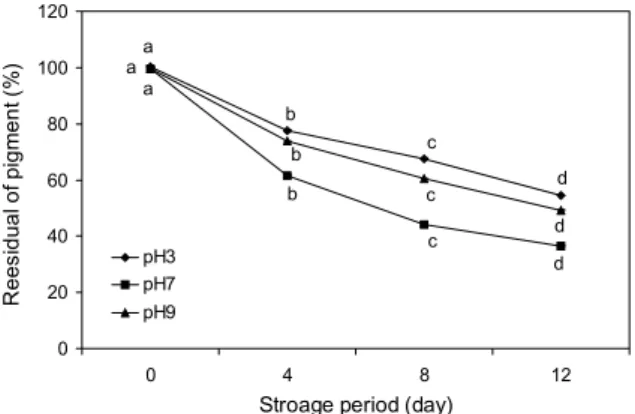
Fig. 1. Residue for the anthocyanin of amaranth baby leaf ex- tracts with various temperatures stored in the dark at pH 3.
Results are presented as the mean±SD of 3 independent in tripli- cate. Means with different letters are significantly different at P<0.05 by Duncan’s multiple range test.
0 20 40 60 80 100 120
0 4 8 12
Stroage period (day)
Reesidual of pigment (%) .
pH3 pH7 pH9 a a a
d d
c c c
b b b
d
Fig. 2. Residue for the anthocyanin of amaranth baby leaf ex- tracts with various pHs stored in the dark at 25°C. Results are presented as the mean±SD of 3 independent in triplicate. Means with different letters are significantly different at P<0.05 by Duncan’s multiple range test.
0 20 40 60 80 100 120
0 4 8 12
Stroage period (day)
Reesidual of pigment (%) .
Glucose Fructose Xylose a
d d c
cc b
bb a
a
d
Fig. 3. Residue for the anthocyanin of amaranth baby leaf ex- tracts with various sugars stored in the dark at pH 3 in 25°C.
Results are presented as the mean±SD of 3 independent in tripli- cate. Means with different letters are significantly different at P<0.05 by Duncan’s multiple range test.
결과 및 고찰
저장온도와 pH에 따른 색소 안정성 평가
아마란스 추출물의 안토시아닌 색소의 저장온도 및 pH의 영향을 알아보기 위해 10 mL 아마란스 추출물을 pH에 따른 아로니아 색소의 안정성 실험에서 가장 높은 흡수 스펙트럼 을 나타낸 pH 3.0 완충용액에서 저장온도별(4, 25 및 40°C) 및 pH별(3.0, 7.0 및 9.0)에 따른 색소 안정성을 측정하였다 (Fig. 1와 Fig. 2). 4°C에서는 색소 함량이 감소가 서서히 관찰되어 비교적 안정하였으나 25 및 40°C에서는 저장 기 간이 증가할수록 빠르게 색소 함량이 감소하였다. 12일 저 장 후 온도별 아마란스 추출물의 색소 함량은 4°C에서 87.79
±0.35%, 25°C에서 55.08±0.56%, 40°C에서 24.86±0.33
%로 각각 나타나 아마란스 안토시아닌은 저온에서 안정하 였다. Hwang과 Ki(27)의 아로니아 안토시아닌은 저장온도 가 높을수록 색소의 파괴 정도가 높다는 보고와 마찬가지로 아마란스의 안토시아닌 색소의 경우도 낮은 저온에서 저장 하는 것이 색소의 안정성을 유지하는 데 도움이 될 것으로
생각된다. pH별 아마란스 추출물의 색소 안정성은 25°C, pH 3.0, 7.0, 9.0의 완충용액에서 12일간 색소 변화로 측정 하였다. 보관하는 동안 아마란스 안토시아닌 색소 함량은 pH 3.0에서 54.56±0.08%, pH 7.0에서 36.59±0.21%, pH 9.0에서 49.28±0.11%로 pH 3.0에서 변화율이 가장 낮았 다. 이는 Kang 등(28)이 보고한 오디 색소의 안정성 연구에 서도 pH 3과 pH 4에서 색소의 최대 흡수 파장을 보였으며, 자색고구마와 아로니아 유래의 안토시아닌 색소의 안정성 도 pH 3에서 가장 안정적임을 보이는 연구 결과와 일치하며 (28,29), pH 9.0에서 pH 7.0보다 색소 함량이 적은 이유는 안토시아닌은 알칼리성 조건에서 황색 chalcone이 분해되 는데 이로 인한 흡광도의 증가가 색소 잔존율에 영향을 미친 것으로 생각된다. 이러한 안토시아닌의 불안정성은 flavy- lium 양이온 구조에 기인하며 pH, 온도, 효소, 빛, 산소, 당 류, 유기산, flavonoid, phenolic acid, 금속이온 등의 화합 물에 영향을 받는 것으로 알려져 있다(21,22,30-32). 따라 서 아마란스 안토시아닌 유래의 색소를 식품용 천연색소나 건강기능소재로서 다양하게 활용하기 위하여 저장에도 안 정성을 높일 수 있는 추가적인 연구가 필요하겠다.
당에 따른 색소 안정성 평가
저장기간에 당에 대한 아마란스 안토시아닌 색소 안정성 을 알아보기 위해 pH 3.0, 25°C에서 0.1 M의 glucose, fructose, xylose를 첨가한 후 색소의 변화를 측정하였다 (Fig. 3). 당의 첨가 후 색소의 분해 정도는 당의 첨가와 종류 와 관계없이 큰 차이 없이 유사하게 감소하였으나, 저장 12 일째는 당이 첨가되지 않은 대조군과 glucose나 xylose에 비해 fructose를 첨가한 경우가 색소 함량이 다소 낮았다.
이는 아로니아 유래의 안토시아닌 색소의 강도가 maltose, galactose, sucrose, glucose 및 fructose 순으로 낮은 색소 의 잔존율을 보인 연구 결과(27)와 maltose, glucose, fruc- tose, sucrose 순으로 당 안정성을 보인 오디 안토시아닌의 결과(28)와 다소 차이가 있는데, 이는 식물체에 따라 안토시
Table 1. Total phenolic content of amaranth baby leaf Sample Total phenolic contents
(mg GAE1)/g) RSD2) Amaranth baby leaf 5.62±0.123) 2.23
1)Gallic acid equivalent (GAE).
2)Relative standard deviation.
3)Mean±standard deviation.
0 20 40 60 80 100
DPPH radical scavenging activity (%) .
1 2.5 5 0.01 0.05 0.1 Amaranth baby leaf (mg/mL) Ascorbic acid (mg/mL)
d
a b
e b
c
Fig. 4. DPPH radical scavenging activity of amaranth baby leaf extracts. Results are presented as the mean±SD of three independ- ent in triplicate. Means with different letters above bars are sig- nificantly different at P<0.05 by Duncan’s multiple range test.
0 0.1 0.2 0.3 0.4 0.5 0.6
FRAP activity (O.D. 593 nm) .
2.5 5 10 0.01 0.05 1 Amaranth baby leaf (mg/mL) Ascorbic acid (mg/mL)
c
a
d
e a
b
Fig. 6. FRAP activity of amaranth baby leaf extracts. Results are presented as the mean±SD of three independent in triplicate.
Means with different letters above bars are significantly differ- ent at P<0.05 by Duncan’s multiple range test.
0 20 40 60 80 100
Nitrite scavenging ability (%) .
d c
b
e b
a
2.5 5 10 0.1 0.5 1 Amaranth baby leaf (mg/mL) Ascorbic acid (mg/mL)
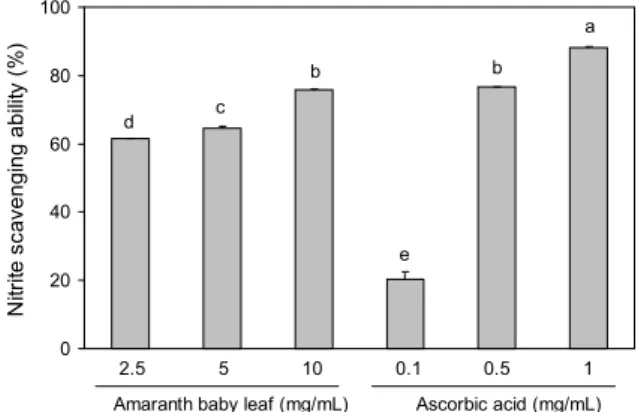
Fig. 5. Nitrite scavenging ability of amaranth baby leaf extracts.
Results are presented as the mean±SD of 3 independent in tripli- cate. Means with different letters above bars are significantly different at P<0.05 by Duncan’s multiple range test.
아닌의 측쇄에 연결된 당의 종류가 다르기 때문이라고 제시 하였다(33,34).
총 페놀 함량 변화
총 페놀 함량이 5.62±0.12 mg GAE/g으로 측정되었으며 (Table 1), 이는 Paśko 등(35)의 아마란스 종자 Amaranthus cruentus v. Aztek과 Amaranthus cruentus v. Rawa의 총 페놀 함량인 2.95±0.07과 3.00±0.42 mg GAE/g, Hong 등(2)의 강릉, 대관령에서 수확한 아마란스 종자 품종별 총 페놀 함량인 0.9~1.7 mg/g보다는 높았으며, 청국장으로부 터 분리된 B. amyloliquefaciens CGD3를 이용하여 발효하 여 페놀 함량이 높아진 아마란스 발효물의 총 페놀 4.28±
0.46~6.27±0.37 mg GAE/g 값과 유사한 함량을 보였다 (36).
항산화 활성에 대한 안정성 조사
아마란스 추출물의 항산화 활성을 DPPH 라디칼 소거능, 아질산염 소거능 및 FRAP를 분석하였다. 아마란스 추출물 1, 2.5, 5 mg/mL의 DPPH 라디칼 소거능은 37.67±0.87%, 57.65±0.52%, 88.09±0.10%로 아마란스 추출물의 농도가 증가함에 따라 DPPH 라디칼 소거능도 유의적으로 증가하 였으며, 5 mg/mL 농도의 아마란스 추출물은 0.05 mg/mL ascorbic acid와 유사한 DPPH 라디칼 소거능을 보였다 (Fig. 4). 이와 같은 DPPH 라디칼 소거능은 Hong 등(2)의 아마란스 종실의 8.38~20.58% DPPH 라디칼 소거능보다 높았는데, 이는 본 연구의 아마란스 추출물에 함유된 높은
페놀성 화합물 함량에서 기인한 것으로 생각된다. 아질산염 소거능은 라디칼류 중 하나인 nitrite 제거능을 nitrite와 반 응한 Griess reagent와의 비색법에 의해 측정할 수 있는데, 아마란스 추출물의 아질산염 소거능을 측정한 결과는 Fig.
5에 나타내었다. 아마란스 추출물의 농도를 2.5, 5 및 10 mg/mL로 처리하였을 때 아질산염 소거능은 각각 61.53±
0.03%, 64.54±0.46% 및 75.70±0.32%로 나타나 추출물 의 농도에 비례하여 아질산염 소거능은 증가하는 것으로 나 타났다. 10 mg/mL 추출물의 농도에서 측정한 아질산염 소 거능은 75.70±0.32%로 대조군인 0.5 mg/mL ascorbic acid의 아질산염 소거능 76.51±0.18%와 비슷한 수치를 나 타내었다. 한편 FRAP 분석은 산화와 환원 반응을 이용한 항산화 검증법으로 아마란스 추출물은 2.5, 5 및 10 mg/mL 농도에서 0.34±0.00, 0.40±0.01, 0.53±0.01로 유의적으 로 증가하는 경향을 보였다(Fig. 6). 이러한 농도 의존적 항 산화능의 증가는 아마란스 추출물이 함유한 총 페놀 함량 성분의 증가로 인한 것으로 생각된다.
요 약
본 연구에서는 아마란스 안토시아닌 색소의 온도별(4, 25 및 40°C), pH별(3.0, 7.0, 및 9.0), 당에 대한 안정성을 12일 간 4일 간격으로 색소 함량, 총 페놀 함량, DPPH 라디칼 소거능, 아질산염 소거능 및 FRAP를 측정하여 평가하였다.
아마란스 안토시아닌 색소는 저온 4°C과 pH 3.0에서 색소 함량의 변화가 적었으며, glucose, xylose를 첨가 시 당의 첨가에 따른 색소 함량의 큰 변화는 보이지 않았으나 다른 당에 비해 fructose 첨가에 의해 색소 함량의 감소가 다소 크게 측정되었다. 아마란스의 항산화 효과를 측정한 결과 아마란스 추출물 1, 2.5, 5 mg/mL의 DPPH 라디칼 소거능 은 37.67±0.87%, 57.65±0.52%, 88.09±0.10%로 평가되 었고, 아질산염 소거능은 아마란스 추출물의 농도를 2.5, 5 및 10 mg/mL로 처리하였을 때 각각 61.53±0.03%, 64.54
±0.46% 및 75.70±0.32%로 평가되었다. 또한, FRAP 활성 은 아마란스 추출물 2.5, 5 및 10 mg/mL 농도에서 0.34±
0.00, 0.40±0.01, 0.53±0.01로 추출물의 농도가 증가함에 따라 항산화 활성도 증가하였다. 이상의 결과는 향후 아마란 스를 활용한 가공식품 미 천연 식품 색소 개발을 위한 기초 자료로 활용할 수 있을 것으로 생각된다.
감사의 글
이 논문은 2017년도 정부(미래창조과학부)의 재원으로 한 국연구재단 현장맞춤형 이공계 인재양성 지원사업(No. 2017 H1D8A1028271)의 지원을 받아 수행된 연구입니다.
REFERENCES
1. Lee JH, Kim KJ, Lee J, Lee ST, Ryu SN. 1996. Functional ingredient and their some variance in amaranth and quinoa.
Korean J Crop Sci 41: 145-165.
2. Hong SY, Cho KS, Jin YI, Yeon YH, Kim SJ, Nam JH, Jeong JC, Kwon OK, Sohn HB. 2014. Comparison of growth characteristics, antioxidant activity and total phenolic con- tents of Amaranthus species according to the different culti- vation regions and varieties in South Korea. Korean J Crop Sci 59: 16-21.
3. Choi HS. 2011. Effect of adding amaranth powder on noo- dle quality. Korean J Food Nutr 24: 664-669.
4. Kim JS, Ryoo HJ. 2002. Application to the biscuits manu- facture of processed amaranth seeds. Korean J Food Nutr 15: 321-325.
5. Lee JH. 2007. New beneficial crops amaranth and quinoa for food nutritional source. Food Industry and Nutrition 12(2): 29-36.
6. Suda I, Ishikawa F, Hatakeyama M, Miyawaki M, Kudo T, Hirano K, Ito A, Yamakawa O, Horiuchi S. 2008. Intake of purple sweet potato beverage affects on serum hepatic biomarker levels of healthy adult men with borderline hep- atitis. Eur J Clin Nutr 62: 60-67.
7. Wu DM, Lu J, Zheng YL, Zhou Z, Shan Q, Ma DF. 2008.
Purple sweet potato color repairs D-galactose-induced spa-
tial learning and memory impairment by regulating the ex- pression of synaptic proteins. Neurobiol Learn Mem 90:
19-27.
8. Kong JM, Chia LS, Goh NK, Chia TF, Brouillard R. 2003.
Analysis and biological activities of anthocyanins. Phyto- chemistry 64: 923-933.
9. Suda Y, Nakabayashi J, Matsuo I, Aizawa S. 1999. Function- al equivalency between Otx2 and Otx1 in development of the rostral head. Development 126: 743-757.
10. Francis FJ. 1989. Food colorants: Anthocyanins. Crit Rev Food Sci Nutr 28: 273-314.
11. Bridle P, Timberlake CF. 1997. Anthocyanin as natural food colours selected aspects. Food Chem 58: 103-109.
12. Liu PZ, Yao B, Kallio H. 2010. Characterization of phenolic compounds in Chinese hawthorn (Crataegus pinnatifida Bge. var. major) fruit by high performance liquid chroma- tography-electrospray ionization mass spectrometry. Food Chem 121: 1188-1197.
13. Öztürk N, Tunçel M. 2011. Assessment of phenolic acid content and in vitro antiradical characteristics of hawthorn.
J Med Food 14: 664-669.
14. Zhang Z, Ho WKK, Huang Y, Chen ZY. 2002. Hypocholes- terolemic activity of hawthorn fruit is mediated by regu- lation of cholesterol-7α-hydroxylase and acyl CoA: choles- terol acyltransferase. Food Res Int 35: 885-891.
15. Huang D, Ou B, Prior RL. 2005. The chemistry behind anti- oxidant capacity assays. J Agric Food Chem 53: 1841-1856.
16. Salam OMEA, Sleem AA, Shafee N. 2012. Effect of Cra- taegus extract on carbon tetrachloride-induced hepatic dam- age. Comp Clin Pathol 21: 1719-1726.
17. Rodrigues S, Calhelha RC, Barreira JCM, Dueñas M, Carvalho AM, Abreu RMV, Santos-Buelga C, Ferreira ICFR.
2012. Crataegus monogyna buds and fruits phenolic ex- tracts: Growth inhibitory activity on human tumor cell lines and chemical characterization by HPLC-DAD-ESI/MS. Food Res Int 49: 516-523.
18. Cho SB, Kim HJ, Yoon JI, Chun HS. 2003. Kinetic study on the color deterioration of crude anthocyanin extract from Schizandra fruit (Schizandra chinensis fructus). Korean J Food Sci Technol 35: 23-27.
19. Chung KW, Joo YH, Lee DJ. 2004. Content and color dif- ference of anthocyanin by different storage periods in seed coats of black soybean [Glycine max (L.) Merr.]. Kor J Intl Agri 16: 196-199.
20. Hong JH, Chung HS, U H, Youn KS. 2002. Storage stability of anthocyanin pigment isolated from a wasted grape peels.
Korean J Food Preserv 9: 327-331.
21. Yang HC, Lee JM, Song KB. 1982. Anthocyanins in cul- tured Omija (Schizandrae chinensis Baillon) and its stability.
J Korean Agric Chem Soc 25: 35-43.
22. Wang H, Cao G, Prior RL. 1997. Oxygen radical absorbing capacity of anthocyanins. J Agric Food Chem 45: 304-309.
23. Duval B, Shetty K. 2001. The stimulation of phenolics and antioxidant activity in pea (Pisum sativum) elicited by ge- netically transformed anise root extract. J Food Biochem 25: 361-377.
24. Ozgen M, Reese RN, Tulio AZ Jr, Scheerens JC, Miller AR.
2006. Modified 2,2-azino-bis-3-ethylbenzothiazoline-6-sul- fonic acid (ABTS) method to measure antioxidant capacity of selected small fruits and comparison to ferric reducing antioxidant power (FRAP) and 2,2'-diphenyl-1-picrylhydra- zyl (DPPH) methods. J Agric Food Chem 54: 1151-1157.
25. Gray JI, Dugan LR Jr. 1975 Inhibition of N-nitrosamine for- mation in model food system. J Food Sci 40: 981-984.
26. Biglari F, AlKarkhi AFM, Easa AM. 2008. Antioxidant ac- tivity and phenolic content of various date palm (Phoenix dactylifera) fruits from Iran. Food Chem 107: 1636-1641.
27. Hwang ES, Ki KN. 2013. Stability of the anthocyanin pig- ment extracted from aronia (Aronia melancocarpa). J Food Sci Technol 45: 416-421.
28. Kang CS, Ma SJ, Cho WD, Kim JM. 2003. Stability of an- thocyanin pigment extracted from mulberry fruit. J Korean Soc Food Sci Nutr 32: 960-964.
29. Park JS, Bae JO, Chung BW, Jung MY, Choi DS. 2011.
Degradation kinetics of anthocyanin pigment solutions from purple-fleshed sweet potato cultivars. Korean J Food Nutr 24: 559-566.
30. Eiro MJ, Heinonen M. 2002. Anthocyanin color behavior and stability during storage: effect of intermolecular copigmen- tation. J Agric Food Chem 50: 7461-7466.
31. Garcı́a-Viguera C, Bridle P. 1999. Influence of structure on colour stability of anthocyanins and flavylium salts with as- corbic acid. Food Chem 64: 21-26.
32. Yoon JM, Cho MH, Hahn TR, Paik YS, Yoon HH. 1997.
Physicochemical stability of anthocyanins from a Korean pigmented rice variety as natural food colorants. Korean J Food Sci Technol 29: 211-217.
33. Lee RS, Kim SJ, Rhim JW. 2000. Analysis of anthocyanin pigments from purple-fleshed sweet potato (Jami). J Korean Soc Food Sci Nutr 29: 555-560.
34. Malien-Aubert C, Dangles O, Amiot MJ. 2001. Color stabil- ity of commercial anthocyanin-based extracts in relation to the phenolic composition. Protective effects by intra- and intermolecular copigmentation. J Agric Food Chem 49: 170- 176.
35. Paśko P, Bartoń H, Zagrodzki P, Gorinstein S, Fołta M, Zachwieja Z. 2009. Anthocyanins, total polyphenols and an- tioxidant activity in amaranth and quinoa seeds and sprouts during their growth. Food Chem 115: 994-998.
36. Lee RH, Yang SJ, Rhim JH. 2016. Changes in cultural char- acteristics and biological activities of amaranth during fer- mentation. Korean J Food Preserv 23: 568-575.