미세섬유 기반의 생분해성 담배 필터 소재 개발 (제1보) - 필터 원료 제조 및 특성 분석 -
최사랑
1, 이중명
2†접수일(2021년 2월 4일), 수정일(2021년 2월 17일), 채택일(2021년 2월 19일)
Development of Biodegradable Cigarette Filter Material from Microfibers (Part 1)
- Preparation of the Filter Raw Materials and their characteristics -
Sa Rang Choi
1, Jung Myoung Lee
2†Received February 4, 2021; Received in revised form February 17, 2021; Accepted February 19, 2021
ABSTRACT
Cellulose acetate, a raw material for cigarette filter tow, is not easily decomposed in nature, causing serious problems in the ecosystem. Thus, it is necessary to develop biodegradable filter materials that can replace it. To produce a cigarette filter from microfibers derived from pulp, a way of achieving this is to fabricate a three-dimensional mesh network with cross-linked microfibers. Thus, the factors affecting the reactivity of microfibers with cross-linking agents should be investigated prior to the fabrication. In this study, five types of microfibers including cellulose nanofibrils with different particle sizes and lignin contents from pulp were prepared. The morphological, chemical, and physical properties of each of the microfiber types were characterized and compared to select potential feedstocks for the fabrication of cigarette filters. Based on analysis with optical images, Kajaani fiber analyzer, particle size analyzer, water retention value, and chemical compositions, cellulose nanofibril, kneaded organosolv pulp, and lignin-rich microfibrillated cellulose were shown to have relatively high hydroxyl groups, indicating that they are potential feedstocks for the cigarette filter.
Printed in Korea http://dx.doi.org/10.7584/JKTAPPI.2021.02.53.1.66
1 경북대학교 임산공학과(Department of Wood Science and Technology, Kyungpook National University), 학생
2 경북대학교 산림과학·조경학부 임산공학전공 및 농업과학기술연구소(Major in Wood and Paper Science, School of Forestry, Science and Landscape Architecture & Agricultural Science and Technology Research Institute, Kyungpook National University), 교수
† 교신저자(Corresponding Author): E-mail: [email protected] (Address: Major in Wood and Paper Science, School of Forestry, Science and Landscape Architecture, Kyungpook National University, Daegu, 41566, Republic of Korea)
1. 서 론
매년 전 세계적으로 생산되는 담배는 약 5조 개에 달하 며, 그중 수백만 톤의 담배꽁초가 무자비하게 자연에 버 려지고 있다.1,2) 담배 필터의 주원료로 사용되는 셀룰로 오스 아세테이트(CA, cellulose acetate)는 셀룰로오스 와 무수초산을 황산 촉매하에서 반응시킴으로써 셀룰로 오스 분자의 수산기가 소수성을 띄는 아세틸기로 치환되 며 제조된다.3) 이는 자연에서 쉽게 분해되지 않으므로 토 양 및 해양오염을 유발하여 생태계에 심각한 폐해를 일 으키고 있다.4) 따라서, 셀룰로오스 아세테이트를 대체할 수 있는 친환경적 담배 필터 소재 개발이 필수적이다.
셀룰로오스 섬유를 화학적 혹은 기계적으로 처리하여 얻어지는 MFC(microfibrillated cellulose) 및 CNF(cel- lulose nanofibrils) 등의 미세섬유는 자연계에 풍부하게 존재하는 천연 고분자로써 생분해성을 가지며, 비표면적 이 크고 화학적 개질성과 기계적 물성이 우수하기 때문 에, 학계에서는 이를 다양한 분야에 적용하기 위한 연구 가 활발히 진행 중이다.5-9)
대표적으로 이를 적용한 신소재 중 하나인 셀룰로오스 에어로겔은 높은 공극률을 지닌 다공성 물질로써10-14) 내 부 공극의 크기 및 공극률을 적절히 조절하여 대기 중 존 재하는 유해물질을 효과적으로 여과하거나 포집할 수 있 는 필터로의 활용을 기대할 수 있다. 그러나, 섬유 간의 수소결합으로 형성된 셀룰로오스 에어로겔은 수분 침지 시 쉽게 해리되어 물속에서 형태를 유지할 수 없다는 문 제점이 있으며,15) 이를 해결하기 위해서는 섬유 간의 화 학적 결합에 의한 가교결합이 필요하다. 가교제에 의해 가교결합이 이루어진 고분자는 3차원 그물망 구조의 네 트워크를 가지며, 가교결합이 형성된 셀룰로오스 에어로 겔은 수분 침지 시에도 해리되지 않고 본래를 형태를 유 지할 수 있다.16-18)
본 연구의 최종적인 목표는 섬유의 크기 및 리그닌 함 량이 상이한 미세섬유를 제조하고 이를 기반으로 가교결 합이 형성된 미세섬유 에어로겔을 제조하여 이를 담배 필 터에 적용해보고자 한다. 이전의 연구20)에서 제조된 유기 용매 펄프는 크라프트 펄프에 비해 잔존 리그닌 함량이
높고 짧은 섬유장을 가질 뿐만 아니라 고해 혹은 니딩과 같은 기계적 처리로 비교적 쉽게 미세섬유화되므로21,22) 유기용매 펄프를 에어로겔 제조의 원료로 사용하고자 하 였다. 또한, 에어로겔 제조 시 사용되는 가교제는 글리세 롤 디글리시딜 에테르(Glycerol dyglycidyl ether, GDE)이며, 이는 섬유 표면의 수산기와 반응하여 에스터 (ester) 결합을 형성하므로,19) 섬유의 입자 크기, 리그닌 및 수산기 함량 등이 가교제와 섬유 간의 반응성에 영향 을 미치는 요소가 될 수 있다. 섬유 표면의 수산기 함량 이 많을수록 가교제와의 반응성이 높을 것으로 예상되 며, 본 연구에서는 미세섬유 에어로겔을 제조하기 이전 에 섬유의 크기 및 잔존 리그닌 함량이 상이한 미세섬유 를 제조하고 각 섬유의 형태학적 특성과 화학적 및 물리 적 특성을 비교·분석해보고자 한다.
2. 재료 및 방법
2.1 공시재료
2.1.1 소나무 목재 칩(Pine wood chips)
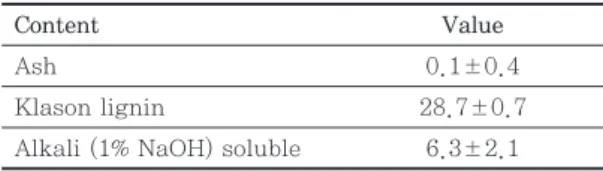
본 연구에서는 organosolv pulp 제조를 위해 국내 S 목재회사로부터 공급받은 러시아산 라디에타 소나무 (Pinus radiata D. Don)를 사용하였으며(Table 1), 목재 칩의 함수율은 5.7±0.3%이다. 목재 칩의 크기는 높이 35(±3)×폭 8(±3)×두께 7(±2) mm이다.
2.1.2 시약
본 연구에서 organosolv 펄프화법에 사용된 반응 시약 은 이전 연구20)의 용매 중 하나인 glycol ether 용매 (Pure grade, Sigma Aldrich Co., USA)를 사용하였으 Keywords: Biodegrabale, organosolv pulp, microfibrillated cellulose, cigarette filter,
cross-linking
Table 1. Chemical compositions of pine wood
chips (Unit: %)
Content Value
Ash 0.1±0.4
Klason lignin 28.7±0.7
Alkali (1% NaOH) soluble 6.3±2.1
며, 촉매제로는 순도 95%의 황산(Extra pure grade, Daejung Chemicals & Metals, Korea)을 사용하였다.
2.1.3 Enzyme-cellulose nanofibrils (E-CNF) 2% 고형분 함량의 E-CNF(enzyme-cellulose nano- fibrils)를 제지기업 M사로부터 제공받았다. 이는 셀룰로 오스계 분해효소인 endo-glucanase로 전처리된 활엽 수 표백 크라프트 펄프(HwBKP)를 800-1000 bar의 압 력의 고압호모게나이저(Ariete NS311OH, GEA Niro Soavi, Italy)에서 6회 처리하여 제조되었다.
2.2 제조 방법
2.2.1 Unbleached organosolv pulp (UBOP) 이전의 연구20)와 같이 목재 칩과 글리콜 에테르-황산 혼합 용제를 1:2(wt./vol.)의 액비로 고압 증기 처리 장 치(autoclave, HST 506-6, Hanbaek ST, Korea)에 투 입하여 120℃에서 120분간 반응시켰다. 제조된 orga- nosolv 펄프의 수율은 약 60±2.4%이다.
2.1.2 Washed organosolv pulp (WOP)
리그닌 함량에 따른 섬유의 특성을 비교하고자 상기 방 법으로 제조된 unbleached organosolv pulp(UBOP)의 리그닌 분리를 위해 0.5 N 수산화나트륨 용액을 2 L 사 용하여 여과한 뒤 중성이 될 때까지 증류수로 충분히 세 척하였다.
2.1.3 Kneaded organosolv pulp (KOP)
제조된 unbleached organosolv pulp(UBOP)를 미세 섬유화시키기 위하여 이전의 연구와 같이21,22) 알칼리 니 딩(kneading) 처리를 실시하였다. 0.25 N 수산화나트륨 용액을 사용하여 7.5% 농도로 희석한 후, 희석된 펄프 지 료를 실험실용 호바트 믹서기(N50, Hobart Corpora- tion, USA)에 투입해 상온에서 2단계(281 rpm)로 3시간 동안 반응시켰다. 니딩 처리 후 리그닌의 분리를 위해 0.5 N 수산화나트륨 용액으로 여과하고 중성이 될 때까 지 증류수로 세척하였다.
2.1.4 Lignin-rich microfibrillated cellulose (L-MFC)
상기의 unbleached organosolv pulp를 1.5%의 슬러리 농도로 물에 희석한 뒤, 고압호모게나이저(panda
plus2000, GEA Niro Soavi., Italy)를 이용하여 1000 bar 의 압력 조건 하에서 3회 통과시켜 L-MFC를 제조하였다.
2.3 측정 방법
미세섬유의 형태를 관찰하기 위하여 60배율의 광학현 미경(BX 50, Olympus Optical Co. Ltd., Japan)을 이 용하였다. 현미경 관찰로 얻어진 사진에서 약 200개 섬 유의 섬유장, 섬유폭 및 장폭비를 측정하고. 평균값을 구 하였다. 또한, 광학현미경으로 관찰된 섬유장 및 섬유폭 과의 비교 분석을 위해 섬유분석기(Kajaani FS300, Metso Automation, Finland)로 UBOP, WOP, KOP의 평균 섬유장, 평균 섬유폭, 미세분 함량(<0.2 mm)을 측 정하였으며, 입도분석기(Mastersizer 3000, malvern Instruments Ltd, orcestershire, UK)를 이용하여 KOP, L-MFC 및 E-CNF의 입자크기를 측정하였다. 미 세섬유의 화학적 특성을 확인하기 위해 잔존 리그닌 (TAPPI T 222 om-15) 함량을 측정하였으며, aldi- tol-acetate법에 따라 시료를 전처리하여 가스 크로마토 그래피(GC, HP-6890, Agilent, USA)로 조성당 분석 을 실시하였다. 또한, 이전의 연구21,22)를 참고하여 시료 의 보수도(water retention value, WRV)를 측정하였 다. 2% 농도의 펄프 슬러리 10mL를 정량하여 3000 G-force로 20분간 원심분리한 뒤, 다음 식에 의해 WRV 값을 계산하였다.
WRV W W W
Wet Dry
Dry
(%)
100
WWet: wet weight of fibrillated fiber after centrif- ugation(g),
WDry: dry weight of fibrillated fiber(g).
3. 결과 및 고찰
3.1 미세섬유의 특성 분석
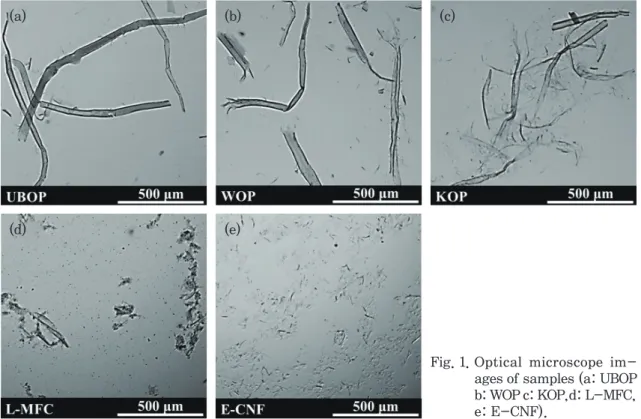
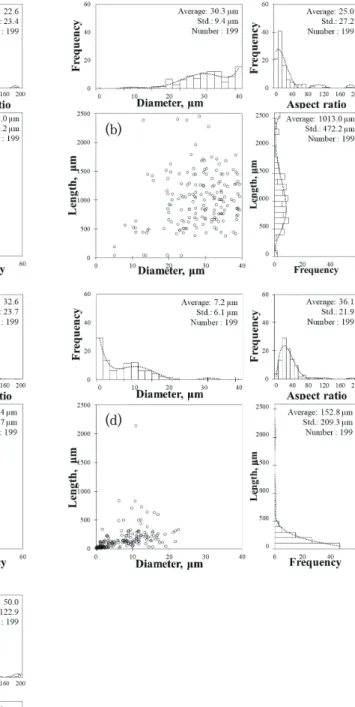
현미경 관찰(Fig. 1)로부터 얻어진 미세섬유의 현미경 사진을 이용하여 측정한 각 시료의 섬유장, 섬유폭, 및 장폭비를 Fig. 2에 나타내었다. UBOP와 알칼리 세척된 WOP의 경우, 평균 섬유장이 각각 1014.0(±695.2) μm 와 1013.0(±472.2) μm, 섬유폭은 각각 32.0(±8.4) μm
및 30.3(±9.4) μm로 측정되었으며, 평균 장폭비는 각 각 22.6과 25.0으로 큰 차이는 보이지 않았으나 WOP가 UBOP에 비해 섬유장 및 섬유폭이 소폭 감소하고 장폭비 가 약간 증가하였다. 니딩 처리된 KOP 섬유는 평균 섬유 장 288.4(±433.7) μm, 섬유폭은 15.5(±7.0) μm이고, 장폭비가 32.6으로 측정되었다. 이는 원료 물질인 UBOP의 섬유장 및 섬유폭과 비교하였을 때 확연히 감소 된 수치이다. 또한, Kajaani 섬유분석기로 측정한 결과 는 현미경과 관찰과 비슷한 경향을 보였다(Table 2).
WOP가 UBOP에 비해 섬유장 및 섬유폭이 소폭 감소하 고, 미세분 함량이 0.8% 정도 증가하였으나 큰 차이는 나타나지 않았으며, KOP는 니딩 처리의 영향으로 섬유 장 및 섬유폭이 확연히 감소하고 미세분 함량이 66.5%로 UBOP에 비해 약 17% 증가한 수치를 나타냈다.
L-MFC와 E-CNF의 경우 평균 섬유장은 각각 152.8(±109.3) μm와 60.2(±38.3) μm이고 섬유폭은 7.2(±6.1) μm 및 2.2(±1.1) μm으로 측정되었다. 또한, 평균 장폭비는 각각 36.1와 50.0으로 E-CNF가 L-MFC 에 비해 더 작은 입자 크기 및 높은 장폭비를 보였다.
Fig. 3은 입도분석기를 이용하여 KOP, L-MFC 및
E-CNF의 섬유 크기를 분석하고, 섬유의 크기별 분포도를 나타낸 그래프이다. 먼저, KOP의 경우 0-100 μm 크기의 섬유가 47.3% 정도의 분포를 이루고 있으며, 101-300 μm 크기의 섬유가 28.4%, 이보다 큰 301-800 μm 및 801-1050 μm 크기의 섬유가 각각 19.8% 및 4.4% 정도의 분포를 나타냈다. L-MFC는 0-100 μm 크기의 섬유가 87.4%, 101-300 μm 크기의 섬유가 28.4% 정도의 분포를 이루고 있으며, 이보다 큰 301-800 μm 및 801-1050 μm 크기의 섬유가 각각 2.3% 및 0.3% 정도로 미미한 분포를 나타냈다. 입자 크기가 가장 작은 E-CNF는 0-100 μm 크기의 섬유가 98.9% 로 거의 대부분을 차지했으며, 101-300 μm, 301-800 μm 및 801-1050 μm 크기의 섬유가 각각 0.4%, 0.5% 및 0.2%로 극히 낮은 비율로 나타났다.
Fig.1의 현미경 사진에 나타난 바와 같이 UBOP와 WOP의 경우, 섬유 표면의 피브릴화는 거의 발생하지 않 았지만 펄핑 시에 촉매제로 황산을 사용하기 때문에 일 반적으로 널리 사용되는 크라프트 펄프보다 섬유를 단섬 유화시키는 것에 용이하다는 장점이 있다.23) 일반적으로 펄프 섬유에 니딩 혹은 고해와 같은 기계적 전단처리를
Fig. 1. Optical microscope im- ages of samples (a: UBOP b: WOP c: KOP,d: L-MFC, e: E-CNF).
(a) (b) (c)
(d) (e)
Fig. 2. Fiber Size distributions and aspect ratio of samples (a: UBOP b: WOP c: KOP, d: L-MFC, e: E-CNF).
(a) (b)
(c) (d)
(e)
가하면 섬유 외층의 제거, 피브릴화, 단섬유화 및 미세분 (fines) 생성 등의 효과가 발생하게 된다.24,25) 또한 알칼 리 니딩 처리 과정에서 NaOH에 의해 섬유 팽윤이 이루 어지면서 섬유 내·외부의 피브릴화가 더욱 촉진된다.26) 알칼리 니딩 처리된 KOP의 경우 UBOP에 비해 피브릴 화 및 미세분이 많이 발생하였으며, 호모게나이징 처리 로 비교적 균일하게 미세화된 L-MFC 및 E-CNF와 다 르게 장섬유와 미세섬유가 다량 혼재되어 있는 특징을 보 였으며 섬유 크기는 UBOP>WOP>KOP>L-MFC>
E-CNF 순으로 나타났다.
미세섬유 제조 시, 목재 원료의 수종(침·활엽수)과 제 조 방법에 따른 화학적 구성 성분의 차이를 확인하기 위 하여 잔존 리그닌 함량과 조성 당분석을 실시하였다.
UBOP의 잔존 리그닌 함량은 24.4%이며, 0.5 N 수산화
나트륨으로 세척된 WOP와 KOP의 경우, 원료 물질인 UBOP에 비해 각각 3.0%p 및 6.8%p 감소된 리그닌 함 량을 보였다(Table. 3). 일반적으로 알칼리 처리는 세포 벽으로부터 헤미셀룰로오스 및 리그닌의 일부를 용출시 키는 것으로 알려져 있다.27,28) 니딩 처리로 섬유가 더욱 미세화된 KOP의 경우 WOP에 비해 NaOH 침투가 용이 하게 이루어졌기 때문에, 상당량의 리그닌이 제거된 것 으로 판단된다. 알칼리 세척 없이 물리적으로 미세화 처 리된 L-MFC는 24.0%로 UBOP와 비슷한 리그닌 함량 을 나타냈다.
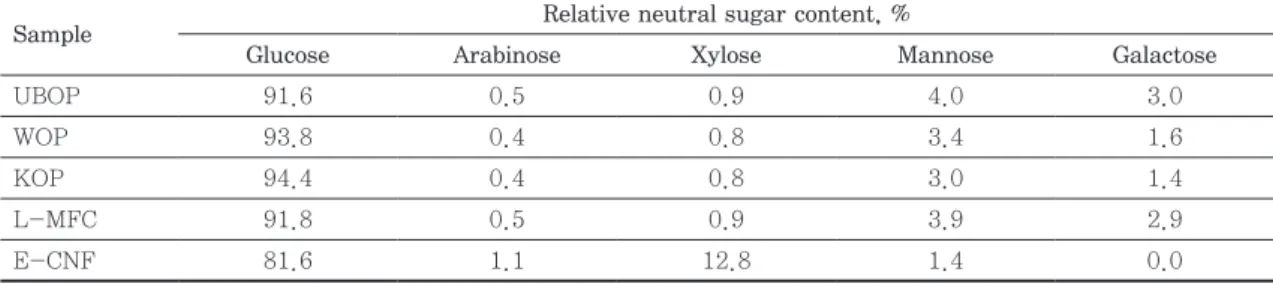
Table 4는 가스 크로마토그래피(GC)로 당 조성을 분석 한 결과이다. 5가지 시료 모두 셀룰로오스를 구성하는 glucose의 비율이 가장 높게 나타났으며, E-CNF를 제 외하고 나머지 시료 모두 glucose 비율이 90% 이상으로 측정되었다. 원료 물질인 UBOP와 이를 단순히 기계적 처리한 L-MFC는 화학적 조성에 큰 차이를 나타내지 않 았다.29) 그러나, WOP 및 KOP는 원료 물질인 UBOP와 비교하였을 때, 알칼리 세척 처리로 인해 리그닌이 분리 되는 과정에서 침엽수 헤미셀룰로오스를 구성하는 탄수 화물인 mannose와 galactose의 손실이 소량 발생하여 상대적으로 glucose의 비율이 소폭 증가하였다. E-CNF 는 glucose의 비율이 81.6%로 다른 시료들에 비해 비교 적 낮게 나타났으며. 이는 활엽수를 원료로 제조되었기 때문에 헤미셀룰로오스의 주성분인 자일란을 구성하는 xylose가 12.9%로 비교적 높은 비율을 차지하며, 또한, Table 2. Dimensional characteristics of UBOP, WOP and KOP
Sample Arithmetic length (mm)
Length Weighted length
(mm)* Fiber width (μm) Fines (<0.2 mm) (%)
Coarseness (mg/m)
UBOP 0.44 1.38 34.13 49.3 0.307
WOP 0.43 1.31 34.02 50.1 0.306
KOP 0.27 0.99 30.40 66.5 0.205
*average length weighted fiber length
Fig. 3. Changes in particle size distributions of KOP, L-MFC and E-CNF.
Table 3. Klason lignin content of microfibers
Sample Klason lignin (%)
UBOP 24.4±0.2
WOP 20.4±0.4
KOP 17.6±0.1
L-MFC 24.0±0.4
E-CNF 0.0±0.0
E-CNF 제조 시에 셀룰로오스 섬유의 피브릴화를 촉진 시키기 위한 전처리제로써 셀룰로오스계 분해 효소인 endo-glucanase 사용으로 인하여, 셀룰로오스 β-1,4 글루코시드 결합이 무작위로 절단되므로 전처리 과정에 서 일부 절단된 글루코스가 용해되어 손실이 발생한 것 으로 사료된다.30)
WRV(water retention value)는 섬유의 구조와 수분 흡수 및 팽창 능력 또는 피브릴 정도를 나타내는 지표 중 하나이다.31) 각 샘플의 WRV 측정 결과(Fig. 4), 원료 물 질인 UBOP와 이를 알칼리 세척 처리한 WOP는 WRV 값이 각각 90.5% 및 113.4%로, WOP가 더 높은 수치를 보였다. 알칼리 세척으로 인해 리그닌 함량이 24.4%에 서 20.4%로 약 4% 감소했을 때 WRV 값이 약 23% 증가 하였다. 리그닌은 소수성을 띠기 때문에 리그닌 함량이 많을수록 WRV가 감소할 수 있으며,32) 알칼리 세척 등에 의해 리그닌이 제거되면서 생성된 섬유 내부의 공극에 수분이 보류될 수 있으므로 리그닌 함량이 WRV에 영향 을 미친 것으로 사료된다.33) KOP와 L-MFC의 경우 WRV 값이 각각 283.2% 및 386.2%으로 알칼리 니딩 처 리 및 호모게나이징 처리로 인해 섬유의 소섬유화 및 피 브릴화가 발생하였고 이로 인해 섬유 내·외부의 수산기 함량이 증가하면서 원료 물질인 UBOP에 비해 WRV가 현저히 증가하였다. 5가지의 샘플 중 장폭비가 가장 크 고, 더욱 미세한 입자크기를 가진 E-CNF는 1214.7%로 가장 높은 WRV 값을 나타냈으며, E-CNF가 지닌 다량 의 수산기로 인해 가교제를 통한 화학적 반응성이 가장 용이할 것으로 기대된다.
4. 결 론
본 연구에서는 담배 필터의 원료로 사용하기 위한 입자
크기 및 잔존 리그닌 함량이 상이한 섬유를 제조하고, 섬 유의 형태학적 특성과 화학적 및 물리적 특성을 비교·분 석하였다.
광학현미경과 섬유분석기 및 입도분석기의 종합적인 측정 결과, KOP는 원료 물질인 UBOP 및 WOP에 비해 알칼리 니딩 처리로 인해 소섬유화 및 피브릴화가 발생 하였으나 장섬유와 미세섬유가 다량 혼재되며 섬유의 크 기가 매우 불균일한 특징을 나타냈다. 반면, 호모게나이 징 처리로 제조된 L-MFC는 KOP에 비해 비교적 고르게 소섬유화 되었으며, 평균 입자크기가 KOP보다 작게 측 정되었다. 한편, E-CNF는 섬유의 크기가 비교적 균일 하며, 평균 입자크기가 가장 작고, 가장 큰 장폭비를 가 진 것으로 측정되었다. 클라손 리그닌 및 당 분석 결과, 알칼리 세척은 리그닌 손실을 유발하며, 니딩 및 호모게 나이징과 같은 기계적 처리는 리그닌 함량에 영향을 미 Table 4. Neutral sugar content of microfibers
Sample Relative neutral sugar content, %
Glucose Arabinose Xylose Mannose Galactose
UBOP 91.6 0.5 0.9 4.0 3.0
WOP 93.8 0.4 0.8 3.4 1.6
KOP 94.4 0.4 0.8 3.0 1.4
L-MFC 91.8 0.5 0.9 3.9 2.9
E-CNF 81.6 1.1 12.8 1.4 0.0
Fig. 4. Water retention value(WRV) of micro- fibers.
치지 않았다. WRV 측정결과, 리그닌 함량이 감소하거나 섬유가 미세화될 때 WRV가 증가하였으며, UBOP
<WOP<KOP<L-MFC<E-CNF 순으로 높은 WRV 값을 보였다.
GDE/미세섬유 기반으로 담배 필터 제조 시, 본 연구 결과를 토대로 비교적 높은 수산기 함량을 지닌 것으로 판단되는 KOP, L-MFC, E-CNF가 가교제와의 반응성 이 우수할 것으로 기대된다.
사 사
본 연구는 산림청(한국임업진흥원)‘산림과학기술 연구 개발사업’(FTIS-2019149A00-2123-0301 및 FTIS- 2020241A00-2021-0001)의 지원에 의해 이루어졌습 니다.
Literature Cited
1. Mohajerani, A., Kadir, A. A., and Larobina, L., A practical proposal for solving the world’s cigarette butt problem: Recycling in fired clay bricks, Waste management, 52:1-170 (2016).
2. Smith, E. A. and Novotny, T. E., Whose butt is it? tobacco industry research about smokers and cigarette butt waste. Tobacco control, 20(Suppl 1):i2-i9 (2011).
3. Hebeish, A. and Guthrie, T. J., The Chemistry and Technology of Cellulsic Copolymers, Springer Verlag, 202-206 (1981).
4. Kim, K. D., Shin, S. H., Lee, C. H., Kim, Y. T., and Kim, J. Y., Study on bio-degradation of cigarette filter rods with filter materials, Journal of the Korean Society of Tobacco Sci- ence, 27(1):75-82 (2005).
5. Ryu, J. A., Pack, S. J., Eom, T. J., and Lee, J.
M., 3D Printer Application Properties of MFC- PLA Composite Filament Fabricated with Organosolv-Derived MFC, Journal of Korea TAPPI, 51(6):110-119 (2019).
6. Seo, E. J., Kim, K. J., and Lee, J. M., A Com- parative Analysis of the Characteristics of Cellulose Nanofibril Films Fabricated by Batch-Wise Mode, Journal of Korea TAPPI, 52(1):11-19 (2020).
7. Pan, L., Wang, X., Gao, Y., Zhang, Y., Chen, Y., and Sun, Z., Electrosorption of anions with carbon nanotube and nanofibre composite film electrodes, Desalination, 244(1-3):139-143 (2009).
8. Zhang, X. F., Feng, Y., Huang, C., Pan, Y., and Yao, J., Temperature-induced formation of cellulose nanofiber film with remarkably high gas separation performance, Cellulose, 24(12):5649-5656 (2017).
9. Lundahl, M. J., Klar, V., Wang, L., Ago, M., and Rojas, O. J., Spinning of cellulose nanofi- brils into filaments: A review, Industrial &
Engineering Chemistry Research, 56(1):8-19 (2017).
10. Chin, S. F., Romainor, A. N. B., and Pang, S.
C., Fabrication of hydrophobic and magnetic cellulose aerogel with high oil absorption capacity, Materials Letters, 115:241-243 (2014).
11. Carlsson, D. O., Nyström, G., Zhou, Q., Ber- glund, L. A., Nyholm, L., and Strømme, M., Electroactive nanofibrillated cellulose aerogel composites with tunable structural and elec- trochemical properties, Journal of Materials Chemistry, 22(36):19014-19024 (2012).
12. Jin, H., Nishiyama, Y., Wada, M., and Kuga, S., Nanofibrillar cellulose aerogels, Colloids and Surfaces A: Physicochemical and Engi- neering Aspects, 240(1-3):63-67 (2004).
13. Shi, J., Lu, L., Guo, W., Zhang, J., and Cao, Y., Heat insulation performance, mechanics and hydrophobic modification of cellulose–
SiO2 composite aerogels, Carbohydrate poly- mers, 98(1):282-289 (2013).
14. Karadagli, I., Schulz, B., Schestakow, M.,
Milow, B., Gries, T., and Ratke, L., Production of porous cellulose aerogel fibers by an extru- sion process, The Journal of Supercritical Flu- ids, 106:105-114 (2015).
15. Zhang, Z., Sèbe, G., Rentsch, D., Zimmer mann, T., and Tingaut, P., Ultralightweight and flexible silylated nanocellulose sponges for the selec tive removal of oil from water Chem.
Mater, 26:2659-2668 (2014).
16. Kim, C. H., Youn, H. J., and Lee, H. L., Preparation of cross-linked cellulose nanofi- bril aerogel with water absorbency and shape recovery, Cellulose, 22(6):3715-3724 (2015).
17. Li, Y., Liu, Y., Liu, Y., Lai, W., Huang, F., Ou, A., and Wang, X., Ester crosslinking enhanced hydrophilic cellulose nanofibrils aerogel, ACS Sustainable Chemistry & Engi- neering, 6(9):11979-11988 (2018).
18. Zhang, Y., Yin, M., Lin, X., Ren, X., Huang, T. S., and Kim, I. S., Functional nanocompos- ite aerogels based on nanocrystalline cellulose for selective oil/water separation and antibac- terial applications, Chemical Engineering Journal, 371:306-313 (2019).
19. Li, R. J., Gutierrez, J., Chung, Y. L., Frank, C. W., Billington, S. L., and Sattely, E. S., A lignin-epoxy resin derived from biomass as an alternative to formaldehyde-based wood adhesives. Green chemistry, 20(7):1459-1466 (2018).
20. Lee, J. M., Ahn, E. B., Choi, H. S., Ryu, J. A., and Eom, T. J., Study on improvement of preparation efficiency of lignin rich microcel- lulosic fines, Journal of Korea TAPPI 50(5):114-122 (2018).
21. Choi, S. R., Seo, E. J., Ryu, J. A., Eom, T. J., and Lee, J. M., Effect of Pulp Volume Con- centration in Fibrillation of Organosolv Pulp by Kneading Process, Journal of Korea TAPPI 52(1):31-37 (2020).
22. Choi, S. R. and Lee, J. M., Comparison of
Fibrillation Characteristics of Unbleached Kraft Pulp and Organosolv Pulp by Alkali Kneading Process, Journal of Korea TAPPI 52(3):50-57 (2020).
23. Johansson, A., Aaltonen, O., and Ylinen, P., Organosolv Pulping-Methods and Pulp Prop- erties, Biomass 13(1):45-65 (1987).
24. Chen, W., Abe, K., Uetani, K., Yu, H., Liu, Y., and Yano, H., Individual cotton cellulose nanofibers: pretreatment and fibrillation tech- nique, Cellulose, 21(3):1517-1528 (2014).
25. Wang, Q. Q., Zhu, J. Y., Gleisner, R., Kuster, T. A., Baxa, U. and McNeil, S. E., Morpholog- ical development of cellulose fibrils of a bleached eucalyptus pulp by mechanical fibril- lation, Cellulose, 19(5):1631-1643 (2012).
26. Öztürk, H. B., Potthast, A., Rosenau, T., Abu-Rous, M., MacNaughtan, B., Schuster, K. C., and Bechtold, T., Changes in the intra- and inter-fibrillar structure of lyocell (TEN- CEL®) fibers caused by NaOH treatment, Cel- lulose, 16(1):37 (2009).
27. Harris, E. E., Effect of alkali treatment on the yield of lignin, Industrial & Engineering Chemistry Analytical Edition, 5(2):105-106 (1933).
28. Wu, L., Arakane, M., Ike, M., Wada, M., Takai, T., Gau, M., and Tokuyasu, K., Low temperature alkali pretreatment for improving enzymatic digestibility of sweet sorghum bagasse for ethanol production, Bioresource Technology, 102(7):4793-4799 (2011).
29. Bian, H., Dong, M., Chen, L., Zhou, X., Ni, S., Fang, G., and Dai, H., Comparison of mixed enzymatic pretreatment and post-treatment for enhancing the cellulose nanofibrillation efficiency, Bioresource Technology, 293:122171 (2019).
30. Wang, S., Gao, W., Chen, K., Xiang, Z., Zeng, J., Wang, B., and Xu, J., Deconstruction of cellulosic fibers to fibrils based on enzymatic
pretreatment, Bioresource technology, 267:426-430 (2018).
31. Gu, F., Wang, W., Cai, Z., Xue, F., Jin, Y., and Zhu, J. Y., Water retention value for characterizing fibrillation degree of cellulosic fibers at micro and nanometer scales, Cellu- lose, 25(5):2861-2871 (2018).
32. Bian, H., Chen, L., Dai, H., and Zhu, J. Y., Integrated production of lignin containing cel-
lulose nanocrystals (LCNC) and nanofibrils (LCNF) using an easily recyclable di-carbox- ylic acid, Carbohydrate Polymers, 167:167-176 (2017).
33. Pejic, B. M., Kostic, M. M., Skundric, P. D., and Praskalo, J. Z., The effects of hemicellu- loses and lignin removal on water uptake behavior of hemp fibers, Bioresource technol- ogy, 99(15):7152-7159 (2008).