Soar (State Operator and Result)와 ROS 연계를 통해 거절가능 HRI 태스크의 휴머노이드로봇 구현
Implementation of a Refusable Human-Robot Interaction Task with Humanoid Robot by
Connecting Soar and ROS
당반치엔
1
, 트란트렁틴1
, 팜쑤언쭝1
, 길 기 종1
, 신 용 빈1
, 김 종 욱† Chien Van Dang 1 , Tin Trung Tran 1 , Trung Xuan Pham 1 ,
Ki-Jong Gil 1 , Yong-Bin Shin 1 , Jong-Wook Kim †
Abstract This paper proposes combination of a cognitive agent architecture named Soar (State, operator, and result) and ROS (Robot Operating System), which can be a basic framework for a robot agent to interact and cope with its environment more intelligently and appropriately. The proposed Soar-ROS human-robot interaction (HRI) agent understands a set of human’s commands by voice recognition and chooses to properly react to the command according to the symbol detected by image recognition, implemented on a humanoid robot. The robotic agent is allowed to refuse to follow an inappropriate command like “go” after it has seen the symbol ‘X’ which represents that an abnormal or immoral situation has occurred. This simple but meaningful HRI task is successfully experimented on the proposed Soar-ROS platform with a small humanoid robot, which implies that extending the present hybrid platform to artificial moral agent is possible.
Keywords Soar, ROS, Human-robot interaction, Artificial moral agent
Received : Oct. 15. 2016; Revised : Dec. 16. 2016; Accepted : Jan. 31. 2017
※This work was supported partly by the Ministry of Trade, Industry & Energy (MOTIE, Korea) under Industrial Technology Innovation Program. No.
10062368, and partly by the MSIP (Ministry of Science, ICT and Future Planning), Korea, under the ITRC (Information Technology Research Centre) support program IITP-2016-H8501-16-1017) supervised by the IITP (Institute for Information & communications Technology Promotion).
†
Corresponding author: Department of Electronic Engineering, Dong-A University, Busan, Korea ([email protected])
1
Department of Electronic Engineering, Dong-A University, Busan (dvchienbkvn@
gmail.com)
CopyrightⓒKROS
1. Introduction
Intelligent robots are the machines equipped with a diverse set of visual and non-visual sensors and actuators, which possess decision making and problem solving
capabilities within their domain of operation
[1,2]. As the intelligent robots are gradually coexisting with human in wider areas such as service robots, social robots, and healthcare robots, a basic level of morality or ethics is necessary for safe and natural HRI tasks.
After the pioneering work of Asimov’s three laws of
robotics, architectural mechanisms to enable the agent
to reason and determine ethically about their actions have
been proposed
[3,4]. In
[4], the authors employed a cognitive
robotic architecture, DIARC/ADE, in determining whether
a human’s directive should be accepted or rejected according
to the excuse categories. However, the architecture is mainly
focused on HRI and natural language processing, and thus
Fig. 1. Soar architecture In the artificial intelligence society, human-level cognitive
agent architectures have long been developed and disseminated worldwide including ACT-R
[5], CRAM
[6], SS-RICS
[7], and Soar
[8]. Soar is reported to have superiority over the well-known cognitive architectures in terms of complete symbolic reasoning, easily understandable structure, and simple programming complexity, and complex implementation in low-level control, which is a consequence of a long development history since 1981
[9].
Soar has been rarely applied to robotics technology despite its rich components of various memories and learning functionalities. Therefore, a successful coordination of the cognitive architecture and ROS
[10]will be a higher level integrated development environment (IDE) available to the roboticists whose goal is developing more human-like robots.
In the present paper, the authors propose a hybrid platform which integrates two different types of software platforms, Soar and ROS. The former helps robots restore the environment information and process on them with intelligence, and the latter provides robots with useful libraries to respond well to the situation where the robot is deployed. This study will cover connection of the two platforms and creating Soar agents to help a humanoid robot make reasonable and refusable decisions on an HRI task.
In this paper, Section 2 outlines the structure of Soar and its decision cycle. This section also briefly describes ROS platform as an environment for the soar agent and how messages are shared in ROS. In Section 3, the pro- posed connection strategy is described. Section 4 provides an experiment result for a simple HRI task implemented on the present hybrid platform with a small humanoid robot, and Section 5 concludes the present work with
Soar and ROS are both software frameworks on which libraries and applications are executed. For the connection, the two structures are analyzed and investigated on how data moves.
2.1 Soar
Soar is a cognitive agent software architecture, which considers problem solving as application of an operator to a state to get a desired result
[11,12]. Soar integrates knowledge-intensive reasoning, reactive execution, hier- archical reasoning, planning, and learning from experience, with the goal of creating a general computational system that has the similar cognitive abilities as humans. Soar is both a software platform for agent development and a theory of what computational structures are necessary to embody human-level agents.
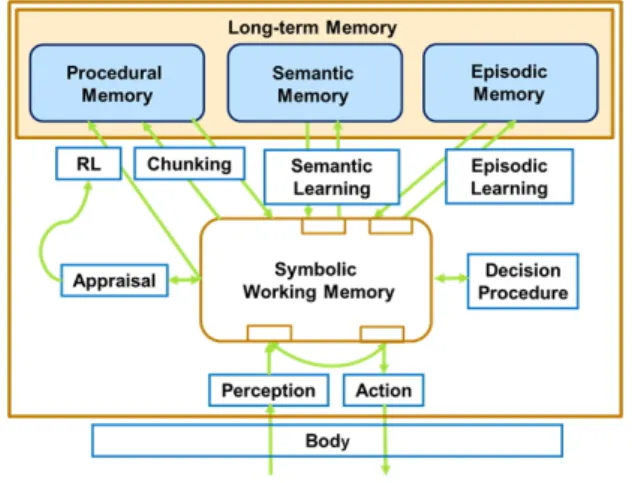
Fig. 1 illustrates the Soar architecture composed of
working memory, decision cycle, and long-term memories
including procedural memory, semantic memory, and
episodic memory, which correspond to their learning
mechanisms. Each of the memory systems in Soar will
Fig. 2. Soar rule for hello-world
Fig. 3. Soar processing cycle be briefly introduced and compared below.
Firstly, the working memory is the short-term memory that represents the current problem-solving situation. This memory holds the current state and operator, or the current knowledge of the world and the status in problem solving.
Secondly, the procedural memory is the long-term know- ledge which encodes procedural knowledge. Thirdly, the episodic memory deals with specific events which are snapshots of working memory images. In other words, it is a record of an agent’s experience. Finally, the semantic memory restores general facts independent of specific contexts. These memories are like those of human, helping a software agent interact with external environment.
Soar acquires knowledge by production rules. If the conditions of a production rule match with those of working memory, the production fires, and the actions are performed. These production rules are to be understood as “if-then” statements in the conventional programming languages as shown in Fig. 2. The “if” part of the production is called its condition and the “then” part separated by
“-->” is called its action. When the conditions of some production rules are matched with the current situation defined in the working memory, the corresponding pro- duction rules will fire in parallel, which means that their actions are executed and make changes to working memory.
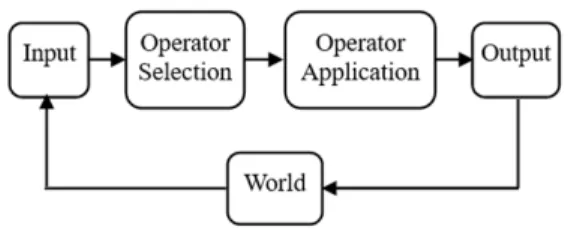
A Soar agent is created with rules and applied to send commands out via output link based on the current context. The decision of the Soar agent is governed by a reasoning cycle as shown in Fig. 3, where the agent chooses an appropriate operator based on the information it knows about its current situation, i.e., working memory,
and its long-term knowledges and memories. This cycle can be divided into four phases.
In the input phase, Soar agent can receive information from a simulated or real surrounding environment. In the operator selection phase, the current state is elaborated and one or more operators are proposed depending on the contents of the working memory. If more than one operator have been proposed, Soar has a mechanism to help its agents attempt to choose the most appropriate operator for the current situation using preference symbols such as acceptable (+), reject (-), indifferent (=), better/best (>), worse/worst (<). In the operator application phase, the selected operator is fired and make changes to the current working memory. In the output phase, Soar agent sends information to external environment or its actuators such as motors.
2.2 ROS
ROS is a sophisticated open source robot middleware platform. It can provide a communication framework, hardware abstraction, device drivers with a lot of useful libraries and tools to quickly develop robot applications.
ROS consists of a number of executables called nodes which are connected in a peer-to-peer network topology.
These nodes perform the system’s computation and com- municate with other nodes through the message exchange mechanism in ROS.
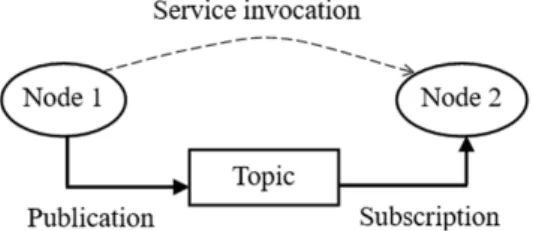
ROS supports two types of messaging mechanisms
between nodes; topic and service. A topic associates
publisher and subscriber where a publisher broadcasts
topic messages to the whole ROS system, while the
Fig. 4. Communication between nodes in ROS
Fig. 5. Soar-ROS connection example graph subscribers listen to the published information on this
topic. There may be more than one publisher or subscriber for the same topic. On the other hand, service is a pair of request and response. Unlike the topic, there is only one provider to handle the request for each service. In general, basic communication between nodes in ROS can be described in Fig. 4.
3. Connection of Soar and ROS
With Soar and ROS software platforms mentioned above, a method is required to bridge the two archi- tectures which must ensure the processing cycle of Soar as well as the message exchange mechanism in ROS.
Fortunately, Soar provides users a tool named Soar markup language (SML) which allows to build an interface for collaboration of two or more Soar agents
[12]. The interface is also designed to support connecting other software development environments to Soar where input and output data structures are sent back and forth. In addition, ROS provides users with the two types of communication mechanisms, i.e., topic and service, which can be created in a package to send and receive messages from other packages.
In this paper, the authors propose a connection method to bridge Soar and ROS by creating a Soar wrapper inside a ROS package. This Soar wrapper package plays a key role as a common ROS package which subscribes to topics from other packages and publishes topics as well. Moreover, the Soar wrapper package with SML tool puts input data to input link of Soar agent and reads
output data from its output link. By using this method, Soar wrapper becomes a ROS package obeying ROS communication framework and also following Soar reasoning cycle.
Fig. 5 depicts the Soar-ROS example graph as a first successful result of Soar-ROS association, where according to the input number between 0 and 9 the capital city for the corresponding country is printed as an output using semantic memory of Soar
[13]. The figure clearly points out that there are three nodes (talker, soarwrapper, and listener) which exchange messages via the “number” topic from the talker node to the soarwrapper node, and the
“statement” topic from the soarwrapper node to the listener node. Inside the soarwrapper is a Soar agent that gets identifier number using SML input and make decisions according to it.
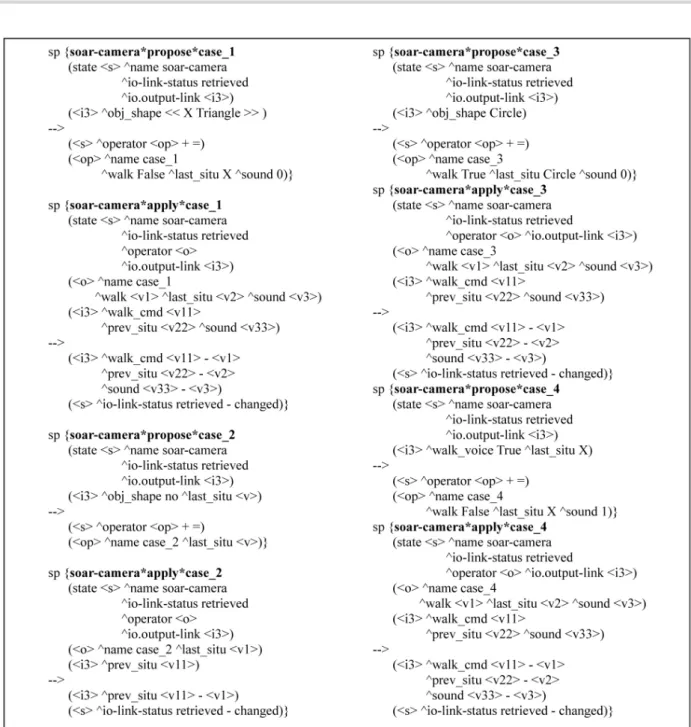
SML output reads decision commands from the Soar agent via output link and publishes them. This is how Soar agent interacts with other environments. The rules of the Soar wrapper agent are shown in Fig. 6 written in plain words.
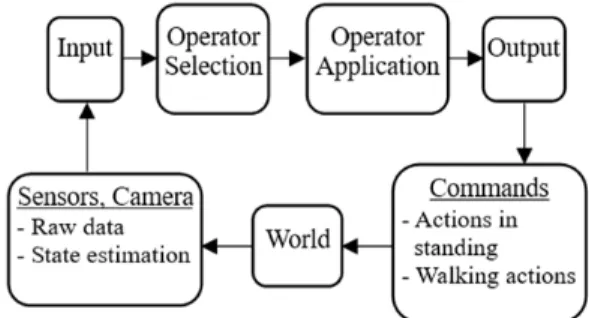
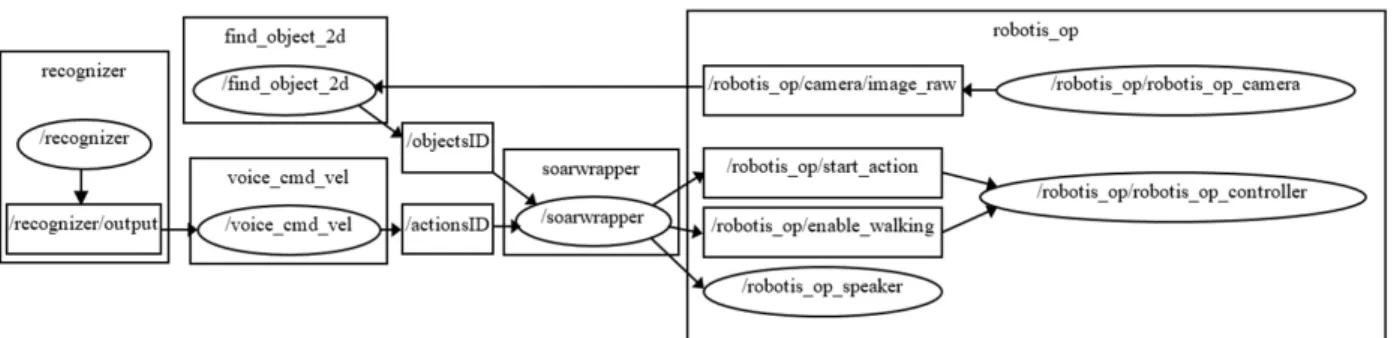
As the next step of connecting Soar and ROS, the authors attempt to apply this Soar-ROS hybrid platform into a humanoid robot ROBOTIS-OP2 (OP2 hereafter)
[14]. The OP2 robot has been well known in the literature
[15,16]