Virtual Environment Building and Navigation of Mobile Robot using Command Fusion and Fuzzy Inference
Taeseok Jin1*
<Abstract>
This paper propose a fuzzy inference model for map building and navigation for a mobile robot with an active camera, which is intelligently navigating to the goal location in unknown environments using sensor fusion, based on situational command using an active camera sensor. Active cameras provide a mobile robot with the capability to estimate and track feature images over a hallway field of view.
In this paper, instead of using “physical sensor fusion” method which generates the trajectory of a robot based upon the environment model and sensory data. Command fusion method is used to govern the robot navigation. The navigation strategy is based on the combination of fuzzy rules tuned for both goal-approach and obstacle-avoidance.
To identify the environments, a command fusion technique is introduced, where the sensory data of active camera sensor for navigation experiments are fused into the identification process. Navigation performance improves on that achieved using fuzzy inference alone and shows significant advantages over command fusion techniques.
Experimental evidences are provided, demonstrating that the proposed method can be reliably used over a wide range of relative positions between the active camera and the feature images.
Keywords : Mobile robot, Navigation, Obstacle Avoidance, Active Camera
1* Corresponding Author, Professor Dept. of Mechatronics, Dongseo University Zip Code: 47011
E-mail: [email protected], Tel: 053-810-2447
1. Introduction
Autonomous mobile robot is intelligent robot that performs a given work with sensors by identifying the surrounded environment and reacts on the state of condition by itself instead of human. Unlike general manipulator in a fixed working environment[1][2], it is required intelligent processing in a flexible and variable working environment. And studies on a fuzzy-rule based control are attractive in the field of autonomous mobile robot. Robust behavior in autonomous robots requires that uncertainty be accommodated by the robot control system. Fuzzy logic is particularly well suited for implementing such controllers due to its capabilities of inference and approximate reasoning under uncertainty [3][4].
This requires formulation of a large and complex set of fuzzy rules. In this situation a potential limitation to the utility of the monolithic fuzzy controller becomes apparent.
Since the size of complete monolithic rule-bases increases exponentially with the number of input variables [5], multi-input systems can potentially suffer degradations in real-time response. This is a critical issue for mobile robots operating in dynamic surroundings. Hierarchical rule structures can be employed to overcome this limitation by reducing the rate of increase to linear [6][7].
The paper is organized as follows: In section 2, we introduces the operation of each command and the fuzzy controller for
navigation system. In chapter 3, we explain about map-building from image informations of active camera. Finally, Section 4 presents experimental results to verify efficiency of system and concludes this research work and mentions possible future related work.
2. Fuzzy Commands for navigation
Seeking goal command of mobile robot is generated as the nearest direction to the target point. The command is defined as the distance to the target point when the robot moves present with the orientation for goal,
and the velocity, . Therefore, a cost function is defined as Eq. (1).
2
2 d
( ) { cos )}
{y sin )}
d d c
c
E x x t
y t
(1)where, is max , , is the goal position, , , is the current robot position and orientation and represents the reduction ratio of rotational movement.
Avoiding obstacle command is represented as the shortest distance to an obstacle based upon the sensor data in the form of histogram. The distance information is represented as a form of second order energy, and represented as a cost function by inspecting it about all as shown in Eq. (2).
E
0( ) d
sensor2( ) (2)
To navigate in a dynamic environment to the goal, the mobile robot should recognize the dynamic variation and react to it.
Maintain heading command is minimizing rotational movement aims to rotate wheels smoothly by restraining the rapid motion. The cost function is defined as minimum at the present orientation and is defined as a second order function in terms of the rotation angle, as Eq. (3).
2
( ) ( ) :
cr c
E present angle
(3)The command represented as the cost function has three different goals to be satisfied at the same time. Each goal differently contributes to the command by a different weight, as shown in Eq. (4).
1 2 3
( ) d( ) o( ) r( )
E w E w E w E (4)
where is the weight of corresponding rules, Seeking goal, Avoiding obstacle, Maintain heading, respectively.
3. Inference of cost function
We infer the weights of the usual fuzzy if-then rule by means of fuzzy algorithm. The main reason of using fuzzy algorithm is that it is easy to reflect the human’s intelligence into the robot control. Fuzzy inference system
is developed through the process of setting each situation, developing fuzzy logic with proper weights, and calculating weights for the commands [8].
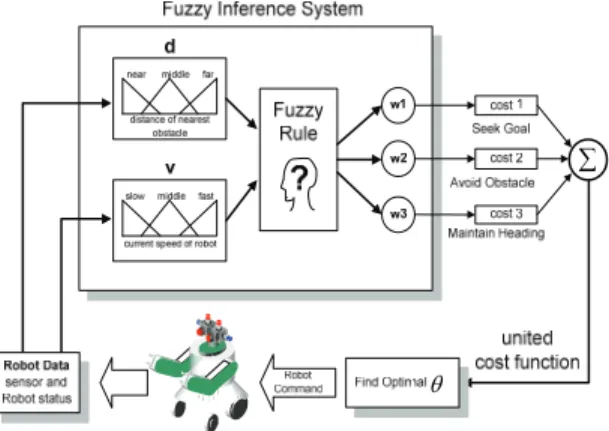
Fig. 1 shows the structure of a fuzzy inference system. We define the circumstance and state of a mobile robot as the inputs of fuzzy inference system, and infer the weights of cost functions. The inferred weights determine a cost function to direct the robot and decide the velocity of rotation. For the navigation control of the mobile robot, the results are transformed into the variation of orientation and angular velocities by the inverse kinematics of the robot [9].
Fig. 1 Structure of Fuzzy Inference System
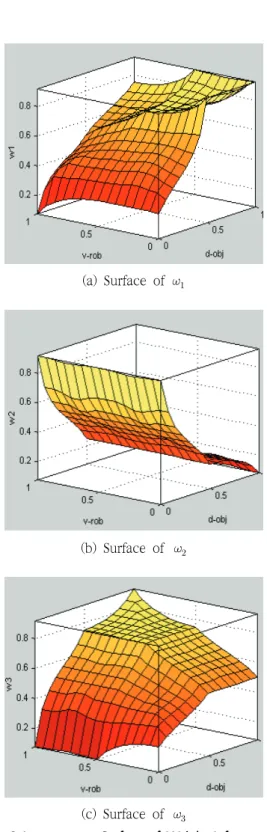
Fig. 2 shows the output surface of the fuzzy inference system for each weight fuzzy subsets using the inputs and the output. The control surface is fuzzy logic controller of seeing goal (a), fuzzy logic controller of avoiding obstacle (b) and fuzzy logic controller of minimizing rotation (c).
(a) Surface of
(b) Surface of
(c) Surface of
Fig. 2 Input-output Surface of Weight Inference System
4. Experiments
This navigation method that includes the proposed algorithm is applied for mobile robot named as AmigoBot that has been developed in the laboratory for Intelligent Robotics as shown in Fig. 3.
2 DOF active camera
Inner odometry Notebook
(robot controller)
Fig. 3 AmigoBot mobile robot
This modified AmigoBot robot had to be fast, flexible and offer real time image processing capabilities for navigation, so we applied Controller Area Network(CAN) to Pioneer-DX[10]. CAN is a serial bus system especially suited for networking “intelligent”
devices as well as sensors and actuators within a system or sub-system. CAN nodes can request the bus simultaneously and the maximum transmission rate is specified as 1M bit/s. With the proposed method, we make an experiment on building environmental map. Parameter values used for experiment are shown in Table 1.
l1 : 55cm, l2 : 7.5 cm, l3 : 4 cm Px 320 pixel Py 240 pixel
x 50° y 40°
Table 1. Parameter values used for experiment
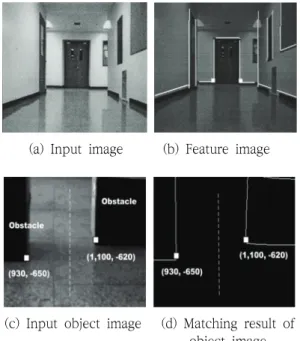
Fig. 4(a) is the image used on the experiment; Width of corridor is 2m and Joint angle parameter α, β of active camera are 11° and 0° respectively. After capturing the image, The ‘LOG’ operator is utilized to extract the edge elements. It is suitable for detecting edge element at corridor that appear noises (e.g.: Patterns of the bottom, wall) sensitively because it is difficult for edge detection in case of other edge operators which has the characteristic of high-pass filter.
The essential information to map building is edge information that meets with the bottom in the edge information extracted from LOG operation. Fig. 4(b) shows the feature image that the points meet with the bottom through LOG operation. We construct probability map by this informations. And the size of an obstacle will also play an important role in its detect ability by vision as shown in Fig. 4(b). To gain an understanding of these limitations, we performed experiments usingtwo small cardboard boxes of two different colors, brown and blue, each of height 40cm and width 30cm, as obstacles.
(a) Input image (b) Feature image
(c) Input object image (d) Matching result of object image Fig. 4 Experimental result of the vision system
Fig. 5(a) shows the map including the experimental environment. We exclude the information over 6m because that has low probability. Because we can estimate the reliability through the probability approach, the better map can be acquired.
Fig. 5(b) is the values resulted from matching after image processing which shows the estimated map over front 6m. The brightness presents the probability, and through the transformation, in case of having the area of the same distance in the image, the farther the point is, the smaller the probability is. Therefore the information which extracted image has low truthness because it has wide probability density.
0 x y
(a) Navigation environment
(b) Virtual map of corridor A Fig. 5 The results of matching
Fig. 5(b) shows that maximum matching error is within 4% of the dash-line area in Fig. 5(a).
The mobile robot was run out to a nearby location and created the map environment in Fig.
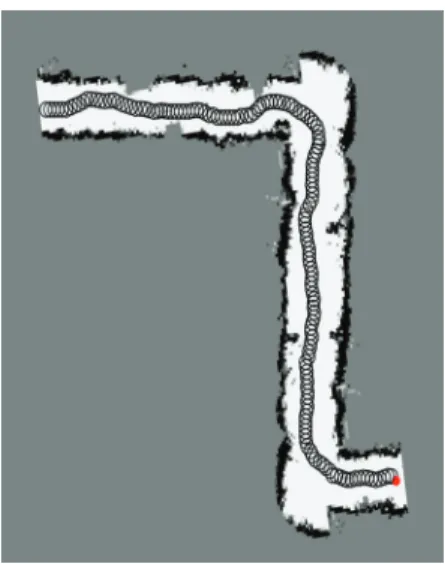
5(b). Therefore, it can be seen that above vision system is proper to apply to navigation. The mobile robot navigates along a corridor with 2m widths and with obstacles, respectively, as shown in Fig. 5. The final global map and real trace of the mobile robot obtained at the end of the experiment is shown in Fig. 6. It demonstrates that the mobile robot avoids the obstacles intelligently and follows the corridor to the goal.
5. Conclusion
We have demonstrate that the navigation of a mobile robot system with an active camera which permits vision to be used effectively in simultaneous localization and map-building for mobile robots using command fusion based fuzzy inference. A fuzzy inference algorithm for both obstacle avoidance and path planning has been implemented in experiment so that it enables the mobile robot to reach to goal point under the unknown environments safely and autonomously.
And also, we showed an architecture for intelligent navigation of mobile robot which determine robot’s behavior by arbitrating distributed control commands, seek goal, avoid obstacles, and maintain heading. Commands are arbitrated by endowing with weight value and
Fig. 6 Navigation map and trajectory with obstacles
combining them, and weight values are given by fuzzy inference method. Arbitrating command allows multiple goals and constraints to be considered simultaneously. To show the efficiency of proposed method, real experiments are performed.
To show the efficiency of proposed method, real experiments are performed. The experimental results show that the mobile robot can navigate to the goal point safely under unknown environments and also can avoid moving obstacles autonomously.
Our ongoing research endeavors include the validation of the more complex sets of behaviors, both in simulation and on an actual mobile robot. Further researches on the prediction algorithm of the obstacles and on the robustness of performance are required.
Acknowledgements
This research was supported by Basic Science Research Program through the National Research Foundation of Korea (NRF) funded by the Ministry of Education(No.
2016R1D1A1B04932124).
References
[1] M. Er, T. P. Tan, and S. Y. Loh, “Control of a mobile robot using generalized dynamic fuzzy neural networks,” Microprocessors and Microsystems, vol.28, pp. 491-498, 2004.
[2] G. Leng, T. M. McGinnity, and G. Prasad, “An approach for on-line extraction of fuzzy rules using a self-organising fuzzy neural network,” Fuzzy Sets and Systems, vol.150, no.2, pp. 211-243, 2005.
[3] T. Nishina, and M. Hagiwara, “Fuzzy inference neural network,” Neurocomputing, vol. 14, pp.
223-239, 1997.
[4] E. Grosso, and M. Tistarelli, “Active/Dynamic stereo vision,” IEEE Transaction on Pattern Analysis and Machine Intelligence, vol. 7, pp.
868-879, 1995.
[5] T. S. Jin, J.M. Lee, and H. Hashimoto, “Position Estimation of Mobile Robot using Images of Moving Target in Intelligent Space with Distributed Sensors” Advanced Robotics, The Robotics Society of Japan, vol.20, no.6, pp. 737- 762, 2006.
[6] T.S. Jin, J.W. Park, and J.M. Lee, “Trajectory Generation for Capturing a Moving Object in Predictable Environments” JSME International Journal, vol. 47, no. 2, pp. 722-730, 2004.
[7] H. Mehrjerdi, M. Saad, and J. Ghommam,
“Hierarchical Fuzzy Cooperative Control and Path Following for a Team of Mobile Robots,”
IEEE/ASME Transactions on Mechatronics,vol.
16, no.5, pp. 907-917, 2011.
[8] D. S. Wang, Y. S. Zhang, and W. J. Si,
“Behavior-based hierarchical fuzzy control for mobile robot navigation in dynamic environment,”
Chinese Control and Decision Conference (CCDC), pp. 2419-2424, 2011.
[9] A. Ohya, A. Kosaka, and A. Kak, “Vision-Based Navigation by a Mobile Robot with Obstacle Avoidance Using Single-Camera Vision and Ultrasonic Sensing,” IEEE Transactions on Robotics and Automation,vol.14, no. 6, pp.
969-978, 1998.
[10] E. W. Tunstel “Fuzzy-behavior synthesis, coordination, and evolution in an adaptive behavior hierarchy,” Studies in Fuzziness and Soft Computing, Springer-Verlag, Heidelberg, vol.61, pp. 205-234, 2001.
(Manuscript received May 10, 2019;
revised June 5, 2019; accepted June 13, 2019)