논문번호 18-02-30 http://dx.doi.org/10.7471/ikeee.2018.22.2.440 214
최적화된 퍼지로직 기반 이동로봇의 지능주행 알고리즘
Intelligent Navigation Algorithm for Mobile Robots based on Optimized Fuzzy Logic
조 연 *, 이 홍 규*★
Ran Zhao*, Hong-Kyu Lee*★ Abstract
The work presented in this paper deals with a navigation problem for a multiple mobile robots in unknown dynamic environments. The environments are completely unknown to the robots; thus, proximity sensors installed on the robots’ bodies must be used to detect information about the surroundings. In order to guide the robots along collision-free paths to reach their goal positions, a navigation method based on a combination of primary strategies has been developed. Most of these strategies are achieved by means of fuzzy logic controllers, and are uniformly applied in every robot. In order to improve the performance of the proposed fuzzy logic, the genetic algorithms were used to evolve the membership functions and rules set of the fuzzy controller. The simulation experiments verified that the proposed method effectively addresses the navigation problem.
요 약
본 논문은 미지 유동환경에서 다중 이동로봇들의 주행문제에 대한 연구결과이다. 여기에서 환경은 로봇에게는 알려져 있지 않기 때문에 로봇의 몸체에 부착된 근접센서들을 이용하여 주변환경들을 감지하여야 하고, 로봇이 충돌 없이 경로를 추적하여 목표지점에 도착하도록 기본 방책들을 조합한 지능주행 방법을 제안하였다. 이러한 대부분 기법들은 퍼지논리 제어기들을 이용하여 구현하였으며, 모든 로봇에 동일하게 적용하였다. 퍼지 제어기의 성능을 향상시키기 위해서 유전 알고리즘을 이용하여 퍼지 제어기의 membership function과 rules set를 진화시켰 다. 모의실험 결과 제안한 방법이 주행문제에 긍정적인 결과가 있음이 증명되었다.
Key words : Multiple Mobile Robots, Fuzzy Logic, Dynamic Environments, Navigation, Genetic Algorithm
* Dept. of Electrical Engineering, Korea University of Technology and Education
★ Corresponding author
E-mail: [email protected], Tel: +82-41-560-1162
※ Acknowledgment
This work was supported by Korea University of Technology and Education Research Grants Manuscript received Jun. 15, 2018; revised Jun. 26, 2018; Accepted Jun. 29, 2018
This is an Open-Access article distributed under the terms of the Creative Commons Attribution Non-Commercial License(http://creativecommons.org/licenses/by-nc/3.0) which permits unrestricted non-commercial use, distribution, and reproduction in any medium, provided the original work is properly cited.
RB R RF F LF L LB B
S PB PB NB NB NS PB PB PS M PB PB NB NB PB PB PS PS B PB PB NS Z PB PB PS PS VB PB PB PS PS PB PB PS PS
RB R RF F LF L LB B
S PB PB NS NS NB PB PB PB M PS PB PB Z NB PB PB PB B PS PB PB PB NS PB PB PB VB PS PB PB PB PS PB PB PB
Ⅰ. Introduction
In the applications of mobile robots, the navigation problem is one of the most important issues. A number of approaches for this problem have been presented; examples include genetic algorithms [1], neural networks [2], artificial vision methods [3], vector field histograms (VFHs) [4] and the artificial potential field (APF) approach [5] in static environments. Many researchers also applied the fuzzy logic for solving the robot navigation problem [6]-[7]. These methods perform well in static environments, but are not as effective in dynamic environments.
Otherwise, establishing high-efficiency membership functions and rules set of the fuzzy logic controller (FLC), which will improve the performance of the fuzzy inference, is one of the most important issues. This work focus on the optimized fuzzy logic based navigation problem in completely unknown dynamic environments for multiple mobile robots. And the proposed optimized fuzzy logic is evolved by Genetic Algorithm (GA).
Ⅱ. Navigation Strategies
In this paper, we choose a classic wheeled robot as an example for simulation. The proposed approach here is based on fuzzy inference system and is inspired by human behaviors, which consists of danger judgment strategy and target positioning strategy.
1. Danger Judgment Strategy for Obstacle Avoidance The “danger judgment strategy” developed here is used to avoid obstacles. It is obtained by means of a fuzzy logic controller (FLC1).
The sensors installed on the robot body are set to run once by every 0.1 seconds. Thus, in such a short time, we can simplify the relative velocity calculation by recording the
adjacent twice measurement. We use the expected time of collision
to denote the danger coefficient of the sensor, that is,
(1)
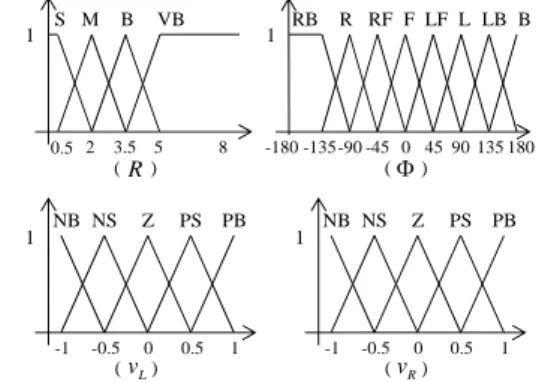
Here, the minimum danger coefficient and the angle of the corresponding sensor are used as the input variables of FLC1. Moreover, the linear velocities of the left and right wheels will be the output variables.
vR
Fig. 1. Membership functions for input and output variables of FLC
Table 1. Rules set of FLC1
2. Target Positioning Strategy
When there is no risk of collision, another strategy for target positioning is to be active.
The new FLC which the target orientation process is achieved by is denoted as FLC2.
The schematic model of target positioning is as given in Fig. 2. One of the inputs of FLC2 is the angular difference , where is the angle between the robot moving direction
S M B VB
0.5 2 3.5 8
( )
RB R RF F LF
-90 -45 0 45 90 ( ) NB NS Z PS PB
-1 1
-0.5 0 0.5 1
( vL ) 5 R
L LB B
135 180 -180 -135
1 1
NB NS Z PS PB
-1 1
-0.5 0 0.5 1
( vR )
RB R RF F LF L LB B
S 5 5 1 1 2 5 5 4
M 5 5 5 5 5 5 4 4
B 5 5 2 3 5 5 4 4
VB 5 5 4 4 5 5 4 4
RB R RF F LF L LB B
S 5 5 2 2 1 5 5 5
M 4 5 5 3 1 5 5 5
B 4 5 5 5 2 5 5 5
VB 4 5 5 5 4 5 5 5
and x-axis.
Another constraint for FLC2 is the distance
between the robot and its target. Moreover, the output variables also are the linear velocities of left and right wheels.
FLC1, the triangular membership functions are used for both input and output variables of FLC2.
Fig. 2. Target positioning schem
Ⅲ Optimized FLC by GA
The rules set and membership functions discussed in section Ⅱ are created all by human experience. Thus, it is indispensable to adjust them to get a better performance. A genetic algorithm is employed here to do this work. In this paper, we only focus on the optimization of the fuzzy controller of obstacle avoidance.
In order to encode a FLC, we integrated the proposed encoding procedure with both the membership functions and rules set. We use ,
, , (i=1,2,3,4,5) to denote the five linguistic values of input and output variables.
For the triangular membership functions every linguistic value can be described by three points. But in particular, the linguistic values on both ends of every membership function are described by two points by experience, hence, we can encode the membership functions which with the length of 58 in the way as shown in Fig. 3. The numbers from 1 to 5 are used to encoding the linguistic values of the rules set.
Thus, the rules set can be encoded as Table 2,
which can be defined as another part of the chromosome of GA.
1,c, 1,r, 2,l, 2,c, 2,r,..., 4,l, 4,c, 4,r, 5c, 5,r, C C C C C C C C C C
1,c, 1,r, 2,l, 2,c, 2,r,..., 4,l, 4,c, 4,r, 5c, 5,r
D D D D D D D D D D
Fig. 3. Encoding for membership functions Table 2. Encoding for rules set of FLC1
In our case, for the individual, the running time of the process from the start location to target location, the total path length and the distance between the robot body and the surrounding obstacles should be taken into account. The path length can be described by the following equation:
× (2)
A penalty function is required to insure that the robot will not collision any obstacles.
Denote that is the safety distance, the penalty function can be designed as:
≤ (3)Then the fitness function can be written as:
(4)
where , , are weighting coefficients.
Similar to
x y
vr
vo PR
PO PT
t
D
A1,c,A1,r,A2,l,A2,c,A2,r,A3,l,A3,c,A3,r,A4c,A4,r, +
B1,c,B1,r,B2,l,B2,c,B2,r,...,B7,l,B7,c,B7,r,B8c,B8,r, +
C1,c,C1,r,C2,l,C2,c, C2,r,...,C4,l,C4,c,C4,r,C5c,C5,r, +
D1,c,D1,r,D2,l,D2,c,D2,r,...,D4,l,D4,c,D4,r,D5c,D5,r
10bit 22bit
13bit 13bit + + +
RB R RF F LF L LB B
S PB PS NB NB NS PS PS PS M RB PB NB NB PB PB PB NS B PB PB NS Z PB PB PS PS VB PB PB PB PS PB PB PB PB
RB R RF F LF L LB B
S PB PS NS NB NB PB PB PB M RS PB PB NB NB PB PB PB B PS PB PB PB NB PB NB NS VB PS PB PB PB PB Z Z NS Fig. 4. Optimized membership functions of FLC1
In this paper, the ‘Stochastic Universal Sampling’ (SUS) is used as the selection operator, and the ‘Double-Point Crossover’
operator and ‘Real-valued Mutation’ operator were used for crossover and mutation procedure.
By following the above steps, the optimized membership functions and rules set compared with the original ones are shown in Fig. 4 and Table 3.
Table 3. Evolved fuzzy rules set of FLC1.
Ⅳ Simulation Results
To demonstrate the effectiveness of the proposed navigation algorithm, simulations with different environments are implemented in this paper. Here, all the robots have the same size and move on a horizontal plane using the exact same navigation strategies. To denote the movement trajectories, we will record the position and moving direction of all the robots by every one second.
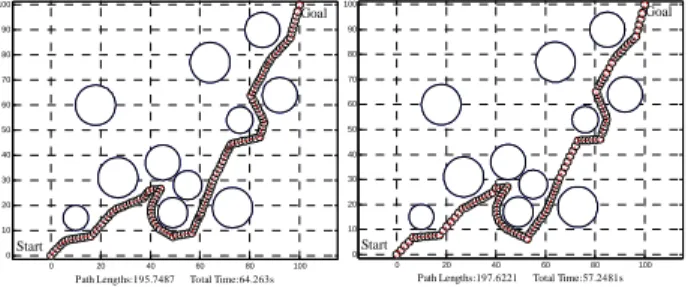
1. Simulation for Single robot with static obstacles The GA-Fuzzy based simulation results in the environment with static regular obstacles are shown in Fig. 5. Compare the path generated by evolved and un-evolved FLC, we can find that the evolved FLC demonstrated almost useless to shorten the path length.
However, the running time has been observably decreased from 64.263s to 57.2481s. Compared with the results of performance gain (7.63%, in running time) in [8] and that (1.72%, in path length) in [9], the method proposed in this work can get the 10.92% of performance improvement, which should be more effective.
Fig. 5. The path of one robot before (left) and after (right) evolution in static regular obstacle environments
2. Simulation for single robot with dynamic obstacles The results of one robot in the dynamic environments are shown in Fig. 6. The dotted line denotes the trajectories of dynamic obstacles.
Here, the dynamic obstacles, which with different radius, speed and moving directions, will continue moving back and forth during the entire process.
Compare the paths generated by evolved and un-evolved FLC1, we can find that the path length was decreased at 7.84%, while the running time was decreased at 13.80%.
Fig. 6. The path of one robot before (left) and after (right) evolution in dynamic obstacle environments
-1 -0.8-0.6-0.4-0.2 0 0.2 0.4 0.6 0.8 1
0 0.2 0.4 0.6 0.8 1
VR
NB NS Z PS PB
-1 -0.8-0.6-0.4-0.2 0 0.2 0.4 0.6 0.8 1
0 0.2 0.4 0.6 0.8 1
VL
NB NS Z PS PB
-150 -100 -50 0 50 100 150
0 0.2 0.4 0.6 0.8 1
Danger direction
RB R RF F LF L LB B
0 1 2 3 4 5 6 7 8
0 0.2 0.4 0.6 0.8 1
Danger coefficient
S MB VB
0 20 40 60 80 100
0 10 20 30 40 50 60 70 80 90 100
Path Lengths:195.7487 Total Time:64.263s
0 20 40 60 80 100
0 10 20 30 40 50 60 70 80 90 100
Path Lengths:197.6221 Total Time:57.2481s Start
Goal
Start
Goal
0 20 40 60 80 100
0 10 20 30 40 50 60 70 80 90 100
Robot1 - Path Lengths:166.8056 Total Time:78.1607s
R1
T1
0 20 40 60 80 100
0 10 20 30 40 50 60 70 80 90 100
Robot1 - Path Lengths:153.7208 Total Time:67.3609s
R1
T1
3. Simulation for multiple robots with dynamic obstacles
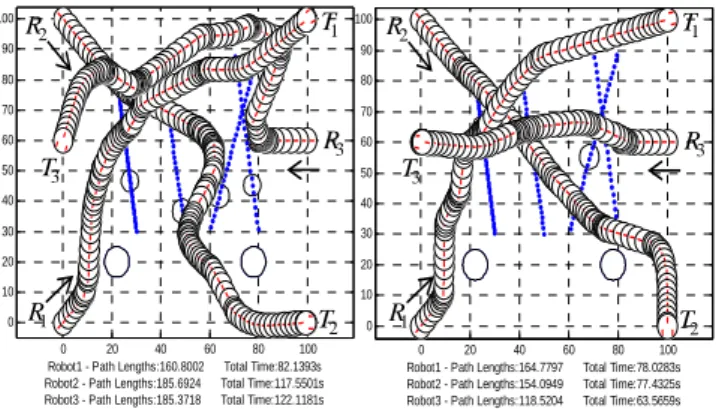
The simulation results of the navigation of multiple mobile robots are shown in Fig. 7.
Compare the paths generated by evolved and un-evolved FLC1, we can find that the path length of three robots was respectively decreased at -2.47%, 17.02%, 36.06%, and the running time was decreased at 5.00%, 34.13%, 47.95%.
00 10
20 30 40 50 60 70 80 90 100
3s 01s 81s
R1
Fig. 7. The path of one robot before (left) and after (right) evolution in dynamic obstacle environments
Ⅴ Conclusions
This paper studied an intelligent navigation problem for multiple mobile robots in unknown dynamic environment using optimized fuzzy logic. In order to establish high-efficiency membership functions and rules set, the genetic algorithms were used to do this work. Compare the paths generated by the optimized and un-optimized fuzzy controller, because the path planning of real-time navigation in unknown environments is not a global one, thus, the evolved FLC demonstrated almost useless to shorten the path length. However, the running time of the navigation procedure was observably decreased.
References
[1] C. E. Thomas, M. A. C. Pacheco, M.M. and B.R. Vellasco, “Mobile Robot Path Planning Using Genetic Algorithms,” International Work-Conference on Artificial Neural Networks, Springer Berlin Heidelberg, pp.
671-679, 1999. DOI: 10.1007/BFb0098225
[2] D. Janglová, “Neural Networks in Mobile Robot Motion,” International J ournal of Advanced Robotic Systems, vol. 1, no. 1, pp.
15-22, 2004. DOI: 10.5772/5615
[3] R. Carelli, C.M. Soria and B. Morales,
“Vision-based Tracking Control for Mobile Robots,” in Proceedings of 12th International Conference on Advanced Robotics(ICAR'05), Seattle, WA, pp. 148-152, 2005. DOI:
10.1109/ICAR.2005.1507405
[4] W. J. Yim, J. B. Park, “Analysis of Mobile Robot Navigation using Vector Field Histogram According to the Number of Sectors, the Robot Speed and the Width of the Path,” in Proceedings of 2014 14th International Conference on Control, Automation and Systems (ICCAS), IEEE, pp. 1037-1040, 2014.
DOI: 10.1109/ICCAS.2014.6987943
[5] M. G. Park, J. H. Jeon, M. C. Lee,
“Obstacle Avoidance for Mobile Robots using Artificial Potential Field Approach with Simulated Annealing,” in Proceedings of IEEE International Symposium on Industrial Electronics, ISIE 2001, vol. 3, pp. 1530-1535, 2001. DOI: 10.1109/ISIE.2001.931933
[6] T. Jin, “Obstacle Avoidance of Mobile Robot based on Behavior Hierarchy by Fuzzy Logic,”
International J ournal of Fuzzy Logic and Intelligent Systems, vol. 12, no. 3, pp. 245-249, 2012. DOI: 10.5391/IJFIS.2012.12.3.245
[7] H. G. Nguyen, W. H. Kim, J. H. Shin, “A Study on an Adaptive Robust Fuzzy Controller with GAs for Path Tracking of a Wheeled Mobile Robot,” International J ournal of Fuzzy Logic and Intelligent Systems, vol. 10, no. 1,
0 20 40 60 80 100
0 10 20 30 40 50 60 70 80 90 100
Robot1 - Path Lengths:160.8002 Total Time:82.1393s Robot2 - Path Lengths:185.6924 Total Time:117.5501s Robot3 - Path Lengths:185.3718 Total Time:122.1181s
R1 R2
R3 T1
T2 T3
0 20 40 60 80 100
0 10 20 30 40 50 60 70 80 90 100
Robot1 - Path Lengths:164.7797 Total Time:78.0283s Robot2 - Path Lengths:154.0949 Total Time:77.4325s Robot3 - Path Lengths:118.5204 Total Time:63.5659s
R1 R2
R3 T1
T2 T3
pp. 12-18, 2010. DOI: 10.5391/IJFIS.2010.10.1.012 [8] I. Hassanzadeh, S.M. Sadigh, “Path Planning for a Mobile Robot using Fuzzy Logic Controller Tuned by GA,” 6th International Symposium on Mechatronics and its Applications, pp. 1-5, 2009.
DOI: 10.1109/ISMA.2009.5164798
[9] Q. Liu, Y. G. Lu, C. X. Xie, “Optimal Genetic Fuzzy Obstacle Avoidance Controller of Autonomous Mobile Robot Based on Ultrasonic Sensors,” in Proceedings of 2006 IEEE International Conference on Robotics and Biomimetics, pp. 125-129, 2006. DOI:
10.1109/ROBIO.2006.340327
BIOGRAPHY
Ran Zhao (Member)
2006 : BS degree in Department of Information Engineering, Shandong University.
2009 : MS degree in Department of Electrical and Electronics Engineering from Korea University of Technology and Education.
2018 : PhD degree in Department of Electrical and Electronics Engineering from Korea University of Technology and Education.
Hong-Kyu Lee (Member)
1977 : BS degree in Department of Electronics Engineering from Seoul National University.
1979 : MS degree in Department of Electronics Engineering from Seoul National University.
1989 : Ph. D degree in Department of Electronics Engineering from Seoul National University.
1979~1992 : Agency of Defense Development 1992~present : Professor, Department of Electrical Engineering, Korea University of Technology and Education