40(11), 1507~1511(2011) http://dx.doi.org/10.3746/jkfn.2011.40.11.1507
RAW264.7 대식세포에서 Heme Oxygenase-1의 유도에 의한 개망초 ( Erigeron annuus L.) 꽃 Methanol 추출물의 항염증 효과
성미선․김영화․최용민․함현미․정헌상․이준수†
충북대학교 식품공학과
Anti-Inflammatory Effect of Erigeron annuus L. Flower Extract through Heme Oxygenase-1 Induction in RAW264.7 Macrophages
Misun Sung, Younghwa Kim, Youngmin Choi, Hyeonmi Ham, Heon-Sang Jeong, and Junsoo Lee† Dept. of Food Science and Technology, Chungbuk National University, Chungbuk 361-763, Korea
Abstract
This study investigated the anti-inflammatory effect of Erigeron annuus L. flower (EAF) methanol extract.
We examined the involvement of heme oxygenase-1 (HO-1) in the inhibitory activities of EAF methanol extract on nitric oxide (NO) production in lipopolysaccharide (LPS)-stimulated RAW264.7 macrophages. Cell viability and NO assays were performed. In addition, inducible nitric oxide synthase (iNOS) and HO-1 expressions were detected by Western blotting and blocking HO-1 activity on NO production. EAF methanol extract (25, 50, 100, 200 μg/mL) significantly inhibited LPS-stimulated NO production (p<0.05; 12.82, 9.61, 6.83, 2.52 μM) in a con- centration-dependent manner. EAF methanol extract also reduced the expression of iNOS protein. The EAF methanol extract induced the expression of HO-1 in a dose-dependent manner. Blockage of HO-1 activity by zinc protoporphyrin suppressed EAF methanol extract-induced reductions in the production of NO. The present results suggest that EAF methanol extract has a potent anti-inflammatory effect in RAW264.7 macrophages through the induction of HO-1.
Key words: Erigeron annuus, anti-inflammation, nitric oxide, inducible nitric oxide synthase, heme oxygenase-1
†
Corresponding author. E-mail: [email protected]
†
Phone: 82-43-261-2566, Fax: 82-43-271-4412
서 론
염증은 외부 자극에 대한 생체조직의 국소적 방어반응 중 하나이다. 염증이 발생하면 여러 가지 염증매개인자들이 생 성되며 이로 인하여 발열, 홍반, 부종, 기능 장애 등의 증상이 나타난다(1-3). 대식세포는 숙주의 항상성 유지와 같은 여러 종류의 숙주 반응에 관여하는 것으로 알려져 있으며, nitric oxide(NO)와 cytokine을 분비하여 염증 반응 시 생체 방어 에 중요한 역할을 하는 세포로 알려져 있다(4). 일반적인 NO 의 형성은 신경계 및 면역계에서 중요한 전달 물질로 작용하 여 박테리아를 사멸시키거나 종양을 제거하는 중요한 역할 을 하지만, 과도한 NO의 형성은 염증을 유발시키게 되며 조 직의 손상, 유전자 변이, 신경 퇴행성 질병 등의 발생에 관여 한다(5,6). Nitric oxide synthase(NOS)는 NO 생성에 관여 하는 효소로 세포의 종류에 따라 신경성 NOS(nNOS), 내피 성 NOS(eNOS), 유도성 NOS(iNOS)로 구분되며 그중 iNOS 는 NO의 과발현에 영항을 미치며 다양한 세포에서 유도되 어 병리생태학적 관점에서 중요한 역할을 한다(7). Heme oxygenase-1(HO-1)은 heme이 carbon monoxide(CO), bi-
liverdin, free iron으로 분해되는 반응을 촉진하는 효소이며
pro-inflammatory cytokines를 줄이고 anti-inflammatory
cytokines의 생성을 촉진시키는 생리학적인 기능에 관여한
다(8,9). HO-1은 스트레스나 허혈 및 염증 반응에서 유도되
며 주로 세포를 보호하는 기전에 작용하는 것으로 알려져 있
다(10). HO-1과 CO는 nuclear factor(NF)-κB의 inactivation
을 통해 활성화된 대식세포에서 NO의 생성과 iNOS 단백질
의 발현을 조절한다고 보고되어 있다(11). 개망초(
Erigeron annuusL.)는 국화과에 속하는 두해살이풀로서 한국에서 흔
히 볼 수 있다. 예로부터 소화불량, 장염으로 인한 복통 및
설사 치료, 혈당 강하작용 등의 약효가 있어 민간요법으로
널리 이용되는 것으로 알려져 있다(12). 본 연구에서는 개망
초 꽃(EAF) methanol 추출물의 항염증 효과를 알아보기 위
하여 lipopolysaccharide(LPS)로 염증을 유도하여 활성화된
RAW264.7 대식세포에서 염증 반응의 중요 매개물질 억제
효과, 즉 NO의 생성에 미치는 영항과 iNOS 단백질 발현에
미치는 영향에 대해 알아보고 EAF methanol 추출물이 HO-
1의 발현에 미치는 영향을 연구하여 EAF methanol 추출물
의 항염증 효과에 미치는 HO-1의 역할을 규명하고자 하였다.
재료 및 방법
재료 및 시약
본 실험에 사용된 개망초 꽃은 충북대학교 원예과학과에 서 제공받아 사용하였다. DMEM 배지(Dulbecco's modified Eagle's medium)와 FBS(Fetal bovine serum)는 Hyclone (Logan, UT, USA)사에서 구입하였다. 실험에 사용된 항체 는 Santa Cruz Biotechnology Inc.(Santa Cruz, CA, USA)에 서 구입하였으며 zinc protoporphyrin IX(ZnPP)는 Frontier scientific Inc.(Logan)에서 구입하여 사용하였다. 그 밖에 사 용된 추출용매 및 시약은 analytical 및 HPLC 등급을 사용하 였다.
Methanol 추출물의 제조
개망초 꽃 10 g에 100% methanol 300 mL을 가한 뒤 상온 에서 24시간 동안 혼합하여 개망초 꽃으로부터 유용성분을 추출하였다. 추출 후 잔사는 filter paper(TOYO, No. 2)를 이용하여 분리하였고 추출액은 rotary evaporator(EYELA, Tokyo, Japan)를 이용하여 40
oC 이하에서 감압 농축하여 추 출액을 완전히 휘발시켰다. 추출물은 100% methanol을 이 용하여 50 mL로 정용한 뒤 모든 추출물의 농도를 100 mg/
mL이 되도록 DMSO(dimethylsulfoxide)에 재용해하였다.
제조된 추출물의 유용 성분이 손실되는 것을 방지하기 위하 여 질소 충진 한 후 -74
oC에서 보관하였으며 실험에 사용된 추출물은 모두 0.2 μm filter로 멸균하여 사용하였다.
세포 배양
실험에 사용된 RAW264.7 대식세포는 한국세포주은행 (KCLB, Korea Cell Line Bank, Seoul, Korea)에서 분양 받 아 사용하였다. RAW264.7 대식세포는 직경 10 mm의 cul- ture dish에서 10% FBS, 100 unit/mL penicillin, 50 μg/mL streptomycin을 함유한 DMEM 배지를 사용하여 5% CO
2가 공급되는 incubator에서 37
oC로 배양하였다.
Nitric oxide 함량 측정
RAW264.7 대식세포를 1.5×10
5cells/well의 농도로 96- well plate에 분주하여 6시간 배양한 후에 EAF methanol 추출물을 농도별(25, 50, 100, 200 μg/mL)로 처리한 다음, LPS(1 μg/mL)를 처리하여 24시간 배양하였다. 세포 배양액 150 μL와 Griess 시약 20 μL를 혼합하여 37
oC에서 10분 동안 incubator에서 반응시킨 후, ELISA reader를 이용하여 550 nm에서 흡광도를 측정하였고 sodium nitrate로 표준곡선을 작성하여 NO의 함량을 산출하였다(13).
세포 독성 측정
EAF methanol 추출물의 세포 독성은 MTT(3-(4,5- dimethylthiazol-2-ly)-2,5-diphenyl tetrazolium bromide) assay를 이용하여 측정하였다(14). RAW264.7 대식세포를 1.5×10
5cells/well의 농도로 96-well plate에 분주하여 6시
간 배양한 후에 EAF methanol 추출물을 농도별(25, 50, 100, 200 μg/mL)로 처리한 다음, LPS(1 μg/mL)를 처리하여 24시 간 배양하였다. 배양 후 MTT(5 mg/mL) 시약을 각 well에 20 μL씩 첨가하고 4시간 동안 37
oC incubator에서 반응시킨 후 상징액을 제거하였다. 각 well에 150 μL의 DMSO를 첨가 하여 불용성 MTT formazan을 용해한 후 ELISA reader를 이용하여 550 nm에서 흡광도를 측정하였다.
Western blot
RAW264.7 대식세포를 1.0×10
6cells/well의 농도로 6- well plate에 분주하여 6시간 배양한 후에 EAF methanol 추출물을 농도별(25, 50, 100, 200 μg/mL)로 처리한 다음, LPS(1 μg/mL)를 처리하여 24시간 배양하였다. 24시간 배양 후 phosphate buffered saline(PBS)로 3회 세척한 후 세포를 얻어 원심분리 하여 pellet에 lysis buffer를 가하여 -20
oC에 서 overnight한 후 12,000 rpm으로 30분간 원심분리 하여 상등액을 모았다. 모은 상등액은 bicinchoninic acid(BCA) protein assay kit(Thermo Scientific, Rockford, IL, USA)를 사용하여 단백질을 정량하였다. 단백질 10 μg을 5×sample buffer에 넣고 100
oC에서 10분간 불활성화시켜 10% SDS polyacrylamide gel에 전기영동 하였다. 분리된 단백질은 nitrocellulose membrane으로 transblotting 한 후 5% non- fat dry milk에서 90분 동안 blocking하였다. iNOS와 HO-1 항체는 1:1000의 비율로 4
oC에서 24시간 부착시킨 후 tris- buffered saline Tween-20(TBST) buffer로 10분간 3회 washing하였고 2차 항체는 1:2000의 비율로 희석하여 2시간 상온에서 부착시켰다. TBST buffer로 10분간 3회 washing 한 membrane에 ECL(Amersham Pharmacia Biotech, NJ, USA)을 처리하여 X-ray film에 감광시켜 암실에서 현상하 였다.
통계분석
대조군과 각 시료로부터 얻은 실험 결과들의 유의성을 검 정하기 위하여 분산분석(ANOVA)을 행한 후 p<0.05 수준 에서 Duncan's multiple range test를 실시하였으며, 그 결과 는 평균±표준편차로 표시하였다.
결과 및 고찰
세포독성과 nitric oxide 생성 저해 효과
NO는 L-arginine을 기질로 하여 NOS에 의해 생성되는
무기 유리체로 LPS 처리에 의해 급격히 증가된다(15). NO
는 염증 유발에도 중요한 역할을 하는 것으로 알려져 있으며
(16) 매우 불안정하여 NO
2-의 형태로 바로 전환되기 때문에
NO
2-의 형태로 Griess 시약을 이용하여 NO의 농도를 정량하
였다(17). LPS를 처리한 RAW264.7 대식세포에서 생성된 NO
의 함량이 11.48 μM 수준으로 증가하였으며 EAF methanol
추출물을 농도별로(25, 50, 100, 200 μg/mL) 처리하였을 때
0 4 8 12 16 20
N it ra te ( μ M ) .
0 20 40 60 80 100 120
C e ll v ia b ili ty ( % ) .
Nitrate (μM) Cell viability (%)
#
*
*
UPS(1 μg/mL) - + + + + + EAF(μg/mL) - - 200 100 50 25
Fig. 1. Effects of the Erigeron annuus L. flower methanol extract on cell viability and nitric oxide production in lipo- polysaccharide-stimulated RAW264.7 macrophages. Each value is expressed as a mean±standard deviation (n=3). LPS, lipopolysaccharides; EAF, Erigeron annuus L. flower methanol extract.
#p<0.05 compared to control,
*p<0.05 compared to LPS.
0 30 60 90 120 150
E x p re s s io n o f iN O S ( % L P S ) .
LPS(1 μg/mL) - + + + + + EAF(μg/mL) - - 200 100 50 25
#
*
*
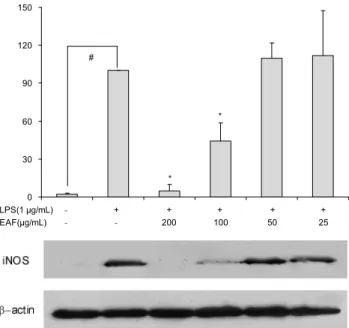
Fig. 2. Effects of the Erigeron annuus L. flower methanol extract on lipopolysaccharide-stimulated inducible nitric ox- ide synthase protein expression in RAW264.7 macrophages.
The values were expressed as a percentage of band intensity of iNOS in culture treated with lipopolysaccharide alone. Each value is expressed as a mean±standard deviation (n=3). LPS, lip- opolysaccharides; EAF, Erigeron annuus L. flower methanol ex- tract; iNOS, inducible nitric oxide synthase.
#p<0.05 compared to control,
*p<0.05 compared to LPS.
12.82, 9.61, 6.83, 2.52 μM로 농도 의존적으로 감소되는 것으 로 나타났다(Fig. 1). MTT assay를 이용하여 RAW264.7 대 식세포에서 EAF methanol 추출물의 세포독성을 확인하였 다. EAF methanol 추출물을 농도별로(25, 50, 100, 200 μg/
mL) 처리한 결과, 모든 농도에서 90% 이상의 생존율을 보여 EAF methanol 추출물은 RAW264.7 대식세포에서 독성을 나타내지 않은 것을 확인하였다(Fig. 1). 따라서 EAF me- thanol 추출물의 처리 농도를 RAW264.7 대식세포에서 독성 을 보이지 않은 25, 50 100, 200 μg/mL로 하여 다음 실험을 진행하였다. 이와 같은 결과는 Jang 등(18)과 Zhao 등(19)이 보고한 국화과에 속하는
Atractylodes japonica와
Arctium lappaL.의 NO 생성 억제에 대한 연구와 유사한 경향을 나타 내었다.
Inducible nitric oxide synthase 생성 억제 효과
NO 생성 억제에 대한 실험결과를 토대로 iNOS 생성에 미 치는 EAF methanol 추출물의 영향을 확인하기 위하여 LPS 에 의해 활성화된 RAW264.7 대식세포에 EAF methanol 추 출물을 농도별로(25, 50, 100, 200 μg/mL) 처리하여 Western blotting을 통해 iNOS 단백질의 발현을 확인하였다(Fig. 2).
iNOS는 LPS를 처리하지 않은 상태의 RAW264.7 대식세포 에서 거의 발현되지 않았지만 LPS 처리 시 현저하게 증가하 였다. EAF methanol 추출물을 처리한 결과 LPS 처리에 의 해 증가한 iNOS 단백질 발현이 25, 50 μg/mL에서는 유의적 인 차이를 보이지 않았으나 100, 200 μg/mL 처리하였을 때 는 감소하였으며 200 μg/mL을 처리하였을 때의 iNOS 단백 질 발현은 LPS를 처리하지 않은 상태와 비슷한 수준으로 감소되었다. iNOS는 여러 자극에 의해 활성화된 세포에서 유도되어 과량의 NO를 생성하는 것으로 알려져 있으며 염 증 반응에서 생성되는 NO는 대부분 iNOS에 의한 것이라 할 수 있다(20). Park과 Son(21) 및 Han 등(22)은 NO 저해 활성
을 높게 나타낸
Euphorbia supinaRafin과
Chrysanthemum zawadskiivar.
latilobum추출물은 iNOS 단백질 발현도 효 과적으로 저해한다고 보고하였다. 본 연구 결과 EAF me- thanol 추출물의 NO 생성 억제와 iNOS 단백질 발현 저해는 유사한 경향을 나타내었다. 따라서 EAF methanol 추출물에 의한 iNOS 단백질의 발현 억제는 NO의 생성 억제에 영향을 미친다고 판단된다.
Heme oxygenase-1(HO-1)의 발현 효과
HO-1은 heme을 CO, biliverdin, free iron으로 분해시키 는 효소이며(8) HO-1의 유도는 산화적 손상으로부터 세포 내 지질 및 단백질들을 보호하는 방어 기작의 하나로 보호 작용을 할 뿐 아니라 염증 반응을 약화시키기도 한다(23).
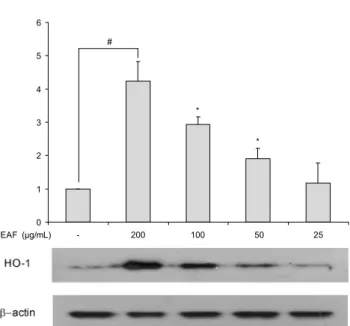
EAF methanol 추출물은 RAW264.7 대식세포에서 농도 의
존적으로 HO-1의 발현을 유도하였다(Fig. 3). EAF meth-
anol 추출물에 의한 HO-1 발현이 NO 생성에 미치는 영향에
대해 확인하기 위해 HO-1의 inhibitor인 ZnPP를 사용하였
다. 실험결과 ZnPP를 처리하여 HO-1의 발현을 저해하였을
때 추출물에 의해 감소된 NO의 함량이 다시 증가되었다
(Fig. 4). HO-1의 heme 분해에 의해 생성된 CO와 bili-
verdin/bilirubin은 iNOS와 COX-2의 활성과 발현 및 NO의
생성을 억제하며 biliverdin은 pro-inflammatory cytokines
인 IL-6와 IL-1β의 생성을 억제시키는 것으로 보고되었다
(24,25). Kim 등(26)과 Hwangbo 등(27)은
Chrysanthemum0 1 2 3 4 5 6
CON 200 100 50 25
H O -1 e x p re s s io n ( fo ld ) .
EAF (μg/mL) - 200 100 50 25
#
*
*
Fig. 3. Effects of Erigeron annuus L. flower extract on the production of heme oxygenase-1. RAW264.7 cells were treated with the Erigeron annuus L. flower methanol extract at concen- trations of 25, 50, 100 or 200 μg/mL for 24 hr. Each value is ex- pressed as a mean±standard deviation (n=3). The results were expressed as fold compared to band intensity of untreated RAW 264.7 cells which was assigned a value of 1. LPS, lipopolysac- charides; EAF, Erigeron annuus L. flower methanol extract; HO- 1, heme oxygenase-1.
#p<0.05 compared to control,
*p<0.05 com- pared to LPS.
0 2 4 6 8 10 12 14
Nitrate (μM)
*
*
#
LPS (1 μg/mL) - + + + + EAF (200 μg/mL) - - + + + ZnPP (30 μM) - - - + +
Fig. 4. Involvement of heme oxygenase-1 in the inhibitory effects of the Erigeron annuus L. flower methanol extract on lipopolysaccharide-stimulated nitric oxide production in RAW264.7 macrophages. Each value is expressed as a mean±
standard deviation (n=3). LPS, lipopolysaccharides; EAF, Eriger- on annuus L. flower methanol extract; ZnPP, zinc protoporphyrin IX.
#p<0.05 compared to LPS,
*p<0.05 compared to EAF treated with LPS.
boreale
Makino와
Tussilago farfara추출물에 의해 유도된 HO-1이 항염증 특성을 조절한다고 보고하였다. 본 실험결 과 EAF methanol 추출물에 의해 발현된 HO-1은 NO의 생 성을 억제할 수 있으며 이로 인해 염증 반응에 효과가 있다 는 것을 확인할 수 있었다. 염증 반응에 관여하는 iNOS 단백 질의 발현과 NO의 생성은 NF-κB의 inactivation을 통해 억 제되며 NF-κB의 inactivation은 mitogen-activated protein
kinase(MAPK) signaling pathway에 의해 조절된다는 연구 가 보고되어 있다(28). 또한, HO-1의 발현이 iNOS의 발현과 iNOS에 의해 유도되는 NO의 생성을 억제하며 이는 NF-κB 의 inactivation을 통해 조절된다는 연구가 보고된바 있다 (29). 본 연구결과 EAF methanol 추출물의 항염증 효과는 iNOS의 발현을 억제하고, HO-1의 발현을 유도하여 NO의 생성을 조절하는 것으로 판단된다. 따라서 EAF methanol 추출물이 iNOS 발현과 NO 생성을 조절하는 NF-kB의 활 성, MAPK signaling pathway에 관여하며 MAPK의 활성이 HO-1의 발현에 미치는 영향에 대해 연구되어야 할 것으로 생각한다.
감사의 글
본 연구는 농촌진흥청 지역농과계기반조성사업의 지원으 로 수행되었으며 이에 감사드립니다.
요 약
본 연구에서는 LPS에 의해 활성화된 RAW264.7 대식세 포에서의 NO 생성 및 iNOS와 HO-1 단백질 발현의 변화를 측정하여 개망초(
Erigeron annuusL.) 꽃(EAF) methanol 추출물의 항염증 효과를 확인하였다. RAW264.7 대식세포 에 LPS를 처리한 결과 NO의 함량이 11.48 μM 수준으로 증가하였다. 그러나 EAF methanol 추출물(25, 50, 100, 200 μ g/mL)을 처리하였을 때 NO의 함량이 12.82, 9.61, 6.83, 2.52 μ M로 농도 의존적으로 감소하였다. 또한 EAF methanol 추 출물은 NO의 생성에 관여하는 iNOS 단백질의 발현을 농도 의존적으로 저해하였으며 HO-1 단백질의 발현을 유도하였 다. EAF methanol 추출물에 의한 HO-1 발현이 NO 생성에 미치는 영향에 대해 확인하기 위해 HO-1의 inhibitor인 ZnPP를 사용하였다. 실험결과 ZnPP를 처리하여 HO-1의 발현을 저해하였을 때 추출물에 의해 감소된 NO의 함량이 다시 증가되었다. 본 연구 결과, EAF methanol 추출물은 염증을 유발하는 중요 인자인 NO를 저해하였고, iNOS의 발현을 억제시켰으며 산화적 손상으로부터 세포 보호 방어 기작에 관여하는 HO-1의 발현 등 항염증에 우수한 효과를 보였으며 항염증 연구의 기초 자료로 활용될 것으로 예상된다.
문 헌