| Abstract |
Purpose: The purpose of this study was to determine the effects of action observation training on lower limb muscle activity and dynamic balance in chronic stroke patients.
Methods: This study evaluated 20 chronic stroke patients who were divided randomly into a control and an experimental group comprising 10 patients each. Both the experimental group and the control group performed the general exercise therapy provided by the hospital, but the experimental group also performed action observation training. Lower limb muscle activity was measured with a surface electromyograph, and dynamic balance was measured with the Timed Up and Go test and the 10-meter walk test.
The paired t-test was used to compare the groups before and after the experiment. Furthermore, the independent t-test was used to assess differences in the degree of change between the two groups before and after the experiment.
Results: The within-group comparisons for both the experimental group and the control group showed significant differences in muscle activity and dynamic balance (p<0.05). In a comparison between the groups, the differences in the muscle activity and dynamic balance of the experimental group appeared significant compared with those of the control group (p<0.05).
Conclusion: The study results indicate that action observation training is effective in improving the muscle activity and dynamic balance of chronic stroke patients.
Key Words: Action observation training, Muscle activity, Dynamic balance
†Corresponding Author : Yong-Nam Kim ([email protected]) PNF and Movement, 2019; 17(2): 245-252
https://doi.org/10.21598/JKPNFA.2019.17.2.245
Print ISSN: 2508-6227 Online ISSN: 2508-6472
Original Article Open Access
동작관찰훈련이 만성 뇌졸중 환자의 하지 근 활성도 및 동적 균형에 미치는 영향
김재운⋅손영란⋅김용남
1†1)남부대학교 대학원 물리치료학과,
1남부대학교 물리치료학과
The Effects of Action Observation Training on Lower Limb Muscle Activity and Dynamic Balance in Chronic Stroke Patients
Jae-Woon Kim⋅Young-Lan Son⋅Yong-Nam Kim
1†Department of Physical Therapy, Graduate School, Nambu University
1
Department of Physical Therapy, Nambu University
Received: April 13, 2019 / Revised: May 23, 2019 / Accepted: May 23, 2019
ⓒ 2019 Journal of Korea Proprioceptive Neuromuscular Facilitation Association
This is an Open Access article distributed under the terms of the Creative Commons Attribution Non-Commercial License
(http://creativecommons.org/licenses/by-nc/3.0) which permits unrestricted non-commercial use, distribution, and reproduction
in any medium, provided the original work is properly cited.
ԺԼԾ ք ՖՎԨթնլԨՕշվխյխնռԨ՞շմԶԨԹԿԴԨՖշԶԨԺ
Ⅰ. 서 론
뇌졸중은 뇌의 혈액을 공급하는 일부 혈관의 흐름 에 문제가 생겨 막히거나 터짐으로 인해 뇌가 원활히 혈액 공급을 받지 못하여 발생하는 중추신경계 질환 이다 (Prange et al., 2016). 뇌졸중의 병리학적 특성으로 인해 비정상적인 움직임 패턴과 균형 장애, 근육 약화 가 일어난다 (Hong et al., 2014; Yang et al., 2015). 대부분 의 뇌졸중 환자들은 손상된 부위와 정도에 따라 다르 게 나타나지만 근 수축능력 약화와 수축 시 운동단위 의 수가 감소되고 적절한 타이밍의 근 활성 조절능력 이 결여된다(Pattenrson et al., 2000). 그로 인한 신체활 동의 제한은 중력중심점의 비 마비측 이동으로 마비 측 하지의 체중이동능력과 지지시간을 감소시킨다 (Kirker et al., 2000). 또한, 하지의 움직임 제한은 낙상 의 위험을 증가시키며 균형 , 보행능력에 부정적인 영 향을 미친다(Liepert et al., 2000).
뇌졸중 환자가 독립적인 보행을 수행하기 위해서 는 걷는 동안 균형을 유지할 수 있는 능력이 필요하다 (Ham & Lim, 2016; Shin et al., 2015). 뇌졸중 환자에게서 관찰되는 비대칭적 보행패턴은 비마비측과 마비측의 보폭길이의 차이 , 느린 보행속도와 보행주기, 마비 측 의 짧은 입각기에 비해 상대적으로 긴 유각기 등이 있다 (Ford et al., 2007). 그러므로 뇌졸중 환자는 하지 근력 및 협응 능력을 강화하여 약화된 보행능력을 회복시키 는 훈련을 해야 한다 (Duncan et al., 1990). 하지만 기존의 재활치료 프로그램들은 주로 비마비측 제한을 이용한 반복적이고 능동적인 기능적 움직임을 요구하는 직접 적인 신체훈련에만 중점을 두고 있다(Lee, 2013).
동작관찰훈련은 현재 재활분야에서 기능향상을 위 한 방법 중 하나로 시행되고 있다(Garrison, 2010). 이 방법은 거울신경세포 시스템(mirror neuron system, MNS)에 이론적 기초를 두고 있다(Small et al., 2012).
거울신경세포라는 명칭은 동작을 수행할 때 활성화되 는 뇌 영역이 그 동작을 관찰할 때에도 활성화되는 거울과 같은 특성 때문에 붙여진 것이다(Rizzolatti, 1996). 다른 사람의 목표 지향적 동작을 단순히 관찰하
는 것으로 인간 운동시스템의 겉질 회로에서 특정한 신경생리학적 변화가 일어난다 (Koch et al., 2010). 선 행연구에서 만성 뇌졸중 환자에게 동작관찰훈련을 적 용한 결과 보행속도와 보행 지구력 및 동적 보행 지수 가 향상되었다고 보고하였고(Song, 2016) 또 다른 연구 에서 만성 뇌졸중환자에게 동작관찰훈련을 적용한 결 과 동적 균형이 향상되었다고 하였다(Kim & Lee, 2015). 선행연구들을 통해 뇌졸중 환자에게 동작관찰 운동의 효과가 긍정적으로 보고가 되고 있지만(Jeong
& Choi, 2014) 환측 하지의 근 활성도 영향에 대한 연구는 아직까지 부족한 실정이다 . 따라서 본 연구에 서는 동작관찰훈련이 만성 뇌졸중 환자의 근 활성도 와 동적 균형에 미치는 영향을 알아보고 임상에 나아 가 기초자료를 제공하는 데 목적이 있다.
Ⅱ. 연구 방법
1. 연구 대상자
본 연구에 참여한 대상자는 입원환자 20명을 대상 으로 동작관찰 훈련을 적용한 군 10명과 대조군 10명 으로 나눠 실험을 진행하였으며, 각 실험의 대상자들 은 본 연구에 참여를 동의한 자, 뇌졸중으로 진단 후 6개월 이상 경과한 자, 보조도구의 관계없이 10m 이상 독립보행이 가능한 자, 연구자의 지시를 이해하고 이 에 따를 수 있는 의사소통이 가능한 자로 무작위 선정 하였다. 대상자 선정 시 하지에 정형외과적 질환이 있는 자, 연구에 영향을 주는 시각적 장애가 있는 자, 뇌졸중 이외의 연구에 영향을 주는 신경학적 질환이 있는 자는 실험에서 제외하였다.
2. 측정 도구
1) 표면 근전도 측정
근 활성도는 표면 근전도 측정장비 EMG BTS300
თ⒏৾⤮㏆ᔦ⑲ԨᛊḯԨ໊╶☏Ԩ㍖⒎Ԩ㉖⚾ԨૺԨ㍚ḯჂԨᤍԨთ⓿Ԩ㌓⋎Ԩ⭖ྒԨ⋿㊣ ք ԺԼԿ
(BTS COMPANY, ITARY)을 사용하였다. 표면 근전도 신호에 대하여 피부저항을 감소시키기 위해 부착하려 는 부위의 털을 제거하고 사포를 이용하여 각질을 제 거하였고 알코올 솜으로 피부를 청결히 한 후에 피부 표면에 부착하여 전극 , 근전도 기기를 연결하였다. 표 면 근전도 전극은 보행에 있어서 큰 영향을 미치는 근육인 넙다리곧은근, 넙다리두갈래근, 앞정강근, 장 딴지근에 각각 부착하였다(Cheng et al., 2007). 근육별 근전도 신호를 수합하여 %RVC로 정규화하고 reference voluntary contraction (RVC)을 사용한 후, root mean square (RMS)로 처리, 분석하였다. 대상자들의 RVC 기본값으로 측정하기 위해 보행의 준비동작인 양발지 지기 중 부하반응기 동작을 5초간 유지하게 하여 측정 하였다. 자발적 기준 수축의 측정자세는 중간 입각기 부터 말기 입각기까지 특정 구간의 값을 3회 반복하여 측정한 후 평균값을 측정하였다. 수집한 근전도 신호 들을 특정동작을 시행했을 때 RMS 평균값을 기준동 작을 했을 때 RMS 평균값으로 백분율하여 %RVC 값 을 구하였다.
2) 동적 균형 측정(TUG)
동적 균형을 측정하기 위해 일어나 걷기 검사(time up and go, TUG)를 시행하였다. 3m 거리를 팔걸이가 있는 의자에 앉아 걸어서 반환점을 기준으로하여 다 시 되돌아와 의자에 앉는 시간을 3회 반복 측정하여 평균값을 구하였다. 측정자 내 신뢰도 r=0.99, 측정자 간 신뢰도 r=0.98로 매우 높은 신뢰도를 보이고 있다 (Podisadlo & Richardson, 1991)
3) 동적 균형 측정(10MWT)
보행속도를 측정하기 위해 10m 걷기 검사(10m walking speed test, 10MWT)를 시행하였다. 보행의 가 속기와 감속기의 거리를 고려하여 10m에서 2m씩 총 4m를 추가하여 총 14m를 평상시 걷는 것처럼 편안하 게 걷도록 지시하였다. 검사 전 대상자는 먼저 1회
걷게 한 후 3회 측정하여 평균값을 사용하였다. 측정자 내, 측정자 간 신뢰도는 r=0.95 이상으로 매우 높은 신뢰도를 보이고 있다(Van et al., 2004).
3. 실험 절차
실험군의 동작관찰훈련 프로그램은 정상성인이 보 행하는 모습이 담긴 동영상을 재생하여 타인의 걷는 모습을 관찰하게 하였다 . 동영상의 훈련은 3m를 걷고 되돌아오기, 10m 걷기, 불안정한 지지면서에의 걷기, 장애물을 피하여 걷기, 장애물 넘어서 걷기 동영상으 로 총 5개의 훈련 동영상으로 구성하였다. 5분 동안 집중하여 관찰하도록 하였고, 동영상 시청 후 10분 동안 동영상에서 나오는 동일한 동작을 치료사와 일 대일로 신체훈련을 실시하였고, 두 번 반복하여 총 30분간 실시하였다. 실험군의 운동프로그램은 1일 30 분 , 매주 3회, 총 4주 동안 실시하였고 대조군은 동영상 을 관찰하지 않고 신체훈련을 실시하였다. 실험군과 대조군 모두 병원에서 제공하는 일반적 운동치료를 1일 30분, 매주 5회, 총 4주 동안 실시하였다.
4. 자료 분석
모든 자료는 SPSS ver 23.0(SPSS, IBM, USA)를 이용
하여 분석하였다 . Shapiro-wilk test를 통하여 정규 분포
함을 확인하였다. 대상자의 일반적 특성을 알아보기
위해 기술 통계량을 사용하였다 . 중재 전과 후의 변화
를 알아보기 위하여 대응표본 t 검정(paired t-test)을
실시하였고, 중재 전의 일반적 특성과 종속 변수에
대한 군 간의 차이를 비교하기 위해 독립표본 t 검정
(independent t-test)을 실시하였다. 두 군 간 중재 전과
중재 후의 군 간 차이를 비교하기 위하여 중재 전 값을
공변량으로 설정한 후 , 공분산분석(ANCOVA)을 실시
하였다. 모든 통계학적 유의수준은 α=0.05로 하였다.
ԺԼՀ ք ՖՎԨթնլԨՕշվխյխնռԨ՞շմԶԨԹԿԴԨՖշԶԨԺ
Ⅲ. 연구 결과
1. 연구대상자의 일반적 특성
본 연구에 참여한 대상자들은 총 20명으로 실험군 10명과 대조군 10명이다. 실험군에서 남성 5명, 여성 5명이였고 대조군에서는 남성 4명, 여성 6명으로 환측 부위는 실험군에서 왼쪽 6명, 오른쪽 4명이고 대조군 에서 왼쪽 5명, 오른쪽 5명이였다. 뇌졸증 발병 기간은 실험군에서 25.49년, 대조군에서 21.80년이었다. 대상 자들의 평균 나이는 실험군 61.45세와 대조군 62.64세
였다. 평균 신장은 실험군이 166.23cm, 대조군은 168.53cm 이었으며, 평균 몸무게는 실험군 68.77kg, 대조군 66.18kg 이었다. 모든 대상자들은 훈련을 끝까 지 완료하였고 연구대상자들의 일반적 특성은 다음과 같다(Table 1).
2. 집단 내 두 군의 %RVC와 동적 균형 변화비교
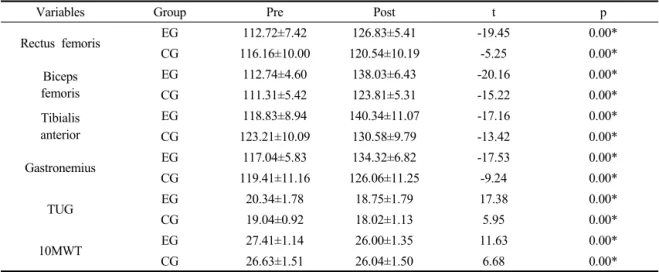
동작관찰군의 집단 내 %RVC 변화비교에서는 넙다 리곧은근, 넙다리두갈래근, 앞정강근, 장딴지근에서 유의하게 증가하였고(p<0.05), 동적 균형 변화비교에
Experimental group (n=10) Control group (n=10) p Sex (n)
Male 5 4
Female 5 6
Paretic side (Lt./Rt.) 6/4 5/5
Time since stroke (years) 25.49±8.21 21.80±10.21 0.61
Age (years) 61.45±6.22 62.64±6.33 0.78
Height (cm) 166.23±5.37 168.53±5.48 0.51
Weight (kg) 68.77±10.72 66.18±10.53 0.86
MMSE (scores) 27.43±2.52 27.63±2.41 0.63
a
Means (SD); *significant difference between experimental and control group test (p<0.05).
Table 1. General characteristics of study subjects (n=20)
Variables Group Pre Post t p
Rectus femoris EG 112.72±7.42 126.83±5.41 -19.45 0.00*
CG 116.16±10.00 120.54±10.19 -5.25 0.00*
Biceps femoris
EG 112.74±4.60 138.03±6.43 -20.16 0.00*
CG 111.31±5.42 123.81±5.31 -15.22 0.00*
Tibialis anterior
EG 118.83±8.94 140.34±11.07 -17.16 0.00*
CG 123.21±10.09 130.58±9.79 -13.42 0.00*
Gastronemius EG 117.04±5.83 134.32±6.82 -17.53 0.00*
CG 119.41±11.16 126.06±11.25 -9.24 0.00*
TUG EG 20.34±1.78 18.75±1.79 17.38 0.00*
CG 19.04±0.92 18.02±1.13 5.95 0.00*
10MWT EG 27.41±1.14 26.00±1.35 11.63 0.00*
CG 26.63±1.51 26.04±1.50 6.68 0.00*
a
Means (SD); *significant difference between pre- and post- test(p<0.05).
EG: experimental group, CG: control group
Table 2. Comparison of the results of muscle activity and dynamic balance between pre and post intervention
თ⒏৾⤮㏆ᔦ⑲ԨᛊḯԨ໊╶☏Ԩ㍖⒎Ԩ㉖⚾ԨૺԨ㍚ḯჂԨᤍԨთ⓿Ԩ㌓⋎Ԩ⭖ྒԨ⋿㊣ ք ԺԼՁ
서는 TUG, 10MWT 모두 유의하게 감소하였다 (p<0.05). 대조군의 집단 내 %RVC 변화비교에서는 넙 다리곧은근, 넙다리두갈래근, 앞정강근, 장딴지근에 서 유의하게 증가하였고(p<0.05), 동적 균형 변화비교 에서는 TUG, 10MWT 모두 유의하게 감소하였다 (p<0.05) (Table 2).
3. 집단 간 두 군의 %RVC와 동적 균형 변화비교
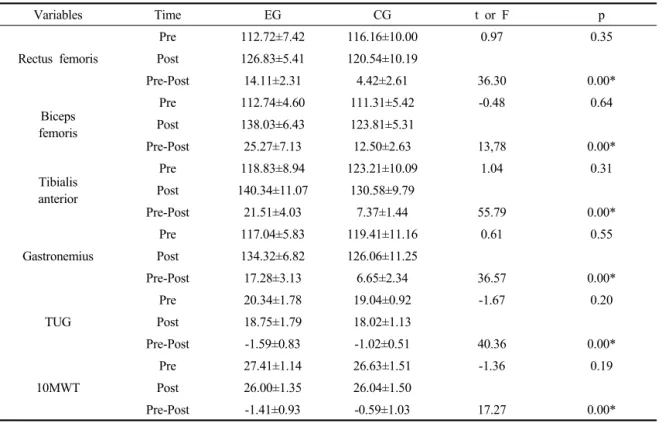
집단 간 실험 전⋅후의 차이 값에 대한 %RVC 변화 비교에서는 넙다리곧은근, 넙다리두갈래근, 앞정강 근, 장딴지근에서 유의한 차이가 있었고(p<0.05), 동적 균형 변화비교에서는 TUG, 10MWT 모두 유의한 차이 가 있었다(Table 3).
Ⅳ. 고 찰
본 연구는 만성 뇌졸중환자 20명을 대상으로 동작 관찰훈련을 적용하고 훈련 방법에 따른 근 활성도 및 동적 균형의 변화를 비교하여 신체기능의 개선에 대 한 효과성을 제시함으로 향후 뇌졸중 재활에 기여하 고자 한다. 이에 본 연구는 대상자들을 동작관찰훈련 군과 대조군으로 분류하여 4주 후의 각각 근 활성도 및 보행능력의 변화를 확인하였다. 근 활성도는 EMG 를 사용하여 넙다리곧은근, 넙다리두갈래근, 앞정강 근 , 장딴지근을 각각 측정하였고, 동적 균형은 TUG와 10MWT를 이용하여 각각 측정하여 분석하였다.
본 연구 결과 넙다리곧은근 , 넙다리두갈래근, 앞정 강근, 장딴지근의 근 활성도 집단 내 비교에 실험군과 대조군에서 유의한 차이가 있었다(p<0.05). 집단 간 실험 전⋅후의 차이 값에 대한 비교에서도 실험군의
Variables Time EG CG t or F p
Rectus femoris
Pre 112.72±7.42 116.16±10.00 0.97 0.35
Post 126.83±5.41 120.54±10.19
Pre-Post 14.11±2.31 4.42±2.61 36.30 0.00*
Biceps femoris
Pre 112.74±4.60 111.31±5.42 -0.48 0.64
Post 138.03±6.43 123.81±5.31
Pre-Post 25.27±7.13 12.50±2.63 13,78 0.00*
Tibialis anterior
Pre 118.83±8.94 123.21±10.09 1.04 0.31
Post 140.34±11.07 130.58±9.79
Pre-Post 21.51±4.03 7.37±1.44 55.79 0.00*
Gastronemius
Pre 117.04±5.83 119.41±11.16 0.61 0.55
Post 134.32±6.82 126.06±11.25
Pre-Post 17.28±3.13 6.65±2.34 36.57 0.00*
TUG
Pre 20.34±1.78 19.04±0.92 -1.67 0.20
Post 18.75±1.79 18.02±1.13
Pre-Post -1.59±0.83 -1.02±0.51 40.36 0.00*
10MWT
Pre 27.41±1.14 26.63±1.51 -1.36 0.19
Post 26.00±1.35 26.04±1.50
Pre-Post -1.41±0.93 -0.59±1.03 17.27 0.00*
a