pISSN 1738-6640 eISSN 2234-4020 http://dx.doi.org/10.6114/jkood.2017.30.3.155
Original Article / 원저
한의학 외치법과 관련된 국내 실험 연구 고찰
박장경
1)
·김경한2)*
1) 한약진흥재단, 2) 우석대학교 한의과대학 예방의학교실
Trend of Domestic Research about Experimental Studies of External Treatment in Korean Medicine
Jang-Kyung Park
1)·Kyeong-Han Kim
2)*1)
National Development Institude of Korean Medicine
2)
Department of Preventive Medicine, College of Korean Medicine, Woosuk University
Abstract
Objectives : The purpose of this study is to analyze the trends of domestic experimental research of external treatment in Korean medicine and use it as a basic data to expand the therapeutic field of Korean medicine.
Methods : In December 2016, two authors searched for experimental studies of external treatment in Korean medicine researches in 6 Korean databases.
Results : Among the 379 researches that were initially searched, two authors reviewed 190 researches, excluding duplicate researches, and finally 11 researches were selected for the study. The target disease was confined to the skin and mucosa, and the most of selected Korean medicine was based on the literature.
Conclusions : Considering the range of application of the external treatment described in the literature and the domestic market for external medicine, it is expected that the development of various external medicine using herbal medicine will be expected in the future.
Key words : External treatment; External application; Experimental Studies; Herbal external preparation
ⓒ 2017 the Society of Korean Medicine Ophthalmology & Otolaryngology & Dermatology
This is an Open Access journal distributed under the terms of the Creative Commons Attribution Non-Commercial License (http://creativecommons.org/license/by-nc/3.0/) which permits unrestricted non-commercial use, distribution, and reproduction in any medium, provided the original work is properly cited.
I. 서 론
한의학에서 외치법(外治法)은 내치법(內治法)에 상 대되는 영역으로, 병소에 화학적·물리적 작용을 가 하여 효과를 얻는 치료법이다
1)
. 외치법은 약을 복용 하지 않고, 피부나 호흡기 등(九竅)에 다양한 자극을 통하여 치료 효과를 유도하므로 복약으로 발생할 수 있는 환자의 불편감이나 전신적인 부작용을 줄일 수 있다는 장점이 있다2,3)
.한의학 외치법의 기원은 『山海經』의 “향기 나는 풀을 차고 다님으로써 역병을 물리친다.”로 볼 수 있다
3)
. 또한 『黃帝內經』에는 외치법에 대해 “寒痺 를 藥熨法을 사용하여 치료할 수 있다.”라고 기록되 어 있으며3)
, 『金櫃要略』에서 “浸淫瘡 黃連粉 主之”라고 하였다. 이후 많은 의가(醫家)들에 의해서 세제 (洗劑), 산제(散劑), 열홍요법(熱烘療法), 연훈법(煙薰 法) 등으로 다양한 한의학 외치법이 개발되고 사용 되어 왔다
4)
.현재 우리나라에서 국내 일반의약품 품목별 상위 30위 생산실적 중 5품목이 외용제에 해당할 정도로 외용제는 널리 사용되고 있다. 한의계에서도 피부질 환의 치료에 있어서 한방 외용약, 연고 등의 외치법 을 활용하려는 관심이 높아지고 있으며 이에 대한 연구가 꾸준히 이루어지고 있다
5)
.하지만 외치법에 대한 연구는 특정 질환에 대한 연구
6)
와 문헌 고찰4)
을 중심으로 이루어지고 있으며, 외치법 전반에 대한 연구 현황 고찰은 부족한 편이 다. 이에 저자들은 2016년 12월까지 국내에서 발표 된 한의학 관련 외치법을 목적으로 한 실험논문들을 종합하여 연구의 경향 및 결과를 파악함으로써 한의 학 외치법 연구에 도움을 줄 수 있는 기초 자료로삼고자 하였다.
II. 방 법
1. 대상 및 방법
검색일 이전(2016년 12월)까지 국내 학술지에 출 판된 한의학과 관련된 외치법에 대한 연구를 대상으 로 하였다. 연구보고서나 학위논문으로 출판된 자료 는 제외하였다.
검색엔진은 국가과학기술정보연구원(http://www.ndsl.
kr), 한국학술정보(http://kiss.kstudy.com), 학술연구 정보서비스(www.riss.kr), 전통의학정보포털(https://
oasis.kiom.re.kr), 대한한의학회지(https://www.
jkom.org/), 한방안이피인후피부과학회지(http://ocean.
kisti.re.kr)를 활용하였다.
검색 범위는 제목, 키워드, 초록으로 하였다. 전통 의학정보포털, 대한한의학회지, 한방안이비인후피부 과학회지에서는 검색어를 ‘외용제’, ‘외용약’, ‘외치’,
‘외치법’, ‘외치요법’으로 하였고, 국가과학기술정보연 구원, 한국학술정보, 학술연구정보서비스에서는 중재 방법에 해당하는 ‘외용제’, ‘외용약’, ‘외치’, ‘외치법’,
‘외치요법’과 ‘한방’, ‘한약’, ‘한의학’, ‘한의약’을 조합 하여 사용하였다.
3. 자료분석
자료 추출은 2명의 저자(PJK, KKH)에 의해 수 행되었다. 1차로 검색된 논문들의 제목과 초록을 통 해 검토하였으며, 초록이 누락되어 있거나 내용이 모호한 경우 원문을 읽고 분석하였다.
2차로 원문을 검토하였고, 2명의 저자(PJK, KKH)가 최종 선정된 각 논문들의 원문을 검토한 뒤 핵심정보를 추출하였으며, 의견이 다른 경우 논 의를 통해 합의하여 결정하였다. 이후 선정된 논문 들의 저자, 적용된 중재, 실험 모델, 평가지표, 결과 는 각 논문별로 정리하여 서술하였다. 자료추출의
Corresponding author : Kyeong Han Kim, Woosuk university college of Korean medicine deptment of preventive medicine, 61, Seoneomeo 3-gil, Wansan-gu, Jeonju-si, Jeollabuk-do, 54986, Korea(Tel : 063-290-9031, Fax : 063-291-1240,
E-mail : [email protected])
Recieved 2017/7/7 Revised 2017/7/23 Accepted 2017/7/30
선정기준과 배제기준은 다음과 같다(Table 1).
Selection Criteria
1. Experimental study using external medicine 2. Korea Classification Index(KCI) entry paper Extraction Criteria
1. Studies not directly related to Korean medicine : Ex> Aroma
2. Literature study on external medicine 3. Case or clinical study using external medicine 4. Articles in Journals rather than KCI
5. Papers can not be identified in the original text or do not contain a prescription
Table 1. The Criteria of Data Selection and Extraction
III. 결 과
1. 선정된 문헌의 개요
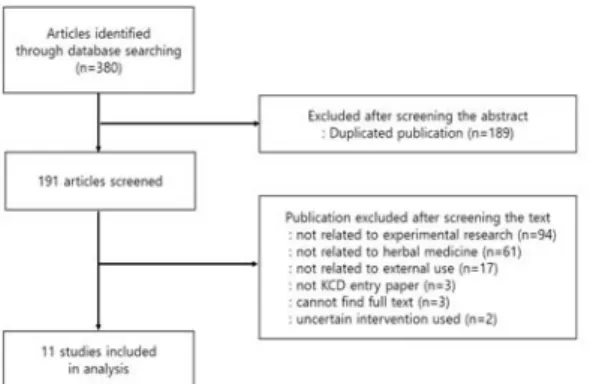
초기 검색된 380편의 논문 중 중복된 논문 189편 을 제외한 191편의 논문을 1차로 선정한 후 2명의 저자가 초록을 토대로 본 주제와의 관련성을 검토하 였다. 그 결과 검색결과에 포함되었으나 한약재를 사용하지 않은 연구(아로마요법 등의 중재를 사용), 문헌 연구, 증례연구와 임상연구, 한국연구재단 등재 지(혹은 후보지)가 아닌 학술지에 수록된 논문, 원문 이 확인되지 않거나 처방이 확인되지 않은 연구를 배제하여 총 11편의 논문을 연구대상으로 선정하였 다(Fig. 1).
2. 연도별 분류
한의학 관련 외치요법을 목적으로 한 첫 실험 연 구는 1993년도에 발표되었고
7)
, 2001년 이후 조사시 점까지 연평균 0.625±0.72편 발표되었다(Fig. 2).Fig 1. The Process of Data Selection and Extraction
Fig. 2. Classification by Year of Publication
Fig. 3. Classification According to the Published Journal
3. 학회별 분류
한의학 관련 외치요법을 목적으로 한 실험연구가 가장 많이 발표된 학회지는 한방안이비인후피부과학 회지
8,9)
, 대한한의학회지7,10)
, 동의생리병리학회지11,12)
, 대한본초학회지13,14)
로 각 2건의 연구가 발표되었고, 한방재활의학과학회지15)
, 한방부인과학회지16)
와 한국 미생물생명공학회지17)
에 1편의 연구가 발표되었다 (Fig. 3).4. 주제별 분류
한의학 관련 외치요법을 목적으로 한 실험연구 중 가장 많이 수행된 주제는 아토피 피부염으로 총 4건 의 연구가 발표되었다
9-11,13)
. 다음으로 화상에 대한연구
14,15)
와 질염7,17)
에 대한 연구가 각 2건이었으며,구창(口瘡)
8)
, 월경통12)
, 피부미용(항노화, 미백)16)
에 대한 연구가 각 1건으로 조사되었다.1) 아토피
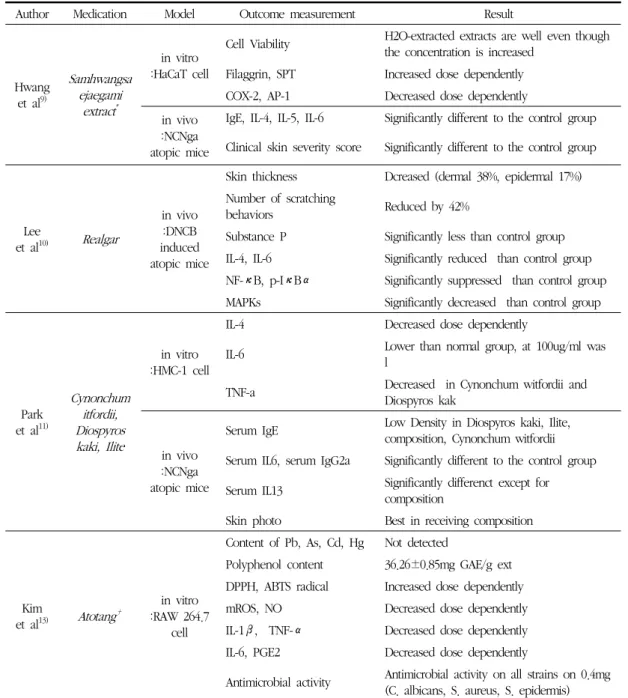
아토피성 피부염에 대한 한의학 외치법을 연구한 실험논문은 총 4편으로, 2건의 연구
9,11)
에서는 in vivo 연구와 in vitro 연구를 모두 수행하였고, 다른 2건의 연구에서는 각각 in vivo연구10)
와 in vitro연 구13)
만을 수행하였다. 사용한 중재법으로는 외치법 을 단독으로 사용한 연구가 3건10,11,13)
있었고, 외치 법과 내복약을 동시에 사용한 연구가 1건9)
있었는 데, 이 경우 동일한 약물로 내외복을 겸하였다. 사 용된 한약의 경우 1건의 연구에서는 단일약재를 사 용하였고10)
, 다른 3건의 연구에서는 선행연구를 바 탕으로 조성물11,13)
을 구성하여 활용하거나 경험방9)
을 선정하여 사용하였다. 측정한 평가 결과로는 알 러지 관련 사이토카인9-11,13)
, 항염증 효과10)
, 항산화 효과13)
, 피부두께의 조직학적 변화9,10)
등이 있었다 (Table 2).2) 화상
화상에 대한 한의학 외치법을 연구한 실험논문은 2편으로 모두 in vivo 연구를 수행하였다. 사용된 중재법으로는 2건 모두의 연구에서 복합 중재법을 선택하였는데, 1건의 연구에서는 외용제와 TDP (Tending Diancibo Pu) 조사를 병행하였고
14)
, 다른 1건의 연구에서는 외용제와 침치료를 병행하였다15)
. 사용된 한약의 경우 1건의 연구에서는 단일 약재를14)
, 1건의 연구에서는 경험방을 선정하여15)
사용하 였다. 측정한 평가 결과로는 육안적 상처 크기15)
, 조 직학적 검사14,15)
, 혈액학적 검사15)
, 진피재생15)
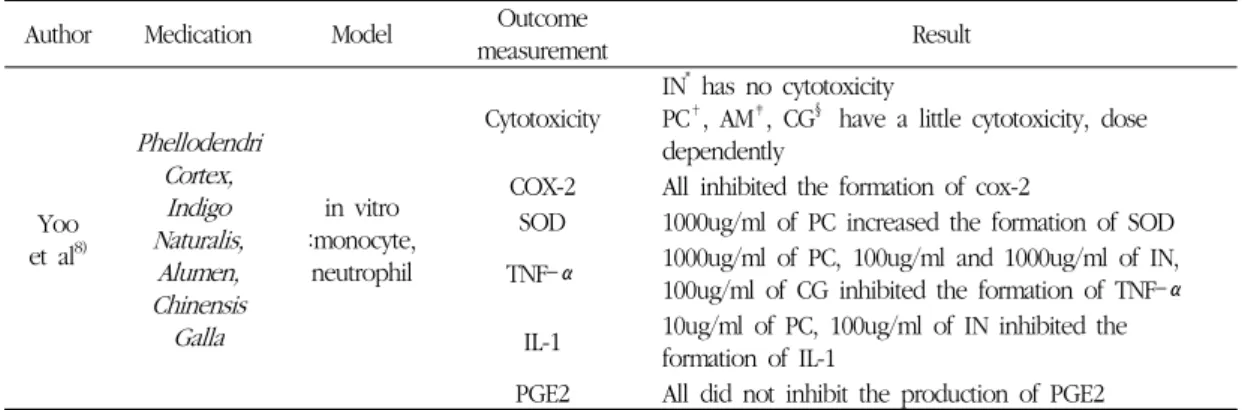
등이 있었다(Table 3).3) 구창
구창에 대한 한의학 외치법을 연구한 실험논문은 1편으로 in vitro 연구만을 수행하였다
8)
. 문헌적으로 구창에 외용제로 다용된 약재를 선택하여, 각각의 약재의 세포독성 검사와 항염 작용에 대한 효과를 평가하였다(Table 4).4) 질염
질염을 대상으로 한의학 외치법을 연구한 실험논 문은 총 2편으로 모두 in vitro 연구만을 수행하였
다
7,17)
. 사용된 약재는 문헌적으로 항균 활성이 높은한약재들을 선택하여, 각각의 한약재가 질염을 유발 하는 원인균에 가지는 항균 활성을 평가하였다. 1건 의 연구에서는 단일 균종에 대한 실험을 시행하였고
7)
, 다른 연구에서는 다양한 균에 대한 항균활성을 평가하였는데17)
, 공통되는 균종은 없었고, 모두 항균 활성을 가지는 것으로 나타났다(Table 5).5) 월경통
월경통을 대상으로 한 한의학 외치법 관련 실험논 문은 1건으로 in vivo 연구와 in vitro 연구를 모두 수행하였다
12)
. 문헌에 월경통을 비롯한 다양한 증상 에 외용약(좌약)으로 사용된다고 기재된 처방인 좌궁단을 선정하여, in vivo 연구에서는 자궁내 어혈에 대한 항혈전, 진통작용을 평가하였고 in vitro연구에
Author Medication Model Outcome measurement Result
Hwang et al
9)Samhwangsa ejaegami
extract
*in vitro :HaCaT cell
Cell Viability H2O-extracted extracts are well even though the concentration is increased
Filaggrin, SPT Increased dose dependently COX-2, AP-1 Decreased dose dependently in vivo
:NCNga atopic mice
IgE, IL-4, IL-5, IL-6 Significantly different to the control group Clinical skin severity score Significantly different to the control group
Lee
et al
10)Realgar
in vivo :DNCB induced atopic mice
Skin thickness Dcreased (dermal 38%, epidermal 17%) Number of scratching
behaviors Reduced by 42%
Substance P Significantly less than control group IL-4, IL-6 Significantly reduced than control group NF-κB, p-IκBα Significantly suppressed than control group MAPKs Significantly decreased than control group
Park et al
11)Cynonchum itfordii, Diospyros kaki, Ilite
in vitro :HMC-1 cell
IL-4 Decreased dose dependently
IL-6 Lower than normal group, at 100ug/ml was l
TNF-a Decreased in Cynonchum witfordii and Diospyros kak
in vivo :NCNga atopic mice
Serum IgE Low Density in Diospyros kaki, Ilite, composition, Cynonchum witfordii Serum IL6, serum IgG2a Significantly different to the control group Serum IL13 Significantly differenct except for
composition
Skin photo Best in receiving composition
Kim
et al
13)Atotang
†in vitro :RAW 264.7
cell
Content of Pb, As, Cd, Hg Not detected
Polyphenol content 36.26±0.85mg GAE/g ext DPPH, ABTS radical Increased dose dependently
mROS, NO Decreased dose dependently
IL-1β, TNF-α Decreased dose dependently
IL-6, PGE2 Decreased dose dependently
Antimicrobial activity Antimicrobial activity on all strains on 0.4mg (C. albicans, S. aureus, S. epidermis)
* :
Samhwangsaejaegami extract : Rhei Radix et Rhizoma, Scutellariae Radix, Phellodendri Cortex, Scophorae Flavescentis Radix, Lonicerae Flos, Forsythiae Fructus, Portulaca olerscea
† :
Atotang : Sophorae Radix, Fagopyri Semen, Dictamni Radicis Cortex, Duchesneae Herba, Adenophorae Radix, Terebinthinae Oleum, Houttuyniae Herba, Mume Fructus, Lithospermi Radix, Kochiae Fructus
Table 2. Experimental Studies on Atopic Dermatitis in Korean Medicine
서는 항균 활성을 측정하였다(Table 6).
Author Medication Model Outcome measurement Result Nam
et al
14)Myrrha application + Irradiation of
TDP
in vivo :scald burn
model
Protein concentration Significantly increased than control group Content of EGF Significantly increased than control group Histological change Epithelial regeneration and dermal collagen
synthesis from fibroblasts are accelerated
Jo et al
15)Herbal External Prepration
*+
Acupuncture
in vivo :deep partial thickness burn
model
Wound size Significantly less than control group
Hematological findings Significantly decreased than control group in neutrophil and leukocyte level
Epidermal regeneration Significantly increased than control group Histological change Significantly increased in EGF expression
* : Black Sesame Oil, Lard, Bee's Wax, Angelicae Gigantis Radix, Lithospermi Radix, Scutellariae Radix, Coptidis Rhizoma, Sophorae Radix, Angelicae dahuricae Radix, Platycodi radix, Mori Folium, Lonicerae Flos, Forsythiae Fructus, Glycyrrhizae Radix, Portulaca oleraceae Ladix, Mentha Piperita
Table 3. Experimental Studies on Burn Wound in Korean Medicine
Author Medication Model Outcome
measurement Result
Yoo et al
8)Phellodendri Cortex, Indigo Naturalis,
Alumen, Chinensis
Galla
in vitro :monocyte,
neutrophil
Cytotoxicity
IN
*has no cytotoxicity
PC
†, AM
‡, CG
§have a little cytotoxicity, dose dependently
COX-2 All inhibited the formation of cox-2
SOD 1000ug/ml of PC increased the formation of SOD TNF–α 1000ug/ml of PC, 100ug/ml and 1000ug/ml of IN,
100ug/ml of CG inhibited the formation of TNF–α IL-1 10ug/ml of PC, 100ug/ml of IN inhibited the
formation of IL-1
PGE2 All did not inhibit the production of PGE2
* : Indigo Naturalis, † : Phellodendri Cortex, ‡ : Alumen, § : Chinensis Galla
Table 4. Experimental Study on Gu-Chang in Korean Medicine
Author Medication Model Outcome measurement Result
Kim et al
7)Herbal medicines with high antibacterial activity
in literature*
in vitro Anti-bacterial activitity (Gardnerella vaginalis)
High antimicrobial effect in Diospyros kaki, Paeonia lactiflora, Coptis chinensis, Pueraria lobata, Rhaponticum uniflorum, Sophora flavescens, Acorus gramineus, Syzygium aromaticum order
Jang et al
17)Galla Rhois
in vitro
Anti-bacterial activitity (S. aureus, bacillus, E.
coli, K. pneumonia, Ps.
aeruginosa, C. albicans)
S. aureus, bacillus, E. coli, K.
pneumonia, Ps. aeruginosa
Artemisiae Vulgaris Folium S. aureus
Sophorae Radix S. aureus, B. subtilis
Zanthoxyli Fructus S. aureus, B. subtilis
Phellodendri Cortex S. aureus, B. subtilis, C. albicans
* :
Pueraria lobata, Glycyrrhiza uralensis, Sophora flavescens, Lonicera japonica, Rhaponticum uniflorum, Ophiopogon japonicus, Saussurea lappa, Saposhnikovia divaricata, Paeonia lactiflora, Cnidium monnieri, Acorus gramineus, Diospyros kaki, Syzygium aromaticum, Coptis chinensis
Table 5. Experimental Studies on Vaginitis in Korean Medicine
6) 미용
피부미용을 목적으로 한의학 외치법을 실험한 연 구는 1건으로 피부질환과 대사질환에 빈번히 활용되 는 처방인 온청음을 선택하여 in vivo 연구와 in vitro 연구를 모두 수행하였다
16)
. 세포독성, 피부재 생, 주름개선, 미백 및 보습효과를 측정하였고, 그 결과 노화 억제 개선제 혹은 기능성 화장품의 주요 소재로서의 긍정적인 가능성을 판단하였다(Table 7).Author Medication Model Outcome measurement Result
Cho et al
12)Joagoung -dan *
in vivo :Sprague-Dawl
ey rat
Platelet aggregation Significantly increased Pulmonary embolism Significantly decreased Count of platelet Significantly increased
PT Significantly increased
aPTT Decreased but not significant
Count of fibrinogen Decreased but not significant Analgesic Effect on the Writhing
Syndrome Significantly decreased
in vitro
Anti-bacterial activitity (S. aureus, bacillus, E. coli,
K.pneumonia, Ps. aeruginosa, C.albicans)
Didn't show anti-bacterial action
* :
Ang elicae gig antis Radix, Cnidii Rhizoma, Cory dalis Tuber, Linderae Radix, Obibanum, Myrrha, Cuscutae Semen, Asiasari Radix, Torilis Fructus, Caryophylli Flos, Ciniamomi Cortex, Ansu Semen, Bletillae Tuber, Evodiae Fructus, Coicis Semen, Amomi Semen, Ostreae Testa
Table 6. Experimental Studies on Burn Wound in Korean Medicine
Autho
r Medication Model Outcome
measurement Result
An et al
16)Oncheongeum
*
in vitro : human normal fibroblast, B16/F10 murine melanoma
MTT No cytotoxic effects
Collagen type I Increased concentration-dependently Elastase Significant Increase of the inhibitory
activity
MMP-1 Significant Increase of the inhibitory activity
Melanin Significant Increase of the inhibitory activity
Tyrosinase Significant Increase of the inhibitory activity
in vivo : mice Skin water
content test Significantly increased
* :
Oncheongeum : Angelicae Gigantis Radix, Rehmanniae Radix, Paeoniae Radix, Cnidii Rhizoma, Scutellariae Radix, Coptidis Rhizoma, Phellodendri Cortex, Gardeniae Fructus
Table 7. Experimental Studies on Anti-aging, Whitening in Korean Medicine
IV. 고 찰
일반적으로 치료 시 경구투여를 우선적으로 고려 하는 경우가 많지만, 약물을 경구투여하는 경우 인 체에서 약물이 대사하는 과정에서 상당수의 성분이 분해·배출되기 때문에 실제 필요한 양보다 많은 양 을 투여할 수 있고, 그에 따라 약의 부작용 또한 증 가할 수 있다는 단점이 발생한다
18)
. 반면에 병소에직접적으로 화학·물리적 작용을 가하여 효과를 얻 는 치료법인 외치법은 복약 시 발생할 수 있는 전신 적인 부작용을 줄일 수 있다는 장점이 있다
1,2)
. 현재 『대한민국약전』(제2016-57호) 제제총칙의 투여경로에 따른 대분류에 의하면, 피부 외에도 눈, 코, 귀, 직장, 질, 구강, 기관지에 적용하는 다양한 외용제제들이 정의되어 있다19)
. 해외에서는 한약 기 반의 연고(MEBO)가 임상 근거를 바탕으로 화상에 대한 중요한 대안적 처치로 자리 잡고 있으며20)
, 미 국 FDA에서 최초로 승인 받은 천연물 신약도 생식 기 사마귀를 치료하는 외용제로, 한약과 한약제제를 활용한 외치법의 개발 가능성에 대한 기대는 높다고 할 수 있겠다.한의학에서 외치법은 약을 복용하지 않고, 피부나 호흡기 등에 다양한 자극의 방법을 통하여 치료 효 과를 유도하는 방법으로 정의되고 있으며
3)
. 『山海 經』, 『黃帝內經』, 『金櫃要略』등에 초기 외치요 법에 대한 기록이 수재되어 있다3,4)
. 문 등3)
의 연구 에 따르면 역대 한의학에서 외치법의 활용범위는 외 과질환 치료 중심에서 내과, 외․ 피부과, 오관과, 산 부과, 소아과, 신경정신과로 점차 넓어져서, 옹저(癰 疽), 두면풍(頭面風)과 같은 피부질환 뿐 아니라 목 적통(目赤痛), 비색(鼻塞), 비통(鼻病), 이병(耳病), 구 치병(口齒病), 후병(喉病)과 같은 구규(九竅) 관련 질 환 뿐 아니라 외감(外感), 상한(傷寒), 변비(便祕), 사 리(瀉痢), 음냉(陰冷), 음취(陰吹), 객오(客忤), 경계 (驚悸) 등 다양한 한의학적 질환에 응용된 것을 알 수 있다. 또한 외치법의 적용에 있어 훈법(薰法), 약 욕요법(藥浴療法), 첩부요법(貼付療法), 약대요법(藥袋 療法), 약위요법(藥熨療法) 등 다양한 방법이 활용되 었고, 환(丸), 산(産), 고(膏), 향(香), 즙(汁) 등 다양 한 제형의 약물이 활용되어 왔다. 최근 한의학에서 도 각종 외치요법에 대한 관심이 높아지고 있고, 많 은 임상의들이 조제의 형태로 처방하여 활용하고 있 다. 그러나 외치요법에 대한 연구는 특정 질환에 대 한 연구4)
와 문헌 고찰3)
에 대한 발표만 있었고, 외치요법 전반을 조사하여 연구의 경향을 파악하는 연구 는 수행된 바 없었다. 이에 저자들은 현재까지 국내 에서 발표된 한의학 외치요법의 효과를 규명하고자 한 한 실험논문들을 조사하여 연구의 경향 및 결과 를 파악하고, 한의학의 치료 영역을 확대시키는 기 초 자료로 삼고자 하였다.
검색기준에 따라 초기 파악된 380편의 논문 중 중복된 논문 189편을 제외한 191편의 논문을 대상 으로 2명의 저자가 초록과 원문을 확인하여 최종 11편의 논문을 연구대상으로 선정하였다.
한국연구재단은 국내에서 발간되는 학술지의 질적 향상을 위해서 매년 학술지를 평가하여 등재 및 등 재후보 학술지를 발표하고 있으며, 이는 국내 학술 지를 평가하는 가장 광범위하고 객관적인 기준으로 인정되고 있으므로, 한국연구재단 등재지 및 등재후 보지로 선정된 학술지를 연구대상으로 선정하였다
21)
. 한의학 관련 외치법을 목적으로 한 첫 실험연구는 1993년도에 발표되었고, 이후 연간 0~2편 발표되는 수준으로 전체 한의학 관련 전체 논문 발표 수에 비 해 미미한 수준으로 평가되었다. 이는 한의학 관련 외치법 실험연구가 실제로 적게 이루어졌을 수도 있 으나 연구결과를 해외 학술지에 주로 발표했을 가능 성도 있기 때문에 이 부분에 대해서는 추가적인 연 구가 필요할 것으로 생각된다.실험논문이 게재된 학회지를 분석한 결과, 7개의 학회지에 총 11편의 논문이 각 1~2편씩 발표된 것 으로 나타나 학회지에 따른 논문의 경향성은 뚜렷하 지 않았다. 이는 관련 연구가 외용법이라는 측면에 서는 한방안이비인후피부과학회에서, 생리·병리적 기전을 밝히는 측면에서는 생리·병리학회에서, 외 용제 조제의 재료적 측면에서 본초학회에서, 외용제 의 활용 측면에서는 재활의학과학회·부인과학회 등 임상 각과의 영역에서 연구할 수 있는 다양한 특성 을 가지고 있기 때문으로 사료된다.
연구가 수행된 기관을 조사해보았을 때, 산업체, 학교, 연구기관이 함께 연구에 참여한 경우는 없었
으며, 산업체가 공동 연구자로 참여한 경우는 단 한 가지 연구에 불과하여
9)
대다수의 실험이 제품개발의 목적을 염두에 둔 소재 탐색이라기보다는 기초연구 의 성격으로 판단되었다.한의학 외치요법과 관련된 실험논문을 주제별로 분류한 결과 총 6개의 주제로 대별할 수 있었다. 그 중 아토피 피부염에 대한 실험논문이 4편(36.4%)을 차지하여 가장 많이 연구된 주제로 조사되었으며
9-11,13)
, 다음으로 화상14,15)
과 질염7,17)
에 대한 연구가각 2편(18.2%), 구창
8)
, 월경통12)
, 피부미용16)
에 대한 연구가 각 1편(9.1%)으로 조사되었다. 실험방법으로 in vivo 연구와 in vitro 연구를 모두 수행한 경우 가 4건(36.4%)9,11,12,16)
, in vivo 연구만 시행한 경우 가 3건(27.3%)
10,14,15)
, in vitro 연구만 수행한 경우 는 4건(36.4%)7,8,13,17)
으로 조사되었다. 외용약의 투 여경로에 있어, in vivo 연구는 연구에 기술된 투여 경로를 기준으로 하였고, in vitro 연구에서는 질환 의 특성을 고려하여 투여경로를 추정하였다. 그 결 과 피부에 적용하는 경우가 7건(63.7%)으로 가장많았고
9-11,13-16)
, 질에 적용하는 경우가 3건(27.3%)이었으며
7,12,17)
, 구강에 적용하는 경우는 1건(9.3%)8)
으로 나타났다. 그 외 눈, 귀, 코, 기관지, 직장에 적 용할 목적으로 실험을 진행한 연구는 파악되지 않 아, 외치법의 적용에 대한 연구가 일부 질환과 일부 기관에 국한되는 것으로 파악되었다.
중재법으로 외치요법 단일 중재를 선택한 경우가 8건(72.8%)으로 대부분을 차지하였으며
7,8,10-13,16,17)
, 3 건(27.3%)의 연구에서는 동일한 처방을 내·외복 겸 치9)
, 침치료 병용15)
, TDP 조사 병용14)
과 같은 다른 중재법을 병행하여 임상에서 활용하는 치료법을 반 영하고자 하였다. 실험에서 사용하기 위해 선정된 한약의 경우 단일 한약재를 선정하거나 다수의 한약 재를 선정하더라도 개별 한약재의 효능을 평가한 연 구가 5건(45.5%)7,8,10,14,17)
이었는데, 모두 역대 문헌 에서 외치법을 목적으로 다빈도로 사용되었다고 기 재된 한약재를 선정하였다. 조성물이나 경험방과 같
은 복합제제의 효능을 평가한 경우가 6건 (54.6%)
9,11-13,15,16)
으로, 그 중 선행연구를 통해 선택 된, 특정 질환에 우수한 효능을 나타내는 한약재의 조합을 통한 조성물을 선정한 연구가 2건 (18.2%)11,13)
, 문헌에 기재된 우수 경험방을 선정한 경우가 4건(36.4%)9,12,15,16)
으로 조사되었다.
국내에서 발표된 한의학 관련 외치법을 목적으로 한 실험논문들을 종합하여 연구의 경향 및 결과를 파악한 결과, 분석에 활용된 연구 수가 11편에 불과 하고, 대부분이 대학을 위주로 수행된 기초연구들로 외치법과 관련된 제품개발은 활성화되어 있지 않다 고 유추할 수 있었다. 또한 약물이 적용되는 부위는 피부질환과 점막이라는 일부기관에 국한되어 있었고, 선정된 약물들은 주로 문헌 기록에 근거하며, 제형 도 다변화되지 못하였다.
그러나 문헌에 기재된 외치법의 제형과 활용범위 는 매우 다양하다는 점과 국내 의약품 시장 중 외용 약이 차지하는 높은 비중 및 해외시장에서 보여준 외용제로서 한약제제의 활용 가능성을 감안할 때, 향후 다양한 질환을 대상으로 한, 다변화된 외용약 을 개발하기 위한 연구가 기대되는 분야이다. 이를 위해서는 수요자 중심의 산-학-연 협력의 연구개발 이 필요할 것으로 사료된다.
이번 연구는 한의학 외치요법 실험연구에 대한 경 향을 파악했다는 점에 의의가 있으나 한정된 데이터 베이스만을 활용하였고 국내에서 발표된 학술지만을 대상으로 실험연구만을 조사하여 얻은 결과만을 분 석하였기 때문에 관련된 모든 연구를 포함하지 못하 였다는 한계가 있다. 향후 국내외 연구를 대상으로 실험논문에 대한 폭넓은 동향분석이 뒷받침 되어야 할 것이며, 나아가 임상연구까지 포괄하는 체계적 문헌 고찰을 통해 한의학 외치요법에 대한 근거 축 적이 필요할 것으로 사료된다.
V. 결 론
한의학 관련 외치법의 실험논문의 경향을 살펴보 고자 검색기준에 부합하는 11편의 논문을 연구대상 으로 선정하였다.
그 결과 한의학 관련 외치법을 목적으로 한 실험 연구는 아토피 피부염을 대상으로 한 연구가 가장 많았고, 다음으로 화상과 질염에 대한 연구가 많았 다. 외용약의 투여경로에 있어 피부에 적용하는 경 우가 7건으로 가장 많았고, 다음으로 질에 적용하는 경우가 3건으로 나타나 일부기관에 국한되는 것으로 나타났다. 선정된 약물들은 주로 문헌 기록에 근거 하는 것으로 나타났다. 문헌에 기재된 외치요법의 활용범위와 국내외 외용약 시장을 고려했을 때 앞으 로 한약을 이용한 다양한 외용약 개발이 기대되는 분야로 사료된다.
References
1. Korean Dermatological Association. Detmatology.
3rd ed. Seoul:RyoMoonGak. 1994;548.
2. Jo SJ, ChoI YD, Jang JT, Kim KS, Lee SD.
A Randomized Controlled Clinical Trial of Topical Herbal Gel Treatment for Chronic Shoulder Pain. The Acupuncture. 2014;
31(4):1-9.
3. Moon WS, Lee BW, Ahn SW, Kim EH. A Historical consideration on the External Treatment theories and diseases for which medicine is efficacious. Korean Journal of Oriental Medicine. 2004;10(2):1-21.
4. Park HS, Gu DM, Jee SY. A study of external therapy of Atopic dermatitis. The Journal of Oriental Medical Surgery.
2001;14(1):32-41.
5. Lee KY, Hong CH. A Case of Pustulosis Palmaris et Plantaris. J Korean Med Ophthalmol Otolaryngol Dermatol. 2013;26 (4):81-90.
6. Shin SH, Kim MB, Byun SM, Lee HS, Park SG, Ko WS, et al. A Review of External Treatment for Atopic Dermatitis in Korean Journals. J Korean Med Ophthalmol Otolaryngol Dermatol. 2008;21(2):80-93.
7. Jang JB, Lee KS, An BK. Anti-bacterial and trypsin-inhibitory activities of extracts from Galla Rhois, Antemisiae folium, Sophorae Radix, Zanthoxyli Fructus and Phellodendri Cortex, externally used in gynecology. J Korean Med. 1993;14(2):270-80.
8. Yoo JG, Choi KH, Kim YK, Kang SK, Jung SY, Jung JH, et al. The study on the anti-inflammatory effects of Phellodendri Cortex, Indigo Naturalis, Alumen, and Chinesis Galla, most frequently used for the external theraphy of Gu-Chang. J Korean Med Ophthalmol Otolaryngol Dermatol.
2005;18(1):183-98.
9. Hwang CY, Park MC, Hong SH, Joo HA, Cho HW, Jung SY, et al. The External Use Effects of Samwhangsejegami Extract on Atopic dermatitis of NC/Nga mice. J Korean Med Ophthalmol Otolaryngol Dermatol.
2012;25(1):22-32.
10. Lee JS, Choi YY, Yang YM. Effects of topical application of realgar on pruritus and inflammation of atopic dermatitis. J Korean Med. 2015;36(1):9-21.
11. Park JO, Jo SI, Lee YH, Jo EJ. Improving Effect on Atopic Dermatitis with Treatment of Selected Herbs ; Polygoni Multiflori
Radix, Diospyros Kaki, ilite and its Mixture in NCNga Mice. Korean J Oriental Physiology & Pathology. 2008;22(4):891-5.
12. Cho SH, Jeong JH, Yoo DY. Study on the Effect of Joagoung-dan on Antimicrobial, Antithrombotic and Analgesic Action.
Korean J Oriental Physiology & Pathology.
2001;15(4):605-10.
13. Kim GW, Bak JW, Sim BY, Kim DH. An experimental study for the development of prescription on atopic dermatitis. Kor J Herbology. 2014;29(4):13-20.
14. Nam SW, Lee BK, Cho HG. Acceleration of Wound Healing on Scald Burn Skin Using Irradiation of TDP and Skin Spread of Myrrha. Kor J Herbology. 2003;18(4):263-8.
15. Jo HG, Park AR, Choi JB. Therapeutic Effects of Acupuncture and Herbal External Preparation on Healing of Deep Partial Thickness Burn Wound in Rats. Journal of Korean Medicine Rehabilitation. 2014;24(3):
87-98.
16. An TEB, Kim DC. In Vitro Cytotoxicity, Skin Regeneration, Anti-wrinkle, Whitening and In Vivo Skin Moisturizing Effects of Oncheongeum. J Korean Obstet Gynecol.
2016;29(1):14-34.
17. Kim YH, Lee HS. Antibacterial Effects of Oriental Herb Extract Against Gardnerella vaginalis. Kor J Biotechnol. 2006;34(1):70-3.
18. Jeong SH, Ok SM, Huh JY, Ko MY, Ahn YW. A Study for Direct Application of Drug on Oral Mucosa. J Oral Med Pain.
2010;35(4):229-35.
19. Ministry of Food and Drug Safety. General Requirements for Pharmaceutical Preparations:
Korean Pharmacopoeia. 11th ed. Ministry of Food and Drug Safety. 2017;11-23.
20. Jewo PI, Fadeyibi IO, Babalola OS, Saalu LC, Benebo AS, Izegbu MC, et al. A Comparative Study of the Wound Healing Properties of Moist Exposed Burn Ointment(MEBO) and Silver Sulphadiazine.
Ann Burns Fire Disasters. 2009;22(2):79-82.
21. Yea SJ, Kim C, Kim SK, Jang HC, Kim JH, Jeon BU, et al. Bibliometric Analysis of Traditional Korean Medical .Toumals Registered with the National Researcb Foundations of Korea. J Korean Oriental Med. 2011:32(5):66-77.