Print ISSN: 2288-4637 / Online ISSN 2288-4645 doi:10.13106/jafeb.2021.vol8.no11.0021
Financial Development, Income Inequality and the Role of Democracy: Evidence from Vietnam
Hung Thanh NGUYEN
1Received: July 15, 2021 Revised: September 28, 2021 Accepted: October 05, 2021
Abstract
The objective of this study is to see how a country’s level of democracy impacts the relationship between financial development and income disparity. We argue that political regimes, supported by their degree of democracy, are important for various decentralization theories to predict the impact of financial development on income inequality. Our study tests this argument using Vietnam time series data for the period 2000–2020 through the ARDL model. The financial development variable is represented by five proxies, the income inequality variable is represented by the GINI coefficient and the role of democracy is represented by the Freedom House Index. Data serving for the study is taken from data sources with high reliability. The results of the study have strong evidence that (1) financial development has a positive impact on income inequality, (2) democratic government will reduce national income inequality. (3) And a higher degree of democracy tends to mitigate the positive impact of financial development on income inequality. Thus, our study contributes to the literature by providing a new look at the mixed results regarding the relationship between financial development and theoretical income inequality.
Finally, the article provides policy implications for the Government of Vietnam.
Keywords: Financial Development, Income Inequality, ARDL, Democracy, Economic Growth, Political Institutions, Vietnam JEL Classification Code: O11, O15, F62, F63, D31
growth and developments (McKinnon, 1973; Shaw, 1973;
Levine, 1997; Levine et al., 2000). Strong financial sector development may also create a major contribution to alleviating income disparity, according to several academics (Beck et al., 2007; Agnello &Sousa, 2012;
Clarke et al., 2013; Hoi & Hoi, 2013; Nikoloski, 2013). It is therefore highlighted in the literature that a robust financial system is sure to encourage the desired level of investment and the development of economic growth. An active and highly established financial sector can offer people lower lending and easier access to financial services, helping to increase business operations, thereby creating employment possibilities and improving the wellbeing of society.
It is also considered that a stable and functioning financial system is an indication of the good macroeconomic performance of any economy. In fact, active and robust financial markets can play a crucial role in broadening trade and industry, thereby strengthening a country’s inclusive economy. Nevertheless, numerous studies suggest that limited financial markets can be a cause of income inequality and the lack of a financial sector creates income inequality by helping entrepreneurs and creditors by lowering the capital rent rate (Westley, 2001;
Mookherjee & Ray, 2003; Hye & Islam, 2013; Hye, 2011).
1
First Author and Corresponding Author. [1] Lecturer, Faculty of Economics, Binh Duong University, Vietnam [Postal Address: No.
504, Binh Duong Boulevard, Hiep Thanh Ward, Thu Dau Mot City, Binh Duong 75000, Vietnam] [2] Lecturer, School of Public Finance, University of Economics Ho Chi Minh City, Ho Chi Minh City, Vietnam. Email: [email protected]
© Copyright: The Author(s)
This is an Open Access article distributed under the terms of the Creative Commons Attribution Non-Commercial License (https://creativecommons.org/licenses/by-nc/4.0/) which permits unrestricted non-commercial use, distribution, and reproduction in any medium, provided the original work is properly cited.
1. Introduction
In recent years, there has been a heated debate on the effectiveness of financial sector development in advancing economic growth and reducing inequality, and particular attention has been paid to the issue of what role strong financial sector development plays in income inequality reduction. On the other side, desirable economic growth and development levels are always required to push an economy and thus improve the social welfare of the citizens.
Several empirical studies have nonetheless highlighted
the essential importance of financing and the robust,
well-effective financial system in promoting economic
It is not surprising that income inequality has been on the upsurge worldwide and it affects almost all the developed, emerging, and developing countries, whereas the social welfare of the people varies negatively with the country’s level of inequality. In addition, it has been argued that high inequality weakens economic power and promotes economic instability (Stiglitz, 2012).
Gradstein et al. (2001) concluded that the impact of democracy on income inequality is negative. In addition, democracy can affect income inequality not only directly but also through the type of political system. In other words, democracy in a parliamentary system can have a different effect on inequality than democracy in a presidential system.
Former democracy is closer to direct democracy and, by giving greater roles to political parties and the formation of coalition governments, it can stimulate redistributive policies of the kind that we often associate with voter behavior.
Thus, these different predictions about the relationship between financial development and income inequality are, at least in part, based on the specific political regimes that give rise to different types of government. We argue that, compared with non-democracies, democracies are more likely to support a benevolent government, meaning that financial development in democracies is more likely to improve, improve local accountability, leading to greater control of inequality. We test this hypothesis using a time series dataset for a developing country like Vietnam for the period 2000–2020. We find strong evidence that (1) overall, financial development is positively associated with income inequality, support as a tool to promote local income growth, thereby increasing income inequality, (2) Financial development in highly democratic countries tends to dampen the positive effects of financial development on income inequality due to the high degree of democracy.
(3) A democratic government would lessen income disparity in the United States. As a result, we add to the literature by offering a comprehensive explanation of the seemingly contradictory perspectives on the relationship between financial development and income disparity. These results are robust on surrogate measures of key variables and surrogate specifications, e.g. sub, data frames, and estimation methods.
2. Literature Review
The theory of Kuznets inverted-U is known as the first survey to explore the link between economic growth and income inequality. Theory shows that economic growth would improve in the early stages with income disparity due to the huge number of low-income farmworkers who shift into the higher-income industry, but redistribution is unjust. When a large quantity of labor moves to urban regions, the average income increases until the highest in the inverted U pattern, producing the income difference
between urban and rural areas. In the future, the general economy income disparity is reduced until substantial government intervention in implementing macro-policies.
Poverty reduction in emerging nations will take longer in the early phases of economic expansion resulting in larger income inequalities (Kuznet, 1955). Only under specific conditions is the effective market available (Stiglitz, 2000).
The contribution of the financial system to the economy has been discussed for many years and the widespread view in the literature is that it has a positive effect on the economy. Emphasizing the importance of the financial system, Levine (1997) showed the effect of the role of the sector on economic growth by encouraging entrepreneurs who use technology in a well-functioning banking system.
In addition to the factors determining income inequality the relationship between financial evolution and income inequality has been received with much attention by academics, practitioners and in particular policymakers during the past decades (Agnello et al., 2012; Clarke et al., 2006). Levine (1997) argued that financial markets in many ways contribute positively to economic growth. He stated that the financial system provides the tools to direct savings to investment, uses the fund transfer mechanism for this, and this contributes to economic growth. It eliminates the risk of liquidity by reducing the costs of obtaining and processing information, thereby arguing that it paves the way for technological innovations (McKinnon, 1973). Some research indicated that the financial growth has a favorable link with the income disparity. For example, in 138 developing and developed nations during the years 1960–2008, Jauch and Watzka (2016) studied the link between financial development and income disparities. Using GMM methods, the results showed that financial development had a substantial positive influence on income inequality, suggesting that the financial development had a negative effect on income inequality and that the hypothesis had to be reduced by a negative impact on income inequality. In addition, the empirical results of a sample, comprising several countries, verified the positive relationships between financial development and income disparity, since nations were categorized at four levels (e.g.
high, upper-media, lower-middle, and low income).
Greenwood and Jovanovic (1990) argued that there is a
nonlinear, inverse-U-shaped relationship between financial
development and income inequality. According to the
hypothesis, the financial sector is not yet fully developed in the
early stages of economic development and economic growth
is slow. At this stage, the fact that financial intermediaries
are low and costly causes the poor to not benefit from
the financial system and only the wealthy evaluate the
opportunities. Savers are high-income individuals. This
will increase income inequality at the first stage. Financing
savings in the next stage makes the economy strong, and
with the realization of economic growth, the income of all
individuals increases. Increased savings rates and financial
resources will reach all members of society as the financial system develops, leveling the income distribution and progressively closing the income gap.
Another important hypothesis regarding the relationship between financial development and income inequality is the positive linear relationship hypothesis of Rajan and Zingales (2003). According to this hypothesis, even if the financial sector is developed, income inequality will not improve unless there are well-functioning institutions. In the absence of developed institutions, access to loans in the financial system will only be by the high-income segment, and financial sector development will favor rich groups. This will increase the difference between high and low-income groups. It can be said that this hypothesis is less supported throughout the literature.
This hypothesis has been put forward based on financial market failures. Due to the injustice of access to credit, rich individuals can provide more opportunities by showing collateral and the poor cannot access these opportunities. This situation leads to an increase in income inequality.
The reverse U-hypothesis and linear negative relationship hypotheses show that a well-developed financial sector helps to minimize income inequality and enhance economic growth (Hoi & Hoi, 2013; Nikoloski, 2013).
As discussed previously, the relationship between financial development and income inequality is neither theoretically clear nor empirically clear, largely on the theoretical basis of Kuznet (1955). We argue that there is a need to focus more on the relevance of political regimes, as they strongly influence the workings of different theories and thus facilitate the relationship between economic development, financial development, and income inequality.
In particular, the traditional theory of income inequality is the presence of a benevolent, responsive and responsible government to the preferences and needs of the local population and accordingly the classical theory. It seems that the aforementioned prediction of transmission theory would not hold if no democratic institutions existed. In particular, with a mature democracy, various supervisory mechanisms, such as elections and freedom of the press, can work well, which is essential for the survival of a human government for acting in the interests of the people.
Recent research results of Bao et al. (2021) showed that there exists a cointegration relationship between the stock market, credit market development, and economic growth.
Empirical evidence from CCE model estimates indicates that there is a positive and significant long-run effect of stock market developments on steady-state GDP per capita levels.
Therefore, financial development is a cause as well because of economic growth in Asian countries.
Vietnam is a developing country with many interesting issues. There is income inequality between provinces.
Provinces are encouraged to attract foreign investment for economic development, but they were concerned about corruption in the locality. Export value is forced back
by investing capital in the host country in the process of exploiting low-cost labor, transferring technology and knowledge approaches (Hung et al., 2020a), preferential policies in trade liberalization agreements, as well as positive exchange rate policies of countries to trading partners.
A study by Hung et al. (2020b) on the simultaneous relationship between government quality, economic growth, and income inequality of Vietnam in the period 2006 to 2017, showed that economic growth can improve the quality of government but increase income inequality across provinces. Hence, improving the quality of government will not only promote economic growth but also reduce income inequality among provinces. And the government needs to reform the institutions to achieve sustainable economic growth through transparency of the governance system, curbing corruption, giving people equal access to resources to improve living standards, and all these will promote economic development.
In addition, to ensure competition among development finance resources as an effective mechanism to enhance local or sectoral accountability, transparent institutions must be in place to enable people and businesses to compare government quality and policies. Unfortunately, these freedoms are often restricted in many undemocratic or authoritarian countries.
Therefore, the prediction of the traditional theory of fiscal federalism for larger government sizes is more likely to occur in countries with democratic institutions. We, therefore, hypothesize that a degree of democracy can facilitate the relationship between financial development and national income inequality. Thus, by exploring the role of democracy, we also offer an alternative explanation for the inconsistent results in empirical studies on the relationship between financial development and income inequality.
3. Methodology and Data
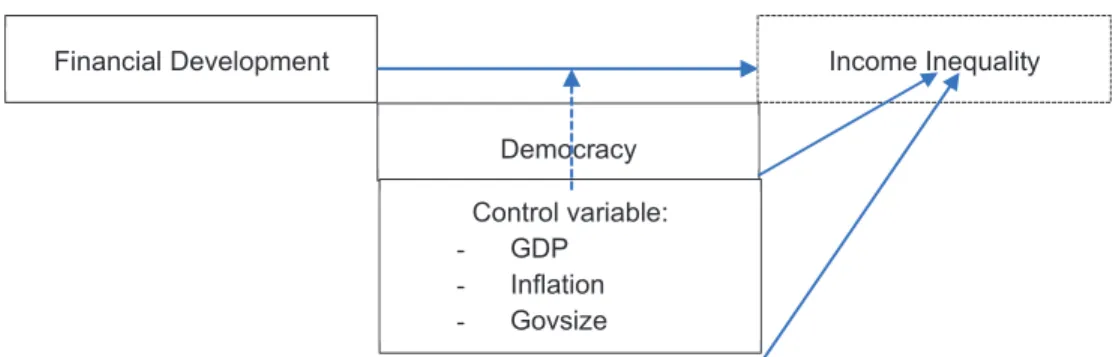
The aim of this paper is to determine if the relationship between financial development and income inequality depends on the level of democracy within a country (Figure 1). The research question that will be answered is Does the level of democracy condition the relationship between financial development and income inequality?
Based on the literature reviewed, our research expects
that only democratic countries will be able to exploit the
advantages of financial development to reduce income
inequality within a country. Previous theoretical work has
emphasized two types of mechanisms that can influence
the relationship between financial development and
income inequality: Mechanisms affecting competition by
the authority in financial development and mechanisms
that affect accountability. The study expects both types of
mechanisms to be influenced by political regimes, and have
different effects depending on the degree of democracy in
the country.
First, the accountability models for the financial development policies of decision-makers must meet the requirements of citizens who are able to receive information about government behavior. This is theoretically not the case in authoritarian countries. Countries with autocratic systems of government often do not respond to the demands of their citizens. Thus, citizens in authoritarian countries have little ability to punish government behavior they dislike. In particular, in countries where freedom of the press and freedom of speech are limited, as is the case with most authoritarian countries, citizens will have little chance of shaping their own behavior. Therefore, achieving any mechanism to prevent corruption, improve the quality of government and reduce income inequality is assumed by accountability models is not possible in authoritarian countries. And that is only possible in democracies where leaders respond quickly to voters and citizens can receive information about government behavior.
Second, regional models of competition for financial resources presume that citizens may compare and act on government behavior in different subnational jurisdictions.
This requires conditions for information to be spread and citizens to be able to move freely within the country.
These conditions are more likely to occur in a democratic country with a free press and free civil society than in a country where information flows are limited, as is the case in many dictatorship countries. It is also unlikely to achieve competitive access to the financial resources in an authoritarian state. Thus, achieving competition for access to financial resources is more likely to occur in democracies than in authoritarian countries.
In summary, it seems unlikely that authoritarian states will be able to exploit the potential positive effects of resources resulting from national financial development.
This access in authoritarian states is likely to be weighed down by potential costs. The positive effects of financial development require the presence of formal institutions that provide citizens with information about government behavior and the capacity to act on given information.
These institutions are pre-deposited in democracies, and
thus accessibility can be non-transparent and democratic in that country.
3.1. Data
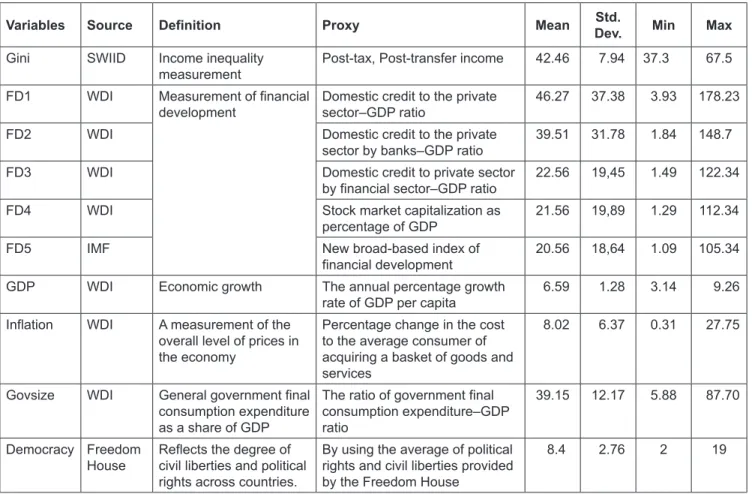
The data used in the analysis was compiled from different sources that have been merged into an original and unique data set. That one is quarterly data series, starting from the first quarter of 2000 to the fourth quarter of 2020. Data of variables is described in detail in Table 1.
3.2. Model Specification
We investigate the effect of financial development on income inequality, with a particular focus on the role of democracy. To achieve this goal, we estimate the research model with the following general form:
GINI
t= β
0+ β
1FD
t+ β
2Demo
t+ β
3FD
t× Demo
t+ β
4X
t+ u
tWhere: the dependent variable (GINI
t) represents the Income Inequality in year t. FD
tis the financial development indicator in year t. Demo
tis a lagged democracy index.
FD
t× Demo
tis the interaction term between the two variables, being a key variable. Based on the previous theoretical illustration, we expect to find a negative sign for coefficient β
3, implying that with the increase in the democratic level of a country, financial development is more likely to result in low-income inequality. And X
tis the set of control variables including GDP, Inflation, and Govxize.
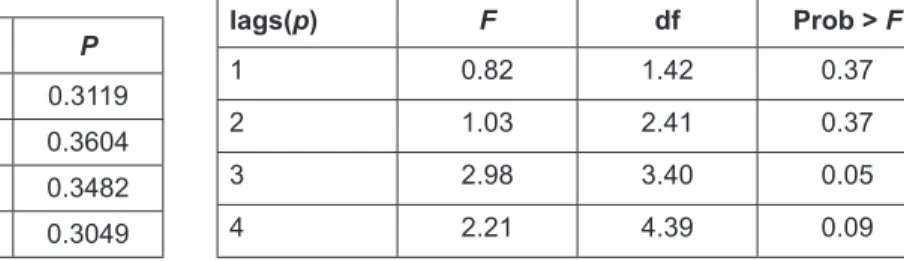
From the proposed model and the above research data, the study tested the stationarity of the series.
The stationarity test results in Table 2 show that the series FD and Inflation are stationary at the original order I(0);
while the variables Gini, GDP, Govsize are stationary at the order of difference, I(1).
Thus, the existence of mixed stationary series I(0) and I(1) is the basis for choosing ARDL (Autoregressive Distributed Lag) model.
Financial Development Income Inequality
Democracy Control variable:
- GDP
- Inflation - Govsize
Figure 1: Analytical Framework
Table 1: Description of Variables, Sources and Descriptive Statistics (%)
Variables Source Definition Proxy Mean Std.
Dev. Min Max
Gini SWIID Income inequality
measurement Post-tax, Post-transfer income 42.46 7.94 37.3 67.5
FD1 WDI Measurement of financial
development Domestic credit to the private
sector–GDP ratio 46.27 37.38 3.93 178.23
FD2 WDI Domestic credit to the private
sector by banks–GDP ratio 39.51 31.78 1.84 148.7
FD3 WDI Domestic credit to private sector
by financial sector–GDP ratio 22.56 19,45 1.49 122.34
FD4 WDI Stock market capitalization as
percentage of GDP 21.56 19,89 1.29 112.34
FD5 IMF New broad-based index of
financial development 20.56 18,64 1.09 105.34
GDP WDI Economic growth The annual percentage growth
rate of GDP per capita 6.59 1.28 3.14 9.26
Inflation WDI A measurement of the overall level of prices in the economy
Percentage change in the cost to the average consumer of acquiring a basket of goods and services
8.02 6.37 0.31 27.75
Govsize WDI General government final consumption expenditure as a share of GDP
The ratio of government final consumption expenditure–GDP ratio
39.15 12.17 5.88 87.70
Democracy Freedom
House Reflects the degree of civil liberties and political rights across countries.
By using the average of political rights and civil liberties provided by the Freedom House
8.4 2.76 2 19
Table 2: Augmented Dickey-Fuller (ADF) Test
ADF Z(t) p(*)
GINI
t−1.67 0.76
GDP
t−3.19 0.09
inflation
t−5.37 0.00
Govsize
t−3.28 0.07
FD1
t−6.26 0.00
FD2
t−5.78 0.00
FD3
t−5.86 0.01;
FD4
t−6.02 0.00
FD5
t−6.17 0.00
Demo
t−5.12 0.00
FD
t× Demo
t−4.57 0.00
∆GINI
t−5.24 0.00
∆GDP
t−9.34 0.00
∆Govsize
t−6.86 0.00
FD
tis represented by FD1, FD2, FD3, FD4, and FD5, respectively.
Note: (*) MacKinnon approximate p-value.
The ARDL model is used to model the relationship between (economic) variables in a time series equation. The existence of a long-run or co-integrated relationship can be tested against the error-corrected form. A bound testing procedure can be used to draw conclusions about whether the order of integration of sequences is I(0) or I(1) (Pesaran et al., 2001).
The ARDL model (p, q) has the form of equation 1:
0 /
1 0
, 1, 0
p q
t i t i i t i t
i i
y c φ y
−β x
−u p q
= =
= + ∑ + ∑ + ≥ ≥ (1)
Here, y
tis GINI. The explanatory variables X
tinclude the National growth rate of national income, GDP;
Consumer price index, Inflation; Financial development Index, FD; Democracy Index, Demo; and Government Size, Govsize.
And the ARDL model can be re-parameterized as Error - Correction Model (ECM) as follows:
( )
/0 1
1 0
p q
t t t yi t i xi t i t
i i
y c α y
−θ x ψ y
−ψ x
−u
= =
∆ = − − + ∑ ∆ + ∑ ∆ + (2)
Which:
• Speed-of-adjustment coefficient,
1
1
p ii
α φ
=
= − ∑
• Long-term coefficient,
0q i i