• 검색 결과가 없습니다.

A Narrative Strategy of Storytelling Advertising Videos: Heineken's Case

N/A
N/A
Protected

Academic year: 2021

Share "A Narrative Strategy of Storytelling Advertising Videos: Heineken's Case"

Copied!
10
0
0

로드 중.... (전체 텍스트 보기)

전체 글

(1)

¶ Corresponding Author: Chan-Bok Byun, Dept. of Tourism Management, Anyang University, 22, Samdeokro 37beon-gil, Manan- gu, Anyang-si, Gyunggi-do, 430-714, South Korea, Tel. +82-31-467-0844, E-mail: [email protected]

Culinary Science & Hospitality Research. 2016;22(1):9-18.

https://cshr.jams.or.kr/ ISSN  2466‐0752  (Print) ISSN  2466‐1023  (Online)

A Narrative Strategy of Storytelling Advertising Videos:

Heineken's Case

Chan-Bok Byun

Dept. of Tourism Management, Anyang University

ABSTRACT: The purpose of this paper was to explore the narrative strategy of storytelling advertise- ment videos for a beer brand Heineken. Heineken was one of the most active advertisers who had made very impressive ad videos. The author selected five story driven advertisement videos which had been most frequently watched by Internet viewers. Those were "The Insider", "Odyssey 2011", "Heineken lip gross", "Italy Activation Milan AC vs. Real Madrid", "the Match". The five selected videos have 90 second running time. The target videos were repeatedly watched and the expected key image cuts and key verbal copies were captured as well. To categorize the narrative structure and key copies of each video, Fog, Budtz & Yakaboylu's four element model of storytelling and Gustav Freytag's three act structure or five stage model of a plot were exploited as underlying theories. Most of the ad videos had clear boundary between or among the stages of the plot and used emotional appeals including humor and sexual appeals. This paper found that the target videos used visual rhetorics to enhance the viewers' persuasion and comprehension. It also revealed that the target videos took advantage of football match as an emotional engagement to get ad viewers closely banded with Heineken.

Keywords: narrative, storytelling, message strategy, emotional appeal, emotional engagement

INTRODUCTION

Nowadays people live in a myriad of advertise- ments. Obviously the eventual aim of the ad is to persuade readers or viewers to buy something or to switch brands. Not a few studies reveal that the per- suasive ads positively influence brand image and customer brand loyalty[1,2,3]. To accomplish the company's marketing goals, advertisers always have to find out the creative ways that can attract the at- tention of consumers and influence their feelings to- ward the brands. The message conveyed through advertising influences the purchasing decisions of consumers. In a dictionary sense, a creative strategy can be defined as an outline of what message sh- ould be conveyed, to whom, and with what tone

which is generally the result of a team composed of copywriters, art directors and creative directors[4].

In many cases creative strategy and message stra-

tegy have been used somewhat synonymously. Each

advertiser should use different creative strategies

and appealing methods in order to obtain his target

consumers' attentions. In other words advertisers

use different ways of thinking to create persuasive

expressions and catchy slogans that capture con-

sumer attention. One of the most effective ways of

making people feel really good about a brand is to

tell stories relevant to the brand. In the last few

years, the leading beer brands have made very crea-

tive storytelling videos and aired them in online and

TV. For example, in 2014 the Budweiser company

(Anheuser-Busch's flagship brew) released a heart

(2)

breaking beer commercial which covered the story of friendship between a puppy and a horse. And a couple of Heineken's ads have won marketer of the year in Cannes Lions International Festival of Creati- vity last three years. The story-driven ads of the global beer companies have been recognized as one of the best heartstrings. The touching messages were transmitted through internet and attracted a huge amount of attention of potential customers. As consumption of mobile TV increases, people are able to watch tons of advertising videos through person- al mobile phone. Social network means contributes to consumers' easier access to advertising videos[5, 6]. YouTube also makes the advertisers free from the straight jacket of a 30-second TV commercial. In ad- dition to the storytelling videos, the leading beer brands are also recognized for excellency in making very creative and interesting print advertisements.

Comprehending beer advertising exemplars will give us invaluable implications in terms of advertising creative strategies.

Creative executives also need to understand both verbal and visual structures of narratives used in the successful advertising exemplars in order to find out why or how these companies could make audience highly emotional and gain authenticity and atten- tion-getting power. In this study, Heineken was se- lected as a target beer brand because it had been recognized not only for the world's third largest brewer but also for its outstanding ability for crea- tive advertising. In sum, the purpose of this study is to analyze narrative strategies used in Heineken's storytelling advertising campaigns on online and TV and find out some implications of the ad creative strategy.

LITERATURE REVIEW

Advertising Appeals

In business dictionary, advertising appeals are de- fined as distinctive claim of an advertising. In Anne Marie's individual homepage, advertising appeals are defined as the persuasive pressures that stimulate a person to buy a product or service by speaking to an individual's needs, interests or wants[7]. Adverti- sers exploit some forms of appealing techniques to influence a customer's buying motives because his

purchase decisions are often made on the basis of both emotional and rational motives. Many re- searchers presented the classification of advertising appeals. Ashwini Ambekar presented advertising ap- peals that advertising agencies and companies have used in recent years[8]. He divided ad appeals into emotional, rational, sexual, humor and adventure.

Haley, Staffaroni, Fox[9] focused on non-verbal fac- tors and classified them as music, behaviors, model, and backdrops. Kim Junghyun[10] classified ad ap- peals into model, information transmission, sophisti- cation, humor, musical backdrop. The most common way of classification is that of emotional appeal and rational appeal. Rational appeals focuses on in- dividual's functional needs for a brand and presents rational reasons for buying and key benefits of con- sumers for use of a brand. They will be more effec- tive than emotional ones when they are applied to comparison, the slices-of-life, and testimonial types of advertisement. Emotional appeals are quite rele- vant to psychological and social needs of customers.

They take advantage of customers' psychological and social emotions such as love, friendship, fear, sorrow, nostalgia, and sex. In recent years, many popular Korean brands such as Bacchus, KCC Swit- zen and SK Telecom execute heartwarming TV com- mercials which can stimulate emotional reponses and lead to customers' positive attitudes towards the brands. Advertising with emotional appeals is liked more and ultimately create a more positive at- titude towards a brand[11]. Well-liked advertising clearly enhances the level of both memorability and persuasion.

Message Strategy

In discussing advertisement issues, the message strategy and the creative strategy are frequently mingled with each other. In fact, an ad consists of both message strategy which is for the guidelines on "what to say" and creative execution which is for

"how to say"[12]. Frazer[13] presented seven alter-

native message strategies. However, he still doubted

the clear separation of creative execution from mes-

sage strategy. Message structure is a framework to

describe the techniques employed in commercial

messages. Taylor[14] suggests six major message

strategies: ego, social, sensory, routine, acute need,

(3)

ration. Six segments are originated from two basic typology of advertisements emerged: transmission and ritual. These two classifications are similar to the terms of informational and transformational re- spectively[15]. Advertising that has been categorized as ritual is typically defined as utilizing emotional means and strategies to reach consumers[12,16,17].

Out of six segments of message strategy, ego, social, and sensory are for ritual category while routine, acute need, and ration are included in the informa- tional category. The messages of ego segment in- dicate how the individual would like to be perceived by others and typically related to self-actualiza- tion[14,15]. The messages of social segment indicate that consumers should be able to gain social appro- val and enhance their social experiences through brand consumption. Advertisements in the sensory segment use a sense of touch, smell, taste, sight or sound.

Advertising Campaign Storytelling

An advertising campaign is a specific course of ac- tion designed to advertise a company, cause, or pro- duct that employs an intentional and carefully coor- dinated series of marketing tools in order to reach the target audience[18]. It consists of a series of ad- vertisement messages that share a single subject.

Advertising campaigns appear in different media channels across a specific time frame. The campaign theme is generally embedded in the various promo- tional mix such as prints, online video, TV commer- cials, personal selling and promotional activities.

Due to information overload today, consumers are better informed than ever and they tend to se- lectively accept and retain marketing information. To make ad content be more emotional and memo- rable, brands need to be less like marketing ma- chines and more like friends, telling stories and shar- ing experiences. Today's consumers who live amid the flood of advertisement are searching for market- ing communications that are more authentic and emotional and storytelling may be a means to that end. In fact, many leading brands create story-driven videos and load them on online. In addition, ads au- dience increasingly consume television and commer- cial messages through mobile TV, a system that con- veys the television content to the mobile phone.

Especially in Korea where about 80% of pop- ulation is equipped with digital multimedia broad- casting (DMB)[19] (Lim, Ri, Egan, Biocca, 2015).

Therefore consumers are more likely exposed to story-driven videos which have been made as the part of a brand's ad campaign. For example, in 2011 Heineken's "The Entrance" web campaign was the second-most watched web ad in the latest Ad Age Viral Video Chart with nearly a million views in a week. The initial commercial in a new campaign is frequently loaded on Web sites first before a new campaign ad being viewed on TV. The digital ele- ment allows advertisers to put their creative adver- tisement at lower cost.

Due to a fierce competition on the market, the most common and probably the best option for al- cohol advertising is storytelling. There are many fa- mous brands that successfully do it. Heineken is one of them. To create emotional and memorable story telling in ads, advertisers should be able to under- stand the fundamentals of strong scene construction and the essential elements of the ad narratives such as character development, themes, conflicts and plots. Fog, Budtz & Yakaboylu[20] presented mes- sage, conflict, character and plot as the four effec- tive elements of storytelling in their study.

A message or theme is the point that is con-

sistently reflected not only in a single story but also

in the whole advertising campaign like the latest

Heineken's campaign theme "Open your world". By

the time the audience reaches the end of the ad

campaign, they should get this point. In fact, the

whole object of everything in the advertising cam-

paign is to build a case for this point. Audience can

easily understand what sort of campaign a company

try to develop through the specific message. Adver-

tisers then should be able to make simple and clear

wording and visual presentation which covers all

promotional and advertising activities. In general

stories, conflict and tension play a role of increasing

suspense since we have no idea how these people

will behave with each other in the next moment. In

ad cases, conflict and tension are also essential fac-

tors to stimulate viewers' attentions and curiosities

because dramatic tensions make audience members

expect something to happen. The conflict in a ad

is very critical factor in that the characters go th-

(4)

rough a meaningful changes in their lives through the conflicts and the viewers then become easily empathy to the characters' plights. They put them- selves in the place of the characters and relate to characters' situations and decisions on the level of emotion and thought.

To deliver a key message to audience properly, each character of the story has his marked indivi- duality. Characters are those who behave according to their underlying themes. According to fairy tale model of Fog, Budtz & Yakaboylu[20], the persons connected with the storytelling events are catego- rized into hero, adversary, supporter and beneficiary.

In addition to the above sub elements of character, character’s appearance, dialogue and action are also powerful sub tools for communicating some useful information to audience.

Plot refers to the sequence of events inside a story which affect other events through the principle of cause and effect[21]. It includes actions and re- actions and a cause and effect series of things hap- pening to propel a character from a beginning, th- rough a middle to an end. According to Wikipedia, today screenwriters generally divide plot structure into three acts: the setup, the confrontation and the resolution. In fact, the three act structure is similar to Gustav Freytag's pyramid which divides a drama into five parts: exposition, rising action, climax, fall- ing action, and denouement[21]. Physical backdrop or setting is one of the most important factors for giving an effective communication to audience. A setting is the place where advertising events are tak- ing place. The foreground and sound of a scene has become one of the important factors in advertise- ment videos because they plays a role of stimulating target audience's imagination about what sort of ac- tions might expect to take place. The background emphasize the character’s emotions rather than sim- ply describing them, and impact viewer more fully.

For example, a coastal port where many large size merchant ships come and go and a main character stands on a ship will give viewers a very distracted mood and a tension.

METHODS Sample Selection

This paper aimed to analyze message strategies used in Heineken's storytelling advertising campai- gns on online and TV and gain some practical im- plications about beer advertisement. Specifically it analyze the narrative structures and key copies of the storytelling advertisement videos which have been loaded on Internet. As a surging amount of multimedia contents and videos including TV com- mercials have been made available online, more and more population might be exposed to advertise- ment. Heineken is one of the most active advertisers who has made very impressive ad videos and loaded online. The author selected five storytelling adver- tisement videos which had been most frequently watched by Internet viewers. Those are "The Insider",

"Odyssey 2011", "Heineken lip gross", "Italy Activa- tion Milan AC vs. Real Madrid", "the Match". All of the selected videos have 90 second running time.

Analysis Method

The author watched five target videos repeatedly and captured the expected key image cuts and key verbal copies. The narrative analysis was performed based on Fog, Budtz & Yakaboylu's four element of storytelling such as message(theme), character, con- flict and plot. And sub-elements of character and plot were also exploited as basis of the narrative analysis. Character was divided into four categories:

hero, adversary, supporter, and benefactor. The sub- elements of the plot was divided into five stages based on Gustav Freytag's three act structure which eventually divides drama into five parts: exposition, rising action, climax, falling action, and denouement.

The narrative of each Heineken ad videos was cate- gorized based on the above analytical tools. In addi- tion, the physical setting of the narrative was de- scribed.

RESULTS OF NARRATIVE ANALYSIS

Insider

Heineken has performed "Open Your World" glo- bal ad campaign for a long-time basis from 2010.

The Insider is one of "Open your City" series which

is part of "Open Your World" ad campaign. The con-

sumer benefit which "Open your City" ads imply was

to enjoy unpredictable and unforgettable night. The

(5)

key copy of "Open your City" was "Open up your city and a bottle of Heineken too while you're at it for an unforgettably good time." The main purpose of the "Open Your City" campaign was to allow Heineken drinkers to escape their usual routine and venture backstage of famous cities to explore the unexpected. The Insider also aimed to inspire tou- rists to move away from their usual tour course to discover the secrets of Paris. The beginning setting was a peaceful boat marina at Seine River. This is the peaceful place where most viewers never expect any unique events. The hero was sitting at a street cafe seeing a tourist group that was about to get on a cruise boat. He hijacked the tourist group(ex- position stage/ benefactor) and takes them into a rio- tous underground club in the Catacombs(rising ac- tion/supporter), and finally gets them dancing the can-can(climax/supporter). He also saves one tourist from being mugged by a group of mime artists(con- flict/adversary). From the narrative structure point of view, this ad lacks both falling down and denoue- ment stage. The hero takes them to a hidden gems of the city rather than the same old tour. The main message is to encourage an adventurous experience with Heineken beer in the city.

The arousal of emotions is one of the many fea- tures of adventure activities. This ad encouraged tourists to take a risk and look for a backstage of the city rather than the same old place. The hero took away tourists' fear and apprehension and had them run counter to emotions such as fun, enjoy- ment and the sense of achievement. Humor was used to manipulate emotions with the projection of danger and transform the adventure experience po- sitively. Each image at the below was one of images at exposition, rising action, conflict, climax, and de- nouement stage respectively from the left to the right. At the first image the hero gives a tour guide with a bottle of Heineken beer in return for a guide flag. It used a sort of visual rhetoric in that the tour guide was portrayed as a symbol of routineness whi- le the hero was symbolized as a novelty.

The Odyssey

"The Odyssey" borrowed Greek mythology story and applied it to the narrative structure of the ad.

The maritime setting made us remind the story that Odysseus overcame countless obstacles during his long journey home at sea. The protagonist in the ad was portrayed as a very talented man in various en- tertaining activities such as b-boying, tap dancing, diving, limboing or salsa dancing. The video began with the scene that the hero come up to the deck holding a rope from the sea(exposition stage). On the deck he met with many tourists and ran into a beautiful woman and get her a bottle of beer(rising action/supporter). He also morphed into different men as he made his way through the ship. Toward the end of the ad, just as all the ship’s crew and tourists were most thoroughly impressed, a woman asks the captain, “Who is that man?” The captain knowingly replies, "that can't be just one man." This implies that every man can be a hero. And this scene is for the climax stage in that people on the deck recognized the identity of the protagonist and the captain(adversary) changed his negative attitude into positive towards the hero. When the hero threw himself from the deck into sea, everyone was be- wildered(falling action stage). But when they saw many same men wearing different costumes on a raft, they were impressed(denouement). This stage was the reverse point which turned audience's scary feeling into a touching moment.

The key copy was "that can't be just one man"

which eventually could be induced into the main

theme, "everyone is legendary at something." Just as

Odyssey myth gives us a lesson of how Odysseus

grows spiritually from his mortal experience when

he returns home, the protagonist of the ad shows

more humble and spiritually inclined attitude in the

end. Each image at the below was one of images

at exposition, rising action, climax, falling action and

denouement stage respectively from the left to the

right.

(6)

Italian Activation AC Milan vs Real Madrid Heineken has been one of the biggest sponsor- ship with UEFA for Champions League. Heineken ad- vertiser organized a fake classic music concert. This ad was made in a form of candid camera based on the secretly devised fake events. On the night of the October 21st the Real Madrid played Champions League match against AC Milan. Heineken advertiser convinced several university professors, girlfriends, and several bosses to convince their students, boy- friends and employees to go to a concert on that night. All of them could not say no and had to go to the classical concert[22]. As fifteen minutes pa- ssed after the concert had started, the insert dia- logues began to present on the stage screen as fol- lows;

Hard to say no to your boss, isn't it? To your girlfriend? And to the match?

How could you even have thought of missing the big match?

Are you still with us? Real madrid and Milan are now on the pitch.

Let's enjoy the match together.

The insert dialogues of the ad continued to say:

Over 1.5 million watched this ad live on Sky Sport and ten million saw the events on news the day after. Over five million visitors on the Internet in the two weeks after the event. Many soccer fans appre- ciated the events on their blogs, forums and social networks.

The very reason why people were so impressed with this ad was not simply because they could watch what they wanted to but because Heineken Company showed much delicacy of feeling for them.

As a result, the many soccer fans might have a strong sense of identity with the event organizer, Heineken Company. Especially, the wording of "Are you still with us?" created a sort of pun that could suggest two or more meanings for an intended rhe- torical effect. In here, "us" might mean either all of

soccer fans or Heineken consumers. The most sce- nes of the video consisted of words rather than ima- ges in order to put video viewers across the whole event. There was no specific hero in this video. The- refore, the event organizer's preparation itself to make many supporters was for an exposition stage.

The process that many accomplices(supporters) con- vinced their boyfriends, students, and husbands was for the rising action stage. At least at this point, the victims were adversary because if they were not convinced to come a fake concert, the event would be failed. When all accomplices and victims entered concert hall, the tension between accomplices and victims reached a climax. Actually the time when the insert letters started to be presented on the screen was for the denouement of the story. The key copy of the ad might be "Are you still with us?" And main message was that "Heineken goes always with the soccer fans." The important success factor of the ad was the ability to portray situations which could create emotional connections with people.

Heineken Lip Gloss

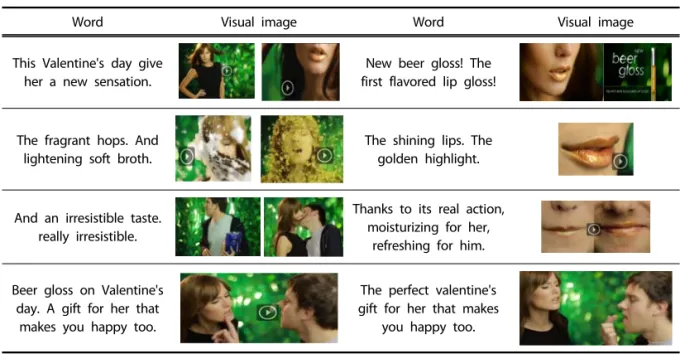
Heineken created and launched the beer gloss, the first beer flavored lip gloss. In this way Heineken offered beer drinkers an entertaining brand experi- ence for Valentine's day: a real long delightful beer taste on the mouth. Actually, Beer Gloss was sold out in two weeks and in a few days the news about this product turns all over the world through social network[23]. They performed a short-term communi- cation campaign to promote both online and off- line sale. This campaign was very successful in Italy in 2010. The ad was so successfully executed as well in that both word and visual image were ideally combined and maximized advertising effectiveness.

The ad emphasized sexual appeal of the product.

The song of the ad is "love's in the air," a 1977 disco

song sung by John Paul Young. Sex appeals remain

a common advertising technique used in various

media to draw consumer attention. It has become

a powerful means in recent advertisements. This vi-

(7)

Word Visual image Word Visual image

This Valentine's day give her a new sensation.

New beer gloss! The first flavored lip gloss!

The fragrant hops. And lightening soft broth.

The shining lips. The golden highlight.

And an irresistible taste.

really irresistible.

Thanks to its real action, moisturizing for her,

refreshing for him.

Beer gloss on Valentine's day. A gift for her that

makes you happy too.

The perfect valentine's gift for her that makes

you happy too.

Table 1. Combination between word and image

deo also implied sex-related benefits especially for male partner even if lip gross was a female consu- mer product. The ad started by saying that Heineken created first beer flavored lip gloss. Both word and image were perfectly matched with each other as follows;

The color of the backdrop of each scene was mostly green so that people could easily recognize the product was made by Heineken. The white broth was one of the brand associations which put people in mind of beer broth while the golden chips reminded us of beer itself. Actually the white color was symbolized as the lightness of beer lip gloss while gold color represented the taste of hops. In addition, this ad contained a viewing context of hu- mor: the male character squeezed woman's lips through his finger and tasted the lip gross from the finger. The male character's behavior incited unclean and funny mood. Research reveals that humorous content incite a positive mood, which increase the affect and intensity of perceived humor in the adver- tisements[24]. The words of "an irresistible taste of lip gloss" was one of the metaphors for an sexual desire. The statement that "the gift for her that makes you happy" was also used as a metaphor for sexual appeal. The key copy was "the perfect valen- tine's gift."

The Match

Heineken released a 90 second video ad as a part of the social media campaign in 2015. The begin- ning setting of the video was a coastal port where a lot of sea crew moved around for loading and unloading. The bustling atmosphere with the sound of a boat whistle implied a last minute departure for the long journey. A supervising sailor checked out the fact that the UEFA final match would be held in a minute. He rushed to prepare with his col- leagues for being able to watch the match on the ship(exposition stage; colleagues are his supporters).

They even tore off a thick ship window for magnify- ing TV screen and even dove into the sea to rip off a screw of the ship(rising action stage). They rigged up a makeshift satellite dish so they could get TV signal and watch the game at sea(climax). Finally, all crews changed their costumes for a party and gave a shout of joy raising their glasses of Heineken beer (denouement). Heineken’s ‘Champion Of The Match’

campaign celebrated the UEFA Champions League, offering fans the chance to create a truly great match night for them and their friends, ensuring they do not just watch the match but they cham- pion it.

The video ended with an impromptu deck party

(8)

amid hearty cheers. Drinking beer with colleagues during the sporting games created strong feelings of identity and unity. The video showed that Heinek- en penetrated into the slices of soccer fans' real lives and invoked their emotions. There was no key copy because this video consisted of only non-verbal sce- nes. The main message can be induced from non- verbal story as "create a truly great match night."

This message encourages people to have more in- terest in enjoying soccer match which eventually leads to a positive consumer engagement in terms not only of personal level (self-esteem and intrinsic enjoyment) but also of social-interactive level(partic- ipation and sociating). Each image at the below was one of scenes at exposition, rising action, climax and denouement stage respectively from the left to the right.

DISCUSSION AND CONCLUSIONS

Discussion of Findings

The purpose of this paper was to illuminate the narrative strategy of five target videos. The target videos depended mostly on visual narratives except

"Heineken Lip Gross" that used voice over narration.

The usage of verbal dialogues were very limited. To achieve the goal of the study, five storytelling adver- tisement videos were selected on Internet. The tar- get videos were repeatedly watched and their ex- pected key image cuts and verbal copies were cap- tured as well. To categorize the narrative structure and key copies of each video, Fog, Budtz & Yakaboy- lu's four element model of storytelling and Gustav Freytag's three act structure or five stage model of plot were exploited as underlying theories. In addi- tion, character was divided into four categories:

hero, adversary, supporter, and benefactor. The phy- sical settings and key copies were also illuminated.

"The Insider" was one of "Open your City" ad se- ries which introduced a hidden gems or unique spot of the city. The main message was to encourage

people to take an adventurous experience with Heineken beer by visiting a hidden spots of the city rather than following the same old tour. Humor was used to manipulate emotions with the projection of danger. "The Odyssey" borrowed Greek mythology story and thus had a similar narrative structure as that of Greek myth. It had relatively clear boundary between or among five stages of a story plot. The key copy was "that can't be just one man" which eventually can be induced into the main theme,

"everyone is legendary at something." "Italian Activa- tion AC Milan vs. Real Madrid" was a candid camera typed ad video based on the fake event. The suc- cessful factor of the ad video was not simply be- cause they could watch what they wanted to but because Heineken Company showed pretty much delicacy of feeling for them which eventually incited their touching emotions. The key copy of the ad might be "Are you still with us?" The main message was that "Heineken goes always with the soccer fans." "Heineken Lip Gloss" ad video was made in line with a short term advertisement campaign for selling beer flavored lip gloss. This ad was so suc- cessfully executed partly because both word and vis- ual image were ideally combined and maximized ad- vertising effectiveness. It used both sexual and hu- morous appeals effectively. The key copy was "the perfect Valentine's gift." However, it did not follow a step-by-step narrative structure because it directly focused on the product features rather than an in- direct approach. The key message of "The match"

was to encourage people to enjoy soccer match which eventually led to a positive customer engage- ment with the advertising company in terms not on- ly of personal level but also of social-interactive level.

Implications

The common features of the target videos' narra-

tives were as follows: First, they focused more on

visual rhetoric rather than on verbal copy. The visual

(9)

rhetoric can be described as a form of communica- tion that uses images for creating meaning or con- structing an argument[25]. Visual rhetoric is a sort of creative techniques to persuade the audience by using the distinct characteristic of visual symbols.

For example, all target videos put up the picture marked with Heineken's red star and ad campaign slogan at the last cut of the video. Second, each ad video included a joyous party as a part of content.

A party was ultimately used as one of the brand as- sociations to remind ad viewers of alcoholic beve- rages including beer. Brand associations are any pathways linked in memory to a brand. In "Insider,"

two kinds of parties(an underground mask ball and a cancan dance party) were held to create a sensa- tion and a heady atmosphere. "The Odyssey" in- cluded a party which all the characters had hilarious time from the hustle and bustle of cruise travel.

Third, the target ad videos are bound up with sport- ing games. In fact, sports is one of the most com- mon themes in beer advertisement. Many famous beer brands have done sponsorship campaigns and ad videos as Heineken has done. However, Heineken has always stayed ahead by coming up with some- thing creative. Both "Italian Activation" and "The Match" were examples. Heineken considers a sport- ing match not just as one of the leisures but as a part of life. These two ads encouraged audience to engage in creating a truly meaningful match night.

The festive and dramatic ambience of the match night allowed Heineken and the audience to be emotionally linked. This was one of the consumer engagement forms which both advertiser and audi- ence got together and created a new meaning and value about the football match. Even though these ads could not directly connect to consumer purchas- ing behaviors, they at least might enhanced emo- tional level of brand engagement in that ad audi- ence experienced pleasure while viewing the video.

This study was to ensure that the message strategy issue would be able to link to the brand engage- ment.

Limitations and Future Research

Despite the findings and implications, the current paper only dealt with Heineken's advertising videos.

Therefore, its findings might not be directly applied

to other global beer brands. However, they could be borrowed and applied partially to any beer brands as Heineken has been one of the leading advertising gurus. Especially, the issues of visual image strategy and emotional engagement through advertising could be applied to the future research for narrative comparison between or among the beer brands.

From the findings a couple of subjects could be drawn for future researches as follows; First, how vis- ual rhetoric can be used in beer advertising videos?

Second, what sort of brand associations beer brands use in their advertising videos? Third, how beer

brands take advantage of consumer engagement through advertising?

REFERENCES

[1] Jang LG, Hwang DH, Jeon MS (2015). The influ- ence of Korean and Chinese customers' percep- tion about product placement inserted into Ko- rean TV dramas on brand image and purchase intention. Culinary Science & Hospitality Research 21(4):309-324.

[2] Lee SM (2014). The impact of experience value on brand image, satisfaction, and customer lo- yalty in context of full-service restaurants. Culi- nary Science & Hospitality Research 20(5):93-100.

[3] Kim BN, Moon, SS (2014). A study on mediating effect of customer satisfaction and attitudinal loyalty between the brand image and behavioral loyalty in coffeeshops. Culinary Science & Hospi- tality Research 20(1):205-219.

[4] http://www.businessdictionary.com, 2015.

[5] Lee EJ, Kim DS (2014). The effects of marketing mix strategies on perceived value and loyalty in Korean restaurants. Culinary Science & Hospitality Research 20(2):136-151.

[6] Shin SY, Cha SM (2013). Motive on social net- working service usage of restaurant customers.

Culinary Science & Hospitality Research 19(1):121- 138.

[7] http://study.com/academy, 2015.

[8] http://www.infojug.com, 2009

[9] Haley R, Staffaoni J, Fox A (1994). The missing measures of copy testing. Journal of Advertising Research 47-59.

[10] Kim JH (2003). The communication effective-

(10)

ness of advertisement expression elements. The Korean Journal of Advertising 14(2):209-229.

[11] Stout PA, Leckenby JD (1988). The nature of emo- tional response to advertising: A further exa- mination. Journal of Advertising 17(4):53-57.

[12] Taylor CR (2005). Moving international advertis- ing research forward: a new research agenda.

Journal of Advertising 4(1):7-16.

[13] Frazer C (1983). Creative strategy: a manage- ment perspective. Journal of Advertising 21(4):

7-16.

[14] Taylor RE (1999). A six-segment message stra- tegy wheel. Journal of Advertising Research 39 (6): 7-17.

[15] Carey JW (1975). A cultural approach to co- mmunication. Communication 2:1-12.

[16] Golan GJ, Zeidner L (2008). Creative strategies in viral advertising: an application of Taylor's six segment message strategy wheel. Journal of Computer Mediated Communication 13(4):959- 972.

[17] James WM (2011). The appeals of luxury adver- tising: an application of Taylor's six segment message strategy wheel. The Elon Journal of Undergraduate Research in Communication 2(2):

62-72.

[18] http://www.wisegeek.com, 2015.

[19] Lim JS, Ri SY, Egan BD, Biocca FA (2015). The cross platform synergies of digital video adver- tising: implications for cross media campaigns in television, Internet and mobile TV. Computers in Human Behavior 48:463-472.

[20] Fog K, Budtz C, Yakaboylu, B (2005). Storytell- ing: Branding in Practice. Springer.

[21] https://en.wikipedia.org/wiki/Plot_(narrative) [22] https://www.youtube.com/watch

[23] http://www.advertolog.com/heineken/online/beer- gloss-13721205

[24] Benson A, Perry SD (2006). The influence of hu- mor in radio advertising on program enjoyment and future intent to listen. Journal of Radio Studies 13(2):169-186.

[25] Albakry NS, Daimin G (2014). The visual rhetoric in public awareness print advertising toward Ma- laysia perspective socioculture design. Social Behavioral Sciences 155:28-33.

Received: 28 DEC, 2015

Revised: 6 JAN, 2016

Accepted: 11 JAN, 2016

수치

Table  1.  Combination  between  word  and  image

참조

관련 문서

The purpose of the study was to analyze the needs of faculty and students regarding e-Learning and to provide policy implications about the government

The purpose of this study is to find out the factors to be considered to allow people with disabilities to work stably and propose the direction of

The purpose of this study is to examine the service quality of a tennis court which is one of public sport facilities and analyze a difference in

The purpose of this study is to analyze the effects of sports marketing strategy fit on organizational attitude and organizational citizenship behavior

The purpose of this study is to analyze the influence of dance leaders' inst ructional behavior patterns on participants' desire to participate and

The purpose of this study is to analyze the situations of violating the right to learn and violence in student-athletes from an ethnographic view and

The purpose of this study is to analyze the interest and self-confidence of middle school students in learning English grammar and to examine the

In short, the finding of the study indicated that the students' interest, satisfaction, and participation in English are improved as a result of