1. INTRODUCTION
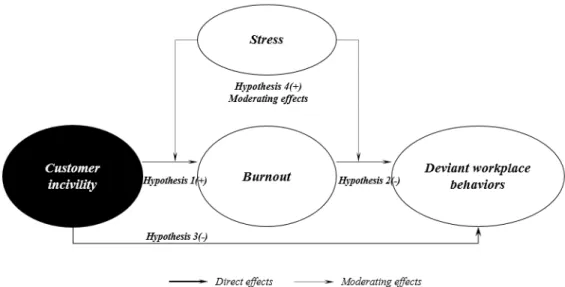
The hospitality industry has more depressed employees than any other industry. The cause is the working environ- ment and culture of the industry where harrassment and inci- vility frequently occur (Pizam, 2008). Rowley and Purcell (2001) noted that there were many reasons for high turnover rate in the hospitality industry, and major reasons among them were excessive exposure of employees to stress and its failure to appropriately deal with incivility from superiors or custo- mers (Adam & Webster, 2013). Kern and Grandy (2009) observed incivility service employees in retail stores under- went from their customers increased their stress, ultimately
leading to emotional burnout or negative emotions. As men- tioned in research by Grandy, Dicketer, and Sin (2004) 20%
of phone calls that call center employees receive involve their customers' oral aggressive behaviors; customers are probably the most representative cause of incivility to which those employees are frequently and severely exposed.
In particular, because employees of deluxe hotels as a representative service industry work at the forefront of service and interactions while contacting their customers in such service encounters are a very crucial task of them (Sliter, Jex., Wolford, & McInnerney, 2010), they are relatively much ex- posed to harassment by their customers (Cho, Bonn, Han, &
Lee, 2016). Further, frontline employees should abide by pre- Information available at the Culinary Society of Korea (http://www.culinary.re.kr/)
Culinary Science & Hospitality Research
Journal & Article Management System: https://cshr.jams.or.kr/
http://dx.doi.org/10.20878/cshr.2017.23.6.012
Spillover Effects in Customer Incivility: Impacts on Frontline Employees’ Negative Behaviors
Hyo Sun Jung
1, Young Mi Park
2and Hye Hyun Yoon
11
Dept. of Culinary Arts and Food Service Management, Kyung Hee University
2