제주마 집단의 세대 경과에 따른 모색 유전자 변화 연구
김남영1․채현석1․백광수1․조인철1․정영훈1․우제훈1․박설화1․김지향1․이성수1․양영훈2†
1농촌진흥청 국립축산과학원, 2제주대학교
A Study on the Changes of Coat Color-Related Genes according to Generational Changes in Jeju Horses
Nam-Young Kim1, Hyun-Seok Chae1, Kwang-Soo Baek1, In-Chul Cho1, Young-Hun Jung1, Jae-Hoon Woo1, Seol-Hwa Park1, Ji-Hyang Kim1, Sung-Soo Lee1 and Young-Hoon Yang2†
1National Institute of Animal Science, RDA, Jeju 690-150, Korea
2Faculty of Animal Biotechnology, Jeju National University, Jeju 690-756, Korea
ABSTRACT
This study analyzed the coat color-related genes of MC1R, ASIP, ECA3-inversion, and STX17 of 1,462 Jeju horses administered by the Jeju Special Self-Governing Province. This was done to investigate the distributional characteristics of coat color-related genes in the Jeju horse group and the changes of its coat color-related genes by generation. The genotype frequency of the MC1R gene of E+/E+ and E+/Ee related to black coat color was 0.122 and 0.447, respectively, while Ee/Ee of the chestnut genotype was 0.429. The genotype frequency of the ASIP gene of AA/AA, AA/Aa, and Aa/Aa was 0.46, 0.448, and 0.091, respectively, where the genotype frequency of Aa/Aa turned out to be relatively low. The To/To and +/To genotype that manifests the Tobiano shape was 0.001 and 0.119, respectively, with the share of Tobiano shape around 12%. The genotype frequency of G/G and G/g of STX17 related to grey coat color was 0.002 and 0.680, respectively, with the share of grey horses among the Jeju horse group at 68.2%. As for the change of coat color genes by generation, no large changes were observed in the MC1R and ASIP genes. In ECA3-inversion, the To allele that manifests Tobiano significantly decreased following the generational change (p<0.05), while the STX17 G allele related to grey coat color significantly increased following the generational change (p<0.05). It will be necessary to examine the coat color genes when selecting breeding horses so that the diversity of coat colors among the Jeju horse group can be maintained.
(Key words : coat color, generation, Jeju horse)
*본 논문은 농촌진흥청 연구사업(세부과제명: 제주마 활용을 위한 기초 축군 조성 연구, 세부과제번호: PJ01010503)의 지원에 의해 이루어진 것임.
†Correspondence : [email protected]
서 론
모색은 표현형이 쉽게 관찰될 뿐만 아니라, 세대 간 유전 양 상이 비교적 쉽게 확인될 수 있어서 유전자 작용이나 유전자 간 상호작용에 관한 연구를 위한 모델 형질로도 취급되면서 사 람, 돼지, 소, 개, 말 등 다양한 종에서 피모색의 표현형뿐만 아 니라, 분자유전학적인 수많은 연구가 진행되어 왔다(Valverde 등, 1995; Kijas 등, 1998; Klungland 등, 1995; Schmutz와 Ber- ryere, 2007).
말의 모색은 흑색, 적색, 적갈색, 회색 등 표현형적으로 우 점 모색과 바탕 모색 자체뿐만 아니라, 유색 바탕에 백색 무늬
인 백반이 발현되는 양상에 따라 다양하게 분류된다. 말에 있 어서 기본 모색은 흑색(Black), 적색(Chestnut), 적갈색(Bay)으 로 분류되며, 희석모에는 크림색(Cream), 은회색(Silver), 던색 (Dun), 얼룩모(Dapple), 황갈색(Champagne)으로 구분될 수 있 다. 또한 백색 털의 혼재한 상태에 따라 회색(Gray), 조모색 (Roan), 백색(White)으로 구분되며, 백반의 형태에 따라서 토비 아노(Tobiano), 오베로(Overo), 세비노(Sabino) 유형 등으로 분 류된다(Thiruvenkadan 등, 2008).
기본 모색에 해당하는 흑색, 적색, 적갈색은 Extension(E)과 Agouti(A) 좌위에 의해 발현되며, Melanocortin-1-receptor(MC1R) 과 agouti signaling protein(ASIP) 유전자가 관여한다. Marklund
등(1996)은 MC1R 유전자의 단일과오돌연변이(single missense mutation)인 g.901C>T(83Ser → Phe)의 결과로 적색과 흑색/적 갈색의 표현형이 결정된다고 보고하였다. 또한 Rieder 등(2001) 은 ASIP exon 2에서 11-bp 삽입/결실 돌연변이가 MC1R 유전 자와 상호 길항적으로 작용하여 흑모색 발현을 조절한다고 보 고하였다. 회색 모색 표현형은 우성 G와 열성 g 대립유전자의 유전자형에 따라 G/— 유전자형은 회색을 발현한다. Pielberg 등(2008)은 STX17(syntaxin17) 유전자의 intron 6번에서 4.6-kb 염기사슬중복(duplication)이 회색을 발현하는 것으로 보고하였 다. 백반의 발현 양상과 관련된 토비아노, 오배로, 세비노는 각 각 ECA3-inversion(Brooks 등, 2007; Haase 등, 2008), endothe- lin-B-receptor(EDNRB)(Metallinos 등, 19981) 유전자의 missense mutation, KIT intron 16 exon skipping (Brooks와 Bailey, 2005) 이 연관된 것으로 보고되었다.
제주마의 모색은 조사자에 따라 다소 차이는 있지만, 과거 부터 매우 다양하게 존재했던 것으로 추정된다. Lee(1971)는 제주마의 모색 명칭을 외국 모색 분류와 연계하여 40여 종으 로 세분한 바 있으며, Nam(2003)은 제주마 모색의 고어 명칭 과 국문 명칭을 종합하여 49종으로 세분한 바 있다. 제주마의 대표적인 모색 명칭은 기본 모색으로 가라(흑색, Black), 적다 (적색, Chestnut), 유마(적갈색, Bay)로 구분되고 있으며, 회색 모(Gray)는 총마 그리고 유색 바탕에 백반이 발현된 얼루기 형태는 월라로 불리고 있다.
최근 제주마의 관광자원화에 따라 다양한 제주마의 모색 확 보와 유지에도 관심이 모아지고 있다. 제주마는 경마와 승마 장의 수요 증가에 따라 급속하게 증식되면서 2,500여 두에 달 하고 있다. 현재 소수의 한정된 종마로 번식되는 제주마 집단 에는 종마의 모색이 우점적으로 영향을 미치게 된다. 1960년대 제주마의 모색 빈도에 관한 보고에 의하면 가라, 총마, 적다, 유 마 그리고 월라의 빈도는 각각 7.3%, 13%, 30.5%, 0.3%, 42.7%
로 나타나 유마와 적다 모색 빈도가 높았으나(Lee, 1971), 최 근 조사에 의하면 가라, 적다, 유마 모색 빈도는 감소하고, 총 마 모색이 증가(60.2%)(NIAS, 2012)되는 양상으로 모색의 다 양성이 급속하게 감소하는 경향을 보이고 있다.
따라서 본 연구는 모색 관련 유전자 분석을 통해 제주마 모 색의 유전적 다양성을 확인하고, 세대 경과에 따른 모색 유전 자 변화 양상을 구명하여 제주마의 모색 정립 및 모색 다양성 확보를 위한 기초자료를 수집하고자 수행되었다.
재료 및 방법
1. 공시동물 및 시료확보
본 연구에 이용된 공시재료는 제주특별자치도 축산진흥원 에서 등록 관리되고 있는 제주마 1,462두에 대한 DNA 시료
를 분양받아 분석에 이용하였다.
2. 중합효소연쇄반응
말의 모색 관련 유전자인 MC1R, ASIP, ECA3-inversion,
STX17의 유전자형 결정을 위해 공시재료의 DNA를 주형으로
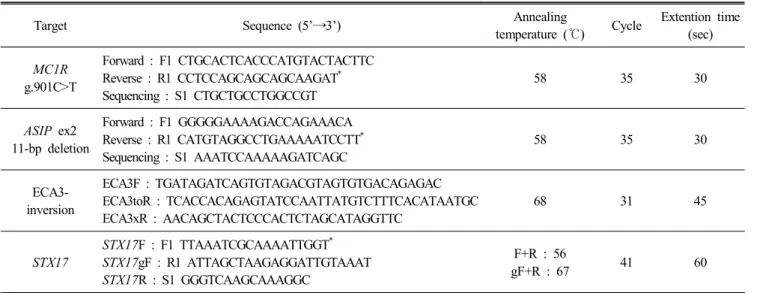
중합효소연쇄반응(polymerase chain reaction, PCR)을 통해 유 전자 절편을 증폭하였다. PCR 반응은 1× reaction buffer, 20 mM dNTP, 각 유전자별 10∼7.5 pmol primer, 0.5∼0.75 unit HS Prime Taq DNA Polymerase(GENETBIO, Korea), 25∼50 ng genomic DNA를 혼합하여 반응하였다. 유전자의 증폭은 DNA Engine Tetrad 2(Bio-Rad, USA)를 이용하여 94℃, 5분 초기 변성 후, 94℃ 30초, 각 primer에 따른 적정 결합 온도에 서 30∼45초, 72℃ 30초~1분으로 구성된 연쇄반응을 30℃40 회 반복한 후 최종 72℃에서 5분간 신장하였다(Table 1).
3. 유전자형 결정
MC1R 유전자 g.901C>T 염기치환과 ASIP 유전자 exon 2 11-bp 절편의 삽입/결실 돌연변이(insertion/deletion mutation) 유전자형 결정은 Kim(2011) 등이 보고한 방법을 이용하였다.
Biotinylated PCR 산물은 염기서열 분석을 위해 Streptavidin Sepharose HP beads(GE Healthcare, Sweden)와 흡착 후 변성, 세척하여 pyrosequencing primer를 혼합하여 80℃에서 변성, 냉 각하였다. 냉각된 반응물은 PyroMark Gold Reagents(Qiagen, Germany)를 혼합하여 PyroMark Q96 ID(Qiagen, Germany)로 유전자형을 결정하였다.
ECA3-inversion 유전자형 결정은 Kim(2012) 등이 보고한 방 법을 이용하였다. 3개의 PCR primer를 이용하여 증폭된 PCR 산물은 QIAxcel Advanced (Qiagen, Germany) 자동전기영동 장치를 이용하여 유전자형을 확인하였다.
STX17 유전자 intron 6번 4.6-kb 중복 유전자형의 확인을 위 해 Han(2009) 등이 보고한 방법을 변형하여 이용하였다. PCR primer F+R과 gF+R primer를 이용하여 증폭된 산물을 각각 QIAxcel Advanced(Qiagen, Germany) 자동전기영동 장치를 이 용하여 유전자형을 확인하였다.
4. 통계분석
제주마 1,465두의 모색 유전자 4종에 대한 대립인자와 유전 자형 빈도 분석과 Hardy-Weinberg 평형에 대한 진단은 CER- VUS(version 3.0.3) software를 이용하였다. 세대 간 모색유전 자의 유전 양상은 제주특별자치도 축산진흥원에서 운영 중인 제주마 등록관리 정보시스템의 가계자료를 이용하여 확인하 였다. 세대 경과에 따른 유전인자의 빈도 변화는 R 통계 패키 지(version 3.0.3)를 이용하여 선형 회귀 분석하였다. 선형회귀 모형은 다음과 같다. , 독립변수 는 각 세대(0,
Table 1. Primer sequences used in this study
Target Sequence (5’→3’) Annealing
temperature (℃) Cycle Extention time (sec) MC1R
g.901C>T
Forward : F1 CTGCACTCACCCATGTACTACTTC Reverse : R1 CCTCCAGCAGCAGCAAGAT* Sequencing : S1 CTGCTGCCTGGCCGT
58 35 30
ASIP ex2 11-bp deletion
Forward : F1 GGGGGAAAAGACCAGAAACA Reverse : R1 CATGTAGGCCTGAAAAATCCTT* Sequencing : S1 AAATCCAAAAAGATCAGC
58 35 30
ECA3- inversion
ECA3F : TGATAGATCAGTGTAGACGTAGTGTGACAGAGAC ECA3toR : TCACCACAGAGTATCCAATTATGTCTTTCACATAATGC ECA3xR : AACAGCTACTCCCACTCTAGCATAGGTTC
68 31 45
STX17
STX17F : F1 TTAAATCGCAAAATTGGT* STX17gF : R1 ATTAGCTAAGAGGATTGTAAAT STX17R : S1 GGGTCAAGCAAAGGC
F+R : 56
gF+R : 67 41 60
* 5’-end biotinylated.
1, 1.5, 2, 2.5세대), 종속변수 는 각각 E+, AA, To와 G 유전인 자의 빈도를 이용하였다. 모델의 계수는 t 검정을 이용하였고, 모형 검정은 F 검정을 이용하여 유의성을 나타내었다.
결과 및 고찰
말의 기본 모색은 MC1R과 ASIP 두 유전자의 유전자형에 따라 흑색, 적갈색 및 적색으로 발현된다. MC1R 유전자형이 E+/— 형은 흑색 및 적갈색을 발현하며, Ee/Ee 형은 적색으로 발현된다. 또한 MC1R과 길항적으로 작용하는 ASIP 유전자형 에 따라 단순 흑색과 적갈색으로 발현된다. MC1R 유전자형 이 E+/— 형인 경우, ASIP 유전자형이 AA/—형은 적갈색으로, Aa/Aa 형은 단순 흑색으로 발현된다. MC1R 유전자형이 Ee/Ee 유전자형인 경우, ASIP 유전자형에 상관없이 적색으로 발현된 다(Marklund 등, 1996; Rider 등, 2001).
제주마 집단에서 MC1R 유전자의 E+/E+, E+/Ee와 Ee/Ee유전 자형 빈도는 각각 0.122, 0.447, 0.429로 나타나, 흑색 계열인 E+/— 빈도는 0.569로 적색 계열 Ee/Ee는 0.429 보다 높게 조사 되었다(Table 2). ASIP 유전자형인 AA/AA, AA/Aa 및 Aa/Aa 형의 빈도는 각각 0.46, 0.448, 0.091로 확인되어 Aa/Aa 형 빈도는 매우 낮은 것으로 조사되었다. 흑모색은 MC1R의 E+/— 형과 ASIP의 Aa/Aa 형의 조합으로 발현되므로, 제주마에서 흑모색 발현율은 5.1% 이하로 나타날 것으로 추정된다.
얼루기 모색은 토비아노(Tobiano), 오베로(Overo), 세비노 (Sabino)로 분류되고 있는데, 토비아노 모색은 3번 염색체의 역 위 염기서열(inversion)에 의해 KIT 유전자의 비암호화(non- coding) 영역이나 조절(regulatory) 영역에 영향을 미치는 것으
로 추정된 바 있다. 토비아노 모색의 확인은 ECA3-inversion 상 태를 그 마커로 이용되고 있는데(Brooks 등, 2007), Kim(2012) 등이 분석에 의하면 제주마의 얼루기 모색은 모두 토비아노에 속하는 것으로 확인된 바 있다. 제주마 집단에서 얼루기 모색 점유율은 전체 12%로 ECA3-inversion의 인자형 To/To, +/To, +/+의 빈도는 각각 0.001, 0.119, 0.879로 확인되었다.
STX17 유전자의 intron 6번에서 4.6-kb의 중복으로 발현되 는 회색모(Gray)는 말의 기본 모색에 대해 우성형질로 작용한다 (Pielberg 등, 2008). 제주마 집단에서 STX17의 유전자형 G/G, G/g 및 g/g의 빈도는 각각 0.002, 0.68, 0.317로 확인되었다. 회 색 모색을 나타내는 유전자형 G/G와 G/g의 빈도 합이 0.682 로 제주마 집단에서 회색 모색의 빈도가 높은 것을 확인할 수 있었다. 이는 Lee(1971)가 1960년대에 조사한 제주마 모색 빈 도에서 회색 모색인 총마의 빈도가 13%이었던 것과 비교할 때 회색 인자의 빈도가 크게 증가된 것을 알 수 있다. 회색 모 색의 증가는 지정된 종마로 세대를 이어가는 제주마의 혈통 관리 집단에서 회색 인자를 소유한 종마 선정으로 회색 인자 가 과도하게 집단에 전파되었음을 의미한다.
제주마 집단의 모색유전자 MC1R, ASIP, ECA3-inversion 및 STX17의 Hardy-Weinberg equilibrium을 검정한 결과, MC1R, ASIP와 ECA3-inversion에서는 평형상태를 유지하였으나(p>
0.05), STX17에서는 평형상태를 이루지 않는 것으로 확인되었 다(p<0.001). 이는 제주마 집단 유지를 위해 종마 선정 시 총 마 모색의 종마를 선정하여 교배한 결과, 총마 유전인자의 증 가에 의한 것으로 사료되었다.
제주마 집단의 세대 경과에 따른 모색 인자와 인자형의 빈 도를 기초 세대인 0세대(181두)로부터 시작하여 1세대(30두),
Table 2. Genotype and allele frequencies of MC1R, ASIP, ECA3-inversion, and STX17 in Jeju horse
No. of horse Genotype No. (frequency) Allele No. (frequency) p
MC1R g.901>T 1,452
E+E+ E+Ee EeEe E+ Ee
0.6969 178 (0.122) 650 (0.447) 623 (0.429) 1,006 (0.346) 1,896 (0.653)
ASIP exon 2
11-bp deletion 1,459
AAAA AAAa AaAa AA Aa
0.1619 672 (0.460) 654 (0.448) 133 (0.091) 1,998 (0.684) 920 (0.315)
ECA3-inversion 1,460
To/To +/To +/+ To +
0.1799 2 (0.001) 174 (0.119) 1,284 (0.879) 178 (0.061) 2,742 (0.939)
STX17 1,460
GG Gg gg G g
<0.0001 3 (0.002) 994 (0.680) 463 (0.317) 1,000 (0.342) 1,920 (0.657)
p: χ2 p-value for Hardy-Weinberg equilibrium test.
Fig. 1. MC1R, ASIP, ECA3-inversion and STX17 allele frequency change by generation in Jeju horses.
1.5세대(578두), 2세대(197두) 그리고 2.5세대(272두)로 구분 하여 분석한 바, 얼루기 모색과 관련된 ECA3-inversion의 인 자 빈도와 회색 모색과 관련된 STX17의 인자 빈도에 변화를 확 인할 수 있었다(Table 1).
MC1R 유전자의 E+와 Ee는 allele의 세대별 빈도 변화는 0세 대에서 각각 0.259와 0.74, 1세대에서는 각각 0.433과 0.566으 로 유전인자가 다소 증감하는 경향이 있었으나, 1.5, 2, 2.5세대 를 지나면서 세대 간 큰 변화 없이 유지되었다(Fig. 1).
얼루기 발현과 관련 있는 ECA3-inversion 마커의 To allele의
0세대 빈도는 0.126이었으나, 2.5세대에서는 0.034로 감소하였 으며, 회귀분석 결과, 이 —0.039로 나타나 세대 진행에 따라 To allele 빈도는 유의적으로 감소하였다(p<0.05). 또한 To/—
유전자형의 빈도도 0세대에서는 0.245였으나, 2.5세대에서는 0.065로 점진적으로 감소되었다. 본 결과에 의하면 제주마 집 단에서 얼루기 모색은 세대가 경과됨에 따라 점진적으로 감 소되어 종마 선정 시점에 얼루기 유전자의 도입을 고려하지 않으면 얼루기 모색은 지속적으로 감소될 것으로 사료된다.
회색 모색과 관련 있는 STX17 유전자에서 회색 모색을 발
현하는 G allele의 빈도는 0세대에 0.192에서 2.5세대 0.386으 로 증가하였으며, 회귀분석 결과 이 0.081로 세대 진행에 따 라 G allele 빈도는 유의적으로 증가하였다(p<0.05). G/— 유전 자형 빈도도 0세대 0.384에서 2.5세대 0.764로 2배 증가하였 다. 제주마에서 과거 회색마의 표현형 빈도가 13%에서 60.2%
로 증가된 보고와 같이 유전자 수준에서도 회색 모색 유전자 가 급격히 증가된 것으로 확인되었다.
본 연구결과, 제주마 집단의 기본 모색과 관련 있는 유전자 인 MC1R과 ASIP는 세대 경과에 따른 큰 변화를 찾을 수는 없었으나, 얼루기 모색과 관련 있는 ECA3-inversion 유전인자 와 유전자형 빈도가 점진적으로 감소하는 것으로 나타났다. 또 한 회색마와 연관 있는 STX17의 회색 발현 인자와 인자형 빈 도는 세대 경과에 따라 증가하는 것으로 나타났다. 이런 세대 간 변화는 한정된 종마에 의한 증식에 기인된 것으로, 제주마 집단의 모색 다양성의 유지를 위해서는 종마 선정 단계에서 모색 관련 유전자들에 대한 검토도 필요한 것으로 사료된다.
적 요
본 연구는 제주마 집단의 모색유전자 분포 특성 및 세대별 모색 유전자 변화 양상을 분석하기 위해 제주특별자치도에서 관리하는 제주마, 1,462두에 대한 모색 관련 유전자인 MC1R, ASIP, ECA3-inversion, STX17을 분석하였다. 흑모색과 관련된 MC1R 유전자의 E+/E+와 E+/Ee유전자형 빈도는 각각 0.122와 0.447로 조사되었고, 적색(chestnut) 유전자형인 Ee/Ee 유전자 형 빈도는 0.429로 확인되었다. ASIP 유전자의 AA/AA, AA/Aa 및 Aa/Aa유전자형 빈도는 각각 0.46, 0.448, 0.091로 확인되어 Aa/Aa 유전자형 빈도가 낮았다. 토비아노(Tobiano) 형태를 발 현하는 To/To와 +/To 유전자형은 각각 0.001과 0.119로 토비아 노 형태의 모색은 12%를 점유하고 있었다. 회색 모색과 관련된 STX17의 G/G와 G/g 유전자형의 빈도는 각각 0.002와 0.680로 나타나 제주마 집단에 회색마는 68.2%를 점유하였다.
세대별 모색 변화는 MC1R, ASIP 유전자에서는 큰 변화를 확 인할 수 없었다. ECA3-inversion에서는 토비아노를 발현하는 To allele은 세대변화에 따라 유의적으로 감소하였고(p<0.05), 회색 모색과 관련된 STX17 G allele은 세대변화에 따라 유의 적으로 증가하였다(p<0.05). 본 연구결과, 제주마 집단의 모색 다양성을 유지하기 위해서는 종마 선정 단계에 모색 유전자의 검토가 필요한 것으로 사료되었다.
REFERENCES
Brooks SA and Bailey E. 2005. Exon skipping in the KIT gene causes a Sabino spotting pattern in horses. Mamm. Genome
16(11):893-902.
Brooks SA, Lear TL, Adelson DL and Bailey E. 2007. A chro- mosome inversion near the KIT gene and the Tobiano spotting pattern in horses. Cytogenet. Genome Res. 119(3-4):225-230.
Haase B, Jude R, Brooks SA and Leeb T. 2008. An equine chromosome 3 inversion is associated with the tobiano spo- tting pattern in German horse breeds. Anim. Genet. 39(3):
306-309.
Han SH, Lee CE, Kim NY, Ko MS, Jeong HY and Lee SS.
2009. Genetic polymorphisms of candidate loci and inheri- tance patterns of Gray Coat color in Jeju horses. J. Life Sci. 19:793-798.
Kijas J, Wales R, Tornsten A, Chardon P, Moller M and An- dersson L. 1998. Melanocortin receptor 1 (MC1R) mutations and coat color in pigs. Genet. Mol. Res. 150:1177-1185.
Kim NY, Han SH, Lee SS, Lee CE, Park NG, Ko MS and Yang YH. 2011. Relationship between MC1R and ASIP genotypes and basic coat colors in Jeju horses. J. Anim.
Sci. & Technol. 53:107-111.
Kim NY, Shin KY, Lee CE, Han SH, Lee SS, Park YS, Ko MS, Hong HJ, Yang JH, Jang DJn and Yang YH. 2012. Genetic characterization of Wolla Coat color in Jeju horses. J. Anim.
Sci. & Technol. 54:375-379.
Klungland H, Vage DI, Gomez-Raya L, Adalsteinsson S and Lien S. 1995. The role of melanocyte-stimulating hormone (MSH) receptor in bovine coat color determination. Mamm.
Genome 6:636-663.
Lee KM. 1971. Studies on the old name and distribution of coat color in the Cheju horse. Konkuk Univ. 12:893-909.
Marklund L, Moller MJ, Sandberg K and Andersson L. 1996. A missense mutation in the gene for melanocyte-stimulating hormone receptor (MC1R) is associated with the chestnut coat color in horses. Mamm. Genome 7(12):895-899.
Metallinos DL, Bowling AT and Rine J. 1998. A missense mu- tation in the endothelin-B receptor gene is associated with Lethal White Foal Syndrome: An equine version of Hirsch- sprung disease. Mamm. Genome 9(6):426-431.
Nam DY. 2003. The Stock Farm History of Jeju Island. pp.
91-108.
National Institute of Animal Science. R.D.A. 2012. Determining the genetic characteristics of horse coat color(PJ906975). pp 14.
Pielberg GR, Golovko A, Sundström E, Curik I, Lennartsson J and Seltenhammer MH, 2008. A cis-acting regulatory mu-
tation causes premature hair graying and susceptibility to melanoma in the horse. Nat. Genet. 40(8):1004-1009.
Rieder S, Taourit S, Mariat D, Langlois B and Guérin G. 2001.
Mutations in the agouti (ASIP), the extension (MC1R), and the brown (TYRP1) loci and their association to coat color phenotypes in horses (Equus caballus). Mamm. Genome 12 (6):450-455.
Schmutz SM and Berryere T. 2007. Genes affecting coat colour and pattern in domestic dogs: A review. Anim. Genet. 38:
539-549.
Thiruvenkadan AK, Kandasamy N and Panneerselvam S. 2008.
Coat colour inheritance in horses. Livest. Sci. 117(2-3):109- 129.
Valverde P, Healy E, Jackson I, Rees JL and Thody AJ. 1995.
Variants of the melanocyte-stimulating hormone receptor gene are associated with red hair and fair skin in humans.
Nat. Genet. 11:329-330.
Received August 17, 2015, Revised September 23, 2015, Accepted September 30, 2015