*Corresponding Author : Hyo-Lyun Roh([email protected]) Received June 12, 2020
Accepted July 20, 2020 Revised July 7, 2020
Published July 28, 2020
The Effect of Convergence Vision Therapy on Symptoms and Visual Perception in Children with ADHD tendency
Hyung-Chel Cho1, Hyo-Lyun Ro2*
1Doctoral Course, Division of Medical, Graduate School, Kangwon National University
2Professor, Division of Physical-therapy, Kangwon National University
융복합적 비전테라피가 ADHD 경향 아동의 증상과 시지각에 미치는 영향
조형철1, 노효련2*
1강원대학교 대학원 의학과 박사과정, 2강원대학교 물리치료학과 교수
Abstract The purpose of this study is to determine whether vision therapy improves symptom and visual perceptual skills in children with attention deficit hyperactivity disorder tendency who have visual problems. The subjects of this study were 10 children. Before and after vision therapy, the visual function test, developmental test of visual-motor integration, test of visual perceptual skills, and ADHD rating scale test were performed. Vision therapy was conducted twice a week for a period of 6 months to 1 year. After vision therapy, all subjects achieved normal ranges of visual function, sensory fusion, stereoacuity, vergence function, and convergence. The visual function and visual perceptual skill were improved and the score for ADHD symptoms was reduced. Therefore, it seems that vision therapy can be used to improve the symptoms and visual perception of children with ADHD.
Key Words : ADHD children, Visual function, Developmental Test of Visual-Motor Integration: VMI, Test of visual perceptual skills, Vision therapy
요 약 본 연구는 비전테라피가 시각 문제를 가지고 있는 ADHD 경향 아동의 증상과 시지각 기술을 향상시키는지 알아보고자 한다. 본 연구의 대상자는 ADHD 경향이 있는 아동 중 시각적인 문제를 가지고 있는 아동 10명이다. 비전 테라피 전· 후로 시각 기능 검사, 시지각 운동협응 검사, 시지각 기술 검사, ADHD 평가척도 검사를 실시하였다. 비전 테라피는 주 2회, 6개월∼1년 동안 실시되었다. 비전테라피 후에 대상자 모두 시각기능의 시력, 입체시, 버전스 범위, 폭주 근점에서 정상 범위에 도달했으며, 시각 기능과 시지각 기술이 향상되었고 ADHD 증상에 대한 점수가 낮아진 것으로 나타났다. 따라서, 비전테라피가 ADHD 경향을 가진 아동들의 증상과 시지각을 개선하고 시각문제를 해결하는 데 활용될 수 있는 것으로 보인다.
주제어 : ADHA 아동, 시각기능, 시지각운동 협응 검사, 시지각 기술검사, 비전테라피
1. Introduction
Vision provides accurate spatial information
and information to identify characteristics and locations of distant environmental objects[1]. In addition, vision is closely related to attention[2]
and has a direct relationship to posture and balance[3]. For this reason, if there is a problem with vision, it becomes difficult to accurately determine the distance, characteristics, and locations of distant objects[4]. Therefore, hyperactivity, the behavior caused by constant movement of one's body, may develop, resulting in distraction, difficulty in attention, difficulty in visual-motor integration, deterioration of the learning ability, and visual perception problems[5].
Visual perception is a function that collects and regulates the given stimuli or information through the eyes to help judge, interpret, and perform tasks appropriately. It also recognizes, discriminates, and interprets the information based on experience, and it includes the ability to recognize and interpret the central nervous system[6,7]. Therefore, the quality of visual perception affects all aspects of physical, intellectual, emotional, and social growth of children[7]; lower visual perception leads to learning disabilities, mental retardation, and developmental problems[6]. Children with Attention Deficit Hyperactivity Disorder (ADHD), who have developmental problems, also have visual perception problems. ADHD children account for approximately 77.5% of affective behavioral disorders, and the prevalence of ADHD is gradually increasing because of changes in the environment and parenting style[8].
Treatment methods for ADHD children include medication therapy[9], psychology, art therapy[10], special education[11]. and sensory integrative interventions, including cognitive intervention, exercise intervention, and sensory physical activity[12].Although these interventions are partially effective in improving symptoms in ADHD children, there are side effects in medication therapy[12] and limitations in improving symptoms for visual problems[13].
Thus, it is necessary to explore safe and effective intervention methods.
In ADHD children, the frequency of visual perception problems with color distinction and depth perception is higher than that in general children[14], and they show behavioral characteristics similar to those of children with vision problems[15]. In adult ADHD, problems such as car accidents are more frequent than in normal people, and it is reported that this is related to visual problems[16]; therefore, it is essential to improve visual perception in ADHD.
Vision therapy has been introduced as a method for improving visual perception[17].
Vision therapy affects the visual system, including the eyes and brain, through physical and physiological visual perception treatments to solve problems that occur in the cognitive process of visual perception as well as in vision.
It is a training course that promotes a change and improves the eye function[6]. Vision therapy is applied to people with complex vision problems, such as stereoacuity and sensory fusion, unlike general vision correction that focuses on improving the visual acuity[18], and it focuses on solving visual function problems. This is the difference regarding vision therapy, and it could provide safe and efficient intervention without side effects for ADHD children. Vision therapy uses not only a lens but also a method of improving visual function through visual perception activity programs, including prism and physical activity[19]. Vision therapy includes suppression therapy (ST), binocular fusion reinforcement training (BFRT), extraocular muscle reinforcement training (EMRT), tracking reinforcement training (TFT), peripheral vision-perceptual training (PVPT), stereoacuity function therapy (SFT), amblyopia therapy (AT), computer vision therapy (CVT), and vision therapy-based virtual environmental model (VTVM) (http://www.visiontherapy.co.kr). The ultimate goal of vision therapy is not only to improve visual acuity through these treatments, but also to achieve a clear and comfortable
binocular vision[6].
Vision has a high impact on the developmental process and everyday life. Therefore, it plays an important role in enhancing the developmental tasks and academic achievement of children[7,20], and it can cause obstacles even in adulthood. Therefore, this study aims to investigate the improvement in visual perception ability and ADHD symptoms by applying vision therapy to subjects with high scores and visual problems in the ADHD screening test. Through this study, we will learn how to improve the visual function of ADHD children, and at the same time, we will share information about vision therapy.
2. Methods
This study investigates the changes in visual function and visual perception after applying vision therapy to ADHD children with visual perception problems.
2.1 Subjects
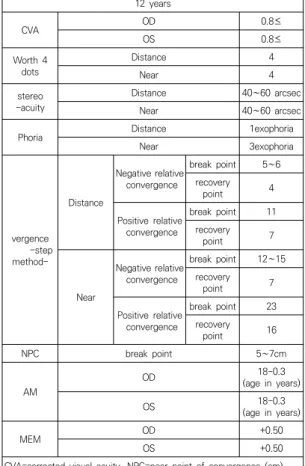
The subjects of this study were children aged 6 to 12 years who had a vision problem and at least 19 points on the ADHD evaluation scale among children diagnosed with ADHD at the hospital. All subjects were evaluated for visual function, and the data were outside the normal range on comparing with the normal standard for children (see Table 1). Subjects were 10 children (males: 8, females: 2, average age: 7 ± 0.64 years) without medication therapy and who received vision therapy from specialized institutions located in the metropolitan area August 2017-August 2018 (see Table 2). The data used in this study were based on the clinical data applied with vision therapy. Since the children were underage, we explained the purpose of the study to the guardians and obtained their consent to conduct the study and use the data.
Major eligibility criteria Expected for Primary School children aged 6 to 12 years
CVA OD 0.8≤
OS 0.8≤
Worth 4 dots
Distance 4
Near 4
stereo
-acuity Distance 40∼60 arcsec
Near 40∼60 arcsec
Phoria Distance 1exophoria
Near 3exophoria
vergence -step method-
Distance
Negative relative convergence
break point 5∼6 recovery
point 4
Positive relative convergence
break point 11 recovery
point 7
Near
Negative relative convergence
break point 12∼15 recovery
point 7
Positive relative convergence
break point 23 recovery
point 16
NPC break point 5∼7cm
AM
OD 18-0.3
(age in years)
OS 18-0.3
(age in years)
MEM OD +0.50
OS +0.50
CVA=corrected visual acuity, NPC=near point of convergence (cm), AM=accommodative amplitude (cm), MEM=monocular estimate method, exophoria (Δ), OD=oculus dexter (right eye), OS=oculus sinister (left eye), arcsec (Seconds of ARC).
***[20]
Table 1. Major eligibility criteria in children
Subject Gender Age Diagnosis & problem 1 F 9 years ADHD tendency, learning problem
2 M 12 years ADHD, learning problem
3 M 6 years ADHD, learning problem
4 F 6 years
5 months ADHD tendency, learning problem
5 M 11 years ADHD, learning problem
6 M 9 years months ADHD, learning problem
7 M 9 years
11 months ADHD, learning problem 8 M 12 years ADHD tendency, learning problem 9 M 7 years
9 months ADHD, learning problem 10 M 8 years
9 months ADHD tendency, learning problem Table 2. General characteristics of subjects (N=10)
2.2 Measurement Method
In this study, before and after the application of vision therapy, measurements were performed using the Visual Function Test (VFT), Developmental Test of Visual-Motor Integration (VMI), Test of Visual-Perceptual Skills-Revised (TVPS-R), and ADHD evaluation scale test[21-23].
2.2.1 Visual Function Problem Assessment Visual function test (VFT) was performed to select children with ADHD who had visual function problems.
VFT was performed by using equipment and tools, including VISUSSCREEN 500 (Carl Zisss Inc, Germany), Worth 4 Dot (Bernel Inc, USA), Prism Bar (Bernel Inc, USA), Polaroid glass device (Carl Zisss Inc, Germany), Polarized Glasses (Bernel Inc, USA), Howell Visual function using phoria card (Cyclopean Design Inc, made in Australia), Titmus fly (Stereo Optical co., Inc USA), Pencil, red-green filter glasses, and Penlight.
Before performing VFT, if the subject had refractive problems, the test was performed in a state in which the maximum plus to the maximum visual acuity was displayed through the test lens so that the visual function due to the refractive problem did not occur. When it was determined that there was a problem in the reliability of the measurement by attention and perception levels among the subjects, functions, such as AM were not tested. To ensure the reliability of the measurement in the VFT, perceptual practice was sufficiently performed by the subjects who needed it, and then the average value was recorded after the test was conducted twice or more than two times.
2.2.2 Normal Child Visual Functions Criteria Table 2 compares the degree of visual development in study subjects with elementary school children (major eligibility criteria) aged 6 to 12 years.
By this standard, when the distance corrected visual acuity was more than 0.8 (cutoff; ≥ 0.8) due to amblyopia, the NPC had two break points of 7 cm or less in pencil or penlight (cutoff; ≤7 cm) or an accommodative target was considered to have passed the normal standard when it was 5 cm or less (cutoff; ≤ 5 cm).
The distance/near stereoacuity was considered to be normal at 60 or less than 60 seconds (cutoff; ≤60 arcsec), or the fusion state was considered as a suitable criterion in Worth 4 Dots, a sensory fusion test[21-23].
In the case of distance (1 exophoria) and near (3 exophoria) in the exophoria group among heterophoria, the range of vergence NRC and PRC was compared with the Expected criteria for Primary School children in the 6 to 12 year age level[23] to judge success.
In the esophoria group, Percival's criterion was applied. Percival's criterion is primarily an effective criterion for the esophoria group rather than the exophoria group. The clinically important part of the Zone of clear single binocular vision (ZCSBV) is divided into three parts of NRC and PRC (blurred line); the middle part is considered as the comfort zone, and it was evaluated as a success criterion when the position of heterophoria was within the comfort zone[22].
2.2.3 ADHD Rating Scale
The ADHD Rating Scale-IV is a standard reference checklist for measuring the symptoms of ADHD according to the diagnostic criteria of DSM-IV, and it is a publicly available measurement tool for use[24]. The rating scale consists of a total of 18 questions answered by parents or teachers, and each item is rated on a 4-point scale, with or without (0 points), occasionally (1 point), often (2 points), and very often (3 points). Odd questions in the rating scale are designed to respond to attention deficit and even questions to hyperactivity-impulsive
symptoms. It is scored to measure the attention deficit symptom as the total score of odd items and the hyperactivity-impulsive symptom as the total score of even items, and the total score of all items indicates the measurement of ADHD.
Assessments by parents were used in this study and study subjects were selected in case of a score 19 or higher.
2.2.4 Test of Visual-Perceptual Skills-Revised (TVPS-R)
Test of TVPS-R is available for children aged 4 to 12 years and 11 months, and it is a visual perception test tool that does not require motor skills, such as drawing or shape description. It is a tool used clinically by occupational therapists, special teachers, and psychologists to identify visual perception weaknesses and strengths in children, and it is also used for research purposes[25].
The test is divided into the following seven areas: visual discrimination, visual memory, visual spatial relationships, visual form constancy, visual sequential memory, visual figure ground, and visual closure. In addition to the total visual perceptual skill score, each sub-area score is also provided[26].
2.2.5 Developmental Test of Visual-Motor integration (VMI)
VMI helps in screening children who may need special support or assistance through initial screening[27].
VMI consists of a total of 27 items for children from 3 to 13 years. It, is performed in groups or individually, and it is designed to evaluate the degree to which individuals can integrate visual and motor skills reflecting the developmental age differences. Beery-Buktenica VMI was first published by studying many geometric shapes, developmental ages, and distinct developmental characteristics, and later, the effectiveness and
validity of VMI was established by a cross-sectional study[27].
2.3 Arbitration Method
2.3.1 Arbitration method to improve visual function
In order to control Visual dysfunction problems (VDP), if there were significant refractive errors in the clinical field, clinicians used optical lenses, added lens power, prism, filters, occlusion, and various options for visual perception treatment, alone or in combination which are the general therapeutic guidelines[22].
The prism prescription is a very effective therapeutic method as it serves as a motive or supplement that prevents the progression of more severe suppression and promotes visual development by helping in efficient simultaneous processing of the visual information from both eyes in the brain. Prism lenses were prescribed after comprehensive evaluation according to criteria, such as clinical wisdom criterion, Sheard`s criterion, associated phoria, and prism confirmation procedure[22].
2.3.2 Composition and Application of the Vision Therapy Program
In this study, children with ADHD tendency received a vision therapy program twice a week for 45 minutes to 1 hour, for a period of 6 months to 1 year. The program was conducted in a one-on-one quiet treatment room setting with visual perception training experts.
The order of vision therapy was generally basic visual perception training, suppression therapy, extraocular muscle reinforcement training (EMRT), and binocular fusion reinforcement training (BFRT), vergence training, and tracking reinforcement training(TRT).
However, because each ADHD child has a different evaluation of optometric visual function problems and different levels of attention,
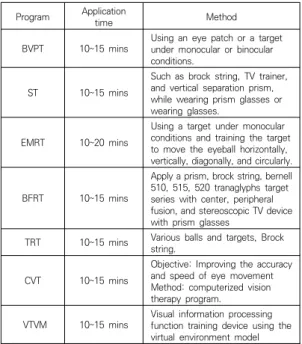
behavior, and perception, treatment methods and procedures are not uniform but active. In addition, by using a program based on Virtual environment-brain cognition vision therapy (VEMVT, Patent No. 10-0876085) using a virtual environment model, it helps to solve binocular fusion reinforcement and vergence disorder through visual feedback and movement. At the same time, it was designed to help attention control and provide motivation for ADHD children to effectively train them (see Table 3, 4).
Program Application
time Method
BVPT 10~15 mins Using an eye patch or a target under monocular or binocular conditions.
ST 10~15 mins
Such as brock string, TV trainer, and vertical separation prism, while wearing prism glasses or wearing glasses.
EMRT 10~20 mins
Using a target under monocular conditions and training the target to move the eyeball horizontally, vertically, diagonally, and circularly.
BFRT 10~15 mins
Apply a prism, brock string, bernell 510, 515, 520 tranaglyphs target series with center, peripheral fusion, and stereoscopic TV device with prism glasses
TRT 10~15 mins Various balls and targets, Brock string.
CVT 10~15 mins
Objective: Improving the accuracy and speed of eye movement Method: computerized vision therapy program.
VTVM 10~15 mins Visual information processing function training device using the virtual environment model BVPT: basic visual-perceptual training, ST: suppression therapy, EMRT: extraocular muscle reinforcement training, BFRT: binocular fusion reinforcement training, TRT: Tracking reinforcement training, CVT: computerized vision therapy program, VTVM: vision therapy-based virtual environmental model.
Table 3. Vision therapy training program
Session Stages Treatment program
1~8 Introduction stages BVPT, VTVM, ST, EMRT 9~18
Practice stages
BVPT, VTVM, ST, EMRT
19~28 BVPT, VTVM, ST, EMRT, BFRT, TRT
29~38 BVPT, VTVM, ST, EMRT, BFRT, TRT
39~48 VTVM, EMRT, BFRT, TRT, CVT
49~58 Final stages VTVM, EMRT, BFRT, TRT CVT Table 4. Vision therapy training program progress
2.4 Data Analysis
Visual perception changes and ADHD symptoms of children were compared with the normal criteria. To investigate the effectiveness before and after treatment, a non-parametric test, Wilcoxon signed rank test, was performed.
SPSS 21.0 for Windows was used for statistical processing and statistical significance was set at p <.05.
3. Results
3.1 Level of Visual Function of Study Subjects
On comparing the visual function of study subjects on the basis of that of normal children, the types of visual problem in the study subjects included 1 of amblyopia, 1 of basic esophoria associated with amblyopia, 1 of divergence excess, and 3 of convergence insufficiency, 2 of amblyopia associated with convergence insufficiency, 1 of basic exophoria, and 1 of convergence insufficiency associated with vertical deviation (see Table 5).3.2 Changes in Visual Function Before and After Vision Therapy in ADHD Children
The degree of visual function change in ADHD children before and after vision therapy was examined (see Table 6) After applying vision therapy, 4 subjects (amblyopia) who had vision development problems met the normal criteria;and in sensory fusion tests (Worth 4 dot), the number of suitable persons at distance was increased from 2 to 10, and the number of suitable persons near was increased from 1 to
10. The stereoacuity function achieved the normal standard of 40 to 60 arcsec at distance (suitable persons: 1 to 10) and Near (suitable persons: 2 to 10). In the evaluation of vergence dysfunction, 9 patients belonging to the exophoria group met both the expected value
Test
Major eligibility criteria Expected forPrimary School children
aged 6 to 12 years
Normal standard Conformity assessment
people (persons) Before
Treatment After Treatment Table 6. Comparison of normal criteria for visual
function before and after vision therapy
Test Normal criteria S1 S2 S3 S4 S5 S6 S7 S8 S9 S10
vision dysfunction type Amb XT CI Amb,
CI BE CI, VD Basic
eso, amb Amb,
CI CI CI
CVA OD 0.8≤ 0.3 0.8 1.0 0.2 1.0 1.0 0.5 0.6 1.0 0.9
OS 0.8≤ 0.3 0.8 1.0 0.2 1.0 1.0 0.6 0.6 1.0 0.9
W4 D D 4 2,.3,.4 5 5 2,3 4 5 5 5 4 5
N 4 2,3,4 5 5 3 4 5 5 5 5 5
stereo- D 40-60 arcsec 200 300 180 360 120 300 300 240 60 180
N 40-60 arcsec 150 200 60 200 60 80 200 200 80 200
Phoria D 1exo 1exo 20XT 1exo 7exo 1exo 10exo 12eso 7exo 3exo 10exo
N 3exo 3exo 8exo 7exp 15exo 1exo 20exo 10eso 15exo 12exo 20exo
vergence -step method
D
NRC bre 5-6 4 20 4 10 8 15 2 12 8 14
rec 4 2 15 2 8 6 12 -2 8 6 10
PRC bre 11 4 4 4 4 6 4 20 4 4 6
rec 7 2 2 2 2 4 2 15 2 2 4
N
NRC bre 12-15 12 20 12 20 15 25 4 25 15 25
rec 7 10 15 10 15 12 20 -2 20 10 20
PRC bre 23 8 6 6 8 15 10 25 6 6 6
rec 16 6 4 4 6 12 6 20 4 4 4
NPC break point 5-7cm 15 20 10 25 5 20 5 25 25 18
AM
OD 18-0.3
(age in yrs) 40cm 19cm (-) (-) 9cm 5cm (-) (-) (-) (-)
OS 18-0.3
(age in yrs) 40cm 20cm (-) (-) 9cm 5cm (-) (-) (-) (-)
MEM OD +0.50 +2.25 0.00 0.00 +175 +0.25 +0.25 +2.00 +1.50 0.00 +0.25
OS +0.50 +2.25 0.00 0.00 +1.75 +0.25 +0.25 +2.00 +1.50 0.00 +0.25
CVA=corrected visual acuity, W4D=Worth 4 dot, Stereo=stereoacuity, NPC=near point of convergence (cm), AM=accommodative amplitude (cm), MEM=monocular estimate method, exo=exophoria (Δ), eso=esophoria (Δ), D=distance, N=near, OD=oculus dexter (right eye), OS=oculus sinister (left eye), NRC=negative relative convergence, PRC=positive relative convergence, bre=break point (Δ), rec=recovery point (Δ), CI=convergence insufficiency, DE=divergence excess, BE=basic exophoria, VD=vertical deviation, XT (intermittent exotropia, Δ), Δ=prism, arcsec (Seconds of ARC). Amb=amblyopia Table 5. Major eligibility criteria and Clinical Details of Subjects
and Sheard`s criterion after vision therapy, and 1 case of esophoria type satisfied Percival`s criterion; therefore, the vergence function problem was solved. NPC of near was increased from 2 to 10 people, and break points were recorded at the normal standard of 5-7 cm.
3.3 Comparison of Developmental Test of Visual-Motor Integration (VMI) before and after vision therapy
VMI before and after vision therapy showed a statistically significant difference in all items (p
<.001). Therefore, after vision therapy, the visual-motor integration ability seemed to have improved (see Table 7).
3.4 Comparison of the Test of Visual- Perceptual Skills-Revised (TVPS-R) Before and After Vision Therapy
The visual perception function test before and after vision therapy showed a statistically significant difference in all 7 sub-categories.
Therefore, the visual perception function seemed to have improved after vision therapy(see Table 8).
CVA OD 0.8≤ 6 10
OS 0.8≤ 6 10
W 4 Dots D 4 2 10
N 4 1 10
stereo- D 40∼60 arcsec 1 10
N 40∼60 arcsec 2 10
Phoria D 1 exophoria 4 6
N 3 exophoria 2 4
vergence assessment
exophoria group: N(9)
• In case of Distance (1 exophoria) and Near (3 exophoria), the range of NRC and PRC of vergence is evaluated as the expected value
• In case of out of Distance (≥ 3 exophoria) and Near (≥ 5 exophoria), Sheard’s criterion for heterophoria and PRC are applied.
0 9
esophoria group: N (1 person)
• Percival’s criterion is applied
0 1
NPC break
point 5∼7 cm 2 10
AM OD 18-0.3
(age in yrs) (-) (-)
OS 18-0.3
(age in yrs) (-) (-)
MEM OD +0.50
OS +0.50
• Analysis of the expected value, Sheard's criterion, and Percival's criterion: If prism glasses were prescribed, it was determined by the range of heterophoria and vergence amount under wearing conditions.
VMI items Pre Post
z p
Mean ± SD
VMI- raw scores 15.30 ±1.42 20.70±2.11 -2.82 .00**
VMI- standard
scores 86.20 ±7.91 100.90±4.75 -2.80 .00**
VMI- percentiles 20.00 ±14.99 52.30 ±12.23 -2.81 .00**
**p≤.01
Table 7. Changes in VMI after vision therapy
TVPS-R item Pre Post
z p
Mean ± SD
Visual discrimination 103.10±19.30 112.30±7.66 -1.96 .050*
Visual memory 91.80 ±18.35 113.20±9.93 -2.39 .017* Visual spatial
relationships 104.90±12.31 114.40±7.66 -2.49 .012* Visual form constancy 77.00 ±13.70 103.90±10.45 -2.80 .005**
Visual sequential
memory 84.50± 16.53 97.40±18.61 -1.94 .005**
Visual figure ground 97.20±13.63 106.30±14.61 -2.38 .028* Visual closure 87.70±16.52 102.10±20.88 -2.80 .028*
*p≤.05, **p<.01
Table 8. Changes in TVPS-R after vision therapy
3.5 ADHD RS-IV Score Comparison Before and After Vision Therapy
ADHD scores before and after vision therapy were also statistically significant (p <.001).
Therefore, ADHD tended to decrease after visual treatment (see Table 9).
Pre Post z p
ADHD score* 30.00±9.39 9.00±4.30 -2.80 .00
*Mean±SD
Table 9. Changes in ADHD score after vision therapy
4. Discussion
This study was conducted among children who have visual problems and ADHD tendency. Based on the results of this study, this study is a preliminary study for the future study, in which the study subjects are sufficiently secured and ADHD children who do not have visual problems form the control group.
In this study, a large proportion of the problems with visual acuity development, sensory fusion, stereoacuity function, and vergence function were satisfied up to normal standards by applying vision therapy to children with visual function problems and ADHD tendency. After applying vision therapy, 4 of amblyopia met the normal criteria; and in the sensory fusion test, the number of suitable persons at distance increased from 2 to 10 and the number of suitable persons near increased from 1 to 10. In the stereoacuity function, the number of suitable persons increased from 1 to 10 people at distance, and in the near region, the number of suitable persons increased from 2 to 10 people obtaining 40-60 arcsec, the normal standard. In the evaluation of vergence dysfunction, nine patients belonging to the exophoria group achieved the normal range after vision therapy,
and one esophoria type satisfied Percival's criterion; therefore, the vergence function problem was solved. In near of point convergence (NPC) of near, the number of people judged for conformity was increased from 2 to 10.
Children with vision problems have difficulty in identifying the shape or form of an object (what system; “what is it”) and when sensory fusion or vergence anomalies occur, it is difficult to keep an eye on objects or target. lt causes failure to maintain visual attention[3], which has a negative effect on short-term memory; thus, making learning difficult. This negatively affects visual perception development, which is the basis for cognitive development. Stereoacuity provides the most accurate information on distance determination based on the information obtained using both eyes[3,28] but when such a problem occurs, it causes difficulty in determining the correct distance, and frequently collides with objects or targets. Also, unnatural behavior may occur when you go upstairs or downstairs. In addition, since stereoacuity function affects exercise performance, shape perception, hand movement, and muscle performance[29-31], and examination of stereoacuity function is necessary in children with related problems.
In this study, it was found that the developmental test of Visual-Motor Integration (VMI) was improved after applying vision therapy. Jung[32] showed similar results as this study, which is that training with the visual perception program was effective for discrimination training on color, shape, location, and size of children with developmental disabilities. In the Developmental Test of Visual-Motor Integration (VMI), the correlation between form copy tests and learning readiness tests is 0.50 to 0.70, and it is one of the excellent indicators that determine the success of future academic performance[33,34]. The correlation between form copy tests and reading
achievement is 0.40 to 0.60. To learn the concept of reading, writing, and number, the form copy function should be matured to some extent[33].
Reading ability, the most basic ability to accept new information[35], is indispensable for learning, and it requires more visual function and visual perception than any other sense. In this study, the average standard score of VMI in the study subjects was 86.20. Since all study subjects had learning disabilities or serious problems in learning, the low score of VMI can be predicted to be difficult for learning and this is supported by Beery's[33] study. One of the subjects in this study had a normal VMI score, but had difficulty learning. This suggests that even if the VMI shows a normal level, it can cause learning difficulties if there are visual problems, such as diplopia and stereoacuity function problems.
Therefore, it is considered that if there is a problem with learning, it is necessary to examine and evaluate the functional problems of children's vision.
In this study, it was found that after vision therapy, all seven sub-areas in TVPS-R were improved, including visual discrimination, visual memory, visual spatial relationships, visual form constancy, visual sequential memory, visual figure ground, and visual closure. Visual discrimination is an item that distinguishes a given picture from other similar pictures, visual memory is an item that remembers all characteristics of a given shape and identifies it from similar forms, visual spatial relationships is an item that identifies pictures in a different direction from the remaining pictures, visual form constancy is an item that looks and identifies a given form even if it is different in size, direction, or hiding, visual sequential memory is an item that remembers a given group of pictures from different groups of pictures, visual figure ground is an item to identify a given picture hidden in another object, and visual closure is an item to identify a picture that
matches the given figure when all lines are connected[26]. Kim and Song[26] said that visual sequential memory and visual closure can vary depending on the differences in children's educational experiences and environments based on where the children live. On comparison of TVPS-R among general children and children with learning problems in previous studies, standard scores were about 100 in 7 sub-areas among general children and about 85 to 91 points in 7 sub-areas among children with learning problems. In this study, the average standard score was 84.50 ~ 104.90 in the seven sub-areas of TVPS-R, showing a lower score than that in normal children and a similar or slightly higher score than that in children with learning problems.
In this study, the tendency of ADHD decreased after vision therapy. DeCarlo et al.[36] supported the findings of this study by reporting that ADHD is more common in children with visual problems than in children without visual problems. Studies have shown that ADHD-related symptoms were reduced before and after surgery of pediatric intermittent exotropia[37], and children with visual problems may be misdiagnosed as ADHD[38]. The American Psychiatric Association[39] reported a higher incidence of ADHD in children with eye dysregulation or convergence insufficiency. Granet et al.[14]
reported that the incidence of convergence insufficiency in ADHD patients accounted for 15.9%, and Borsting, Rouse, and Chu[15] also reported a high incidence of ADHD in children with vergence abnormalities.
Because the behavioral features seen in ADHD are similar to those seen in visual problems[15], it is important to pay attention to the screening diagnosis between ADHD children and children with visual problems. Vision therapy combines eye-to-head coordination, proprioceptive information in neck and limbs, and information from the overall body and other sensations to
create spatially and temporally efficient and coordinated behaviors and exert sensations under a variety of external and internal conditions[6]. On the other hand, it is known that there is reduction in the frontal lobe region and damage to the prefrontal cortex and the cerebral basal ganglia in ADHD[40,41]. The frontal lobe is the cortical center, which is responsible for saccade movement, voluntary convergence, and divergence in eye movement[42]. Therefore, it seems that the problem of visual function in ADHD is partially related to the frontal lobe region. The frontal lobe is known to be responsible for comprehensive thinking and reasoning, and the prefrontal cortex is known as the motor area. Thus, there is a lack of clinical research on the relationship between visual function problems and ADHD symptoms, and more specific neurophysiological mechanisms should be unveiled in the future.
In this study, there was a remarkable change in the ADHD evaluation scale score after applying vision therapy to children with ADHD tendency and visual function problems, and visual function was also improved. On the other hand, Yang, Lee, and Jeong[43] reported that when diagnosing ADHD symptoms in domestic adolescents, it would be helpful to understand the symptoms by distinguishing hyperactivity symptoms and impulsive symptoms rather than considering the number of corresponding symptoms among the diagnostic criteria.
However, in this study, the hyperactivity symptoms and the impulsive symptoms were not considered separately; therefore, it was not possible to determine which part of the hyperactivity and impulsivity was more affected through vision therapy. In addition, Yang, Lee, and Jeong[43] stated that it is necessary to verify whether the ADHD diagnosis system of DSM made for Westerners matches the ADHD symptoms of Korean children and adolescents. It is recommended that the diagnosis of ADHD
should be made through various and complex diagnostic and evaluation processes of the psychiatric department, and that appropriate therapeutic interventions, including drugs, should be performed based on the diagnosis and evaluation. Although it is difficult to conclude that vision therapy is associated with the improvement of ADHD symptoms only based on the results of this study, the degree of reduction in ADHD tendency after vision therapy was quite high to state that there was no relationship between ADHD tendency and visual function problems. Myoung and Kim[44] said that emotional problems, difficulties in social relation formation, and learning problems are related to the innate temperament, but they cannot only be determined by innate characteristics such as temperament. Therefore, it seems that various approaches to the potential causes of ADHD tendency are needed. In addition, it is necessary to first perform a screening diagnosis through the visual function test (VFT) under the assumption that it is a serious visual function problem before diagnosing ADHD.
Children with a tendency for ADHD without visual problems should be set as the control group and research should be conducted to further secure the number of subjects in the future. In addition, research should be conducted to determine the location where vision therapy affects ADHD trends.
4. Conclusion
In conclusion, it seems that vision therapy can be used to improve visual perception &
symptoms of children with ADHD tendency and visual problems. Also, the limitation of this study is that vision therapy was applied to a single group, and it is difficult to secure objectivity with respect to the results of the study because the subjects were not sufficiently secured. In
addition, it was not determined which vision therapy is more relevant to hyperactivity and impulsive symptoms among ADHD symptoms.
REFERENCES
[1] S. E. Palmer. (1999). Vision science: Photons to phenomenology, Cambridge, Massachusetts: The MIT Press.
[2] E. B. Goldstein. (2002). Sensation & Perception (6th ed.), Belmont, CA: Wadsworth Publishing.
[3] C. R. Fox. (1990). Some visual influences on human postural equilibrium: Binocular versus monocular fixation. Perception and Psychophysics, 47, 409-422.
[4] C. M. Schneck & S. J. Amundson. (2010). Prewriting and handwriting skills. In J. Case-Smith & J. C.
O'Brien (eds.), Occupational Therapy for Children (6th ed., pp 555–580). St. Louis, MO: Mosby Elsevier.
[5] K. J. Ciuffreda. (2002). The scientific basis for and efficacy of optometric vision therapy in nonstrabismic accommodative and vergence disorders. Optometry, 73(12), 735-762.
[6] S. W. Lee & H. M. Lee. (2015). Effect of visual perception by vision therapy for improvement of visual function. Journal of Korean Ophthalmic Optics Society, 20(4), 491-499.
[7] L. A. Kurtz. (2006). Visual perception Problems in Children with AD/HD, Autism and Other Learning Disabilities, London, Jessica Kingsley Publishers.
[8] J. Y. Kim & S. H. Y. (2020). A Study on Mediation Plans on ADHD Reading Comprehension and Reading Fluency. Journal of Special Education & Rehabilitation Science, 59(1), 109-132.
[9] C. Klein, B. Fischer Jr, B. Fischer & K. Hartnegg.
(2002). Effects methylphenidate on saccadic responses in patients with ADHD. Experimental Brain Research, 145(1), 121-125.
[10] J. Y. Hong. (2017). Effects of Small Group Art Therapy on Development of College Students with ADHD.
Journal of Special Education & Rehabilitation Science, 56(4), 105-127.
[11] S. A. Kim & E. K. Kim. (2018). A Literature Review of Reading Intervention for ADHD. The Journal of Learner-Centered Curriculum and Instruction, 18(23), 157-186.
[12] Y. J. Park & E. J. Kim. (2019). Effects of Therapeutic Interventions for Children With Attention Deficit Hyperactivity Disorder: A Systematic Review. The Journal of Korean Academy of Sensory Integration, 17(1), 43-53.
[13] R. Farrar, M. Call, & W. C. Maples. (2001). A
comparison of the visual symptoms between ADD/ADHD and normal children. Optometry, 72(7), 441-451.
[14] D. B. Granet, C. F. Gomi, R. Ventura & A.
Miller-Scholte. (2005). The relationship between convergence insufficiency and ADHD. Strabismus, 13(4), 163-168.
[15] E. Borsting, M. Rouse & R. Chu. (2005). Measuring ADHD behaviors in children with symptomatic accommodative dysfunction or convergence insufficiency: a preliminary study. Optometry, 76(10), 588-592.
[16] S. Kim, S. Chen & R. Tannock. (2014). Visual function and color vision in adults with Attention–Deficit/
Hyperactivity Disorder. Journal of Optometry, 7(1), 22-36.
[17] P. Harris. (2002). Learning related visual problems in Baltimore city: a long-term program. Journal of Optometric Vision Development, 33, 75-115.
[18] K. J. Ciuffreda, D. Rutner, N. Kapoor, I. B. Suchoff, S.
Craig, & M. E. Han. (2008). Vision therapy for oculomotor dysfunctions in acquired brain injury: a retrospective analysis. Optometry, 79(1), 18-22.
[19] G. T. Peachey, B. Optom &, P. M. Peachey. (2015).
Optometric vision therapy for visual deficits and dysfunctions: A suggested model for evidence-based practice. Vision Develpoment & Rehabilitation, 1(4), 290-336.
[20] M. B. Kim. (2017). Correlations between the reading accuracy, speed, and linguistic ability in elementary 3rd and 4th graders. Journal of the Korean Data Analysis Society, 19(2), 957-970.
[21] R. P. Rutstein & K. M. Daum. (1997). Anomalies of Binocular vision: Diagnosis & Management, (1st ed., pp 61-67). Maryland Heights, MO: Mosby.
[22] J. R. Griffin & J. D. Grisham. (2002). Binocular Anomailes: Diagonosis and vision therapy, (4th ed., pp. 70-90). Oxford: Butterworth-Heinemann.
[23] M. Scheiman & B. Wick. (2002). Clinical management of Binocular vision: Heterophoria, Accommodation, and Eye movement Disorders. (2nd ed., pp 7-10).
Philadelphia, PA: Lippincott Williams & Wilkins.
[24] G. J. DuPaul, T. J. Power, A. D. Anastopoulos & R.
Reid. (1998). ADHD rating scale-IV: Checklists, norms, and clinical interpretation, New York, NY: Guilford Press.
[25] F. G. Morrison. (1992). Test of Visual-Perceptual Skills (Non-Motor) Tvps-R 30, Belford, Northumberland:
Ann Arbor Publishers.
[26] J. M. Kim & S. J. Song. (2007). Analysis of Korean children's visual-perceptual development using TVSR-R. Journal of Emotional & Behavioral Disorders, 23(4), 241-262.
[27] B. Pfeiffer B. Moskowitz, A. Paoletti, E. Brusilovskiy, S.
l.. Zylstra & T. Murray. (2015). Developmental Test of Visual–Motor Integration (VMI): An Effective Outcome Measure for Handwriting Interventions for Kindergarten, First-Grade, and Second-Grade Students? American Journal of Occupational Therapy, 69(4), 1-7.
[28] J. C. A. Read. (2015). Stereo vision and strabismus.
Eye, 29(2), 214-224.
[29] A. R. Fielder & M. J. Moseley. (1996). Does stereopsis matter in human? Eye, 10, 233-238.
[30] M. Hayhoe, B. Gillam, K. Chajka & E. Vecellio. (2009).
The role of binocular vision in walking. Visual Neuroscience, 26(1), 73-80.
[31] A. R. O`Connor, E. E. Birch, S. Anderson & H. Draper H. (2010). The functional significance of stereopsis. Investigative Opthalmology & Visual Science, 51(4), 2019-2023.
[32] J. H. Jung. (2008). The effects of discrimination training of color, shape and size with a 9-year boy with developmental disability, Master’s thesis. Daejin University, Pocheon.
[33] K. E. Beery. (1982). Administration, scoring, and teaching manual for the developmental test of visual-motor integration, Westchester, IL: Follett Pub.
Co.
[34] H. Mati-Zissi & M. Zafiropoulou. (2001). Drawing performances in prediction of special learning difficulties of kindergarten children. Perceptual and Motor Skills, 92, 1154-1166.
[35] M. J. Huh & C. H. Park. (2018). Variables affecting reading learning in nulticultural family children.
Journal of the Korean Data Analysis Society, 20(3), 1491-1501.
[36] D. K. DeCarlo, M. Swanson, G. McGwin, K. Visscher &
C. Owsley. (2016). ADHD and vision problems in the national survey of children's health. Optometry and Vision Science, 93(5), 459-465.
[37] S. Rhiu, S. A. Chung, Y. H. Chang & J. B. Lee. (2009).
Attention deficit hyperactivity in exotropia before and after strabismus surgery. Journal of the Korean Ophthalmological Society, 50(5), 756-761.
[38] D. K. DeCarlo, E. Bowman, C. Monroe, R. Kline, G.
McGwin Jr. & C. Owsley. (2014). Prevalence of attention- deficit/hyperactivity disorder among children with vision impairment. Journal of AAPOS, 18(1), 10-14.
[39] American Psychiatric Association (APA). (2013).
Diagnostic and Statistical Manual of Mental Disorders (5th ed.)Edition (DSM 5). Washington D.C.: American Psychiatric Association.
[40] J. Y. Lee, W. S. Choi, S. H. Eun, B. L. Eun, Y. S. Hong
& J. W. Lee. (2008). Use of herbal medicine in epileptic children, Korean Journal of Pediatrics, 51(4), 935-943.
[41] K. A. Lane. (2005). Developing Ocular Motor and Visual Perceptual Skills: An Activity Workbook, Thorofare, NJ: Slack Incorporated.
[42] C. Barnhardt, S. A. Cotter, G. L. Mitchell, M. Scheiman, M. T. Kulp & CITT Study Group. (2012). Symptoms in children with convergence insufficiency: before and after treatment. Optometry and Vision Science, 89(10), 1512-1520.
[43] M. H. Yang, D. H. Lee & B. Y. Jeong. (2018).
Examination of the factor structure models of ADHD symptoms in Korean early adolescence using self, parent and teacher report. Journal of the Korean Data Analysis Society, 20(3), 1473-1490.
[44] S. Myoung & L. J. Kim. (2017). Effect of young child–
and child care teacher-level factors on young child’s disturbance and instability perceived by child care teacher: A multilevel model. Journal of the Korean Data Analysis Society, 19(2), 945-956.
조 형 철(Hyung-chel Cho) [정회원]
․ 2018년 2월 : 강원대학교 응급의료재 활학과 (이학석사)
․ 2018년 9월 ~ 현재 : 강원대학교 의 학과 박사과정
․ 2003년 5월 ~ 현재 : 한국시지각센터 원장
․ 관심분야 : Brain Cognition, Visual Physiology, Vision Therapy
․ E-Mail : [email protected]
노 효 련(Hyo-Lyun Ro) [정회원]
․ 2002년 8월 : 대구대학교 재활의학과 (이학석사)
․ 2008년 2월 : 대구대학교 물리치료학 과(이학박사)
․ 2010년 3월 ~ 현재 : 강원대학교 물리 치료학과 교수
․ 관심분야 : 운동치료, 아동 물리치료
․ E-Mail : [email protected]