노트북 열발생에 따른 열해석에 관한 융합연구
최계광
1
, 조재웅2*
1공주대학교 금형설계공학과 교수, 2공주대학교 기계자동차공학부 교수
A Convergent Investigation on the Thermal Analysis due to Heat Generation of Laptop
Kye-Kwang Choi
1
, Jae-Ung Cho2*
1Professor, Department of Metal Mold Design Engineering, Kongju national University
2Professor, Division of Mechanical & Automotive Engineering, Kongju National University
요 약 본 연구에서는 노트북의 Model A,B,C에 대한 열응력 해석을 통하여 열에 대한 내구성을 고찰하였다. Model A는 일체형으로서 열을 받는 자판 부분이 가장 뜨겁고 열 받는 곳과 거리가 먼 모니터 부분이 가장 온도가 낮은 것을 보였다. Model B와 Model C에서는 열을 받는 자판부분만 모델링 하였기 때문에 전체적으로 뜨거워지는 것을 알 수가 있다. Model A의 경우는 노트북 자판의 두께가 더 두껍지만 변형이 제일 많이 나타났고 Model C는 두께가 가장 얇으 면서도 응력과 변형이 가장 작게 나타났다. Model B의 경우는 응력이 제일 많았지만 변형은 비교적 적게 나타났다.
본 연구에서의 열해석 결과를 이용함으로서 내구성이 있는 노트북의 효율적인 최신 설계를 할 수 있다고 사료된다. 본 연구 결과를 노트북에 적용함으로서 열에 대한 노트북의 내구성을 평가할 수 있고 그 결과가 강성있는 노트북의 설계와 미적인 융합이 될 수 있다고 보인다.
주제어 : 노트북, 열 발생, 온도, 응력, 변형량, 융합
Abstract In this study, the durability on heat was considered through the thermal stress analyses on models A, B, and C of laptops. Model A is an integral part, indicating that the heated keyboard showed the highest temperature and the monitor part far from the heated one showed the coldest. In models B and C, only the heated keyboard parts are modeled, so it can be seen that they get hot overall. In the case of model A, the thickness of the laptop keyboard was thicker, but there were the most deformations, while model C had the thinnest thickness with the smallest stress and deformation. Model B had the highest stress but relatively little deformation. It is considered that the result of thermal analysis in this study can be used to make the latest efficient design of durable laptop. The durability of laptop against the heat can be evaluated by applying this study result to the laptop. And it is seen that the result can be the design of laptop with strength and the aesthetic convergence.
Key Words : Laptop, Heat generation, Temperature, Stress, Deformation, Convergence
*Corresponding Author : Jae-Ung Cho([email protected]) Received July 24, 2020
Accepted November 20, 2020 Revised August 11, 2020
Published November 28, 2020
최근에 노트북의 사용량이 많아지게 되면서 사용자들 의 needs에 맞추어 열 발생이 적고 수명이 오래가는 노 트북을 필요로 하고 있다. 따라서 노트북의 방열에 대한 연구를 활발하게 진행되고 있다. 노트북이 열을 많이 받 게 되면 수명이 줄어들 뿐만 아니라 성능 또한 저하되고, 심하게 되면 노트북 자판 부분의 모양이 변형될 수 있는 문제점이 있다. 이로 인해서 노트북의 열 발생에 따른 열 응력 해석을 시뮬레이션하여 연구를 하고 있다. 본 연구 에서 3개의 노트북 모델을 설계하였다[1-5]. 이 세 가지 모델들에 대하여 열해석을 하였다. 노트북이 일정시간 사 용되었을 때의 온도를 35℃로 가정하고 바닥을 제외하고 대류의 온도를 적용하여 열이 얼마나 많이 발생하는지에 대해서 분석하였고[6-10], 노트북 Model들 A,B,C에 대 한 열응력 해석을 통하여 열에 대한 내구성을 고찰하였 다[11-15]. 본 연구의 해석 결과를 이용하면 실제적으로 노트북의 열발생에 따른 강도를 시험하지 않고서도 측정 할 수 있다고 보인다. 그리고 그 결과가 강성있는 노트북 의 설계와 미적인 융합이 될 수 있다고 보인다.
2. 모델들에 대한 열 해석 및 구조해석의 조건들
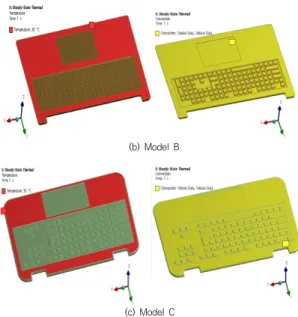
본 연구에서는 3가지의 각 모양이 다른 노트북의 자판 부분을 설계하였다. 디자인과 자판모양에 따른 열발생 차 이 를 비교하기 위해서 3가지 형상의 노트북을 설계 및 비교하였다. Model A는 모니터와 자판의 일체형 모델이 고 Model B 와 C는 자판 모델이다[11-15]. Fig. 1은 각 모델의 형상에 대하여 열 해석시의 구속 조건들을 보여 주고 있다. Table 1에서와 같이 Model A, B 및 C에 대 한 메쉬들의 절점수 및 요소수들을 나타내고 있다.
(a) Model A
(b) Model B
(c) Model C
Fig. 1. Boundary conditions of thermal analyses Table 1. Mesh informations of models
Nodes Elements
Model A 52903 30174
Model B 28800 15786
Model C 27539 14944
Table 2. Material property
Parameter Values
Young's Modules 71 GPa
Poisson's Ratio 0.33
Density 2770 kg/
Tensile Yield Strength 280 MPa
Compressive Yield Strength 280 MPa
Tensile Ultimate Strength 310 MPa
Coefficient of Thermal Expansion 2.3 ⨯10
-5/℃
각 모델마다 열이 가해지는 부분으로는 35℃로서 자 판의 윗부분에 가해지고 있고, 대류 조건으로서 책상에 닿아 있는 밑바닥 면만 제외하고 주위에 접촉하는 주위 온도는 상온인 21℃이고 대류 열전달 계수는 5 W/ m2 ㆍ℃ 이다. 그 물성치는 알루미늄 합금으로서 Table 2와 같다.
(a) Model A (b) Model B
(c) Model C
Fig. 2. Constraint conditions of structural analyses Fig. 2는 노트북 모델의 구조 해석을 하기 위한 구속 조건의 그림이다. 노트북에 추가적인 장치를 설치한다는 가정이 없기 때문에 압력을 따로 설정을 하지 않았고, 바 닥에 고정이 되는 구속조건을 부여하였다. 노트북을 바닥 에 놓는다고 가정하고 이외의 다른 압력은 없다고 하여 바닥에 고정 조건을 부여하여 열응력 및 변형량을 해석 하였다.
3. 해석 결과
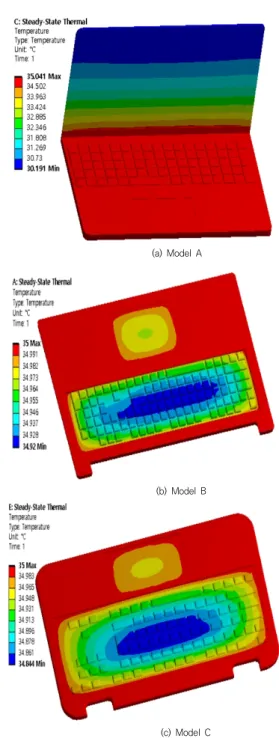
Fig. 3에서와 같이 Model A,B,C에 대한 온도 분포를 보이고 있다. Model A의 해석 그림에서는 일체형이기 때문에 모니터와 열을 받는 자판과의 온도를 비교해 보 았을 때 열을 받는 자판부분이 가장 뜨겁고 열 받는 곳과 거리가 먼 모니터 부분이 가장 온도가 낮은 것을 알 수가 있다. 수치로 보면 가장 온도가 높은 곳은 35.041℃이고 가장 낮은 곳은 30.191℃ 인 것을 알 수가 있다. Model B에서는 열을 받는 자판부분만 모델링 하였기 때문에 전 체적으로 뜨거워지는 것을 알 수가 있다. 수치로 보면 가 장 높은 곳은 35℃가 가장 높고, 34.92℃가 가장 낮은 것 을 알 수가 있다. Model C도 마찬가지로 자판 부분만 모 델링 하였기 때문에 B와 비슷한 결과가 나온다.Model C 는 열을 받은 곳에서 온도가 가장 높게 나와서 그 온도는 35℃이고 가장 낮은 곳은 34..844℃이다.
(a) Model A
(b) Model B
(c) Model C
Fig. 3. Contours of temperature analyses(a) Model A
(b) Model B
(c) Model C
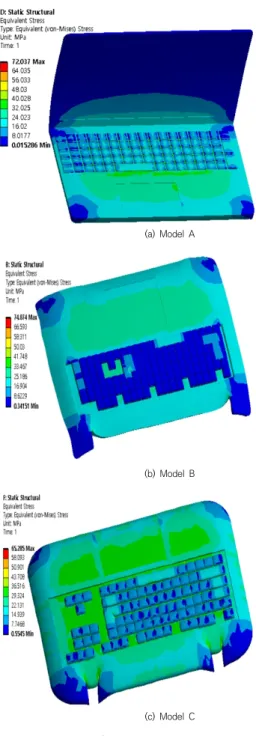
Fig. 4. Contours of equivalent stressesFig. 4 및 Fig. 5는 3가지 Model들에 대한 열 응력 및 열변형들에 대한 등고선들이다. 체형 노트북인 Model A의 경우는 노트북 자판의 두께가 두껍지만 변형 이 제일 많이 나타났고 Model C는 두께가 가장 얇으면 서도 응력과 변형이 가장 작게 나타났다.
(a) Model A
(b) Model B
(c) Model C
Fig. 5. Contours of total deformations
Model B의 경우는 응력이 제일 많았지만 변형은 비 교적 적게 나타났다.
4. 결론
본 연구에서는 노트북 Model A,B,C에 대한 열응력 해석을 통하여 열에 대한 내구성을 고찰하였다. 연구 결
과로서는 다음과 같다.
1. Model A는 일체형이기 때문에 모니터와 열을 받 는 자판과의 온도를 비교해 보았을 때 열을 받는 자판부분이 가장 뜨겁고 열 받는 곳과 거리가 먼 모니터 부분이 가장 온도가 낮은 것을 알 수가 있 다. Model B와 Model C에서는 열을 받는 자판 부분만 모델링하였기 때문에 전체적으로 뜨거워지 는 것을 알 수가 있다.
2. 체형 노트북인 Model A의 경우는 노트북 자판의 두께가 두껍지만 변형이 제일 많이 나타났고 Model C는 두께가 가장 얇으면서도 응력과 변형 이 가장 작게 나타났다. Model B의 경우는 응력 이 제일 많았지만 변형은 비교적 적게 나타났다.
3. 노트북의 두께가 얇아지면서 중량이 감소되므로서 소비자들에게 편의성이 증가되고 있다. 본 연구에 서의 열변형 및 열응력에 대한 결과를 이용함으로 서 내구성이 있고 중량이 감소된 노트북의 효율적 인 최신 설계를 할 수 있다고 사료된다. 그리고 그 결과가 강성 있는 노트북의 설계와 미적인 융합이 될 수 있다고 보인다.
REFERENCES
[1] C. W. Park. (2011). Injection Molding and Structure Analysis of Inline Skate Frames Using FEA. Journal of the Korean Society of Mechanical Technology, 35(11), 1507-1514.
DOI: 10.3795/ksme-a.2011.35.11.1507
[2] K. J. Kim & S. T. Won. (2020). Coupled Simulation of Thermal Stress by using Input Values Through Temperature Distribution by Thermal Conduction After Heat Transfer Analysis for 2.9 Liter Indirect Injection Engine Piston. Journal of the Korean Society of Mechanical Technology, 22(3), 463-468.
DOI: 10.17958/ksmt.22.3.202006.463
[3] B. S. Oh & J. U. Cho. (2020). Convergent Analysis through Durability by Thermal Stress at Drum Brake.
Journal of the Korea Convergence Society, 11(5), 139-144.
DOI: 10.15207/JKCS.2020.11.5.139
[4] Y. S. Yang & K. Y. Bae. (2020). Analysis of Thermal Stress and Fatigue Life in the Steel Shell of a Cupola Furnace. Journal of the Korean Society of Manufacturing Process Engineers, 19(2), 47-54.
DOI: 10.14775/ksmpe.2020.19.02.047
[5] M. C. Jung, S. G. Yoon, D. J. Yoon & J. S. Suh. (2020).
Numerical Analysis of Heat Transfer Characteristics inside a Solenoid Motor System. Journal of the Korean Society of Manufacturing Process Engineers, 19(4), 99-104.
DOI: 10.14775/ksmpe.2020.19.04.099
[6] H. H, Hyeon, B. H, Jeong, J. W. Kim & K. Y. Lee.
(2019). A Comparison of Performance on the Orthogonal and Refraction Heat Exchanger Shape in Air Ventilation System. Journal of the Korea Convergence Society, 10(7), 281-287.
DOI: 10.15207/JKCS.2019.10.7.281
[7] S. C. Han & B. G. Lee. (2018). A Study on Convergence Contact Behavior of Friction Heat and Pad on Disk Brake. Journal of the Korea Convergence Society, 9(1), 283-289.
DOI: 10.15207/JKCS.2018.9.1.283
[8] J. H. Lee & J. U. Cho. (2015). Convergence Technique Study through Simulation Thermal Analysis due to the Shape of Electric Heater. Journal of the Korea Convergence Society, 6(6), 241-246.
DOI: 10.15207/JKCS.2015.6.6.241
[9] E. T. Swartz & R. O. Pohl. (1989). Thermal boundary resistance. Reviews of Modern Physics, 61, 605-668.
DOI: 10.1103/RevModPhys.61.605
[10] S. H. Chang. (2015). A Consider Mechanical Rock Excavation Focusing on TBM and Roadheader. Journal of Korean Society Mineral Energy Resources Engineers, 52(5), 531-548.
DOI: 10.12972/ksmer.2015.52.5.531
[11] G. G. Choi & J. U. Cho. (2017). Convergence Study due to the Configuration of Radiant Heat Panel of Automotive LED Heat Lamp. Journal of the Korea Convergence Society, 8(3), 199-204.
DOI: 10.15207/JKCS.2017.8.3.199
[12] G. G. Choi & J. U. Cho. (2019). Convergence Study on the Thermal Stress According to the Structure of Automotive Heating Seat. Journal of the Korea Convergence Society, 10(7), 169-174.
DOI: 10.15207/JKCS.2019.10.7.169
[13] B.S. Oh & J. U. Cho. (2020). A Convergent Investigation on Structural Analysis with Thermal Stress at the Shape of Brake Disk for Racing Car.
Journal of the Korea Convergence Society, 11(6), 209-213.
DOI: 10.15207/JKCS.2020.11.6.209
[14] J. H. Yoo, J. H. Choi, I. Lee, J. H. Han, S. M. Jeon &
J. H. Kim. (2004). Transient Heat Transfer and Structural Analyses for the Turbopump Turbine of a Liquid Rocket Engine. J ournal of the Korean Society for Aeronautical & Space Sciences, 32(3), 58-65.
DOI: 10.5139/JKSAS.2004.32.3.058
[15] S. R. Park, D. C. Shim, D. Kim & M. Y. Lyu. (2010). A Study on the Structural Analysis for Plastic Door Handle of Automobile. The Korean Society for Technology of Plasticity, 19(3), 185-190.
DOI: 10.5228/KSPP.2010.19.3.185
Technology Metalmold Engineering (공학사)
․ 1995년 8월 : 국민대학교 대학원 기 계설계학과 (공학석사)
․ 2005년 2월 : 국민대학교 대학원 기 계설계학과 (공학박사)
․ 2005년 8월 : (주) 현대배관 기술부장
․ 2006년 5월 ~ 현재 : 공주대학교 금형설계공학과 교수
․ 2013년 1월 ~ 현재 : 공주대학교 글로벌 금형 기술 연구소 소장
․ 관심분야 : 3D CAD, CAM Programing
․ E-Mail : [email protected]
조 재 웅(Jae-Ung Cho) [종신회원]