www.earticle.net
돈분슬러리의 산성화처리에 따른 질소무기질화과정 및 암모니아 배출
박상현1 · 김태환2*
전남대학교 동물자원학부 박사후연구원1, 교수2
Acidification of Pig Slurry Effects on Nitrogen Mineralization and Ammonia Emission
Sang-Hyun Park1 and Tae-Hwan Kim2*
1Post-doc, 2Professor, Department of Animal Science, Institute of Agricultural Science and Technology, College of Agriculture
& Life Science, Chonnam National University, Gwangju 61186, Korea
ABSTRACT1)
This study was conducted to assess the effect of acidification of pig slurry on nitrogen (N) mineralization and its environmental impacts during pig slurry fermentation. Different inorganic and organic acids were used to acidify pig slurry. Four treatments including non-acidified pig slurry (control), pig slurry acidified with sulfuric acid, lactic acid, and citric acid were allocated with three replications.
The total N content in the acidified pig slurry was higher than non-acidified pig slurry after fermentation.
Acidification tended to increase total N content in pig slurry. Ammonium N (NH4+-N) released from pig slurry was obviously increased at 7 days after incubation, representing 61.4%, 36.8%, and 37.4% increase in the acidified pig slurry with sulfuric acid, lactic acid, and citric acid, respectively. Nitrate N (NO3--N) in the acidified pig slurry with sulfuric acid was the highest throughout the experiment period, but non-significant effect of organic acid. A large portion of ammonia (NH3) emission occurred within 10 days, corresponding to more than 55% of total NH3 emission. Total cumulative NH3 emission during the experimental period was lower 91% (2.9 mg N kg-1), 78% (7.3 mg N kg-1), and 81% (6.2 mg N kg-1) in the acidified pig slurry with sulfuric acid, lactic acid, and citric acid, respectively, than non-acidified pig slurry (32.7 mg N kg-1). These results suggest that acidification of pig slurry (particularly with sulfuric acid) can be faced as a good strategy to reduce NH3 emission without depressing the mineralization process.
(Key words: Acidification, Ammonia, Fermentation, Pig slurry, Nitrogen)
*Corresponding author: Tae-Hwan Kim, Department of Animal Science, College of Agriculture & Life Science, Chonnam National University, Gwangju 61186, Korea. Tel: +82-62-530-2126, E-mail: [email protected]
This is an Open Access article distributed under the terms of the Creative Commons Attribution Non-Commercial License (http://creativecommons.org/licenses/by-nc-nd/3.0/deed.ko), which permits unrestricted non-commercial use, distribution, and reproduction in any medium, provided the original work is properly cited. The moral rights of the named author(s) have been asserted.
I. INTRODUCTION
Nitrogen (N) is an important nutrient element and improves the growth and development of plants. Animal manure presents a low-cost alternative organic fertilizer providing valuable nutrients to improve crop yield and
soil quality so that it is used largely in the world- wide agro-ecosystem. Among the uses of animal manure, pig slurry is the most viable recycling option because pig farm usually has little or no arable land for forage production in Korea. When pig slurry is applied for the crop cultivation, the N which is bound
[Provider:earticle] Download by IP 118.70.52.165 at Monday, December 20, 2021 7:45 PM
www.earticle.net
in organic compounds must be mineralized by the soil microbes to be in a form available such as ammonium-N (NH4+-N) or nitrate-N (NO3-- N). The organic N from livestock manure into ammonium (NH4+), a process called ammonification or mineralization, with bacterial or fungal activity. The nitrification is followed to convert NH4+ to nitrate (NO3-) by the nitrifying bacteria. In the primary stage of nitrification, the oxidation of NH4+ is performed by bacteria such as the Nitrosomonas species, which converts ammonia (NH3) to nitrites (NO2-). Other bacterial species, such as Nitrobacter, are responsible for the oxidation of the NO2- into NO3-. The N mineralization of pig slurry has an important influence on soil physical and chemical properties, soil management, and soil microorganisms as well as the crop N use efficiency (Eckard et al., 2003;Boeckx et al., 2005; Li and Li, 2014).
The largest pathway of N loss from the pig slurry applied to land is NH3 volatilization, which is not only of direct loss of plant N nutrient (Chantigny et al., 2004; Hoekstra et al., 2010) but also of public concern for health and environment (Bittman and Mikkelsen, 2009). The volatilization of NH3 is a major contributor toodorous gas and a possible causal substrate of greenhouse gas such as nitrous oxide (N2O) emission via nitrification and denitrification. (Schröder, 2005).
Furthermore, the atmospheric NH3 can rapidly react with a number of acidic compounds (such as nitric acid or sulfuric acid) to form very small secondary aerosol particles. This fine particulate matter has a diameter of <2.5 microns (referred to as PM 2.5) (Bittman and Mikkelsen, 2009). Ammonia-containing materials are more prone to volatilization in alkaline conditions than under acidic conditions (pKa=9.2, 25℃).
In the alkaline condition of manure, NH4+ is readily converted to a gas, accounting typically for 40-50% in housing, 5-15% from storage, and 40-55% during application (Bittman and Mikkelsen, 2009). In this context, the possible ways to minimize NH3 emission in the animal manure managements have been performed. As a simple approach to minimize the conversion of NH4+ to NH3, the process and practice
for lowering slurry pH have been widely tested and reviewed (Fanguerio et al., 2015). In our previous study, it has shown that the final pH of pig slurry was directly associated with NH3 emissions following slurry application to soil (Park et al., 2018), inconsistent with previous results (Petersen et al., 2013; Fangueiro et al., 2015). However, the effect of initial pH level after acidification of pig slurry on mitigating NH3
emission has been poorly studied.
Sulfuric acid is utilized to acidify manure mainly for economic reasons also it acts as a sulfur fertilizer.
However, the use of sulfuric acid for acidification includes the possibility of releasing toxic gases such as hydrogen sulfide. Organic acids are widely found in nature as common plant and animal components. The use of organic acids reduces NH3 emissions and does not alter the characteristics of manure without affecting the health of farmers and animals. However, the use of organic acid additives for manure acidification has been poorly investigated.
We hypothesized in the present study that different acidification substrates affect the mineralization of pig slurry N and NH3 volatilization during the mineralization of pig slurry. To test this hypothesis, the effects of acidification with different acids including sulfuric, lactic, and citric acid on NH3 emission, and N mineralization of pig slurry were assessed during the process of liquid fermentation.
Ⅱ . MATERIALS AND METHODS
1. Experiment design
The raw pig slurry was obtained from the ECOBIO farming/agricultural association corporation (Namwon, Korea). The N property of pig slurry used in this experiment is presented in Table 1. The experiment was allocated with four treatments with three replications; pig slurry alone (control), pig slurry acidified with sulfuric acid, lactic acid, or citric acid.
For the acidification treatment, the pH of pig slurry
[Provider:earticle] Download by IP 118.70.52.165 at Monday, December 20, 2021 7:45 PM
www.earticle.net
Table 1. Nitrogen compounds of the pig slurry
Total N (g N kg-1) NH4+ (g N kg-1) NO3- (g N kg-1) Organic N (g N kg-1)
Pig slurry 2.12±0.06 343.0±4.0 70.5±0.5 1.71±0.06
Values are mean±SE of three replicates.
was adjusted to pH 6.0 by the different acid substrates.
Two kilograms of pig slurry was put into the acryl incubating chamber measured 0.2 m × 0.2 m × 0.2 m, and stirred regularly with magnetic. The incubation temperature was 25℃ and humidity was 60%.
2. Sampling of NH3emission and analysis
To collect NH3 emission, modified acid trap system method described by Ndegwa et al. (2009). Each chamber was connected (via a septum located in the lid of the chamber) to NH3-N trapping bottles containing 20 ml of 50 mM sulfuric acid. The other glass tube was connected to the vacuum system that created an airflow through the chambers at a constant rate of 1.0 L per min to exhaust the NH3-scrubbed air.
The sampling was done up to 28 days (e.g., 1, 3, 5, 7, 10, 14, 21, and 28 days at incubation), when the minimum NH3 emission of treated pig slurry was near to the negligible level. The gas sampling of each treatment was done after clamping with an attached silicone sealing for 24h. For the determination of daily NH3 emission, the concentration of NH3 in the acid trap solution (e.g. ammonium sulfate) was colorimetrically determined with Nessler’s ammonium color reagent after microdiffusion in a Conway dish (Kim and Kim, 1996). The NH3 measured for the given time was converted to daily NH3 emission per kilogram pig slurry. Cumulative NH3 emissions over the entire experimental period were calculated by summing all daily emissions at the given measurement time.
3. Nitrogenous compounds of pig slurry sample
The content of nitrogenous compounds in the pig slurry sample was determined according to the method of Bremner (1996). Total nitrogen was determined by
digestion using the Kjeldahl procedure (Tecator Kjeltec Auto 1030, Tecator, Sweden). Inorganic Nin pig slurry was extracted with 2 M KCl for 1 hour (2.5:100), followed by centrifugation and filtration through a glass filter. The NH4+-N was determined by distillation in an alkaline MgO medium. The samples in the flask then were distilled again after the addition of Devarda’s alloy for NO3--N determination (Lu, 2000).
4. Calculation
Net N mineralization (mg N/kg/d) was calculated as the difference between post- and pre- inorganic N (NH4+-N plus NO3--N) by the following equation (Hood et al., 2003; and Azeez and Averbeke, 2010):
Net N mineralization = [(NH4+ + NO3-) Dt- (NH4+ + NO3- ) D0] / incubation time
where D0 and Dt are the initial- and post-incubation time, respectively.
5. Statistical analysis
Duncan’s multiple range tests were used to compare the means of three replications between treatments.
Unless otherwise stated, conclusions are based on differences between the means, with the significant level at p 0.05 by using SAS 9.1.3 software.
Ⅲ . RESULTS AND DISCUSSION
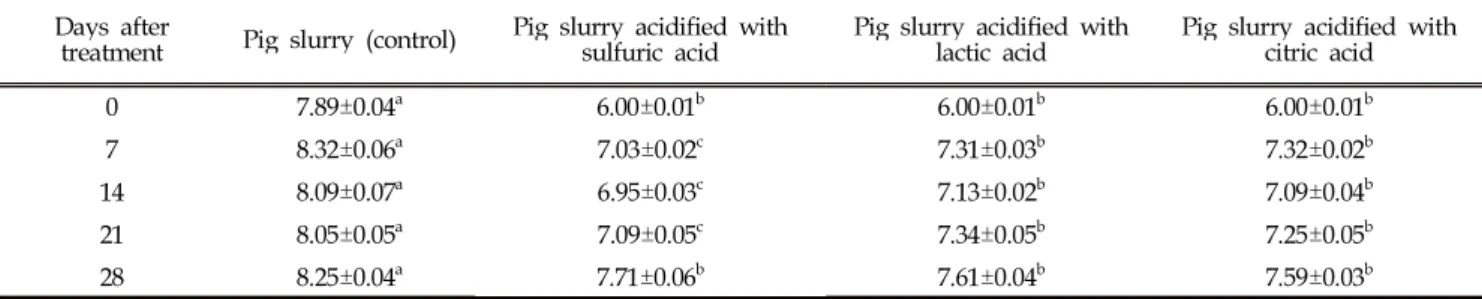
The effect of acidification on the pH of pig slurry is given in Table 2. The initial pH of non-acidified (control) pig slurry was 7.89. The pH of control pig slurry increased for the first 7 days and then slightly decreased within a range of 8.05 - 8.25. The pH of all acidified pig slurries increased from the initial pH 6.0, which was adjusted with different acidification
[Provider:earticle] Download by IP 118.70.52.165 at Monday, December 20, 2021 7:45 PM
www.earticle.net
Table 2. Changes in pH of non-acidified control, and acidified pig slurry with sulfuric acid, lactic acid and citric acid Days after
treatment Pig slurry (control) Pig slurry acidified with
sulfuric acid Pig slurry acidified with
lactic acid Pig slurry acidified with citric acid
0 7.89±0.04a 6.00±0.01b 6.00±0.01b 6.00±0.01b
7 8.32±0.06a 7.03±0.02c 7.31±0.03b 7.32±0.02b
14 8.09±0.07a 6.95±0.03c 7.13±0.02b 7.09±0.04b
21 8.05±0.05a 7.09±0.05c 7.34±0.05b 7.25±0.05b
28 8.25±0.04a 7.71±0.06b 7.61±0.04b 7.59±0.03b
Values are mean±SE of three replicates.
Different letters in horizontal row indicate significantly different at p<0.05 according to the Duncan’s multiple range test.
substrates, to 7.71, 7.61 and 7.59, respectively, for acidified pig slurry with sulfuric acid, lactic acid, and citric acid. It was noteworthy that the increase in pH for the first 7 days was the highest for all treatments.
In the early period, the mineralization of organic matter leads to an increase in pH level (Table 2), ammonium N (NH4+-N) (Fig. 1B), and ammonia (NH3) volatilization (Gigliotti et al., 2012). The decrease of pH from day 7 to 14 was possibly due to the formation of low molecular weight fatty acid and carbon dioxide (CO2) during organic matter degradation (Mao et al., 2017). In the present study, the overall pH of acidified pig slurry with inorganic acid (sulfuric acid) was relatively lower than those of acidified with organic acid such as lactic acid and citric acid. For considering an optimum nitrification pH around 7 to 8 during the fermentation of pig slurry (USEPA, 2002), it has shown that the pH of acidified pig slurry was included in the optimum range (Table 2).
The total N was decreased for the first 7 days in all treatments (Fig. 1A). The loss of total N in this early period reflected a large portion of volatile NH3
emission during this period(Fig. 3). Eklind and Kirchmann (2000), also reported that the nitrogen losses during composting occur mainly as ammonia, but may also occur as nitrogen and NOx. The loss of total N could be occurred amount to 33-50% of the initial nitrogen (Witter and Lopez-Real, 1988), while in this study, for the first 7 days, the decrease rate of total N was 36% (2.06 to 1.32 g N kg-1) in non-acidified pig slurry, whereas pig slurry with sulfuric acid, lactic acid, and citric acid decreased 6%
(2.06 to 1.93 g N kg-1), 10% (2.06 to 1.85 g N kg-1) and 12% (2.06 to 1.81 g N kg-1), respectively. Total N in acidified pig slurry was significantly higher than that of non-acidified pig slurry. Chen et al. (2010) reported that the loss of total Kjeldahl nitrogen was decreased by 28%, 61%, and 65% in addition to 3%, 6%, and 9%
of bamboo charcoal as organic matter, during pig manure composting. With the progression of composting time, the total N increased by degradation of organic compounds (Steiner et al., 2010).
The content of NH4+-N released from pig slurry also highly increased during the first 7 days in all treatments increased in all treatment (Fig. 1B).
Acidification effect on ammonification was the most obvious for the early 7 days, increase by 121% (0.34 to 0.76 g NH4+-N kg-1) with sulfuric acid, 87% (0.34 to 0.63 g NH4+-N kg-1) with lactic acid, and 88.2% (0.34 to 0.66 g NH4+-N kg-1) with citric acid. Similarly, in the acidification experiment with different acids, the content of NH4+-N released from dairy slurry over 60 days was the highest in the sulfuric acid treatment and followed by citric acid, lactic acid, acetic acid, and aluminum sulfate (Regueiro et al., 2016).
After 7 days of fermentation, the NH4+-N content in pig slurry sharply decreased under 200 mg N/kg in all treatments. This decrease in NH4+-N might be associated with the nitrification of NH4+-N to NO3--N.
Bernal et al. (2009) reported that the NH4+-N in final compost should be lower than 200 mg/kg for assuring maturity and stability.
Nitrate-N (NO3--N) tended to increase in all treatments throughout the experimental period (Fig. 1C).
[Provider:earticle] Download by IP 118.70.52.165 at Monday, December 20, 2021 7:45 PM
www.earticle.net
Fig. 1. Changes in total nitrogen (A), ammonium-N (NH4+-N, B) and nitrate-N (NO3--N, C) throughout the whole period of measurement of non-acidified pig slurry, pig slurry with sulfuric acid, pig slurry with lactic acid and pig slurry with citric acid fermentation. Data are mean±SE (n=3). Different letters indicate significantly different at p<0.05 according to the Duncan’s multiple range test.
In the acidified pig slurry with sulfuric acid, the content of NO3--N was significantly lower only at 7 days and maintained a higher level compared to other
treatments. The acidification with organic acid (citric acid and lactic acid) had not significantly influenced NO3--N content (except for day 28).
[Provider:earticle] Download by IP 118.70.52.165 at Monday, December 20, 2021 7:45 PM
www.earticle.net
The net mineralization of pig slurry was increased 148%, 113%, and 108% by acidification with sulfuric acid, lactic acid, and citric acid, respectively (Fig. 2).
However, 7 days later the net mineralization in all treatment was negative due to a rapid decrease of NH4+-N and increase of NO3--N after 7 days.
A large portion of NH3 emission occurred within 10
days, representing more than 55% of total NH3
emission (Fig. 3). Similarly, most NH3 emissions occurred within 7 days in laboratory aerobic incubation of chicken, pig, and cattle manure (Li and Li, 2014).
The emission of NH3 from pig slurry was much less in sulfuric acid, lactic acid, and citric acid treatments than that of non-acidified pig slurry. The reduction of
Fig. 2. Net nitrogen mineralization in different periods of non-acidified pig slurry, pig slurry with sulfuric acid, pig slurry with lactic acid and pig slurry with citric acid fermentation. Data are mean±SE (n=3). Different letters indicate significantly different at p<0.05 according to the Duncan’s multiple range test.
Fig. 3. Changes in daily emission of ammonia (NH3) and total cumulative NH3 emission throughout the whole period of measurement (inlet of Fig. 3) of non-acidified pig slurry, pig slurry with sulfuric acid, pig slurry with lactic acid and pig slurry with citric acid fermentation. Data are mean±SE (n=3). Different letters indicate significantly different at p<0.05 according to the Duncan’s multiple range test.
[Provider:earticle] Download by IP 118.70.52.165 at Monday, December 20, 2021 7:45 PM
www.earticle.net
NH3 emission by acidification was estimated in the previous studies: within a range of 40 to 80% for pig slurry (Stevens et al., 1989; Nyord et al., 2013) and 15 to 80% for cattle slurry (Fangueiro et al., 2013; Bussink et al., 1994). In the present study, total cumulative NH3 emission during the experimental period decreased 91%, 78%, and 81% in the pig slurry acidified with sulfuric acid, lactic acid, and citric acid, respectively (inlet of Fig. 3).
In conclusion, all acids used to acidify pig slurry allowed lower NH3 emissions in comparison with the non-acidified slurry. Among acids, Sulfuric acid can be faced as a good acidification substrate since it much efficiently reduced NH3 emissions without depressing the mineralization process.
ACKNOWLEDGMENTS
This study was financially supported by the National Research Foundation of South Korea (NRF-2019R1A6A3A01092319).
Ⅳ . REFERENCES
1. Azeez, J. O. and Averbeke, V. W. 2010. Nitrogen mineralization potential of three animal manures applied on a sandy clay loam soil. Bioresour.
Technol. 101:5645-5651.
2. Bernal, M. P., Alburquerque, J. and Moral, R. 2009.
Composting of animal manures and chemical criteria for compost maturity assessment. A review.
Bioresour Technol 100:5444-5453.
3. Bittman, S. and Mikkelsen, R. 2009. Ammonia Emissions from Agricultural Operations: Livestock.
Better Crops. 93:28-31.
4. Boeckx, P., Paulino, L., Oyarzún, C., Van Cleemput, O. and Godoy, R. 2005. Soil delta 15N patterns in old-growth forests of southern Chile as integrator for N-cycling. Isot. Environ. Health Stud. 41:249-259.
5. Bremner, J. M. 1996. Nitrogen-total. In: Sparks, D. L.,
Page, A. L., Helmke, P. A., Loeppert, R. H., Soltanpour, P. N., Tabatabai, M. A., Johnston, C. T.
and Sumner, M. E. (Ed.). Methods of soil analysis.
Part 3: chemical methods. SSSA Book Series 5. SSSA and ASA. Madison, Wisconsin, U.S.A. pp. 1085-1121.
6. Bussink, D. W., Huijsmans, J. F. M. and Ketelaars, J.
J. M. H. 1994. Ammonia volatilization from ni tric-acid-treated cattle slurry, surface applied to grassland. Neth. J. Agric. Sci. 42:293-309.
7. Chantigny, M. H., Angers, D. A., Morvan, T. and Pomar, C. 2004. Dynamics of pig slurry nitrogen in soil and plant as determined with 15N. Soil Sci. Soc.
Am. J. 68:637-643.
8. Chen, Y. X., Huang, X. D., Han, Z. Y., Huang, X., Hu, B., Shi, D. Z. and Wu, W. X. 2010. Effects of bamboo charcoal and bamboo vinegar on nitrogen conservation and heavy metals immobility during pig manure composting. Chemosphere. 78:1177-1181.
9. Eckard, R. J., Chen, D., White, R. E. and Chapman, D. E. 2003. Gaseous nitrogen loss from temperature perennial grass and clover dairy pastures in south-eastern Australia. Aust. J. Agric. Res.
54:561-570.
10. Eklind, Y. and Kirchmann, H. 2000. Composting and storage of organic household waste with different litter amendments. II. Nitrogen turnover and losses. Bioresour. Technol. 74:125-133.
11. Fangueiro, D., Surgy, S., Coutinho, J. and Vasconcelos, E. 2013. Impact of cattle slurry acidification on carbon and nitrogen dynamics during storage and after soil incorporation. J. Plant Nutr. Soil Sci. 176:540-550.
12. Fanguerio, D., Maibritt, H. and Gioelli, F. 2015.
Acidification of animal slurry - a review. J.
Environ. Manage. 149:46-56.
13. Gigliotti, G., Proietti, P., Said-Pullicino, D., Nasini, L., Pezzolla, D., Rosati, L. and Prorceddu, R. 2012.
Co-composting of olive husks with high moisture contents: organic matter dynamics and compost quality. Int. Biodeterior. Biodegrad. 67:8-14.
14. Hoekstra, N. J., Lalor, S. T. J., Richards, K. G., O’Hea, N., Lanigan, G. J., Dyckmans, J., Schulte, R.
[Provider:earticle] Download by IP 118.70.52.165 at Monday, December 20, 2021 7:45 PM
www.earticle.net
P. O. and Schmidt, O. 2010. Slurry 15NH4-N recovery in herbage and soil: effects of application method and timing. Plant Soil. 330:357-368.
15. Hood, R., Bautista, E. and Heiling, M. 2003. Goss mineralization and plant N uptake from animal manures under non-N limiting conditions, measured using 15N isotope dilution techniques.
Phytochem. Rev. 2:113-119.
16 Kim, T. H. and Kim, B. H. 1996. Ammonia microdiffusion and colorimetric method for determining nitrogen in plant tissues. J. Kor. Soc.
Grassl. Forage Sci. 16:253-259.
17. Li, L. L. and Li, S. T. 2014. Nitrogen mineralization from animal manures and its relation to organic N fractions. J. Integr. Agric. 13:2040-2048.
18. Lu, R. 2000. Analysis Method of Soil Agricultural Chemistry. China Agricultural Science and Technology Press, Beijing, China.
19. Mao, H., Zhang, T., Li, R., Zhai, B., Wang, Z., Wang, Q. and Zhang, Z. 2017. Apple pomace improves the quality of pig manure aerobic compost by reducing emissions of NH3 and N2O.
Sci. Rep. 7:870.
20. Ndegwa, P. M., Vaddella, V. K., Hristov, A. N.
and Joo, H. S. 2009. Measuring concentration of ammonia in ambient air or exhaust air steam using acid traps. J. Environ. Qual. 38:647-653.
21. Nyord, T., Liu, D., Eriksen, J. and Adamsen, A. P.
S. 2013. Effect of acidification and soil injection of animal slurry on ammonia and odour emission. In:
Proceedings from the 15th RAMIRAN Conference;
2013 Jun 3-5: Versailles, France.
22. Park, S. H., Lee, B. R., Jung, K. H. and Kim, T. H.
2018. Acidification of pig slurry effects on ammonia and nitrous oxide emissions, nitrate leaching, and
perennial ryegrass regrowth as estimated by
15N-urea flux. Asian Australas. J. Anim. Sci.
31:457-466.
23. Petersen, J., Lemming, C. and Rubæk, G.H. 2013.
Side-band injection of acidified cattle slurry as starter P-fertilization for maize seedlings. In:
Proceedings from the 15th RAMIRAN Conference;
2013 Jun 3-5: Versailles, France.
24. Regueiro, I., Coutinho, J. and Fangueiro, D. 2016.
Alternatives to sulfuric acid for slurry acidification:
impact on slurry composition and ammonia emissions during storage. J. Clean. Prod. 131:296- 307.
25. Schröder, J. 2005. Revisiting the agronomic benefits of manure: a correct assessment and exploitation of its fertilizer values spares the environment.
Bioresour. Technol. 96:253-261.
26. Steiner, C., Das, K., Melear, N. and Lakly, D. 2010.
Reducing nitrogen loss during poultry litter composting using biochar. J. Environ. Qual.
39:1236-1242.
27. Stevens, R. J., Laughlin, R. J. and Frost, J. P. 1989.
Effect of acidification with sulphuric acid on the volatilization of ammonia from cow and pig slurries. J. Agric. Sci. 113:389-395.
28. USEPA. 2002. Nitrification. http://www.epa.gov/
safewater/tcr/pdf/nitrification.pdf
29. Witter, E. and Lopez-Real, J. 1988. Nitrogen losses during the composting of sewage sludge, and the effectiveness of clay soil, zeolite, and compost in adsorbing the volatilized ammonia. Biol. Wastes.
23:279-294.
(Received 26 October 2020, Revised 26 April 2021, Accepted 30 April 2021)
[Provider:earticle] Download by IP 118.70.52.165 at Monday, December 20, 2021 7:45 PM