
IEG 환경지질연구정보센터
10
0
0
전체 글
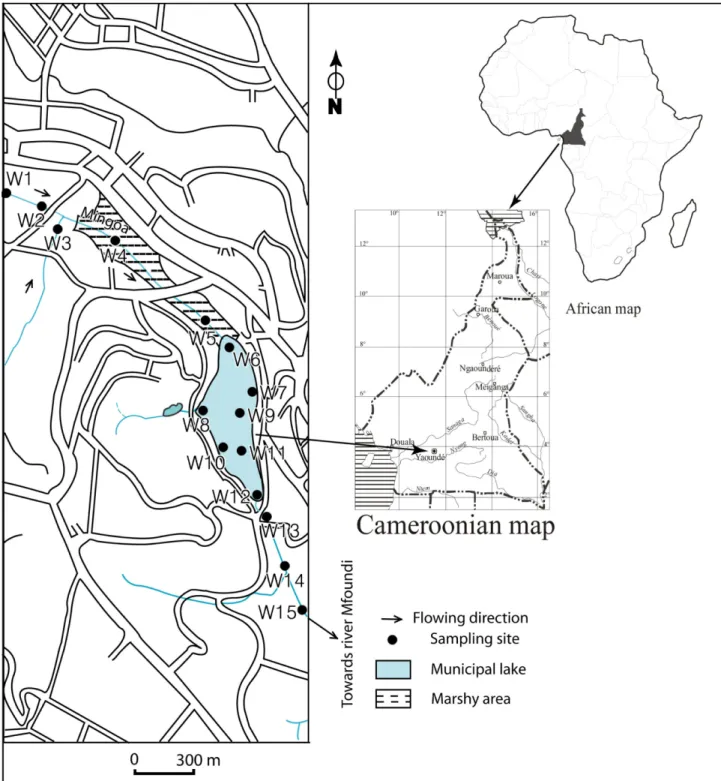
(2) 194. Ji Cheol Kwon, Ekengele Nga Léopold, Myung Chae Jung, Ekodeck Georges Emmanuel, Mbome Lape Israël, and Ki-Hyun Kim. 2. MATERIALS AND METHODS 2.1. The Study Area Yaounde is the political capital of Cameroon and second most populated city of the country with more than 1.5 million inhabitants. It is located between latitudes 3°47–3°56 N and longitudes 11°10–11°45 E, over a mean altitude of 710.8 m. Annual rainfall is around 1,600 mm and annual. Fig. 1. Locations of 15 water sampling points in this study.. mean temperature is 23 °C. The geology of the area is underlain by metamorphic rocks including migmatites, migmatitic gneisses, banded gneisses and mica schists (Nzenti et al., 1984; Mvondo et al., 2003). Yaounde counts four seasons including two (major and minor) rainy seasons and two (major and minor) dry seasons. The Municipal Lake (Fig. 1) was created in 1951, as a recreational area in the country. River Mingoa serves as a main tributary for the lake and water from the lake flows to River Mfoundi. The slop-.
(3) Impact assessment of heavy metal pollution in the municipal lake water, Yaounde, Cameroon. ing side of the lake and River Mingoa is subject to several activities such as automobile service stations, garages, a treatment station (non-operational), anarchistic disposal of domestic wastes, agricultural activities in the marshy zone, and various effluents coming from populated neighbourhoods (Mokolo, Elig-Effa, Melen, Ngoa-Ekelle and Messa). These mentioned activities are suspected to be major contributions of the degradation of the lake environment. 2.2. Sampling Method Water samples were collected from fifteen selected sites of the lake and River Mingoa on August 16th (both 2005 and 2006) and 30th (2007) all of which correspond to the minor dry season and the analyses of physico-chemical parameters and heavy metals were then made subsequently. All the samples were collected at a depth of 50 cm to minimize the introduction of floating particles. For sampling, polyethylene bottles were prewashed in the order of detergent, distilled water, 2 M nitric acid, distilled water, and the lake water. Thus, a total of 45 (i.e., triplicates from 15 sites) water samples were taken for the analysis. Each sample of 3,000 mL was taken as triplicates within a 2 m diameter in each site. A separate 250 mL sample for heavy metal analysis was filtered immediately (in-situ) through a Whatman filter paper (N° 42) and acidified with ultrapure 2 M HNO3 to pH < 2. These samples were then brought to the laboratory and kept in a refrigerator until analysis. The remaining samples were used in-situ for the determination of temperature, electrical conductivity and pH. The grid sampling was designed to describe the quality of water in the study area. Thus, five samples (W1-W5) were taken from River. 195. Mingoa, the main tributary to the lake; seven samples (W6W12) within the lake and three samples (W13-W15) in the boundary between the lake and River Mfoundi. 2.3. Analytical Methods From filtrates, concentrations of heavy metals (Na, Mg, K, Ca, Al, Fe, Cr, Mn, Co, Ni, Cu, Zn, Sr, Cd, Ba, and Pb) and Si were determined using an Inductively Coupled Plasma Atomic Emission Spectrometer (ICP-AES) (Perkins-Elmer Optima 3000 XL) under the conditions of RF power (1,300 W), plasma flow (15 L/min), coolant flow (1.5 L/min), and nebulizer flow (0.8 L/min). The precision and accuracy of analytical procedure, standard duplicates and analytical blanks were assessed for the quality control the standard procedure suggested by Ure (1995). 2.4. Statistical Analyses In order to determine the variations in heavy metal content in the Municipal Lake water and their natural or anthropogenic sources, multivariate analysis techniques were utilized with the aid of XLSTAT 2007. Multivariate statistical analysis provides an alternative method to assess the pollution sources as it allows, to apportion the relative contribution between natural versus anthropogenic process and to give indications about the transport processes and the prevailing environmental conditions (Yalcin et al., 2008). PCA is a multivariate method mainly used for the reduction of data groups and finding a few significant components that explain the major variation within each data group (Zhou et al., 2008). A probability value of p < 0.05 was considered as statisti-. Table 1. Elemental concentrations (mg/L) and physicochemical characteristics of water samples collected in two year periods between 2005 and 2007 Na Mean (2005) Min. Max. Stdev. Mean (2006) Min. Max. Stdev. Mean (2007) Min. Max. Stdev. WHO (2008). Mg. K. Ca. Al. Fe. Si. Cr. Mn Co mg/L. Ni. Cu. Zn. Sr. Cd. Ba. Pb. pH. EC Temp (µS/cm) (°C). 35.37 3.77 20.01 20.78 0.22 1.60 4.91 0.02 0.245 0.008 0.014 0.016 0.013 0.043 0.008 0.060 0.015 7.10. 410. 26. 20.82 2.65 10.97 16.59 0.06 0.23 1.44 0.01 0.125 0.006 0.004 0.004 0.006 0.032 0.001 0.050 0.007 6.47 74.44 7.95 54.79 31.58 1.18 6.57 8.30 0.03 0.491 0.012 0.020 0.023 0.041 0.081 0.032 0.082 0.035 7.75 16.65 1.42 12.52 3.39 0.28 2.17 1.52 0.01 0.144 0.002 0.007 0.007 0.009 0.012 0.011 0.010 0.008 0.38. 295 753 139. 26 27 1. 68.07 27.97 39.10 14.40 0.07 1.51 2.88 0.02 0.244 0.008 0.006 0.005 0.025 0.039 0.007 0.053 0.018 6.82. 336. 25. 8.88 1.66 1.25 7.08 0.01 0.09 1.31 0.00 0.093 0.002 0.003 0.001 0.005 0.016 0.001 0.034 0.001 6.12 596.90 371.98 384.46 26.18 0.16 5.03 5.75 0.11 0.470 0.012 0.007 0.011 0.210 0.059 0.025 0.090 0.052 7.90 147.56 95.18 96.20 6.66 0.04 1.91 1.64 0.03 0.146 0.002 0.001 0.003 0.052 0.010 0.009 0.017 0.015 0.52. 99 830 192. 25 26 0. 31.86 3.68 15.57 24.30 0.05 1.76 3.05 0.01 0.307 0.011 0.006 0.008 0.012 0.046 0.007 0.058 0.016 7.22. 304. 26. 9.65 1.94 4.10 9.31 0.01 0.19 1.42 0.00 0.062 0.004 0.001 0.001 0.003 0.021 0.001 0.030 0.004 6.55 73.38 6.87 41.57 66.42 0.19 5.86 5.89 0.03 0.628 0.032 0.008 0.035 0.020 0.068 0.029 0.106 0.046 7.80 17.32 1.17 9.18 12.45 0.04 2.24 1.72 0.01 0.218 0.006 0.003 0.008 0.005 0.010 0.010 0.024 0.010 0.35. 119 555 118. 26 27 0. −. −. 200.00. −. −. 300.00 0.20 0.30. −. 0.050 0.400 0.050 0.070 2.000 5.000. −. 0.003 0.700 0.010 6.5−8.5.
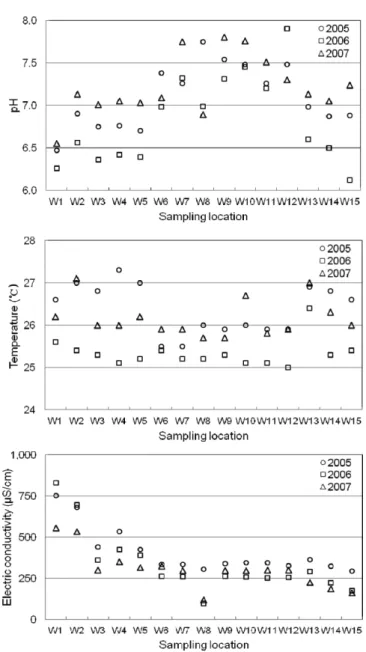
(4) 196. Ji Cheol Kwon, Ekengele Nga Léopold, Myung Chae Jung, Ekodeck Georges Emmanuel, Mbome Lape Israël, and Ki-Hyun Kim. cally significant cases in this study. 3. RESULTS AND DISCUSSION 3.1. Physico-Chemical Analyses The physico-chemical conditions of our water samples are summarized in Table 1. The pH ranged from 6.12 to 7.90 with a mean value of 7.05, the electrical conductivity (µS cm−1) varied from 98.60 to 830 with a mean value of 350. The temperature of surface waters in the study area ranged from 25.0 to 27.30 °C with a mean value of 29.0 °C. The minimum pH value was measured as 6.12 in August 2006 and the maximum pH value was 7.90 measured in August 2006. In terms of pH, water in the studied area can be classified in class 1A/1B, i.e., good to excellent quality. These pH values in all two years of samples comply with guideline values of the WHO (6.5–8.5). The minimum and maximum electrical conductivities were measured as 98.6 µS cm−1 within the lake (August 2006) and 830 µS cm−1 in River Mingoa (August 2006), respectively. Electrical conductivity values in all the years are compatible with the values proposed by Didier Gaujous (1995) for fairly good river (750~1500 µS cm−1). The minimum and maximum temperatures were measured as 25 °C within the lake (August 2006) and 27.3 °C in River Mingoa (August 2005), respectively. In terms of water temperature, the studied area is mediocre which can enhance the growth of microorganisms, while increasing taste, odour, colour and corrosion problems. In addition, these properties of water may affect the solubility of gases and salts in the water column Dixit and Tiwari (2008).. lutants from activities in the sloping side of river Mingoa and the Municipal Lake. For instance, the agricultural practice in the marshy zone can be a source of many of those metals. Domestic inputs and other wastes (such as vehicle exhaust, brake wear, tire wear, paints, solders, and building materials) can also contribute significantly to the enrichment of metals in the study zone. Various studies pointed out that a variety of anthropogenic activities may change the dynamics of the river system and add a variety of heavy metals contaminants (Ouyang et al., 2006; Cortecci et al., 2009; N’guessan et al., 2009; Moore et al., 2011; Varol, 2011; Li et al., 2011). Likewise, studies carried out in India where anthropogenic activities such as agriculture, domestic with production of waste, industries, are present, were considered to be major sources of metals like Cu, Zn, Cr, Co, Ni, Pb, Cd, Fe and Mn to the system (Banerjee et al., 2012).. 3.2. Annual Variations of Elemental Concentrations in the Lake The elemental concentrations and physicochemical properties of water samples measured during this study are given in Table 1. The metal concentrations (mg L−1) measured in this study generally exhibited strong variability such as Na, 8.88~76.35 (mean value of 33.16); Mg, 1.66~ 37.20 (4.37); K, 1.25~54.79 (17.21); Ca, 7.08~66.42 (20.72); Al, 0.01~1.18 (0.11); Fe, 0.09~6.57 (1.62); Cr, 0.004~0.112 (0.017); Mn, 0.062~0.628 (0.265); Co, 0.002~0.032 (0.009); Ni, 0.001~0.020 (0.009); Cu, 0.001~0.035 (0.010); Zn, 0.003~0.210 (0.016); Sr, 0.016~0.081 (0.043); Cd, 0.001~ 0.032 (0.007); Ba, 0.030~0.106 (0.057); Pb, 0.001~0.052 (0.016). Si varied moderately from 1.31 to 8.30 with the mean value of 3.61. The results of chemical analyses indicate that maximum concentrations of heavy metals (and Si) occur in River Mingoa (e.g., Na, Mg, K, Al, Fe, Cr, Mn, Cd, and Pb). This finding suggests that River Mingoa, the main tributary to the Municipal Lake most likely is the main collector of pol-. Fig. 2. Annual variation in physicochemical properties of water samples taken from 2005 to 2007..
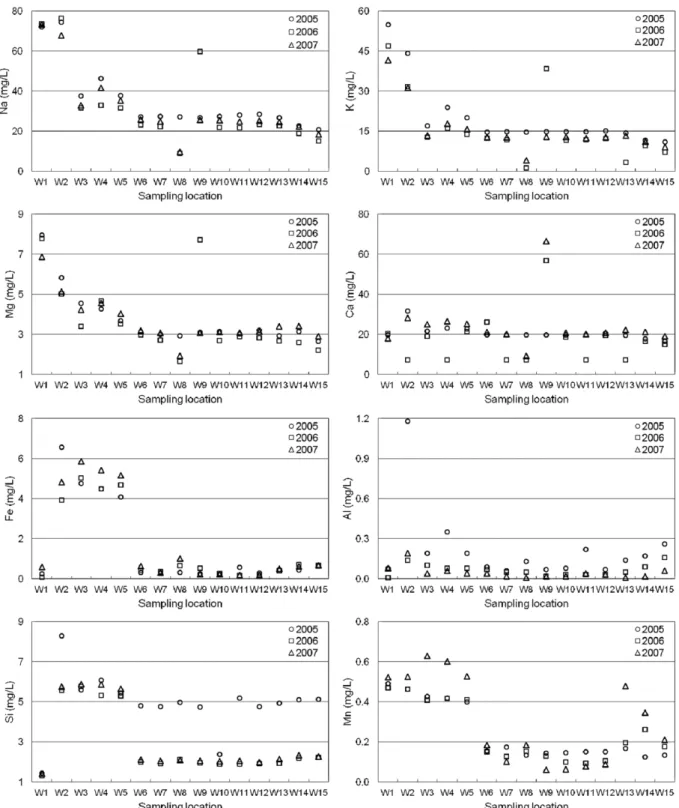
(5) Impact assessment of heavy metal pollution in the municipal lake water, Yaounde, Cameroon. The concentration of Pb is mostly linked to automobiles and petrol station services nearby (Léopold et al., 2008). Lead concentration was also found high within the lake. This can be traced from the destruction of batteries nearby the lake (by craftsmen) to recover lead and cadmium. In contrast, the distribution of Co, Ni, Cu, Zn, Sr, Ba, and Si did not show significant variations among sites.. 197. The concentrations of Na, K, Ca and Mg are excessively high at site 12 within the lake, especially in 2006, as shown in Figure 3. This can be explained by possible influx of effluents from a nearby hotel of which waste waters are discharged to the lake. However, the results also suggest that some of the analysed elements should share similar sources which can be related to the geological structure of the area.. Fig. 3. Annual variation in major and minor element concentrations of water samples taken from 2005 to 2007..
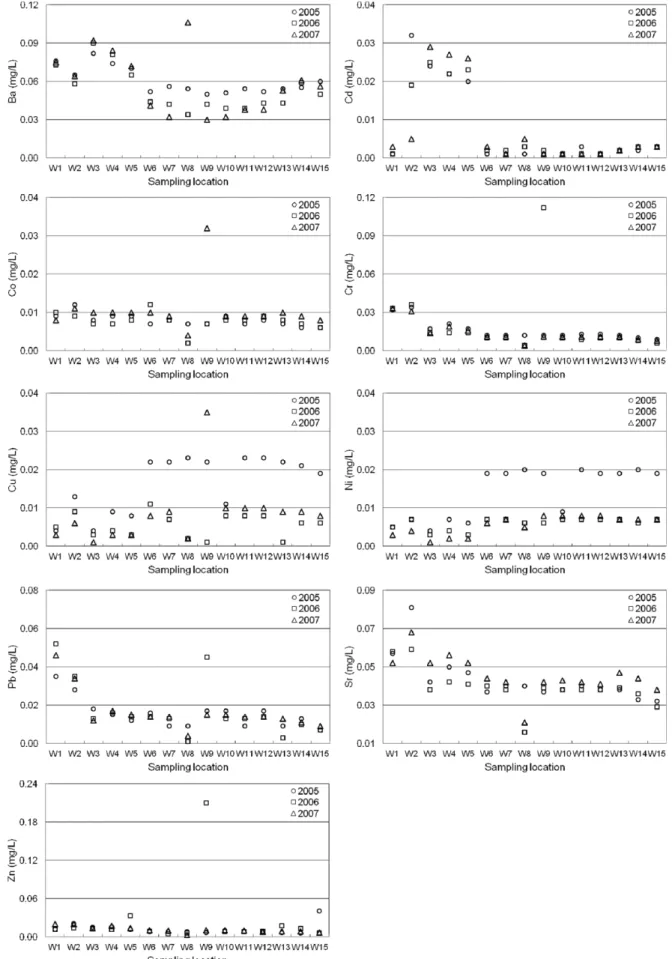
(6) 198. Ji Cheol Kwon, Ekengele Nga Léopold, Myung Chae Jung, Ekodeck Georges Emmanuel, Mbome Lape Israël, and Ki-Hyun Kim. Fig. 4. Annual variation in trace element concentrations of water samples taken from 2005 to 2007..
(7) Impact assessment of heavy metal pollution in the municipal lake water, Yaounde, Cameroon. The average concentrations of Al, Fe, Mn, Cd, and Pb are higher relative to the WHO standards (WHO, 2008) (Table 1). These elements except Pb are highly concentrated in River Mingoa, while Pb is rather concentrated in both River Mingoa and within the lake. It was seen that River Mingoa had a slightly acidic pH, especially in 2005 and 2006; this might explain the relative enhancement of Al, Fe, Mn, Cd, and Pb. Samecka-Cymerman and Kempers (2001) showed that the highest concentrations of cadmium, copper and lead in water were found in lakes with the lowest pH values. Tokalioglu et al. (2000) indicated that cadmium, copper, and lead concentrations in lake water samples decrease with increasing pH, because the metal binding abilities decrease with declining pH (due to proton binding). A decrease in pH will also promote the competition between metal species and hydrogen ions for binding sites. As a result, metal complexes can dissolve to release free metal ions into the water column (Ebrahimpour and Mushrifah, 2008). An increase in pH is thus often accompanied by a decrease in the solubility of many toxic heavy metals in water (Avila-Pérez et al., 1999). In the present study, Al, Fe, Mn, Cd, and Pb appear to be the major pollutants in the study area referring to WHO standards (Table 1), which can ultimately pose health risks for those who use these waters. The annual variations of physico-chemical properties, major and minor element concentrations and trace element concentrations across three year periods (2005 to 2007) are shown in Figures 2, 3, and 4, respectively. As shown in these. 199. figures, the annual differences in Na, K, and Mg in these samples seem to maintain a highly constant pattern in the study area, suggesting their common abilities of identical origin. Similar patterns are also found in the annual variation of Fe, Si, Mn, Sr, Cd and Pb concentrations in the study area. 3.3. Statistical Analysis A variety of methods are used the information concealed between the variables water quality monitoring, and the multivariate statistical techniques are one of the appropriate tools for a meaningful and their interpretation. The multivariate statistical techniques, such as cluster analysis (CA), principal component analysis (PCA), factor analysis (FA), discriminant analysis (DA), and multidimensional scaling (MDS) have been successfully used as unbiased methods in the analysis of water quality (Altin et al., 2009). PCA and FA are multivariate statistical techniques used to identify important components or factors that explain most of the variances of a system. They are designed to reduce the number of variables to a small number of indices (i.e., principal components or factors) while attempting to preserve the relationships present in the original data (Ouyang, 2005; Ouyang et al., 2006). From the analysis of variance, most of the elements (including Na, Mg, K, Al, Fe, Cr, Zn, and Cd) varied significantly from one site to another over the years (p < 0.05). Ca, Si, Mn, Co, Ni, Cu, Sr, Ba, and Pb displayed moderate. Table 2. Spearman correlation coefficients among element concentrations and physicochemical properties of water samples collected in two year periods between 2005 and 2007 Variables Na Mg K Ca Al Fe Si Cr Mn Co Ni Cu Zn Sr Cd Ba Pb pH EC Temp Na 1.00 Mg 0.98 1.00 K 1.00 0.99 1.00 Ca 0.02 0.02 0.01 1.00 Al 0.01 −0.07 0.01 −0.26 1.00 Fe 0.01 −0.07 −0.03 0.04 0.46 1.00 Si −0.08 −0.13 −0.10 −0.24 0.59 0.77 1.00 Cr 0.95 0.88 0.95 0.01 0.14 0.14 0.03 1.00 Mn 0.02 −0.10 −0.01 0.06 0.22 0.76 0.45 0.22 1.00 Co −0.02 −0.05 −0.02 0.81 0.02 0.03 −0.08 0.03 0.00 1.00 Ni −0.11 −0.07 −0.10 −0.39 0.10 −0.48 0.19 −0.18 −0.55 −0.15 1.00 Cu −0.23 −0.21 −0.22 0.06 0.14 −0.38 0.19 −0.26 −0.49 0.39 0.84 1.00 Zn 0.97 0.98 0.97 0.04 0.00 0.02 −0.05 0.89 −0.03 −0.04 −0.10 −0.23 1.00 Sr 0.12 −0.04 0.10 0.17 0.52 0.55 0.39 0.37 0.67 0.34 −0.30 −0.12 0.02 1.00 Cd 0.00 −0.07 −0.04 −0.01 0.45 0.96 − 0.11 0.72 0.00 −0.46 −0.37 0.02 0.46 1.00 Ba −0.06 −0.12 −0.07 −0.16 0.16 0.63 0.47 0.06 0.75 −0.24 −0.32 −0.38 −0.07 0.26 0.64 1.00 Pb 0.56 0.42 0.55 0.10 0.12 0.12 −0.05 0.75 0.43 0.16 −0.24 −0.24 0.43 0.62 0.05 0.17 1.00 pH 0.01 0.08 0.03 0.23 −0.17 −0.40 −0.17 −0.09 −0.58 0.29 0.37 0.48 0.01 −0.14 −0.42 −0.58 −0.21 1.00 EC 0.11 −0.06 0.10 −0.12 0.41 0.36 0.32 0.38 0.56 0.14 −0.12 −0.06 −0.01 0.76 0.32 0.34 0.75 −0.39 1.00 Temp −0.09 −0.15 −0.09 −0.10 0.42 0.25 0.36 0.02 0.33 0.07 0.11 0.14 −0.09 0.43 0.18 0.22 0.06 −0.05 0.31 1.00 Values in bold face represent the cases that are statistically significant correlation at 95% confidential level (p < 0.05)..
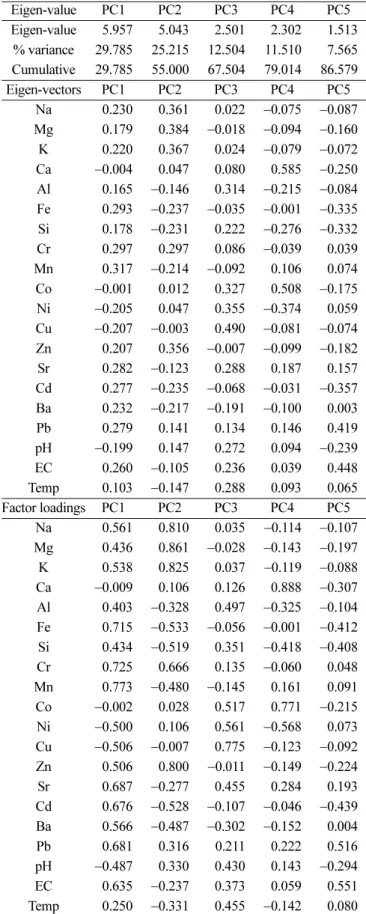
(8) 200. Ji Cheol Kwon, Ekengele Nga Léopold, Myung Chae Jung, Ekodeck Georges Emmanuel, Mbome Lape Israël, and Ki-Hyun Kim. variation from one site to another (p < 0.05). The temperature and pH did not vary significantly (p < 0.05), while the electrical conductivity varied moderately from one site to another. The inter-element Pearson correlation matrix for the water in the study area water is shown in Table 2. Very high positive correlations (P < 0.05) were observed between the pairs of Mg/Na, K/Na, K/Mg, Cr/Na, Cr/K, Zn/Na, Zn/Mg, Zn/K and Cd/Fe. High positive correlations (p < 0.05) were also noticed between Zn/Cr, Cr/Mg, Cu/Ni and Co/Ca pairs. Moderate correlations (p < 0.05) were observed between Pb/Na, Pb/K, Si/Al, Sr/Al, Si/Fe, Mn/Fe, Sr/Fe, Ba/Fe, Cd/ Si, Pb/Cr, Sr/Mn, Cd/Mn, Ba/Mn, Pb/Sr and Ba/Cd pairs. In addition, the existence of inverse correlation (p < 0.05) was also observed between Ni/Mn, pH/Mn and pH/Ba pairs. Moderate correlations were noticed between the conductivity and the following elements: lead, manganese and strontium. Correlation coefficients are one of the indices to assess the strength of a relationship between different variables (Kim et al., 2007). The strong correlations between the elements generally indicate that these elements had the same input sources and similar geochemical behavior (Moore et al., 2011). Eigen-vectors, factor loadings, eigen-values and variances in the PCA for the chemical properties of the waters in the studied area are shown in Table 3. Five factors (with eigenvalues > 1) computed from principal component analysis are explained with a cumulative variance of 86.6%. The 29.8% of total variance is contributed by PC1 with higher positive loadings for Mn, Cr, Fe, Sr, Pb, Cd, Ba, Na, K and Zn and negative loadings for Ni and Cu. Considering the low enrichment of some metals especially Pb and Cd in the non-mineralized metamorphic rocks in the study area, this type of association between elements suggests that their principal sources are anthropogenic, although the presence of Sr is not well explained. The role of anthropogenic source is most evident with the above listed activities carried out on the sloping side of river Mingoa and the Municipal lake. PC2 highly positively loaded with Mg, K, Na, Zn and Cr, and negatively with Si, Fe and Cd, accounts for 25.2% of the total variance. It takes its origin from human activities that are mainly domestic and/or agriculture. This explains their relative dominance in River Mingoa and the lake where domestic effluents come from a nearby hotel. PC3 with high positive contribution of Cu, Co and Ni accounts for 12.5% of the total variance. Although some human activities can lead to the enrichment of these elements in the environment, their presence in the studied area is more likely controlled by the “natural factor” of the lithogenic processes due to the weathering progress of natural parent materials (such as rocks and soils). PC4 exhibits high positive loading for Ca and Co and negative for Ni, with a maximum contribution of 11.5% of the total variance. This is also expected to be controlled by. Table 3. Summary of statistic results from principal component analysis (PCA) using physicochemical properties and chemical components of water samples collected in two year periods between 2005 and 2007 Eigen-value Eigen-value % variance Cumulative Eigen-vectors Na Mg K Ca Al Fe Si Cr Mn Co Ni Cu Zn Sr Cd Ba Pb pH EC Temp Factor loadings Na Mg K Ca Al Fe Si Cr Mn Co Ni Cu Zn Sr Cd Ba Pb pH EC Temp. PC1 5.957 29.785 29.785 PC1 0.230 0.179 0.220 −0.004 0.165 0.293 0.178 0.297 0.317 −0.001 −0.205 −0.207 0.207 0.282 0.277 0.232 0.279 −0.199 0.260 0.103 PC1 0.561 0.436 0.538 −0.009 0.403 0.715 0.434 0.725 0.773 −0.002 −0.500 −0.506 0.506 0.687 0.676 0.566 0.681 −0.487 0.635 0.250. PC2 5.043 25.215 55.000 PC2 0.361 0.384 0.367 0.047 −0.146 −0.237 −0.231 0.297 −0.214 0.012 0.047 −0.003 0.356 −0.123 −0.235 −0.217 0.141 0.147 −0.105 −0.147 PC2 0.810 0.861 0.825 0.106 −0.328 −0.533 −0.519 0.666 −0.480 0.028 0.106 −0.007 0.800 −0.277 −0.528 −0.487 0.316 0.330 −0.237 −0.331. PC3 2.501 12.504 67.504 PC3 0.022 −0.018 0.024 0.080 0.314 −0.035 0.222 0.086 −0.092 0.327 0.355 0.490 −0.007 0.288 −0.068 −0.191 0.134 0.272 0.236 0.288 PC3 0.035 −0.028 0.037 0.126 0.497 −0.056 0.351 0.135 −0.145 0.517 0.561 0.775 −0.011 0.455 −0.107 −0.302 0.211 0.430 0.373 0.455. PC4 2.302 11.510 79.014 PC4 −0.075 −0.094 −0.079 0.585 −0.215 −0.001 −0.276 −0.039 0.106 0.508 −0.374 −0.081 −0.099 0.187 −0.031 −0.100 0.146 0.094 0.039 0.093 PC4 −0.114 −0.143 −0.119 0.888 −0.325 −0.001 −0.418 −0.060 0.161 0.771 −0.568 −0.123 −0.149 0.284 −0.046 −0.152 0.222 0.143 0.059 −0.142. PC5 1.513 7.565 86.579 PC5 −0.087 −0.160 −0.072 −0.250 −0.084 −0.335 −0.332 0.039 0.074 −0.175 0.059 −0.074 −0.182 0.157 −0.357 0.003 0.419 −0.239 0.448 0.065 PC5 −0.107 −0.197 −0.088 −0.307 −0.104 −0.412 −0.408 0.048 0.091 −0.215 0.073 −0.092 −0.224 0.193 −0.439 0.004 0.516 −0.294 0.551 0.080.
(9) Impact assessment of heavy metal pollution in the municipal lake water, Yaounde, Cameroon. local geology. PC5 accounts for 7.6% of the total variance and contains a high loading of Pb. It has been observed that certain craftsmen destroy batteries to recover lead. This activity is carried out close to the lake (Léopold et al., 2008). Atmospheric deposition could be another source of lead in the studied area with the high automobiles traffic in the Yaounde city. It thus implies that the presence of lead in these waters has many anthropogenic sources and entrances into the lake. 4. CONCLUSIONS In recent years, many African countries have undergone considerable population growth, accompanied by a steep increase in urbanization. Consequently, large amount of contaminants were found at elevated levels in the river water system. The present study was undertaken to evaluate the extent of heavy metal pollution in water influx, within and efflux the Municipal Lake of Yaounde. The results of this study which was taken over a three year periods (from August 2005 to August 2007) are analyzed to assess their variability and origin. The results of chemical analyses showed that concentrations of heavy metals such as Al, Fe, Mn, Cd and Pb exceeded the general guideline values of the WHO for drinking water. These elements are considered as major pollutants in these waters and may pose potential health risks for their users. It has also been noticed that these elements are more concentrated in River Mingoa relative to the surrounding areas that Mingoa is the principal collector of pollutants due probably to the several activities carried out on the sloping side. According to multivariate statistic approaches (PCA) as a tool to distinguish sources of heavy metals, highly strong correlations were observed between many element pairs. When our data were examined in terms of PCA, factors computed explained 86.6% of total variance. These factor loadings are mainly explained by anthropogenic inputs, lithogenic processes (during weathering progress of natural parent materials), and local geology. In detail, the concentrations of Mn, Cr, Fe, Sr, Pb, Cd, Ba, Na, K, Zn and Mg, are mainly from anthropogenic sources, while Cu, Co, Ni and Ca are mostly controlled by local geology. REFERENCES Altin, A., Filiz, Z., and Iscen, C.F., 2009, Assessment of seasonal variations of surface water quality characteristics for Porsuk Stream. Environmental Monitoring Assessment, 158, 51−65. An, Q., Wu, Y., Wang, J., and Li, Z., 2010, Assessment of dissolved heavy metal in Yangtze River estuary and its adjacent sea, China. Environmental Monitoring Assessment, 164, 173−187. Avila-Pérez, P., Balcázar, M., Zarazúa-Ortega, G., Barceló-Quintal, I., and Díaz-Delgado, C., 1999, Heavy metal concentrations in water and bottom sediments of a Mexican reservoir. Science of the Total Environment, 234, 185−196.. 201. Baldantoni, D., Alfani, A., Tommasi, P.D., Bartoli, G., and Santo, A.V., 2004, Assessment of macro and microelement accumulation capability of two aquatic plants. Environmental Pollution, 130, 149−156. Banerjee, K., Senthilkumar, B., Purvaja, R., and Ramesh, R., 2012, Sedimentation and trace metal distribution in selected locations of Sundarbans mangroves and Hooghly estuary, Northeast coast of India. Environmental Geochemistry and Health, 34, 27−42, DOI 10.1007/s10653-011-9388-0. Bulut, V.N., Bayram, A., Gundogdu, A., Soylak, M., and Tufekci, M., 2010, Assessment of water quality parameters in the stream Galyan, Trabzon, Turkey. Environmental Monitoring Assessment, 165, 1−13. Cortecci, G., Boschetti, T., Dinelli, E., Cidu, R., Podda, F., and Doveri, M., 2009, Geochemistry of trace elements in surface waters of the Arno River Basin, northern Tuscany, Italy. Applied Geochemistry, 24, 1005−1022. Dixit, S. and Tiwari, S., 2008, Impact Assessment of Heavy Metal Pollution of Shahpura Lake, Bhopal, India. International Journal of Environmental Research and Public Health, 2, 37−42. Dragun, Z., Roje, V., Mikac, N., and Raspor, B., 2009, Preliminary assessment of total dissolved trace metal concentrations in Sava River water. Environmental Monitoring Assessment, 159, 99−110. Ebrahimpour, M. and Mushrifah, I., 2008, Heavy metal concentrations in water and sediments in Tasik Chini, a freshwater lake, Malaysia. Environmental Monitoring Assessment, 141, 297−307. Gaujous, D., 1995, La pollution des milieux aquatiques : aidemémoire, 2nd edition, Technique & Documentation – Lavoisier, Paris, 220 p. Hur, J. and Jung, M.C., 2009, The effects of soil properties on the turbidity of catchment soils from the Yongdam dam basin in Korea. Environmental Geochemistry and Health, 31, 365−377. Kamau, J.N., Gachanja, A., Ngila, C., Kazungu, J.M., and Zhai, M., 2008, Anthropogenic and seasonal influences on the dynamics of selected heavy metals in Lake Naivasha, Kenya. Lakes and Reservoir Research and Management, 13, 145−154. Kim, J.G., Ko, K.-S., Kim, T.H., Lee, G.H., Song, Y., Chon, C.-M., and Lee, J.-S., 2007, Effect of mining and geology on the chemistry of stream water and sediment in a small watershed. Geosciences Journal, 11, 175−183. Léopold, E.N., Jung, M.C., Auguste, O., Ngatcha, N., Georges, E., and Lape, M., 2008, Metals pollution in freshly deposited sediments from river Mingoa, main tributary to the Municipal lake of Yaounde, Cameroon. Geosciences Journal, 12, 337−347. Li, S., Li, J., and Zhang, Q., 2011, Water quality assessment in the rivers along the water conveyance system of the Middle Route of the South to North Water Transfer Project (China) using multivariate statistical techniques and receptor modelling. Journal of Hazardous Materials, 195, 306−317. Li, S., Xu, Z., Cheng, X., and Zhang, Q., 2008, Dissolved trace elements and heavy metals in the Danjiangkou Reservoir, China. Environmental Geology, 55, 977−983. Mathooko, J.M., 2001, Disturbance of a Kenya Rift Valley stream by daily activities of local people and their livestock. Hydrobiologia, 458, 131−139. Moore, F., Esmaeili, K., and Keshavarzi, B., 2011, Assessment of heavy metals contamination in stream water and sediments affected by the Sungun porphyry copper deposit, East Azerbaijan Province, Northwest Iran. Water Quality, Exposure and Health, DOI 10.1007/s12403-011-0042-y. Mvondo, H., Den Brok, S.W.J., and Ondoa, M.J., 2003, Evidence for.
(10) 202. Ji Cheol Kwon, Ekengele Nga Léopold, Myung Chae Jung, Ekodeck Georges Emmanuel, Mbome Lape Israël, and Ki-Hyun Kim. symmetric extension and exhumation of the Yaounde nappe (Pan-African fold belt, Cameroon). Journal of African Earth Sciences, 36, 215−231. N’guessan, Y., Probst, J., Bur, T., and Probst, A., 2009, Trace elements in stream bed sediments from agricultural catchments (Gascogne region, S-W France): where do they come from? Science of the Total Environment, 407, 2939−2952. Nzenti, J.P., Barbey, P., Jegouzo, P., and Moreau, C., 1984, Un nouvel exemple de ceinture granulitique dans une chaîne protérozoïque de collision: les migmatites de Yaoundé au Cameroun. Comptes Rendus Academy Sciences Paris, 299, 1197−1199. Ouyang, Y., 2005, Evaluation of river water quality monitoring stations by principal component analysis. Water Research, 39, 2621−2635. Ouyang, Y., Nkedi-Kizza, P., Wu, Q.T., Shinde, D., and Huang, C.H., 2006, Assessment of seasonal variations in surface water quality. Water Research, 40, 3800−3810. Samecka-Cymerman, A. and Kempers, A.J., 2001, Concentrations of heavy metals and plant nutrients in water, sediments and aquatic macrophytes of anthropogenic lakes (former open cut brown coal mines) differing in stage of acidification. Science of the Total Environment, 281, 87−98. Tokalioglu, S., Karta, S., and Elçi, L., 2000, Speciation and determination of the heavy metals in lake waters by atomic absorption spectrometry after sorption on Amberlite XAD 16 Resin. Analytical Sciences, 16, 1169−1174. Ure, A.M., 1995, Methods of Analysis for Heavy Metals in Soils. In: Alloway, B.J. (ed.), Heavy Metals in Soils. 2nd edition, BlackieAcademic & Professional, London, p. 40−82. Varol, M., 2011, Assessment of heavy metal contamination in sediments of the Tigris River (Turkey) using pollution indices and multivariate statistical techniques. Journal of Hazardous Materials 195, 355−364.. Vázquez, N.N., Gil, M.A., Esteves, J.L., and Narvarte, M.A., 2007, Monitoring heavy metal pollution in San Antonio Bay, Río Negro, Argentina. Bulletin of Environmental Contamination and Toxicology, 79, 121−125. WHO, 2008, Guidelines for drinking-water quality third edition incorporation thr first and second addenda Volume 1 Recommendations. WHO, Geneva, 668 p. Wu, J.-Y., 2005, Assessing surface water quality of the Yangtze Estuary with genotoxicity data. Marine Pollution Bulletin, 50, 1661− 1667. Yalcin, M.G., Narin, I., and Soylak, M., 2008, Multivariate analysis of heavy metal contents of sediments from Gumusler creek, Nigde, Turkey. Environmental Geology, 54, 1155−1163. Yalcin, M.G., Tumuklu, A., Sonmez, M., and Erdag, D.S., 2010, Application of multivariate statistical approach to identify heavy metal sources in bottom soil of the Seyhan River (Adana), Turkey. Environmental Monitoring Assessment, 164, 311−322. Yuce, G., Ugurluoglu, D., Dilaver, A.T., Eser, T., Sayin, M., Donmez, M., Ozcelik, S., and Aydin, F., 2009, The effects of lithology on water pollution: Natural radioactivity and trace elements in water resources of Eskisehir Region (Turkey). Water, Air, and Soil Pollution, 202, 69−89. Zhang, Y., Guo, F., Meng, W., and Wang, X.-Q., 2009, Water quality assessment and source identification of Daliao river basin using multivariate statistical methods. Environmental Monitoring Assessment, 152, 105−121. Zhou, J., Ma, D., Pan, J., Nie, W., and Wu, K., 2008, Application of multivariate statistical approach to identify heavy metal sources in sediment and waters: a case study in Yangzhong, China. Environmental Geology, 54, 373−380. Manuscript received March 21, 2011 Manuscript accepted February 9, 2012.
(11)
수치
+2
관련 문서
However, by selective application of elevated PWHT time and temperature (Figure 13), control of bead shape during welding (Figure 15) to enhance interbead tempering or
Offices for minimum forty people for AIT management, test equipment operators, test engineers, maintenance staff are necessary. In addition, many extra offices for
• 불가리아의 소피아 대학교 한국어과는 이미 설립되어 있으나, 벨리코 떠르노보 대학교 한국어 과정이 운영중이고 바르나 자유대학교에도 한국어과가 생길 예정.
• Khan Asparukh가 이끄는 원 불가리아인들은 다뉴브 강을 건너 현 재의 불가리아 땅에 들어 왔으며 지금의 Shumen 가까이에 있는 Pliska에 수도를 정하고 비잔틴과 전쟁 후
-1396년 오스만 터키제국의 술탄 Bayezid I세는 불가리아 북부 다뉴브 강의 도시 Nikopo에서 십자군과의 전쟁인 Battle of Nicopolis에서 승리하여 불가리아를
Development of Bulgaria Граждани за европейско развитие на България.. Rosen Asenov Plevneliev
경고: 컴퓨터 내부에서 작업하기 전에 컴퓨터와 함께 제공된 안전 정보를 읽어보십시오.. 자세한 안전 모범 사례 정보는 Regulatory
동 기한내 위반사항이 개선되지 않는 경우「사회적기업 육성법」제18조의 규정에 따라 사회적기업 인증이 취소될 수 있음을 알려드립니다... 동
