Healthcare-Associated Pneumonia among Hospitalized Patients: Is It Different from Community Acquired Pneumonia?
Gil Myung Seong, M.D.
1, Miok Kim, M.D., Ph.D.
1, Jaechun Lee, M.D., Ph.D.
1, Jong Hoo Lee, M.D., Ph.D.
1, Sun Young Jeong, M.D., Ph.D.
2, Yunsuk Choi, M.D., Ph.D.
3and Woo Jeong Kim, M.D., Ph.D.
4Departments of
1Internal Medicine,
2Radiology,
3Anesthesia and Pain Medicine, and
4Emergency Medicine, Jeju National University School of Medicine, Jeju, Korea
Background: The increasing number of outpatients with multidrug-resistant (MDR) pathogens has led to a new category of pneumonia, termed healthcare-associated pneumonia (HCAP). We determined the differences in etiology and outcomes between patients with HCAP and those with community-acquired pneumonia (CAP) to clarify the risk factors for HCAP mortality.
Methods: A retrospective study comparing patients with HCAP and CAP at Jeju National University Hospital. The primary outcome was 30-day mortality.
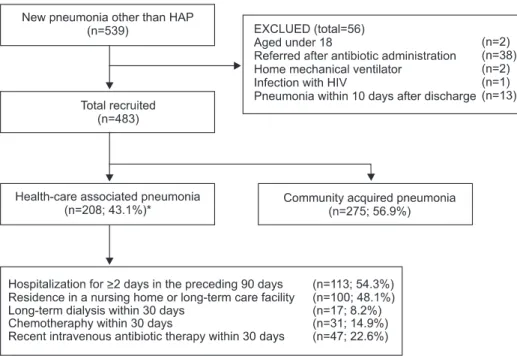
Results: A total of 483 patients (208 patients HCAP, 275 patients with CAP) were evaluated. Patients with HCAP were older than those with CAP (median, 74 years; interquartile range [IQR], 65−81 vs. median, 69 years; IQR, 52−78;
p<0.0001). Streptococcus pneumoniae was the major pathogen in both groups, and MDR pathogens were isolated more frequently from patients with HCAP than with CAP (18.8% vs. 4.9%, p<0.0001). Initial pneumonia severity was greater in patients with HCAP than with CAP. The total 30-day mortality rate was 9.9% and was higher in patients with HCAP based on univariate analysis (16.3% vs. 5.1%; odds ratio (OR), 3.64; 95% confidence interval (CI), 1.90−6.99; p<0.0001). After adjusting for age, sex, comorbidities, and initial severity, the association between HCAP and 30-day mortality became non-significant (OR, 1.98; 95% CI, 0.94−4.18; p=0.167).
Conclusion: HCAP was a common cause of hospital admissions and was associated with a high mortality rate. This increased mortality was related primarily to age and initial clinical vital signs, rather than combination antibiotic therapy or type of pneumonia.
Keywords: Pneumonia; Anti-Bacterial Agents; Drug Resistance; Mortality
Introduction
Pneumonia is typically classified as community-acquired pneumonia (CAP), hospital-acquired pneumonia (HAP), or ventilator-associated hospital-acquired pneumonia (VAP).
However, over the past few decades, some patients present- ing as outpatients with pneumonia have been infected with multidrug-resistant (MDR) pathogens such as Pseudomonas aeruginosa, methicillin-resistant Staphylococcus aureus, and extended-spectrum β-lactamase producing Enterobacteria- ceae
1. The potential involvement of these MDR pathogens has led to a new category of pneumonia, termed healthcare-asso- ciated pneumonia (HCAP). In 2005, the American Thoracic Copyright © 2014
The Korean Academy of Tuberculosis and Respiratory Diseases.
All rights reserved.
Address for correspondence: Miok Kim, M.D., Ph.D.
Department of Internal Medicine, Jeju National University Hospital, 15 Aran 13-gil, Jeju 690-767, Korea
Phone: 82-64-717-1614, Fax: 82-64-717-1131 E-mail: [email protected]
Received: Nov. 20, 2012 Revised: Jan. 20, 2014 Accepted: Jan. 29, 2014
cc It is identical to the Creative Commons Attribution Non-Commercial License (http://creativecommons.org/licenses/by-nc/3.0/).