The Difference in Clinical Presentations
between Healthcare-Associated and Community-Acquired Pneumonia in University-Affiliated Hospital in Korea
Eun Ju Jeon, Sung-Gun Cho, Jong Wook Shin, Jae Yeol Kim, In Won Park, Byoung Whui Choi, and Jae Chol Choi
Division of Pulmonary and Critical Care Medicine, Department of Internal Medicine, Chung-Ang University College of Medicine, Seoul, Korea.
Received: May 3, 2010 Revised: June 17, 2010 Accepted: June 17, 2010
Corresponding author: Dr. Jae Chol Choi, Division of Pulmonary and Critical Care Medicine, Department of Internal Medicine, Chung-Ang University College of Medicine, Hangang-ro 3-ga, Yongsan-gu,
Seoul 140-757, Korea.
Tel: 82-2-748-9804, Fax: 82-2-749-9560 E-mail: [email protected]
∙ The authors have no financial conflicts of interest.
© Copyright:
Yonsei University College of Medicine 2011 This is an Open Access article distributed under the terms of the Creative Commons Attribution Non- Commercial License (http://creativecommons.org/
licenses/by-nc/3.0) which permits unrestricted non- commercial use, distribution, and reproduction in any medium, provided the original work is properly cited.
Purpose: Healthcare-associated pneumonia (HCAP) has been proposed as a new category of pneumonia. However, epidemiological studies for HCAP in South Ko- rea are limited. This study aimed to reveal the differences between HCAP and com- munity-acquired pneumonia (CAP), especially in elderly patients, in university-af- filiated hospital in South Korea. Materials and Methods: We conducted a retrospective observational study of patients with HCAP and CAP (older than 60 years old) who were hospitalized between January 2007 and December 2008. We compared the baseline characteristics, comorbidities, severity, pathogen distribu- tion, antibiotics, and clinical outcomes. Results: A total of 210 patients were evalu- ated, including 35 patients with HCAP (17%) and 175 with CAP (83%). The most common causative organism was Streptococcus pneumoniae in CAP (33.3%), whereas, Staphylococcus aureus was most common pathogen in HCAP (40.0%).
Initial inappropriate antibiotics (6.3% vs. 22.9%; p < 0.005) and initial treatment failure (15.4% vs. 31.4%; p = 0.018) were more frequent in HCAP than CAP. How- ever, mortality (11.4% vs. 5.7%; p = 0.369) was not different between the two groups. Conclusion: The present study provides additional evidence that HCAP should be distinguished from CAP, even in elderly patients, in South Korea. Physi- cians should consider S. aureus and MDR pathogens in selecting initial empirical antibiotics of HCAP in South Korea.
Key Words: Health care, pneumonia, epidemiology
INTRODUCTION
Based on historical data, pneumonia has been categorized into community-ac- quired pneumonia (CAP) and the nosocomial pneumonia which has been further differentiated into hospital-acquired pneumonia (HAP) and ventilator-associated pneumonia (VAP).1,2 Recently, the number of non-hospitalized patients who are in regular contact with the health care centers is increasing. And over the last several years, many investigators have documented that the pathogens coming from health care systems may be different from the pathogens seen in patients from other pop-
Definition
The clinical diagnosis of pneumonia was based on the fol- lowing criteria: 1) the presence of new cough with or with- out sputum production, pleuritic chest pain, dyspnea, 2) a new radiographic infiltrate compatible with pneumonia, 3) the presence of fever (> 38°C) or hypothermia(≤ 35°C), leukocytosis (> 11.0 × 10⁹/L) or leucopenia (< 3.5 × 10⁹/L), increased arterial-alveolar gradient.16
HCAP and CAP were defined according to American Tho- racic Society (ATS)/Infectious Diseases Society of America (IDSA) guidelines.2 HCAP is defined as a patient with pneu- monia and any of the following historical features; hospital- ization for more than 48 hours in an acute care facility within 90 days of infection, resident of a nursing home or long-term care facility, attended a hospital or hemodialysis clinic, has received intravenous antibiotics, chemotherapy, or wound care within 30 days of infection.2
Inappropriate antibiotics were defined if the empirical an- tibiotics were not effective against the identified pathogens based on in vitro susceptibility test.7 Initial treatment failure was defined as death during initial treatment or change of antibiotics from initial agents to others after 48 hours due to clinical instability.11
Microbiology
Pathogens in samples obtained from sputum, tracheal aspi- rate, and blood were investigated. Standard serologic meth- ods were used to determine antibodies against atypical agents such as Mycoplasma pneumonia. MDR pathogen was de- fined as resistance to two or more different classes of anti- microbial drugs.17
Statistical analysis
All statistical analyses were performed using Statistical Package for the Social Science ver. 12.0 (SPSS Inc, Chica- go, IL, USA). Continuous variables were compared, using the Student t test for normally distributed variables and the Mann-Whitney U test for non-normally distributed vari- ables. Univariate analysis was carried out using the Chi- square test or Fishers exact test for categorical data. p val- ues less than 0.05 were considered significant.
RESULTS
Patient characteristics
A total of 210 patients with a suspected diagnosis of pneu- ulations who have been admitted to the hospital from the
community.3-5 Therefore, a fourth category, healthcare-associ- ated pneumonia (HCAP), has been introduced.2,6 Previous studies have documented that compared with CAP patients, HCAP patients are often at greater risk for colonization and infection with a wider spectrum of multi-drug resistance (MDR) pathogens.5 However, HCAP patients have had a variably reported frequency of drug-resistant gram-nega- tives pathogens and Staphylococcus aureus.7,8
The population in South Korea is now aging very rapidly and there are about 5 million people aged 65 or older.9 Therefore, CAP is an important cause of illness, admission and death in South Korea, particularly for elderly adults.10 Furthermore, nearly 1 million of the elderly suffer from de- mentia, strokes or other chronic cardiovascular illnesses.
Therefore, HCAP has a upward trend in an acceleration de- gree with the increase of health care center.
HCAP patients tend to be older than CAP patients.5-8,11,12 Because age is a well known risk factor for the poor prog- nosis of pneumonia and diseases in elderly patients seem to differ in microbial spectrum, it is not clear whether the poor outcome observed in HCAP patients is related to the pres- ence of more comorbidities and old age or to a higher inci- dence of antibiotic-resistant bacteria and inappropriate em- pirical antibiotic treatment.13,14 However, epidemiological studies for HCAP in South Korea, especially in elderly pa- tients, are limited.
The objective of this study was to determine the differ- ences in baseline characteristics, pathogen distribution and outcomes between HCAP and CAP, especially in elderly patients, in university-affiliated hospitals in South Korea.
MATERIALS AND METHODS
Study design and setting
We conducted a retrospective observational study of pa- tients with pneumonia older than 60 years old between Jan- uary 2007 and December 2008 in Chung-Ang University Hospital and Yongsan Hospital, Seoul, Korea. Patients with HAP were excluded. We compared the baseline characteris- tics, comorbidities, severity, distribution of pathogen, anti- biotics, and clinical outcomes between HCAP and CAP.
The severity of pneumonia was evaluated using the pneu- monia severity index (PSI).15 The Institutional Review Board of the Yongsan Hospital and Chung-Ang University Hospi- tal approved this study.
(63/175) of patients with CAP and in 85.7% (30/35) of pa- tients with HCAP. Streptococcus pneumoniae was the most frequently isolated pathogens in the CAP, while Staphylococ- cus aureus in the HCAP. Staphylococcus aureus, Pseudomo- nas aeruginosa, Stenotrophomonas maltophilia and MDR pathogens were isolated more frequently in HCAP patients than in CAP patients.
Antibiotic treatment and clinical outcomes
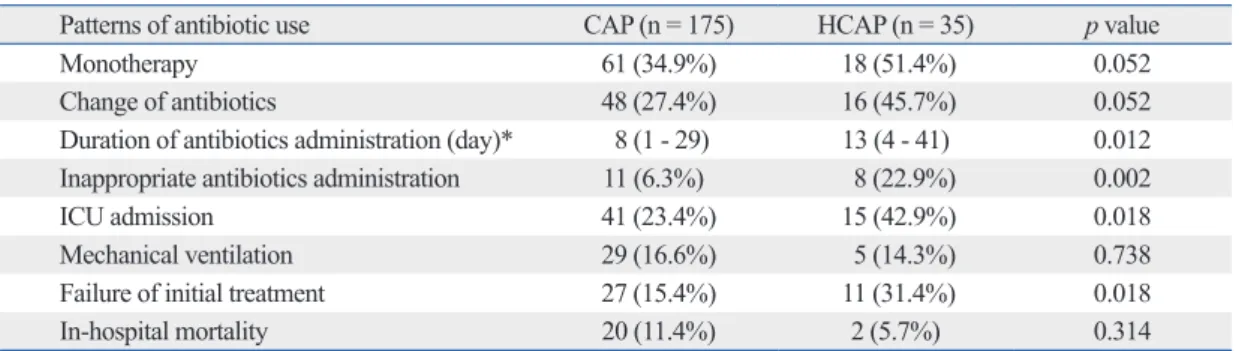
Patterns of antibiotic administration were similar in both groups, except for the fact that CAP tended to receive more combination of β-lactamase and macrolide than those with HCAP. However, initial administration rate of inappropriate antibiotics (6.3% vs. 24.2%; p = 0.002) and duration of anti- biotics administration (8 days vs. 13 days; p = 0.012) were more frequent in HCAP group than CAP. HCAP group had a higher frequency than CAP group in intensive care unit (ICU) admission (42.9% vs. 23.4%, p = 0.018) and initial treatment failure (15.4% vs. 31.4%, p = 0.018). However, in- hospital mortality was not different between the two groups (Table 4).
DISCUSSION
Few studies have examined the incidence of HCAP in hos- pitalized patients with pneumonia, and found that the inci- dence of HCAP was variable between 17.3-67.4%.6-8,11 However, there was lack of data about the HCAP in South Korea. The present retrospective study showed that the in- cidence of HCAP was 17% in elderly patients (older than monia were enrolled, including 35 patients with HCAP and
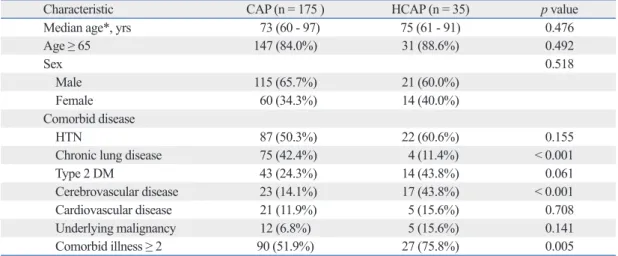
175 with CAP. Baseline characteristics are described in Table 1. The median age of the patients with HCAP was 75 years old (range 61 to 91) and that of patients with CAP was 73 years old (range 60 to 97), showing no statistically significant difference between two groups (p = 0.476). Among thirty- five patients with HCAP, twenty-one patients were those hospitalized for more than 48 hours in the preceding 90 days (60.0%), eleven patients were those with residence in a nurs- ing home or extended care facility (31.4%), four patients were those with chronic dialysis within 30 days (11.4%) and nine patients received intravenous antibiotics, chemotherapy, or wound care within 30 days of infection (25.7%). In co- morbid illness, cerebrovascular diseases were significantly more frequent in HCAP than in the CAP group (43.8% vs.
14.1%; p < 0.001), while chronic lung diseases (42.4% vs.
11.4%; p < 0.001) were significantly more frequent in CAP group than in the HCAP group.
Clinical, laboratory and radiographic findings at presentation
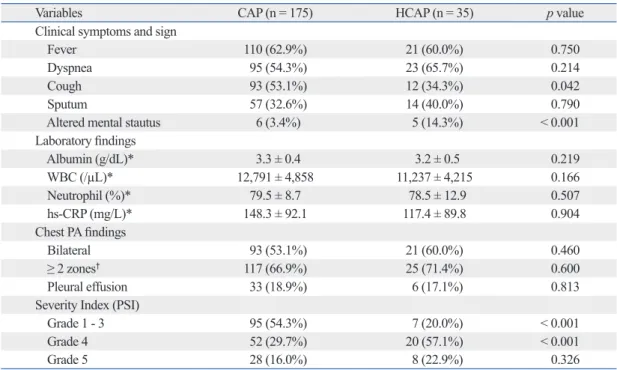
Cough was more frequent in patients with CAP, and altered mental status was more frequent in patients with HCAP. In laboratory and radiographic findings, there were no differ- ences between two groups. Patients with HCAP were more commonly classified into moderate risk (class 4) of PSI.
However, there was no difference in class 5 of PSI (Table 2).
Etiology of pneumonia
The distribution of pathogens for CAP and HCAP is listed in Table 3. A microbiologic diagnosis was established in 36.0%
Table 1. Baseline Characteristics of Patients with HCAP and CAP
Characteristic CAP (n = 175 ) HCAP (n = 35) p value
Median age*, yrs 73 (60 - 97) 75 (61 - 91) 0.476
Age ≥ 65 147 (84.0%) 31 (88.6%) 0.492
Sex 0.518
Male 115 (65.7%) 21 (60.0%)
Female 60 (34.3%) 14 (40.0%)
Comorbid disease
HTN 87 (50.3%) 22 (60.6%) 0.155
Chronic lung disease 75 (42.4%) 4 (11.4%) < 0.001
Type 2 DM 43 (24.3%) 14 (43.8%) 0.061
Cerebrovascular disease 23 (14.1%) 17 (43.8%) < 0.001
Cardiovascular disease 21 (11.9%) 5 (15.6%) 0.708
Underlying malignancy 12 (6.8%) 5 (15.6%) 0.141
Comorbid illness ≥ 2 90 (51.9%) 27 (75.8%) 0.005
HCAP, healthcare-associated pneumonia; CAP, community-acquired pneumonia; HTN, hypertension; DM, diabetes mellitus.
Data are presented as numbers and percentages unless otherwise indicated.
*Range is shown in parentheses.
HCAP. Previous studies found that cerbrovascular disease was more common in patients with HCAP.8,11 Our finding was also consistent with these studies. Our finding showed that 17 of 35 (43.8%) had a history of cerebrovascular dis- eases, showing a statistical difference from the patients with CAP. These patients suffered from difficulty of swallowing, and reduction of cough reflex. These patients also tended to 60 years old), and that the most common pathogen in
HCAP was Staphylococcus aureus. Furthermore, initial in- appropriate antibiotics and initial treatment failure were more frequent in HCAP group than CAP.
Patients with HCAP could complain of atypical symp- toms. The present study showed that altered mental state and lack of cough were more common in patients with
Table 2. Comparison of Clinical and Laboratory Findings at Presentation in CAP and HCAP
Variables CAP (n = 175) HCAP (n = 35) p value
Clinical symptoms and sign
Fever 110 (62.9%) 21 (60.0%) 0.750
Dyspnea 95 (54.3%) 23 (65.7%) 0.214
Cough 93 (53.1%) 12 (34.3%) 0.042
Sputum 57 (32.6%) 14 (40.0%) 0.790
Altered mental stautus 6 (3.4%) 5 (14.3%) < 0.001
Laboratory findings
Albumin (g/dL)* 3.3 ± 0.4 3.2 ± 0.5 0.219
WBC (/µL)* 12,791 ± 4,858 11,237 ± 4,215 0.166
Neutrophil (%)* 79.5 ± 8.7 78.5 ± 12.9 0.507
hs-CRP (mg/L)* 148.3 ± 92.1 117.4 ± 89.8 0.904
Chest PA findings
Bilateral 93 (53.1%) 21 (60.0%) 0.460
≥ 2 zones† 117 (66.9%) 25 (71.4%) 0.600
Pleural effusion 33 (18.9%) 6 (17.1%) 0.813
Severity Index (PSI)
Grade 1 - 3 95 (54.3%) 7 (20.0%) < 0.001
Grade 4 52 (29.7%) 20 (57.1%) < 0.001
Grade 5 28 (16.0%) 8 (22.9%) 0.326
CAP, community-acquired pneumonia; HCAP, healthcare-associated pneumonia; WBC, white blood cell; CRP, C-reactive protein; PSI, pneumonia severity index.
Data are presented as numbers and percentages unless otherwise indicated.
*Values are mean ± standard deviation.
† ≥ 2 zones, involvement of two or more lobes.
Table 3. Comparison of Identified Pathogens in CAP and HCAP
Pathogens CAP (n = 63) HCAP (n = 30)‡ p value
S. pneumoniae 21 (33.3%) 2 (6.7%) 0.005
S. aureus 9 (11.1%) 12 (40.0%) 0.006
MRSA 6 (6.3%) 9 (30.0%) 0.012
MSSA 3 (4.8%) 3 (10.0%) 0.339
K. pneumoniae 13 (20.6%) 8 (26.7%) 0.515
P. aeruginosae 4 (6.3%) 8 (26.7%) 0.006
H. influenzae 7 (11.1%) 1 (3.3%) 0.211
M. pneumoniae 2 (3.2%) 0 (0%) 0.324
S. maltophilia 0 (0%) 3 (10.0%) 0.011
Other organisms* 7 (11.1%) 5 (16.7%) 0.017
MDR pathogens† 9 (14.3%) 17 (56.7%) < 0.001
CAP, community-acquired pneumonia; HCAP, healthcare-associated pneumonia; MRSA, meticillin-resistance Staphylococcus aureus;
MSSA, meticillin-sensitive Staphylococcus aureus; MDR, multi-drug resistance.
Data are presented as numbers and percentages unless otherwise indicated.
*Other organisms were Escherichia coli, Acinetobacter baumannii, Burkholderia cepacia, Enterobacter cloaca, Klebsiella oxytoca and Enterococcus faecalis.
†MDR pathogens were defined as resistance to two or more different classes of antimicrobial drugs.
‡Mixed population of pathogens was detected in 9 of patients with HAP.
tion of β-lactamase and macrolide than those with HCAP.
This shows that HCAP has been overlooked in clinical prac- tice. Actually, in South Korea, there are no data about HCAP and there is a lack of guideline for the treatment of HCAP.
Therefore, physicians in clinical practice, tend to choose the antibiotics like to CAP patient. Considering our data, there- fore, S. aureus and other drug-resistant pathogens must be considered when choosing antibiotics.
Previous investigations have shown that HCAP patients had more comorbid conditions and a higher fatality rate than CAP.1,6,8 However, our study failed to show a signifi- cant difference in mortality between CAP and HCAP. The reason for the discrepancy could be explained by pneumo- nia severity. Patients with HCAP were more commonly classified into PSI class 4. However, there were no differ- ences in PSI class 5. Our study included more than 60 years old only. Age is a well known risk factor for the poor prog- nosis of pneumonia.14 El-Solh, et al.24 also reported that there was no difference in the outcome between those ad- mitted from the community and those older patients who were residing in nursing homes. Therefore, CAP patients might show the same mortality rate as HCAP.
This study has several important limitations. First, the data were retrospectively collected. We did not use uniform methods for the detection of pathogens. Additionally, evalu- ation for atypical pathogens was inadequate because of the retrospective design. Therefore, a microbiologic diagnosis was established only in 36.0% (63/175) of patients with CAP. However, the most common pathogen in CAP was the same, compared with previous reports. Furthermore, in HCAP cases, a microbiologic diagnosis was established in 85.7% (30/35) of patients. Therefore, we can conclude that the distribution of pathogens was different between CAP and HCAP. Second, the size of the population is relatively go through a long convalescence at healthcare center and to
be prone to aspiration.8 Therefore, patients with HCAP could show atypical symptoms.
Previous studies documented that HCAP is not bacterio- logically similar to CAP, but HCAP patients have a vari- ably reported frequency of drug-resistant gram-negatives pathogens and S. aureus. Kollef, et al.6 reported that S. au- reus was the most common pathogen in HCAP. However, Lim and Macfarlane18 reported that the most common pathogen was S. pneumonia in both groups when compared with nursing home acquired pneumonia and CAP. Carrata- là, et al.8 also reported that S. pneumonia was the most common pathogen in HCAP, although aspiration pneumo- nia was more common in HCAP group. Our present result showed that the most common pathogen in HCAP was S.
aureus, and 9 of 12 (75%) were methicillin resistant S. au- reus (MRSA). Furthermore, HCAP had a high frequency of Pseudomonas aeruginosa, Stenotrophomonas maltophilia, and MDR pathogens. In CAP, several studies demonstrated that Streptococcus pneumoniae was the most common pathogen in South Korea.19,20 Our findings in CAP were consistent with these reports. On the other hand, however, the pathogen distribution in HCAP was different, although patients with HCAP are present from in the community.
This difference affects the initial inappropriate antibiotics and the failure of initial treatment. Several studies showed that HCAP patients were significantly more likely to be treated with an inappropriate antibiotic regimen.7,8,11,21-23
Our present findings are consistent with these previous stud- ies. The ATS/IDSA guidelines suggest that HCAP should be treated as a form of HAP, using antibiotics similar to those used for patients with late-onset HAP.2 In our study, the anti- biotics regimens were not different between CAP and HCAP, except for the fact that CAP tended to receive more combina-
Table 4. Comparison of Patterns of Antibiotic Administration in CAP and HCAP
Patterns of antibiotic use CAP (n = 175) HCAP (n = 35) p value
Monotherapy 61 (34.9%) 18 (51.4%) 0.052
Change of antibiotics 48 (27.4%) 16 (45.7%) 0.052
Duration of antibiotics administration (day)* 8 (1 - 29) 13 (4 - 41) 0.012 Inappropriate antibiotics administration 11 (6.3%) 8 (22.9%) 0.002
ICU admission 41 (23.4%) 15 (42.9%) 0.018
Mechanical ventilation 29 (16.6%) 5 (14.3%) 0.738
Failure of initial treatment 27 (15.4%) 11 (31.4%) 0.018
In-hospital mortality 20 (11.4%) 2 (5.7%) 0.314
CAP, community-acquired pneumonia; HCAP, healthcare-associated pneumonia; Clinda, clindamycin; metro, metronidazole; ICU, inten- sive care unit.
Data are presented as numbers and percentages unless otherwise indicated.
*Values are given as median (range).
hospital admission: epidemiology, antibiotic therapy, and clinical outcomes. Arch Intern Med 2007;167:1393-9.
9. Kim IK. Demographic transition and population aging in Korea.
Korea J Popul Dev 1996;25:27-40.
10. Hwang SS, Lee JH, Jung GW, Lim JH, Kwon HJ. [Spatial analysis of air pollution and lung cancer incidence and mortality in 7 metro- politan cities in Korea]. J Prev Med Public Health 2007;40:233-8.
11. Shindo Y, Sato S, Maruyama E, Ohashi T, Ogawa M, Hashimoto N, et al. Health-care-associated pneumonia among hospitalized patients in a Japanese community hospital. Chest 2009;135:633-40.
12. Venditti M, Falcone M, Corrao S, Licata G, Serra P; Study Group of the Italian Society of Internal Medicine. Outcomes of patients hospitalized with community-acquired, health care-associated, and hospital-acquired pneumonia. Ann Intern Med 2009;150:19-26.
13. Kollef MH, Morrow LE, Baughman RP, Craven DE, McGowan JE Jr, Micek ST, et al. Health care-associated pneumonia (HCAP): a critical appraisal to improve identification, management, and out- comes--proceedings of the HCAP Summit. Clin Infect Dis 2008;
46 Suppl 4:S296-334.
14. Ewig S, Welte T, Chastre J, Torres A. Rethinking the concepts of community-acquired and health-care-associated pneumonia. Lan- cet Infect Dis 2010;10:279-87.
15. Fine MJ, Auble TE, Yealy DM, Hanusa BH, Weissfeld LA, Singer DE, et al. A prediction rule to identify low-risk patients with com- munity-acquired pneumonia. N Engl J Med 1997;336:243-50.
16. Maruyama T, Niederman MS, Kobayashi T, Kobayashi H, Takagi T, D’Alessandro-Gabazza CN, et al. A prospective comparison of nursing home-acquired pneumonia with hospital-acquired pneu- monia in non-intubated elderly. Respir Med 2008;102:1287-95.
17. Siegel JD, Rhinehart E, Jackson M, Chiarello L; Healthcare Infec- tion Control Practices Adrisory Committee. Management of mul- tidrug-resistant organisms in health care settings, 2006. Am J Infec Control 2007;35(10 Suppl 2):S165-93.
18. Lim WS, Macfarlane JT. A prospective comparison of nursing home acquired pneumonia with community acquired pneumonia.
Eur Respir J 2001;18:362-8.
19. Song JH, Oh WS, Kang CI, Chung DR, Peck KR, Ko KS, et al.
Epidemiology and clinical outcomes of community-acquired pneumonia in adult patients in Asian countries: a prospective study by the Asian network for surveillance of resistant pathogens.
Int J Antimicrob Agents 2008;31:107-14.
20. Matsushima T, Miyashita N, File TM, Jr. Etiology and manage- ment of community-acquired pneumonia in Asia. Curr Opin Infect Dis 2002;15:157-62.
21. Alvarez-Lerma F. Modification of empiric antibiotic treatment in patients with pneumonia acquired in the intensive care unit. ICU- Acquired Pneumonia Study Group. Intensive Care Med 1996;22:
387-94.
22. Kollef MH, Ward S. The influence of mini-BAL cultures on pa- tient outcomes: implications for the antibiotic management of ventilator-associated pneumonia. Chest 1998;113:412-20.
23. Kumar A, Roberts D, Wood KE, Light B, Parrillo JE, Sharma S, et al. Duration of hypotension before initiation of effective antimi- crobial therapy is the critical determinant of survival in human septic shock. Crit Care Med 2006;34:1589-96.
24. El-Solh AA, Sikka P, Ramadan F, Davies J. Etiology of severe pneumonia in the very elderly. Am J Respir Crit Care Med 2001;
163(3 Pt 1):645-51.
small, therefore, our results should be interpreted with cau- tion. Finally, the pathogens identified could be oropharyngeal colonizers and could not be definite causes of pneumonia since sputum culture could not always distinguish between colonization and true infection. Despite the limitations de- scribed above, our results nevertheless showed meaningful information about HCAP in South Korea.
In summary, the present study provides additional evi- dence that HCAP should be distinguished from CAP, even in elderly patients, in South Korea. Patients with HCAP were more likely to receive inappropriate initial antibiotics.
Therefore, clinicians caring for patients with pneumonia who require hospital admission should be aware of the risk factors for HCAP. In addition, a proper guideline is needed for proper management of HCAP in South Korea.
ACKNOWLEDGEMENTS
This work was supported Chung-Ang University Grant 2010.
REFERENCES
1. Slaven EM, Santanilla JI, DeBlieux PM. Healthcare-associated pneumonia in the emergency department. Semin Respir Crit Care Med 2009;30:46-51.
2. American Thoracic Society; Infectious Diseases Society of Amer- ica. Guidelines for the management of adults with hospital-ac- quired, ventilator-associated, and healthcare-associated pneumo- nia. Am J Respir Crit Care Med 2005;171:388-416.
3. Naimi TS, LeDell KH, Como-Sabetti K, Borchardt SM, Boxrud DJ, Etienne J, et al. Comparison of community- and health care- associated methicillin-resistant Staphylococcus aureus infection.
JAMA 2003;290:2976-84.
4. Tambyah PA, Habib AG, Ng TM, Goh H, Kumarasinghe G.
Community-acquired methicillin-resistant Staphylococcus aureus infection in Singapore is usually “healthcare associated”. Infect Control Hosp Epidemiol 2003;24:436-8.
5. Hiramatsu K, Niederman MS. Health-care-associated pneumonia:
a new therapeutic paradigm. Chest 2005;128:3784-7.
6. Kollef MH, Shorr A, Tabak YP, Gupta V, Liu LZ, Johannes RS.
Epidemiology and outcomes of health-care-associated pneumo- nia: results from a large US database of culture-positive pneumo- nia. Chest 2005;128:3854-62.
7. Micek ST, Kollef KE, Reichley RM, Roubinian N, Kollef MH.
Health care-associated pneumonia and community-acquired pneu- monia: a single-center experience. Antimicrob Agents Chemother 2007;51:3568-73.
8. Carratalà J, Mykietiuk A, Fernández-Sabé N, Suárez C, Dorca J, Verdaguer R, et al. Health care-associated pneumonia requiring