저작자표시 2.0 대한민국 이용자는 아래의 조건을 따르는 경우에 한하여 자유롭게 l 이 저작물을 복제, 배포, 전송, 전시, 공연 및 방송할 수 있습니다. l 이차적 저작물을 작성할 수 있습니다. l 이 저작물을 영리 목적으로 이용할 수 있습니다. 다음과 같은 조건을 따라야 합니다: l 귀하는, 이 저작물의 재이용이나 배포의 경우, 이 저작물에 적용된 이용허락조건 을 명확하게 나타내어야 합니다. l 저작권자로부터 별도의 허가를 받으면 이러한 조건들은 적용되지 않습니다. 저작권법에 따른 이용자의 권리는 위의 내용에 의하여 영향을 받지 않습니다. 이것은 이용허락규약(Legal Code)을 이해하기 쉽게 요약한 것입니다. Disclaimer 저작자표시. 귀하는 원저작자를 표시하여야 합니다.
1
석사학위논문
제주 지역 의료기관관련폐렴과
지역 사회 폐렴의 차이 분석
제주대학교 대학원
의 학 과
성길명
2013년 2월
2
Healthcare-associated pneumonia among hospitalized
patients : Is it different from community acquired
pneumonia?
Gil Myeong Seong, M.D.
(Supervised by professor Miok Kim)
February, 2013
Department of Internal Medicine
GRADUATE SCHOOL
JEJU NATIONAL UNIVERSITY
3
제주 지역 의료기관관련폐렴과
지역 사회 폐렴의 차이 분석
지도교수 김미옥
성길명
이 논문을 석사 학위 논문으로 제출함
2013년 2월
성길명의 의학 석사 학위 논문을 인준함
심사위원장 최 윤 숙 ○
인위 원 김 미 옥 ○
인위 원 허 상 택 ○
인제주대학교 대학원
2013년 2월
4
ABSTRACT
Background: The increasing number of outpatients with MDR pathogens has led to a new
category of pneumonia, termed healthcare-associated pneumonia (HCAP). We determined the differences in etiology and outcomes between patients with HCAP and those with community-acquired pneumonia (CAP) to clarify the risk factors for HCAP mortality.
Methods: A retrospective study comparing patients with HCAP and CAP at Jeju National
University Hospital. The primary outcome was 30-day mortality.
Results: A total of 483 patients (208 patients HCAP; 275 patients with CAP) were evaluated.
Patients with HCAP were older than those with CAP (median, 74 years; IQR, 65–81 vs. median, 69 years; IQR, 52–78; p < 0.0001). Streptococcus pneumoniae was the major pathogen in both groups, and MDR pathogens were isolated more frequently from patients with HCAP than with CAP (18.8% vs. 4.9%; p < 0.0001). Initial pneumonia severity was greater in patients with HCAP than with CAP. The total 30-day mortality rate was 9.9% and was higher in patients with HCAP based on univariate analysis (16.3% vs. 5.1%; odds ratio (OR), 3.64; 95% confidence interval (CI), 1.90–6.99; p < 0.0001). After adjusting for age, sex, comorbidities, and initial severity, the association between HCAP and 30-day mortality became non-significant (OR, 1.98; 95% CI, 0.94–4.18; p = 0.167).
Conclusions: HCAP was a common cause of hospital admissions and was associated with a
high mortality rate. This increased mortality was related primarily to age and initial clinical vital signs, rather than combination antibiotic therapy or type of pneumonia.
5
Introduction
Pneumonia is typically classified as community-acquired (CAP), hospital-acquired (HAP), or ventilator-associated (VAP). However, over the past few decades, some patients presenting as outpatients with pneumonia have been infected with multidrug-resistant (MDR) pathogens such as Pseudomonas aeruginosa, methicillin-resistant Staphylococcus
aureus, and extended-spectrum β-lactamase (ESBL) producing Enterobacteriaceae1. The
potential involvement of these MDR pathogens has led to a new category of pneumonia, termed healthcare-associated pneumonia (HCAP). In 2005, the American Thoracic Society (ATS) and the Infectious Disease Society of America (IDSA) published the first guidelines for managing adults with HCAP2. In these guidelines, HCAP is included in the spectrum of
HAP and VAP, and all patients with HCAP require therapy with dual antipseudomonal antibiotics plus linezolid or vancomycin for MDR pathogens.
Although the new pneumonia classification system has been helpful for determining empirical antibiotic strategies, it is not without its disadvantages. First, because of a lack of large-scale prospective studies and limited epidemiological data, the clinical outcomes of the 2005 ATS/IDSA guidelines are still under discussion. Not all MDR pathogens are associated with all risk factors. In addition, risk factors for an MDR pathogen infection do not preclude the development of pneumonia caused by the typical CAP pathogens3.
Methods
This was a retrospective observational study conducted at Jeju National University Hospital, a 500-bed teaching hospital in Jeju, Republic of Korea, between January 2010 and December 2011. All consecutive patients with pneumonia admitted to the hospital through the
emergency or outpatient department were eligible. One of the investigators (GM Seong) reviewed all 1,754 patients hospitalized at the Department of Respiratory and Allergy during the 2-year period to identify appropriate patients. Patients with HAP, those on a home
6
mechanical ventilator, patients referred after antibiotic administration, and patients with HIV infection or organ transplantation were excluded. We considered that patients who fulfilled the HCAP criteria but developed pneumonia within 10 days after discharge as having developed HAP. We classified study patients into CAP and HCAP groups, and compared clinical characteristics, severity, pathogen distribution, and outcomes between the two groups. Our study protocol was approved by the Institutional Review Board of Jeju National University Hospital.
Definition of pneumonia
Patients with pneumonia were defined as those presenting with a new radiographic infiltrate and at least two of the following symptoms or signs: cough, sputum production, hemoptysis, dyspnea, fever, pleuritic chest pain, or signs consistent with pneumonia on physical examination4. HCAP and CAP were defined according to the ATS/IDSA guidelines2,5. The
HCAP group included patients with any of the following: (1) hospitalization for ≥2 days during the preceding 90 days; (2) residence in a nursing home or long-term care facility; (3) recent intravenous antibiotic therapy, chemotherapy, or wound care within the past 30 days before entering the study; (4) long-term dialysis, including hemodialysis and peritoneal dialysis, within 30 days of entering the study. The diagnosis and type of pneumonia were verified twice from the medical records by one of the investigators (GM Seong or MO Kim).
Microbiological evaluation
Recommended initial microbiological investigations were sputum and blood cultures,
Legionealla and pneumococcal urine antigen testing, an antibody titer for Mycoplasma pneumonia, and acid-fast bacterial (AFB) stains and cultures in selected patients. Specimens
acceptable for positive culture results included sputum, tracheal aspirate, bronchoscopic bronchoalveolar lavage fluid, and blood. Blood culture results were accepted if the same
7
microorganism was also identified in a respiratory specimen or if no other source for the positive blood culture was identified. Additionally, a positive Legionealla urine antigen result, an antibody titer for an atypical pathogen that changed to 4-fold or converted to positive, and a positive polymerase chain reaction (PCR) for Mycobacterium tuberculosis were considered to indicate etiological pathogens.
Antibiotic therapy was classified as being inappropriate if the initially prescribed antibiotics were not active against the identified pathogens, based on in vitro susceptibility testing. Exceptionally, atypical pathogens such as M. pneumoniae, Chlamydophila species, and
Legionella species were considered fully susceptible to fluoroquinolones or macrolides, and M. tuberculosis was excluded from being judged appropriately, because it requires a special
antibiotic regimen.
Severity evaluation and outcomes
All patients were assessed for risk at admission using the Pneumonia Severity Index (PSI) and CURB-65 scores6,7. Patients were followed for 30 days from the date of admission. We
recorded the 30-day mortality and the need for admission to the intensive care unit, mechanical ventilation, and/or vasopressor support. Initial treatment failure was defined as death during initial treatment or a change from the initial antibiotic to another drug after 48 h because of clinical instability (e.g., lack of response, worsening of fever, or requirement for mechanical ventilation or vasopressors).
Statistical analysis
All statistical analyses were performed using PASW Statistics 17(SPSS, Inc., Chicago, IL, USA). A level of α < 0.05 was considered to indicate statistical significance. The χ-squared test was used to compare categorical variables. Continuous variables were analyzed using Student’s t-test or the Mann-Whitney U test. Multivariate logistic regression analysis was
8
performed to identify independent risk factors associated with 30-day mortality, as measured by the adjusted odds ratio (AOR) with 95% confidence intervals (CIs). The 30-day mortality was the dependent variable, and all potential risk factors with p-values < 0.2 in the univariate analysis were independent variables in the multivariate logistic regression model.
Results
Patients
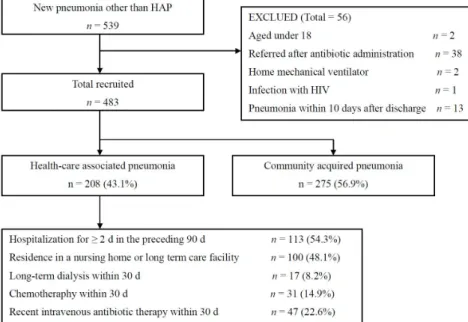
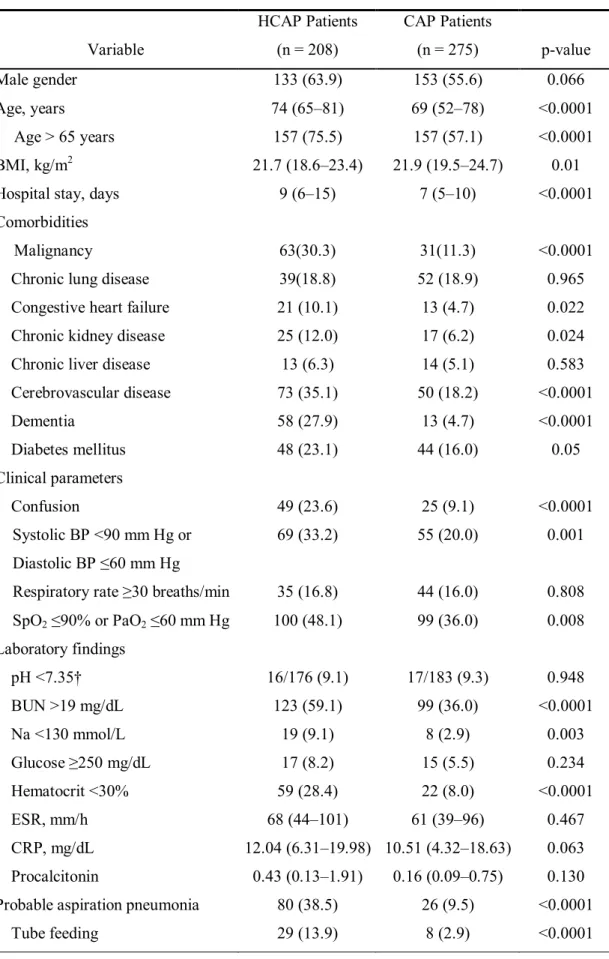
A total of 483 patients were evaluated (208 patients with HCAP and 275 with CAP) (Figure 1). Most of these patients were admitted due to a recent admission (54.3%) or residence in a nursing home (48.1%) (Including overlapping cases). Eighty-four patients (40.4%) had more than two risk factors. The demographic and baseline clinical characteristics of the patients with HCAP and CAP are presented in Table 1. Patients with HCAP were older and had a lower body mass index than patients with CAP. No gender differences were observed between the groups, but comorbidities such as cancer, congestive heart failure, cerebrovascular disease, and dementia occurred more frequently in patients with HCAP.
9
Table 1. Baseline demographics and illness severity*
Variable HCAP Patients (n = 208) CAP Patients (n = 275) p-value Male gender 133 (63.9) 153 (55.6) 0.066 Age, years 74 (65–81) 69 (52–78) <0.0001 Age > 65 years 157 (75.5) 157 (57.1) <0.0001 BMI, kg/m2 21.7 (18.6–23.4) 21.9 (19.5–24.7) 0.01
Hospital stay, days 9 (6–15) 7 (5–10) <0.0001
Comorbidities
Malignancy 63(30.3) 31(11.3) <0.0001
Chronic lung disease 39(18.8) 52 (18.9) 0.965
Congestive heart failure 21 (10.1) 13 (4.7) 0.022
Chronic kidney disease 25 (12.0) 17 (6.2) 0.024
Chronic liver disease 13 (6.3) 14 (5.1) 0.583
Cerebrovascular disease 73 (35.1) 50 (18.2) <0.0001 Dementia 58 (27.9) 13 (4.7) <0.0001 Diabetes mellitus 48 (23.1) 44 (16.0) 0.05 Clinical parameters Confusion 49 (23.6) 25 (9.1) <0.0001 Systolic BP <90 mm Hg or Diastolic BP ≤60 mm Hg 69 (33.2) 55 (20.0) 0.001
Respiratory rate ≥30 breaths/min 35 (16.8) 44 (16.0) 0.808 SpO2 ≤90% or PaO2 ≤60 mm Hg 100 (48.1) 99 (36.0) 0.008 Laboratory findings pH <7.35† 16/176 (9.1) 17/183 (9.3) 0.948 BUN >19 mg/dL 123 (59.1) 99 (36.0) <0.0001 Na <130 mmol/L 19 (9.1) 8 (2.9) 0.003 Glucose ≥250 mg/dL 17 (8.2) 15 (5.5) 0.234 Hematocrit <30% 59 (28.4) 22 (8.0) <0.0001 ESR, mm/h 68 (44–101) 61 (39–96) 0.467 CRP, mg/dL 12.04 (6.31–19.98) 10.51 (4.32–18.63) 0.063 Procalcitonin 0.43 (0.13–1.91) 0.16 (0.09–0.75) 0.130 Probable aspiration pneumonia 80 (38.5) 26 (9.5) <0.0001
10
Severe sepsis 81 (38.9) 56 (20.4) <0.0001
ICU admission 61 (29.3) 36 (13.1) <0.0001
Pneumonia Severity Index score 112 (100–143) 82 (57–111) <0.0001
CURB-65 2 (1–3) 1 (0–2) <0.0001
HCAP, healthcare-associated pneumonia; CAP, community-acquired pneumonia; BMI, body mass index * Data are presented as number (%), mean ± standard deviation, or median (25th–75th percentile).
† Initial arterial blood gas analysis was performed in 359 (74.3%) of the study patients.
Microbiology and antibiotic treatments
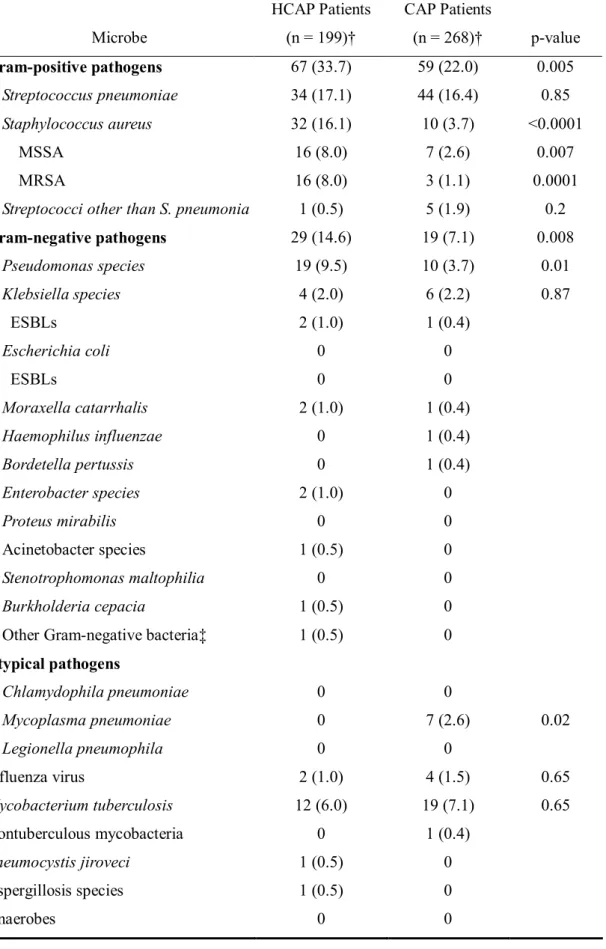
A positive microbiological diagnosis was made in 51.3% of the patients with HCAP compared with 39.2% of the patients with CAP (p = 0.009). The frequencies of the organisms isolated in both groups are shown in Table 2. Streptococcus pneumoniae was the major pathogen in both groups, and S. aureus, P. aeruginosa, and polymicrobial pathogens were isolated more frequently from patients with HCAP than from those with CAP.
Mycobacterium tuberculosis was identified at an overall frequency of 6.4%, with no
significant group difference (p = 0.65).
After adjusting for age, comorbidities, and the HCAP risk group, the use of antibiotics within 90 days and tube feeding were significantly correlated with the occurrence of MDR pathogens (AOR, 8.03; 95% CI, 2.46–26.21; p = 0.001 and AOR, 9.42; 95% CI, 3.40–26.13; p < 0.0001, respectively).
The most frequently prescribed initial antibiotic regimen was antipseudomonal ß-lactam plus fluoroquinolone (48.6%; e.g., piperacillin/tazobactam 4.5 g q8h plus levofloxacin 750 mg q24h) for HCAP and third and fourth-generation cephalosporins and macrolides (63.3%; e.g., ceftriaxone 2 g q24h plus azithromycin 500 mg q24h) for CAP (data not shown). In addition, vancomycin was used in 15 patients with HCAP (7.2%) and eight patients with CAP (2.9%).
11
Table 2. Microbes identified in the HCAP and CAP groups*
Microbe HCAP Patients (n = 199)† CAP Patients (n = 268)† p-value Gram-positive pathogens 67 (33.7) 59 (22.0) 0.005 Streptococcus pneumoniae 34 (17.1) 44 (16.4) 0.85 Staphylococcus aureus 32 (16.1) 10 (3.7) <0.0001 MSSA 16 (8.0) 7 (2.6) 0.007 MRSA 16 (8.0) 3 (1.1) 0.0001
Streptococci other than S. pneumonia 1 (0.5) 5 (1.9) 0.2
Gram-negative pathogens 29 (14.6) 19 (7.1) 0.008 Pseudomonas species 19 (9.5) 10 (3.7) 0.01 Klebsiella species 4 (2.0) 6 (2.2) 0.87 ESBLs 2 (1.0) 1 (0.4) Escherichia coli 0 0 ESBLs 0 0 Moraxella catarrhalis 2 (1.0) 1 (0.4) Haemophilus influenzae 0 1 (0.4) Bordetella pertussis 0 1 (0.4) Enterobacter species 2 (1.0) 0 Proteus mirabilis 0 0 Acinetobacter species 1 (0.5) 0 Stenotrophomonas maltophilia 0 0 Burkholderia cepacia 1 (0.5) 0
Other Gram-negative bacteria‡ 1 (0.5) 0
Atypical pathogens Chlamydophila pneumoniae 0 0 Mycoplasma pneumoniae 0 7 (2.6) 0.02 Legionella pneumophila 0 0 Influenza virus 2 (1.0) 4 (1.5) 0.65 Mycobacterium tuberculosis 12 (6.0) 19 (7.1) 0.65 Nontuberculous mycobacteria 0 1 (0.4) Pneumocystis jiroveci 1 (0.5) 0 Aspergillosis species 1 (0.5) 0 Anaerobes 0 0
12
Polymicrobial pathogens 10/102 (9.8) 4/105 (3.8) 0.009
MDR pathogens 36 (18.1) 13 (4.9) <0.0001
No pathogen identified 97 (48.7) 163 (60.8) 0.009
*Data are presented as number (%).
†Nine HCAP and seven CAP patients were excluded from the analysis because of missing data. ‡ Unidentified Gram-negative pathogen in the blood culture.
Severity of pneumonia and clinical outcomes
As shown Table 1, initial severities as measured by the PSI and CURB-65 were significantly higher in patients with HCAP than in those with CAP, and a probable case of aspiration pneumonia was more frequent in patients with HCAP.
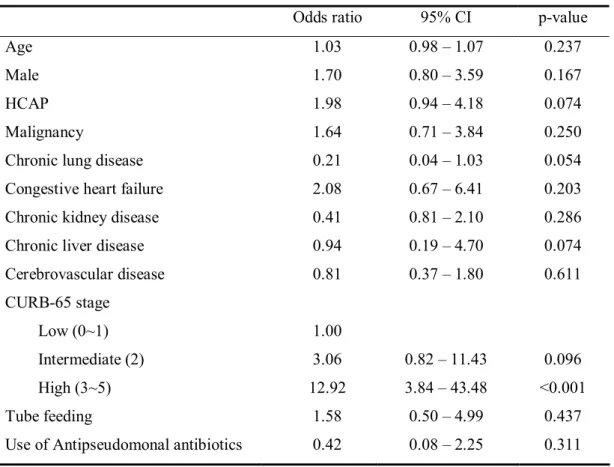
The overall 30-day mortality rate was 9.9%. In a univariate analysis, HCAP was associated with not only an increased 30-day mortality rate (HCAP, 16.3%; CAP, 5.1%; p < 0.0001) but also an increased rate of mechanical ventilation or vasopressor support (HCAP, 20.7%; CAP, 9.5%; p < 0.0001). The age distribution was one of the strongest risk factors for mortality. After excluding six unusually young cases (extreme values), the minimum age in the HCAP group was 42 years. Thus, we limited our study patients to those aged ≥42 years to reduce the effect of age. Forty-nine patients (6 with HCAP and 43 with CAP) were excluded, and there were no 30-day mortalities among these patients. In this limited study population, the univariate OR for HCAP and 30-day mortality was 3.15 (95% CI, 1.64–6.06; p < 0.0001). However, after adjusting for age, sex, comorbidities, initial severity (CURB-65 score) and use of antipseudomonal antibiotics, the association between HCAP and the 30-day mortality rate became non-significant (OR, 1.98; 95% CI, 0.94 – 4.18; p = 0.167) (table 3). The Hosmer–Lemeshow test indicated a good fit for both models (p > 0.05).
Inappropriate initial antimicrobial treatment was significantly higher in patients with HCAP than in those with CAP (p = 0.047), but it did not correlate with 30-day mortality (p = 0.293). Among patients with HCAP, the use of antipseudomonal antibiotics as an initial therapy was not associated with a decrease in 30-day mortality in either the univariate (p = 0.09) or
13
multivariate analysis (AOR, 1.67; 95% CI, 0.72–3.90; p = 0.24). Of the HCAP risk factors, only residence in a nursing home was independently associated with an increase in 30-day mortality (AOR, 4.46; 95% CI, 1.37–13.90; p = 0.013).
Table 3. Multivariate analysis of the predictors of 30 day mortality
Odds ratio 95% CI p-value
Age Male HCAP Malignancy
Chronic lung disease Congestive heart failure Chronic kidney disease Chronic liver disease Cerebrovascular disease CURB-65 stage Low (0~1) Intermediate (2) High (3~5) Tube feeding
Use of Antipseudomonal antibiotics
1.03 1.70 1.98 1.64 0.21 2.08 0.41 0.94 0.81 1.00 3.06 12.92 1.58 0.42 0.98 – 1.07 0.80 – 3.59 0.94 – 4.18 0.71 – 3.84 0.04 – 1.03 0.67 – 6.41 0.81 – 2.10 0.19 – 4.70 0.37 – 1.80 0.82 – 11.43 3.84 – 43.48 0.50 – 4.99 0.08 – 2.25 0.237 0.167 0.074 0.250 0.054 0.203 0.286 0.074 0.611 0.096 <0.001 0.437 0.311
14
Discussion
Healthcare-associated pneumonia is a new category of pneumonia with potential involvement of MDR pathogens and is distinct from CAP. The 2005 IDSA/ATS guidelines concluded that all patients with HCAP are at risk for MDR pathogen infection. Thus, broad spectrum therapy with triple antibiotics is recommended for all patients with HCAP2.
Despite these recommendations, the evidence specifically related to patients with HCAP is weak, and no randomized controlled trials have been conducted. Of the 294 references cited by the ATS/IDSA guidelines, only seven originally related to HCAP, and these were about nursing home-associated pneumonia8-10. Kollef et al.1 published a large retrospective HCAP data series in the U.S., shortly after the guidelines were introduced. Among patients with HCAP, about 50% had MRSA or Pseudomonas aeruginosa, and overall mortality was similar to that of patients with HAP (19.8% and 18.8%, respectively). These findings were consistent in several subsequent U.S. studies11-14. However, many disagreements have
occurred among physicians, and recently reported studies from countries other than the U.S. have suggested that the frequency of MDR pathogens is more similar to that with CAP15-20.
Our study aimed to determine the differences in etiology and outcomes between patients with HCAP and those with CAP, and to clarify antibiotic strategies for HCAP in a tertiary teaching hospital in Jeju, Korea. HCAP accounted for 43.1% of hospitalized patients with pneumonia in the present study, and the incidence of HCAP was higher than that in previous studies (17.3–38.0%)1,15,21,22. The definition of HCAP was widely variable in previous
studies, and some studies included only culture-positive patients. Our analysis included only hospitalized pneumonia cases and studies performed at a referral hospital. Because of the retrospective nature of this study, the true incidence of HCAP cannot be estimated. However, it is of greater importance that more than one-third of hospitalized pneumonia cases may have MDR pathogens.
15
mortality rate of patients with HCAP was three times that of patients with CAP. However, no relationship between HCAP and mortality was observed after adjustments for confounding variables. Investigating the underlying reasons for the increased mortality was complicated for several reasons. First, patients with HCAP were older and had more frequent comorbidities. As these two factors are powerful prognostic factors for pneumonia, other factors would be easily diluted in a retrospective study. In addition, it is uncertain whether MDR pathogens and inappropriate antibiotics were directly associated with higher mortality in patients with HCAP. Previous data on critically ill patients have shown that inappropriate antibiotic treatment is related to higher mortality23-25. However, outcomes and initial extended antibiotics are not simply defined in patients with HCAP. Rello et al.26 reported
that pneumococcal HCAP results in excess mortality that is independent of bacterial susceptibility. These differences in outcomes were probably due to differences in age, comorbidities, and ICU admission criteria, rather than therapeutic decisions. Recent studies from the U.S.27 and Canada28 have suggested that therapy consistent with the 2005
ATS/IDSA guidelines fails to decrease mortality and in some cases, tends to correlate with increased mortality.
About 40% of the patients in the HCAP group had more than two risk factors. It is unclear whether each healthcare environment had the same risk for MDR pathogens, or whether there are multiple risk factors for MDR pathogens. According to the current definition, HCAP is a distillation of multiple risk factors; thus, each patient must be considered individually, particularly with regard to performance status. For example, the risk for infection with MDR pathogens in a nursing home resident who has dementia but maintains daily self-care activities is different from the risk in a patient who is in a vegetative state with a tracheostomy and a feeding tube.
The ATS-IDSA guidelines for the empirical treatment of HCAP indicate that MRSA should be treated with either vancomycin or linezolid2,19. However, the impact of this
16
recommendation on clinical outcomes, including mortality, is limited, and the prevalence of MRSA varies29,30. In the present study, MRSA was identified in 7.7% of the patients with
HCAP, and 7.2% of the patients with HCAP were initially prescribed vancomycin. We could not analyze clinical outcomes and vancomycin use because the incidence of MRSA and frequency of vancomycin administration were too low.
Mycobacterium tuberculosis was isolated from 5.8% of patients with HCAP and 6.9% of
patients with CAP. In most previous HCAP studies, M. tuberculosis was not considered a major pathogen and was not evaluated. According to our data, M. tuberculosis is not rare in patients with HCAP, and AFB staining and cultures should be considered in the initial diagnostic work-up in M. tuberculosis-endemic areas31,32.
Although study did not establish a clear guideline to choose antibiotics, it is important to know local epidemiologic data.
We found causative microorganisms in hospitalized pneumonia cases except those of HAP. Significantly more Pseudomonas species were identified in the HCAP group than in the CAP group, yet fewer than 10% of the Pseudomonas pneumonia cases occurred in the HCAP group. This suggests that the use of double or triple broad-spectrum antibiotics may not be justified, although we did not seek to establish clear guidelines for choosing antibiotics in the present study. After adjusting for potential confounders, the 30-day mortality rate was not significantly higher in the HCAP group compared with the CAP group. The observed higher mortality in patients with HCAP may be attributable mainly to the age of the patient and the initial clinical severity of the disease. While an unverified, broad definition of HCAP may obscure the importance of healthcare-associated MDR infections, it is nevertheless important to understand local epidemiological data on MDR infections. Unfortunately, few studies have evaluated HCAP epidemiology in Korea33,34.
Our study had some limitations that warrant consideration. First, because this was a retrospective study, unintentional data loss might have influenced the HCAP classification,
17
despite our careful review of medications and hospitalization. We did not collect data on premorbid performance status or treatment limitations such as do not resuscitate orders. Therefore, we could not evaluate how performance status and treatment restrictions might have influenced clinical outcomes. Second, there are some limitations regarding available laboratory data. Haemophilus influenza is a major pathogen of adult pneumonia, but reported culture-positive results were extremely rare. No follow-up antibody titer tests were performed in any of the suspected M. pneumonia patients. Third, consideration of special conditions such as tracheostomy or a feeding tube in situ was lacking.
In conclusion, HCAP was a common cause of hospital admissions and was associated with a high mortality rate. However, the higher mortality rate in patients with HCAP was not related to MDR pathogens. Thus, broad-spectrum antibiotics should be used with caution in these patients. The regional variations in the incidence and microbiology of HCAP emphasize the importance of understanding the local epidemiology. Furthermore, heterogeneous HCAP data may be confusing, and the HCAP concept should be carefully defined. A well-designed substantial study is imminent.
Acknowledgements
18
References
1. Kollef MH, Shorr A, Tabak YP, Gupta V, Liu LZ, Johannes R. Epidemiology and outcomes of health-care–Associated pneumonia*. Chest 2005;128:3854-62.
2. American Thoracic Society, Infectious Diseases Society of America. Guidelines for the management of adults with hospital-acquired, ventilator-associated, and healthcare-associated pneumonia. Am J Respir Crit Care Med 2005;171:388-416.
3. Dan L. Longo, Anthony S. Fauci, Dennis L. Kasper, Stephen L. Hauser, J. Larry Jameson, Joseph Loscalzo.: Harrison's principles of internal medicine. 18th ed.: McGraw-Hill Co, Inc.; 2012. p. 2130-41.
4. Carratala J, Fernandez-Sabe N, Ortega L, Castellsague X, Roson B, Dorca J, et al. Outpatient care compared with hospitalization for community-acquired pneumonia: A randomized trial in low-risk patients. Ann Intern Med 2005;142:165-72.
5. Mandell LA, Wunderink RG, Anzueto A, Bartlett JG, Campbell GD, Dean NC, et al. Infectious diseases society of America/American thoracic society consensus guidelines on the management of community-acquired pneumonia in adults. Clinical Infectious Diseases 2007;44:S27.
6. Lim WS, van der Eerden MM, Laing R, Boersma WG, Karalus N, Town GI, et al. Defining community acquired pneumonia severity on presentation to hospital: An international derivation and validation study. Thorax 2003;58:377-82.
7. Fine MJ, Auble TE, Yealy DM, Hanusa BH, Weissfeld LA, Singer DE, et al. A prediction rule to identify low-risk patients with community-acquired pneumonia. N Engl J Med 1997;336:243-50.
8. Mylotte JM. Nursing home-acquired pneumonia. Clin Infect Dis 2002;35:1205-11. 9. Hutt E, Kramer AM. Evidence-based guidelines for management of nursing home-acquired pneumonia. J Fam Pract 2002;51:709-16.
10. Lim W, Macfarlane J. A prospective comparison of nursing home acquired pneumonia with community acquired pneumonia. European Respiratory Journal 2001;18:362-8.
19
11. Micek ST, Kollef KE, Reichley RM, Roubinian N, Kollef MH. Health care-associated pneumonia and community-acquired pneumonia: A single-center experience. Antimicrob Agents Chemother 2007;51:3568-73.
12. Schreiber MP, Chan CM, Shorr AF. Resistant pathogens in nonnosocomial pneumonia and respiratory failure. Chest 2010;137:1283-8.
13. Zilberberg MD, Shorr AF, Micek ST, Mody SH, Kollef MH. Antimicrobial therapy escalation and hospital mortality among patients with health-Care–Associated pneumonia. Chest 2008;134:963-8.
14. Fujitani S, Sun HY, Victor LY, Weingarten JA. Pneumonia due to pseudomonas aeruginosa. Chest 2011;139:909-19.
15. Carratala J, Mykietiuk A, Fernandez-Sabe N, Suarez C, Dorca J, Verdaguer R, et al. Health care-associated pneumonia requiring hospital admission: Epidemiology, antibiotic therapy, and clinical outcomes. Arch Intern Med 2007;167:1393-99.
16. Lim WS, Baudouin S, George R, Hill A, Jamieson C, Le Jeune I, et al. BTS guidelines for the management of community acquired pneumonia in adults: Update 2009. Thorax 2009;64:iii1-iii55.
17. Woodhead M, Blasi F, Ewig S, Huchon G, Leven M, Ortqvist A, et al. Guidelines for the management of adult lower respiratory tract infections. European Respiratory Journal 2005;26:1138-80.
18. Chalmers JD, Taylor JK, Singanayagam A, Fleming GB, Akram AR, Mandal P, et al. Epidemiology, antibiotic therapy, and clinical outcomes in health care-associated
pneumonia: A UK cohort study. Clin Infect Dis 2011;53:107-13.
19. Kollef MH, Morrow LE, Baughman RP, Craven DE, McGowan Jr JE, Micek ST, et al. Health Care-Associated pneumonia (HCAP): A critical appraisal to improve identification, management, and Outcomes—Proceedings of the HCAP summit. Clinical Infectious Diseases 2008;46:S296-334.
20. Lambert ML, Suetens C, Savey A, Palomar M, Hiesmayr M, Morales I, et al. Clinical outcomes of health-care-associated infections and antimicrobial resistance in patients
20
admitted to european intensive-care units: A cohort study. The Lancet infectious diseases 2011;11:30-8.
21. Venditti M, Falcone M, Corrao S, Licata G, Serra P. Outcomes of patients hospitalized with community-acquired, health Care–Associated, and hospital-acquired pneumonia. Ann Intern Med 2009;150:19-26.
22. Shindo Y, Sato S, Maruyama E, Ohashi T, Ogawa M, Hashimoto N, et al. Health-care– associated pneumonia among hospitalized patients in a japanese community hospital. Chest 2009;135:633-40.
23. Kollef MH. Inadequate antimicrobial treatment: An important determinant of outcome for hospitalized patients. Clinical Infectious Diseases 2000;31:S131-8.
24. Kollef MH, Sherman G, Ward S, Fraser VJ. Inadequate antimicrobial treatment of infections*. Chest 1999;115:462-74.
25. Garnacho-Montero J, Garcia-Garmendia JL, Barrero-Almodovar A, Jimenez-Jimenez FJ, Perez-Paredes C, Ortiz-Leyba C. Impact of adequate empirical antibiotic therapy on the outcome of patients admitted to the intensive care unit with sepsis*. Crit Care Med 2003;31:2742-51.
26. Rello J, Luján M, Gallego M, Vallés J, Belmonte Y, Fontanals D, et al. Why mortality is increased in health-care-associated pneumonia. Chest 2010;137:1138-44.
27. Kett DH, Cano E, Quartin AA, Mangino JE, Zervos MJ, Peyrani P, et al. Implementation of guidelines for management of possible multidrug-resistant pneumonia in intensive care: An observational, multicentre cohort study. Lancet Infect Dis 2011;11:181-9.
28. Grenier C, Pépin J, Nault V, Howson J, Fournier X, Poirier MS, et al. Impact of guideline-consistent therapy on outcome of patients with healthcare-associated and community-acquired pneumonia. J Antimicrob Chemother 2011;66:1617-24.
29. El Solh AA, Pietrantoni C, Bhat A, Bhora M, Berbary E. Indicators of potentially drug resistant bacteria in severe nursing home acquired pneumonia. 2004;39:474-80.
21
30. Micek ST, Reichley RM, Kollef MH. Health care-associated pneumonia (HCAP): Empiric antibiotics targeting methicillin-resistant staphylococcus aureus (MRSA) and pseudomonas aeruginosa predict optimal outcome. Medicine (Baltimore) 2011;90:390-5. 31. Jensen PA, Lambert LA, Iademarco MF, Ridzon R, CDC. Guidelines for preventing the transmission of mycobacterium tuberculosis in health-care settings, 2005. MMWR Recomm Rep 2005;54:1-141.
32. Feng JY, Fang WF, Wu CL, Yu CJ, Lin MC, Ku SC, et al. Concomitant pulmonary tuberculosis in hospitalized healthcare-associated pneumonia in a tuberculosis endemic area: A multi-center retrospective study. PloS one 2012;7:e36832.
33. Park HK, Song JU, Um SW, Koh WJ, Suh GY, Chung MP, et al. Clinical characteristics of health care-associated pneumonia in a korean teaching hospital. Respir Med
2010;104:1729-35.
34. Jung JY, Park MS, Kim YS, Park BH, Kim SK, Chang J, et al. Healthcare-associated pneumonia among hospitalized patients in a korean tertiary hospital. BMC Infectious Diseases 2011;11:61.