Tuberc Respir Dis 2009;67:430-435
CopyrightⒸ2009. The Korean Academy of Tuberculosis and Respiratory Diseases. All rights reserved.
지역사회획득폐렴 환자의 중증도 평가에서 Procalcitonin 유용성
1
창원파티마병원 호흡기내과,
2대구파티마병원
박훈표1, 이정수2, 장예수2, 김민수1Usefulness of Procalcitonin in the Assessing the Severity of Com- munity-Acquired Pneumonia Patient
Hun-Pyo Park, M.D.1, Jung-Soo Lee, M.D.2, Ye-Su Jang, M.D.2, Min-Su Kim, M.D.1
Department of Respiratory Medicine, 1Changwon Fatima Hospital, Changwon, 2Daegu Fatima Hospital, Daegu, Korea
Background: Thus far, research studies on community-acquired pneumonia (CAP) have focused on its clinical severity. Recently, it has been determined that procalcitonin (PCT) level is correlated with severity of CAP. A retrospective study conducted at our hospital used risk predictability and PCT to determine whether or no PCT is useful in assessing the severity of CAP.
Methods: This study covered 92 CAP cases that were admitted to the respiratory department at Changwon Fatima Hospital between July 1, 2008 and June 30, 2009. All enrolled subjects were measured for infection markers and risk predictability.
Results: Based on hospital admission data, enrolled subjects had Pneumonia Severity Index (PSI) scores serving as risk predictors showed that both PCT and white blood cell (WBC) were statistically significant as infection markers (p=0.001, 0.037). Thus, this study used ROC curves in PSI for data analysis. As a result, it was determined that the area under curve (AUC) of PCT and WBC was 0.694 and 0.593 respectively, indicating that PCT has a higher test value for WBC, when PCT was higher than 0.745 ng/mL. In addition, it was found that PCT levels higher than 0.745 ng/mL had higher PSI scores than the group with PCT lower than 0.745 ng/mL (p=0.032).
Conclusion: In order to predict risk of pneumonia cases admitted due to symptoms of CAP, it is important to consider PCT as well as PSI, and follow-up monitoring of PCT cases.
Key Words: Pneumonia; Community-Acquired Infections; Procalcitonin; Severity Illness Index
Address for correspondence: Hun-Pyo Park, M.D.
Department of Respiratory Medicine, Changwon Fatima Hospital, 212, Myeonseo-dong, Changwon 641-560, Korea Phone: 82-55-270-1264, Fax: 82-55-265-7766
E-mail: [email protected] Received: Sep. 9, 2009
Accepted: Sep. 29, 2009
서 론
지역사회획득폐렴은 적절한 항생제 사용으로 빠른 회 복을 보이기도 하나 입원한 환자의 10∼20%가 집중치료 실에서 치료를 받고 이들 가운데 사망률이 20∼50%가 될 정도로 감염으로 인한 사망 중 많은 부분을 차지하는 질환 이다1,2. 이러한 사망률을 감소시키기 위해서 오래 전부터
입원 초기에 폐렴의 중증도 및 위험인자를 파악하려는 연 구가 지속되었다. 영국흉부학회에서는 호흡수(30회 이상), 이완기 혈압(60 mmHg 이하), 혈액요소질소(20 mg/ dL 초 과)가 사망과 관련된 인자라고 발표하였고3 이후 Confu- sion, Uremia, Respiratory rate, Blood pressure (CURB) 점수를 개발하였다4,5. 그리고 혈액요소질소를 대신하여 65세 이상의 나이를 이용한 Confusion, Respiratory rate, Blood pressure (CRB)-65를 사용하기도 하였다. 미국에서 도 Patients Outcome Research Team (PORT)의 Pneu- monia Severity Index (PSI)를 발표한 이후6 최근의 폐렴 치료지침에는 PSI와 CURB-65를 폐렴의 예후와 중증도 인 자로서 입원 결정 및 치료에 이용하였다7.
이런 생체 징후와 관련된 인자들 외에도 체내 염증 반
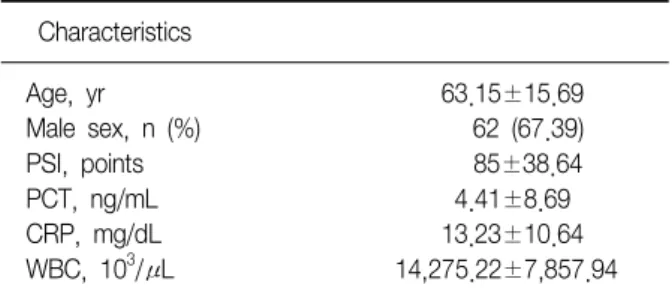
Table 1. Baseline characteristics of the 92 patients
Characteristics
Age, yr 63.15±15.69
Male sex, n (%) 62 (67.39)
PSI, points 85±38.64
PCT, ng/mL 4.41±8.69
CRP, mg/dL 13.23±10.64
WBC, 10
3/μL 14,275.22±7,857.94 Values are number of patients (percentage) or means (standard deviation, SD).
PSI: pneumonia severity index; PCT: procalcitonin; CRP: C-re- active protein; WBC: white blood cell.
응 초기에 상승하는 백혈구를 포함한 염증지표들이 지역 사회획득폐렴의 예후에 영향을 미치는 지에 대한 연구가 지속되었고 그 중에서 C-reactive protein (CRP), Procal- citonin (PCT)가 폐렴의 중증도 평가에 좋은 예측인자라 는 보고가 있다8,9. 특히 PCT는 건강 정상인의 혈청 또는 바이러스 감염이나 비감염성 원인에 의한 염증반응에서 는 증가하지 않고 전형적 폐렴균을 포함한 중증의 세균감 염과 패혈증에서 증가하여 PSI 고위험군일수록 PCT가 높 아 폐렴 중증도를 평가할 수 있다고 한다10. 그 외에도 입 원초기의 PCT가 CRP, 백혈구와 비교하여 폐렴의 중증도 와 예후를 예측할 수 있다고 하며11 위험인자와 관련 없이 PCT가 0.1 ng/mL 미만인 군에서 30일 사망률이 낮았다는 보고가 있다12.
이에 저자들은 기존의 지역사회획득폐렴의 위험예측도 로 사용한 PSI, CRB-65, CURB-65를 이용하여 백혈구, CRP, PCT의 염증지표가 폐렴 중증도 평가에 유용한 지를 후향적으로 알아보고자 하였다.
대상 및 방법
1. 대상
2008년 7월 1일부터 2009년 6월 30일까지 창원파티마 병원 호흡기내과에 지역사회획득폐렴으로 입원하여 처음 24시간 이내에 염증지표와 위험예측도를 측정한 환자를 대상으로 하였다. 이 기간 동안 폐렴으로 호흡기내과에 입원하여 PCT를 포함한 염증지표를 측정한 환자는 286명 이었다. 이 중 흉부사진상 병변이 명확하지 않는 환자 145 명, 최근 1주 내 타 병원에 입원한 환자 31명, PSI를 측정 하지 않은 환자 15명, 추후 결핵으로 판명된 3명을 조사대 상에서 제외하고 지역사회획득폐렴으로 위험예측도를 측 정한 환자 92명을 대상으로 조사하였다.
2. 정의
지역사회획득폐렴은 입원 전 호흡기증상(기침, 객담, 발열, 흉통, 호흡곤란)이 하나 이상 있으면서 흉부사진상 병변이 있고 청진상 수포음이 들린 경우로 하였다. 백혈 구, PCT, CRP를 염증지표로 CRB-65, CURB-65, PSI를 위 험예측도로 규정하였다. CURB-65는 의식혼미, 혈액요소 질소 20 mg/dL 초과, 호흡수 30회 이상, 수축기 혈압 90 mmHg 미만, 이완기 혈압 60 mmHg 이하, 65세 이상으로 하였고 CRB-65는 CURB-65에서 혈액요소질소가 없는 것 이다. 각각에 대해 해당 사항이 있으면 1점씩 부과하여
CURB-65는 0점에서 5점, CRB-65는 0점에서 4점까지 주 었고 0에서 1까지는 저위험군, 2 이상은 고위험군으로 하 였다. PSI는 각각 점수를 계산하여 I군에서 V군으로 측정 하였고 I, II, III군은 저위험군, IV, V는 고위험군으로 하였 다. 혈액에서 CRP 측정은 immunoturbidimetric assay (Modular, Roche, Switzerland), PCT는 enzyme-linked fluorescence assay (VIDAS BRAHMS PCT, France, meas- urement range, 0.05∼200 ng/mL)법으로 하였다.
3. 통계분석
윈도우용 SPSS 12.0 (SPSS Inc., Chicago, IL, USA)을 사용하여 서로 다른 두 군 간의 평균값은 독립표본 T 검정 으로 비교하였고 세 군 간은 일원배치 분산분석법으로 비 교하였다. 그리고 통계학적으로 유의한 차이를 보이는 측 정값은 receiver operating characteristic (ROC) 곡선 분석 을 하였다. 그리고 p값이 0.05 미만일 때 통계학적으로 유의성이 있다고 판정하였다.
결 과
1. 환자
평균 나이는 63세(19∼92세), 여자 30명이었다(Table 1). 그리고 사망자는 6명(6.52%)이었고 사망자의 평균 PCT는 9.30±12.24 ng/mL이었다. 생존자의 평균 PCT는 4.07±8.38 ng/mL이었다. 입원 당시 객담검사에서 세균 이 배양된 경우는 33명(35.87%), 2가지 이상 세균이 나온 경우는 4명이었다. 세균은
klebsiella pneumoniae
10명으 로 가장 많았고streptococcal pneumoniae, staphylococ-
cus aureus
가 각각 8명이었다. PSI 고위험군에는pseudo-
Table 2. Biomarkers and prognostic scales in community-acquired pneumonia
N PCT, ng/mL CRP, mg/dL WBC, 10
3/μL
CRB-65
0∼1 72 3.80±8.70 13.95±11.15 13,171.53±6,121.50
2∼4 20 6.62±8.49 10.66±8.24 18,248.22±11,596.24
(p-value) (0.2) (0.222) (0.01)
CURB-65
0∼1 56 3.03±7.53 13.22±11.20 12,879.64±5,393.98
2∼5 36 6.57±9.97 13.25±9.85 16,446.11±10,337.23
(p-value) (0.056) (0.988) (0.033)
PSI
I∼III 61 2.26±4.87 13.42±11.08 13,061.80±5,601.21
IV∼V 31 8.65±12.69 12.87±9.87 16,662.90±10,754.91
(p-value) (0.001) (0.816) (0.037)
Values are means (±SD).
PCT: procalcitonin; CRP: C-reactive protein; WBC: white blood cell; CRB: confusion, respiratory rate, blood pressure; CURB: con- fusion, uremia, respiratory rate, blood pressure; PSI: pneumonia severity index.
Figure 1. Receiver operating characteristic curves com- paring WBC, PCT in PSI. WBC: white blood cell; PCT:
procalcitonin; PSI: pneumonia severity index.
monas aeruginosa
4명, 저위험군에는streptococcal pne- umoniae
가 6명으로 많았다.2. 지역사회획득폐렴에서 염증지표와 위험예측도
Table 2는 일원배치 분산분석법을 이용한 것으로 염증 지표 측면에서 보면 PCT값은 위험예측도의 고위험군일수 록 높았다. 그러나 통계학적인 유의성을 보이는 것은 PSI 이었다. CRP값은 모든 위험예측도에서 유의성이 없었고 반대로 백혈구는 모든 위험예측도에서 유의성이 있었다.
특이한 사항은 CRP값이 모든 위험예측도에서 고위험군보 다 저위험군에서 높았다. 위험예측도 측면에서 보면 CRB- 65, CURB-65에서는 백혈구가 유의성을 보였고 PSI에서는 PCT, 백혈구가 유의성을 보였다.
3. PSI에서 PCT값에 대한 ROC 곡선
PCT와 백혈구 측정값이 PSI에서 통계학적으로 유의성 이 있게 증가하여 이에 대해 ROC 곡선을 분석하였다.
Figure 1에서 PCT가 곡선하면적이 0.694, 백혈구가 곡선 하면적이 0.593로 PSI에서 PCT가 검사적 가치가 있다고 볼 수 있겠다. PCT의 경우 0.745 ng/mL보다 높을 때 특이 도 70.5%, 민감도 61.3%를 나타내어 지역사회획득폐렴의 고위험군으로 판단하는 데 도움이 될 것으로 관찰되었다.
4. PCT에 따른 임상양상
Table 3에서와 같이 PCT가 0.745 ng/mL 이상일 때 CRP, 백혈구는 커졌고 혈액요소질소도 20 mg/dL보다 높
았으며 호흡수도 빠르게 나타났다. 그리고 PCT가 0.745 ng/mL 미만일 때 사망자는 2명(3.57%)이고 그 이상인 경 우는 사망자가 4명(11.11%)이었다.
고 찰
본 연구는 지역사회획득폐렴에서 기존에 알려진 위험 예측도와 염증지표 간의 상관관계를 알아보고자 하였고 그 결과로 입원 당시의 PCT가 높을수록 그 위험예측도가 크다는 것을 확인하였다. 그리고 이 연구에서 두 가지 특 이할 만한 점을 관찰하였는데 첫째는 위험예측도에서
Table 3. Comparison of clinical characteristics of patients with procalcitonin level
Characteristics PCT <0.75 ng/mL (n=56) PCT ≥0.75 ng/mL (n=36) p-value
Age, yr 61±16.72 66.5±13.48 0.101
WBC, 10
3/μL 11,731.96±4,681.40 18,231.39±9,982.82 0.000
CRP, mg/dL 10.83±8.59 16.97±12.43 0.006
BUN, mg/dL 18.17±10.85 25.75±12.28 0.003
RR, /min 21.14±4.23 23.03±3.89 0.034
SBP, mmHg 126.61±21.77 111.94±32.41 0.011
DBP, mmHg 76.61±12.94 68.06±18.33 0.010
PSI, points 74.75±32.83 100.94±41.93 0.032
Values are means (±SD).
PCT: procalcitonin; WBC: white blood cell; CRP: C-reactive protein; RR: respiratory rate; SBP: systolic blood pressure; DBP: diastolic blood pressure; PSI: pneumonia severity index.
PORT의 PSI 고위험군에서만 통계학적으로 PCT가 상승된 것이 유의하였고 CAPNETZ study의 CRB-6513, CURB-65 에서는 유의성이 없다는 점이다. 이것은 동반질환과 나이 구분이 PSI에 있기 때문에 동반질환이 없는 젊은 성인에 서 PSI가 사망위험성이 낮은 환자를 잘 예측할 수 있는 반면 CURB-65는 중증의 사망률이 높은 환자를 보다 정확 히 예측할 수 있는 차이점 때문일 수도 있겠다14. 둘째는 PCT, 백혈구가 위험예측도 고위험군에서 증가 하나 CRP는 비록 통계학적인 유의성은 없을지라도 저위 험군에서 증가하였다. 이것은 최근 폐구균에 의한 지역사 회획득폐렴에서 높은
streptococcal pneumoniae
urinary antigen titer에도 불구하고 CRP가 낮았다는 보고와15 CRP 가 위험예측도와 일치하지 않는다는 보고와16 같은 결과 이다. 또한 CRP가 PCT보다는 중증폐렴환자에서 늦게 상 승하여17 지역사회획득폐렴의 중증도 평가에 유용성이 낮 다고 할 수 있겠다.일반적으로 전신감염을 확인 시 CRP에 비해 민감성이 나 특이성이 높다고 알려진 PCT는 calcitonin의 전구물질 서 중증의 세균성 감염 시 균체내독소(lipopolysaccharide 포함) 혹은 시토카인(interleukin-1β, tumor necrosis fac- tor-α, interleukin-6)의해 4시간부터 증가하여 8∼24시간 에 고점에 이르게 되지만 바이러스에 의해 유도된 사이토 카인(interferon-r)에 의해서는 증가가 둔화된다18-20. 이런 이유로 PCT는 패혈증을 동반한 심한 세균성 감염의 특이 적인 표지자역할과21 응급실에서는 전신감염을 진단하고 사망환자를 예측할 수 있다22. 그러나 중환자실 발열환자 에서 감염성 원인을 진단하는 데 도움이 되지 않는다는 연구와23 PCT 측정값의 확정 범위에 따라 민감도 및 특이 도에 많은 차이가 있어24 추후 임상적으로 진단이나 치료
의 방침을 적용할 수 있는 기준이 요구되는 상황이다. 그 외에 PCT의 유용한 역할은 감염이 있을 때 추적 검사를 하면 항생제 사용기간을 줄일 수 있다는 것이다. 지금까 지는 항생제 사용을 임상적 관찰을 통해 결정을 하였는데 최근 보고에 따르면 만성폐쇄성폐질환의 급성 악화 시 PCT를 이용한 경우는 항생제 처방률이 40%, 그렇지 않는 경우는 72%이었고25 패혈증 환자도 PCT를 이용한 군이 대조군에 비해 항생제 사용기간을 3.5일 줄였고26 지역사 회획득폐렴에서도 대조군에 비해 PCT군이 항생제 사용기 간을 55%나 감소시켰다는 연구처럼27 PCT를 추적 검사하 여 항생제 중단을 결정하면 좀 더 객관적인 지표가 될 뿐 만 아니라 비용측면에서도 효과가 있을 것으로 사료된다.
추가적으로 Nyamande와 Lalloo28의 보고처럼 폐결핵 시 PCT가 세균성 폐렴일 때보다 낮아서 우리나라처럼 결핵 유병률이 높은 나라에서 폐렴과 폐결핵을 감별하는 데 도 움이 될 수 있겠다.
본 조사는 지역사회획득폐렴의 위험예측에 대한 추후 전향적인 연구를 목표한 사전 조사이기에 제한점을 많이 가지고 있다. 첫째, PCT와 지역사회획득폐렴의 사망자를 조사하여 중증도와의 상관관계를 평가할 계획이었으나 사망자수가 적어 PCT와 폐렴의 증증도를 직접 비교하지 못하여 위험예측도를 이용하였다. 그러나 추후 타 병원과 같이 다기관조사를 전향적으로 하면 이런 점은 개선시킬 수 있을 것으로 판단된다. 둘째, 진단적 검사로서 혈액 및 객담 배양 검사, 혈청학적 검사를 모두 시행하지 못하여 폐렴 원인에 따른 PCT 차이를 확인하지 못했다. 비록 PSI 저위험군에 국한되지만 세균성 원인의 폐렴시 비세균성 폐렴에 비해 PCT가 의미 있게 증가되었다는 보고처럼11 철저한 진단검사를 통해 원인 균주에 따른 PCT 차이를
확인하는 것이 필요하겠다. 셋째, PCT가 우리나라에서는 보험이 되지 않아 비용문제로 추적 검사를 하지 못했다.
입원 당시의 PCT를 측정하여 위험예측도에 반영하는 것 도 중요하나 앞서 언급한 대로 PCT의 유용성은 추적 검사 하여 염증이 호전되었을 때 항생제 사용기간을 단축하는 데 더 의미가 있을 수 있고 이로 인해 항생제 비용을 줄여 오히려 폐렴에 대한 전체적인 경비 감소도 가져올 수 있으 므로 이에 대해서는 추후 논의가 필요할 것으로 판단된다.
결론적으로 지역사회획득폐렴으로 입원한 환자에서의 위험도를 예측하기 위해서는 PSI뿐만 아니라 PCT를 함께 고려해보는 것이 중요할 것으로 판단되고 이에 대한 전향 적인 조사 및 PCT의 추적관찰이 필요하겠다.
참 고 문 헌
1. Fine MJ, Smith MA, Carson CA, Mutha SS, Sankey SS, Weissfeld LA, et al. Prognosis and outcomes of patients with community-acquired pneumonia. A meta-analysis.
JAMA 1996;275:134-41.
2. Kaplan V, Angus DC, Griffin MF, Clermont G, Scott Watson R, Linde-Zwirble WT. Hospitalized commun- ity-acquired pneumonia in the elderly: age- and sex-re- lated patterns of care and outcome in the United States.
Am J Respir Crit Care Med 2002;165:766-72.
3. The British Thoracic Society Research Committee and The Public Health Laboratory Service. The aetiology, management and outcome of severe community-ac- quired pneumonia on the intensive care unit. Respir Med 1992;86:7-13.
4. Neill AM, Martin IR, Weir R, Anderson R, Chereshsky A, Epton MJ, et al. Community acquired pneumonia:
aetiology and usefulness of severity criteria on admission. Thorax 1996;51:1010-6.
5. Lim WS, van der Eerden MM, Laing R, Boersma WG, Karalus N, Town GI, et al. Defining community ac- quired pneumonia severity on presentation to hospital:
an international derivation and validation study. Thorax 2003;58:377-82.
6. Fine MJ, Auble TE, Yealy DM, Hanusa BH, Weissfeld LA, Singer DE, et al. A prediction rule to identify low- risk patients with community-acquired pneumonia. N Engl J Med 1997;336:243-50.
7. Mandell LA, Wunderink RG, Anzueto A, Bartlett JG, Campbell GD, Dean NC, et al. Infectious Diseases Society of America/American Thoracic Society consen- sus guidelines on the management of community-ac-
quired pneumonia in adults. Clin Infect Dis 2007;44 Suppl 2:S27-72.
8. Hedlund J, Hansson LO. Procalcitonin and C-reactive protein levels in community-acquired pneumonia: cor- relation with etiology and prognosis. Infection 2000;28:
68-73.
9. Hausfater P, Garric S, Ayed SB, Rosenheim M, Bernard M, Riou B. Usefulness of procalcitonin as a marker of systemic infection in emergency department patients: a prospective study. Clin Infect Dis 2002;34:895-901.
10. Masia M, Gutierrez F, Shum C, Padilla S, Navarro JC, Flores E, et al. Usefulness of procalcitonin levels in community-acquired pneumonia according to the pa- tients outcome research team pneumonia severity in- dex. Chest 2005;128:2223-9.
11. Kruger S, Ewig S, Marre R, Papassotiriou J, Richter K, von Baum H, et al. Procalcitonin predicts patients at low risk of death from community-acquired pneumonia across all CRB-65 classes. Eur Respir J 2008;31:349-55.
12. Huang DT, Weissfeld LA, Kellum JA, Yealy DM, Kong L, Martino M, et al. Risk prediction with procalcitonin and clinical rules in community-acquired pneumonia.
Ann Emerg Med 2008;52:48-58.e2.
13. Bauer TT, Ewig S, Marre R, Suttorp N, Welte T;
CAPNETZ Study Group. CRB-65 predicts death from community-acquired pneumonia. J Intern Med 2006;
260:93-101.
14. Niederman MS. Recent advances in community-acquir- ed pneumonia: inpatient and outpatient. Chest 2007;
131:1205-15.
15. Tateda K, Kusano E, Matsumoto T, Kimura K, Uchida K, Nakata K, et al. Semi-quantitative analysis of Strepto- coccus pneumoniae urinary antigen: kinetics of antigen titers and severity of diseases. Scand J Infect Dis 2006;
38:166-71.
16. Christ-Crain M, Morgenthaler NG, Stolz D, Muller C, Bingisser R, Harbarth S, et al. Pro-adrenomedullin to predict severity and outcome in community-acquired pneumonia [ISRCTN04176397]. Crit Care 2006;10:R96.
17. Muller B, Becker KL, Schachinger H, Rickenbacher PR, Huber PR, Zimmerli W, et al. Calcitonin precursors are reliable markers of sepsis in a medical intensive care unit. Crit Care Med 2000;28:977-83.
18. Linscheid P, Seboek D, Schaer DJ, Zulewski H, Keller U, Muller B. Expression and secretion of procalcitonin and calcitonin gene-related peptide by adherent mono- cytes and by macrophage-activated adipocytes. Crit Care Med 2004;32:1715-21.
19. Reinhart K, Karzai W, Meisner M. Procalcitonin as a
marker of the systemic inflammatory response to infec- tion. Intensive Care Med 2000;26:1193-200.
20. Becker KL, Nylen ES, White JC, Muller B, Snider RH Jr. Clinical review 167: Procalcitonin and the calcitonin gene family of peptides in inflammation, infection, and sepsis: a journey from calcitonin back to its precursors.
J Clin Endocrinol Metab 2004;89:1512-25.
21. Assicot M, Gendrel D, Carsin H, Raymond J, Guilbaud J, Bohuon C. High serum procalcitonin concentrations in patients with sepsis and infection. Lancet 1993;341:
515-8.
22. Hausfater P, Juillien G, Madonna-Py B, Haroche J, Bernard M, Riou B. Serum procalcitonin measurement as diagnostic and prognostic marker in febrile adult pa- tients presenting to the emergency department. Crit Care 2007;11:R60.
23. Kim HC, Kim KM, Lee SM, Lee SJ, Ham HS, Cho YJ, et al. Measuring serum procalcitonin in patients with fever in the ICU to differentiate infectious causes from non-infectious causes. Tuberc Respir Dis 2006;61:20-5.
24. Holm A, Pedersen SS, Nexoe J, Obel N, Nielsen LP,
Koldkjaer O, et al. Procalcitonin versus C-reactive pro- tein for predicting pneumonia in adults with lower res- piratory tract infection in primary care. Br J Gen Pract 2007;57:555-60.
25. Stolz D, Christ-Crain M, Bingisser R, Leuppi J, Miedin- ger D, Muller C, et al. Antibiotic treatment of exacer- bations of COPD: a randomized, controlled trial com- paring procalcitonin-guidance with standard therapy.
Chest 2007;131:9-19.
26. Nobre V, Harbarth S, Graf JD, Rohner P, Pugin J. Use of procalcitonin to shorten antibiotic treatment duration in septic patients: a randomized trial. Am J Respir Crit Care Med 2008;177:498-505.
27. Christ-Crain M, Stolz D, Bingisser R, Muller C, Mieding- er D, Huber PR, et al. Procalcitonin guidance of anti- biotic therapy in community-acquired pneumonia: a randomized trial. Am J Respir Crit Care Med 2006;174:
84-93.
28. Nyamande K, Lalloo UG. Serum procalcitonin disting- uishes CAP due to bacteria, Mycobacterium tuber- culosis and PJP. Int J Tuberc Lung Dis 2006;10:510-5.