Tuberc Respir Dis 2013;74:207-214
CopyrightⒸ2013. The Korean Academy of Tuberculosis and Respiratory Diseases. All rights reserved.
Usefulness of Plasma Procalcitonin to Predict Severity in Elderly Patients with Community-Acquired Pneumonia
Ji Hye Kim, M.D.1, Joo Wan Seo, M.D.1, Jeong Ha Mok, M.D.1, Mi Hyun Kim, M.D.1, Woo Hyun Cho, M.D.1, Kwangha Lee, M.D., Ph.D.1, Ki Uk Kim, M.D., Ph.D.1, Doosoo Jeon, M.D., Ph.D.1, Hye-Kyung Park, M.D., Ph.D.1, Yun Seong Kim, M.D., Ph.D.1, Hyung Hoi Kim, M.D., Ph.D.2, Min Ki Lee, M.D., Ph.D.1
Departments of 1Internal Medicine and 2Laboratory Medicine, Pusan National University School of Medicine, Busan, Korea
Background: Community-acquired pneumonia (CAP) is one of the leading causes of death among the elderly.
Several studies have reported the clinical usefulness of serum procalcitonin, a biomarker of bacterial infection.
However, the association between the levels of procalcitonin and the severity in the elderly with CAP has not yet been reported. The aim of this study was to evaluate usefulness of procalcitonin as a predictor of severity and mortality in the elderly with CAP.
Methods: This study covers 155 CAP cases admitted to Pusan National University Hospital between January 2010 and December 2010. Patients were divided into two groups (≥65 years, n=99; <65 years, n=56) and were measured for procalcitonin, C-reactive protein (CRP), white blood cell, confusion, uremia, respiratory rate, blood pressure, 65 years or older (CURB-65) and pneumonia severity of index (PSI).
Results: The levels of procalcitonin were significantly correlated with the CURB-65, PSI in totals. Especially stronger correlation was observed between the levels of procalcitonin and CURB-65 in the elderly (procalcitonin and CURB-65, ρ=0.408 with p<0.001; procalcitonin and PSI, ρ=0.293 with p=0.003; procalcitonin and mortality, ρ
=0.229 with p=0.023). The correlation between the levels of CRP or WBC and CAP severity was low. The existing cut-off value of procalcitonin was correlated with mortality rate, however, it was not correlated with mortality within the elderly.
Conclusion: The levels of procalcitonin are more useful than the levels of CRP or WBC to predict the severity of CAP. However, there was no association between the levels of procalcitonin and mortality in the elderly.
Key Words: Community-Acquired Infections; Aged; Pneumonia; Procalcitonin
Address for correspondence: Min Ki Lee, M.D., Ph.D.
Department of Internal Medicine, Pusan National University Hospital, Pusan National University School of Medicine, 179 Gudeok-ro, Seo-gu, Busan 602-739, Korea
Phone: 82-51-240-7225, Fax: 82-51-244-8180 E-mail: [email protected]
Received: Sep. 16, 2012 Revised: Oct. 18, 2012 Accepted: Mar. 21, 2013
CCIt is identical to the Creative Commons Attribution Non-Commercial License (http://creativecommons.org/licenses/by-nc/3.0/).
Introduction
Pneumonia is the sixth leading cause of overall mor- tality in Republic of Korea in 2011, which represents a 15.3% increase from 2010 and a 186.2% from 2001
1. Pneumonia in older people refers to pneumonia in peo-
ple aged 65 or older. Pneumonia is one of the most common diseases, leading to death among the elderly.
Older people tend to develop different symptoms of pneumonia, when compared with young people, mak- ing it difficult for doctors to treat and predict the prognosis. Instead of typical respiratory symptoms such as fever, cough and sputum, older people may have more vague signs such as subtle changes in mental sta- tus
2. Older adults have the risk for delayed diagnosis for pneumonia. Older patients are at the high risk of developing concurrent illness, which affect clinical out- come even after treatment
3.
Generally, a severity-based approach is recommen-
ded for the diagnosis and treatment of community-ac-
quired pneumonia. Pneumonia severity index (PSI) and
CURB-65 are widely used as severity scoring systems.
And severity scores serve as useful indicators in clinical decision making
4. PSI, developed by Fine et al.
5is measured with 20 items, and each item is scored. In PSI, patients are classified into five severity classes where the higher class means poor prognosis and high mortality
5. The CURB-65 is based on the CURB parame- ters: confusion, urea, respiration rate, and blood pres- sure. A score of 1 is given to each parameter for pa- tients aged 65 or over
6,7. Thus both scoring systems use patient's age as an important parameter. However, these systems are not effective to assess patients with a high mortality risk as much as it is for measuring patients with a low mortality risk
8,9.
In addition to PSI and CURB-65, biological markers have been developed to predict the severity of pneumo- nia in patients during the early infection. Among them, procalcitonin, a calcitonin precursor, has been reported as an useful indicator in assessment of severity of pneu- monia
10,11. The use of procalcitonin was more evident for bacterial infections, including sepsis than local and viral infection as it facilitates not only assessment of se- verity but also identification of associated bacteria
12,13. Procalcitonin can also help reduce unwanted antibiotic treatment when its change is closely monitored
14. Study results on the association between PSI and procalcitonin have been divided. But Masia et al.
15claimed high lev- els of procalcitonin and subsequent increase in in- cidence of complications and mortality in the group with high PSI scores. Given a rapid increase in serum density during the early infection, procalcitonin tests al- low easy specimen sampling, simple testing and prompt results. It is therefore very useful for older people as their symptoms may not be prominent and an invasive testing is not appropriate for them.
This study was aimed to evaluate the effectiveness of procalcitonin as a screening tool in assessing the se- verity and mortality risk in community-acquired pneu- monia in elderly people.
Materials and Methods 1. Study subjects
A total of 250 patients admitted to Busan University Hospital due to community-acquired pneumonia and underwent the procalcitonin test during the period from January through December 2009. Their medical records were retrospectively analyzed. A total of 95 patients who developed pneumonia in 48 hours after initial hos- pital admission or received the procalcitonin test after taking antibiotics were excluded. The remaining 155 subjects were grouped into two groups using age 65 as a cutoff. And the differences in CURB-65, PSI, white blood cell, C-reactive protein (CRP), and procalcitonin test results were compared.
2. Study methods
Age, gender, comorbidities, white blood cell at ad- mission, CRP, procalcitonin, length of hospital stay, and mortality. Charlson's comorbidity index (CCI)
16were calculated based on comorbidities. PSI levels and CURB-65 were calculated to estimate the severity of pneumonia. PSI class≥IV and CURB-65 score≥2 are defined as severe pneumonia. Sputum samples were in- cubated and evaluated to detect pathogenic bacteria of pneumonia. Serum samples were tested to evaluate the role of Mycoplasma pneumonia and Chlamydia pneu- monia . Also, urinary antigen test was performed and na- sopharyngeal smear examined to detect Streptococcus pneumonia and influenza virus.
Community-acquired pneumonia is defined as the
presence of respiratory symptoms including a fever of
38
oC, purulent sputum, cough, shortness of breath,
backed by signs of new pulmonary infiltration on the
radiograph. CURB-65 was measured on a six point scale
(range, 0–5) by adding a score of 1 for each of the fol-
lowing conditions: decreased consciousness, blood urea
nitrogen >20 mg/dL, respiration rate of more than 30
times, systolic blood pressure of less than 90 mm Hg,
diastolic blood pressure 60 mm Hg or less. PSI score
was calculated, and each score places a patient into one
of four risk classes (range, I–IV). Procalcitonin level was
≥65 years (n=99) <65 years (n=56) p-value
Mean age, yr 74.51±6.64 52.34±10.44 <0.001
Range of age, yr 65–98 19–64 -
Male gender 74 (74.7) 25 (44.6) 0.653
Charlson's comorbidty score 2.828±2.62 2.393±2.83 0.336
Hospital LOS, days 14.96±13.24 16.70±17.20 0.483
Hospital mortality 19 (19.2) 7 (12.5) 0.463
WBC, 103/μL 13,620±7,056 12,367±6,191 0.269
CRP, mg/dL 14.81±11.05 14.54±11.74 0.888
Procalcitonin, ng/mL 4.80±14.54 3.16±8.65 0.444
PSI score 104.25±29.02 74.39±30.52 <0.001
Class I 0 (0) 5 (8.9) <0.001
Class II 14 (14.1) 24 (42.9) -
Class III 21 (21.2) 14 (25) -
Class IV 51 (51.5) 9 (16.1) -
Class V 13 (13.1) 4 (7.1) -
CURB-65 1.44±0.66 0.21±0.46 <0.001
0 0 (0) 45 (80.4) <0.001
1 63 (63.6) 10 (17.9) -
2 29 (29.3) 1 (1.8) -
3 6 (6.1) 0 (0) -
4 1 (1.0) 0 (0) -
Microbiology
Streptococcus pneumonia 9 (9.0) 5 (8.9) 0.973
Klebsiella pneumonia 4 (4.0) 1 (1.8) 0.654
Staphylococcus aureus 4 (4.0) 5 (8.9) 0.285
Mycoplasma pneumonia 8 (8.1) 10 (17.9) 0.068
Chlamydia pneumonia 7 (7.1) 3 (5.4) 1.0
Influenza virus 4 (4.0) 2 (3.6) 1.0
Values are presented as number of patients (%) or means±standard deviation.
LOS: length of stay; WBC: white blood cell; CRP: C-reactive protein; PSI: pneumonia severity index.
Table 1. Clinical characteristics of total enrolled patients measured using an enzyme linked fluorescent assay (VIDAS BRAHMS procalcitonin; bioMérieux SA, Marcy- l'Etoile, France). Based on out-of-hospital mortality, pa- tients were divided into a survival and a death group.
Hopeless state was classified as death.
3. Statistical analysis
Statistical analysis was performed using SPSS version 18.0 (SPSS Inc., Chicago, IL, USA). Pearson chi-square test or Fisher's exact test was performed for univariate comparison of discrete variables. Student t-test was used to compare continuous variables, including age, CCI, length of hospital staym procalcitonin and PSI. Results are expressed as mean±standard deviation. Spearman
correlation and receiver operating characteristic (ROC) curve analysis was performed to evaluate biomarkers for risk prediction of pneumonia severity. Lastly, a logistic regression was used to estimate the effects of the cut-off value of procalcitonin on risks of pneumonia and mortality. Data results with p-values of less than 0.05 are considered statistically significant.
Results 1. Clinical characteristics of subjects
The average age was 52.3±10.4 years and 74.5±6.6
years, respectively in the under-65 age group and the
65+ age group. Charlson's comorbidity score was high-
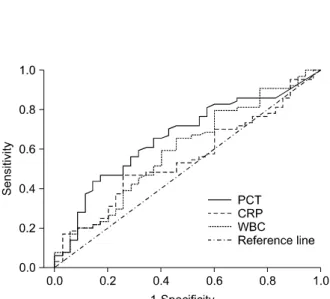
Figure 1. Receiver operating characteristic curves of pro- calcitonin (AUC 0.663), CRP (AUC 0.556), WBC (AUC 0.597) for prediction of severe community-acquired pneu- monia defined as PSI≥IV in the elderly CAP patients (≥
65 years). AUC: area under the curve; CRP: C-reactive protein; WBC: white blood cell; PSI: pneumonia severity index; CAP: community-acquired pneumonia; PCT: pro- calcitonin.
er in the 65+ age group, compared with the under-65 age group (2.82±2.62 vs. 2.39±2.83), although the dif- ference was not significant. Length of hospital stay was 16.7±17.2 days and 14.9±13.2 days, respectively, in the under-65 age group and the 65+ age group.
The mean PSI score was 104.25±29.02 in the 65+
age group. Patients with risk class IV constituted the lar- gest group (51.5%), followed by the class III group (21.2%), the class II group (14.1%), and the class V group (13.1%). The mean CURB-65 score was 1.44±
0.66 in the same group in which 63.6% of patients had a score of 1, followed by score 2 (29.3%), score 3 (6.1%), and score 4 (1.0%). The mean PSI score was 74.39±29.02 in the under-65 age group. Patients with risk class II constituted the largest group (42.9%), fol- lowed by the class III group (25%) and the class IV group (16.1%). The mean CURB-65 score was 0.21±
0.46 in the same group in which 80.4% of patients had a score of 0, followed by score 1 (17.9%) and score 2 (1.8%). Higher levels of white blood cells, CRP and procalcitonin were observed in the 65+ age group, compared with the younger age group (13,620/μL vs.
12,367/μL, 14.81 mg/dL vs. 14.54 mg/dL, and 4.80 ng/mL vs. 3.16 ng/mL, respectively). However, the dif- ferences in these inflammatory markers were not significant.
S. pneumonia (9%) was the most common cause of bacterial pneumonia in the 65+ age group while M.
pneumonia (17.9%) was in the under-65 age group (Table 1).
2. The association between pneumonia severity and inflammatory indicators
Correlation analysis was used to estimate the relation- ship between white blood cell count, CRP and procalci- tonin and CURB-65 score, PSI class and length of hospi- tal stay. A significantly positive correlation was ob- served between procalcitonin level and CURB-65 (ρ=
0.309, p=0.01) and PSI (ρ=0.306, p=0.01) in all age groups. This significantly positive relationship was also found in the 65+ age group with CURB-65 (ρ=0.408, p=0.01) and PSI (ρ=0.263, p=0.01). However, no asso-
ciation was present between procalcitonin level and length of hospital stay. The other two inflammatory in- dicators, CRP and white blood cell count were not asso- ciated with pneumonia severity in all age groups.
However, white blood cells were positively correlated with CURB-65 scores in the 65+ age group (Table 2).
Based on a positive correlation between procalcito- nin, white blood cells and PSI, CURB-65, ROC curve analysis was performed. When PSI class of IV or above was defined as severe community-acquired pneumonia, area under the ROC curve (AUC) was 0.663 for procalci- tonin (Figure 1). With the cutoff value of 2 in CURB-65, AUC increased to 0.741 for procalcitonin while AUC was 0.644 for white blood cell count. Thus procalcito- nin level demonstrated more effectively to predict pneu- monia severity, compared with white blood cell count.
A cutoff value of 0.265 ng/mL showed a sensitivity of
88.9% and specificity of 52.4% for procalcitonin (Figure
2).
Figure 2. Receiver operating characteristic curves com- paring procalcitonin (AUC 0.741), CRP (AUC 0.567), WBC (AUC 0.644) for prediction of severe community-ac- quired pneumonia defined as CURB-65≥II in the elderly CAP patients (≥65 years). AUC: area under the curve;
CRP: C-reactive protein; WBC: white blood cell; CAP:
community-acquired pneumonia; PCT: procalcitonin.
Correlation coefficient (ρ) Procalcitonin CRP WBC
All age CURB-65 0.309** 0.110 0.144
PSI 0.306** 0.115 0.136
Hospital LOS 0.120 0.064 0.123
≥65 years CURB-65 0.408** 0.108 0.226*
PSI 0.263** 0.107 0.188
Hospital LOS 0.054 0.076 0.148
*Spearman correlation is significant at the 0.05 level (2-tailed).
**Spearman correlation is significant at the 0.01 level (2-tailed).
CRP: C-reactive protein; WBC: white blood cell; PSI: pneumo- nia severity index; LOS: length of stay.
Table 2. Correlation of biomarkers and CURB-65, PSI, hospitalization periods in subjects
Procalcitonin
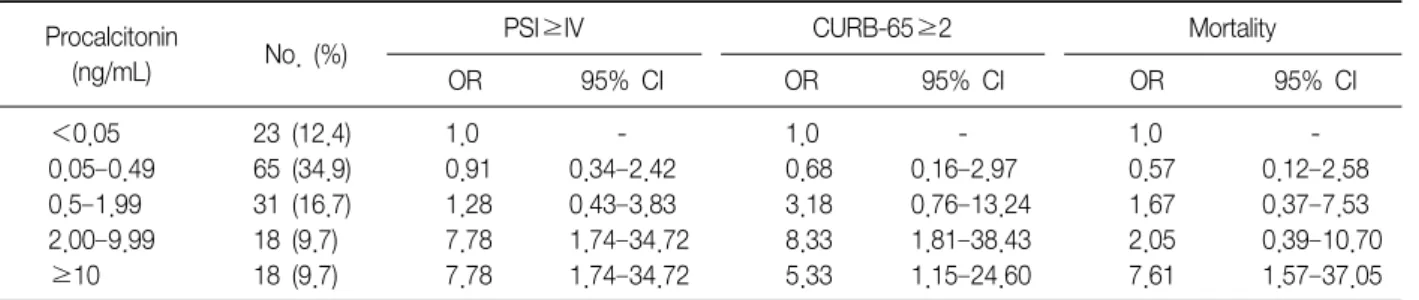
(ng/mL) No. (%) PSI≥IV CURB-65≥2 Mortality
OR 95% CI OR 95% CI OR 95% CI
<0.05 23 (12.4) 1.0 - 1.0 - 1.0 -
0.05–0.49 65 (34.9) 0.91 0.34–2.42 0.68 0.16–2.97 0.57 0.12–2.58
0.5–1.99 31 (16.7) 1.28 0.43–3.83 3.18 0.76–13.24 1.67 0.37–7.53
2.00–9.99 18 (9.7) 7.78 1.74–34.72 8.33 1.81–38.43 2.05 0.39–10.70
≥10 18 (9.7) 7.78 1.74–34.72 5.33 1.15–24.60 7.61 1.57–37.05
PSI: pneumonia severity index; OR: odds ratio; CI: confidence interval.
Table 3. Logistic regression result for predicting severe pneumonia: all patients 3. Correlation between procalcitonin levels and seve-
rity and morality risk in community-acquired pneu- monia
Logistic regression was performed to determine the correlation between procalcitonin levels and severity and morality risk in patients with community-acquired pneumonia. In all age groups, the odds ratio for se- vere pneumonia showed a seven- to eight-hold in- crease for PSI and CURB-65 at procalcitonin level of 2.0 ng/mL or higher. However, the odd ratio remained unchanged with procalcitonin levels of higher than 10 g/mL. The odd ratio for mortality had a seven-fold in-
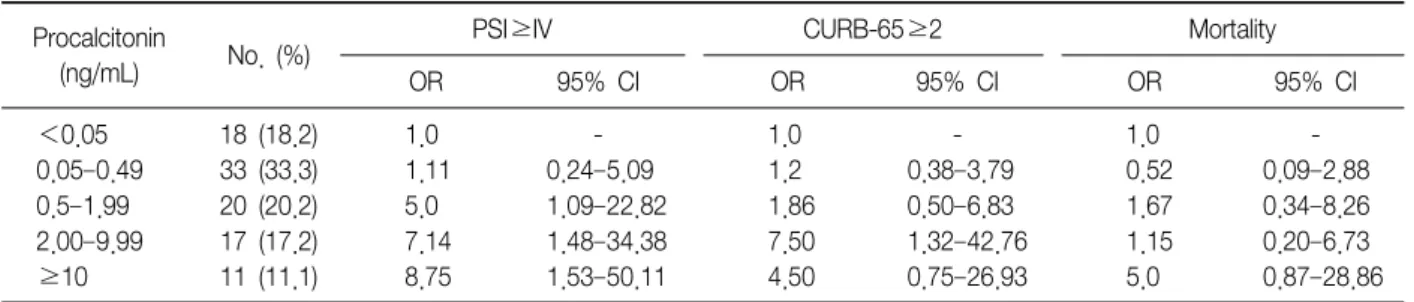
crease with procalcitonin levels of higher than 10 ng/mL (Table 3). In the 65+ age group, the odds ratio was positively correlated with procalcitonin levels showing a 5-fold, 7.1-fold, and 8.7-fold increase, re- spectively, with procalcitonin level of 0.5 ng/mL, 2.0 ng/mL, and 10 ng/mL or above. However, no correla- tion was found between procalcitonin levels and mor- tality in this group (Table 4).
Discussion
Calcitonin is a hormone released from C-cells of the
thyroid gland with the function of regulating the body's
calcium metabolism. However, its precursor, procalcito-
nin has almost no hormonal activity
17. Microbial in-
fection induces increases of calcitonin gene expression
via endotoxin or pro-inflammatory cytokines and a con-
stitutive release of procalcitonin from all parenchymal
Procalcitonin
(ng/mL) No. (%) PSI≥IV CURB-65≥2 Mortality
OR 95% CI OR 95% CI OR 95% CI
<0.05 18 (18.2) 1.0 - 1.0 - 1.0 -
0.05–0.49 33 (33.3) 1.11 0.24–5.09 1.2 0.38–3.79 0.52 0.09–2.88
0.5–1.99 20 (20.2) 5.0 1.09–22.82 1.86 0.50–6.83 1.67 0.34–8.26
2.00–9.99 17 (17.2) 7.14 1.48–34.38 7.50 1.32–42.76 1.15 0.20–6.73
≥10 11 (11.1) 8.75 1.53–50.11 4.50 0.75–26.93 5.0 0.87–28.86
PSI: pneumonia severity index; OR: odds ratio; CI: confidence interval.