• 검색 결과가 없습니다.

Particulate-Matter Related Respiratory Diseases

N/A
N/A
Protected

Academic year: 2021

Share "Particulate-Matter Related Respiratory Diseases"

Copied!
6
0
0

로드 중.... (전체 텍스트 보기)

전체 글

(1)

Introduction

Particulate matter (PM) is suspended dust that has a di- ameter of <10 µm (PM

10

) and can be inhaled by humans and deposited in the lungs, particularly the alveoli. In addition to PM

10

, PM with diameter <2.5 µm (PM

2.5

) and <0.1 (PM

0.1

) is classified as fine and ultrafine PM, respectively

1,2

. A major

source of PM is the combustion of fossil fuels from human activity; however, natural sources, such as yellow dust, are also significant. Domestic PM consists of fine dust from China, sea- sonal yellow dust, and domestic-generated air pollutants

3,4

. As PM poses considerable health risks, individual countries have set maximum acceptable concentrations of PM within the atmosphere, based on the results of concentration prediction systems to estimate levels of PM

1,5-7

.

In 2005, as outlined by the World Health Organization (WHO), the maximum acceptable annual average concen- tration of PM

10

was ≤20 µg/m

3

, with a limit of ≤50 µg/m

3

per 24-hour period. In Korea, the annual and daily average con- centrations of PM

10

are <50 and <100 µg/m

3

, respectively. The annual and daily average concentrations of PM

2.5

are <15 and 35 µg/m

3

, respectively. Overall concentrations of PM

10

and PM

2.5

are above 81 µg/m

3

and 36 µg/m

3

, respectively, and therefore the PM concentration forecast grade is designated as ‘bad’ in Korea (Tables 1, 2)

1,8

.

According to current literature, exposure to PM leads to in- creased pulmonary inflammation and respiratory symptoms aggravation due to oxidative stress and direct toxic injury

5,6

. This is particularly dangerous for patients with pre-existing respiratory diseases, as exposure to PM can lead to acute ex-

Particulate-Matter Related Respiratory Diseases

Sun Young Kyung, M.D., Ph.D.

1,2

and Sung Hwan Jeong, M.D., Ph.D.

1,2

1

Department of Allergy, Pulmonary and Critical Care Medicine, Gachon University Gil Medical Center, Incheon,

2

Gachon Particulate Matter Associated Disease Institute, Gachon University, Incheon, Korea

Particulate matter (PM) is suspended dust that has a diameter of <10 µm and can be inhaled by humans and deposited in the lungs, particularly the alveoli. Recent studies have shown that PM has an adverse effect on respiratory diseases. The aim of this article is to review respiratory diseases associated with PM. According to existing studies, PM is associated with chronic obstructive pulmonary disease, bronchial asthma, and several other respiratory diseases and increases the mortality rates of these diseases. Moreover, increased exposure in the high concentration of atmospheric PM is associated with the development of lung cancer. The most simple and common way to protect an individual from airborne PM is to wear a face mask that filters out PM. In areas of high concentration PM, it is recommended to wear a face mask to minimize the exposure to PM. However, the use of N95 or KF94 masks can interfere with respiration in patients with chronic respiratory diseases who exhibit low pulmonary function, leading to an increased risk of respiratory failure. Conclusionally, reduction of the total amount of PM is considered to be important factor and strengthening the national warning notification system to vulnerable patients and proper early management of exacerbated patients will be needed in the future.

Keywords: Face Mask; Particulate Matter; Respiratory Diseases

Address for correspondence: Sung Hwan Jeong, M.D., Ph.D.

Department of Allergy, Pulmonary and Critical Care Medicine, Gachon University Gil Medical Center, 21 Namdong-daero 774beon-gil, Namdong-gu, Incheon 21565, Korea

Phone: 82-32-458-2872, Fax: 82-32-458-2891 E-mail: [email protected]

Received: Apr. 10, 2019 Revised: Oct. 10, 2019 Accepted: Jan. 21, 2020 Published online: Mar. 10, 2020

cc
It is identical to the Creative Commons Attribution Non-Commercial License (http://creativecommons.org/licenses/by-nc/4.0/).

Copyright © 2020

The Korean Academy of Tuberculosis and Respiratory Diseases.

(2)

acerbation of their ailment. It has also been reported that long- term exposure to high concentrations of PM increases the prevalence of chronic obstructive pulmonary disease (COPD) and lung cancer in adults, leading to a decline in pulmonary function

9-12

. The high concentration of PM in the atmosphere has a profound effect on the prevalence of chronic respira- tory diseases, and the risk of acute exacerbation (which can prove fatal)

13,14

. Additionally, PM

2.5

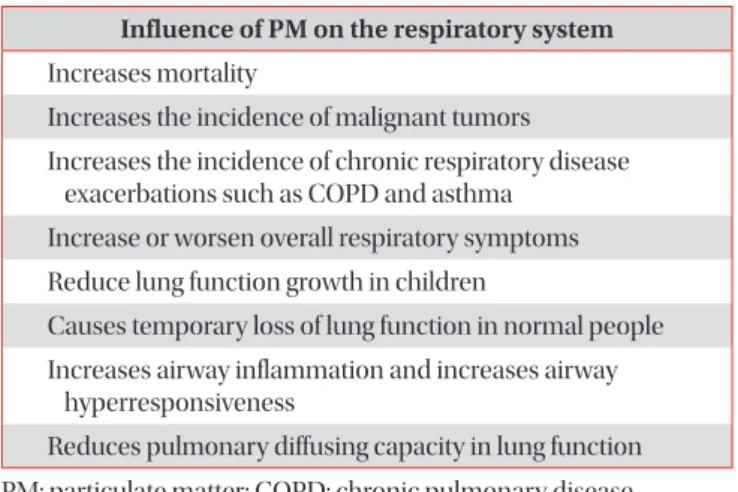
exposure is associated with a long recovery time, more leading to an increase in both the mortality rate and the overall medical burden. Therefore, it is of the utmost importance that effective policies and medical practices are put into place to minimize the public health risks associated with PM exposure (Table 3)

15

.

PM and Pulmonary Function

Pulmonary function is an indicator of respiratory health.

Generally, pulmonary function increases from birth until the mid-20s, after which it begins to decrease. Air pollution, espe- cially PM exposure, is associated with decreased pulmonary function, leading to an increase in the rate of lung function decline in adults

16-19

.

Large-scale cohort studies of the effect of fine dust on pul- monary function in adults are typically based on National Health and Nutrition Examination Surveys (NHANEs). No- tably, the Swiss Study on Air Pollution and Lung Diseases in Adults (SAPALDIA), and the German study on the Influence of Air Pollution on Lung Function, Inflammation, and Aging (SALIA), show interesting results. In the SAPALDIA study, 9,651 adults, aged 18–60 years, were monitored over a period of 11 years. The average forced vital capacity (FVC) and mean forced expiratory volume in 1 second (FEV

1

) decreased by

3.4% and 1.6%, respectively. The PM

10

concentration declined during the observation period, which was associated with reduced lung function decline

18

. In the SALIA study, FEV

1

and FVC decreased by 4.7% and 3.4%, respectively, and the FEV

1

/ FVC decreased by 1.1%, with an increase in PM

10

concentra- tion by 10 µg/m

3

between 1985 and 1994. Thus, lung function was negatively affected, but the decline in pulmonary function was attenuated by reducing PM exposure through environ- mental improvement

13

. However, it is not yet fully understood how other factors affect pulmonary function, such as age, other pollutants, individual susceptibility, and genetic factors.

Effect of PM on COPD and Bronchial Asthma

COPD has been widely studied in relation to fine dust expo- sure in pulmonary diseases

1,8,20

. Studies showed that the rate of hospitalization of patients suffering from COPD increased with increasing exposure to PM

20-22

. A meta-analysis car- ried out in Korea showed that COPD admissions increased by ~2.7% (95% confidence interval [CI], 1.9%–3.6%) with an increase in PM

10

concentration of 10 µg/m

3

(odds ratio [OR], 1.027; 95% CI, 1.019–1.036). In addition, a positive correla- tion between an increase in PM

10

concentration and COPD mortality was also found: COPD mortality increased by 1.1%

(95% CI, 0.8%–1.4%) with an increase in PM

10

concentration of 10 µg/m

3

(OR, 1.011; 95% CI, 1.008–1.014)

8

. These results strongly suggest that exposure to PM increased both the hos- pital admission and mortality rate of COPD. Recent studies have shown that hospitalization due to deterioration of COPD is associated more with atmospheric concentrations of PM

2.5

versus PM

10

. This is especially significant for the 14–90-day period prior to hospital admission (relative risk, 1.06–1.32)

14,15

. About 1.6 million deaths from COPD are believed to be due to air pollution

23

. In Korea, there has been no detailed study on the effect of air pollution and PM on the aggravation of COPD Table 1. Overview of guidelines for particulate matter (PM)

PM

10

(µg/m

3

) PM

2.5

(µg/m

3

) Daily

average Annual

average Daily

average Annual average

WHO 50 20 25 10

Republic of Korea 100 50 35 15

PM

10

: PM with diameter <10 µm; PM

2.5

: PM with diameter <2.5 µm;

WHO: World Health Organization.

Table 2. Particulate matter (PM) concentration forecast grade in Korea

PM concentration (µg/m

3

)

Good Moderate Bad Very bad

PM

10

0–30 31–80 81–150 ≥151

PM

2.5

0–15 16–50 51–100 ≥101

PM

10

: PM with diameter <10 µm; PM

2.5

: PM with diameter <2.5 µm.

Table 3. Influence of PM on the respiratory system Influence of PM on the respiratory system Increases mortality

Increases the incidence of malignant tumors

Increases the incidence of chronic respiratory disease exacerbations such as COPD and asthma

Increase or worsen overall respiratory symptoms Reduce lung function growth in children

Causes temporary loss of lung function in normal people Increases airway inflammation and increases airway

hyperresponsiveness

Reduces pulmonary diffusing capacity in lung function

PM: particulate matter; COPD: chronic pulmonary disease.

(3)

patients; thus, further research is imperative to better under- stand the effect of PM exposure on COPD patients.

In addition to COPD, asthma has also been studied in rela- tion to fine dust exposure

4,24

. Exposure to PM can cause al- lergic sensitization and asthma exacerbation

24,25

. In asthmatic patients, both the exhaled nitric oxide fraction (FeNO) and air- way hyperresponsiveness increases due to aggravation of the allergic inflammatory response. Moreover, asthmatic patients also show reduced lung volume or lung diffusion capacity

24

. Subsequently, PM exposure has been reported to lead to an increase in hospital visits as symptoms including decreased lung function, coughing, wheezing, and dyspnea worsen. In particular, PM

2.5

significantly increased the incidence and prevalence of asthma. According to recent reports, for every 10 µg/m

3

increase in PM

2.5

concentration, the total number of hospital, out-patient, and emergency room visits increased by 0.67, 0.65, and 0.49%, respectively. These findings indicate a significant correlation between PM exposure and acute asth- matic exacerbations

26

. In addition, both domestic and inter- national studies have shown that long-term exposure to PM increases the overall prevalence of asthma

12

.

PM and Interstitial Lung Disease

In 2014, an international study of the relationship between air pollution and idiopathic pulmonary fibrosis (IPF) reported that concentrations of ozone and nitrogen dioxide in airborne fine dust were associated with acute exacerbation of IPF at 6 weeks after initial exposure

27

. A recent study reported that the FVC of IPF patients was reduced by 46 mL with an increase in PM

10

exposure concentration of 5 µg/m

3

, indicating that the increase of PM was closely associated with the progression of IPF

28

. In the 2018 French cohort study, Cohorte Fibrose (COFI), it was reported that as the concentration of PM

10

and PM

2.5

increased by 10 µg/m

3

, the IPF mortality rate increased significantly, by 2.01- and 7.93-fold, respectively

29

. These re- sults suggest that an increase in PM exposure significantly decreases pulmonary function, leading to an increase in mor- tality, as well as acute exacerbation, of IPF

30

.

PM and Lung Cancer

In 2013, the WHO and the International Agency for Re- search on Cancer (IARC) announced that PM is carcino- genic

31

, and that increased atmospheric PM concentrations are associated with lung cancer development

32,33

. In the Euro- pean Study of Cohorts of Air Pollution Effects (ESCAPE), the hazard ratio of lung cancer was 1.22 and 1.18 for an increase in PM

10

concentration of 10 µg/m

3

, and in PM

2.5

of 5 µg/m

3

, respectively

34,35

. In a comprehensive meta-analysis conducted in Korea in 2015, the risk of lung cancer increased by 1.09-fold

(95% CI, 1.01–1.14) when the concentration of PM

2.5

increased by 10 µg/m

3

. A correlation between PM

10

concentration and lung cancer incidence was also observed; however, the cor- relation was comparatively weak compared to that between lung cancer risk and PM

2.5

concentration (1.08-fold increased risk; 95% CI, 1.00–1.17)

8

. In addition, lung cancer incidence was higher in smokers who were exposed to high amounts of PM

2.5

; it was confirmed that fine PM affects smokers’ lung cancer development to a significantly greater degree relative to healthy people

6,31,32

. It is estimated that about 500,000 lung cancer deaths can be attributed to air pollution

23

. Both PM

10

and PM

2.5

were reported to significantly increase the mortality rate in lung cancer patients in 2017 and 2018 meta-analyses

36

. Thus, to reduce lung cancer prevalence and mortality, control of PM generation and avoidance of PM exposure, together with smoking cessation, are of the utmost importance

33

.

PM and Pneumonia Mortality Rate

PM increases airway inflammation in the lungs, leading to increased levels of both inflammatory cytokines and neutro- phils, and an increase in serum 8-isoprostane in bronchoalve- olar lavage fluid or induced sputum

25,37

. These findings accord with the incidence of pneumonia, and it is known that the risk and mortality rate of pneumonia increase in both children and adults with higher PM exposure

34,38,39

. A recent meta-anal- ysis showed that the incidence rate of pneumonia in children increased by 1.5% and 1.8% for every 10 µg/m

3

increase in PM

10

and PM

2.5

, respectively, demonstrating the relationship between PM and pneumonia

11

. In another meta-analysis, the overall mortality rate (relative risk, 1.02) of respiratory disease patients was significantly increased for every 10 µg/m

3

in- crease of PM

2.5

in fine dust

10

.

PM and Protective Face Masks

The most simple and common way to protect against air-

borne fine dust is to wear a mask that filters out fine dust or

gas. Protective masks against PM used in Korea include the

N95, KF94, and KF99 models. Such precautionary measures

are vital, as natural air pollution phenomena, such as yellow

sand, pose severe health risks in Korea. To specifically combat

the danger posed by yellow sand, a specialized mask (KF80)

has been developed

40

. Among filtering face respirators, the

N95 and KF94 masks are the most commonly used, protect-

ing the respiratory tract from fine dust exposure in industrial

workers. These masks are also used to protect against respira-

tory pathogens in hospitals and public places

41

. Both the N95

and KF94 masks are superior to the KF80 mask in preventing

PM inhalation. However, industrial workers who wear these

masks for long periods tend to have subjective complaints,

(4)

including discomfort when breathing. It is known that, in ad- dition to carbon dioxide accumulation, a decrease in the con- centration of inhaled oxygen can lead to an increase in respi- ratory dead space

42

. Although the N95 and KF94 masks have no significant effect on pulmonary function in healthy people or patients with mild respiratory issues, for patients with low pulmonary function and high levels of respiratory distress, caution should be taken when using these masks. All filtration masks (KF80, KF94, and N95) are commercially available and can prevent harmful exposure to PM due to the inflow of fine dust into the body. It is recommended that both the general public and people suffering from mild and moderate chronic respiratory diseases and/or cardiovascular diseases use these preventative measures

40,41

. However, the use of N95 and KF94 masks by people with COPD (stage C/D), or advanced IPF is associated with severe respiratory failure; thus, caution is necessary regarding their use. Further research on the effec- tiveness of masks for preventing PM exposure is needed for patients with advanced respiratory diseases

8

.

Conclusion

Several studies have shown that exposure to high concen- trations of PM leads to an increase in hospitalization and mortality rates in patients suffering from COPD. Acute exacer- bation of bronchial asthma and IPF is also linked to high con- centrations of PM. Long-term exposure to PM is associated with lung cancer development; particularly, high concentra- tions of PM

2.5

have been linked with acute exacerbation and increased prevalence of chronic respiratory disease in smok- ers aged 60 years and over. Therefore, patients with chronic respiratory diseases are vulnerable to high concentrations of environmental PM and should limit outdoor activities and use medication regularly to reduce the risk of acute exacerba- tion. Visiting a medical institution for immediate treatment is recommended if any acute exacerbation symptoms are experienced. In addition, in high PM concentration environ- ments, it is recommended that a face mask be worn to mini- mize exposure. However, for patients with chronic pulmonary diseases and very low pulmonary function, caution must be taken when using the N95 and KF94 masks. Numerous health problems are associated with PM exposure, all of which can lead to the progression and worsening of lung disease; thus, it is extremely important that national policy helps manage resources of PM and focuses on preventative medical care.

Strengthening the notification system to vulnerable patients and proper management of PM production control are con- sidered to be important factors in suppressing prevalence in chronic respiratory disease, decreasing the hospitalization rate, and reducing the mortality associated with acute exacer- bations.

Authors’ Contributions

Conceptualization: Jeong SH. Methodology: Kyung SY.

Formal analysis: Jeong SH, Kyung SY. Writing - original draft preparation: Jeong SH, Kyung SY. Writing - review and editing:

Jeong SH. Approval of final manuscript: all authors.

Conflicts of Interest

No potential conflict of interest relevant to this article was reported.

Funding

No funding to declare.

References

1. World Health Organization. WHO Air quality guidelines for particulate matter, ozone, nitrogen dioxide and sulfur dioxide [Internet]. Geneva: World Health Organization; 2005 [cited 2019 Dec 10]. Available from: http://whqlibdoc.who.int/

hq/2006/WHO_SDE_PHE_OEH_06.02_eng.pdf.

2. World Health Organization. Ambient air pollution: a global assessment of exposure and burden of disease [Internet].

Geveva: World Health Organization; 2016 [cited 2019 Dec 10]. Available from: http://apps.who.int/iris/bitstream/

10665/250141/1/9789241511353-eng.pdf?ua=1.

3. Ministry of Environment. What is the particulate matter?

[Internet]. Sejong: Ministry of Environment; 2018 [cited 2019 Dec 10]. Available from: http://www.me.go.kr/ebook/svs/gt/

view/159.

4. Yang HJ, Kim SH, Jang AS, Kim SH, Song WJ, Kim TB, et al.

Guideline for the prevention and management of particu- late matter/yellow dust-induced adverse health effects on the patients with bronchial asthma. J Korean Med Assoc 2015;58:1034-43.

5. Dockery DW, Pope CA 3rd, Xu X, Spengler JD, Ware JH, Fay ME, et al. An association between air pollution and mortality in six U.S. cities. N Engl J Med 1993;329:1753-9.

6. Pope CA 3rd, Burnett RT, Thun MJ, Calle EE, Krewski D, Ito K, et al. Lung cancer, cardiopulmonary mortality, and long-term exposure to fine particulate air pollution. JAMA 2002;287:1132-41.

7. WHO Regional Office for Europe Review of evidence on health aspects of air pollution - revihaap project: technical report. Copenhagen: WHO Regional Office for Europe; 2013.

8. Kyung SY, Kim YS, Kim WJ, Park MS, Song JW, Yum H, et al.

Guideline for the prevention and management of particulate

matter/Asian dust particle-induced adverse health effect on

(5)

the patients with pulmonary diseases. J Korean Med Assoc 2015;58:1060-9.

9. Zhang S, Li G, Tian L, Guo Q, Pan X. Short-term exposure to air pollution and morbidity of COPD and asthma in East Asian area: a systematic review and meta-analysis. Environ Res 2016;148:15-23.

10. Fajersztajn L, Saldiva P, Pereira LA, Leite VF, Buehler AM.

Short-term effects of fine particulate matter pollution on daily health events in Latin America: a systematic review and meta-analysis. Int J Public Health 2017;62:729-38.

11. Nhung NT, Amini H, Schindler C, Kutlar Joss M, Dien TM, Probst-Hensch N, et al. Short-term association between am- bient air pollution and pneumonia in children: a systematic review and meta-analysis of time-series and case-crossover studies. Environ Pollut 2017;230:1000-8.

12. Abbey DE, Burchette RJ, Knutsen SF, McDonnell WF, Leb- owitz MD, Enright PL. Long-term particulate and other air pollutants and lung function in nonsmokers. Am J Respir Crit Care Med 1998;158:289-98.

13. Schikowski T, Adam M, Marcon A, Cai Y, Vierkotter A, Carsin AE, et al. Association of ambient air pollution with the preva- lence and incidence of COPD. Eur Respir J 2014;44:614-26.

14. Zielinski M, Gasior M, Jastrzebski D, Desperak A, Ziora D. In- fluence of particulate matter air pollution on exacerbation of chronic obstructive pulmonary disease depending on aero- dynamic diameter and the time of exposure in the selected population with coexistent cardiovascular diseases. Adv Respir Med 2018;86:227-33.

15. Atkinson RW, Kang S, Anderson HR, Mills IC, Walton HA.

Epidemiological time series studies of PM2.5 and daily mor- tality and hospital admissions: a systematic review and meta- analysis. Thorax 2014;69:660-5.

16. Gauderman WJ, McConnell R, Gilliland F, London S, Thomas D, Avol E, et al. Association between air pollution and lung function growth in southern California children. Am J Respir Crit Care Med 2000;162(4 Pt 1):1383-90.

17. Gehring U, Gruzieva O, Agius RM, Beelen R, Custovic A, Cyrys J, et al. Air pollution exposure and lung function in children:

the ESCAPE project. Environ Health Perspect 2013;121:1357- 64.

18. Downs SH, Schindler C, Liu LJ, Keidel D, Bayer-Oglesby L, Brutsche MH, et al. Reduced exposure to PM10 and at- tenuated age-related decline in lung function. N Engl J Med 2007;357:2338-47.

19. Pope CA 3rd, Ezzati M, Dockery DW. Fine-particulate air pol- lution and life expectancy in the United States. N Engl J Med 2009;360:376-86.

20. Gan WQ, FitzGerald JM, Carlsten C, Sadatsafavi M, Brauer M.

Associations of ambient air pollution with chronic obstruc- tive pulmonary disease hospitalization and mortality. Am J Respir Crit Care Med 2013;187:721-7.

21. Li J, Sun S, Tang R, Qiu H, Huang Q, Mason TG, et al. Major air pollutants and risk of COPD exacerbations: a systematic

review and meta-analysis. Int J Chron Obstruct Pulmon Dis 2016;11:3079-91.

22. Sunyer J, Basagana X. Particles, and not gases, are associated with the risk of death in patients with chronic obstructive pul- monary disease. Int J Epidemiol 2001;30:1138-40.

23. Schraufnagel DE, Balmes JR, Cowl CT, De Matteis S, Jung SH, Mortimer K, et al. Air pollution and noncommunicable diseases: a review by the Forum of International Respiratory Societies’ Environmental Committee, part 2: air pollution and organ systems. Chest 2019;155:417-26.

24. Guarnieri M, Balmes JR. Outdoor air pollution and asthma.

Lancet 2014;383:1581-92.

25. Thurston GD, Kipen H, Annesi-Maesano I, Balmes J, Brook RD, Cromar K, et al. A joint ERS/ATS policy statement: what constitutes an adverse health effect of air pollution? An ana- lytical framework. Eur Respir J 2017;49:1600419.

26. Tian Y, Xiang X, Juan J, Sun K, Song J, Cao Y, et al. Fine par- ticulate air pollution and hospital visits for asthma in Beijing, China. Environ Pollut 2017;230:227-33.

27. Johannson KA, Vittinghoff E, Lee K, Balmes JR, Ji W, Kaplan GG, et al. Acute exacerbation of idiopathic pulmonary fi- brosis associated with air pollution exposure. Eur Respir J 2014;43:1124-31.

28. Winterbottom CJ, Shah RJ, Patterson KC, Kreider ME, Panett- ieri RA Jr, Rivera-Lebron B, et al. Exposure to ambient particu- late matter is associated with accelerated functional decline in idiopathic pulmonary fibrosis. Chest 2018;153:1221-8.

29. Sese L, Nunes H, Cottin V, Sanyal S, Didier M, Carton Z, et al.

Role of atmospheric pollution on the natural history of idio- pathic pulmonary fibrosis. Thorax 2018;73:145-50.

30. Carey IM, Atkinson RW, Kent AJ, van Staa T, Cook DG, An- derson HR. Mortality associations with long-term exposure to outdoor air pollution in a national English cohort. Am J Respir Crit Care Med 2013;187:1226-33.

31. Straif K, Cohen A, Samet J. Air pollution and cancer [Internet].

Lyon: International Agency for Research on Cancer; 2013 [cited 2019 Dec 10]. Available from: http://www.iarc.fr/en/

publications/books/sp161/AirPollutionandCancer161.pdf.

32. Hamra GB, Guha N, Cohen A, Laden F, Raaschou-Nielsen O, Samet JM, et al. Outdoor particulate matter exposure and lung cancer: a systematic review and meta-analysis. Environ Health Perspect 2014;122:906-11.

33. Huang F, Pan B, Wu J, Chen E, Chen L. Relationship between exposure to PM2.5 and lung cancer incidence and mortality:

a meta-analysis. Oncotarget 2017;8:43322-31.

34. MacIntyre EA, Gehring U, Molter A, Fuertes E, Klumper C, Kramer U, et al. Air pollution and respiratory infections during early childhood: an analysis of 10 European birth co- horts within the ESCAPE Project. Environ Health Perspect 2014;122:107-13.

35. Raaschou-Nielsen O, Andersen ZJ, Beelen R, Samoli E, Sta-

foggia M, Weinmayr G, et al. Air pollution and lung cancer

incidence in 17 European cohorts: prospective analyses from

(6)

the European Study of Cohorts for Air Pollution Effects (ES- CAPE). Lancet Oncol 2013;14:813-22.

36. Kim HB, Shim JY, Park B, Lee YJ. Long-term exposure to air pollutants and cancer mortality: a meta-analysis of cohort studies. Int J Environ Res Public Health 2018;15:E2608.

37. Suhaimi NF, Jalaludin J. Biomarker as a research tool in link- ing exposure to air particles and respiratory health. Biomed Res Int 2015;2015:962853.

38. Cai Y, Schikowski T, Adam M, Buschka A, Carsin AE, Jacque- min B, et al. Cross-sectional associations between air pollu- tion and chronic bronchitis: an ESCAPE meta-analysis across five cohorts. Thorax 2014;69:1005-14.

39. Kyung SY, Jeong SH. Adverse health effects of particulate mat-

ter. J Korean Med Assoc 2017;60:391-8.

40. Langrish JP, Li X, Wang S, Lee MM, Barnes GD, Miller MR, et al. Reducing personal exposure to particulate air pollution improves cardiovascular health in patients with coronary heart disease. Environ Health Perspect 2012;120:367-72.

41. Langrish JP, Mills NL, Chan JK, Leseman DL, Aitken RJ, Fok- kens PH, et al. Beneficial cardiovascular effects of reducing exposure to particulate air pollution with a simple facemask.

Part Fibre Toxicol 2009;6:8.

42. Roberge RJ, Coca A, Williams WJ, Powell JB, Palmiero AJ.

Physiological impact of the N95 filtering facepiece respirator

on healthcare workers. Respir Care 2010;55:569-77.

수치

Table 3. Influence of PM on the respiratory system Influence of PM on the respiratory system Increases mortality

참조

관련 문서

Although the coastal area of Jeju has already been developed, it has high pressure and demands for development continually increasing due to the increase

In matter of business scale, it is no surprise that general logistics company with asset fits more than small business, which has limitation in

As the application of materials having transparent property-of-matter including glass increases sharply in modern architectural space, 'transparency' has become

Background : Janus tyrosine kinase 2 (JAK2) V617F mutation has been described in a high proportion of patients with Philadelphia

Furthermore, as interest in persons with Visual Impairments increases, social perception changes are gradually taking place, and it has been confirmed that

1) Global Initiative for Chronic Obstructive Lung Disease (GOLD). Global strategy for the diagnosis, management and prevention of COPD. Yates, B.S., Jørgen Vestbo, M.D.,

1 John Owen, Justification by Faith Alone, in The Works of John Owen, ed. John Bolt, trans. Scott Clark, &#34;Do This and Live: Christ's Active Obedience as the

Specifically, the prevalence and incidence rates of cancer among chronic diseases are continuously increasing, while early diagnosis and treatment of cancer