미국의 노인전문약사 제도에 대한 체계적 고찰: 인증, 교육 및 성과
남혜연·조은# 숙명여자대학교 약학대학
(Received February 24, 2014; Revised March 10, 2014; Accepted March 17, 2014)
A Systematic Review on the Certified Geriatric Pharmacist Program of the U.S.:
Certification, Education and Outcomes
Hye Yeon Nam and Eun Cho#
College of Pharmacy, Sookmyung Women’s University, Seoul 140-742, Korea
Abstract — Background: As elderly population has been increasing, pharmacists need to possess special knowledge and skills to provide enhanced pharmaceutical care for senior patients. Purpose: This study aims to systematically review on (1) the certified geriatric pharmacists (CGP) system, (2) the curriculum related to geriatric pharmacy education, and (3) the CGP’s performance in terms of clinical, economic and humanistic outcomes in the U.S. Method: The information related to CGP system and curriculum was obtained through the official websites of ‘American Society of Consultant Pharmacists’,
‘Commission for Certification in Geriatric Pharmacy’ and the selected pharmacy school samples. Articles about on the out- comes of pharmacist-provided cognitive services including Medication Therapy Management were searched through PubMed.
Results: To gain the CGP credential, pharmacists need 2-year experience as pharmacist in advance and take the CGP exam- ination. This certification must be renewed every 5 year. Most pharmacy schools provide geriatric-related curriculum through didactic or pharmacy practice classes for pharmacy students and certificate or dual degree in gerontology are given on com- pletion. Most previous outcomes research reported that pharmacists have played a role in yielding favorable results regarding clinical, economic and humanistic outcomes for nursing facilities, hospitals and community pharmacy settings. Conclusion:
Considering the organized CGP certification system and concrete educational courses established the basis for pharmacists to exert their ability for senior patients of the U.S., it is suggested to build a geriatric pharmacist credential model for pharmacists to provide the increasing elderly patients with the requisite safe and effective pharmacy care in Korea.
Keywords□ certified geriatric pharmacists, geriatric pharmacist, cognitive service, medication therapy management
우리나라 65세 이상의 노인인구는 2010년 전체 인구의 11.0%
를 차지하여 이미 고령화 사회에 접어들었고, 이 증가 추세는 계 속되어 2026년에는 20.8%에 달할 것이다.1)이 같은 노인인구의 증가는 노인환자의 증가와 연결되는데, 노인들은 생리적인 노화 과정을 겪으면서 일반적으로 건강이 약화되어 있고, 여러 가지 만성질환을 가지고 있으며, 한 가지 이상의 약물을 동시에 복용 하고 있는 특징을 가진 집단이라는 것에 주목할 필요가 있다. 약 물 간 상호작용으로 인한 부작용 외에도 노인들은 젊은 성인보 다 감소된 약물 대사 및 배설기능으로 인한 체내 약물 축적 및
독성 부작용 위험이 높다.2)다제 약물 복용과 약물 부작용 치료 는 의료비용에도 영향을 미쳐 건강보험심사평가원의 '2012 의료 급여 진료비 통계지표' 자료에 의하면 65세 이상 노인 의료비가 전체 의료비의 42.6%를 차지하였다.3)
이와 같이 약물 부작용 및 의료비 지출 위험에 직면하고 있는 노인환자의 약물치료 효과를 높이고 의료비용을 절감하기 위해 노인환자들에 대해 전문화된 서비스를 제공할 수 있는 약사의 역 할은 매우 중요하다. 미국의 경우 노인환자에게 최적의 약물치 료 서비스를 제공하고 건강한 삶을 살도록 돕기 위한 약사회와 정부의 노력이 일찍이 있었다. 1969년 미국의 상담전문약사협회 (American Society of Consultant Pharmacists, ASCP)은 노인 의 약물치료 성과를 높이고 질 높은 건강관리(care)를 제공하기 위한 활동을 개시했고, 1979년에 노인전문약사위원회(Commission for Certification in Geriatric Pharmacy, CCGP)를 설립하고 노 인전문약사(Certified Geriatric Pharmacist, CGP) 자격증 제도
#Corresponding Author Eun Cho
College of Pharmacy, Sookmyung Women's University, Hyochang- won-gil 52, Yongsan-gu, Seoul 140-742 , Korea
Tel.: 02-2077-7606 Fax.: 02-710-9871 E-mail: [email protected]
종설
를 만들어 지금까지 노인 분야의 전문화된 약사를 배출해왔다.
미국 정부는 1970년대 말부터 1980년대에 약학을 포함한 보건 의료분야가 노인의학(Geriatric) 교육을 하도록 장려했고, 같은 시기에 노인청(Administration on Aging, AOA)도 노인 관련 교 과과정 및 연수 프로그램을 만든 학교에 재정적인 지원을 했다.4) 또한, 10년 전 2003년 65세 이상 노인의 처방약 보험 Medicare Prescription Drug Plan(Part D)을 도입하면서 약물치료관리 (Medication Therapy Management, MTM) 서비스 제공을 법제 화함으로써 최적의 약물치료를 위한 움직임을 더 강화하였다.5) MTM 서비스란 Part D 가입자 중 (1) 복합 만성질환을 가지고 있고 (2) 처방 의약품을 여러 개 복용하고 있어 (3) 연간 $ 3,017 이상6)(2014년 기준) 비용을 지출하는 사람을 대상으로 하여 약 물의 적절한 사용, 부작용 발생 위험요인 차단 및 환자의 복약 순응도 향상을 통해 약물치료 효과의 극대화를 목표로 하는 프 로그램이다. 특히 Part D에 관해 제정된 법률 조항에 보건전문 인이 MTM 서비스를 제공할 것을 포함하고, 구체적으로 '약사' 를 MTM 서비스의 제공자로 유일하게 언급함으로써 약사가 노 인의 약물치료에 중심적인 역할을 할 수 있는 전문인임을 시사 했다.7)
반면 우리나라는 노인들의 안전한 약물 사용을 위한 관리가 부족하며 전문적인 약물치료 서비스를 제공할 수 있는 약사의 양 성과 이들의 활동을 위한 구조적 기반이 부재한 실정이다. 2001 년 국내 병원의 노인약학에 관한 실태조사에서 노인환자를 위한 투약지침이 있는 곳은 23곳 중 단 1곳이었고 노인약학 관련 문 헌이 구비된 곳은 30.0%에 불과했다.8)한편 외래노인환자 중 노 인 약물사용 적절성 판단 표준 지침서인 Beer's criteria에 해당 하는 부적절 약물 1개 이상 처방된 경우가 11.7%이었고,9)의원 을 내원한 노인환자의 46.9%가 부적절한 약물을 처방 받고 있 다는 연구 결과도 있었다.10)지난 2010년에 의료법 시행규칙 개 정으로 노인성질환 및 만성질환 환자를 주 입원대상으로 하는 요 양병원에 대하여 1인 이상의 약사 또는 한약사 고용이 의무화되 면서,11)노인의 병태생리학적 특성에 대한 이해가 깊고 전문 약 물치료 지식을 갖춘 노인전담약사의 요구는 점점 증대되고 있다.
하지만 우리나라에는 노인 약물치료의 전문 지식을 갖춘 약사를 배양하기 위한 체계화된 교육제도 및 자격제도가 미비하다. 약 사를 양성하는 국내 약학대학에서도 노인 관련 교육이 제대로 갖 춰지지 않은 실정이며, 노인전담약사가 환자의 약물치료를 높이 는데 도움이 될 것이라 예측은 하면서도 그 영향력이 얼마만큼 인지 구체적인 성과에 대한 이해가 부족하다. 따라서 본 연구는 노인 약물치료의 전문약사 제도가 잘 발달된 미국의 사례를 중 심으로 미국의 (1) 노인전문약사(CGP) 자격제도와 (2) 약학대학 의 노인 관련 교육 시스템을 조사하고 (3) 노인전문약사들의 활 동과 이들의 개입으로 인한 MTM 서비스의 성과에 대한 문헌들 을 체계적으로 조사, 분석, 고찰하고자 한다.
연구방법
연구대상 및 연구자료 검색
미국의 노인전문약사 자격제도를 이해하기 위하여 Certified Geriatric Pharmacist(CGP)의 취득 및 갱신방법을 조사했으며, 관련된 자료는 미국 노인전문약사위원회(CCGP) 인터넷 웹 페이 지를(http://www.ccgp.org)12)통하여 수집하였다. 자격 취득과 갱신에 필요한 교육과정은 상담전문약사협회(ASCP, https://
www.ascp.com)13)노인전문약사위원회의 웹 페이지에서 정보를 수집하였다.
약학대학 학부생을 대상으로 한 학부 커리큘럼 내에 노인환자 에 대한 관련 교육과정이 있는지 여부와 그 과정의 교과목과 강 의내용을 조사하였다. 조사를 위해서 다음 두 방법을 이용하여 미국 약학대학 샘플을 선정하였다. 우선, 2012년 미국 US News and World report에서 제공한 약학대학 순위 평가에서 상위 1위 부터 10위에 해당하는 약학대학을 포함하였다.14)또한, 구글 (Google)에서 검색어 "geriatrics in colleges and schools of pharmacy"를 입력해 정확도 순으로 검색되는 학교 총 30곳으로 정했다. 검색된 약학대학들의 각 학교 웹 페이지를 통해, 약학대 학 대학원(Graduate school) 과정이 아닌 Pharm.D. 과정 중에 있는 학생들을 위한 노인 관련 교과목 있는 학교만 최종적으로 연구조사 대상에 포함시켰다. 약학대학 내 학과가 아닌 다른 학 과와 연계하여 노인 관련 교육을 제공하고 있는 경우 연계된 학 과의 웹 페이지도 방문해 같은 교과목이 서로 다른 두 학과에 개 설되어 있는지 이중 점검을 했으며, 교과목 이름이나 과목 설명 이 완전히 일치하지 않는 경우 약학대학의 교육과정 담당자에게 이메일을 보내 해당 수업 과목을 제공하는지 최종적으로 확인 하였다. 노인 관련 교과목 리스트는 약학대학 홈페이지에서 제 공하는 2013년 커리큘럼 항목이나 가장 최근 발행된 학생을 위 한 안내서(Student handbook)를 확인했고 약학대학 홈페이지에 서 커리큘럼 설명이 부족한 경우에는 대학교 메인 홈페이지에 서 수강신청 사이트에 접속하여 수강신청 가능 과목과 그 과목 의 개요 정보를 수집했다. 노인 관련 교과목 정의는 교과목 이 름에 다음과 같은 단어가 포함되어 있거나: 'Geriatrics'; 'Older adults'; 'Elderly'; 'Long term'; 'Aging'; 노인을 주제로 별도의 학점을 부여해 1학기 이상 강의가 진행되는 과목을 노인 관련 교과목으로 인정하였고, 특정 수업 중에 노인 관련 주제가 한 단원 등으로 구성된 교과목은 노인 관련 교과목으로 인정하지 않았다.
과거부터 현재까지 지난 30년 동안 미국 약학대학의 노인 관련 교육과정에 대한 자료는 PubMed를 통해 검색된 학술 문헌자료 를 이용하여 조사하였다. 특히 이러한 학술 문헌들에서 언급된 미국 약학대학들은 추출하여 추가로 각 학교 웹 페이지를 다시 검색하여 현재 노인과 관련된 약대 내 교육내용을 조사하였다.
PubMed 검색 시 검색조건은 "geriatric pharmacy education"
AND "US"를 입력하였고(검색일: 2013년 8월 1일) 검색된 3개의 각 논문에서 인용하고 있는 논문들을 순차적으로 찾아 조사했다.
노인전문약사의 활동을 중재로 한 성과를 고찰하기 위하여 미 국 노인전문약사위원회 웹 페이지에 소개된 정보, 인용된 논문, 소식지(newsletter), 연차보고서(annual report)에서 언급된 내용 들을 이용하여 조사하였다. 약사가 제공한 MTM 서비스의 성과 에 관한 문헌 고찰은 PubMed 검색 시, title에 'medication therapy management'로 제한하여 조사하였다(검색기간: 2013년 10월28일~2013년 11월2일). 9개 리뷰 논문을 포함하여 총 190 개 논문이 검색되었는데, 검색된 논문과 리뷰 논문에서 인용한 개별 논문들 중, 서비스 제공자가 약사이면서(의사 혹은 다른 보 건전문인이 함께 참여한 경우도 포함) MTM 서비스를 제공했을 때와 제공하지 않았을 때의 성과를 비교 조사 분석(comparative analysis)한 연구만을 선정하여 추출하였다. 연구 논문 선정을 위 해 각 논문들의 초록을 인쇄한 후, 두 명의 연구자가 각기 검토 하여 함께 확인 논의하는 과정을 거쳤다. 본 연구에서는 각 문헌 들에서 보고한 성과를 ECHO(Economic, Clinical, Humanistic outcomes) 모델에 따라 결과를 분류하였다. ECHO 모델은 임상 적 효능 외에도 비용과 삶의 질 측면을 함께 고려해 의료 서비 스 또는 의료 개입(intervention)의 가치를 평가하고 의사결정을 돕는 프레임워크이다.15) 임상적 성과(Clinical outcomes)는 치료 의 효능 또는 효과 평가로 결정되며 삶의 질 성과(Humanistic outcomes)는 환자의 신체적, 정신적 기능, 만족도 등으로 평가되 고 경제적 성과(Economic outcomes)는 의료 서비스에 대한 환 자의 지불의사, 자원 절약 등과 관련이 있으며 비용-편익분석, 비 용-효과분석, 비용-효용분석, 비용-최소화분석이 비교분석에 사용 된다.
연구결과
노인전문약사(Certified Geriatric Pharmacist) 자격제도 노인전문약사(CGP) 자격제도는 노인전문약사위원회 (Commission for Certification in Geriatric Pharmacy, CCGP)
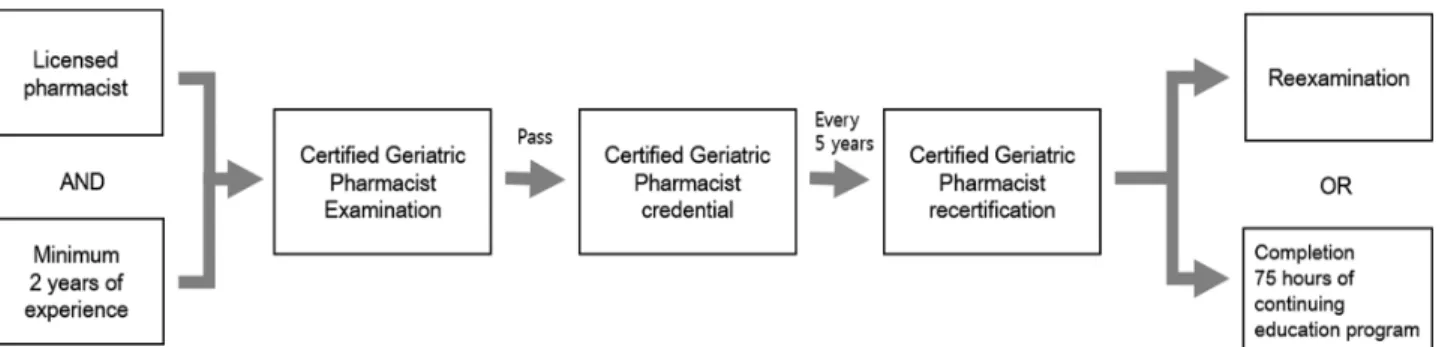
에서 관리하는 것으로 1997년 11월에 처음 시작되었다.16)노인 전문약사 자격을 취득하려면 약사 면허증을 소지하고 적어도 2 년 이상 약사로서 활동 경험을 쌓은 뒤 자격시험에 응시하여 합 격해야 한다.17)이 자격의 유효 기간은 5년으로, 5년 마다 갱신 해야만 자격을 유지할 수 있다(Fig. 1).18)자격시험의 기회는 1 년에 4번 제공되며, 시험에는 총 150문제가 출제된다. 시험 내용 은 크게 3개 분야인데, (1) 노화에 따른 생물학적 및 사회경제적 인 변화에 대한 노화 이론(General principles of aging)이 전체 내용의 25.0%를 차지하고; 노인환자의 상태 평가, 건강 개선을 위한 근거 중심적 접근법, 치료, 모니터링, 환자 교육, 치료 계획 및 성과 문서화 등과 관련된 노인환자 돌봄 및 치료(General principles of caring for older adults) 토픽이 전체의 60.0%; (3) 노인환자 교육 프로그램 개발, 노인 약물치료의 경제성 평가, 안 전한 약물 사용 등과 같은 내용의 인구 특성 맞춤 분야(Population specific activities)가 15.0%로 구성되어 있다.19)
노인전문약사(CGP) 자격시험을 준비하는 약사들은 노인전문 약사위원회(CCGP)와 상담전문약사협회(ASCP)에서 제공하는 다 양한 종류의 교육프로그램 및 자료를 이용할 수 있다. 예를 들어, 노인전문약사위원회(CCGP)에서는 노인 약물사용의 주요 논문들 과 복합 질환을 가진 노인의 치료 가이드라인, 노인 약물사용 적 절성 판단 표준지침서(Beer's criteria), 노인에게 사용할 수 있는 의약품 목록, 노인의학 교재 목록, 노인의학 저널 및 노인전문약 사(CGP) 자격시험의 온라인 자가 모의시험(self-assessment exam)을 제공하고 있다.20-22)상담전문약사협회(ASCP)에서는 유 료 온라인 교육을 제공하고 있으며 노인의학 관련 자료에 편리 하게 접근할 수 있도록 노인 약물치료의 정보 및 웹사이트들이 링크되어있다.23,24)이 외에도 캘리포니아 노인교육센터(California geriatric education center)와 웨스턴 대학교(Western University of Health Sciences)의 약학대학(College of Pharmacy)에서 매년 시행하는 노인약학 집중코스(Intensive Course in Geriatric Pharmacy and Board Review)나 캐나다의 온타리오 약사회 (Ontario Pharmacists Association)가 주최하는 노인전문약사 (CGP) 자격 대비 과정(Medication Therapy Management for Older Adults - CGP Preparation Course)의 평생 교육(continuing
Fig. 1 − The methods of gaining the CGP credential and recertification.
education)에 참여할 수 있다.20)
노인전문약사(CGP) 자격의 갱신 방법은 두 가지로, 노인전문 약사(CGP) 자격시험을 재응시하는 것과 평생교육(continuing education credit)을 75시간 이상 이수하는 것이다.18)두 번째 갱 신 방법은 'Professional Development Pathway'라고 하며 상담 전문약사협회(ASCP) 웹사이트에서 제공하는 온라인 강의를 듣 거나 현장 평생 교육(ASCP 연례 모임 및 워크샵 ASCP annual meeting & exhibition)에 참석하여 학점을 인정받을 수 있다.25) 상담전문약사협회(ASCP) 웹사이트에서 제공하는 노인전문약사 (CGP) 자격 갱신을 위한 온라인 강의는 '고급 노인약물치료강좌' 26.5시간과 기초 노인약물치료 과목에서 일부를 선정한 'CGP갱 신을 위한 보충강좌' 48.5시간이 있으며, 약사들이 매년 15시간 씩 5년간 꾸준히 평생교육을 이수할 것을 장려하기 위하여 15시 간짜리 강좌 패키지를 제공한다.24)
Pharm.D. 과정 중 노인약학과 관련된 커리큘럼
미국약학교육위원회(American Council on Pharmaceutical Education, ACPE)는 1980년대 이후 미국의 각 약학대학에서 제 공하는 노인환자와 관련된 커리큘럼에 대하여 조사 발표하고 있 다. 1980년 당시 승인된 72개 약학대학의 노인 관련 교육과정
실태에 관한 조사(응답률: 100.0%)에서 43.0%에 해당하는 학교 가 적어도 1개 이상의 노인 관련 교육을 제공했고, 22.0%는 전 혀 제공하지 않았다고 응답하였다.26) 1994년 조사에서는 71개 약학대학(응답률: 94.7%) 중 대부분이 노인 관련 교육을 이론 선 택과목이나 실습 선택과목 형태로 운영하고 있었다.27) 2005년에 는 설문에 응답한 42개 대학교(응답률: 50.0%) 모두가 노인 관 련 교육을 제공하고 있었으며28) 2011년 조사에 응답한 50개의 모든 대학교(응답률: 50.0%)가 노인 관련 교육이 있었고 이 중 에서 34.0%의 대학교는 필수과목으로, 62.0%는 선택과목으로 운 영하고 있었다.29)
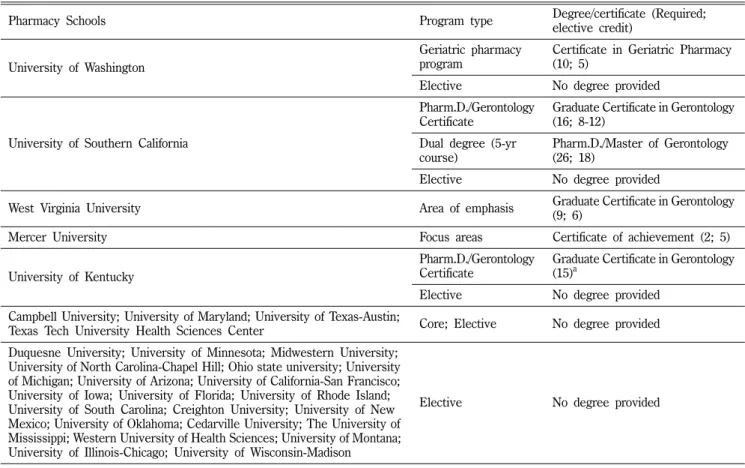
본 연구의 샘플로 선정된 30개 약학대학의 노인 관련 교육의 프로그램을 명칭, 학위 또는 증명서 수여 여부, 학위 또는 증명 서 취득을 위한 최소 요구 학점을 필수와 선택으로 구분해 Table I에 표시하였다. 연구 대상으로 선정된 미국 약학대학의 노인 관 련 커리큘럼은 크게 Pharm.D. 학위와 더불어 노인학 관련 학위 또는 과정 이수 증명서를 수여하는 프로그램과 그렇지 않은 것 으로 구분할 수 있는데, 예를 들어 University of Southern California(USC)는 Pharm.D. 과정과 노인학 석사(Master of gerontology) 과정을 5년에 마치는 복수 학위제도를 운영하고 있 는데 이에 필요한 노인관련 이수 과목 요건은 44학점이다. 노인
Table I − Geriatric course of pharmacy schools in the U.S.
Pharmacy Schools Program type Degree/certificate (Required;
elective credit)
University of Washington
Geriatric pharmacy program
Certificate in Geriatric Pharmacy (10; 5)
Elective No degree provided
University of Southern California
Pharm.D./Gerontology Certificate
Graduate Certificate in Gerontology (16; 8-12)
Dual degree (5-yr course)
Pharm.D./Master of Gerontology (26; 18)
Elective No degree provided
West Virginia University Area of emphasis Graduate Certificate in Gerontology
(9; 6)
Mercer University Focus areas Certificate of achievement (2; 5)
University of Kentucky
Pharm.D./Gerontology Certificate
Graduate Certificate in Gerontology (15)a
Elective No degree provided
Campbell University; University of Maryland; University of Texas-Austin;
Texas Tech University Health Sciences Center Core; Elective No degree provided Duquesne University; University of Minnesota; Midwestern University;
University of North Carolina-Chapel Hill; Ohio state university; University of Michigan; University of Arizona; University of California-San Francisco;
University of Iowa; University of Florida; University of Rhode Island;
University of South Carolina; Creighton University; University of New Mexico; University of Oklahoma; Cedarville University; The University of Mississippi; Western University of Health Sciences; University of Montana;
University of Illinois-Chicago; University of Wisconsin-Madison
Elective No degree provided
aAmong 15, 3-credits for applied experience may be 2 options: field experience or research project.
학 이수 증명서(Certificate in gerontology)를 주는 대학은 USC 를 포함하여 5개 대학이었으며, 이수 증명서를 받기 위해 필요 한 관련 이수 학점은 7학점부터 28학점으로 학교마다 다양한 기 준을 갖고 있었다. 학교들이 요구하는 이수 학점은 필수와 선택 과목으로 구분되며, 교과목의 형태는 이론 또는 실습 수업이었 다. 일부 학교는 노인 관련 교과목의 성적 제한도 두었는데, USC 는 노인학 석사 복수 학위를 위해 최소 3.0 이상, University of Washington와 West Virginia university에서는 노인학 이수 증명 서를 위해 각각 2.7 및 3.0 이상의 학점을 유지해야 한다.
나머지 25개 대학교는 노인학 관련 학위나 증명서를 따로 제공 하지 않고 Pharm.D. 과정을 이수하기 위한 교육과정의 일부분으 로 제공하고 있었다(Table I). 이 중, 21개 대학은 선택과목으로
Table II − Subjects related to geriatric courses offered by pharmacy schools in the U.S.
Types of course Subjects
Elective
Didactic
Advanced Geriatric Pharmacotherapy; Advanced Geriatrics Elective; Aging and Health; Drug Therapy for the Elderly; End-of-Life Care for Adults and Families; Geriatric and Long Term Care Pharmacy Practice; Geriatric Assessment; Geriatric Medication Management; Geriatric Pharm Practice; Geriatric Pharmacotherapy; Geriatric pharmacy I, II; Geriatrics Interprofessional; Geriatrics/Gerontology;
Geriatrics-Pharmaceutical Care; Interprofessional Geriatric Care; Introduction to Senior Care Practicum; Medicare Part D Community Outreach; Geriatric Pharmacy Practice; Perspectives in Geriatrics; Perspectives in Geriatrics Laboratory; Pharmacology and Aging; Pharmacotherapeutics for Older Adults; Pharmacy Practice and the Geriatric Patient; Seminar in Geriatrics; The Aging Patient Advanced Pharmacy
Practice Experiences
Acute Care Geriatrics Clerkship; Advanced Geriatrics Clerkship; Geriatric APPE; Geriatric Pharmacotherapy; Geriatrics Clerkship; Geropsychiatry Clerkship; Geriatric Primary Care Clerkship;
Geriatrics/Gerontology Rotation; Long Term Care Clerkship; Long Term Care Rotation
Core
Introductory Pharmacy
Practice Experiences Healthy Aging Advanced Pharmacy
Practice Experience Geriatrics; Geriatric Pharmacotherapy Clerkship Experiential Program
(1 year program for first year students)
Care And Respect for the Elderly (CARE) Program
Table III − Departments offering geriatric courses for Pharm.D. students in the U.S.
Departments Subject name
Psychology Psychology of Adulthood and Aging Sociology Aging
Medicine Clinical Aspects of Aging Nursing Mental Health of Older Adults
UCONJ a Biological Aspects of Aging; Social and Cultural Aspects of Aging; The Family in Later Life
Gerontology
Administration and System Management in Programs for Older Adults; Applied Policy Skills in Aging; Continuum of Care: A Systems Perspective; Counseling Older Adults and Their Families; Field Practicum; Integrating Gerontology:
An Interdisciplinary Approach; Life Span Developmental Psychology; Life Span Developmental Sociology; Physiology of Development and Aging; Program Evaluation(2013/14, Evaluation: Incorporating Evidence-Based Practices);
Research Methods; Social Policy and Aging
Counseling Older Adults and Their Families; Life Span Developmental Psychology; Life Span Developmental Sociology; Physiology of Development and Aging; Social Policy and Aging; The Aging Family; The Mind and Body Connection through the Lifespan
Evaluation: Incorporating Evidence-Based Practices; Integrating Gerontology
aAbbreviation for University Conjoint which was developed by Interschool or Intercollege Programs.
운영하고, 4개 대학은 선택과 필수과목으로 커리큘럼을 운영하고 있었다. 필수과목의 노인 관련 교육은 모두 기초 또는 필수 실무 실습(Introductory/Advanced Pharmacy Practice Experiences) 형태로 제공되는 과목이었다.30-33)
각 약학대학에서 제공하는 노인 관련 과목의 이름을 크게 선 택과 필수로 구분한 뒤 이론과 실습 형태로 다시 분류하고, 실무 실습의 교육은 기초와 심화로 나누어 Table II에 정리했다. 대부 분의 노인 관련 과목은 이론 형태의 선택과목으로 운영되고 있 었다. 과목명으로 가장 많이 사용된 단어는 "Geriatrics"였고
"Pharmacy", "Pharmacotherapy" 단어와 함께 결합되어 노인의 약물사용 및 치료를 주요 내용으로 가르치고 있었다. USC는
"Geriatric Pharmacy" 과목을 I과 II로 나누어 다른 대학교보다
심화된 교육을 운영하고 있었다. 이 외에도 노화에 따른 생리학 적 변화, 노인의 건강 상태 평가방법, 죽음을 앞둔 노인의 통증 관리(pain treatment)와 가족과의 관계 및 윤리적 이슈 등에 초 점을 두는 과목도 있었다. 실습 형태의 노인 관련 교육은 필수보 다 선택과목으로 많이 운영되고 있었는데, University of Texas- Austin의 경우 Pharm.D.과정 1학년 학생들 모두가 노인이 거주 하고 있는 보조 생활 시설(assisted-living facility)에 학기 당 최 소 6번 이상 방문하여 노인과 1 : 1 또는 1 : 2로 연결되어 노인 의 사회적 지지자가 되어주고, 건강 상태와 약물 부작용을 확인 하는 1년 과정 프로그램(Care And Respect for the Elderly Program)을 운영하고 있었다.30)
조사한 30개 약학대학 중 University of North Carolina- Chapel Hill, USC, University of Washington는 노인 관련 교 육을 약학대학뿐만 아니라 동 대학의 노인학과, 의과대학, 간호 학과, 심리학과, 사회학과와 연계하여 운영하고 있었다(Table III).34-36)이들 학과의 교과목은 노인학 석사 복수학위와 노인학 이수 증명서 취득을 위한 교육과정이 대부분이며 주로 필수과 목이었다. 특히 복수학위 제도가 있는 USC는 노인학 석사 학 위 취득을 위해 추가로 이수해야 하는 학점은 모두 노인학과의 교과목이었다.
미국 노인전문약사들의 성과
미국 노인전문약사(CGP)들이 활동하는 기관은 크게 요양시설, 병원, 지역 약국으로 구분할 수 있다. Nursing facility 또는 skilled nursing facility과 같은 요양시설은 65세 이상의 노인이 대부분을 차지하고 만성질환 및 중증장애를 가진 노인들이 많기 때문에 노인의 적절한 약물사용에 관한 전문 지식이 필요한 곳 이며 노인전문약사의 역량이 가장 발휘될 수 있는 곳이다. 300 개의 전문요양시설과 40개의 노인복지주택(Assisted Living Centers)를 운영하는 미국의 'Golden living' 회사는 노인전문약 사 자격증을 구비한 약사만 고용한다. 노인전문약사 자격증을 갖 고 있지 않은 사람을 고용할 경우, 2년 안에 노인전문약사 자격 을 갖출 것을 요구하여 Golden living이 운영하는 모든 노인요양 시설에서 일하는 약사는 노인전문약사 자격을 갖출 것을 의무화 하고 있다.37)
병원은 두 번째로 많은 수의 노인전문약사가 일하는 곳으로 약 25.0%의 노인전문약사가 활동하는데, 노인전문약사는 분야별 각 보건 전문가와 함께 팀을 이루어 노인환자를 집중적으로 치 료하고 있다. San Francisco General Hospital의 약사는 노인의 급성질환치료를 다른 보건 전문팀과 함께 제공하며, 미국 북부 지역의 300개 병원에서 시행하는 노인의 건강증진 간호(Nurses
Table IV − Clinical, economic, and humanistic outcomes for pharmacists' interventions in various practice settings42-70,73-84)
First author of paper (Year) Outcome type Results
Congdon et al. (2013)53) Clinical Decreased mean HbA1c values; Multiple MTM visits yielded significant HbA1c reductions
Brummel et al. (2013)49) Clinical Meet the HbA1c criterion in 2007; Reduced HbA1c level for MTM patients Touchette et al. (2012)66) Clinical Reduced drug-related problems; No differences in potential ADEs or
health care visits
Koenigsfeld et al. (2012)56) Clinical Achieved goal levels more in diabetes, hypertension, hyperlipidemia or asthma patients receiving MTM in primary settings
Olson et al. (2009)79) Clinical No significant difference in the proportions of patients maintaining their LDL-C goal
Doucette et al. (2005)77) Clinical Identified and solved drug-related issues
Rothman et al. (2004)80) Clinical Achieved goal HbA1c levels in low literacy, intervention group Chrischilles et al. (2004)76) Clinical Solved medication problems; Decreased high-risk medications Isetts et al. (2003)78) Clinical Increased therapeutic goal achievements
Wittayanukorn et al. (2013)69) Economic
Lower costs per patients who received MTM services for pharmacy expenditures, medical expenditures and total direct expenditures;
ROI:$1.67 per $1 in MTM cost
Branham et al. (2013)42) Economic The estimated cost avoidance: $494,000 (4-month)
Dodson et al. (2012)43) Economic Reduced patient out-of-pocket medication expense for 32% of MTM patients
Ward & Xu (2011)67) Economic Decreased total all-cause healthcare expenditure for telephone MTM patients
Michaels et al. (2010)45) Economic Mean cost savings per person to North Carolina Medicaid per year : $107 Schommer et al. (2008)62) Economic 35.0% positive return on investment (ROI), 31.0% not positive ROI, 34.0%
didn't know
Table IV − Continued
First author of paper (Year) Outcome type Results
Sellors et al. (2003)84) Economic No significant differences in health care use or costs
Moczygemba et al. (2012)46) Clinical & Economic Decreased medication- and health-related problems; Decreased drug costs Welch et al. (2009)68) Clinical & Economic Less mortality; More hospitalization; Increased medication costs Fox et al. (2009)44) Clinical & Economic Higher proportion of LDL-C level less than 100 mg/dl; More reduction in
cost
Pindolia et al. (2009)48) Clinical & Economic Improved clinical outcomes; Greater reduction in cost
Bunting et al. (2008)51) Clinical & Economic
Increased the % of patients at blood pressure and LDL cholesterol goal;
Reduction in CV event rate; Decreased CV-related medical costs and total health care costs
Isetts et al. (2008)55) Clinical & Economic Increased the number of patients who achieved goals of therapy;
Decreased total health expenditures by more than 12 to 1
Moczygemba et al. (2011)47) Clinical & Economic Resolved more medication and health-related problems; Decreased drug costs; No differences in the medication possession ratio
Moczygemba et al. (2010)57) Humanistic Most of the beneficiaries were satisfied with telephone MTM services Isetts et al. (2006)82) Humanistic Higher ratings of patient's communication with doctor/nurse; Improved
HRQoL
Pinto et al. (2013)59) Clinical & Humanistic Decreased HbA1c levels, systolic and diastolic blood pressure; Improved knowledge of disease and HRQoL
Yeoh et al. (2013)70) Clinical & Humanistic Resolved drug-related problems; Improved patients' satisfaction
Pinto et al. (2012)58) Clinical & Humanistic
Decreased HbA1c, blood pressure; Decreased Caffeine and alcohol consumption and increase exercise; Increased patients who visited specialists
Carter et al. (2009)81) Clinical & Humanistic Achieved better the mean blood pressure and overall blood pressure control rates greater; Increased mean guideline adherence in both group
Chisholm et al. (2007)52) Clinical & Humanistic
Decreased fasting blood glucose, glycosylated hemoglobin, LDL cholesterol, total cholesterol, triglycerides, blood pressure, and number of graft rejections; Increased HRQOL
Smith et al. (2006)65) Clinical & Humanistic Reduction in emergency department visits, hospitalizations; Improved health status.
Rothman et al. (2005)83) Clinical & Humanistic
Improved greater systolic blood pressure and HbA1c and aspirin use; No change significant cholesterol level, adverse events; No significant differences in use of clinical services; Improved in diabetes knowledge and satisfaction
Pinto et al. (2013)60) Economic & Humanistic Total cost saving: $179,047.80; Improved patient satisfaction and adherence Shimp et al. (2012)64) Economic & Humanistic Reduction in drug cost; Improved medication adherence
Hirsch et al. (2011)54) Clinical, Economic &
Humanistic
Fewer number of medications and contraindicated regimens; No differences in mean total cost; Higher medication adherence rates Scott et al. (2010)63) Clinical, Economic &
Humanistic Resolved drug-therapy problems; Modest gains; High level of satisfaction Ramalho de Oliveira et al.
(2010)61)
Clinical, Economic &
Humanistic
Improved clinical outcomes; Cost savings (estimated ROI: $1.29 per $1 in MTM costs); High level of satisfaction
Community Pharmacy
Medicines Management Project Evaluation Team et al. (2007)73)
Clinical, Economic &
Humanistic
No significant differences in appropriate treatment; Increased cost; Few differences in quality of life
Christensen et al. (2007)74) Clinical, Economic &
Humanistic
Reduced the number of potential drug therapy problems in both the study group; No significant differences in costs for patient co-payment or insurer prescription; High level of satisfaction
Bunting et al. (2006)50) Clinical, Economic &
Humanistic
Improved forced expiratory volume in 1 second; Decreased total asthma- related costs; Decreased emergency department visits, hospitalizations Krska et al. (2001)75) Clinical, Economic &
Humanistic
Resolved pharmaceutical care issues; No changes in medicine costs or health-related quality of life
Improving Care for Healthsystem Elders, NICHE) 프로그램과 노인입원환자의 인지 기능 및 신체 기능이 저하되지 않도록 돕 는 병원 노인건강 프로그램(Hospital Elder Life Program, HELP)에 약사가 의사, 간호사 등과 함께 건강관리 팀의 구성원 으로 일한다.38-40)
지역 사회에서 일하는 노인전문약사(CGP)는 외래 환자 및 이 웃 노인의 건강관리를 담당한다. 이들은 일반 약국처럼 조제 업 무나 비처방 의약품(over the count drug)을 판매하는 것이 아 니라 사무실이나 환자의 집을 방문해 노인환자의 약물 사용 내 역을 검토하고 관리한다.
노인환자의 약물치료에 있어서 약사의 개입은 환자의 질환 관 리와 건강 증진에 긍정적인 영향을 미치는 것으로 나타났다. 약 사는 노인환자의 치료 성과, 안전성, 복약 순응도를 높이고 병원 입원률 낮추는데 기여하며41) Medicare Part D 가입자를 대상으 로 MTM 서비스를 제공했을 때 약물과 관련된 문제들이 감소하 거나 환자의 임상결과가 개선되었으며 비용 절감의 효과를 보였
다.42-48)환자의 입장에서 의료 접근성이 좋은 지역 약사들은
MTM 서비스가 법제화되기 이전부터 풍부한 임상 경험을 바탕 으로 지금의 MTM 서비스에 해당하는 활동을 해왔는데, 본 연 구에서는 2003년 MTM 등장 이전부터 약사들이 제공한 MTM 서비스의 성과(outcomes)에 대한 문헌 29개와42-70)리뷰 논문에
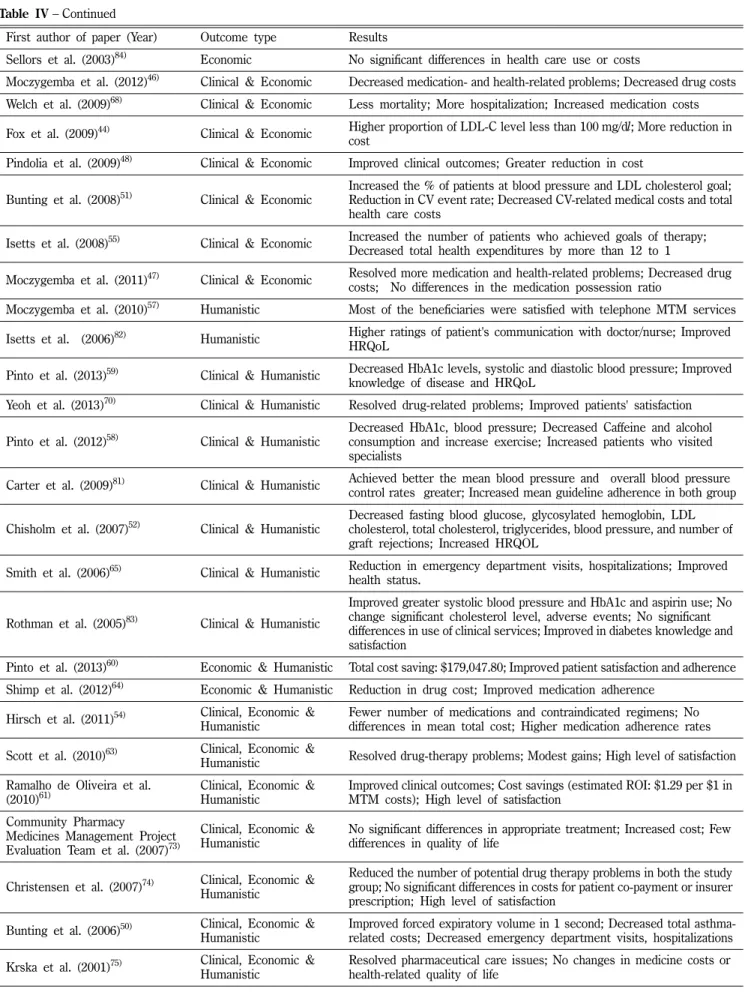
서71,72) 추가로 찾은 인용 논문 12개를73-84) 고찰했다(Table IV).
41개의 문헌 중 임상적 성과만 본 문헌은 9개, 경제적 성과만 본 문헌은 7개, 삶의 질 성과만 본 문헌은 2개였다. 임상적 성 과와 경제적 성과를 함께 본 문헌은 7개, 임상적 성과와 삶의 질 성과는 7개, 경제적 성과와 삶의 질 성과를 비교 분석한 논문은 2개가 포함되었다. 7개 연구 논문은 임상적, 경제적, 삶의 질 모 든 측면에서 성과를 보았다. 문헌의 연구 대상 환자는 고혈압, 당뇨, 고지혈증 등의 만성질환을 가진 환자이거나 질병을 구분 하지 않고 MTM 서비스를 받을 수 있는 Medicare Part D가입 자가 대부분이었다. 몇 개의 논문에서는 임상적 및 경제적 성과 가 통계적으로 유의하지 않다고 언급하기도 하였지만,73,79,84)대 부분의 문헌에서 MTM 서비스로 인해 임상적, 경제적, 삶의 질 성과 중 적어도 1개 이상에서 이득이 있었다고 언급하였다. 경 제적 효과를 분석한 논문 16개 중, 2개와 4개의 논문에서 MTM 서비스와 같은 중재로 비용이 증가하거나 비용의 차이가 없다고 보고하였고, 그 외 10개의 논문에서는 의약품 비용 및 전체 의 료비용의 감소가 약사의 중재가 없는 그룹과 비교하여 통계적으 로 유의하게 감소하였다고 보고하였다. 삶의 질 성과를 비교 분 석한 18개의 논문에서는 2개 문헌에서만이 환자의 삶의 질에 유 의한 차이가 없다고 보고하였고, 그 외 16개 논문에서는 약사의 중재로 인해 약물치료에 있어서의 환자의 만족도, 환자가 인지 하는 건강상태 및 환자의 삶의 질이 유의하게 증가함을 제시하 였다.
고찰 및 결론
본 연구는 노인인구의 증가 및 그에 따른 높은 의료비용 지출 과 요양병원의 약사 또는 한약사 고용이 의무화되면서 노인에게 최적의 약물치료를 제공할 수 있는 전문약사의 요구가 증대됨에 입각해 진행되었다. 미국은 약사의 직능을 보다 전문화하기 위 한 자격제도 및 교육 시스템이 잘 갖추어진 국가이다. 미국은 일 찍이 상담전문약사협회(ASCP), 노인전문약사위원회(CCGP)와 노 인전문약사(CGP) 제도 등을 통해 노인전문약사의 교육과 자격 제도를 체계적으로 운영하기 시작했으며, 각 약학대학에서도 노 인 관련 교육을 이론 수업과 요양기관 실습을 통해 제공하면서 학생들이 졸업 후 노인전문약사로 활동하는데 기반이 되는 지식 과 경험을 제공하고 있었다. 약사들은 임상현장에서 보건 전문 가들과 함께 일하면서 노인환자의 치료 효과를 높이는데 긍정적 인 역할을 해 왔고 노인전문약사(CGP)들도 요양기관, 병원, 지 역 약국에서 일하면서 그들의 역량을 발휘하고 있다. 최근 약사 들이 직능을 넓히기 위해 도전하고 있는 분야인 MTM 서비스에 서 약사의 개입이 환자의 약물관련 문제의 해결과 치료효과 상 승은 물론 의료비용도 감소시킨다는 연구 결과를 통해 약사가 환 자의 건강과 경제적 측면에 미치는 영향력을 확인할 수 있었다.
게다가 Medicare Part D 가입자의 대부분이 2개 또는 3개 이상 의 만성질환을 갖고 있고 2개에서 8개 이상의 Part D약물을 복 용하고 있는 상황에서, 매년 $ 3,017(2014년도 기준) 이상의 비 용이 발생하고 있는 약물치료관리(MTM) 서비스 대상이기에,6) 노인전문약사가 이들에게 전문적인 서비스를 본격적으로 제공할 경우 지금까지 일반 약사가 창출하는 임상적, 경제적, 삶의 질 성 과보다 더욱 큰 성과를 낼 것으로 기대된다.
우리나라의 경우 노인환자 약물치료에 관한 약사의 직능을 강 화시키기 위한 제도가 한국여약사회, 병원약사회에서 운영하고 있으나 자격 인정 기준이나 제도 내용이 체계화되어 있지 않은 실정이다. 한국여약사회의 경우 노인관련 전문약사 배출을 위해 2009년부터 시니어 건강관리 전문약사 양성을 위한 강좌를 열고 있으며 이 강좌를 3회 이상 수료하면 시니어건강관리사 자격증 을 발급하고 있다. 1기부터 2012년에 열린 5기 강좌까지 약 400 여명의 전문약사를 배출했으나 이 제도는 총 36~45시간의 강의 만 들으면 별도의 시험 없이 자격증을 취득할 수 있다. 이는 미 국의 노인전문약사 자격 취득을 돕기 위해 상담전문약사협회 (ASCP)가 제공하는 노인 약물학 기본 강좌 60.25시간에 비해 적 은 시간이며 자격 인증을 위해 반드시 시험을 치러 합격해야 한 다는 점에서 차이가 있다. 또한 한국 여약사회의 시니어건강관 리사 자격증은 한 번 취득하면 평생 사용할 수 있고 지속적인 교 육이수를 요구하지 않기 때문에 자칫 약사들이 노인약학의 최신 정보를 놓치고 오래된 정보로 노인 약물치료 서비스를 제공할 위 험이 있다. 한국 병원약사회에서 운영하는 "만성 및 노인성질환
에 관한 임상약학후 실무연수교육"은 온라인강좌 20시간, 시험, 과제 2회 및 실습 8시간으로 구성되어 있으며 모든 과정을 완료 하면 임상약학후 실무연수교육을 수료한 것으로 인정해 주고 있 다. 병원약사회의 이 교육 프로그램은 여약사회의 시니어 건강 관리 전문약사 양성 프로그램보다 수료기준이 세분화되어 있긴 하나, 교육시간이 미국의 경우와 비교했을 때 턱없이 부족하고 자격 갱신 시스템이 없어 이 연수교육을 수료한 자를 노인전문 약사라고 보기엔 부족한 제도로 보인다. 국내 병원 중 최초로 노 인의료센터를 설립해 노인환자에게 효과적인 진료를 제공하는 분당 서울대 병원은 노인병내과, 신경과, 재활의학과, 정신건강 의학과의 전문의, 노인 전문간호사, 영양사, 약사, 사회복지사 등 으로 구성된 팀의료체제를 구축하여 노인환자를 통합적으로 진 료하고 있다. 팀 구성원인 약사는 노인환자의 약물치료와 검토 에 전문성을 갖추고 있으나 전문성을 인정하는 공식적인 자격제 도는 아직 마련되어 있지 않다.
약학대학 교육 측면에 있어서 미국은 2011년 조사에서 약 50.0%의 대학에서 노인관련 교육을 제공하는데 반해 우리나라는 현재 35개의 약학대학 중 5개 대학(약 14.3%)에서만 노인학, 노 인약학, 노화생물학을 교과명으로 하는 별도의 과목이 있었고 1 개 대학은 노인과 소아를 함께 묶어 1.5학점으로 운영하고 있었 다. 위의 5개의 대학 중 1개 대학에서 전공심화연구로 임상약학 에서 노인환자의 약물요법에 관한 연구를 다루고 있었다. 미국 의 약학대학과 비교했을 때 우리나라는 노인학 관련 학위/이수 증명서(Certificate)를 수여하는 곳은 한 곳도 없었고 노인 관련 교육을 제공하는 학교 수도 상대적으로 적었다. 또한 미국 약학 대학은 이론과 실습 형태로 선택 또는 필수과목으로 노인 관련 교육을 제공했던 반면 국내 위 5개 대학은 모두 이론 형태의 선 택과목이었다.
위와 같은 노인 약물치료 전문약사의 제도와 교육의 부실함은 우리나라 간호계와 비교했을 때 확연한 차이가 있다. 간호계는 2000년에 노인분야를 포함한 13개의 분야(가정, 감염관리, 노인, 마취, 보건, 산업, 아동, 응급, 임상, 정신, 종양, 중환자, 호스피 스)의 전문간호사 자격제도가 시작되었고 2013년에 배출된 전문 간호사 총 567명 중 노인전문간호사가 167명으로 가장 많았다.
두 번째로 많이 배출된 종양전문간호사가 72명인 것과 비교하면 노인전문간호사가 압도적으로 많은 것을 알 수 있으며 이는 노 인전문간호사의 수요가 높고 임상에서 필요한 전문직능임을 의 미한다. 또한 간호대학의 교육과정을 보면 많은 학교에서 노인 관련 교과목을 제공하고 있으며 필수과목으로 지정된 학교도 있 어 약학대학과의 교육과 차이가 있었다.
2008년 미국 보건복지부의 조사에서 병원의 부작용 사고율은 13.5%정도로 그 중 약물관련 사고는 31.0%였다. 환자에게 일시 적인 해를 끼친 경우를 포함한 병원의 부작용 사고율은 27.0%
이며 이 중 예방 가능한 부작용 사례는 전체 부작용 발생의 44.0%
였으며, 그 중 50.0%가 약물관련 사건이었다.85)우리나라에서 분 석한 여러 연구에서도 노인환자를 대상으로 한 부적절한 약물 처 방 및 사용이 여러 번 보고되었다.9,10,86)이와 같은 문제를 해결 하기 위해 노인의 약물치료를 계획하고 검토하는 전문화된 약사 직능이 더욱 더 요구된다. 국내 약사들도 노인에게 질 높은 임상 서비스를 제공하기 위해 노인전문약사의 필요성을 인식하고 있 고87)미국의 약사들이 노인환자의 약물치료에 개입했을 때 나타 나는 긍정적인 성과들과 노인전문약사의 활동을 근거로 하여 우 리나라 약사들도 노인환자의 약물치료에 전문성을 강화해야 한 다. 노인전문약사의 양성을 위해 6년제 약학교육의 실무실습과 정에 노인 관련 기관의 실습을 마련하는 것이 필요하며, 이는 임 상 약학을 대학 교육에서부터 강화시키자는 6년제 교육개편의 취지와 부합하고 약학대학의 학생들에게는 자신에게 맞는 전문 성을 키울 수 있는 기회가 될 것이다. 따라서 미국의 노인전문약 사(CGP)제도와 약학대학 교육 과정을 참고하여 노인전문약사제 도의 체계적 수립과 정착을 위한 계획과 실행 방안 등을 세우는 적극적인 움직임이 필요하다.
References
1) Statistics Korea : Projected population by age (Korea) (2011).
2) Yong, C. S., Kim, J. A., Choi, H. G. and Yoo, B. K. : Patient counseling of pharmacists to elderly patients. The Korean Journal of Clinical Pharmacy 14, 100 (2004).
3) Health Insurance Review & Assessment Service: Statistical Indicators of Medical Benefit Expenses 2012 (2012).
4) Odegard, P. S., Breslow, R. M., Koronkowski, M. J., Williams, B. R. and Hudgins, G. A. : Geriatric pharmacy education: a strategic plan for the future. Am. J. Pharm. Educ. 71, 47 (2007).
5) Medicare Prescription Drug, Improvement, and Modernization Act of 2003 (2003).
6) Tudor, C. G. : Contract Year 2014 Medication Therapy Management Program Guidance and Submission Instructions, Center for Medicare & Medicaid Service (2013).
7) Understanding Medicare Reform : What Pharmacists Need to Know, American Pharmacists Association (2004).
8) 황계자: 노인약학에 대한 실태조사. Journal of Korean Society of Hospital Pharmacists 18, 329 (2001).
9) Nam, J. S., Shin, W. G. and Oh, J. M. : Pattern of medications usage and potentially inappropriate medication uasge among Korean ambulatory elderly patients based on an explicit criterion. The Korean Journal of Clinical Pharmacy 15, 149 (2005).
10) Kang, Y. K. : Analysis of Prescriptions for Elderly at Primary Health Care Using National Health Insurance Database.
Graduate School of Clinical Pharmacy, Sookmyung Women's
University. 국내석사학위논문 (2006).
11) 의료법 시행규칙 보건복지부령 제213호, 2013.10.4. 일부개정, 시 행2014.4.5, 보건복지부 (2013).
12) http://www.ccgp.org/. Commission for Certification in Geriatric Pharmacy. Available at: http://www.ccgp.org/. Accessed Dec 31, 2013.
13) https://www.ascp.com/. American Society of Consultant Pharmacist. Available at: https://www.ascp.com/. Accessed Dec 31, 2013.
14) Pharmacy Ranked in 2012. US News. Available at: http://grad- schools.usnews.rankingsandreviews.com/best-graduate- schools/top-health-schools/pharmacy-rankings?int=493b21.
Accessed Dec 31, 2013.
15) Park, H. J. and Schumock, G. T. : PSAP V BOOK 5 science and practice of pharmacotherapy, The American College of Clinical Pharmacy p. 21 (2005).
16) CCGP History. Commission for Certification in Geriatric Pharmacy. Available at: http://www.ccgp.org/aboutCCGP/
history. Accessed Dec 31, 2013.
17) About the Certified Geriatric Pharmacist Examination.
Commission for Certification in Geriatric Pharmacy. Available at: http://www.ccgp.org/exam. Accessed Dec 31, 2013.
18) Recertification Process. Commission for Certification in Geriatric Pharmacy. Available at: http://www.ccgp.org/
recertification. Accessed Dec 31, 2013.
19) Candidate Handbook of certification examination in geriatric pharmacy, Commission for Certification in Geriatric Pharmacy (2013).
20) How to Prepare for the CGP Examination. Commission for Certification in Geriatric Pharmacy. Available at: http://
www.ccgp.org/exam/prepare. Accessed Dec 31, 2013.
21) Purchase Self-Assessment Exam. Commission for Certification in Geriatric Pharmacy. Available at: http://www.ccgp.org/
content/exam/self-assessment. Accessed Dec 31, 2013.
22) Certified Geriatric Pharmacist Self-Assessment Examination Logic extension resources in Applied Measurement Professionals, Inc. Available at: http://store.lxr.com/dept.aspx?id=47. Accessed Dec 31, 2013.
23) Geriatric Pharmacotherapy Practice Resource Center.
American Society of Consultant Pharmacist. Available at: https://
www.ascp.com/articles/geriatric-pharmacotherapy. Accessed Dec 31, 2013.
24) Geriatric Pharmacy Review. American Society of Consultant Pharmacists. Available at: http://education.ascp.com/gpr.
Accessed Dec 31, 2013.
25) Recertification by Professional Development Program.
Commission for Certification in Geriatric Pharmacy. Available at: http://www.ccgp.org/recertification/pdp. Accessed Dec 31, 2013.
26) Simonson, W. and Pratt, C. C. : Geriatric pharmacy curriculum in U.S. pharmacy schools: a nationwide survey. Am. J. Pharm.
Educ. 46, 249 (1982).
27) Kirschenbaum, H. L. and Rosenberg, J. M.: Geriatric training programs offered at schools and colleges of pharmacy.
American Journal of Pharmaceutical Education 59, 284 (1995).
28) Dutta, A. P., Daftary, M. N., Oke, F., Mims, B., Hailemeskel, B.
and Sansgiry, S. S. : Geriatric education in US schools of pharmacy: a snapshot. Consult Pharm 20, 45 (2005).
29) Jimenez, S. : Geriatric Content in U.S. Doctor of Pharmacy Degree Curricula (2011).
30) Experiential Programs: Care And Respect for the Elderly (CARE) Program. University of Texas Austin, College of Pharmacy. Available at: http://www.utexas.edu/pharmacy/
general/experiential/. Accessed Dec 31, 2013.
31) Experiential Education: Advanced Pharmacy Practice Experiences. Campbell University. Available at: http://www.
campbell.edu/cphs/academic-programs/pharmd/experiential- education/rotations/advanced-practice-experience-rotations/.
Accessed Jan 14, 2014.
32) Catalog 2012-2014, University of Maryland, School of Pharmacy (2011).
33) Doctor of Pharmacy Program Catalog 2013-2014, Texas Tech University Health Sciences Center, School of Pharmacy (2013).
34) Professional Electives for the Doctor of Pharmacy Program.
University of North Carolina-Chapel Hill, College of Pharmacy.
Available at: https://pharmacy.unc.edu/programs/the-pharmd/
curriculum/electives#interdisciplinary-courses-and-non- divisional-courses. Accessed Dec 31, 2013.
35) Student Handbook 2013-2014, University of Southern California Davis, School of Gerontology (2013).
36) School of Pharmacy Professional Electives. University of Washington, School of Pharmacy. Available at: http://
sop.washington.edu/images/stories/school_of_pharmacy/
PharmD/asp/current_students/electivesRev12.202013.pdf.
Accessed Jan 14 2014.
37) Credential news letter, Commission for certification in geriatric pharmacy (2011).
38) An Acute Care for Elders (ACE) project San Francisco General Hospital Foundation Available at: http://www.sfghf.net/
programs/ace_project.html. Accessed Nov 29, 2013.
39) Nurses Improving Care for Healthsystem Elders Program.
NICHE. Available at: http://www.nicheprogram.org/. Accessed Nov 29, 2013.
40) The Hospital Elder Life Program (HELP). HELP. Available at:
http://www.hospitalelderlifeprogram.org/public/public-main.php.
Accessed Nov 29, 2013.
41) Lee, J. K., Slack, M. K., Martin, J., Ehrman, C. and Chisholm- Burns, M. : Geriatric patient care by U.S. pharmacists in