서 론 *
Recieved(01. 23. 2020), Modified(04. 02. 2020), Accepted(04. 02. 2020)
* 본 연구는 KITRI 차세대 보안 리더 양성 프로그램(Best
†
of the Best)의 연구 지원으로 수행되었습니다.
† 주저자, [email protected]
‡ 교신저자,
[email protected](Corresponding Author)VOL.30, NO.2, Apr. 2020 ISSN 2288-2715(Online)
https://doi.org/10.13089/JKIISC.2020.30.2.213
STRIDE 위협 모델링에 기반한 스마트 TV 보안 요구사항 도출*
오 인 경,
1†서 재 완,
1이 민 규,
1이 태 훈,
1한 유 나,
1박 의 성,
1지 한 별,
1이 종 호,
2조 규 형,
1김 경 곤
3‡1
KITRI 차세대 보안 리더 양성 프로그램(연구원),
2,3
고려대학교 정보보호대학원(대학원생, 교수)
Derivation of Security Requirements
of Smart TV Based on STRIDE Threat Modeling*
In-Kyung Oh,
1†Jae-Wan Seo,
1Min-Kyu Lee,
1Tae-Hoon Lee,
1Yu-Na Han,
1Ui-Seong Park,
1Han-Byeol Ji,
1Jong-Ho Lee,
2Kyu-Hyung Cho,
1Kyounggon Kim
3‡1
KITRI Best of the Best(Researcher),
2,3Graduate School of Information Security, Korea University(Graduate Student, Professor)
요 약
스마트 TV가 최근 IoT 생태계의 중심으로 떠오름에 따라 그 중요성은 갈수록 높아지고 있다. 스마트 TV 내 취 약점이 발생하는 경우 도청, 도촬로 인한 사생활 침해 및 개인정보 유출의 측면 뿐만 아니라 금전적 피해까지 발생 할 가능성이 있다. 본 논문에서는 스마트 TV 취약점 분석의 완전성을 높이기 위해 STRIDE 위협 모델링을 통해 위협을 체계적으로 식별하고 공격 대상에 대한 특성을 파악하였다. 또한 Attack Tree와 취약점 점검리스트를 제작 하고 실제 취약점 분석을 통하여 점검리스트의 효과성을 검증하여 안전한 스마트 TV 사용 환경을 위한 보안 요구사 항을 도출하였다.
ABSTRACT
As smart TVs have recently emerged as the center of the IoT ecosystem, their importance is increasing. If a vulnerability occurs within a smart TV, there is a possibility that it will cause financial damage, not just in terms of privacy invasion and personal information leakage due to sniffing and theft. Therefore, in this paper, to enhance the completeness of smart TV vulnerability analysis, STRIDE threat classification are used to systematically identify threats. In addition, through the manufacture of the Attack Tree and the actual vulnerability analysis, the effectiveness of the checklist was verified and security requirements were derived for the safe smart TV use environment.
Keywords: Threat Modeling, Smart TV, Security Requirement, STRIDE Threat Classification
I. 서 론
기존 TV의 일반적인 사용행태는 방송 ‘시청’에 초 점이 맞춰져 있던 것에 반해, 2008년 인터넷과 연결 된 스마트 TV의 등장을 기점으로 TV는 단순한 시 청의 개념을 넘어 사용자에게 다양한 콘텐츠를 더욱 편하게 즐길 수 있게 하는 존재로 자리 잡았다[1].
2012년 스마트 인터랙션이 가능한 스마트 TV로 발 전하면서, 스마트 기기는 물론 클라우드에서 지원되 는 웹 스토리지로 집 밖에서 태블릿이나 노트북과 같 은 스마트 기기 멀티미디어 콘텐츠를 공유하게 되었 다. 2016년에는 스마트 허브를 탑재하여 ‘IoT에 가 장 먼저 준비된 TV’ 라는 타이틀을 가졌다. 그와 함 께 스마트 컨트롤 리모컨을 통해 모든 컨텐츠를 간편 하게 즐길 수 있도록 하고, 스마트 허브를 통해 메 뉴, 영상, 게임 등 스마트 TV 콘텐츠 간 장벽을 없 앴다.
기술적 측면의 발전을 거듭한 결과, 2019년 스마 트 TV는 주위 환경과 콘텐츠, 기기 간 연결에 구애 를 받지 않는 맞춤형 서비스를 제공하는 것을 핵심으 로 하여 음성인식 플랫폼, IoT 서비스 통합 앱과 더 불어 사용자의 시청 이력을 분석하여 취향에 맞는 체 널과 콘텐츠를 자동으로 추천하는 등, 더욱 똑똑한 인공지능 TV로 거듭났다[5].
스마트 TV가 다양한 서비스를 지원하게 되면서 이를 악용하는 사례 또한 증가하게 되었다. 국내외적 으로 스마트 TV의 도입이 증가함과 동시에, 도청, 도촬, 개인정보 유출 등 스마트 TV의 다양한 기술을 보안상 악용하는 사례가 발생하면서 스마트 TV 위 협 분석과 관련된 연구의 필요성이 증가하고 있다 [6].
따라서 본 논문에서는 임베디드 기기의 특성에 기반 한 위협 모델링 기법[22]과 Microsoft 사의 위협 모델링 기법을[12] 중심으로 하여 보안 위협을 식별 하고 최종적으로 스마트 TV에 대한 보안 요구사항 을 도출하는 것을 목표로 한다.
본 논문의 2장에서는 스마트 TV 보안 연구 동향 과 위협 모델링에 대한 기존 연구 사례 및 스마트 TV를 대상으로 제안하는 위협 분석 모델링에 대해 소개한다. 3장에서는 실제 기기에 위협 분석 모델링 절차를 적용하여 데이터 흐름도를 도출하고, 구체적 인 위협 분석을 진행한다. 또한 3.5에서는 도출된 위협들을 이용하여 Attack Tree를 작성하고 이를 기반으로 3.6에서 스마트 TV 모의 해킹 시나리오를
제시한다. 3장의 끝으로 취약점 분석을 위한 취약점 점검리스트 제작을 진행한다. 제작된 점검리스트를 바탕으로 취약점 분석을 진행하여 취약점을 도출하였 고 이를 통해 취약점 점검리스트의 실효성 테스트 또 한 수행하였다. 4장에서는 분석된 위협에 따른 보안 요구사항을 도출하고 마지막으로 5장에서 결론 및 향후 과제를 기술한다.
II. 관련 연구
2.2에서는 위협 모델링 관련 연구 사례를, 2.3에 서는 스마트 TV를 대상으로 제안하는 2가지 위협 모델링 기법을 소개한다. 2.2 및 2.3에서 소개할 것 은 Klockwork사의 임베디드 소프트웨어 위협 모델 링 기법[22]과 MS 위협 모델링[12] 기법에서 사용 하는 STRIDE 공격 유형 분류이다.
2.1 스마트 TV 보안 연구 동향
스마트 TV에 대한 공격사례가 발표되면서 현재 여러 기업에서는 스마트 TV가 높은 컴퓨팅 성능과 네트워크 기능, 카메라, 마이크와 같은 하드웨어 자 원을 이용하는 공격이 발생할 수 있는 문제에 대해 보안성 향상을 위한 노력이 이루어지고 있다. 제품에 대한 설계 및 구현에 대한 안전성 검증을 위해 보안 성 평가 제도를 활용한 제품 인증 및 스마트 TV 해 킹에 대한 다양한 관점에서 접근 시도 등, 스마트 TV 보안 위협을 제거하기 위한 심도 있는 연구 내 용이 보고서 및 논문[19], 컨퍼런스[18]를 통해 발 표되고 있다.
또한, 스마트 TV를 대상으로 한 디지털 포렌식 연구도 이루어지고 있다. 디지털 포렌식의 경우 시스 템 내부에 저장된 사용자 데이터를 수집 및 분석하기 매우 적합하다. 여기서 사용자 데이터란 인터넷 사용 기록, 최근 사용한 앱 및 접속한 웹페이지, 저장된 TV 채널, 시스템 설정 정보, 외부 저장장치 연결 정 보 등이다. 이를 이용하여 포렌식 분석을 진행함으로 써 개인정보를 획득할 뿐만 아니라 사용자의 성향을 파악한다[19].
STRIDE는 가장 널리 알려진 위협 모델링 방법
으로, 위협 모델링을 하는 전체적인 과정 측면에서는
유용하다. 그러나, 소프트웨어 중심의 위협 모델링이
라는 한계점이 있어 임베디드 기기인 스마트 TV와
는 세부적인 사항에서 적합하지 않다. 따라서 스마트
TV 위협 모델링의 전체적인 구성은 Klockwork 사 에서 제안한 임베디드 소프트웨어 위협 모델링[22]
을 따르고, MS 사의 위협 모델링 기법[12]에서 사 용하는 STRIDE 공격 유형 분류를 접목하여 위협 분석 및 분석 방법에 대한 취약점 점검 리스트를 도 출하였다.
2.2 위협 모델링 연구 사례
위협 모델링은 임의의 공격자 관점에서 잠재적인
위협을 식별하고 분석하는 방법론이다
[2,7,8,10,12,13,16]. 위협 모델링을 통해 자산을 식별하고, 발생 가능한 위협을 발견하고, 위험의 우 선순위를 결정하여 위험에 대한 대응책을 결정할 수 있다. 위협 모델링 기법의 특징은 단순히 소프트웨어 관점만이 아닌 공격자와 보안의 관점에서 목적과 요 구사항을 반영한다는 점이다. 일반적인 위협 모델링 을 활용한 취약점 분석은 제품 분석, 위협 식별, Attack Tree 작성, 취약점 점검 리스트 도출 순으 로 진행되며, 이때 각 위협에서 발생 가능한 공격을 식별하기 위해 알려진 기존의 취약점들을 수집한 공 격 라이브러리 생성되어야 한다.
최초의 위협 모델링은 요구사항을 수집하는 단계 와 설계문서를 통합하는 과정에서 위협을 식별하기 위한 절차로 시작되었다. 위협 트리에 대한 개념은 1994년 ‘Fundamentals of Computer Security Technology’에서 처음 소개되었다. 이후 1999년에는 도식적인 위협 모델링 방법인 Attack Tree를 사용하는 것이 제안되었고, 비슷한 시기에 Microsoft 제품의 설계 단계부터 다양한 위협을 식 별하기 위해 STRIDE 공격 유형 분류가 소개되었 다. 나아가 2011년에는 MS 자체 소프트웨어 개발 생명 주기가 만들어 지면서 이를 기반으로 한 자체 위협 모델링 도구가 현재까지 배포되고 있다[14].
MS사에서 제작한 위협 모델링 기법 외에도 여러 다양한 위협 모델링 기법이 존재한다. OWASP에서 는 주로 웹 응용 프로그램 설계를 목적으로 한 위협 모델링 기법이 제안되었다. 또한 임베디드 소프트웨 어 환경에 맞는 시큐어 임베디드 소프트웨어 개발을 위한 위협 모델 연구가 Klockwork사에 의해 시도 되었는데, 위협 모델 생성 시 공격자 모델을 사용하 지 않아 체계적이지 못하고 자동화될 수 없는 기법이 라는 한계점을 확인하였다[22]. 또한 LINDDUN은 소셜 미디어 네트워크 환경의 응용 소프트웨어를 대
상으로 한 privacy 위협 모델링 기법이다.
2.3 임베디드 소프트웨어 위협 모델링 기법
Klockwork사의 임베디드 소프트웨어 위협 모델 링 기법은 다음과 같이 5단계로 구성된다[22].
1. Identify Security Objectives
이 단계에서 수행되는 것은 원하는 보안 수준을 명확히 하는 것이다. 모든 보안 침해를 방지하는 것 이 목표인지, 특정 공격이 허용되는지 등에 대해 고 려해야 한다. 또한, 가능한 모든 공격을 예방하는 것 은 가능하나, 비용 효율의 균형을 맞추어 현실적인 보안 목표를 설계해야 한다.
2. Create a System Overview
이 단계에서 수행되는 것은 시스템 개요를 작성하 는 것이다. 보안 목표가 명확해지면, 위협 모델링을 적용할 대상을 검토하고 자산 식별을 해야 한다.
3. Isolate and Decompose the Device’s Software Design
이 단계에서 수행되는 것은 Abuse Scenario에 대해 고려하는 것이다. Abuse Scenario는 악의적 인 사용자의 시스템 공격 시나리오를 의미한다.
4. Identify Threats
이 단계에서 수행되는 것은 위협을 식별하고 공격 유형을 고려한 Attack Tree를 개발하는 것이다.
가능한 많은 위협을 식별하기 위해 각 자산의 기밀 성, 무결성 또는 가용성에 영향을 미치는 경우를 고 려하는 CIA Method를 사용한다. Attack Tree를 개발하여 사용자를 가장한 공격자가 진행할 수 있는 공격의 유형을 식별하고, 공격이 성공할 수 있는 조 건과 기법 또한 나열한다.
5. Identify Vulnerabilities
이 단계에서 수행되는 것은 취약점을 식별하는 것 이다. 이를 기반으로 공격 완화 전략을 계획하는데 사용될 수 있는 취약점 목록을 구상한다.
2.4 STRIDE 공격 유형 분류
STRIDE 공격 유형 분류는 기밀성, 무결성, 가
용성의 보안의 3요소에 인증, 부인방지, 권한 부여의 3가지 요소를 추가하여 총 6가지 각각의 목표에 대 응하는 위협을 분류한 것이다. 이는 응용프로그램의 취약성 및 잠재적 공격 가능성을 식별하는 데 도움이 된다[3].
1. Spoofing
Spoofing은 보안 속성 중 인증과 관련된 것으로, 거짓된 계정 등을 이용하여 시스템 권한을 획득하는 위협 등을 식별할 수 있다.
2. Tempering
Tempering은 보안 속성 중 무결성과 관련된 것 으로, 불법적으로 데이터를 변경하는 위협 등을 식별 할 수 있다.
3. Repudiation
Repudiation은 보안 속성 중 부인방지와 관련된 것으로, 특정 서비스를 수행하지 않았다고 부인하거 나 책임이 없다고 부인하는 위협 등을 식별할 수 있 다.
4. Information Disclosure
Information Disclosure는 보안 속성 중 기밀 성과 관련된 것으로 접근 권한이 없는 누군가에게 정
보를 제공하는 위협 등을 식별할 수 있다.
5. Denial of Service
Denial of Service는 보안 속성 중 가용성과 관 련된 것으로, 서비스 또는 Application이 정상적으 로 수행되지 않도록 하는 위협 등을 식별할 수 있다.
6. Elevation of Privilege
Elevation of Privilege는 보안 속성 중 권한 부여와 관련된 것으로 누군가가 권한을 부여받아 권 한이 없는 서비스를 수행하도록 하는 위협 등을 식별 할 수 있다.
III. 스마트 TV 위협 모델링
스마트 TV 환경에서 정보의 불법 노출 및 수정, 손상 등을 방지하기 위해서는 주요 정보가 반드시 보 호되어야 한다. 이에 따라 3.1에서는 전반적인 스마 트 TV 위협 모델링 방법론을 제시한다. 그리고 3.2 부터 3.4까지는 수집한 스마트 TV 대상 공격 라이 브러리를 기반으로 데이터 흐름도를 도출하고 STRIDE 공격 유형 분류를 적용하여 데이터 흐름도 의 각 요소 들에서 발생 가능한 위협을 분석한다.
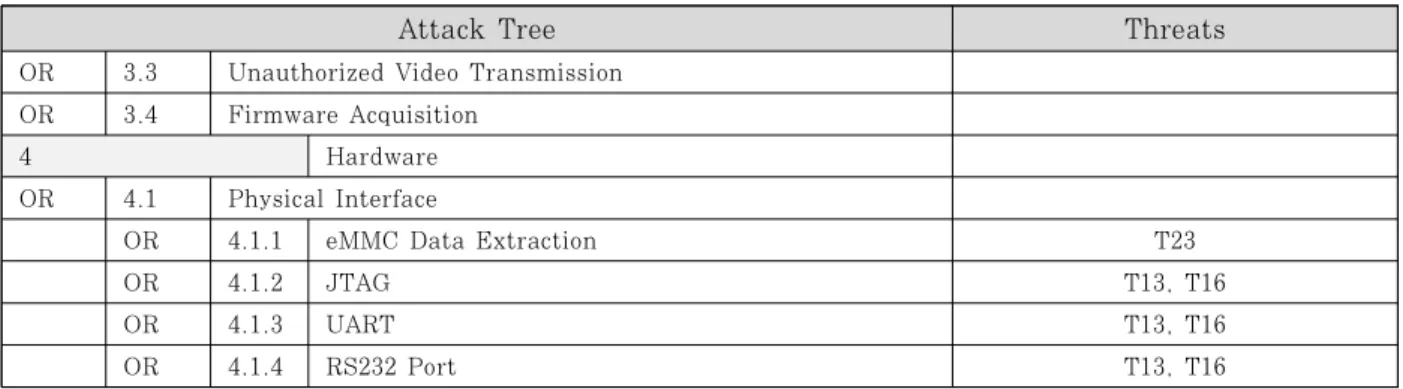
3.5에서는 식별된 위협이 공격에 적용되는 형태를 알아보기 위해 Attack Tree를 작성한다. 3.6에서
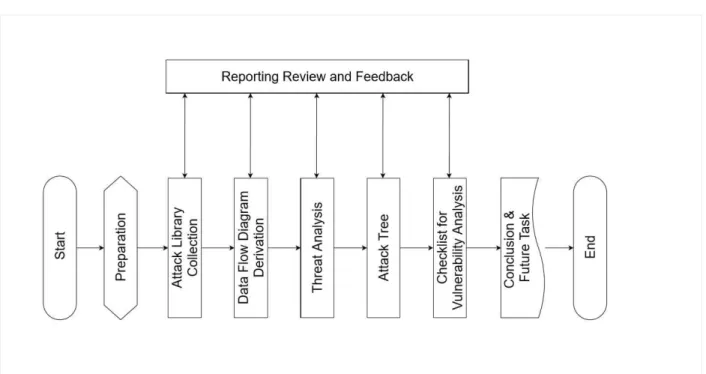
Fig. 1. Threat Modeling Procedure
는 스마트 TV를 공격할 수 있는 방법을 구체화 시 키기 위해 스마트 TV 모의 해킹 시나리오를 제시한 다. 끝으로 3.7에서는 위협 모델링 기법을 적용하여 도출한 위협 목록에서 실제 취약점이 발생할 수 있는 공격 벡터를 선정한 후 취약점 분석을 위한 취약점 점검 리스트를 제작한다[3].
3.1 위협 모델링 방법론
취약점 분석을 진행하기 앞선 위협 모델링 절차는 Fig.1.과 같은 형태로 진행된다. 공격 라이브러리란 선행된 연구 정보를 모아 놓은 것이다. 사용될 수 있 는 정보는 표준, 논문 및 컨퍼런스에서 발표된 선행 연구[19], CVE와 같이 공개된 취약점 정보, OWASP와 같은 보안 연구 프로젝트에서 공개한 취 약점 항목 등이 있다. 이를 이용하여 데이터 흐름도 상의 각각의 요소에서 발생 가능한 위협을 식별할 수 있다. 위협 식별 과정에서는 중복되는 결과를 줄이 고, Attack Tree를 통해 스마트 TV를 공격 할 수 있는 방법을 구체화 시킨다. 끝으로 취약점 점검 체 크리스트를 기반으로 한 실제 분석 시도 및 보안 요 구사항 도출을 결론 및 향후 과제로 제시함으로써 위 협 모델링을 마무리한다.
3.2 공격 라이브러리 수집
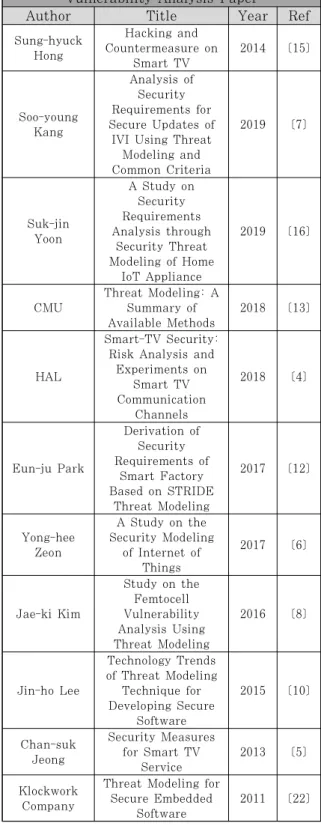
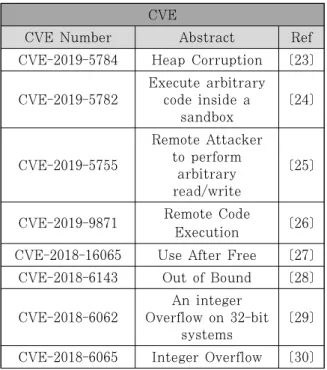
스마트 TV 공격 라이브러리는 크게 논문, CVE, 컨퍼런스 자료를 수집하였다. 총 36개의 논문 및 컨 퍼런스 자료와 총 21개의 CVE를 수집하였고, 이 중 중요 논문, CVE, 컨퍼런스 자료들을 아래의 Table 1, Table 2, Table 3.을 통해 나타내었다.
Vulnerability Analysis Paper
Author Title Year Ref
Gu-hwan Kwon
Research on the Analysis of Smart TV Vulnerabilities and Verification
Methods for Firmware Security
2019 [9]
Min-su Park Study on Security and Privacy of
Smart TV 2018 [3]
Jong-ho Lee
A Study on the Analysis of Smart TV Vulnerabilities Based on WebOS
2017 [1]
Table 1. Attack Library: Paper
Vulnerability Analysis Paper
Author Title Year Ref
Sung-hyuck Hong
Hacking and Countermeasure on
Smart TV 2014 [15]
Soo-young Kang
Analysis of Security Requirements for Secure Updates of
IVI Using Threat Modeling and Common Criteria
2019 [7]
Suk-jin Yoon
A Study on Security Requirements Analysis through
Security Threat Modeling of Home
IoT Appliance
2019 [16]
CMU Threat Modeling: A Summary of
Available Methods 2018 [13]
HAL
Smart-TV Security:
Risk Analysis and Experiments on
Smart TV Communication
Channels
2018 [4]
Eun-ju Park
Derivation of Security Requirements of
Smart Factory Based on STRIDE
Threat Modeling
2017 [12]
Yong-hee Zeon
A Study on the Security Modeling
of Internet of Things
2017 [6]
Jae-ki Kim
Study on the Femtocell Vulnerability Analysis Using Threat Modeling
2016 [8]
Jin-ho Lee
Technology Trends of Threat Modeling
Technique for Developing Secure
Software
2015 [10]
Chan-suk Jeong
Security Measures for Smart TV
Service 2013 [5]
Klockwork Company
Threat Modeling for Secure Embedded
Software 2011 [22]
CVE
CVE Number Abstract Ref
CVE-2019-5784 Heap Corruption [23]
CVE-2019-5782 Execute arbitrary code inside a
sandbox [24]
CVE-2019-5755
Remote Attacker to perform
arbitrary read/write
[25]
CVE-2019-9871 Remote Code
Execution [26]
CVE-2018-16065 Use After Free [27]
CVE-2018-6143 Out of Bound [28]
CVE-2018-6062 An integer Overflow on 32-bit
systems [29]
CVE-2018-6065 Integer Overflow [30]
Table 2. Attack Library: CVE
Conference
Presenter Title Year Ref
Pedro Carbrera
SDR Against Smart TVs URL
and Channel Injection Attacks
2019 [17]
Min-su Park
LG VS Samsung TV: Which is
Better for Tracking You?
2017 [18]
Jong-ho
Lee Are you watching
TV Now? 2017 [19]
Seung-ju Kim
Developing a Protection Profile
for Smart TV 2014 [20]
Seung-jin Lee
Hacking, Surveilling and Deceiving Victims
on Smart TV
2013 [21]
Table 3. Attack Library: Conference
3.3 데이터 흐름도 도출
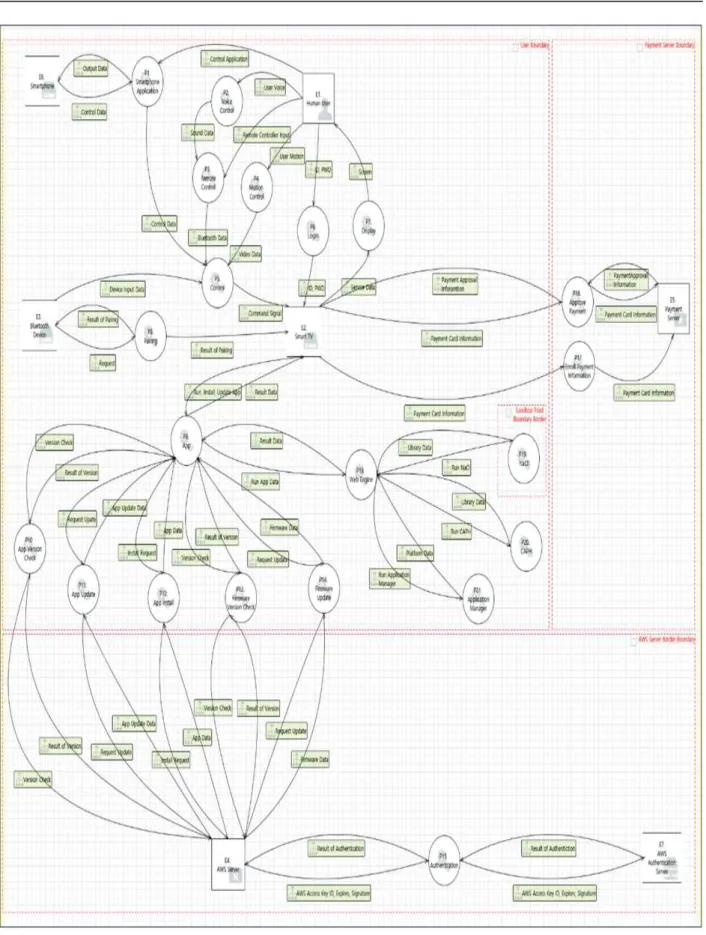
DFD는 시스템에서 데이터의 흐름을 보여주기 위 해 작성하는 그림이다. 가시화된 데이터의 흐름을 기 반으로 하여 보안 문제 발생 여부를 확인시켜 주는 역할을 한다. 이러한 DFD의 구성 요소는 Table
4.와 같이 외부 객체(External Entity), 데이터 저장소(Data Store), 프로세스(Process), 데이터 흐름(Data flow), 신뢰 경계(Trust Boundary) 의 총 5가지로 구성된다. 스마트 TV에 대한 DFD 는 Fig.2.와 같다. DFD 작성 결과로 7개의 외부 객체와 21개의 프로세스, 그리고 59개의 데이터 흐 름을 도출하였다. 신뢰 경계는 총 3개로 사용자와 AWS 서버 간의 경계, 사용자와 Payment 서버 간 의 경계, 사용자와 Sandbox Trust 공간 간의 경 계이다[13].
3.4 위협 분석
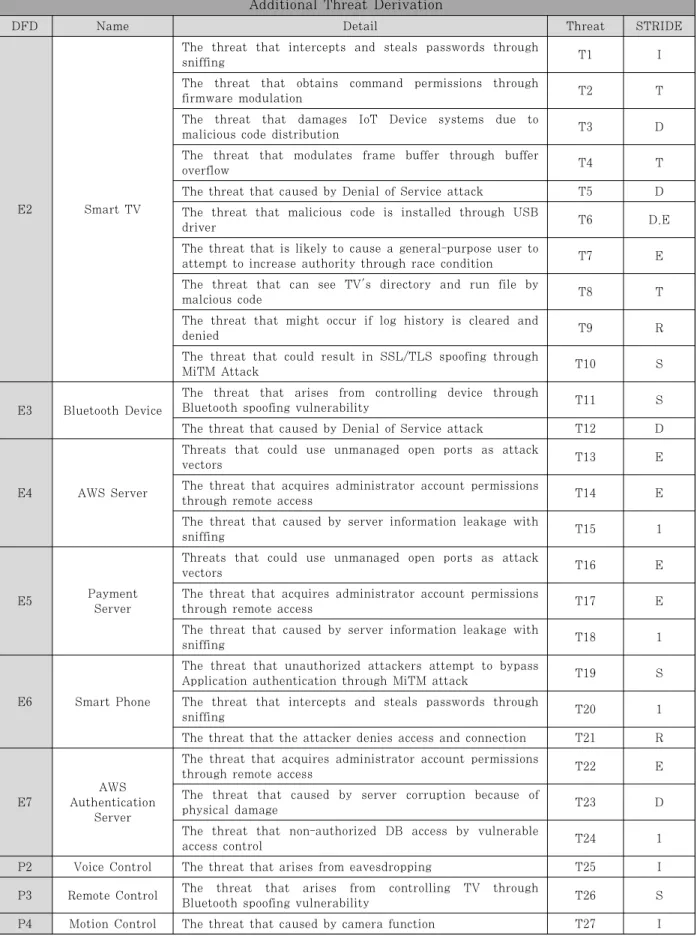
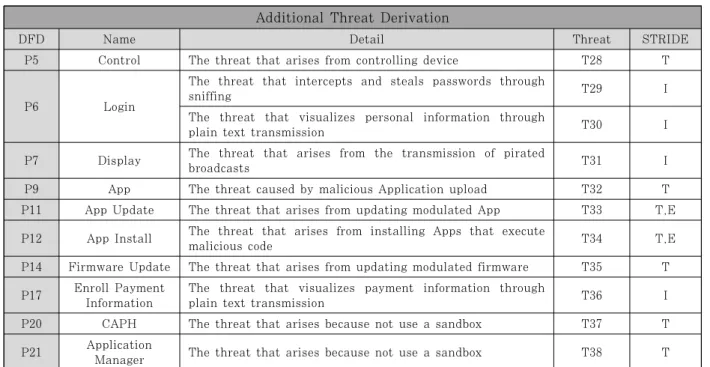
Fig.2.의 DFD Level 2의 요소들을 분리한 후, Microsoft Threat Modeling Tool(이하 MS Tool)을 이용하여 자동 위협 식별 및 도출을 진행한 다. STRIDE 요소에 맞게 분류한 결과 Table 5.와 같이 총 379개의 위협을 도출하였다. 또한 MS Tool에 의한 자동 위협 식별 결과 외에, STRIDE 공격 유형 분류를 이용하여 임베디드 기기의 특성에 맞게 Table 6.과 같이 총 41개의 추가적인 위협을 도출하였다.
Table 7.에서 설명하듯이, 악성코드를 실행시키 는 앱을 설치함으로써 발생하는 위협, MiTM 공격
DFD Component
Element Description Shape
External Entity
External Entity generates inputs of
data and consume outputs Data
Store
Data Stores store data temporarily or
permanently
Process Process get inputs of data and generates outputs
Data Flow
Data Flow indicates movement of data
between the external entity, data
store and process Trust
Boundary
Trust Boundary indicates changes of
privilege levels
Table 4. Data Flow Diagram Component
Fig. 2. Level 2 DFD for Smart TV
을 통한 SSL/TLS Spoofing이 발생 가능한 위협, 스파이캠으로 인한 사생활 침해 위협 등이 있다.
3.5 Attack Tree
Attack Tree란 자산이나 정해진 목표를 공격하 는 시나리오를 제시하는 개념도로, 다중 수준으로 구 성되어 있다[12].
STRIDE 공격 유형 분류를 이용하여 임베디드 기기의 특성에 맞게 도출한 총 41개의 추가적인 위 협을 바탕으로 Table 8.과 같이 공격 대상인 Smart TV를 루트 노드로 한 Attack Tree를 작 성하였다. Table 8.은 STRIDE 분석을 통해 식별 한 위협과 작성된 Attack Tree 사이의 연관성을 보여준다. Attack Tree를 이용하게 되면 스마트 TV를 공격 할 수 있는 방법을 구체화 시킬 수 있다 는 의의가 있다. 이를 통해 3.6과 같이 스마트 TV 모의 해킹 시나리오를 제시할 수 있다.
3.6 스마트 TV 모의 해킹 시나리오
3.4에서는 STRIDE 기법을 통해 위협을 식별하 고, 스마트 TV 공격 벡터를 파악할 수 있었다. 이를 기반으로 3.6에서는 Information Leakage 시나 리오, MiTM을 이용한 유료 컨텐츠 재생 및 다운로 드 시나리오, Third Party Application에 의한 개인정보 유출 시나리오, 악의적인 Application을 이용한 개인정보 유출 시나리오와 같이 4가지 모의 해킹 시나리오를 제시하였다. 각 시나리오 별 구상 목적과 공격 대상에 따른 세부 내용과 그에 따른 예 상 피해를 기술하였다.
1. Information Leakage 시나리오
Table 9.에서 설명하듯이, Information Leakage 시나리오에서는 공격자가 Application에 악의적인 코드를 삽입하여 App Store에 배포하고 사 용자가 이를 다운로드 하여 사용하는 내용을 다룬다.
공격자가 Application을 제작 시 Information Leakage가 발생 가능한 악의적 코드를 삽입 후 App Store에 등록한다. 사용자는 정상적인 Application으로 위장한 악성 Application을 실 행하여 서비스를 이용한다. Application을 실행함 과 동시에 공격자의 서버로 TV 디렉토리 정보 및 바이너리, 쉘 스크립트, DB, 구성 파일 등이 전송된 다. 이를 통해 공격자는 스마트 TV를 대상으로 다른 공격을 하기 위한 정보를 얻을 수 있으며 DB와 구 성 파일에서 사용자의 정보 또한 얻을 수 있다. 이를 통해 스마트 TV 구조 파악 및 개인정보 유출이 가 능하다.
2. MiTM을 이용한 유료 컨텐츠 재생 및 다운로드 시나리오
Table 10.에서 보듯이, MiTM 공격은 통신하는 두 주체 사이에 네트워크 통신을 조작하는 중간자가 침입해 한쪽에서 전달된 정보를 도청 및 조작한 후 다른 쪽으로 전달하는 것이다. 이러한 공격은 TLS 통신을 하지 않기 때문에 가능하다. 만약 사용자가 스마트 TV 서비스 중 유료 컨텐츠를 재생하기 위해 결제하는 경우, 영상 전송 패킷을 확인하여 영상을 획득할 수 있다. 또한, 결제하는 회원의 정보를 전송 하는 패킷을 확인하여 결제 정보 및 개인 정보를 획 득할 수 있다. 이를 통해 공격자는 유료 컨텐츠 URL에 접속하여 파일 직접 다운로드 및 유포가 가 능하고, 획득한 결제 정보 및 개인정보를 각종 사기, MS Tool Threat Derivation Results
STRIDE Spoofing Tampering Repudiation Information
Disclosure Denial of
Service Elevation of
Privilege Total
Number 70 84 47 64 49 65 379
Table 5. MS Tool Threat Derivation Results
MS Tool Threat Derivation Results
STRIDE Spoofing Tampering Repudiation InformationDisclosure Denial of
Service Elevation of
Privilege Total
Number 4 10 2 11 5 9 41
Table 6. Additional Threat Derivation Results
Additional Threat Derivation
DFD Name Detail Threat STRIDE
E2 Smart TV
The threat that intercepts and steals passwords through
sniffing T1 I
The threat that obtains command permissions through
firmware modulation T2 T
The threat that damages IoT Device systems due to
malicious code distribution T3 D
The threat that modulates frame buffer through buffer
overflow T4 T
The threat that caused by Denial of Service attack T5 D The threat that malicious code is installed through USB
driver T6 D,E
The threat that is likely to cause a general-purpose user to
attempt to increase authority through race condition T7 E The threat that can see TV's directory and run file by
malcious code T8 T
The threat that might occur if log history is cleared and
denied T9 R
The threat that could result in SSL/TLS spoofing through
MiTM Attack T10 S
E3 Bluetooth Device
The threat that arises from controlling device through
Bluetooth spoofing vulnerability T11 S
The threat that caused by Denial of Service attack T12 D
E4 AWS Server
Threats that could use unmanaged open ports as attack
vectors T13 E
The threat that acquires administrator account permissions
through remote access T14 E
The threat that caused by server information leakage with
sniffing T15 1
E5 Payment
Server
Threats that could use unmanaged open ports as attack
vectors T16 E
The threat that acquires administrator account permissions
through remote access T17 E
The threat that caused by server information leakage with
sniffing T18 1
E6 Smart Phone
The threat that unauthorized attackers attempt to bypass
Application authentication through MiTM attack T19 S The threat that intercepts and steals passwords through
sniffing T20 1
The threat that the attacker denies access and connection T21 R
E7 AWS
Authentication Server
The threat that acquires administrator account permissions
through remote access T22 E
The threat that caused by server corruption because of
physical damage T23 D
The threat that non-authorized DB access by vulnerable
access control T24 1
P2 Voice Control The threat that arises from eavesdropping T25 I
P3 Remote Control The threat that arises from controlling TV through
Bluetooth spoofing vulnerability T26 S
P4 Motion Control The threat that caused by camera function T27 I
Table 7. Additional Threat Derivation
Additional Threat Derivation
DFD Name Detail Threat STRIDE
P5 Control The threat that arises from controlling device T28 T
P6 Login
The threat that intercepts and steals passwords through
sniffing T29 I
The threat that visualizes personal information through
plain text transmission T30 I
P7 Display The threat that arises from the transmission of pirated
broadcasts T31 I
P9 App The threat caused by malicious Application upload T32 T
P11 App Update The threat that arises from updating modulated App T33 T,E P12 App Install The threat that arises from installing Apps that execute
malicious code T34 T,E
P14 Firmware Update The threat that arises from updating modulated firmware T35 T P17 Enroll Payment
Information The threat that visualizes payment information through
plain text transmission T36 I
P20 CAPH The threat that arises because not use a sandbox T37 T
P21 Application
Manager The threat that arises because not use a sandbox T38 T
Attack Tree Threats
1 Application
OR 1.1 Unauthorized Application Executable
OR 1.1.1 Information Leakage T15, T18
OR 1.1.2 Denial of Service T32
OR 1.2 Unauthorized Accessibility
OR 1.2.1 API Vulnerability T33
OR 1.2.2 Install Malicious Application T32
OR 1.2.3 Modulate Existing Application T32
OR 1.2.4 Permission Intrusion Between Applications T21
OR 1.3 Use of Vulnerable Software
OR 1.3.1 Execute Malicious Script T3, T, T8, T34
2 Network
OR 2.1 Packet Manipulation
OR 2.1.1 Network Packet Spoofing T1, T9, T11, T26, T29, T30, T31
OR 2.1.2 MiTM T10, T19, T20, T25, T29, T30, T31
OR 2.2 Packet Analysis
2.2.1 Download Paid Video by Free T30, T31
2.2.2 Information Leakage T36
OR 2.3 Denial of Service Attack T5, T12
3 System
OR 3.1 Shell Acquisition
OR 3.1.1 1-Day Attack T2, T4, T7, T14, T17, T22, T24
OR 3,2,2 Escaping Container T2
OR 3.2 Modified Firmware Updates
OR 3.2.1 Modify Firmware using USB T35
OR 3.2.2 Modify Firmware Supported by Web T35
Table 8. Attack Tree
도박 등 2차 범죄에 악용할 가능성이 있다.
MiTM 공격을 이용하여 스마트 TV에서 정당한 대가를 지불하지 않고 유료 컨텐츠를 재생 및 다운로 드 하는 시나리오는 다음과 같다.
첫 번째 시나리오는 스마트 TV에서 무료 컨텐츠 의 토큰을 사용하여 인증하고, 유료 컨텐츠를 재생하 는 것이다. 이는 스마트 TV에서 유료 컨텐츠를 보기 위해서 해당 컨텐츠가 무료인지 유료인지 인증하는 과정을 거쳐 영상 재생하는 과정이 필요함을 이용하 는 시나리오이다. 인증 과정에서 무료 컨텐츠 재생 번호를 유료 컨텐츠 재생 번호로 패킷을 변조하여 시
청하고자 하는 유료 컨텐츠를 재생함으로써 결제를 하지 않고도 원하는 유료 영상을 볼 수 있다.
두 번째 시나리오는 스마트 TV의 영상 패킷을 도 청하여 해당 영상의 URL에 접속하는 것이다. 실제 무료 컨텐츠의 패킷을 도청하여 확인한 URL에 접 속한 결과 영상 재생뿐만 아니라 다운로드가 가능한
Attack Tree Threats
OR 3.3 Unauthorized Video Transmission OR 3.4 Firmware Acquisition
4 Hardware
OR 4.1 Physical Interface
OR 4.1.1 eMMC Data Extraction T23
OR 4.1.2 JTAG T13, T16
OR 4.1.3 UART T13, T16
OR 4.1.4 RS232 Port T13, T16
Scenario Overview
Purpose Acquire and analyze key files in a smart TV to understand the structure of a smart TV Target Smart TV Firmware
Attack Step
Preparation
Insert the malicious code that could cause the Information Leakage into the application and register it in the App Store.
Invasion Users install malicious applications and run them on smart TVs.
Security Issue
Directories and binaries, shell scripts, DBs, configuration files on the TV are sent to the attacker's server as soon as the app is run.
End
This allows an attacker to obtain information for other attacks on smart TVs and also user information from DB and configuration files.
Table 9. Information Leakage
Scenario Overview
Purpose
Does not pay due price for playing and downloading paid content on Smart TVs
through MiTM attacks.
Target Smart TV Network Attack Step
Preparation Users pay to play the paid content of Smart TV.
Invasion
Upon payment, the attacker checks the paid content transmission packet and payment member information packet.
Security Issue
An attacker can acquire paid contents through paid contents transmission packet and obtain payment
informations and personal informations through a payment member information packet.
End
In addition to being able to access paid content URLs and directly download and
distribute files, an attacker could potentially exploit acquired payment information and personal information for secondary crimes such as fraud and gambling.
Table 10. MiTM
것을 확인할 수 있었다. 따라서, 이를 유료 컨텐츠의 경우에 적용한다면 결제를 하지 않고도 영상 재생 및 다운로드 등 악용 가능성이 매우 높을 것이다.
3. Third party application에 의한 개인정보 유 출 시나리오
Table 11에서 설명하듯이, 스마트 TV에는 휴대 폰과 마찬가지로 타 사의 Third party application이 기본적으로 설치되어 있다. 따라서 스마트 TV자체 보안이 잘 되어 있더라도, 타 사의 Third party application이 취약하다면 고객 정 보가 공격자에게 노출될 가능성이 있다.
사용자는 스마트 TV에 기본적으로 설치되어 있는 Third party application을 사용하며 로그인, 결 제 등의 통신을 필요로 하는 서비스를 이용한다. 이 때 데이터는 TV에서 라우터를 거쳐 해당 Third party vendor server로 전송된다. 공격자는 이 데이터를 중간에서 가로채는 MiTM 공격을 수행한 다. 이때 만약 Third party application의 통신 방식이 보안 프로토콜인 TLS 프로토콜을 사용하지
않는다면 패킷이 평문으로 전송되는 문제가 발생하게 된다. 이 과정에서 노출된 데이터를 이용하여 공격자 는 스마트 TV에 직접 침투하지 않고도 Third party application을 이용하여 손쉽게 고객의 개 인정보를 획득할 수 있다.
4. 악의적인 Application을 이용한 개인정보 유출 시나리오
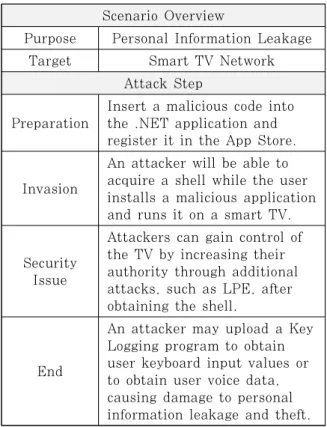
2017년 이후 스마트 TV는 .NET Application 업로드가 가능하다. Table 12에서 설명하듯이, App Store에 배포된 악성 .NET Application을 사용자가 실행하는 경우 공격자는 쉘을 획득할 수 있 게 된다. 그 후 공격자는 LPE 등 추가적인 공격을 통해 권한을 상승시킬 수 있다. 높은 권한을 얻은 공 격자는 Key Logging 프로그램을 업로드 하여 사용 자의 키보드 입력 값을 얻거나 사용자의 음성 데이터 를 얻는 등 개인정보 유출 및 도용의 피해를 발생시 킬 가능성이 있다.
Scenario Overview
Purpose Personal Information Leakage Target Smart TV Network
Attack Step
Preparation Insert a malicious code into the .NET application and register it in the App Store.
Invasion
An attacker will be able to acquire a shell while the user installs a malicious application and runs it on a smart TV.
Security Issue
Attackers can gain control of the TV by increasing their authority through additional attacks, such as LPE, after obtaining the shell.
End
An attacker may upload a Key Logging program to obtain user keyboard input values or to obtain user voice data, causing damage to personal information leakage and theft.
Table 12. Malicious Application
3.7 취약점 분석을 위한 취약점 점검 체크리스트
3.4에서 식별한 위협을 기반으로 Table 14.와 Scenario Overview
Purpose Personal Information Leakage Target Smart TV Network
Attack Step
Preparation
Use the third party
application installed on smart TV that requires a network such as logging in, paying, etc.
Invasion
On smart TVs, through routers, attackers obtain data sent to third party Vendor Server using MiTM attacks.
Security Issue
If the third party
application's network method does not use the TLS
protocol, which is a security protocol, there is a problem in which packets are sent in plain text.
End
Attackers can use Third Party Application to obtain
customer's personal
information without directly invading Smart TVs.
Table 11. Third party application
같이 취약점 점검 체크리스트를 도출한다.
이를 통해 Application, Network, System, Hardware에 대한 취약점 점검을 수행할 수 있다.
취약점 점검 체크리스트는 향후 스마트 TV 안전성 검사 및 보안 가이드 라인 제작에 활용될 것으로 기 대된다[3]. Table 13.은 체크리스트 실효성 검증 결과를 나타낸 것이다.
IV. 스마트 TV 보안 요구사항 도출
스마트 TV 사용자에게 안전한 서비스를 제공하기
위해, 스마트 TV 내 하드웨어 및 소프트웨어 구성 요소들은 여러 다양한 보안 위협으로부터 견고해야 한다[3]. Table 15.는 STRIDE 위협 도출 결과 및 Attack Tree를 바탕으로 작성한 스마트 TV 환 경에서의 보안 요구사항이다.
V. 결 론
스마트 홈의 규모가 커짐에 따라 가장 높은 보급 률과 꾸준한 성장률을 갖는 스마트 TV는 향후 스마 트 홈의 중심이 되어 타 스마트 기기들의 중추 역할
NO Checklist Verification
Item Total Number of Items Vulnerable Number of
Items Verification Rate
1 Application 5 2 40%
2 Network 7 3 43%
3 System 10 4 40%
4 Hardware 4 1 25%
Table 13. Validate Checklist Effectiveness
Checklist
Classification Check Item Detail
Application
Unauthorized Application Executable
Information Leakage Vulnerability by unauthorized application DoS Attack Depleting Storage Space through File Generation
Unauthorized Accessibility
API Vulnerability that allows execution permission on decompression
Acquire Shell by malicious application Install Malicious Application
Modulate the Existing Application Permission Intrusion between Applications
Use of Vulnerable Software Execute Malicious Script by using well known vulnerable software
Network
Packet Manipulation Network Packet Spoofing Attacks for Manipulating System Data
MiTM Attack Using SSL/TLS Certificate Manipulation Packet Analysis Download Paid Video by free
Leaking User Information by plaintext trasmission Denial of Service Attack DoS Attacks by transferring a large amount of network
packets
Use of Vulnerable Port RCE by opening a vulnerable port
System
Shell Acquisition 1-Day Attack through existing CVE
Shell Acquisition through escaping container Modified Firmware Updates Force update using modified firmware
Unauthorized Video
Transmission Showing Pirate broadcasting Firmware Acquisition Firmware Modulation with USB
Modulating Using Firmware Update Supported by Web Command Injection Command Injection by setting the name of TV Hardware Use of Vulnerable Interface
Check Data in Debug, UART, Logic, FANET mode of RS232 Port
Shell Acquisition Using JTAG, UART Port Data Extract eMMC Data Extraction
Table 14. Checklist for Vulnerability Analysis
을 할 것이다.
이에 따라 스마트 홈 전체를 제어하는 기능을 맡 을 경우, 스마트 TV에 대한 보안은 중요도가 더욱 높아질 것이다. 따라서 스마트 TV에 대한 단기적인 보안 솔루션의 개발 및 도입뿐만 아니라 장기적 측면 에서 기기가 가지고 있는 근본적인 위협에 대한 전략 적인 대응방안이 필요하다[5]. 그리고 스마트 TV의 구조를 분석하여 DFD를 도출하고, STRIDE 공격 위협 분류를 활용하여 스마트 TV에 존재 가능한 위 협 요소를 식별하였다.
이를 기반으로 Application, Network, System, Hardware의 4가지 측면에 대한 취약점 점검 리스트를 제작하였다. 위협 분석 모델링을 통해 스마트 TV에 대한 보안 위협을 식별하고 효과적인 취약점 분석을 위한 취약점 점검 리스트를 작성하는 것은, 추후 안전한 스마트 TV 사용 환경을 구축하는 데 도움이 될 것으로 기대된다[2].
향후 진행 방향 및 과제로는 취약점 점검 리스트 기반의 취약점에 대한 구체적인 대응방안 연구가 있 다. 취약점 점검 도구를 개발하여 범용적으로 다양한 Checklist
Category Surface Detail
Application
Unauthorized Application Executable
Set up the permission of application in order to prevent being read the public key file from others to avoid the Information Leakage
vulnerability.
To prevent Information Leakage vulnerability, add authentication to security setting entry.
Manage separately both API permissions and internal permission of Smart TV.
Unauthorized Accessibility OS should offer safe APIs to prevent exposure of key information.
Use of Vulnerable Software
By using the tool which inspect inside of Smart TV, the device check installation and executing of programs and should prevent execution of malicious application.
Network
Packet Manipulation
When attacker attempt to authenticate using forged certificate, application or service should close network connection by SSL pinning.
The functions have to be provided which protect the credential such as key, certifications.
Packet Analysis The user information outflow and illegal download of paid image should be prevented through the SSL/TLS encryption.
Denial of Service Attack DoS Attack is prevented through various access control such as unnecessary port deactivation, initial authentication information change, etc.
Use of Vulnerable Port Device should not provide services that has already known vulnerability to open port.
System
Shell Acquisition
External inputs should not be used as system instructions without validation.
The instrument authentication management procedure should be implemented in order to prevent the illegal use.
To prevent the memory operation, the memory protection technique should be applied to binary file.
It is necessary to devide space by container so that shell acquired inside of container cannot affect the Smart TV.
Modified Firmware
Updates The integrity verification technology for the firmware must be applied so that the modified firmware file cannot be widely distributed.
Unauthorized Video
Transmission To prevent unauthorized video transmission, OS should manage display service using another permission.
Firmware Acquisition Firmware file for customer support should be encrypted to make analysis difficult, and avoid revealing encryption keys.
Command Injection The text which can be edited by user must be encoded to prevent command injection.
Hardware
Physical Interface Internal debugging ports such as JTAG,UART,RS232 port, etc. should be physically removed or deactivated to prevent information retrieval through firmware extraction and file system analysis.
Data Extract Data which is in storagy such as eMMC, Flash Memory, etc. must be encrypted for prevention of physical extraction.