Journal of Mushrooms
한 국 버 섯 학 회 지125
Research Article
This is an Open-Access article distributed under the terms of the Creative Commons Attribution Non-Commercial License (http://
creativecommons.org/licenses/by-nc/3.0) which permits unrestricted non-commercial use, distribution, and reproduction in any medium, provided the original work is properly cited.
J. Mushrooms 2015 June, 13(2): 125-128 http://dx.doi.org/10.14480/JM.2015.13.2. 125 Print ISSN 1738-0294, Online ISSN 2288-8853
© The Korean Society of Mushroom Science
*Corresponding author E-mail : [email protected]
Tel : +82-41-330-1207, Fax : +82-41-330-1209 Received June 17, 2015
Revised June 25, 2015 Accepted June 29, 2015
광환경에 따른 잣버섯의 생육특성
장명준·이윤혜1·조용구·구한모·오태석*
공주대학교 산업과학대학 식물자원학과
1
경기도농업기술원 버섯연구소
Growth properties of Neolentinus lepideus according to the light environment
Myoung-Jun Jang, Yun-Hae Lee1, Yong-Koo Cho, Han-Mo Koo and Tae-Seok Oh*
Department of Plant Resources, KongjuNationalUniversity,Yesan340-702,Korea
1
Mushroom Research Institute, GARES, Gyeonggi Province Gwang-ju 464-870, Korea
ABSTRACT: We found about cultivation light environment conditions of Neolentinus lepideus. For the high quality of N. lepideus,
lights-out was useful. In the lights-out, the diameter of pileus of N. lepideus was smaller, and the length and the thickness of stipes were longer and larger than in that of lighting. At the LED effect, the orange and red LEDs prolonged the cultivation period in N. lepideus. The yields of N. lepideus under the white, blue and green LEDs were higher, and the number of available stipes of N. lepideus under the white and blue LEDs was higher than that of other LEDs. The diameter of pileus of N. lepideus under the white, blue and green LEDs was higher, and the length and the thickness of stipes under the orange and red LEDs was higher than those of other LEDs.
KEYWORDS: Light, Morphology, Neolentinus lepideus
서 론
균류는 광합성 능력이 없고, 햇빛에 노출되면 나쁘다는 사실 등으로 빛은 오히려 무용하거나 유해하다고 보았지 만, 빛을 받아 이에 반응하는 성질이 있음을 알게 되었다.
빛은 버섯이 생장할 때 버섯의 형태를 결정하는데 있어서 도 많은 역할을 한다. 암조건에 배양한 느타리버섯은 착 색이 되지 않고 갓이 거의 형성되지 않지만, 30~100 lux 의 광을 조사했을 때는 대가 길고 크기도 일정한 우수한
품질의 버섯을 생산할 수 있다고 한다(Yoo et al, 2010).
버섯을 재배하기 위해 영양조건인 배지 이외에 외적 환경 조건인 광, 온도, 습도 등은 매우 중요한 생육인자이다.
버섯 재배농가에서는 여러 가지 공조시설 설치로 온도, 습도, 환기 등을 조절하여 고품질 대량생산기술을 확립하 고 있다. 최근 광질 환경제어기술의 하나인 특정파장 영 역의 광원만을 조사하는 LED는 작은 크기로 공간에 구애 를 받지 않고 쉽게 탈부착 할 수 있는 인공조명으로서 차 광의 피해가 적다. 그리고 형광등에 비해 부피와 무게가 적고 수명이 길며 에너지 효율이 높아 반영구적 사용이 가능할 뿐 만 아니라 기존 인공조명과 달리 열선을 방사 하지 않아 열에 의한 농작물의 피해가 적어 안전하다. 또 한 식물생장에 이상적인 빛을 지속적으로 공급함으로써 집약재배가 가능한 장점이 있다(Bula et al, 1991).
담자균류 중에는 자실체 발생이 광에 의해 유기 또는 촉진되는 것이 많으며, 자실체의 분화나 발육에도 광이 효과적으로 작용하는 것으로 알려져 있고, 광이 자실체의 원기형성을 유도하는 대표적인 버섯종류로는 표고, 느타 리 등이 있으며, 갓의 전개를 유도하는 것으로 팽이버섯, 잣버섯 등이 있다(Furukawa, 1992). 따라서 잣버섯의 광 원에 따른 형태적 특성변화를 조사하고 광원을 이용하여
126
장명준·이윤혜·조용구·구한모·오태석
형태적으로 우수한 버섯을 생산하기 위한 기초자료로 활 용코자 본 연구를 수행하였다.
재료 및 방법
액체종균제조
시험균주로 잣버섯 『솔향』(Jang et al, 2011)을 사용하 였고, 접종원배지는 GPYM (Glucose 1.0, Peptone 1.0, Yeast extract 1.0, Malt extract 1.5) 액체배지를 사용하였 으며, 배지량은 100 mL로 250 mL삼각플라스크에 넣어 121oC, 20분 동안 고압살균을 실시하였다. 배지가 식은 후 페트리디쉬에서 생장한 잣버섯 균사체를 메스로 2~3 mm크기로 잘라 접종한 후 진탕기에서 배양온도 25oC, 150 rpm으로 9일 동안 액체배양을 실시하였다. 액체종균 용 배지로는 대두분배지를 이용하였으며, 액체종균 10 L 당 0.2 mL을 접종하여 통기량 1 vvm으로 25 ±1oC의 조 건에서 9일간 배양하였다.
배양봉지 배양
액체종균을 미송 + 옥분(90:10, v/v)에 접종하여 배지를 제조한 후 수분함량은 65%내외로 조절한 다음 121oC에 서 90분간 고압살균하였다. 그리고 20oC내외로 냉각하여 접종원을 접종하였으며, 잣버섯의 배양은 온도 21 ±1oC의 암조건에서 40일간 배양하였다.
광조사 유무에 따른 잣버섯의 생육특성
생육기간 중 광의 유무에 따른 생육특성을 조사하기 위 하여 2개의 생육실에서 생육온도 20 ±1oC, 상대습도 90
±5%, CO2농도 1,500 ±200 ppm으로 각각 설정한 후 점 등처리구는 광원을 생육기간 동안 점등상태로 조정하였고, 소등처리구는 형광등을 꺼놓았다. 생육특성은 농촌진흥청 조사분석기준(2003)에 의하여 조사하였고, 갓색은 색차계 (Minolta CR200, Japan)를 이용하여 L, a, b 값을 측정하
였으며, 대의 물성은 물성분석기(SUN RHEO meter Compac-100D)를 이용하여 10반복 측정하였다.
Light Emitting Diode (LED) 광원이 자실체 발생에 미 치는 영향
LED 시험용 생육상자는 크기는 950(W) × 400(H) × 1000(D)이며, 광원별로 모두 4처리로 475 nm의 청색광, 525 nm의 녹색광, 590 nm의 주황색광, 660 nm의 적색광 을 설치하였다(Jang et al, 2013; Jang et al, 2011). 온도 가 조절되는 버섯재배 생육실에 시험용 챔버를 설치 한 후 1구획당 32병을 입상하였다. 생육실내의 생육환경 조 건은 점등 및 소등 시험에 준하여 설정한 후 조정하였다.
그리고 생육상자내의 생육환경을 생육실과 동일하게 하기 위하여 챔버 후면에 배기용 팬을 달아 생육실에서 조정된 온도, 습도 및 CO2가 챔버내로 유입되어 환경조건이 동일 하게 되도록 하였다. 광원에 따른 잣버섯의 생육특성, 갓 색 및 대의 물성은 광조사 유무에 따른 자실체 형태조사 와 같이 수행하였다.
결과 및 고찰
광조사에 따른 자실체의 생육특성 조사
광조사 유무에 따른 갓의 색도 및 대의 물리성을 조사 한 결과 Table 1과 같다. 점등 처리구의 경우 명도 값이 소등처리구보다 낮았고, 적색도 및 황색도의 경우 소등처 리구 보다 높은 것으로 나타나 소등처리구 보다 점등처리 구에서 갓색이 짙어지는 경향이었다. 그리고 광조사 유무 에 따른 대의 물성을 조사한 결과 소등 처리구에서 경도 20 kg/cm2, 탄성 88%, 응집성 83% 및 깨짐성 33 kg으로 점등 처리구 보다 높았다.
광조사 유무에 따른 재배일수를 조사한 결과 점등처리 구에서 원기형성기간 및 자실체 발육일수가 소등처리구 보다 짧았다. 그리고 점등처리구에서 유효경수 및 수량도 Table 1. Effect of light on the color of pileus and physical properties of stipe of Neolentinus lepideus
Treatment
Color of pileus Physical properties of stipe
Lightness (L)
Redness (a)
Yellowness (b)
Hardness (kg/cm
2)
Springness (%)
Cohesiveness (%)
Brittleness (kg)
Lighting 75.0b
a18.1a 52.4a 17b
a77b 70b 27b
Lights-out 82.9a 7.0b 32.7b 20a 88a 83a 33a
a
Values followed by the same letter do not differ significantly at p>0.05 according to Duncan's multiple range test.
Table 2. Effect of light on the cultivation period and yield of N. lepideus
Treatment Formation of primordia
(days)
Development of fruit body (days)
No. of available stipes (No./1kg)
Yields (g/1kg)
Commercial yields (g/1kg)
Lighting 11 15 16.8a
a136a 88b
Lights-out 17 18 8.9b 117b 102a
a
Values followed by the same letter do not differ significantly at p>0.05 according to Duncan's multiple range test.
광환경에 따른 잣버섯의 생육특성
127 많았으나 상품수량의 경우 88 g으로 소등처리구 보다 작았다(Table 2, Fig 1).
광조사 유무에 따른 잣버섯의 자실체 생육특성은 Table 3과 같다. 자실체 생육기간 중 점등처리구에서 갓크기 37.3 mm, 갓굵기 10.4 mm, 대굵기 9.9 mm, 대길이 55.2 mm로 소등처리구에 비해 갓 및 대의 형태 모두 작은 경 향이었다.
큰느타리버섯의 경우 생육 조사시 형광등을 켜놓고 생 육시킨 결과 무광처리구에 비해 갓은 커지고, 대는 짧아 진다고 보고한 내용과 같이(Hideyuki et al, 2005) 본 실 험에서 수행한 잣버섯의 경우도 이와 같은 형태적 특징을 나타내었다.
Furukawa(1992)에 의하면 잣버섯의 경우 광에 의해 갓
의 전개가 유도된다고 하였는바 본 실험에서도 점등처리 구에서 갓의 전개 및 생육일수도 빠르게 진행된 것으로 나타났다. 따라서 잣버섯은 광에 의해 갓의 전개가 빠르 게 진행되므로 상품수량을 획득하기 위한 적정 광조사 시 기가 추가적으로 검토되어져야 할 것으로 판단되었다.
LED 광원이 자실체 발생에 미치는 영향
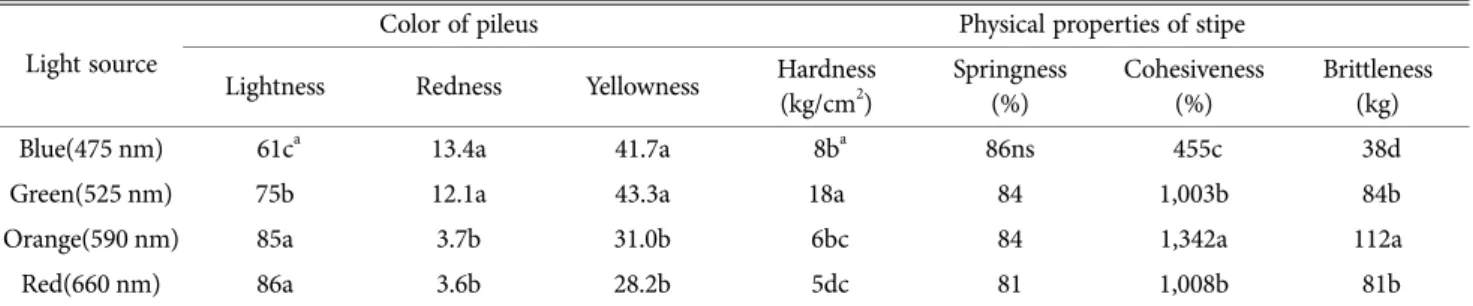
LED광원에 따른 갓의 색차 및 대의 물리성을 조사한 Table 4와 같다. 갓의 색차는 주황색광 및 적색광에서 명 도 값이 높았으며, 적색도는 청색광 및 녹색광에서 높았 고, 황색도는 청색과 녹색에서 높았다. 대의 물리성 중 경 도는 녹색광에서 18 kg/cm2로 가장 컸으며, 응집성 및 깨 짐성은 주황색광에서 가장 컸다.
잣버섯의 LED광조건에 따른 생육특성을 조사한 결과 자실체의 발육기간은 주황색광 및 적색광에서 길었고, 수 량은 청색광 및 녹색광에서 많았으며, 유효경수의 경우 청색광에서 많았고, 상품수량의 경우 주황색광 및 적색광 에서 많았다(Table 5).
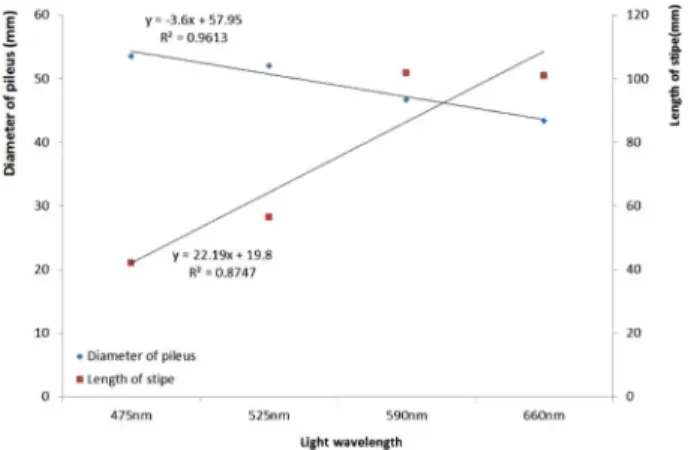
LED광원에 따른 잣버섯 자실체의 생육특성 중 갓크기 는 단파장에서 장파장으로 갈수록 작아지는 경향이었고, 대길이는 이와 반대로 장파장으로 갈수록 커지는 경향이 었다(Fig. 2). 큰느타리버섯에 대한 파장별 형태 중 청색
Fig. 1. Morphology of primordia formation and harvest stage according to light. A, Primordia formation under light; B, Harvest stage period under light; C, Primordia formation under darkness; D, Harvest stage under darkness.
Table 3. Effect of light on the properties of fruit body in N.
lepideus Treatment Diameter of
pileus (mm)
Thickness of pileus (mm)
Thickness of stipe (mm)
Length of stipe (mm) Lighting 47.1a
a10.4b 9.9b 55.2b
Lights-out 37.3b 15.2a 13.3a 111.9a
a
Values followed by the same letter do not differ significantly at p>0.05 according to Duncan's multiple range test.
Table 4. Effect of light source on the color of pileus and the physical properties of stipe of N. lepideus
Light source
Color of pileus Physical properties of stipe
Lightness Redness Yellowness Hardness (kg/cm
2)
Springness (%)
Cohesiveness (%)
Brittleness (kg)
Blue(475 nm) 61c
a13.4a 41.7a 8b
a86ns 455c 38d
Green(525 nm) 75b 12.1a 43.3a 18a 84 1,003b 84b
Orange(590 nm) 85a 3.7b 31.0b 6bc 84 1,342a 112a
Red(660 nm) 86a 3.6b 28.2b 5dc 81 1,008b 81b
a
Values followed by the same letter do not differ significantly at p>0.05 according to Duncan's multiple range test.
Table 5. Effect of light source on the growth period and yields of N. lepideus
Light source
Growth period of fruit
body (days)
No. of available stipes (No./1kg)
Yields (g/1kg)
Commercial yields (g/1kg) Blue LED
(475 nm) 15 23.9a
a103a 64b
Green LED
(525 nm) 15 19.1b 96ab 58b
Orange LED (590 nm)
18 3.5c 80c 72a
Red LED
(660 nm) 18 3.9c 92b 79a
a
Values followed by the same letter do not differ significantly at
p>0.05 according to Duncan's multiple range test.
128
장명준·이윤혜·조용구·구한모·오태석
LED에서는 갓이 커지고, 적색LED에서는 대가 길어진다 고 보고하였고(Hideyuki et al, 2005; Jang et al, 2011), 만가닥버섯(Jang et al, 2013), 표고버섯 (Baek et al, 2013), 맛버섯(Kaori et al, 2005)에 대하여도 이와 대등한 결과에 대하여 보고하였다. 이와 같이 앞선 선행연구의 버섯들처럼 잣버섯도 파장이 짧을수록 갓의 크기가 커지 는 경향이었고, 파장이 길수록 대의 길이와 굵기가 커지 는 경향이었다. 이러한 빛에 따른 형태적 변화를 주시하 여 이에 적합한 광량, 광조사시간 등에 대한 추가적인 연 구를 통해 고품질 안정생산에 기여할 수 있을 것으로 판 단된다.
적 요
광조사 유무에 따른 수량성 조사 결과 수량은 점등처리 구에서 많았으나 상품수량은 소등처리구에서 많았고, 생 육특성은 점등처리구가 소등처리구 보다 갓과 대의 형태 모두 작은 경향이었다. LED광원에 따른 생육특성을 조사 한 결과 자실체의 발육기간은 주황색광 및 적색광에서 길 었고, 수량은 청색광 및 녹색광에서 많았다. 그리고 유효 경수는 청색광에서 많았으나 상품수량은 주황색광과 적색 광에서 많았다. 이와 같은 결과 잣버섯의 경우 파장이 짧 을수록 갓의 크기가 커지는 경향이었고, 파장이 길수록 대의 길이는 커지는 경향이었다.
References
Baek IS, Lee YH, Jang MJ, Jeoung YK, Lee HB, Chi JH. 2013.
Effects of cultural characteristics of Lentinula edodes according to LED wavelength with sawdust substrate cultivation. Journal of Mushroom Science and Production.
11:226-229.
Bula RJ, Morrow, Tibbitts TW, Barta DJ, Ignatius RW, Martin TS.
1991. Light-emitting diodes as a radiation source for plants.
HortScience. 26:203-5.
Furukawa H. 1992. Mushroom science. Tokyo: Kyoritsu Shuppan Co. Ltd.; p. 89-92 (in Japanese).
Hideyuki Y, Daisuke M, Junji H, Toshio M, Kouzou N, Yasuo O.
2005. Effects of wavelength of light stimuli on the bio-electric potential and the morphogenetic properties of Pleurotus eryngii. J. SHITA. 17:175-181.
Jang MJ, Lee YH, Ju YC, Kim SM, Koo HM. 2013. Effect of color of light emitting diode on development of fruit body in Hypsizygus marmoreus. Mycobiology. 41:63-66.
Jang MJ, Lee YH, Kim JH, Ju YC. 2011. Effect of LED light on primordium formation, morphological properties, ergosterol content and antioxidant activity of fruit body in Pleurotus eryngii. The Korean Journal of Mycology. 39:175-179.
Jang MJ, Lee YH, Ju YC, Park YJ, Koo HM. 2011. Cultural characteristics of a new variety, ‘Solhyang’ Neolentinus lepideus. Journal of Mushroom Science and Production. 9:101- 104.
Kaori S, Katsunori J, Koji S, Hidehiko N, Norimitsu F, Toshio O, Junji H, Toshio M. 2005. Analysis on genes expressed during photomorphogenesis the fruiting bodies in Pholiota nameko.
J. SHITA. 17:3-10.
Yoo YB, Koo CD, Kim SH, Seo GS, Shin HD, Lee JW, Lee CS, Jang HY. 2010. Mushroom science. p. 385-420. Nature and man. (in Korean)
Fig. 2. Effect of light source on properties of fruit body in N.
lepideus
Fig. 3. Morphological properties according to light source.