국소성 기질화 폐렴은 양성의 염증성 질환으로써 많은 경우 에서 임상적으로 선행하는 폐렴의 증상이 뚜렷하지 않은 경우 가 많고, 영상 소견만으로는 폐암과의 감별이 어려워 세침흡입 술 또는 수술 등의 침습적인 진단방법이 요구되는 경우가 있 다 (1-4).본 연구의 목적은 국소성 기질화 폐렴의 CT상 특 징을 폐암과의 감별에 도움을 주는 소견에 중점을 두어 알아 보고자 하였다.
대상과 방법
흉부영상 진단상 국소성 폐 병변을 보여 임상적 및 방사선 학적으로 폐암을 의심한 환자 중 병리조직학적으로 국소성 기
질화 폐렴으로 확진 된 13명을 대상으로 하였다. 남자가 10명, 여자가 3명이었고, 나이는 32세에서 74세까지 (평균 60세) 였 다. 확진 방법으로는 5예에서 수술적 적출로 조직을 얻었으며, 6예에서는 세침 흡인 생검법으로, 2예에서 경기관지 폐생검을 시행하였다. 조직학적으로는 악성조직없이 폐포강내 (alveolar space)에 섬유아세포(fibroblast)의 증식을 동반한 육아종과 폐 간질의 비후소견을 보이는 경우 기질화 폐렴으로 진단하였다.
3 명의 방사선과 의사가 각기 국소성 기질화 폐렴의 CT 소견 을 자세하게 분석하고 의견 일치를 수렴하였다. 방사선학적 검 사로는 단순 흉부촬영과 CT를 시행하였으며 전 예에서 조영 증강 전후 촬영 및 고해상 CT를 시행하였다. 조영 증강은 iopromide (Ultravist 300, Schering AG, Berlin, Germany) 150 ml 중 50 ml을 먼저 급속 정주 후 나머지 100 ml를 3분 에 걸쳐 점적(dripping) 하였다. 사용된 CT 기종은 GE 9800 Scanner (General Electric Medical System, Milwaukee, U.S.A.) 이었으며 통상적인 흉부 CT촬영 기법은 절편 간격과 절편 두께는 각각 10 mm로 하였으며, 고해상 CT는 절편 두
국소성 기질화 폐렴의 CT 소견
1박준균・유영훈2・유석종3・윤상욱・남지은・최규옥・김형중4・이두연5・김상진
목적: 국소성 기질화 폐렴은 양성의 염증성 질환이지만 방사선 영상만으로 폐암과 감별에 어려 움이 있다. 따라서 본 연구에서는 국소성 기질화 폐렴의 특징적인 CT 소견을 확인하여 악성 질환과의 감별에 도움을 주고자 하였다.
대상과 방법: 병리조직학적으로 국소성 기질화 폐렴이 확인된 13명의 환자를 대상으로 의무기
록 및 단순 흉부 촬영과 CT 소견을 3명의 방사선과 의사가 후향적으로 분석 하였으며, 13명의 환자 모두 초기 방사선 소견은 폐암이 의심되었다. CT소견은 병변의 크기, 모양, 경계, 주위 구 조와의 관계, 조영증강 양상 및 위치로 구별하였으며, 추적 CT검사상의 변화를 확인하였다.
결과: CT 소견상 모든 예에서 난원형 또는 삼각형 모양을 보였으며, 크기는 1.8 cm 에서 6.5 cm 였다. 한 예를 제외한 모든 예에서 폐의 말초부위에 위치하며, 불규칙한 경계를 보였다. 8 예에서 흉막과 인접해있었으며, 5예에서 기관지-혈관속(bronchovascular bundle)을 따라서 위 치하고 있었다. 8예에서 불균질한 조영증강 양상을 보였으며, 4예에서 흉막 꼬리( pleural tag) 를, 5예에서 거친 침상 변연(coarse spiculation) 및 흉막 압흔(pleural indentation)을, 6예에서 공기-기관지 조영상(air-bronchogram)을, 4예에서 위성결절(satellite nodule)을 보였다. 국소 적 석회화 및 임파절 비대는 1예에서 보였다. 추적 CT 검사를 시행한 4예 중 3예에서 병변의 크기가 확연히 줄었으며 1예에서 병변이 완전히 소실되었다.
결론: 폐암과 국소성 기질화 폐렴은 방사선 영상소견만으로는 감별에 어려움이 있으나, 폐의 말 초부위에 위치하며 난원형 또는 삼각형의 병변으로, 흉막과 넓게 연해있거나 기관지-혈관속을 따라서 위치하며 위성 결절이 동반된 경우에 국소성 기질화 폐렴의 가능성이 고려되어야 할 것 으로 생각한다.
1연세대학교 의과대학 진단방사선과학교실, 연세대학교 방사선의과학연구소
2가천의과대학 길병원 진단방사선과
3인제대학교 의과대학 서울백병원 진단방사선과
4연세대학교 의과대학 내과학교실
5연세대학교 의과대학 흉부외과학교실
이 논문은 2000년 2월 29일 접수하여 2000년 10월 13일에 채택되었음.
결 과
환자들의 임상증세는 기침이 9예로 가장 많았고, 흉부 불쾌
예 (61.5%)에서 병변 내부에 불균질한 조영증강을 보였으며, 5예 (38.5%)에서 균질한 조영증강을 보였다. 고해상 CT 소견
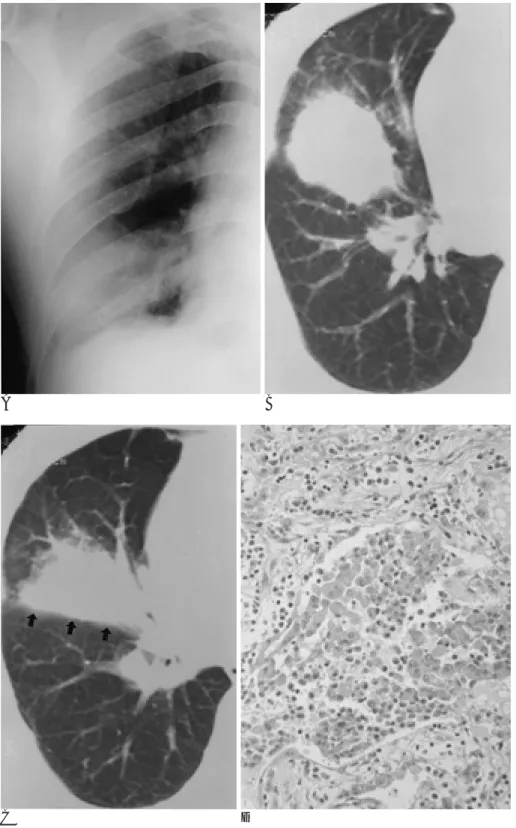
A B
Fig. 1. A 74-year-old man with proved focal organizing pneumonia.
A. Chest radiograph reveals an ill-de- fined, round mass in right lower lobe.
B. High resolution CT scan shows an oval shaped solitary mass with an irreg- ular margin.
C.The lesion is located along the inter- lobar fissure (arrows).
D.Transbronchial lung biopsy speci- men reveals proliferation of fibroblasts as well as intraalveolar and interstitial organization and fibrotic change (hematoxylin-eosin stain, × 400).
C D
상 8예 (61.5%)에서 흉막과 광범위하게 인접하고 있었으며, 공기-기관지 조영상이 6예 (46.2%)에서, 거친 침상변연 (coarse spiculation)이 6예 (46.2%)에서 보였다. 또한 5예 (38.5%)에서는 병변이 기관지-혈관속(bronchovascular bun- dle)을 따라서 위치하고 흉막 압흔(pleural indentation)이 보 였으며 4예 (30.8%)에서 흉막 꼬리(pleural tag) 및 위성 결 절(satellite nodule)을 보였다. 소량의 흉막삼출은 2예 (15.4%) 에서 관찰되었다. 1예에서는 석회화 소견과 임파절 종대 소견 이 보였다. 추적 CT 검사상 4예 중 3예에서 병변의 크기의 확 연한 감소 소견을 보였으며, 1예에서는 병변이 완전히 소실되 었다. 자세한 CT 소견은 Table 1에 요약하였다.
A
C
B
Fig. 2. A 65-year-old man with proved focal organizing pneumonia.
A. Chest radiograph reveals localized pulmonary parenchymal abnormality with an irregular margin.
B. High resolution CT scan shows a soli- tary nodule with an irrgular margin. A pleural tag is apparent.
C. The specimen reveals intraalveolar and interstitial oranization tissue with apparent fibrosis. (hematoxylin-eosin stain, × 200)
Table 1. CT Findings of Focal Organizing Pneumonia
Age Sex Shape Contact Margin Pleural Spiculation Air- Satellite Pleural Along the tag bronchogram nodule indentation BVB
74 M Oval Pleura Irregular + - - + - -
60 M Oval Pleura Irregular - - + - - +
47 F Oval No Smooth + + - - - +
65 M Triangular Pleura Irregular - - + + + -
40 M Triangular Pleura Irregular - - + - + -
77 M Oval No Irregular + + + - - -
32 M Triangular Pleura Irregular - + + - + +
61 M Triangular Pleura Irregular - - - +
38 M Oval No Irregular - + - - - +
47 M Triangular Pleura Irregular + - - + + -
54 M Oval No Irregular - + - - + -
71 F Oval No Irregular - - - + - -
36 F Triangular Pleura Irregular - + + - - -
Abbreviation: BVB-Bronchovascular bundle
된 바 있으나 일관된 임상적 정의는 아직 없는 실정이다 (1- 4). Israel 등의 보고에 의하면 139명의 폐렴 환자를 추적 검 사를 해본 결과 121명 (87%)에서 4주 이내에 폐렴의 음영의 소실 소견이 보였으며, 17명에서 4-8주동안에 폐렴이 없어졌 으나 나머지 한명의 경우 8주가 지나도 폐렴의 음영이 지속적 으로 관찰되었다 (5). 기질화 폐렴의 이환율은 전체 폐렴 환자 중 5-10%로 보고되고 있다 (2-4, 6, 7). 기질화 폐렴과 동 반된 임상 증상으로는 가래가 동반된 기침, 고열, 객혈등 이 있 으며(6, 7) 본 연구에서는 대부분의 환자에서 기침, 흉통 등의 경미한 증상을 보였으나 고열 등의 심한 폐렴 증상을 보인 경 우는 없어서 임상적으로 감별에 어려움이 있었다.
기질화 폐렴은 조직학적으로는 염증성 삼출액이 기질화되 어 섬유아세포, 임파구 및 대식세포가 폐포강 내에 육아종을 형성한다 (9-11). 기질화의 초기에는 신생혈관의 증식이 현 저히 나타나고 진행되면 섬유아세포의 증식이 심화되며 최종 적으로 섬유화에 이르게 된다. 과거에는 용해되지 않은(unre- solved) 세균성 폐렴의 만성 후유증으로 생각되었으며 기강성 폐렴(air-space pneumonia)에서도 발생할 수 있지만 기관지 폐렴에서 더 흔히 발생한다고 알려졌다 (11). 그러나 최근 감 염성 원인 외에도 류마치스염 같은 교원성 혈관질환, acebu- tolol이나 amiodarone등과 같은 약제, 궤양성 대장염, 방사선 노출 등에 의해서도 발생하는 것으로 밝혀져 있다 (9-10).
CT 상에서 악성 결절(nodule)을 시사하는 소견으로는 불규 칙하거나 침상 변연을 보이는 경우, 불균질한 음영 (공기기관 지 음영 또는 공기 방울 음영)이 보이는 경우, 흉막 압흔 (pleural indentation) 등이 있다 (12-15). Kuriyama 등의 보 고에 의하면 CT상에서 2 cm 미만의 폐결절이 보일 경우 공 기기관지 음영은 약 65%의 악성 결절에서 보이며 양성에서는 5%에서 보였다(15). 또한 Zwirewich 등의 보고에 의하면 침 상 변연은 악성 결절의 87%에서, 양성 결절의 55%에서 보였 으며, 흉막 꼬리는 악성 결절의 25%에서, 양성 결절의 9%에 서 보였다 (12). CT상 폐결절의 양성을 시사하는 소견으로는 석회화 또는 지방 성분의 함유와 변연이 뚜렷한 경우이다 (16- 19).
Kohno (20) 등의 보고에 의하면 CT상에서 18예의 병변 중 에서 7예 (39%)에서 비교적 넓은 부위가 늑막과 연해 있었으 며, 6예 (33%)에서 말초의 기관지-혈관속을 따라 위치하고, 나머지 5예 (28%)에서는 늑막이나 기관지-혈관속과 관계없 이 말초 폐실질에 위치하고 있었다. 본 연구에서는 모든 예에 서 흉막과 광범위하게 접하고 있거나 기관지-혈관속을 따라 서 위치하고 있었으며 폐의 말초에 위치하고 있었다. 또한 Kohno 등의 보고에 따르면 위성병소가 56%에서 관찰된 것에 반해 본 연구에서는 30.8%에서 관찰되었다.
해서는 대부분의 경우에서 생검에 의한 확진이 필요할 것으로 생각된다.
결론적으로 국소성 기질화 폐렴의 CT소견은 폐암의 소견과 유사하게 보일 수 있어 감별이 어렵지만, 병변이 폐 말초부에 위치하면서 난원형 또는 삼각형 모양을 보이고 광범위하게 흉 막과 연해 있거나 기관지-혈관속을 따라서 위치하고 있으며 동반된 위성 결절이 있는 경우 국소성 기질화 폐렴의 가능성 을 염두에 두어야 할 것으로 생각한다.
참 고 문 헌
1. Ackerman LV, Elliott GV, Alanis M, et al. Localized organizing pneumonia: It’s resembalance to carcinoma. AJR Am J Roentgenol 1954;71:988-996
2. Sulavik SB. The concept of organizing pneumonia. Chest 1989;96:
967-968
3. Gosink BB, Freidman PJ, Liebow AA. Bronchiolitis obliterans:
Roentgenographic phathological correlation. AJR Am J Roentgenol 1973;117:816-832
4. McLoud TC, Epler GR, Colvy TV, Gaensler EA, Carrington CB.
Bronchiolitis obliterans. Radiology 1986;159:1-8
5. Israel HL, Weiss W, Eisenberg GM, Strandness DE Jr, Flippin HF.
Delayed resolution of pneumonias. Med Clin North Am 1956;40:
1291-1303
6. Mochizuki Y, Kobayashi Y, Iwata T, et al. Clinical and pathologic studies of unresolving pneumonia. Jpn J Thorac Dis 1987;25:86-92.
7. Boyd DHA. Failure of resolution in pneumonia. Br J Dis Chest 1975;69:259-266
8. Matsusita T, Hara H, Katoh O, et al. Background factors of patients with unresolving pneumonia. Jpn J Thorac Dis 1983;20:426-433 9. Katzenstein ALA, Askin FB. Surgical pathology on non-neoplastic
lung disease. 2nd ed. Philadelphia: Saunders, 1990:40-57
10. Hansell DM. What are bronchiolitis obliterans organizing pneumo- nia (BOOP) and cryptogenic organizing pneumonia (COP) ? Clin Radiol 1992;45:369-370
11. Fraser RG, Pare JAP, Pare PD, Fraser RS, Genereux GP. Diagnosis of disease of the chest. 3 rd ed. Philadelphia: Saunders, 1989:810-840 12. Zwirewich CV, Vedal S, Miller RR, Muller NL. Solitary pulmonary nodule: high resolution CT and radiologic-pathologic correlation.
Radiology 1991;179:469-476
13. Gaeta M, Pandolfo I, Volta S, et al. Bronchus sign on CT in periph- eral carcinoma of the lung: value in predicting results of trans- bronchial biopsy. AJR Am J Roentgenol 1991;157:1181-1185 14. Kuriyama K, Tateishi R, Doi O, et al. CT-pathologic correlation in
small peripheral lung cancers. AJR Am J Roentgenol 1987;149:1139- 1143
15. Kuriyama K, Tateishi R, Doi O, et al. Prevalence of air bron- chogram in small peripheral carcinoma of the lung on thin-section CT: comparison with benign tumors. AJR Am J Roentgenol 1991;
156:921-924
16. Siegelman SS, Zerhouni EA, Leo FP, Khouni NF, Stitik FP. CT of
17. Siegelman SS, Khouri NF, Leo FP, Fishman EK, Braverman RM, Zerhouni EA, Solitary pulmonary nodules: CT assessment.
Radiology 1986;160:307-312
18. Zerhouni EA, Stitik FP, Siegelman SS, et al. CT of the pulmonary nodule: a cooperative study. Radiology 1986;160:319-327
19. Siegelman SS, Khouni NF, Scott WW Jr, et al. Pulmonary hamar-
toma: CT findings. Radiology 1986;160:313-317
20. Kohno N, Ikezoe J, Johkoh T, et al. Focal organizing pneumonia:
CT appearance. Radiology 1993;189:278-281
21. 김양수, 김영구, 박언섭. 국소성 기질화 폐렴의 CT 소견: 병리 소견 과의 비교. 대한방사선의학회지 1994;31:875-881
J Korean Radiol Soc 2000;43:711-715
Address reprint requests to : Sang Jin Kim, M.D., Department of Diagnostic Radiology, Research Institute of Radiological Science, Yonsei University College of Medicine., Yong Dong Severance Hospital.
146-92 Dokok-dong, Kangnam-gu, Seoul.
Tel. 82-2-3497-3513 Fax. 82- 2- 3462-5472 E-mail: [email protected]
CT Findings of Focal Organizing Pneumonia
1Jun-Gyun Park, M.D., Young Hoon Ryu, M.D.2, Suk Jong Ryu, M.D.3, Sang Wook Yoon, M.D., Ji Eun Nam, M.D., Kyu Ok Choe, M.D., Hyoung Jung Kim, M.D.4, Du Yon Lee, M.D.5, Sang Jin Kim, M.D.
1Department of Diagnostic Radiology, Research Institute of Radiological Science, Yonsei University College of Medicine
2Department of Diagnostic Radiology, Gachon Medical School, GIL General Hospital
3Department of Diagnostic Radiology, College of Medicine, Inje University
4Department of Internal Medicine, Yonsei University College of Medicine
5 Department of Chest Surgery, Yonsei University College of Medicine
Purpose: Focal organizing pneumonia (FOP) is a benign condition which is often difficult to differentiate from bronchogenic carcinoma, and many patients with FOP undergo invasive procedures. We tried to determine which CT features might help provide a confident diagnosis of FOP.
Materials and Methods: We retrospectively reviewed the medical records, chest radiographs and CT scans of 13 patients with histopathologically proven FOP. Initial chest radiographs in all 13 suggested bronchogenic carcinoma. The CT scans were reviewed by three radiologists, and final decisions were reached by consensus.
They were analyzed in terms of the size, shape, contour and localization of the lesion, internal characteristics of the nodule, changes in surrounding structures, and changes in any of these findings, as revealed by follow- up chest CT scanning.
Results:FOP lesions were oval or triangular in shape and between 1.8 and 6.5 cm in their largest diameter. All had irregular margins and all but one were peripherally located. Eight (61.5%) were in contact with the pleura and five (38.5%) were located along the peripheral bronchovascular bundle, with pleural indentation; in eight (61.5%), post-contrast CT scanning revealed inhomogeneous enhancement, and four (30.8%) had pleural tags.
In five (38.5%), there was coarse spiculation; for six (46.2%), air bronchograms were available, and in four (30.8%), satellite nodules were present. Spotty calcification and lymph node enlargement were each evident in one case only. Follow-up CT scanning, available in four cases, showed that the mass decreased in size in three and disappeared completely in one.
Conclusion: Although there were no consistent CT features for differentiating focal organizing pneumonia from lung cancer, the possibility of the former should be considered when a peripherally-located oval or trian- gular-shaped mass is in broad contact with the pleura or is located along the bronchovascular bundle, and satellite nodules are also present.
Index words :Pneumonia Lung , CT