The Study of Reliability and Validity of the Korean Version of the Trauma Symptom Checklist for Young Children
The present study aimed to evaluate the psychometric properties of the Korean version of the Trauma Symptom Checklist for Young Children (TSCYC) including reliability and validity.
The TSCYC is an instrument to identify trauma symptoms in children from age 3 to 12 yr by their caretakers. The Korean version of the TSCYC was administered to the caretakers of a normative group of 299 children (137 boys and 162 girls) aged 3 to 12 yr and a
traumatized group of 73 sexually abused children (22 boys and 51 girls) aged 3 to 12 yr and their caretakers rated the TSCYC and the Child Behavior Checklist and the Child Sexual Behavior Inventory. Among normative group, 88 performed a re-test after 4 weeks. The internal consistency, Cronbach’s alpha of total scale of the TSCYC was 0.92 (normative group) and 0.96 (traumatized group). For the nine clinical scales in the TSCYC, it ranged between 0.46-0.92 and 0.77-0.96, respectively. Test-retest correlation of the TSCYC was good (Pearson r score ranging 0.52-0.96). Correlations between the TSCYC and other measures of corresponding constructs were satisfactory. Regarding discriminant validity, the mean total score of the TSCYC was significantly higher in the traumatized children than in the normative group. This study demonstrated that Korean version of the TSCYC is a reliable measure with excellent internal consistency and good stability over 4-week test- retest interval. It can be recommended for clinicians to screen for trauma symptoms after child sexual abuse in Korean young children between the ages 3 and 12.
Keywords: Child Sexual Abuse; Preschool; Caregivers; Checklist; TSCYC; Posttraumatic Stress Symptom
Jong Duk Bae,1 Jae Hoon Jeong,2 Jung Jae Lee,3 and Un-Sun Chung2
1Seodaegu Daedong Hospital, Daegu; 2Department of Psychiatry, Kyungpook National University Hospital, Daegu; 3Department of Psychiatry, College of Medicine, Dankook University, Cheonan, Korea Received: 4 March 2015
Accepted: 20 May 2015 Address for Correspondence:
Un-Sun Chung, MD
Department of Psychiatry, Kyungpook National University, School of Medicine, School Mental Health Resources and Research Center, Kyungpook National University Children’s Hospital, 807 Hoguk-ro, Buk-gu, Daegu 702-210, Korea Tel: +82.53-200-6414, Fax: +82.53-426-5361 E-mail: [email protected]
http://dx.doi.org/10.3346/jkms.2015.30.9.1340 • J Korean Med Sci 2015; 30: 1340-1346
INTRODUCTION
Psychological stress after trauma has long been recognized as an important factor in the development of mental disorders (1).
Childhood traumatic events, such as child abuse, parental death, bulling by peers, natural disasters, and medically related trauma, are associated with various negative mental health outcomes.
These include anxiety, depression, substance abuse, posttrau- matic stress, dissociation, oppositional behavior, suicidal and self-injurious behavior, anger and aggression, risk-taking be- havior, and age-inappropriate sexual behavior (2-5).
Among various types of adverse childhood experiences, child sexual abuse has been remarkable academic and public issues in Korea. A child sexual abuse response team, the Sunflower Center was established at Yonsei University Health System by the Ministry of Gender Equality and Family of Government in 2004. Currently there are 34 Sunflower Center are operating in Korea, and over 5,000 sexually abused children under the age of 13 are being serviced every year. The need to evaluate sexually abused child victims has been growing and the standardized, normed tests of trauma-related symptoms in children has been lack and not available to Korean clinicians.
Thorough and accurate assessment is requisite for the imple-
mentation of appropriate interventions for children and ado- lescents after traumatic events (7). Several trauma symptom measures have been translated into Korean. The children’s re- vised impact of Event scale (CRIES) and Clinician-Adminis- tered PTSD Scale for Children and Adolescents (CAPS-CA) are most commonly used ones (8, 9). However, non-inclusion of the hyperarousal dimension in the IES and the time involved in administering the CAPS-CA make it difficult to use as a screen- ing tool in normal clinical settings (8, 10). The Davidson Trau- ma Scale (DTS) is a reliable and valid tool for assessing trauma symptom and a self-rated assessment that requires a very short amount of time to complete, but it had been studied only in adult subjects in Korea (11). For these reasons, development of the Korean version of useful scale is necessary to evaluate chil- dren and adolescents with trauma, especially younger sexual abuse victims.
Among currently available measures for use by clinicians and researchers, we need the instrument that can screen PTSD as well as the multiple symptoms of trauma such as depression, anger, sexual concerns. It also should have the proven norms and data on clinical psychometrics, and be user-friendly re- garding time needed to administer and the appropriate age group of the child for clinical purpose (7). As regarding the cri-
terion of user-friendliness and time to administer, the self-re- port measures are favored because they take a shorter time to administer than clinician-administered interview format. In the self-report measures, there are client self-reports and par- ent-self reports (7). Concerning criteria for age in a Sunflower center, sexually abused children under age 13 had been the tar- get group to evaluate and treat by the government at first be- cause of the limitation of development of cognitive and com- municative development.
Among various measures satisfying these criteria, there are the Trauma Symptom Checklist for Children (TSCC) and the Trauma Symptom Checklist for Young Children (TSCYC) (7, 12- 14). The TSCC is a self-report instrument made to recognize a broad range of symptoms of childhood traumatic experiences in 8 to 17 yr old children and adolescents (7, 14, 15). This 54-item questionnaire takes approximately 10 to 20 min to complete. The Korean version of the TSCC is a screening instrument with satis- factory psychometric qualities and it is capable of identifying self-reported experiencing trauma symptoms among children and adolescents who have experienced trauma (15). The TSCC is designed for the child older than 8 yr because younger chil- dren may not be able to fully understand what a given psycho- logical symptoms or internal state actually represents because of insufficient cognitive development, or not be able to compre- hend written test items well enough for responding pro perly (12).
The TSCYC is 90-item caretaker report measure and takes 10 to 20 min to complete in the caretakers of children and adoles- cents aged from 3 to 12 (12, 13). Both scales measure post trau- matic symptoms, PTSD symptom cluster and abuse related symp- toms associated with trauma in children including sexual as- saults. However, the TSCYC would be more appropriate to use for the younger children, especially preschoolers who have in- sufficient cognitive development for self-report (12). Moreover, the TSCYC includes specific scales to verify the validity of care- taker reports unlike most other parent/caretaker-report mea- sures. Therefore, the purpose of our study was to develop a Ko- rean version of the TSCYC and to evaluate its reliability and va- lidity in normative and traumatized samples with child sexual abuse in a Korean population of children and adolescents.
MATERIALS AND METHODS Participants
Normative group
A total of 307 children’s caretakers agreed to participate in the study and rated the behavior and symptoms of their children.
The caretakers rated children 3 to 12 yr old, who were attending one kindergarten and one elementary school in Daegu, which is the fourth largest city in Korea with approximately 2.5 million inhabitants. Permission was obtained in advance from the head- masters and teacher and parents’ committee of the school board
of the school in which the study was performed. All the partici- pants, their caretakers and school students, had given the in- formed consents. The ethics committee of Kyungpook National University Hospital granted permission for the study. We exclud- ed the participants with prior psychiatric diagnosis and treat- ment. Also, eight were excluded because of missing data, and the final sample included 299 subjects; 137 boys and 162 girls.
The mean age in the normative group was 7.51 yr old (SD = 2.75);
boys only, 7.34 (SD = 2.80) and girls only, 7.68 (SD = 2.86).
For the purpose of test-retest reliability, 88 students were ran- domly selected, and their caregivers completed the TSCYC a second time, 4 weeks later.
Traumatized group
The traumatized group consisted of 73 abused children (51 girls and 22 boys) who consecutively visited the Sunflower Center, treatment center for sexually abused children in Deagu. Parents or other caretakers and children gave informed consent to par- ticipate. All clinical cases had been sexually abused (corrobo- rated by police reports and medical charts). The age in the trau- matized group varied between 3 and 12 yr (boys, mean age 9.14, SD = 2.17; girls, mean age 7.66, SD = 2.70). The TSCYC was com- pleted before the start of the treatment, and no psychiatric diag- noses were made at that time.
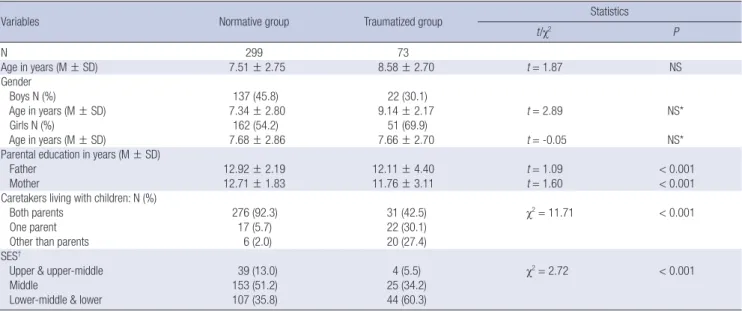
The mean age for total sample and each gender group were not significantly different between normative and traumatized groups. In the normative group, fathers and mothers had sig- nificantly more years of education (t = 1.09, P < 0.001, t = 1.60, P < 0.001) than those in the traumatized group. In the norma- tive group, 92.3% of children had been living with their both par- ents, which was significantly higher proportion (χ2= 11.71, P <
0.001) than 42.5% in the traumatized group. Socioeconomic sta- tus of the normative group had been significantly higher than in the traumatized group (χ2= 2.72, P < 0.001) (Table 1).
Questionnaires
Trauma symptom checklist for young children
The TSCYC is a 90-item caretaker-report instrument, developed for the assessment of trauma-related symptoms in children aged 3-12. Items are rated on a 1 (“not at all”) to 4 (“very often”) scale.
The scales of the TSCYC include two caretaker report validity scales, Response Level (RL) and Atypical Response (ATR). The Response Level validity scale assesses potential under-report which taps a general tendency to deny normal, minor problem- atic behavior in one’s child. The Atypical Response validity scale assesses potential over-report which evaluates parent/caretak- er willingness to endorse a series of very unusual and unrelated behaviors. The questionnaire includes nine clinical scales: Post- traumatic Stress-Intrusion (PTS-I), Posttraumatic Stress-Avoid- ance (PTS-AV), Posttraumatic Stress-Arousal (PTS-AR), Post- traumatic Stress-Total (PTS-TOT), Sexual Concerns (SC), Anxi-
ety (ANX), Depression (DEP), Dissociation (DIS), and Anger/
Aggression (ANG).
In a multi-site sample of 219 traumatized children, the TSCYC scale was reliable and predictive of exposure to childhood sex- ual abuse, physical abuse, and witnessing domestic violence (12, 13).
The questionnaire was translated into Korean by two child and adolescent psychiatrists in our department. After a consen- sus procedure the questionnaire was sent to a translator for back- translation. The back-translation was then compared with the original and a final version with minor differences was sent to, and accepted by the Psychological Assessment Resources, Inc.
(PAR), a copyrighter of the original scale (13).
Child behavior checklist (CBCL)
The CBCL was used for the purpose of assessing concurrent va- lidity. The CBCL-Korean version is a widely used 132-item be- havior rating scale for children ages 4-18 (16). Behaviors are rat- ed by caretaker on a 3-point scale (0 = not true, 1 = somewhat true, 2 = often true) over a 6-month time period. The CBCL di- vides behavior problems into internalizing and externalizing problems. Internalizing problems include withdrawal, somatic concerns, depression, and anxiety. Externalizing problems in- clude aggression, delinquency, and conduct problems. It has good reliability and validity. In previous study, the CBCL Anxi- ety/Depression and Aggression scale were most related with TSCYC Anxiety (ANX), Depression (DEP), and Anger/Aggres- sion (ANG) scales, respectively (17).
Child sexual behavior inventory (CSBI)
The CSBI is a measure that utilizes parent report of sexual be- havior in children ages 2 to 12 yr (18). It is intended for use in
the evaluation of children who have been sexually abused or who are suspected of having been sexually abused. It assesses a wide range of sexual behavior that cover a number of domains, including boundary problems, exhibitionism, gender role be- havior, self-stimulation, sexual anxiety, sexual interest, sexual intrusiveness, sexual knowledge, and voyeuristic behavior. The full version of the CSBI consists of 38 items and three clinical scales (CSBI Total, Developmentally Related Sexual Behavior [DRSB], and Sexual Abuse Specific Items [SASI]) (19). Korean version of the CSBI is a reliable and valid tool which can be ap- plied in the clinical field for assessing the sexual behavior of Korean children aged from 6 to 12 who are suspected to have been sexually abused (20). The CSBI also was used for the pur- pose of testing concurrent validity of the TSCYC Sexual Con- cerns (SC) scale (13, 17, 20).
Statistical procedures
To evaluate internal reliability of the TSCYC in a Korean sam- ple, we calculated Cronbach’s alpha coefficients for the total score and for each clinical scale. A standard of 0.90 or higher was considered excellent (21). Test-retest reliability was evalu- ated using Pearson r. The relations between the total score and the clinical scales also were examined using Pearson r. The P value below 0.05 was considered statistically significant and Pearson r above 0.7 has been evaluated as having highly very strong positive correlation, r between 0.4-0.7 as moderate posi- tive correlation, r between 0.2-0.39 as mild positive correlation and r below 0.2 as weak correlation (21).
The comparisons of the TSCYC total score and subscale scores between normative and traumatized group were examined us- ing independent sample t-test. Statistical analysis was performed with SPSS/Windows (Version 15.0) (P < 0.05).
Table 1. Age and gender difference of the normative group and the traumatized group with child sexual abuse
Variables Normative group Traumatized group Statistics
t/χ2 P
N 299 73
Age in years (M ± SD) 7.51 ± 2.75 8.58 ± 2.70 t = 1.87 NS
Gender
Boys N (%) 137 (45.8) 22 (30.1)
Age in years (M ± SD) 7.34 ± 2.80 9.14 ± 2.17 t = 2.89 NS*
Girls N (%) 162 (54.2) 51 (69.9)
Age in years (M ± SD) 7.68 ± 2.86 7.66 ± 2.70 t = -0.05 NS*
Parental education in years (M ± SD)
Father 12.92 ± 2.19 12.11 ± 4.40 t = 1.09 < 0.001
Mother 12.71 ± 1.83 11.76 ± 3.11 t = 1.60 < 0.001
Caretakers living with children: N (%)
Both parents 276 (92.3) 31 (42.5) χ2= 11.71 < 0.001
One parent 17 (5.7) 22 (30.1)
Other than parents 6 (2.0) 20 (27.4)
SES†
Upper & upper-middle 39 (13.0) 4 (5.5) χ2= 2.72 < 0.001
Middle 153 (51.2) 25 (34.2)
Lower-middle & lower 107 (35.8) 44 (60.3)
*Non-specific; †SES by Hollingshead and Redlich was used. N, number; M, mean; SD, standard deviation.
Table 2. Coefficient alpha reliability of the TSCYC scale in the normative group and the traumatized group with child sexual abuse
TSCYC scale (no. of item) Normative group N = 299
Traumatized group N = 73 Validity scales
RL (9)
ATR (9) 0.80
0.57 0.81
0.35 Clinical scales
ANX (9) DEP (9) ANG (9) PTS-I (9) PTS-AV (9) PTS-AR (9) PTS-TOT (27) DIS (9) SC (9)
0.68 0.57 0.72 0.46 0.54 0.75 0.81 0.82 0.47
0.78 0.85 0.87 0.77 0.81 0.84 0.91 0.90 0.82
Mean clinical scale 0.90 0.96
Total 0.92 0.96
TSCYC, the trauma symptom checklist for young children; no., number; RL, response level; ATR, atypical response; ANX, anxiety; DEP, depression; ANG, anger/aggression;
PTS-I, post-traumatic stress-intrusion; PTS-AV, post-traumatic stress-avoidance; PTS- AR, post-traumatic stress-arousal; PTS-TOT, post-traumatic stress-total; DIS, disso- ciation; SC, sexual concerns.
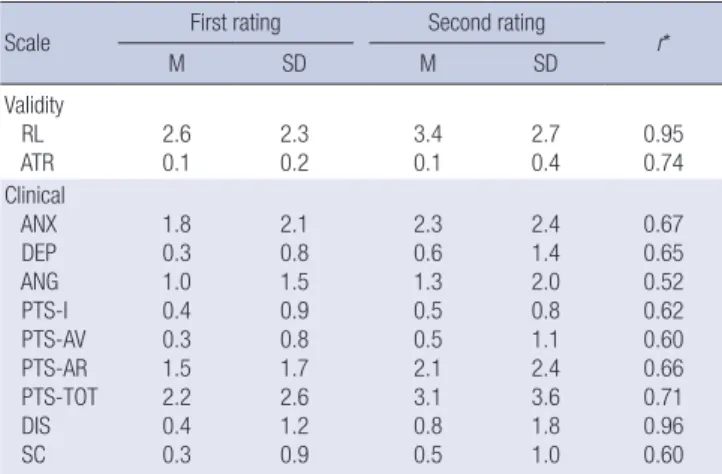
Table 3. Reliability of the TSCYC scales by test-retest after 4 weeks (n = 88)
Scale First rating Second rating
M SD M SD r*
Validity RL ATR
2.6 0.1
2.3 0.2
3.4 0.1
2.7 0.4
0.95 0.74 Clinical
ANX DEP ANG PTS-I PTS-AV PTS-AR PTS-TOT DIS SC
1.8 0.3 1.0 0.4 0.3 1.5 2.2 0.4 0.3
2.1 0.8 1.5 0.9 0.8 1.7 2.6 1.2 0.9
2.3 0.6 1.3 0.5 0.5 2.1 3.1 0.8 0.5
2.4 1.4 2.0 0.8 1.1 2.4 3.6 1.8 1.0
0.67 0.65 0.52 0.62 0.60 0.66 0.71 0.96 0.60 Pearson correlations for all are significant at the 2-tailed P < 0.001 level. *r, Pearson correlation. TSCYC, the trauma symptom checklist for young children; M, mean; SD, standard deviation; RL, response level; ATR, atypical response; ANX, anxiety; DEP, de- pression; ANG, anger/aggression; PTS-I, post-traumatic stress-intrusion; PTS-AV, post- traumatic stress-avoidance; PTS-AR, post-traumatic stress-arousal; PTS-TOT, post- traumatic stress-total; DIS, dissociation; SC, sexual concerns.
Table 4. Intercorrelations among the TSCYC scales in the traumatized group with child sexual abuse
Scales Validity scale Clinical scale
RL ATR ANX DEP ANG PTS-I PTS-AV PTS-AR PTS-TOT DIS SC
Validity scale RL
ATR -
0.36 -
Clinical scale† ANX DEP ANG PTS-I PTS-AV PTS-AR PTS-TOT DIS SC
-0.66 -0.61 -0.53 -0.47 -0.54 -0.71 -0.64 -0.47 -0.48
0.34 0.47 0.29 0.23 0.28 0.48 0.35 0.35 0.39
- 0.68 0.47 0.76 0.69 0.76 0.77 0.42 0.58
- 0.59 0.67 0.56 0.75 0.69 0.64 0.69
- 0.39 0.44 0.66 0.59 0.39 0.37
- 0.76 0.65 0.85 0.38 0.64
- 0.66 0.90 0.36 0.57
- 0.83 0.58 0.61
- 0.45
0.66 -
0.49 -
Pearson correlations for all are significant at the 2-tailed P < 0.001 level. TSCYC, the trauma symptom checklist for young children; M, mean; SD, standard deviation; RL, re- sponse level; ATR, atypical response; ANX, anxiety; DEP, depression; ANG, anger/aggression; PTS-I, post-traumatic stress-intrusion; PTS-AV, post-traumatic stress-avoidance;
PTS-AR, post-traumatic stress-arousal; PTS-TOT, post-traumatic stress-total; DIS, dissociation; SC, sexual concerns.
Ethics statement
The institutional review board of Kyungpook National Universi- ty Hospital reviewed and permitted the study (2012-09-007).
RESULTS Reliability Internal consistency
The internal consistency for the total scale was 0.92 for the nor- mative and 0.96 for the clinical group. The Cronbach’s alpha for the clinical scales varied between 0.82 (DIS) and 0.46 (PTS-I) in the normative group, and between 0.90 (DIS) and 0.77 (PTS-I) in the traumatized group (Table 2).
Test-retest reliability
Test-retest reliability (N = 88) was determined as follows for the indicated scales (ANX r = 0.67, DEP r = 0.65, Anger r [ANG] = 0.52, PTS-I r = 0.62, PTS-AV r = 0.60, PTS-AR r = 0.66, DIS r = 0.96, and SC r = 0.60). RL was r = 0.95, and ATR was r = 0.74 (Table 3).
Validity
Scale intercorrelations
The TSCYC clinical scale intercorrelations in the normative group ranged from 0.36 (for the DIS scale with PTS-AV scale) to 0.90 (PTS-AV with Posttraumatic-Total). As expected, the RL scale was negatively correlated with all scales, ranging from -0.36 with the ATR scale to -0.66 with the ANX scale. The correlations be- tween all the subscales are presented in Table 4.
Concurrent validity
In the normative group, 299 caretakers also had completed the CBCL and the CSBI. All correlations were statistically significant among the TSCYC 11 subscales, the CBCL Anxious/Depressed, the CBCL Aggressive behavior and the CSBI Total (P < 0.001).
The TSCYC ANX (r = 0.54) and DEP (r = 0.49) scales were most related to the CBCL Anxiety/Depression scale. The TSCYC An- ger/ANG (r = 0.53) scale was most correlated with the CBCL Aggressive behavior scale. The TSCYC SC scale was most relat- ed to the CSBI Total among CBCL Anxious/Depressed (r = 0.23), CBCL Aggressive behavior (r = 0.23) and CSBI Total (r = 0.25).
However, the correlation was low and the TSCYC DEP (r = 0.36) and DIS (r = 0.36) were most related to the CSBI Total. The Pear- son’s correlations are shown in Table 5.
Differences between the normative group and the sexually traumatized group
As shown in Table 6, there were significant differences between the normative and the traumatized group on all of the clinical subscales. In normative group, the 8 clinical scale and 2 validity scales did not differ significantly by either age or sex.
DISCUSSION
This study shows that the TSCYC can be translated and used outside English speaking societies, while still keeping its psy- chometric properties. This is the first study using the TSCYC in Korean population.
The psychometric properties of the Korean translation of the TSCYC seem to be good. In our study, concerning internal con- sistency, coefficient alpha for mean clinical scales were 0.92 and 0.96 each for the normative group and the traumatized group with child sexual abuse. Original author, Briere reported coeffi- cient alpha for mean clinical scales was 0.86 for the standard- ization sample (N = 750) and 0.87 for the validation sample (N
= 213) (13). Nilsson et al reported coefficient alpha of the Swed- ish version of the TSCYC for mean clinical scales were 0.93 and 0.96 each for the normative group and the traumatized group (22). In Swedish sample, 59 children in traumatized group had experienced sexual abuse and/or physical abuse, while some had also witnessed violence in their home (22). The internal con- sistency of the Korean version of the TSCYC was higher than re- sults by the original author and similar to the Swedish version (22). Moreover, the internal consistency in our traumatized group was higher than normative group in all clinical scales and in Re- sponse Level validity scale. For clinical scales, the coefficients alpha of in normative group was ranged from 0.57 to 0.90 in our study and from 0.55 to 0.88 in the Swedish sample (22). In the traumatized group, it was ranged from 0.77 to 0.96 in our study and 0.77 to 0.93 in the Swedish sample, which was very similar to our results (22). In validation sample in Briere’s study, the co- efficients alpha was ranged from 0.86 to 0.93 (13).
Among validity scales, coefficient alpha for the ATR scales was low, 0.57 for the normative group and 0.35 for the trauma- tized group. In Briere study, coefficient alpha for the ATR scale also was low, 0.36 for the traumatized sample (N = 213) and 0.46 for the Gilbert sample (N = 433) (13, 17). In the Swedish sample, it was 0.36 for the normative group (N = 629) and 0.12, very low for the traumatized group (N = 59) (22). In our study, coefficient alpha for the ATR scales was similar to the original validation study and much better than the Swedish sample. Aty- pical responding rarely reflects an underlying latent construct, but rather shows a tendency to respond to items that otherwise Table 5. Association between TSCYC and CBCL as well as CSBI in the normative group
Validity scales Clinical scales
RL ATR ANX DEP ANG PTS-I PTS-AV PTS-AR PTS-TOT DIS SC
CBCL anxious/depressed 0.41 0.16 0.54 0.49 0.31 0.43 0.32 0.45 0.49 0.44 0.23
CBCL aggressive behavior 0.62 0.14 0.48 0.36 0.53 0.30 0.31 0.54 0.51 0.34 0.20
CSBI total 0.32 0.41 0.17 0.36 0.23 0.30 0.20 0.24 0.29 0.36 0.25
Correlation is significant at the P < 0.01 level (2-tailed) for all. RL, response level; ATR, atypical response; ANX, anxiety; DEP, depression; ANG, anger/aggression; PTS-I, post- traumatic stress-intrusion; PTS-AV, post-traumatic stress-avoidance; PTS-AR, post-traumatic stress-arousal; PTS-TOT, post-traumatic stress-total; DIS, dissociation; SC, sexual concerns; CBCL, the child behavior checklist; CSBI, the child sexual behavior inventory.
Table 6. Differences between the normative group and the traumatized group with child sexual abuse
TSCYC scale
Normative group
N = 299 Traumatized group
N = 73 t
M SD M SD
Validity RL
ATR 2.4
0.1 2.1
0.3 5.4
9.4 2.7
1.1 8.6
73.6 Clinical
ANX DEP ANG PTS-I PTS-AV PTS-AR DIS SC
1.6 0.3 1.0 0.3 0.4 1.3 0.3 0.2
2.0 0.8 1.6 0.8 0.9 2.1 1.1 0.7
13.5 11.6 11.4 12.2 14.8 14.1 10.9 10.9
4.4 3.5 3.7 3.6 5.0 4.5 3.6 3.2
22.6 27.4 23.5 27.5 24.6 23.6 24.6 28.1 P value < 0.001 for all. N, number; M, mean; SD, standard deviation; RL, response level; ATR, atypical response; ANX, anxiety; DEP, depression; ANG, anger/aggression;
PTS-I, post-traumatic stress-intrusion; PTS-AV, post-traumatic stress-avoidance; PTS- AR, post-traumatic stress-arousal; PTS-TOT, post-traumatic stress-total; DIS, dissoci- ation; SC, sexual concerns; TSCYC, the trauma symptom checklist for young children.
have a low base-rate of acknowledgment. As results, coefficient alpha of infrequently acknowledged items are typically low due to a limitation in score range (13). In general, the internal con- sistency of the Korean version of the TSCYC was satisfactory in both the normative and traumatized group.
In our study of the test-retest reliability, correlations were rang- ed from 0.52 to 0.96 (N = 88), while they were from 0.68 to 0.96 in Briere’s study (N = 33) (13). In the Swedish sample, correla- tions were ranged from 0.56 to 0.95 (N = 26) (22). In Swedish study, retest had been done after 2 weeks and in our study it had been done in 4 weeks. Although the coefficient for the ATR scales was noncalculable because all respondents scored “9”
on the second occasion in Swedish test-retest sample, it was r = 0.74 in our study. The coefficient for the RL validity scale was r = 0.79 in Swedish sample, and better, r = 0.95 in our study. The test-retest reliability of Korean version of the TSCYC was found to be compatible with the original scale and the Swedish version.
Two validity scales, the Response Level scale and the Atypical Response scale, are unique strength of the TSCYC and coeffi- cient alpha and test-retest correlation in two validity scales were better in our study, which meant that Korean version of the TS- CYC were reliable.
When compared with the comparable scale of the CBCL, con- current validity of the depression (r = 0.49) and anxiety scale (r = 0.53) was moderately correlated. Although SC scale was also significantly correlated with the scores of the CSBI, associ- ation was very mild (r = 0.25). In previous study, association was ranging from 0.55 to 0.82 with three parent/caretaker-re- port measures such as the CBCL, the CSBI and the Child Disso- ciative Checklist (13, 17).
There were significant differences between the normative group and the traumatized group on the total scale and all the clinical scales. In Briere’s study, means and standard deviations in 8 clinical scales were between 9.8 ± 2.4 for sexual concern and 13.6 ± 4.2 for PTS-AR in trau matized group (N = 317). In our study, they were similar between 10.9 ± 3.2 for SC and 14.8
± 5.0 for PTS-AV in traumatized group (N = 73). However, means and standard deviations in 8 clinical scales were much lower between 0.2 ± 0.7 and 1.6 ± 2.0 in normative group (N = 299 ) in our study than between 9.3 ± 1.1 and 11.8 ± 3.3 in normative group (N = 433 ) in Briere’s study. Because of stigma for men- tally ill patients, Korea was the one of the countries showing re- sponse bias toward giving the most socially desirable answer and lower means at clinical measures (11, 23). In spite of social- ly desirable manner among Korean, similar means in trauma- tized group in both study support good discriminant validity of the Korean version of the TSCYC. These findings gave support for this scale of the TSCYC as valid.
Symptoms of posttraumatic stress disorder (PTSD) are com- mon sequelae of child sexual abuse. There are several obstacles to the assessment of long term mental health effects of child
sexual abuse. Child victims may deny that the abuse event oc- curred, may be too ashamed about the event to report its im- pact, and may have difficulty with direct questioning. Therefore, the parents’ reports of symptoms are critical in the assessment of PTSD. Many children in our traumatized group had PTSD symptoms and higher PTSD scale scores compared with nor- mative group. For these reasons, the TSCYC may be used as an econo mical and time-efficient screening device for PTSD in traumatized children, especially sexually abused group (24-26).
Although Briere has made divisions with ages 3-4, 5-9 and 10-12 and revealed main effects of child gender, there had been no significantly difference between sex and ages in normative group in our study (12). Small sample size in younger age and relatively very low means in normative group could be the cause of no difference between sex and age.
Our study has some limitations. The study sample is not a representative national sample since the other cities in Korea did not take part in the study. One major limitation of this study is that no other measure of PTSD was administered. Also, the traumatized group in our study was mostly sexually abused chil- dren coming from one Sunflower Center for evaluation and treat- ment. When viewed from perspective from the TSCYC original intent, the traumatized group also included accident and wit- nessed domestic violence. In the future direction, we need Ko- rean national norms, raw score to T-Score and percentile con- version according to age and sex with large representative na- tional sample. Considering that post-traumatic stress, dissocia- tion, and sexual concerns support the construct validity of the TSCYC, it is recommended to correlate the TSCYC with other PTSD scale, dissociative scale for children and specific sexual concern items in the CSBI (2, 13, 27-31). The lack of information on the traumatic events using other traumatic events scales in normative group was also considered to be a limitation.
For the child younger than 8 yr old or for the child with limit- ed cognitive development, the TSCYC should be used and de- pendent on the caretaker’s report. However, the parents who suffer from post-traumatic symptoms or depressive symptoms have limited ability to report their own children’s symptom. The usage of the TSCYC has better accompany the evaluation of parents.
Nevertheless, our study is meaningful (considered discrimi- nant validity) in its potential use with children too young to re- port on their own internal state of symptomatology and diag- nostic tool for screening PTSD with child sexual abuse. The Ko- rean TSCYC can be applied for younger children with insuffi- cient cognitive development, or lack the reading comprehen- sion necessary to respond to written test items.
DISCLOSURE
The authors have no conflicts of interest to disclose.
AUTHOR CONTRIBUTION
Study design: Chung US. Sampling and data collection: Chung US, Bae JD. Data analysis: Bae JD, Lee JJ. Writing: Bae JD, Chung US, Jeong JH, Lee JJ. Revision: Chung US. Agreement and sub- mission of final manuscript: all authors.
ORCID
Jong Duk Bae http://orcid.org/0000-0002-4566-9651 Jung Jae Lee http://orcid.org/0000-0002-0828-3557 Jae Hoon Jeong http://orcid.org/0000-0003-2543-3307 Un-Sun Chung http://orcid.org/0000-0003-3871-1425 REFERENCES
1. Perrin S, Smith P, Yule W. The assessment and treatment of Post-trau- matic Stress Disorder in children and adolescents. J Child Psychol Psy- chiatry 2000; 41: 277-89.
2. Fergusson DM, Horwood LJ, Lynskey MT. Childhood sexual abuse and psychiatric disorder in young adulthood: II. psychiatric outcomes of child- hood sexual abuse. J Am Acad Child Adolesc Psychiatry 1996; 35: 1365- 74.
3. Flannery DJ, Singer MI, Wester K. Violence exposure, psychological trau- ma, and suicide risk in a community sample of dangerously violent ado- lescents. J Am Acad Child Adolesc Psychiatry 2001; 40: 435-42.
4. Guterman NB, Cameron M, Hahm HC. Community violence exposure and associated behavior problems among children and adolescents in residential treatment. J Aggress Maltreat Trauma 2003; 6: 111-35.
5. Johnson JG, Cohen P, Gould MS, Kasen S, Brown J, Brook JS. Childhood adversities, interpersonal difficulties, and risk for suicide attempts dur- ing late adolescence and early adulthood. Arch Gen Psychiatry 2002; 59:
741-9.
6. Korea Support Center for Women and Children Victims of Violence.
Available at http://www.womannchild.or.kr/sub03_1.asp [accessed on February 28 2015].
7. Strand VC, Sarmiento TL, Pasquale LE. Assessment and screening tools for trauma in children and adolescents: a review. Trauma Violence Abuse 2005; 6: 55-78.
8. Blake DD, Weathers FW, Nagy LM, Kaloupek DG, Gusman FD, Char- ney DS, Keane TM. The development of a Clinician-Administered PTSD Scale. J Trauma Stress 1995; 8: 75-90.
9. Oh EA, Park EJ, Lee SH, Bae SM. Validation of the Korean Version of the Children’s Revised Impact of Event Scale. Clin Psychopharmacol Neuro- sci 2014; 12: 149-56.
10. Horowitz M, Wilner N, Alvarez W. Impact of Event Scale: a measure of subjective stress. Psychosom Med 1979; 41: 209-18.
11. Seo HJ, Chung SK, Lim HK, Chee IS, Lee KU, Paik KC, Kim D, Lee SY, Ryu SH, Kim JB, et al.; Disaster Psychiatry Committee, Korean Acade- my of Anxiety Disorders. Reliability and validity of the Korean version of the Davidson Trauma Scale. Compr Psychiatry 2008; 49: 313-8.
12. Briere J, Johnson K, Bissada A, Damon L, Crouch J, Gil E, Hanson R,
Ernst V. The Trauma Symptom Checklist for Young Children (TSCYC):
reliability and association with abuse exposure in a multi-site study. Child Abuse Negl 2001; 25: 1001-14.
13. Briere J. Trauma symptom checklist for young children (TSCYC): profes- sional manual. Lutz, FL: Psychological Assessment Resources, 2005.
14. Briere J, Psychological Assessment Resources. Trauma symptom check- list for children (TSCC). Lutz, FL: Psychological Assessment Resources, 1996.
15. Chung US. The Korean version of the trauma symptom checklist for chil- dren: psychometric properties and the connection to trauma among Ko- rean children and adolescents. J Korean Med Sci 2014; 29: 837-45.
16. Achenbach TM. Manual for the child behavior checklist/4-18 and 1991 profile. Burlington, VT: Dept. of Psychiatry, University of Vermont, 1991.
17. Gilbert AM. Psychometric properties of the Trauma Symptom Checklists for Young Children (TSCYC). San Diego, US: California School of Pro- fessional Psychology, Alliant University, 2004. 478 p. Dissertation.
18. Friedrich WN. Child sexual behavior inventory: professional manual.
Odessa, FL: Psychological Assessment Resources, 1997.
19. Drach KM, Wientzen J, Ricci LR. The diagnostic utility of sexual behav- ior problems in diagnosing sexual abuse in a forensic child abuse evalu- ation clinic. Child Abuse Negl 2001; 25: 489-503.
20. Jin Y, Chung US, Jeong SH, Lee WK. The reliability and validity of the Korean version of the child sexual behavior inventory. Psychiatry Inves- tig 2013; 10: 336-45.
21. Nunnally JC, Bernstein IH. Psychometric theory. New York: McGraw- Hill, 1994.
22. Nilsson D, Gustafsson PE, Svedin CG. The psychometric properties of the Trauma Symptom Checklist for Young Children in a sample of Swed- ish children. Eur J Psychotraumatol 2012; 3.
23. Shin JU, Jeong SH, Chung US. The Korean Version of the Adolescent Dis- sociative Experience Scale: Psychometric Properties and the Connection to Trauma among Korean Adolescents. Psychiatry Investig 2009; 6: 163- 72.
24. Wyatt GE, Loeb TB, Solis B, Carmona JV. The prevalence and circum- stances of child sexual abuse: changes across a decade. Child Abuse Negl 1999; 23: 45-60.
25. Shapiro S, Dominiak G. Common psychological defenses seen in the treat- ment of sexually abused adolescents. Am J Psychother 1990; 44: 68-74.
26. Pollio ES, Glover-Orr LE, Wherry JN. Assessing posttraumatic stress dis- order using the trauma symptom checklist for young children. J Child Sex Abus 2008; 17: 89-100.
27. McLeer SV, Dixon JF, Henry D, Ruggiero K, Escovitz K, Niedda T, Scholle R. Psychopathology in non-clinically referred sexually abused children. J Am Acad Child Adolesc Psychiatry 1998; 37: 1326-33.
28. Margolin G, Gordis EB. The effects of family and community violence on children. Annu Rev Psychol 2000; 51: 445-79.
29. Lanktree C, Briere J, Zaidi L. Incidence and impact of sexual abuse in a child outpatient sample: the role of direct inquiry. Child Abuse Negl 1991;
15: 447-53.
30. Friedrich WN. Assessing children for the effects of sexual victimization.
New Directions for Mental Health Services: Wiley Subscription Services, Inc., Wiley Company, 1994, p.17-27.
31. Elliott DM, Briere J. Forensic sexual abuse evaluations of older children:
disclosures and symptomatology. Behav Sci Law 1994; 12: 261-77.