© 2013 The Korean Academy of Medical Sciences.
This is an Open Access article distributed under the terms of the Creative Commons Attribution Non-Commercial License (http://creativecommons.org/licenses/by-nc/3.0) which permits unrestricted non-commercial use, distribution, and reproduction in any medium, provided the original work is properly cited.
pISSN 1011-8934 eISSN 1598-6357
The Effects of Antihypertensive Drugs on Bone Mineral Density in Ovariectomized Mice
The effects of several antihypertensive drugs on bone mineral density (BMD) and micro- architectural changes in ovariectomized (OVX) mice were investigated. Eight-week-old female C57/BL6 mice were used for this study. Three days after ovariectomy, mice were treated intraperitoneally with nifedipine (15 mg/kg), telmisartan (5 mg/kg), enalapril (20 mg/kg), propranolol (1 mg/kg) or hydrochlorothiazide (12.5 mg/kg) for 35 consecutive days.
Uterine atrophy of all mice was confirmed to evaluate estrogen deficiency state. BMD and micro-architectural analyses were performed on tibial proximal ends by micro-computed tomography (micro-CT). When OVX mice with uterine atrophy were compared with mice without atrophy, BMD decreased (P < 0.001). There were significant differences in BMD loss between different antihypertensive drugs (P = 0.005). Enalapril and propranolol increased BMD loss in mice with atrophied uteri compared with control mice. By contrast, thiazide increased BMD in mice with uterine atrophy compared with vehicle-treated mice (P = 0.048). Thiazide (P = 0.032) and telmisartan (P = 0.051) reduced bone loss and bone fraction in mice with uterine atrophy compared with the control. Thiazide affects BMD in OVX mice positively. The reduction in bone loss by thiazide and telmisartan suggest that these drugs may benefit menopausal women with hypertension and osteoporosis.
Key Words: Antihypertensive Agents; Osteoporosis; Ovariectomized Mice; Thiazides;
Telmisartan Kwi Young Kang,1,2* Yoongoo Kang,1*
Mirinae Kim,1 Youngkyun Kim,2 Hyoju Yi,2 Juryun Kim,2 Hae-Rin Jung,2 Sung-Hwan Park,1 Ho-Youn Kim,1 Ji Hyeon Ju,1,2 and Yeon Sik Hong1
1Division of Rheumatology, Department of Internal Medicine, The Catholic University of Korea, Seoul;
2Convergent Research Consortium for Immunologic Disease, The Catholic University of Korea, Seoul, Korea
*Kwi Young Kang and Yoongoo Kang contributed equally to this study.
Received: 7 March 2013 Accepted: 21 May 2013 Address for Correspondence:
Yeon Sik Hong, MD
Division of Rheumatology, Department of Internal Medicine, The Catholic University of Korea, Incheon St. Mary’s Hospital, 56 Dongsu-ro, Bupyeong-gu, Incheon 430-720, Korea Tel: +82.32-1544-9004, Fax: +82.32-280-5987 E-mail: [email protected]
This work was supported by the Basic Science Research Program, National Research Foundation (NRF) of Korea, Ministry of Education, Science and Technology (2009-0074198); the Korea Healthcare Technology R&D Project, Ministry of Health, Welfare & Family Affairs, Republic of Korea (A092258); and the Basic Science Research Program, NRF, Ministry of Education, Science and Technology (2010-0003446).
http://dx.doi.org/10.3346/jkms.2013.28.8.1139 • J Korean Med Sci 2013; 28: 1139-1144 Immunology, Allergic Disorders & Rheumatology
INTRODUCTION
Osteoporosis is characterized by an increase in bone fragility, resulting in fractures caused by minor trauma or even of a spontaneous nature. The disease is classified clinically as either primary or secondary osteoporosis. Primary osteoporosis is bone loss that occurs in postmenopausal women during nor- mal aging. Postmenopausal osteoporosis, the most common form of the disease, commences when estrogen production de- creases (1). Approximately forty percent of women over 50 years of age will suffer a fracture related to postmenopausal os- teoporosis during their lifetime (2).
The prevalence of hypertension also increases markedly with aging, suggesting that hypertension and osteoporosis coexist.
Because antihypertensive drugs are widely used for the treat- ment of hypertension, it is important to understand the effects of these drugs on bone. Antihypertensive drugs impact osteo- porosis directly and indirectly by affecting bone metabolism,
strength and density (3). Meta- and epidemiological analyses of national databases illustrate an association between antihyper- tensive drugs and bone function (4-7). A reduced fracture risk has been reported with thizide diuretics (5, 6), whereas conflict- ing results have been reported in other antihypertensive drugs (4-7).
There are few studies on the effects of antihypertensive drugs on bone function in animal models of postmenopausal osteo- porosis. Ovariectomized (OVX) mice represent an animal model that mimics postmenopausal osteoporosis in humans.
We used this model to investigate whether antihypertensive drugs affect bone density and cause micro-architectural chang- es that associate with estrogen deficiency.
MATERIALS AND METHODS Animals and drug treatment
Forty eight 8-week-old female C57/BL6 mice weighing 18-20 g
1140 http://jkms.org http://dx.doi.org/10.3346/jkms.2013.28.8.1139 were purchased from Orient Bio (Seongnam, Korea). C57/BL6
mice were anesthetized by inhalation of 2% isoflurane. Bilateral ovariectomy was performed, and mice were sacrificed 5 weeks after surgery by an overdose of anesthetics. Uterine atrophy confirmed estrogen deficiency. Three days after ovariectomy, mice were treated intraperitoneally with different antihyper- tensive drugs for 35 consecutive days. Mice were randomly di- vided into 6 groups (n = 8 for each group) as follows: group 1, control (vehicle-treated); group 2, nifedipine (15 mg/kg body weight [b.w.]); group 3, telmisartan (5 mg/kg b.w.); group 4, enalapril (20 mg/kg b.w.); group 5, propranolol (1 mg/kg b.w.);
and group 6, hydrochlorothiazide (12.5 mg/kg b.w.). Mice were housed in standard cages (4 mice per cage), and maintained at 22°C ± 5°C with constant humidity 50% ± 10% and a 12 hr light:
12 hr dark cycle. Animals had free access to autoclaved water and pellet diet. This experiment was conducted in accordance with institutional guidelines.
Reagents
Nifedipine, enalapril maleate, telmisartan, propranolol and hy- drochlorothiazide were purchased from Sigma-Aldrich (St.
Louis, MO, USA). All drugs were dissolved in dimethyl sulfoxide (DMSO).
Bone mineral density and morphometry measurements Bone mineral density (BMD) and morphometric analyses were performed on fixed proximal tibias by micro-computed tomog- raphy (micro-CT) using a SkyScan 1172 (SkyScan, Aartselaar, Belgium). BMD (mg/cm3) was measured 0.3-0.8 mm distal to the growth plate of tibial proximal ends and analyzed in 77 con- tinuous sections. Samples were fixed in 3.7% formaldehyde (w/
v) for approximately 24 hr, and scanned at 141 A/70 kVp for 590 ms through a 0.5 mm-thick filter. Description and nomencla- tures followed guidelines for the assessment of bone micro- structure with micro-CT analysis (8). To set the trabecular bone region range consistently across samples, data from each sam-
ple were resampled with CTAn software (SkyScan) after recon- structing scanned images with SkyScan reconstruction pro- gram NRecon software. Morphometric parameters, including total volume (TV, μL), bone volume (BV, μL), bone volume frac- tion (BV/TV, %), trabecular thickness (Tb. Th, µm), trabecular number (Tb. N/mm) and connectivity density (Conn D/μL) were measured with CTAn software. Morphometric quantifica- tion was determined 0.3-0.8 mm distal to the growth plate of tibial proximal ends.
Statistical analyses
Statistical analyses were performed using SPSS software (ver- sion 18.0). Data are presented as mean values with standard deviation (SD). The effects of different antihypertensive drugs on BMD were analyzed by one-way analysis of variance (ANO- VA), followed by Dunnett’s test (post hoc analysis). Differences between two groups were analyzed by the independent t-test or Mann-Whitney test (two-tailed) as appropriate. Correlations between parameters are presented as Spearman’s correlation coefficient (r). P values of < 0.05 were considered significant.
RESULTS
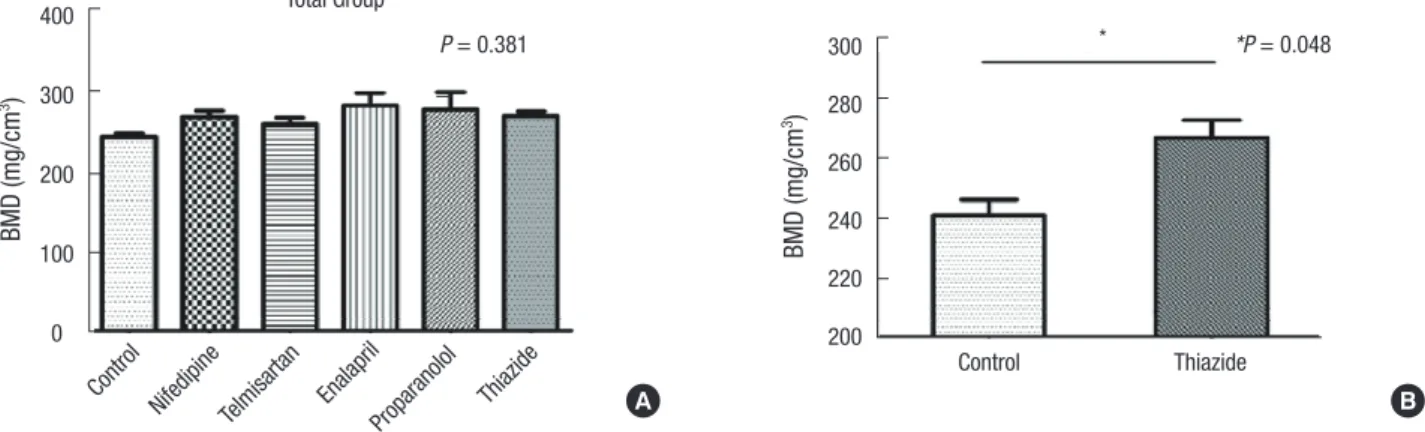
To study the effects of antihypertensive drugs on BMD in post- menopausal women, we used an ovariectomy mouse model of estrogen deficiency. Five weeks after bilateral ovariectomy, BMD was measured in tibial proximal ends of OVX mice (Fig.
1A). Except for thiazide, which significantly increased BMD (P = 0.048), there were no significant differences in BMD in drug-treated OVX mice compared with vehicle-treated OVX mice (Fig. 1B).
To investigate differences in BMD based on the severity of estrogen deficiency, OVX mice were divided into two sub- groups, those with normal uteri and those with atrophied uteri, since uterine atrophy in OVX mice associates with the degree of estrogen deficiency (9). When OVX mice with normal uteri
Fig. 1. The effects of antihypertensive drugs on BMD in OVX mice. (A) Comparison of BMD by
multiple comparison. (B) Comparison of BMD in thiazide-treated mice versus control mice. Data represent means ± SE. Each group consisted of n=8.
Fig. 1. The effects of antihypertensive drugs on BMD in OVX mice. (A) Comparison of BMD by
multiple comparison. (B) Comparison of BMD in thiazide-treated mice versus control mice. Data represent means ± SE. Each group consisted of n=8.
A B
Fig. 1. The effects of antihypertensive drugs on BMD in OVX mice. (A) Comparison of BMD by multiple comparison. (B) Comparison of BMD in thiazide-treated mice vs control mice. Data represent means ± SE. Each group consisted of n = 8.
BMD (mg/cm3)
Control
Nifedipine Telmisartan Enala pril
Proparanolol Thiazide 400
300
200
100
0
Total Group
P = 0.381
BMD (mg/cm3)
Control Thiazide
300 280 260 240 220 200
*P = 0.048
*
http://jkms.org 1141
http://dx.doi.org/10.3346/jkms.2013.28.8.1139
Fig. 3. The effects of antihypertensive drugs on bone in OVX mice. (A) A micro-CT three-dimensional image of the trabecular architecture of a tibial proximal end from a control mouse and thiazide treated mice with normal uterine size or uterine atrophy.
(B) Bone fraction of tibial proximal ends from OVX mice analyzed by micro-CT. (C) Dif- ferences in bone fraction based on uterine atrophy. Data represent medians with in- ter-quartile, minimum and maximum. BV, bone volume; TV, total volume.
A
C
B Control
Thiazide
Normal uterus size Uterine atrophy
Fig. 2. Comparison of BMD based on uterine atrophy. (A) BMD in mice with uterine atrophy (n=28) vs mice without uterine atrophy (n=16). (B) Differences in BMD based on uterine atrophy. BMD difference is the mean BMD of mice with atrophied uteri minus the mean BMD of mice with normal uteri. BMD in mice treated with telmisartan (C) or thia- zide (D) vs vehicle-treated mice. Data represent medians with inter-quartile, minimum and maximum.
Fig. 3. The effects of antihypertensive drugs on bone in OVX mice. (A) A micro-CT three- dimensional image of the trabecular architecture of a tibial proximal end from a control mouse and thiazide treated mice with normal uterine size or uterine atrophy. (B) Bone fraction of tibial proximal ends from OVX mice analyzed by micro-CT. (C) Differences in bone fraction based on uterine atrophy. Data represent medians with inter-quartile, minimum and maximum.
BV, bone volume; TV, total volume
Fig. 3. The effects of antihypertensive drugs on bone in OVX mice. (A) A micro-CT three- dimensional image of the trabecular architecture of a tibial proximal end from a control mouse and thiazide treated mice with normal uterine size or uterine atrophy. (B) Bone fraction of tibial proximal ends from OVX mice analyzed by micro-CT. (C) Differences in bone fraction based on uterine atrophy. Data represent medians with inter-quartile, minimum and maximum.
BV, bone volume; TV, total volume
Fig. 2. Comparison of BMD based on uterine atrophy. (A) BMD in mice with uterine atrophy (n=28) versus mice without uterine atrophy (n=16). (B) Differences in BMD based on uterine atrophy. BMD difference is the mean BMD of mice with atrophied uteri minus the mean BMD of mice with normal uteri. BMD in mice treated with telmisartan (C) or thiazide (D) versus vehicle-treated mice. Data represent medians with inter-quartile, minimum and maximum.
Fig. 2. Comparison of BMD based on uterine atrophy. (A) BMD in mice with uterine atrophy (n=28) versus mice without uterine atrophy (n=16). (B) Differences in BMD based on uterine atrophy. BMD difference is the mean BMD of mice with atrophied uteri minus the mean BMD of mice with normal uteri. BMD in mice treated with telmisartan (C) or thiazide (D) versus vehicle-treated mice. Data represent medians with inter-quartile, minimum and maximum.
A
C
B
D
*
* BMD (mg/cm3)
Atrophy Normal
Size of uterus 400
350
300
250
200
*P < 0.001
Difference of BMD (mg/cm3)
Control Telmisartan
0
-20
-40
-60
-80
*P < 0.051
Fig. 2. Comparison of BMD based on uterine atrophy. (A) BMD in mice with uterine atrophy (n=28) versus mice without uterine atrophy (n=16). (B) Differences in BMD based on uterine atrophy. BMD difference is the mean BMD of mice with atrophied uteri minus the mean BMD of mice with normal uteri. BMD in mice treated with telmisartan (C) or thiazide (D) versus vehicle-treated mice. Data represent medians with inter-quartile, minimum and maximum.
Fig. 2. Comparison of BMD based on uterine atrophy. (A) BMD in mice with uterine atrophy (n=28) versus mice without uterine atrophy (n=16). (B) Differences in BMD based on uterine atrophy. BMD difference is the mean BMD of mice with atrophied uteri minus the mean BMD of mice with normal uteri. BMD in mice treated with telmisartan (C) or thiazide (D) versus vehicle-treated mice. Data represent medians with inter-quartile, minimum and maximum.
*
Difference of BMD (mg/cm3)
Control
Nifedipine Telmisartan Enala pril
Proparanolol Thiazide 0
-50
-100
-150
*Significance in post hoc analysis
P = 0.005
Difference of BMD (mg/cm3)
Control Thiazide
0
-20
-40
-60
-80
*P = 0.038
*
BV/TV (%)
Control
Nifedipine Telmisartan Enala pril
Proparanolol Thiazide 40
30
20
10
0
P = 0.252 Bone fraction
Difference of BV/TV (%)
Control
Nifedipine Telmisartan Enala pril
Proparanolol Thiazide 5
0
-5
-10
-15
*P = 0.006 Bone fraction reduction by uterine atrophy
1142 http://jkms.org http://dx.doi.org/10.3346/jkms.2013.28.8.1139 were compared with mice with atrophied uteri, BMD decreased
significantly (P < 0.001, Fig. 2A). The mean BMD loss in the at- rophied uterine group was -21 ± 7 mg/cm3.
The effects of antihypertensive drugs on BMD loss induced by severe estrogen deficiency were assessed by calculating the BMD difference, which is the mean BMD of mice with atrophied uteri minus the mean BMD of mice with normal uteri. This dif- ference reflected bone loss affected by severe estrogen deficien- cy. BMD loss in each group was as follows: control, -45 ± 15 mg/
cm3; nifedipine, -34 ± 6 mg/cm3; telmisartan, -32 ± 21 mg/cm3; enalapril, -73 ± 7 mg/cm3; propranolol, -93 ± 25 mg/cm3; and thiazide, -26 ± 10 mg/cm3. When BMD was compared across all groups, there was a significant difference in multiple compari- son (P = 0.005, Fig. 2B). By post hoc analysis, enalapril and pro- pranolol increased BMD loss in mice with atrophied uteri com- pared with control mice. By two group analysis (i.e., vehicle- treated versus antihypertensive drug-treated), telmisartan af- fected bone loss moderately (Fig. 2C); however, thiazide signifi- cantly reduced bone loss by severe estrogen deficiency (P = 0.038, Fig. 2D).
Bone volume (BV) and trabecular thickness decreased in mice with uterine atrophy by micro-CT; however, BV and tra- becular thickness increased in thiazide-treated mice with uter- ine atrophy compared with control mice (Fig. 3A). In OVX mice, BMD correlated with BV, bone fraction, trabecular number and trabecular thickness (Table 1). While there was no correlation between BMB and trabecular thickness in mice with normal uteri, an association was evident in mice with atrophied uteri (r = 0.503, P = 0.012). BMD associated most significantly with bone fraction (r = 0.971, P < 0.001).
Following multiple comparison of micro-CT parameters, only BV showed a significant difference between groups (P = 0.044).
No significant differences in bone fraction were observed (P = 0.252, Fig. 3B); however, bone fraction decreased in mice with atrophied uteri treated with nifedipine, telmisartan and thiazide (Fig. 3C). Enalapril and propranolol increased bone fraction in mice with atrophied uteri compared with normal mice (P = 0.006).
DISCUSSION
In the present study, we investigated the effects of antihyperten- sive drugs on BMD and bone morphometry in an animal model
of postmenopausal osteoporosis. Our data showed thiazide to decrease bone loss. When data were analyzed by the severity of estrogen deficiency, thiazide and telmisartan reduced bone loss in the severely deficient estrogen group. To our knowledge, this is the first report to investigate the effects of the most commonly prescribed antihypertensive drugs on bone function in OVX mice in a single study, as suggested in the hypertension guide- line (10). Because osteoporosis can coexist with hypertension, the choice of antihypertensive drugs could be influenced by their potential effect on bone and fracture risk, especially in postmenopausal women.
It is uncertain whether antihypertensive drugs affect bone di- rectly or indirectly. Epidemiological studies report certain anti- hypertensive drugs such as thiazide diuretics to lower fracture risk in postmenopausal women, suggesting that antihyperten- sive drugs affect bone positively. For other antihypertensive drugs, the effects on bone are controversial (11). In epidemio- logical studies, thiazide increases BMD in postmenopausal women (12-14), and these results are consistent with our find- ings. Thiazide protects against age-related bone loss and osteo- porotic fractures (6, 15). Cross-sectional and longitudinal obser- vational studies show that thiazide diuretics increased BMD (12, 15); however, randomized controlled studies could not confirm the increase in BMD by thiazide (3, 14, 16). In other studies, thi- azide significantly reduced all types of fractures (6, 12), suggest- ing that thiazide reduces sodium reabsorption and promotes calcium reabsorption. Indeed, normal calcium homeostasis can affect BMD positively (17). Thiazide also acts on bone cells directly by decreasing osteoclast differentiation (18).
The effects of beta-blocker and calcium channel blockers (CCB) on BMD in humans are controversial, with some drugs reducing fracture risk and others not affecting fracture risk (4, 13, 19-21). In OVX mice, propranolol did not reduce BMD loss in femurs (22). The results of this experiment are consistent with the earlier one. In our study, BMD was unaffected by CCB.
In the case of CCB, use of non-dihydropyridine drugs was asso- ciated with a fracture risk reduction than use of dihydropyri- dine drugs (4). Therefore, additional studies are needed to un- derstand the effects of CCB on bone.
Previous studies show bone to be under the influence of the rennin-angiotensin-aldosterone system, with angiotensin II af- fecting bone homeostasis adversely. Inhibition of angiotensin II is beneficial for bone function. Treatment of angiotensin re- Table 1. The relationship between BMD and morphometric parameters obtained by micro-CT
Group TV (μL) BV (μL) BV/TV (%) Tb. N (/mm) Tb. Th (μm)
Total BMD (mg/cm3) -0.227 0.767† 0.971† 0.938† 0.534†
Subgroup‡
Normal BMD (mg/cm3) -0.028 0.629* 0.958† 0.951† 0.545
Atrophy BMD (mg/cm3) 0.258 0.793† 0.920† 0.821† 0.503*
*P < 0.05; †P < 0.01 (ANOVA); ‡Mice were grouped based on uterus size. BMD, bone mineral density; TV, total volume; BV, bone volume; Tb. N, trabecular number; Tb. Th, tra- becular thickness.
http://jkms.org 1143
http://dx.doi.org/10.3346/jkms.2013.28.8.1139
ceptor blocker (ARB), olmesartan, attenuated the ovariectomy- induced decrease in BMD (23). In a recent cohort study, ARB reduced the risk of fracture in elderly women (6). Although an- giotensine converting enzyme (ACE) inhibitor use was reported with higher BMD in elderly women, captopril did not increase BMD in OVX mice (24). Enalapril also did not influence bone metabolism and BMD (25). Our data suggest that ARB plays a protective role in severely deficient estrogen mice but that BMD is unaffected by an ACE inhibitor.
Our results showed that thiazide and telmisartan reduced BMD loss in OVX mice severely deficient in estrogen. These re- sults were consistent with a recent epidemiological study where Solomon et al. reported a reduction in fracture risk by ARB and thiazide in elderly women (6). These findings suggest that ARB and thiazide are beneficial to elderly women with osteoporosis and hypertension. Because of the increasing population of el- derly people with osteoporosis, the need for preventive therapy is a public health priority. Our findings are likely to help health- care professionals prescribe antihypertensive drugs without further affecting bone function, especially in postmenopausal hypertensive women with osteoporosis.
In summary, thiazide positively affects BMD in OVX mice.
Thiazide and telmisartan also reduced bone loss in severely de- ficient estrogen mice. Thiazide and telmisartan may be front- line therapy for hypertensive patients who are at an increased risk for osteoporosis or already have postmenopausal osteopo- rosis. Long-term prospective randomized studies will need to be performed to further assess the effects of antihypertensive drugs on postmenopausal osteoporosis.
DISCLOSURE
All authors state that they have no conflicts of interest.
REFERENCES
1. Riggs BL, Khosla S, Melton LJ 3rd. Sex steroids and the construction and conservation of the adult skeleton. Endocr Rev 2002; 23: 279-302.
2. Melton LJ 3rd, Chrischilles EA, Cooper C, Lane AW, Riggs BL. How many women have osteoporosis? JBMR Anniversary Classic: JBMR, vol- ume 7, number 9, 1992. J Bone Miner Res 2005; 20: 886-92.
3. Ott SM, LaCroix AZ, Scholes D, Ichikawa LE, Wu K. Effects of three years of low-dose thiazides on mineral metabolism in healthy elderly persons.
Osteoporos Int 2008; 19: 1315-22.
4. Rejnmark L, Vestergaard P, Mosekilde L. Treatment with beta-blockers, ACE inhibitors, and calcium-channel blockers is associated with a re- duced fracture risk: a nationwide case-control study. J Hypertens 2006;
24: 581-9.
5. Wiens M, Etminan M, Gill SS, Takkouche B. Effects of antihypertensive drug treatments on fracture outcomes: a meta-analysis of observational studies. J Intern Med 2006; 260: 350-62.
6. Solomon DH, Mogun H, Garneau K, Fischer MA. Risk of fractures in
older adults using antihypertensive medications. J Bone Miner Res 2011;
26: 1561-7.
7. Yang S, Nguyen ND, Center JR, Eisman JA, Nguyen TV. Association be- tween beta-blocker use and fracture risk: the Dubbo Osteoporosis Epide- miology Study. Bone 2011; 48: 451-5.
8. Bouxsein ML, Boyd SK, Christiansen BA, Guldberg RE, Jepsen KJ, Mül- ler R. Guidelines for assessment of bone microstructure in rodents using micro-computed tomography. J Bone Miner Res 2010; 25: 1468-86.
9. Otto C, Kantner I, Nubbemeyer R, Schkoldow J, Fuchs I, Krahl E, Vonk R, Schüler C, Fritzemeier KH, Erben RG. Estradiol release kinetics deter- mine tissue response in ovariectomized rats. Endocrinology 2012; 153:
1725-33.
10. Chobanian AV, Bakris GL, Black HR, Cushman WC, Green LA, Izzo JL Jr, Jones DW, Materson BJ, Oparil S, Wright JT Jr, et al. The seventh re- port of the Joint National Committee on Prevention, Detection, Evalua- tion, and Treatment of High Blood Pressure: the JNC 7 report. JAMA 2003; 289: 2560-72.
11. Ilić K, Obradović N, Vujasinović-Stupar N. The relationship among hy- pertension, antihypertensive medications, and osteoporosis: a narrative review. Calcif Tissue Int 2013; 92: 217-27.
12. Cauley JA, Cummings SR, Seeley DG, Black D, Browner W, Kuller LH, Nevitt MC. Effects of thiazide diuretic therapy on bone mass, fractures, and falls: the Study of Osteoporotic Fractures Research Group. Ann In- tern Med 1993; 118: 666-73.
13. Lynn H, Kwok T, Wong SY, Woo J, Leung PC. Angiotensin converting en- zyme inhibitor use is associated with higher bone mineral density in el- derly Chinese. Bone 2006; 38: 584-8.
14. Bolland MJ, Ames RW, Horne AM, Orr-Walker BJ, Gamble GD, Reid IR.
The effect of treatment with a thiazide diuretic for 4 years on bone densi- ty in normal postmenopausal women. Osteoporos Int 2007; 18: 479-86.
15. LaCroix AZ, Ott SM, Ichikawa L, Scholes D, Barlow WE. Low-dose hy- drochlorothiazide and preservation of bone mineral density in older adults: a randomized, double-blind, placebo-controlled trial. Ann Intern Med 2000; 133: 516-26.
16. Reid IR, Ames RW, Orr-Walker BJ, Clearwater JM, Horne AM, Evans MC, Murray MA, McNeil AR, Gamble GD. Hydrochlorothiazide reduces loss of cortical bone in normal postmenopausal women: a randomized controlled trial. Am J Med 2000; 109: 362-70.
17. Walsh JS, Newman C, Eastell R. Heart drugs that affect bone. Trends En- docrinol Metab 2012; 23: 163-8.
18. Lalande A, Roux S, Denne MA, Stanley ER, Schiavi P, Guez D, De Verne- joul MC. Indapamide, a thiazide-like diuretic, decreases bone resorption in vitro. J Bone Miner Res 2001; 16: 361-70.
19. Pasco JA, Henry MJ, Sanders KM, Kotowicz MA, Seeman E, Nicholson GC; Geelong Osteoporosis Study. Beta-adrenergic blockers reduce the risk of fracture partly by increasing bone mineral density: geelong osteo- porosis Study. J Bone Miner Res 2004; 19: 19-24.
20. Rejnmark L, Vestergaard P, Kassem M, Christoffersen BR, Kolthoff N, Brixen K, Mosekilde L. Fracture risk in perimenopausal women treated with beta-blockers. Calcif Tissue Int 2004; 75: 365-72.
21. Reid IR, Gamble GD, Grey AB, Black DM, Ensrud KE, Browner WS, Bauer DC. Beta-Blocker use, BMD, and fractures in the study of osteopo- rotic fractures. J Bone Miner Res 2005; 20: 613-8.
22. Pierroz DD, Bouxsein ML, Rizzoli R, Ferrari SL. Combined treatment with a beta-blocker and intermittent PTH improves bone mass and mi-
1144 http://jkms.org http://dx.doi.org/10.3346/jkms.2013.28.8.1139 croarchitecture in ovariectomized mice. Bone 2006; 39: 260-7.
23. Shimizu H, Nakagami H, Osako MK, Hanayama R, Kunugiza Y, Kizawa T, Tomita T, Yoshikawa H, Ogihara T, Morishita R. Angiotensin II accel- erates osteoporosis by activating osteoclasts. FASEB J 2008; 22: 2465-75.
24. Liu YY, Yao WM, Wu T, Xu BL, Chen F, Cui L. Captopril improves osteo-
penia in ovariectomized rats and promotes bone formation in osteo- blasts. J Bone Miner Metab 2011; 29: 149-58.
25. Broulík PD, Tesar V, Zima T, Jirsa M. Impact of antihypertensive therapy on the skeleton: effects of enalapril and AT1 receptor antagonist losartan in female rats. Physiol Res 2001; 50: 353-8.