551
©The Korean Society of Food Science and Technology
첨가원료 종류에 따른 전통발효주의 이화학 및 관능특성
김혜련·조성진·이승주·안병학*
한국식품연구원 전통식품연구단
Physicochemical and Sensory Characterization of a Korean Traditional Rice
Wine Prepared from Different Ingredients
Hye-Ryun Kim, Sung-Jin Jo, Seung-Joo Lee, and Byung-Hak Ahn*
Traditional Food Research Division, Korea Food Research Institute
Abstract In order to investigate the effect of different ingredients on the quality of Korean rice wines, 30% of rice were
substituted by malt, corn, potato, soybean, glutinous millet, unpolished rice, glutinous rice, or non-glutinous rice, when rice wines were prepared. Physicochemical and sensory characteristics of the rice wines from the varying ingredients were evaluated. Sample rice wines were analyzed for ethanol, pH, total acid, amino acid, soluble solid, coloring degree, UV absorbance, reducing sugar, organic acids, and free sugars. After fermentation for 16 days, the ethanol contents ranged from 13.28 to 16.23%, while the total acid levels were within the range of 0.27 to 0.32%. The amino acid contents in eight samples ranged from 0.18 to 0.36%, while the soluble solid contents were within the range of 8.35 to 11.1oBx. Among the eight
samples tested, rice wine prepared with malt showed the highest level of coloring degree, UV absorbance, and reducing sugar levels, while rice wine prepared with potato showed the lowest value. Organic acid contents of rice wines prepared with soybean, glutinous rice, and non-glutinous rice showed the highest levels of succinic acid followed by acetic acid, citric acid, malic acid, and pyroglutamic acid. Free sugar contents of all rice wines showed the higher levels of glucose followed by fructose and maltose. Rice wines prepared with unpolished rice and corn showed the same highest overall sensory preference. By descriptive analysis, the overall mean sensory intensities of samples prepared with glutinous rice and non-glutinous rice, showed similar levels of ‘sweetness’, ‘fruitiness’, and ‘freshness of aroma’, while those samples prepared with soybean, glutinous millet, and potato showed stronger intensities of ‘nuruk’, ‘grain aroma’, and ‘yellowness’. Rice wine prepared with
corn showed middle ranges in all sensory attributes tested.
Key words: physicochemical and sensory characterization, rice wine, ingredients, fermentation
서 론 쌀을주원료로하는우리전통주는일반적으로자연상태의곰 팡이, 효모 및세균을이용하여 제조한누룩을발효에 필요한효 소및 미생물원으로 사용하여 곡물위주의 병행복발효 방식으로 양조되었다(1). 이러한전통주는담금후누룩속에있는미생물 의효소작용으로원료성분을분해하여당분, 아미노산, 유기산등 의맛성분과효모, 젖산균에 의한알코올 등의풍미성분을생성 하여전통주의색과함께품질의조화를이루게된다(2). 우리나라 전통주가소비자에게 관심과수요를 끌기 위해서는 품질개선이 우선이며품질개선을 위해서는원료의 선별, 원료의 구성, 원료의 처리방법등과함께 우수균주의탐색, 균주의개 량, 최적의 발효조건설정, 관능개선등이절실히요구된다. 전통주는주로찹쌀이나멥쌀을원료로하고누룩을발효제로 양조하여왔으나 1964년공포된양곡관리법에의해약주와탁주 원료로쌀사용을금지하여소맥분을이용한탁주가제조되었고 그후보리쌀, 옥수수, 고구마 등의원료도 탁주제조에사용되 었다(3-5). 전통주제조에 이용되는곡물원료와 관계된연구로는 찹쌀을원료로한술에서 Eun 등(6)이진양주의찹쌀벼도정도 에관해보고하였고, Kim 등(7)이진양주의발효온도에 관해보 고하였으며 Jung 등(8)이하양주의효모균주에관해보고하였다. 또한차조를원료로한술에서제주좁쌀약주의발효우수균주 에 관한 Kim 등(9,10)의 보고가있을 뿐첨가원료 자체의비교 에관한연구는찾아볼수가없다. 최근에는 약용식물을이용한 여러 가지전통주를 제조하여이화학적 특성 및관능적특성과 기능성을조사한연구가보고되었으며(11-14) 대부분의연구가단 발성 연구로 수행되어 전통주의 다양한 원료곡물과 누룩, 담금 방법등관능적 특성에영향을줄수 있는많은요인들에대한 분석이간과되어 온실정이다. 또한원료곡물을이용한고품질 특산주의 개발은소비 확대를통한 농가의생산 증가로이루어 질것으로기대된다. 따라서본연구에서는우리나라고문헌에나와 있는전통주제 조에 이용된여러가지 원료중사용빈도가 높았던찹쌀, 현미, 차조, 콩, 감자, 옥수수그리고맥아를 이용하여멥쌀을 기본으로 하는전통주에 2단담금시쌀양의 30%(w/w)로첨가원료를달 리하여전통주를제조하고발효후이화학적특성과관능특성을
*Corresponding author: Byung-Hak Ahn, Traditional Food Research Division, Korea Food Research Institute, Seongnam, Gyeonggi-do 463-746, Korea
Tel: 82-31-780-9102 Fax: 82-31-709-9876 E-mail: [email protected]
Received May 22, 2008; revised July 15, 2008; accepted July 21, 2008
비교하여서로다른곡물첨가원료에서 기인하는당, 유기산등
의맛성분과관능적특성의차이를조사하였다.
재료 및 방법
재료
원료멥쌀은철원오대쌀(Cheolwonnonghyup, Cheolwon,
Gang-won-do, Korea), 찹쌀은 치악산 일반계(shinlimnonghyup, Wonju,
Gangwon-do, Korea), 현미는국산현미(National Agricultural
Coop-erative Federation, Seoul, Korea), 차조는 하나 가득 일반계
(National Agricultural Cooperative Federation, Seoul, Korea), 콩 은 강원도 내린천 생콩가루(Kirinnonghyup, Inje, Gangwon-do,
Korea), 감자는 감자가루(Kirinnonghyup), 옥수수는황옥수수가루
(Kirinnonghyup), 맥아는 엿기름가루 쌀보리100%(Buannonghyup,
Sangseo, Buan, Jeollabuk-do, Korea)를 사용하였고, 효모는
Sac-charomyces cerevisiae(Fermivin No.7013, Inra, Narbonne, Servian, France)를 사용하였으며 입국미(SP 60)는 (주)두산(Yongin,
Kyunggi-do, Korea)으로부터냉동된상태로공급받아사용하였고 누룩은 (주)국순당(Seongnam, Kyunggi-do, Korea)의개량누룩(SP
1000)을사용하였다. 전통 발효주 제조 밑술(효모0.02%, 입국미 SP60 0.77%, 물1.08%)을 25oC에서 1 일간배양하고그밑술에 1단담금(입국미 SP60 12.76%, 물 20.57 %)하여 25oC에서 1일간 발효한 후 2단 담금(쌀 25.13%, 누룩 SP1000 0.23%, 물 40.21%)을하였으며 2단담금시쌀양의 30 %(w/w)를원료 엿기름가루, 옥수수가루, 감자가루 그리고생콩가 루는 100oC로끓인물에서호화하여 첨가하였고 차조, 현미, 찹 쌀그리고 멥쌀은 100oC에서 40분간 증자하여첨가해혼합한후 20oC에서 16일간발효하여 전통주를제조하였다. 일반성분 분석
알코올 함량은 시료를 0.45µm syringe filter(Xpertek, Rivonia,
Republic of South Africa)로 여과하여 GC(Hewlett Packard
6890N, Palo Alto, CA, USA)로 분석하였다. Column은
DB-ALC2(30 m length×0.53 mm i.d×2µm film thickness: J & W
Scientific, Folsom, CA, USA)를사용하였고 oven 70oC isothermal,
inlet 200oC, detector FID 250oC 그리고 carrier gas로 helium을
사용하였으며표준물질농도와 peak area로부터표준곡선을작성
하여각각의알코올함량을 산출하였다. 미생물균수측정은채
취된시료를 멸균희석액(0.85% NaCl)으로 10진희석법에 따라 희석한 후 potato dextrose agar(Difco, Detroit, MI, USA)배지에
평판도말하여 25oC에서 72시간 배양한후효모균수를계수하
였다. 당도는 hand refractometer(Atago Pocket Pal-1, Tokyo,
Japan)로측정하여 oBx로표시하였고 pH는 pH meter(Orion Model
EA 940, Boston, MA, USA)를이용하여측정하였으며총산은시 료 10 mL에 phenolphthalein 지시약 2-3방울을가하여표준후탈 산수소칼륨으로표정한 0.1 N NaOH 용액으로 담녹색을 나타낼 때까지의적정 mL수를 succinic acid로나타내었고아미노산은시 료 10 mL을취해 phenolphthalein 지시약 2-3방울을가하여중화 한후, 중성 formalin 용액 5 mL을가하여유리된아미노산을표 준후탄산수소칼륨으로표정한 0.1 N NaOH 용액으로담홍색을 나타낼때까지적정한 mL수를 glycine으로나타내었다(15). 착색 도는 시료를 430 nm에서 흡광도를 측정하여, 흡광도/셀의 두께 (mm)×10에의해, 자외부흡수는 시료를 25배희석하여 280 nm에 서 흡광도를 측정하여, 흡광도/셀의 두께(mm)×10× 희석배수에
의해 산출하였다(16). 색도는색차계(Hunter Lab Color Quest II,
Richmond, VA, USA)를 이용하여 Hunter scale에 의해 L(명도),
a(적색도), b(황색도)값으로 나타내었고 환원당은 dinitrosalicylic
acid method에 따라UV/VIS spectrophotometer(diod-array) HP
8453(Hewlett Packard)을 이용하여 550 nm에서 흡광도를 측정하 고표준물질 glucose(Sigma, St. Louis, MO, USA)를농도별로 제
조하여정량하였다(17).
유리당·유기산 분석
유리당은 시료 1 mL을 Bio-Rex 5 resin(100-200 mesh chloride
form, Bio-Rad, Hercules, CA, USA)에증류수와함께통과시켜당 을 얻은 뒤 0.45µm syringe filter로 여과하여Aminex
HPX-87C(300 mm×7.8 mm, Bio-rad) column을사용하였고 이동상 흐 름속도 0.6 mL/min, column oven 온도 60oC, injection volume
10µL, refractive index detector를사용하여분석하였다(18). 유기산 은시료에서당을제거한뒤 20% sulfuric acid 2 mL에의해유리 된산을증류수 10 mL를이용하여얻은후 0.45µm syringe filter 로 여과하여 Aminex HPX-87H(300 mm×7.8 mm, Bio-rad)
col-umn을 사용하였으며 이동상 흐름속도 0.6 mL/min, column oven 온도 35oC, injection volume 10µL, UV 210 nm에서 분석하였다
(19). 기기는 HPLC(Jasco UV-975 UV/VIS detector, Tokyo, Japan)
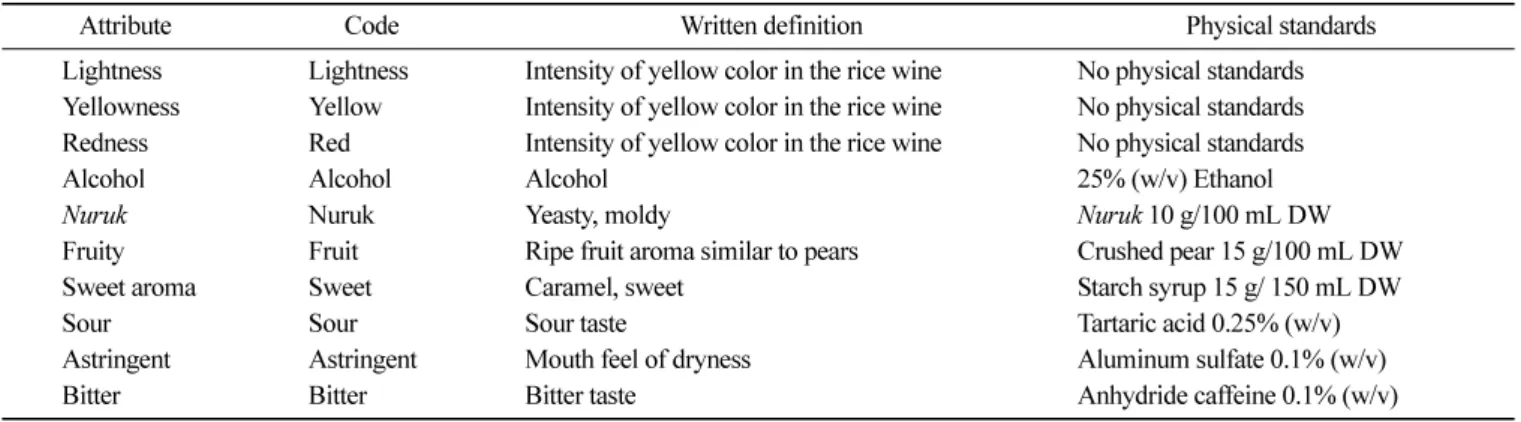
를사용하였다. 묘사·기호도 분석 및 통계처리 묘사·기호도 분석을 위한 검사원은 한국식품연구원 24-37세 남성 5명, 여성 6명으로총 11명이참여하였고기존의전통주 관 련묘사기호도분석 경험이있는 연구원으로이루어졌다. 기호도 분석은 발효후여과한 전통주의색, 향, 맛, 종합적기호도에 대 해 9점평점법으로 평가하여 가장좋다 9, 가장싫다 1의점수 로 표시하였다. 묘사분석 운영은 Lee 등(20)의방법을 참조하여 일부 변형하여실시하였다. 총 6회에걸쳐 패널훈련을 실시하였 고훈련내용은다음과같이이루어졌다: 1. 묘사용어도출과패 널간토의 2. 전세션에도출된향특성스탠다드제시, 선정된 용어와 비교수정 3. 맛특성스탠다드 제시, 선정된용어와 비 교 4. 시료의묘사특성과스탠다드에대한검토, 패널간토의 5. matching test를통한묘사특성이해정도파악, 묘사용어를패널 간 합의로결정 6. 본실험을 위해 채점표와척도에 대해배우 고척도사용에 익숙하도록 한후실제 훈련을통해시료평가 로이루어졌다. 묘사분석 결과도출된 관능평가용어는 Table 1 과같다. 본실험에서는시료가세자리난수표로코드되어 와인 글라스에상온(18-21oC)으로제시되었으며제시된시료는 Williams' latin square 법에의해 랜덤화되어 순서상의 오차를 최소화하였 고실험은각각의부스가분리된관능검사실에서 이루어져검사 의방해를최소한으로 하였다. 각시료에대해 3회반복으로 평 가가이루어졌고척도는 9점척도(1: 대단히약함, 5: 보통, 9: 대 단히 강함)를사용하여 묘사분석 하였다. 묘사분석 결과는분산
분석(analysis of variance)과 주성분 분석(principal component
analysis)을 실시하였고, Statistical Analysis Syatems(SAS, Cary,
NC, USA) for Windows 7.2와 Unscrambler 9.1(Camo, Norway)
결과 및 고찰 원료종류에 따른 전통발효주의 이화학적 특성 고문헌에서보여지는원료로 맥아, 옥수수, 감자, 콩, 차조, 현 미, 찹쌀 그리고멥쌀을 2단담금쌀양의 30%(w/w)로첨가원료 곡물을달리하여제조한발효주의 pH, oBx, 미생물 수그리고알 코올함량변화는 Fig. 1-4에나타냈다. 첨가원료 종류를달리하여 제조한 발효주의 발효기간에 따른 pH는 담금을 끝낸 직후에서 다음날급격히 감소했다가점차증가하는 경향을나타내 Han 등 (21)의보고와 일치하였다. 콩과 맥아를원료로 한술의 pH가담 금 다음날 4.38±0.04, 4.02±0.03으로 가장 높았고 멥쌀이 3.59± 0.21로가장낮았으며 16일발효종료시점에서콩(soybean)과맥 아(malt)는 4.54±0.01, 4.57±0.01 그리고멥쌀은 4.25±0.41로증가 하여나타나발효초기생성된유기산이발효진행에따라 ester와 같은 향미성분형성에이용된 것으로사료된다. oBx는담금을 끝 낸직후에서다음날급격히증가하였다가서서히감소하는경향 을 나타내 Park 등(22)의결과와 대체로 일치하였다. 담금을 끝 낸직후맥아가 8.5±0.42로특이적으로 높았고나머지는 4.1-5.1
Fig. 1. Changes in pH of traditional rice wines made from different ingredients during fermentation time. ○, Malt; ■,
corn; △, potato; ×, soybean; *, glutinous millet; ◆, unpolished rice; +, glutinous rice; -, non-glutinous rice
Fig. 2. Changes in oBx degrees of traditional rice wines made
from different ingredients during fermentation time. ○, Malt; ■
, corn; △, potato; ×, soybean; *, glutinous millet; ◆, unpolished
rice; +, glutinous rice; -, non-glutinous rice
Fig. 3. Changes in microbial cell counts of traditional rice wines made from different ingredients during fermentation time. ○,
Malt; ■, corn; △, potato; ×, soybean; *, glutinous millet; ◆,
unpolished rice; +, glutinous rice; -, non-glutinous rice
Fig. 4. Changes in alcohol contents of traditional rice wines made from different ingredients during fermentation time. ○,
Malt; ■, corn; △, potato; ×, soybean; *, glutinous millet; ◆,
unpolished rice; +, glutinous rice; -, non-glutinous rice
Table 1. Sensory attributes, definitions, and physical standards
Attribute Code Written definition Physical standards Lightness Lightness Intensity of yellow color in the rice wine No physical standards Yellowness Yellow Intensity of yellow color in the rice wine No physical standards Redness Red Intensity of yellow color in the rice wine No physical standards Alcohol Alcohol Alcohol 25% (w/v) Ethanol
Nuruk Nuruk Yeasty, moldy Nuruk 10 g/100 mL DW
Fruity Fruit Ripe fruit aroma similar to pears Crushed pear 15 g/100 mL DW Sweet aroma Sweet Caramel, sweet Starch syrup 15 g/ 150 mL DW Sour Sour Sour taste Tartaric acid 0.25% (w/v) Astringent Astringent Mouth feel of dryness Aluminum sulfate 0.1% (w/v) Bitter Bitter Bitter taste Anhydride caffeine 0.1% (w/v)
을나타냈으며 다음날 찹쌀이 13.9±0.71로 가장 높았고 멥쌀이 12.8±0.9로그다음으로나타났으며 발효 5일까지 감소하다가그 이후에는약간증가하거나거의일정한수준을유지해발효종료 시점에서는맥아가 11.1±0.01로가장높았고감자가 8.35±0.35로 가장 낮게 나타났다. 효모 수는 담금 직후 6.65×10⁷-1.72×10⁸ CFU/mL수준으로 Seo 등(23)의보고와 일치하였으며 담금 다음 날 감자가 4.28×10⁸ CFU/mL로 가장 높게 나타났고 찹쌀이 2.4×10⁸ CFU/mL로가장적은폭으로증가하게나타났으며발효 2일째부터효모수는 감소하기시작하여발효종료시점에서는콩 , 맥아, 멥쌀이 1.44-1.55×10⁸ CFU/mL로 가장 낮았고 현미가 2.69×10⁸ CFU/mL로가장높은효모수를나타냈다. 알코올함량 은담금을끝낸직후 2.07-2.45%로원료에따른 차이가 ±0.38% 로미미하였으나발효 5일이 되면서현미가 14.31±0.13%로가장 높게, 옥수수가 11.28±1.11%로가장 낮게나타나 ±3.03% 차이를 보였으며발효 12일 맥아를제외한 대부분의술이 알코올함량 최대를 나타내 찹쌀이 16.89±0.39%로 가장 높게 감자가 13.68±0.41%로가장 낮게나타났다. 맥아를이용한술은발효 12 일 15.03±0.68%에서발효종료시점인 16일 16.23±0.09%로증가 하였으나모든술의발효종료시점을동일하게하였으므로더이 상의변화는알수없었고다른술들보다발효진행이더딘것을 알수있었다. 첨가원료종류에따른발효주의 발효종료후분석결과는 Table 2-4에나타내었다. 알코올 함량은 맥아와 찹쌀이 16.2%로 가장 높았고 콩이 13.28±0.11%로 가장 낮았으며 pH는 감자가 4.14± 0.04로가장낮았고맥아가 4.57±0.02로가장높게나타났다. 총 산은 맥아가 0.32±0.01%로가장 높게 차조가 0.27±0.01%로가 장낮게 나타났으나큰차이는보이지않았으며 Lee 등(24)의결 과와유사하였고아미노산은맥아가 0.36± 0.02로가장높게감 자가 0.18±0.01로가장낮게나타났다. 당도는맥아가 11.1±0.14 로 가장 높아 고형분 함량이 가장 많음을 나타냈고 감자가 8.35±0.49로고형분함량이가장낮은 것으로나타났다. 착색도, 자외부흡수, 환원당은모두맥아를첨가한술에서 가장높게나 타났고감자를첨가한술에서가장낮게나타나원료에따른특 성 차이를 뚜렷이알 수있었다. 색도에서 명도는 모든술에서 90이상을보여 밝게나타났지만맥아만이 74.44±1.7로가장 어둡 게 나타났고 반대로 적색도는 맥아만이 9.26±3.27로 가장높게 나타났고 나머지술은 모두마이너스 값을보였으며 황색도 또 한 맥아가 33.46±2.91로 가장높게 나타나 적색과 황색이가미 된전통주를개발하고자할때맥아의사용이고려될수있을 것 으로 사료되고 다음으로 콩과 차조가 25.85±0.94, 24.99±2.09를 나타냈으며 찹쌀이 10.98±0.67로가장낮게나타났다. 유기산 중 citric acid는 찹쌀과 멥쌀이 1.97±0.02, 1.96±0.25 mg/mL로가장높게나타났고, 옥수수와감자가 1.80 mg/mL로그 다음으로나타났으며맥아는 0.09±0.06 mg/mL로가장낮게나타
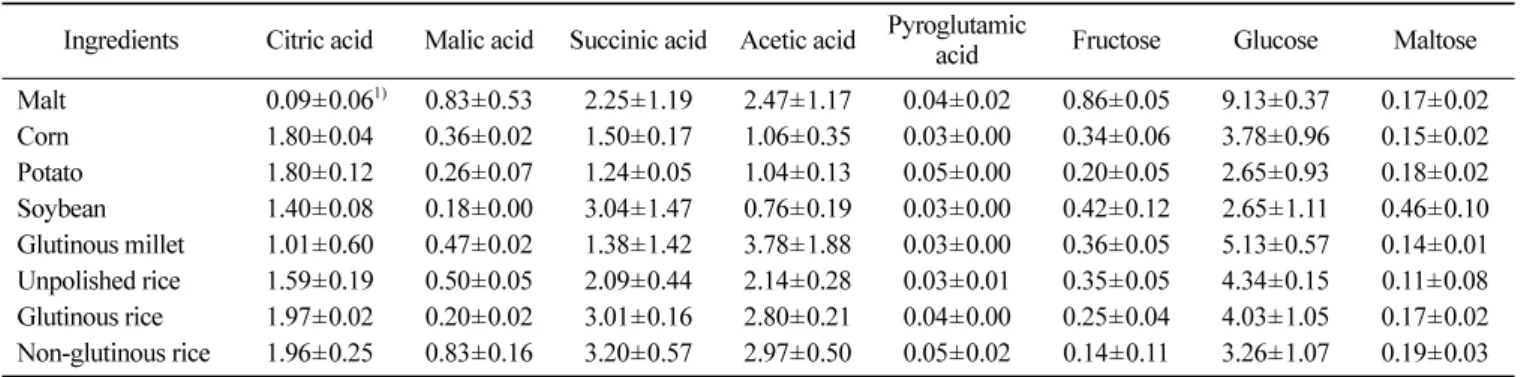
나 20배이상의차이를보였다. Malic acid는 citric acid함량이가 장 낮았던 맥아가 0.83±0.53 mg/mL, 가장 높았던 멥쌀이 0.83± 0.16 mg/mL로동일하게나타났고콩(soybean)이 0.18 mg/mL로가 장 낮은함량을 보였으며, succinic acid는멥쌀이 3.20±0.57 mg/ mL로가장높았고콩과찹쌀이 3 mg/mL로그다음으로나타났 으며 감자가 1.24±0.05 mg/mL로가장 낮은값을보였다. Acetic acid는차조가 3.78±1.88 mg/mL로가장높게 나타났고다음으로 멥쌀이 2.97±0.5 mg/mL 함량을 보였으며콩이 0.76±0.19 mg/mL 로 가장 낮게 나타나 원료에 따른 차이가 컸으며 pyroglutamic acid는모든술에서 0.03-0.05 mg/mL로미량으로나타났다. 유리
Table 2. Chemical contents of traditional rice wines made from different ingredients
Ingredients Alcohol(%) pH Total acid1) Amino acid2) oBx
Malt 016.23±0.093) 4.57±0.02 0.32±0.01 0.36±0.02 11.1±0.14 Corn 15.09±0.29 4.24±0.05 0.32±0.01 0.19±0.03 9.25±0.42 Potato 13.65±0.42 4.14±0.04 0.29±0.03 0.18±0.01 8.35±0.49 Soybean 13.28±0.11 4.54±0.06 0.29±0.01 0.19±0.01 9.00±0.07 Glutinous millet 15.76±0.16 4.43±0.06 0.27±0.01 0.21±0.03 9.85±0.21 Unpolished rice 15.96±0.28 4.25±0.06 0.30±0.01 0.21±0.03 9.90±0.35 Glutinous rice 16.20±0.33 4.23±0.01 0.30±0.02 0.25±0.01 10.15±0.070 Non-glutinous rice 15.89±0.45 4.25±0.02 0.30±0.02 0.27±0.01 10.10±0.130
1)%, total acid contents described as succinic acid 2)%, amino acid contents described as glycine 3)Mean±SD of 3 replications
Table 3. Coloring degree, uv absorbance, reducing sugar and color values of traditional rice wines made from different ingredients
Ingredients Coloring degree1) UV absorbance2) Reducing sugar3) Lightness Redness Yellowness
Malt 05.95±2.414) 29.76±3.75 3.30±0.26 74.44±1.70 -9.26±3.27 33.46±2.91 Corn 2.69±0.30 13.78±0.51 1.65±0.03 93.29±0.11 -2.69±0.35 16.77±0.54 Potato 0.47±0.11 12.53±0.83 1.56±0.09 94.12±0.44 -1.99±0.10 12.58±0.84 Soybean 1.04±0.19 16.00±0.48 2.57±0.01 91.07±0.10 -3.31±0.17 25.85±0.94 Glutinous millet 0.70±0.00 15.76±0.09 1.70±0.05 90.79±0.63 -3.20±0.16 24.99±2.09 Unpolished rice 0.90±0.30 16.21±1.24 1.79±0.01 92.25±0.28 -2.67±0.08 16.00±0.75 Glutinous rice 0.89±0.01 16.68±1.91 1.84±0.07 93.70±0.59 -2.38±0.05 10.98±0.67 Non-glutinous rice 0.78±0.11 18.76±0.98 1.80±0.09 93.93±0.82 -2.24±0.14 11.17±0.74 1)Absorbance at 430 nm 2)Absorbance at 280 nm 3)mg/mL 4)Mean±SD of 3 replications
당은모든술에서 glucose가가장많은함량을나타냈고 맥아가 9.13±0.37 mg/mL로가장높았으며 감자와콩이 2.65 mg/mL로가 장낮았고 fructose 또한맥아가 0.86±0.05 mg/mL로가장높은함 량을보였고감자가 0.20±0.05 mg/mL로가장낮은 함량을보였 으며 maltose는역으로 콩이 0.46±0.1 mg/mL로 가장높게 나타 났고멥쌀이 0.19±0.03 mg/mL로그다음으로나타났으며나머지 술에서는 0.11-0.18 mg/mL로유사하게검출되었다. 원료종류에 따른 전통발효주의 관능적 특성 기호도 분석 결과는 Table 5와 같고 맥아 색상이 3.7±1.95로 가장낮게 나타나유의적인 차이를보였으며 명도가 가장낮은 술이좋지않게나타난것을알수있었고향과맛또한유의적 인차이가 나게가장 낮은점수를 얻었다(p<0.05). 전체적인 기 호도는현미와 묘사분석 결과전반적으로 각특성이 강하지않 고중간 정도수준을 나타낸 옥수수가 6.0으로 가장높게 나타
났고다음으로 단향(sweet aroma), 과일향(fruit aroma), 상쾌한 향(fresh aroma)이높은특성을나타낸찹쌀(glutinous rice)과누룩 향(nuruk aroma), 구수한향(grain aroma)이높은특성으로나타난
차조순서로 나타났다. 우리나라전통주의기본원료인 멥쌀과이 화학적특성을 비교한결과 기호도가 높게나타난옥수수와 현 미가첨가된술의아미노산도가 0.19-0.21±0.03%로나타나멥쌀 0.27±0.01%보다 0.07% 낮게나타났고유기산에서 acetic acid 함 량이 옥수수는 1.06±0.35 mg/ml인데 반해 멥쌀은 2.97±0.50 mg/ mL로 높게 나타났으며 유리당에서 fructose 함량이 멥쌀은 0.14±0.11 mg/mL인데 반해 옥수수와 현미는 0.34, 0.35±0.05 mg/ mL로 0.2 mg/mL 정도높게나타난것을알수있었다. 묘사분석결과의분산분석(three way analysis of variance) 결과 를 살펴보면 각시료 간에는 알코올 향(alcohol aroma), 떫은맛
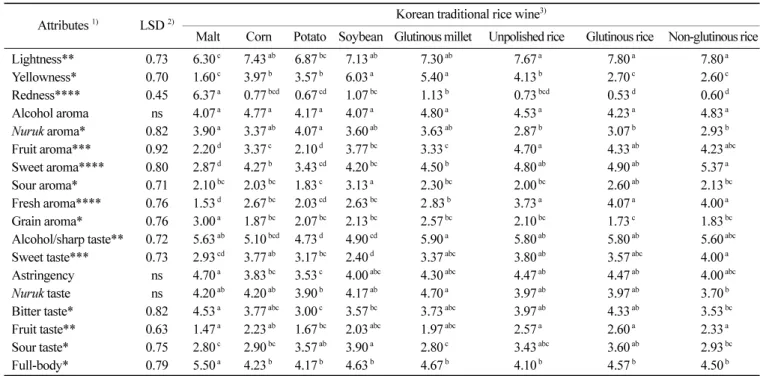
(astringency taste), 누룩맛(nuruk taste)을제외한 모든 항목에서 유의적차이가있었다(p<0.05). 검사자와시료간의교호작용(judge * liquor)에서는모든항목에서 유의적차이를보이지않아서 검 사원의이들항목에서시료간의평가를일관된방식으로이루어 졌음을확인할수있었다. 첨가원료 종류를달리한 8개의 전통약주시료에 대한묘사분 석 결과, 11명 검사원의 3회반복측정한 결과 평균점과 Fisher
Least Significant Difference(LSD)는 Table 6과 같다. 외관과 향
특성을 보면투명도는 전반적으로 모든시료가 높은점수를 나 타냈고황색도의 경우시료간의차이가크게나타났다. 콩을원 료로 한경우황색도가가장높게나타났고반면찹쌀, 멥쌀, 맥 아를원료로한경우에서 낮게나타났다. 적색도도시료간의 차 이가 많이나타났는데 적색도는 맥아로 만든약주의 경우 ‘6.3’ 으로가장 높게나타났고그외의다른 시료는매우낮은것으 로 나타났다. 향특성에서 과일 향과 단향은 전반적으로 ‘2.1-4.5’ 점수준으로크게높은강도를나타내지는않았으나시료간 의차이는보였다. 현미, 찹쌀, 멥쌀로만든약주에서 다른재료 로만든약주에비해높은특성을나타냈고반면 맥아로만든 약 주의경우가장낮은수준을보였다. 구수한향과누룩향도전 반적으로 높은 강도를 보이지 않았다. 알코올 향은 전반적으로 다른시료에 비해강도가높게나타났으나시료간의유의적인차 이를 보이지않았다. 맛특성에서는과일맛, 단맛이 약하고이 에비해쓴맛이높은강도를나타냈으나전반적인맛특성에서 모든 항목이높은 점수를나타내지는 않았다. 전체적인바디감에 서맥아로 만든약주의경우가장높은 점수를나타냈고 그외 다른시료의경우 4점대의비슷한수준을보였다. 묘사분석결과의주성분분석결과는 Fig. 5와같다. 주성분분 석결과는그림에서보여지는바와같이첫번째, 두번째, 세번 째주성분(PC1)은전체데이타편차의 62%, 23%, 그리고 10%를 각각대표하고있다. 관능특성항목의분포를보면 PC1의오른편 으로 적색도, 전체적인 바디감, 구수한향, 누룩 향이나타났고, 반대편위쪽으로는황색도가 분포하였으며, 아래쪽으로는단향, 과일향, 상쾌한향, 투명도가자리잡아서로상관관계가높음을 나타냈다. PC1상으로오른편의적색도와왼편의황색도의대비가 뚜렷하고 PC2상으로는누룩향, 구수한 향, 신향, 신맛과 과일 향, 단향, 단맛등과의대비가 나타났다. 시료의분포를살펴보 면맥아로만든약주의경우다른시료에비해적색도의차이가 커서 이에따라 다른시료와 크게대비되는 것으로나타났으나
Table 4. Organic acid and free sugar contents of traditional rice wines made from different ingredients (mg/mL) Ingredients Citric acid Malic acid Succinic acid Acetic acid Pyroglutamic acid Fructose Glucose Maltose Malt 00.09±0.061) 0.83±0.53 2.25±1.19 2.47±1.17 0.04±0.02 0.86±0.05 9.13±0.37 0.17±0.02 Corn 1.80±0.04 0.36±0.02 1.50±0.17 1.06±0.35 0.03±0.00 0.34±0.06 3.78±0.96 0.15±0.02 Potato 1.80±0.12 0.26±0.07 1.24±0.05 1.04±0.13 0.05±0.00 0.20±0.05 2.65±0.93 0.18±0.02 Soybean 1.40±0.08 0.18±0.00 3.04±1.47 0.76±0.19 0.03±0.00 0.42±0.12 2.65±1.11 0.46±0.10 Glutinous millet 1.01±0.60 0.47±0.02 1.38±1.42 3.78±1.88 0.03±0.00 0.36±0.05 5.13±0.57 0.14±0.01 Unpolished rice 1.59±0.19 0.50±0.05 2.09±0.44 2.14±0.28 0.03±0.01 0.35±0.05 4.34±0.15 0.11±0.08 Glutinous rice 1.97±0.02 0.20±0.02 3.01±0.16 2.80±0.21 0.04±0.00 0.25±0.04 4.03±1.05 0.17±0.02 Non-glutinous rice 1.96±0.25 0.83±0.16 3.20±0.57 2.97±0.50 0.05±0.02 0.14±0.11 3.26±1.07 0.19±0.03 1)Mean±SD of 3 replications
Table 5. Preference test1) for traditional rice wines made from
different ingredients (N=11) Ingredients Color Aroma Taste acceptabilityOverall Malt 3.7b2) 1.8c 1.7c 1.7d
Corn 6.1a 6.3ab 5.4a 5.9ab
Potato 5.8a 5.0b 4.3ab 4.5c
Soybean 6.2a 5.0b 3.8b 4.4c
Glutinous millet 6.4a 5.7ab 4.8ab 5.3abc
Unpolished rice 6.7a 6.6a 5.2a 6.0a
Glutinous rice 6.1a 6.2ab 5.2a 5.4abc
Non-glutinous rice 5.9a 5.4ab 4.97ab 4.8bc
1)9, like extremely; 1, dislike extremely
2)Means with different letters across the line are significantly different at 5% level by Fisher’s LSD test.
적색도를제외한 PCA상에서도(자료미제시) 다른시료와관능특 성에서차이를보이는것으로 여겨진다. 찹쌀과멥쌀로만든시 료는전반적인 관능특성에서 단향, 과일향, 상쾌한 향이높은 특성을나타내어유사한관능특성을보였고반면 PC2 상으로위 쪽으로분포한콩, 차조, 감자로만든 시료의경우누룩향, 구수 한향, 황색도가 강한특성을나타내는 것으로 여겨진다. 그외 옥수수로만든 약주는 plot의중간부분에 위치하여 전반적으로 각특성이강하지않고중간정도수준을나타내는것으로여겨 진다. PC1과 PC3의 Bi-plot은 PC1상의적색도와황색도의대비가 더두드러지고, PC2상으로는위쪽으로는과일 향및단향이, 반 대편으로누룩향이나타나대비를 나타냈다. 시료의분포를살 펴보면맥아로만든시료와감자로만든시료가그외의시료와 구분이가장크게나타났다. 요 약 첨가원료의종류가술에미치는영향을조사하기위해고문헌 에서 보여지는원료로 맥아, 옥수수, 감자, 콩, 차조, 현미, 찹쌀 그리고 멥쌀을 2단담금 쌀양의 30%(w/w)로첨가원료 곡물을 달리하여 발효주를 제조하여 이화학적 특성과 관능특성을 비교 하였다. 16일간발효후최종알코올함량은맥아와찹쌀이 16.2% 로가장높았고 pH는 4.14-4.57, 총산은 0.27-0.32% 수준으로 나
Table 6. Mean sensory attribute ratings of the traditional rice wines made from different ingredients (n = 11 judges×3 replications)
Attributes 1) LSD 2) Korean traditional rice wine 3)
Malt Corn Potato Soybean Glutinous millet Unpolished rice Glutinous rice Non-glutinous rice Lightness** 0.73 6.30 c 7.43 ab 6.87 bc 7.13 ab 7.30 ab 7.67 a 7.80 a 7.80 a
Yellowness* 0.70 1.60 c 3.97 b 3.57 b 6.03 a 5.40 a 4.13 b 2.70 c 2.60 c
Redness**** 0.45 6.37 a 0.77 bcd 0.67 cd 1.07 bc 1.13 b 0.73 bcd 0.53 d 0.60 d
Alcohol aroma ns 4.07 a 4.77 a 4.17 a 4.07 a 4.80 a 4.53 a 4.23 a 4.83 a
Nuruk aroma* 0.82 3.90 a 3.37 ab 4.07 a 3.60 ab 3.63 ab 2.87 b 3.07 b 2.93 b
Fruit aroma*** 0.92 2.20 d 3.37 c 2.10 d 3.77 bc 3.33 c 4.70 a 4.33 ab 4.23 abc
Sweet aroma**** 0.80 2.87 d 4.27 b 3.43 cd 4.20 bc 4.50 b 4.80 ab 4.90 ab 5.37 a
Sour aroma* 0.71 2.10 bc 2.03 bc 1.83 c 3.13 a 2.30 bc 2.00 bc 2.60 ab 2.13 bc
Fresh aroma**** 0.76 1.53 d 2.67 bc 2.03 cd 2.63 bc 2.83 b 3.73 a 4.07 a 4.00 a
Grain aroma* 0.76 3.00 a 1.87 bc 2.07 bc 2.13 bc 2.57 bc 2.10 bc 1.73 c 1.83 bc
Alcohol/sharp taste** 0.72 5.63 ab 5.10 bcd 4.73 d 4.90 cd 5.90 a 5.80 ab 5.80 ab 5.60 abc
Sweet taste*** 0.73 2.93 cd 3.77 ab 3.17 bc 2.40 d 3.37 abc 3.80 ab 3.57 abc 4.00 a
Astringency ns 4.70 a 3.83 bc 3.53 c 4.00 abc 4.30 abc 4.47 ab 4.47 ab 4.00 abc
Nuruk taste ns 4.20 ab 4.20 ab 3.90 b 4.17 ab 4.70 a 3.97 ab 3.97 ab 3.70 b
Bitter taste* 0.82 4.53 a 3.77 abc 3.00 c 3.57 bc 3.73 abc 3.97 ab 4.33 ab 3.53 bc
Fruit taste** 0.63 1.47 a 2.23 ab 1.67 bc 2.03 abc 1.97 abc 2.57 a 2.60 a 2.33 a
Sour taste* 0.75 2.80 c 2.90 bc 3.57 ab 3.90 a 2.80 c 3.43 abc 3.60 ab 2.93 bc
Full-body* 0.79 5.50 a 4.23 b 4.17 b 4.63 b 4.67 b 4.10 b 4.57 b 4.50 b
1)ns, not significant, *p<0.05, **p<0.01, ***p<0.001, ****p<0.0001.
2)Fisher’s least significant differences (LSD) among samples in a given attribute at 5% level
3)Means with different letters across the line are significantly different at 5% level by Fisher’s LSD test.
Fig. 5. Principal component analysis of descriptive data for eight traditional rice wines. (PC1, PC2, and PC3 are 62%, 23%, and 10% of variation, respectively; small letters and underlines correspond to sensory attributes as shown in Table 1 and samples, respectively). G millet, Glutinous millet; G rice, Glutinous rice; NG rice, Non-glutinous rice.
타났으며아미노산은맥아가 0.36±0.02%로가장높게감자가 0.18 ±0.01%로가장낮게나타났다. 당도는 맥아가 11.1로가장높아 고형분함량이가장 많음을나타냈고감자가 8.35로고형분함량 이가장 낮은것으로 나타났다. 착색도, 자외부흡수, 환원당은모 두맥아를첨가한술에서가장높게나타났고감자를첨가한술 에서가장낮게나타나 원료에따른뚜렷한 차이를알수있었 으며색도에서명도는맥아가 74.44로가장어둡게나타났고반 대로적색도는맥아가 9.26로가장높게 나타났으며황색도또한 맥아가 33.46으로가장 높게나타났고찹쌀이 10.98로가장낮게 나타났다. 유기산은맥아, 차조그리고현미는 acetic acid>succinic
acid>malic acid>citric acid>pyroglutamic acid, 옥수수와 감자는
citric acid>succinic acid>acetic acid>malic acid>pyroglutamic acid,
콩은 succinic acid>citric acid>acetic acid>malic acid>pyroglutamic
acid, 찹쌀과 멥쌀은 succinic acid>acetic acid>citric acid>malic
acid> pyroglutamic acid 순으로나타났고 유리당은 모든 술에서
glucose>fructose>maltose 순으로나타났다. 묘사분석결과찹쌀과 멥쌀은전반적인 관능특성에서 단향, 과일향, 상쾌한 향이높 은특성을나타내어유사한관능특성을보였고반면콩, 차조, 감 자는누룩향, 구수한 향, 황색도가 강한특성을나타냈으며 옥 수수는전반적으로각특성이강하지않고중간정도수준을나 타냈다. 전체적인 기호도는 현미와 옥수수가 6.0으로 가장높았 고다음으로 찹쌀과 차조순서로 나타났으며 우리나라 전통주의 기본원료인멥쌀과이화학적특성을비교한결과기호도가높게 나타난 옥수수와 현미가 첨가된 술의 아미노산도가 0.19-0.21±0.03%로나타나멥쌀 0.27±0.01%보다 0.07% 낮게나타났고 유기산에서 acetic acid 함량이옥수수는 1.06±0.35 mg/mL인데반 해멥쌀은 2.97±0.50 mg/mL로높게나타났으며 유리당에서 fruc-tose 함량이멥쌀은 0.14±0.11 mg/mL인데반해옥수수와현미는 0.34, 0.35±0.05 mg/mL로 0.2 mg/mL 정도 높게 나타난 것을 알 수있었다. 문 헌
1. Chang KJ, Yu TJ. Studies on the components of sokokju and commer-cial yakju. Korean J. Food Sci. Technol. 13: 307-313 (1981)
2. Rhee SJ, Lee Jetty CY, Kim KK, Lee CH. Comparison of the tradi-tional (samhaeju) and industrial (cheongju) rice wine brewing in Korea. Food Sci. Biotechnol. 12: 242-247 (2003)
3. Lee SR. Hankuk eui Balhyo Sikpum (Fermented Foods of Korea). Ewha Women’s University Press, Seoul, Korea. pp. 222-294 (1986) 4. Kim CJ, Kim KC, Kim DY, Oh MT, Lee SO, Chung ST, Chung JH.
Fermentation Technology. Sunjinmunwhasa Press, Seoul, Korea. pp. 79-103 (1990)
5. Chung HK. Characteristics and present status of Korean traditional
alcoholic beverage. Korean J. Diet. Culture 4: 311-318 (1989) 6. Eun, JB, Jin TY, Wang MH. The effect of waxy glutinous rice degree
of milling on the quality of Jinyangju, a Korean traditional rice wine. Korean J. Food Sci. Technol. 39: 546-551 (2007)
7. Jin TY, Chung HJ, Eun JB. The effect of fermentation temperature on the quality of Jinyangju, a Korean traditional rice wine. Korean J. Food Sci. Technol. 38: 414-418 (2006)
8. Jung HK, Park CD, Park HH, Lee GD, Lee IS, Hong JH. Manufactur-ing and characteristics of Korean traditional liquor, Hahyangju pre-pared by Saccharomyces cerevisiae HA3 isolated from traditional nuruk. Korean J. Food Sci. Technol. 38: 659-667 (2006)
9. Kim JY, Koh JS. Screening of brewing yeasts and saccharifying molds for foxtail millet-wine making. J. Korean Soc. Appl. Biol. Chem. 47: 78-84 (2004)
10. Kim JY, Koh JS. Fermentation characteristics of Jeju foxtail millet-wine by isolated alcoholic yeast and saccharifying mold. J. Korean Soc. Appl. Biol. Chem. 47: 85-91 (2004)
11. Kim JH, Lee DH, Lee SH, Choi SY, Lee JS. Effect of Ganoderma lucidum on the quality and functionality of Korean traditional rice wine, yakju. J. Biosci. Bioeng. 97: 24-28 (2004)
12. Lee IS, Yang EJ, Jeong YJ, Seo JH. Fermentation process and physio-chemical characteristics of yakju (Korean cleared rice wines) with addition of ginseng powder. Korean J. Postharv. Sci. Technol. 6: 463-468 (1999)
13. Lee DH, Kim JH, Kim NM, Lee JS. Manufacture and physiological functionality of Korean traditional liquor by using chamomile ( Matri-caria hamomile). Korean J. Food Sci. Technol. 34: 109-113 (2002) 14. Yu HE, Lee DH, Lee JH, Choi SY, Lee JS. Quality characteristics and
cardiovascular activities of Korean traditional wines and liquors. Food Sci. Biotechnol. 14: 772-777 (2005)
15. NTSTS Institute. Textbook of alcoholic beverage-making. National Tax Service Technical Service Institute. Seoul, Korea (1997)
16. Japan Sake Brewers Association. A book with Notes National Tax Service Methods of Analysis, 4th ed. Tokyo, Japan. pp. 27-30. (1993) 17. Miller GL. Use of dinitrosalicylic acid reagent for determination of
reducing sugar. Anal. Chem., 31: 426-428 (1959)
18. Bruce WZ, Kenneth CF, Barry HG, Fred SN. Wine Analysis and Pro-duction. Chapman & Hall, New York, NY, USA. pp.370-372 (1995) 19. Bruce WZ, Kenneth CF, Barry HG, Fred SN. Wine Analysis and
Pro-duction. Chapman&Hall, New York, NY, USA. pp.447-449 (1995) 20. Lee SJ, Kwon YH, Kim HR, Ahn BH. Chemical and sensory
charac-terization of Korean commercial rice wines (yakju). Food Sci. Bio-technol. 16: 374-380 (2007)
21. Han EH, Lee TS, Noh BS, Lee DS. Quality characteristics in mash of takju prepared by using different nuruk during fermentation. Korean J. Food Sci. Technol. 29: 555-562 (1997)
22. Park CS, Lee TS. Quality characteristics of takju prepared by wheat flour nuruks. Korean. J. Food Sci. Technol. 34: 296-302 (2002) 23. Seo MY, Lee JK, Ahn BH, Cha SH. The changes of microflora
dur-ing the fermentation of takju and yakju. Korean J. Food Sci. Technol. 37: 61-66 (2005)
24. Lee EN, Lee DH, Kim SB, Lee SW, Kim NM, Lee JS. Effects of medicinal plants on the quality and physiological functionalities of tra-ditional ginseng wine. J. Ginseng Res. 31: 102-108 (2007)