INTRODUCTION
Cervical cancer was the fourth leading cause of cancer deaths among females worldwide in 2008 [1]. Cervical cancer is almost always caused by a human papilloma virus (HPV) infection [2]. In Taiwan, there was an annual incidence rate of 16.2 per 100,000 people for invasive cervical cancer and a mortality rate of 7.8 per 100,000 people in 2006 [3]. A community-based study of 10,602 participants (aged 30 to 65) in Taiwan reported that the overall prevalence of HPV was
16.2% [4].
The peak prevalence of HPV infection occurs within the first decade after sexual debut, typically between the ages of 15 and 25 in most Western countries [5,6]. Therefore, the United States Advisory Committee on Immunization Practices recommended routine vaccination for females between 11 and 12 years of age. Catch-up vaccination was recommended for females aged 13 to 26 who had not been previously vac- cinated or who had not completed their vaccine series. Taiwan first introduced the HPV vaccine in 2006, but few cities have provided free vaccination programs for female junior high school students, and there is still no free access to catch up on vaccinations. The average age of sexual debut in Taiwan is 17 to 18 [7], so there are still a substantial number of potential candi- dates among female college students for catch up vaccinations.
One study in Taiwan found that 38% of the women who were vaccinated were over the age of 26. Women aged 18 to
Factors associated with future commitment and past history of human papilloma virus vaccination among female college students in northern Taiwan
Ping-Fen Kuo1, Ying-Tse Yeh2, Shuh-Jen Sheu1, Tze-Fang Wang1
1National Yang Ming University School of Nursing, Taipei; 2Department of Medicine, Taichung Veterans General Hospital, Taichun, Taiwan
Received Dec 23, 2013, Revised Apr 15, 2014, Accepted Apr 17, 2014 Supplementary material for this article can be found at www.ejgo.org.
Correspondence to Tze-Fang Wang
National Yang Ming University School of Nursing, No. 155, Section 2, Li- Nong St, Shi-Pai, Taipei 11221, Taiwan. E-mail: [email protected]
Objective: To investigate factors influencing commitment to human papilloma virus (HPV) vaccination and prior vaccination among female college students in northern Taiwan.
Methods: A quota sample of 400 female college students was recruited from nine colleges in northern Taiwan during March 2013. Of these, 398 completed the self administered questionnaire which was designed based on the health promotion model.
Results: The results showed that factors associated with prior vaccination behavior were family history of gynecologic malignancy, ever being advised to get HPV vaccination, perceived barriers of action and perceived self-efficacy. Predictors for commitment to HPV vaccination in the next 6 months were the cost of vaccination, ever being advised to get HPV vaccination, perceived self-efficacy and situational influences. Perceived self-efficacy was significantly influenced by relationship status, past receipt of a recommendation for HPV vaccination and level of knowledge about HPV.
Conclusion: When formulating vaccination policies, governmental or medical institutions should include these factors to promote vaccination.
Keywords: College student, Female, Health promotion model, Human papilloma virus, Vaccines
pISSN 2005-0380·eISSN 2005-0399
26 were more likely to consider the cost and availability of vacci nation than women over 26, and the media also played an important role in a woman's decision to seek HPV vaccina- tion [7]. Over 50% of undergraduate women were aware of HPV and the HPV vaccine, and 63% of the students reported a high intent to obtain the HPV vaccine [8]. In the past, college women in Taiwan have experienced difficulties with HPV- related cervical cancer prevention. It has been hoped that a publicly funded HPV immunisation program, a friendly medical environment, sufficient knowledge about HPV, and an open-minded society would improve HPV-related cervical cancer prevention [9].
The health promotion model describes an individual’s be- havioral outcomes that are influenced by “individual character- istics and experiences” and “behavior-specific cognitions and affects.” An individual behavioral outcome includes commit- ment to a plan of action and health-promoting behavior [10].
By utilizing the health promotion model, we hoped to develop insight into the factors influencing both intent to vaccinate and a history of prior vaccination.
Most previous studies have investigated intent of HPV vacci- nation and prior vaccination history among community based women with a wide range of ages [7,11]. The purpose of this study, therefore, was to investigate the factors influencing the prior vaccination and commitment to HPV vaccination in the future among female college students in northern Taiwan, with a particular focus on the dimensions proposed by the health promotion model. There is a geographic variation in the prevalence of HPV between northern and southern Taiwan. The overall HPV prevalence in northern Taiwanese women was 32.4% [12] and it was19.3% in southern Taiwan- ese women. [13] We believed that investigating the factors in- fluencing commitment to vaccination among female college students in northern Taiwan was relatively more important.
MATERIALS AND METHODS 1. Sample and data collection
This was a cross sectional study design. The project was approved by the Institutional Review Board of the Antai Tian- Sheng Memorial Hospital in Taiwan. A quota sample (non- probability) of 400 female college students was recruited from nine colleges in northern Taiwan: 100 from liberal arts colleges (25%), 200 from social science colleges (50%), and 100 from medical science colleges (25%) according to the number of college students in 2012 as reported by the Ministry of Educa- tion. Inclusion criteria were: (1) regularly enrolled in a college/
university; (2) able to read Chinese; and (3) completed informed
consent. College students aged ≥20 were invited to fill out the questionnaire in a classroom under the supervision of research- ers and without the presence of male classmates. Students aged
<20 were asked to fill out the questionnaire on our website due to ethical considerations. Data were collected in March 2013. We obtained written informed consent from each participant, but all questionnaires were administered without a request for names or personal information, so that the participants’ autonomy and confidentiality were protected.
A sample size of 385 was calculated by the following formula:
n= 1.962×p×(1-p)
d2 ,
where p=0.5 was the response rate set to maximize the calculated sample size, and d=0.05 indicated the acceptable margin of error. The calculated sample size of 385 was further increased to 400 to account for nonresponse or noncom- pleted questionnaires.
2. Instruments
The self administered questionnaire was divided into three parts (Suppl. 1). The first included individual characteristics and experiences (e.g., age and personal or family history of gynecologic disease), prior related behaviors that might affect future HPV vaccination (e.g., age at first sexual experience, and past receipt of recommendations for HPV vaccination), and knowledge about cervical cancer as measured by a 15 item quiz. For the first part of the questionnaire, Cronbach’s α=0.78.
The second part included behavior-specific cognitions and affects relative to HPV vaccination. Each of the 21 items was measured on a 4-point Likert scale, ranging from “strongly dis- agree” 1 to “strongly agree” 4. For each of the six dimensions, a higher total score implied more perceived benefits of HPV vac- cination, fewer perceived barriers to HPV vaccination, higher perceived self-efficacy, more positive HPV vaccination-related affect, greater likelihood to be affected by interpersonal influ- ence, or a greater likelihood to be affected by situational influ- ences. For the second part of the questionnaire, Cronbach’s α=0.79.
The final part questioned immediate behavioral contingen- cies including commitment to HPV vaccination and a prior history of HPV vaccination. For nonvaccinated participants, we queried their commitment to vaccination within the next 6 months. Participants were also requested to identify an affordable price for HPV vaccine. For the third part of the questionnaire, Cronbach’s α=0.90.
3. Validity
The questionnaire was validated by an expert panel consist-
ing of four physicians from the Department of Obstetrics and Gynecology and two professors from the Nursing School.
The experts graded the items on the questionnaire using a 5-point Likert scale, ranging from “very unsuitable” 1 to “very suitable.” The content validity index (CVI) was calculated accordingly. For the first part of the questionnaire, “individual characteristics and experience,” the CVI=93.4%; for the second part, “behavior-specific cognition and afffect,” the CVI=92.4%;
for the third part, “immediate competing demands and preferences,” the CVI=90%; and for “commitment to a plan of action and behavior,” the CVI=90%.
4. Statistical analysis
Descriptive analysis included distribution frequencies for cat- egorical variables, means with standard deviations for normally distributed continuous variables, and medians and range for non-normally distributed variables. For inferential statistics to determine the associations of “individual characteristics and experiences” and “cognition and affect relative to HPV vaccina- tion” and “prior HPV vaccination” and ”future HPV vaccination,”
we utilized the independent two samples t-test to compare normally distributed continuous variables between two groups, the nonparametric Mann-Whitney test to compare non-normally distributed continuous variables between two groups, the nonparametric Kruskal-Wallis test to compare non- normally distributed continuous variables between three or more groups, and Fisher exact test to evaluate the associations between categorical variables. Logistic regression models were utilized to evaluate independent factors influencing prior vaccination and future HPV vaccination: variables with a p<0.1 in the univariate logistic regression models were entered step- wise into multivariate logistic regression models by the for- ward conditional selection method. The correlation between scores for total knowledge and perceived self-efficacy was expressed by the Spearman correlation coefficient (ρ). Two- tailed p-values <0.05 were considered statistically significant.
Data were analyzed using SPSS ver. 15.0 (SPSS Inc., Chicago, IL, USA).
RESULTS
1. Individual characteristics and experiences and knowl- edge about HPV vaccine
Of the 400 subjects enrolled in this study, 398 completed the questionnaires. Their average age was 20.04±1.80 years.
With regard to monthly living expenses, 82.4% spent less than US $333 per month (<new Taiwan dollar [NTD], 10,000). Only 5.5% and 9.5% had a personal history of gynecologic disease
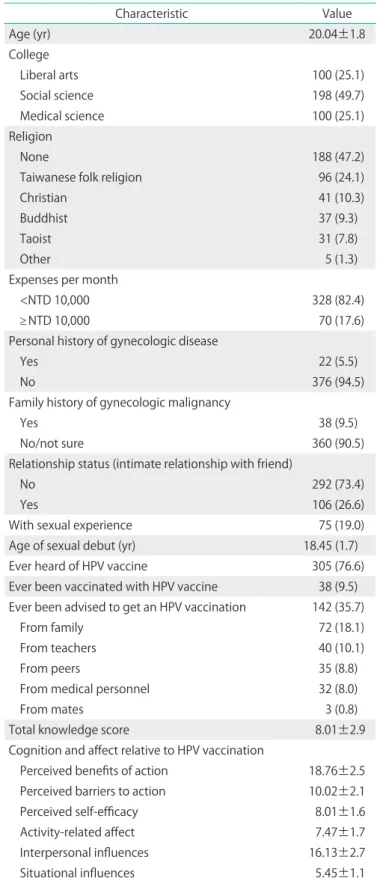
Table 1. Individual characteristics, knowledge about HPV vaccine, and cognitions and affects relative to HPV vaccine (n=398)
Characteristic Value
Age (yr) 20.04±1.8
College
Liberal arts 100 (25.1)
Social science 198 (49.7)
Medical science 100 (25.1)
Religion
None 188 (47.2)
Taiwanese folk religion 96 (24.1)
Christian 41 (10.3)
Buddhist 37 (9.3)
Taoist 31 (7.8)
Other 5 (1.3)
Expenses per month
<NTD 10,000 328 (82.4)
≥ NTD 10,000 70 (17.6)
Personal history of gynecologic disease
Yes 22 (5.5)
No 376 (94.5)
Family history of gynecologic malignancy
Yes 38 (9.5)
No/not sure 360 (90.5)
Relationship status (intimate relationship with friend)
No 292 (73.4)
Yes 106 (26.6)
With sexual experience 75 (19.0)
Age of sexual debut (yr) 18.45 (1.7)
Ever heard of HPV vaccine 305 (76.6)
Ever been vaccinated with HPV vaccine 38 (9.5) Ever been advised to get an HPV vaccination 142 (35.7)
From family 72 (18.1)
From teachers 40 (10.1)
From peers 35 (8.8)
From medical personnel 32 (8.0)
From mates 3 (0.8)
Total knowledge score 8.01±2.9
Cognition and affect relative to HPV vaccination
Perceived benefits of action 18.76±2.5
Perceived barriers to action 10.02±2.1
Perceived self-efficacy 8.01±1.6
Activity-related affect 7.47±1.7
Interpersonal influences 16.13±2.7
Situational influences 5.45±1.1
Values are presented as mean±SD or number (%).
HPV, human papilloma virus; NTD, new Taiwan dollar.
or family history of gynecologic malignancy, respectively. Only 38 participants (9.5%) were vaccinated. Nineteen percent had engaged in sexual intercourse, with an average age of 18.45 for sexual debut. Although 76.6% had heard about HPV vac- cine, only 142 (35.7%) had ever received a recommendation to be vaccinated. Among those who had been advised to be vaccinated, the recommendations were from family (18.1%), teachers (10.1%), and peers (8.8%), and only 8.0% were from medical personnel. The mean score for total knowledge was 8.01±2.91, which showed that the level of knowledge was moderate (Table 1).
2. Cognitive and affect relative to HPV vaccination
The mean scores for perceived benefits of action, perceived barriers to action, perceived self-efficacy, and activity-related
affect were 18.76, 10.02, 8.01, and 7.47 respectively. The mean scores for interpersonal and situational influences were 16.13 and 5.45, respectively (Table 1).
3. Factors influencing prior vaccination
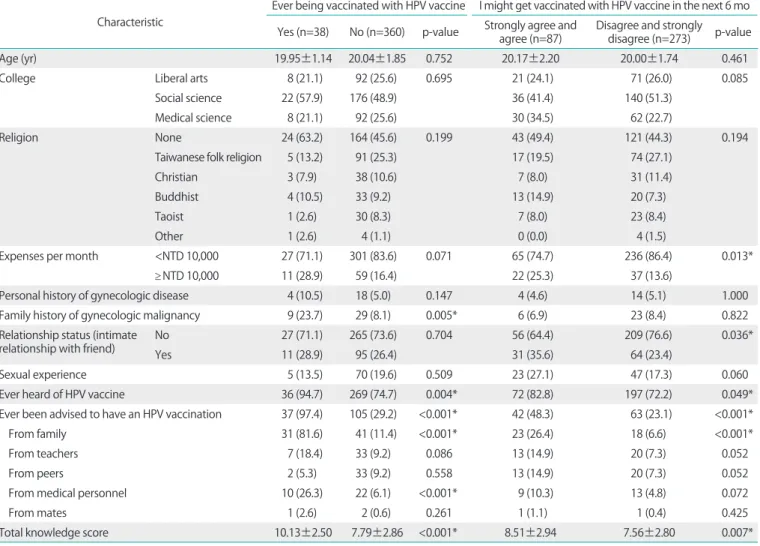
Factors significantly associated with past vaccination were family history of gynecologic malignancy, ever having heard of HPV vaccine, ever having been advised to receive an HPV vaccination, and total knowledge score; 23.7% of those with a family history of gynecologic malignancy were more likely to be vaccinated than were those without such a family history (8.1%, p=0.005). Those who had ever heard of HPV vaccine were more likely to be vaccinated (94.7%) than were those who never heard of it (74.7%, p=0.004). Those who had ever been advised to have an HPV vaccination were more likely to
Table 2. Associations of individual characteristics and scores for human papilloma virus knowledge and commitment for vaccination and prior vaccination history
Characteristic
Ever being vaccinated with HPV vaccine I might get vaccinated with HPV vaccine in the next 6 mo Yes (n=38) No (n=360) p-value Strongly agree and
agree (n=87) Disagree and strongly disagree (n=273) p-value
Age (yr) 19.95±1.14 20.04±1.85 0.752 20.17±2.20 20.00±1.74 0.461
College Liberal arts 8 (21.1) 92 (25.6) 0.695 21 (24.1) 71 (26.0) 0.085
Social science 22 (57.9) 176 (48.9) 36 (41.4) 140 (51.3)
Medical science 8 (21.1) 92 (25.6) 30 (34.5) 62 (22.7)
Religion None 24 (63.2) 164 (45.6) 0.199 43 (49.4) 121 (44.3) 0.194
Taiwanese folk religion 5 (13.2) 91 (25.3) 17 (19.5) 74 (27.1)
Christian 3 (7.9) 38 (10.6) 7 (8.0) 31 (11.4)
Buddhist 4 (10.5) 33 (9.2) 13 (14.9) 20 (7.3)
Taoist 1 (2.6) 30 (8.3) 7 (8.0) 23 (8.4)
Other 1 (2.6) 4 (1.1) 0 (0.0) 4 (1.5)
Expenses per month <NTD 10,000 27 (71.1) 301 (83.6) 0.071 65 (74.7) 236 (86.4) 0.013*
≥NTD 10,000 11 (28.9) 59 (16.4) 22 (25.3) 37 (13.6)
Personal history of gynecologic disease 4 (10.5) 18 (5.0) 0.147 4 (4.6) 14 (5.1) 1.000
Family history of gynecologic malignancy 9 (23.7) 29 (8.1) 0.005* 6 (6.9) 23 (8.4) 0.822
Relationship status (intimate
relationship with friend) No 27 (71.1) 265 (73.6) 0.704 56 (64.4) 209 (76.6) 0.036*
Yes 11 (28.9) 95 (26.4) 31 (35.6) 64 (23.4)
Sexual experience 5 (13.5) 70 (19.6) 0.509 23 (27.1) 47 (17.3) 0.060
Ever heard of HPV vaccine 36 (94.7) 269 (74.7) 0.004* 72 (82.8) 197 (72.2) 0.049*
Ever been advised to have an HPV vaccination 37 (97.4) 105 (29.2) <0.001* 42 (48.3) 63 (23.1) <0.001*
From family 31 (81.6) 41 (11.4) <0.001* 23 (26.4) 18 (6.6) <0.001*
From teachers 7 (18.4) 33 (9.2) 0.086 13 (14.9) 20 (7.3) 0.052
From peers 2 (5.3) 33 (9.2) 0.558 13 (14.9) 20 (7.3) 0.052
From medical personnel 10 (26.3) 22 (6.1) <0.001* 9 (10.3) 13 (4.8) 0.072
From mates 1 (2.6) 2 (0.6) 0.261 1 (1.1) 1 (0.4) 0.425
Total knowledge score 10.13±2.50 7.79±2.86 <0.001* 8.51±2.94 7.56±2.80 0.007*
Values are presented as mean±SD or number (%).
HPV, human papilloma virus and NTD, new Taiwan dollar.
*p<0.05 indicates a significant difference between two groups.
be vaccinated (97.4%) than were those who had never been so advised (29.2%, p<0.001). Recommendations from family and medical personnel were significantly associated with prior vaccination (p<0.001). Compared to the unvaccinated group, the 38 vaccinated subjects had significantly higher scores for total knowledge (10.13 vs. 7.79; p<0.001) (Table 2).
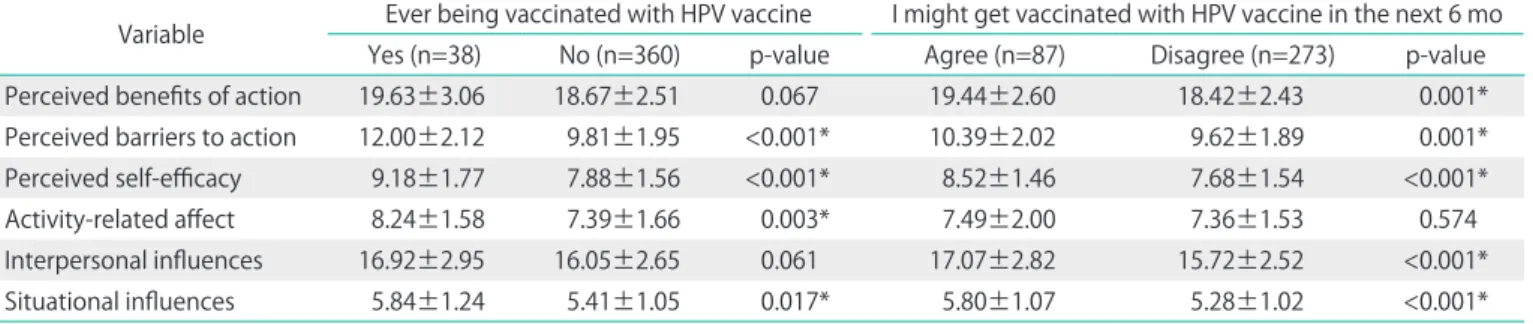
Compared to the unvaccinated group, the 38 vaccinated sub- jects had significantly higher scores on the four dimensions of perceived barriers to action (12.0 vs. 9.81; p<0.001), perceived self-efficacy (9.18 vs. 7.88; p<0.001), activity-related affect (8.24 vs. 7.39; p=0.003), and situational influences (5.84 vs. 5.41;
p=0.017) (Table 3).
4. Independent factors influencing prior vaccination After forward conditional selection of the variables with a p<0.1 in the univariate logistic regression models, four independent factors influencing prior vaccination remained in the multivariate logistic regression model. After the other three factors were controlled, subjects with a family history of gynecologic malignancy were more likely to have been vaccinated (odds ratio [OR], 9.52; p=0.003); subjects who had ever been advised to be vaccinated were more likely to have been (OR, 112.42; p<0.001); and the opportunity to be vac- cinated was increased by every one unit increase in the scores for perceived self-efficacy (OR, 1.50; p=0.006) and perceived barriers to action (OR, 1.44; p=0.008) (Table 4).
5. Factors influencing commitment to vaccination
Living expenses per month, relationship status, ever having heard of HPV vaccine, past receipt of recommendations for HPV vaccination, and total knowledge scores were significantly associated with commitment to vaccination. About one-fourth of the high commitment group (25.3%) had living expenses
≥NTD 10,000 per month, but only 13.6% of the low commit- ment group did (p=0.013). Over one-third of the high commit-
ment group (35.6%) were in a relationship but only 23.4% of the low commitment group were (p=0.036). Over eighty per- cent of the high commitment group (82.8%) had ever heard of HPV vaccine but only 72.2% of the low commitment group had (p=0.049). Nearly half of the high commitment group had ever been advised to be vaccinated but only 23.1% of the low commitment group were (p<0.001). Over one-fourth of the high commitment group (26.4%) had ever been advised by family members to be vaccinated but only 6.6% of the low commitment group had (p<0.001). Compared to the low commitment group, the 87 subjects in the high commitment group had significantly higher scores for total knowledge (8.51 vs. 7.56; p=0.007) (Table 2).
Compared to the low commitment group, the 87 subjects in the high commitment group had significantly higher scores on the five dimensions including perceived benefits of action (19.44 vs. 18.42; p=0.001), perceived barriers to action (10.39 vs.
9.62; p=0.001), perceived self-efficacy (8.52 vs. 7.68; p<0.001), interpersonal influences (17.07 vs. 15.72; p<0.001), and situ- ational influences (5.80 vs. 5.28; p<0.001) (Table 3).
6. Independent factors influencing commitment to vaccination
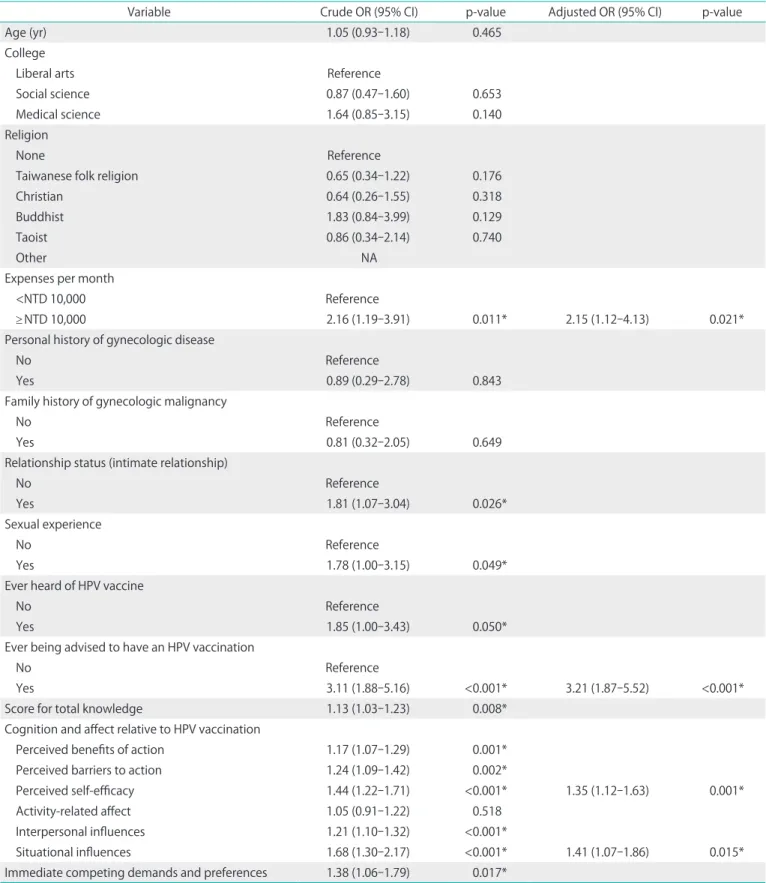
After forward conditional selection of the variables with a p<0.1 in the univariate logistic regression models, four independent factors influencing commitment to vaccination remained in the multivariate logistic regression model. After the other three factors were controlled, subjects with a bud- get of ≥NTD 10,000 per month were more likely to agree to be vaccinated in the next 6 months (OR, 2.15; p=0.021) as were subjects who had ever been advised to have an HPV vaccina- tion (OR, 3.21; p<0.001); the preference to be vaccinated in the next 6 months was increased by every one unit increase in the scores for perceived self-efficacy (OR, 1.35; p<0.001) and situational influences (OR, 1.41; p=0.015) (Table 5).
Table 3. Association among cognitions and affects relative to human papilloma virus (HPV) vaccination and prior vaccination history and commitment to future vaccination
Variable Ever being vaccinated with HPV vaccine I might get vaccinated with HPV vaccine in the next 6 mo
Yes (n=38) No (n=360) p-value Agree (n=87) Disagree (n=273) p-value
Perceived benefits of action 19.63±3.06 18.67±2.51 0.067 19.44±2.60 18.42±2.43 0.001*
Perceived barriers to action 12.00±2.12 9.81±1.95 <0.001* 10.39±2.02 9.62±1.89 0.001*
Perceived self-efficacy 9.18±1.77 7.88±1.56 <0.001* 8.52±1.46 7.68±1.54 <0.001*
Activity-related affect 8.24±1.58 7.39±1.66 0.003* 7.49±2.00 7.36±1.53 0.574
Interpersonal influences 16.92±2.95 16.05±2.65 0.061 17.07±2.82 15.72±2.52 <0.001*
Situational influences 5.84±1.24 5.41±1.05 0.017* 5.80±1.07 5.28±1.02 <0.001*
Values are presented as mean±SD.
*p<0.05 indicates a significant difference in the score between two groups.
Table 4. Independent factors influencing prior vaccination (n=398)
Variable Crude OR (95% CI) p-value Adjusted OR (95% CI) p-value
Age (yr) 0.97 (0.79-1.19) 0.751
College
Liberal arts Reference
Social science 1.44 (0.62-3.36) 0.401
Medical science 1.00 (0.36-2.78) 1.000
Religion
None Reference
Taiwanese folk religion 0.38 (0.14-1.02) 0.054
Christian 0.54 (0.15-1.89) 0.334
Buddhist 0.83 (0.27-2.55) 0.742
Taoist 0.23 (0.03-1.75) 0.155
Other 1.71 (0.18-15.93) 0.638
Expenses per month
<NTD 10,000 Reference
≥ NTD 10,000 2.08 (0.98-4.42) 0.057
Personal history of gynecologic disease
No Reference
Yes 2.24 (0.72-6.98) 0.166
Family history of gynecologic malignancy
No Reference
Yes 3.54 (1.53-8.19) 0.003* 9.52 (2.19-41.42) 0.003*
Relationship status (intimate relationship)
No Reference
Yes 1.14 (0.54-2.38) 0.735
Sexual experience
No Reference
Yes 0.64 (0.24-1.70) 0.372
Ever heard of HPV vaccine
No Reference
Yes 6.09 (1.44-25.79) 0.014*
Ever being advised to have an HPV vaccination
No Reference
Yes 89.86 (12.17-663.45) <0.001* 112.42 (13.17-959.72) <0.001*
Score for total knowledge 1.40 (1.21-1.62) <0.001*
Cognition and affect relative to HPV vaccination
Perceived benefits of action 1.15 (1.01-1.30) 0.030*
Perceived barriers to action 1.84 (1.49-2.26) <0.001* 1.44 (1.10-1.88) 0.008*
Perceived self-efficacy 1.65 (1.33-2.04) <0.001* 1.50 (1.12-2.01) 0.006*
Activity-related affect 1.37 (1.11-1.69) 0.003*
Interpersonal influences 1.12 (0.99-1.26) 0.063
Situational influences 1.47 (1.07-2.02) 0.018*
CI, confidence interval; HPV, human papilloma virus; NTD, new Taiwan dollar; OR, odds ratio.
*p<0.05 indicates a significant influence on prior vaccination.
Table 5. Independent factors influencing commitment to vaccination in the next 6 months (n=360)
Variable Crude OR (95% CI) p-value Adjusted OR (95% CI) p-value
Age (yr) 1.05 (0.93-1.18) 0.465
College
Liberal arts Reference
Social science 0.87 (0.47-1.60) 0.653
Medical science 1.64 (0.85-3.15) 0.140
Religion
None Reference
Taiwanese folk religion 0.65 (0.34-1.22) 0.176
Christian 0.64 (0.26-1.55) 0.318
Buddhist 1.83 (0.84-3.99) 0.129
Taoist 0.86 (0.34-2.14) 0.740
Other NA
Expenses per month
<NTD 10,000 Reference
≥ NTD 10,000 2.16 (1.19-3.91) 0.011* 2.15 (1.12-4.13) 0.021*
Personal history of gynecologic disease
No Reference
Yes 0.89 (0.29-2.78) 0.843
Family history of gynecologic malignancy
No Reference
Yes 0.81 (0.32-2.05) 0.649
Relationship status (intimate relationship)
No Reference
Yes 1.81 (1.07-3.04) 0.026*
Sexual experience
No Reference
Yes 1.78 (1.00-3.15) 0.049*
Ever heard of HPV vaccine
No Reference
Yes 1.85 (1.00-3.43) 0.050*
Ever being advised to have an HPV vaccination
No Reference
Yes 3.11 (1.88-5.16) <0.001* 3.21 (1.87-5.52) <0.001*
Score for total knowledge 1.13 (1.03-1.23) 0.008*
Cognition and affect relative to HPV vaccination
Perceived benefits of action 1.17 (1.07-1.29) 0.001*
Perceived barriers to action 1.24 (1.09-1.42) 0.002*
Perceived self-efficacy 1.44 (1.22-1.71) <0.001* 1.35 (1.12-1.63) 0.001*
Activity-related affect 1.05 (0.91-1.22) 0.518
Interpersonal influences 1.21 (1.10-1.32) <0.001*
Situational influences 1.68 (1.30-2.17) <0.001* 1.41 (1.07-1.86) 0.015*
Immediate competing demands and preferences 1.38 (1.06-1.79) 0.017*
CI, confidence interval; HPV, human papilloma virus; NA, not available; NTD, new Taiwan dollar; OR, odds ratio.
*p<0.05 indicates a significant influence on commitment to vaccination in the next 6 months.
7. Associations of individual characteristics and prior vaccination with cognition and affect relative to HPV vaccination
Since perceived self-efficacy was the only independent factor influencing both prior vaccination and commitment to vaccination, additional analyses of the associations between inde pendent characteristics and prior vaccination with per- ceived self efficacy scores were performed.
Subjects in relationships (p=0.040) and those ever having
been advised to be vaccinated (p=0.031) had significantly higher scores for perceived self-efficacy. A very weak positive correaltion was observed in scores for total knowledge and perceived self-efficacy (ρ=0.138; p=0.006) (Table 6).
DISCUSSION
HPV infection is considered to be one of the most common Table 6. Associations of individual characteristics and prior related behaviors and perceived self-efficacy scores
Characteristic No. Perceived self-efficacy p-value
College 0.148
Liberal arts 100 8.0 (5.0-12.0)
Social science 198 8.0 (3.0-12.0)
Medical science 100 8.0 (3.0-12.0)
Religion 0.246
None 188 8.0 (5.0-12.0)
Taiwanese folk religion 96 8.0 (3.0-12.0)
Christian 41 8.0 (6.0-10.0)
Buddhist 37 8.0 (6.0-12.0)
Taoist 31 9.0 (6.0-12.0)
Other 5 7.0 (3.0-12.0)
Expenses per month 0.490
<NTD 10,000 328 8.0 (3.0-12.0)
≥ NTD 10,000 70 8.0 (6.0-12.0)
Personal history of gynecologic disease 0.195
Yes 22 7.0 (6.0-10.0)
No 376 8.0 (3.0-12.0)
Family history of gynecologic malignancy 0.594
Yes 38 8.0 (6.0-12.0)
No/not sure 360 8.0 (3.0-12.0)
Relationship status (intimate relationship) 0.040*
Yes 106 9.0 (3.0-12.0)
No 292 8.0 (3.0-12.0)
Sexual experience 0.070
Yes 75 9.0 (3.0-12.0)
No 319 8.0 (3.0-12.0)
Ever heard of HPV vaccine 0.766
Yes 305 8.0 (3.0-12.0)
No 93 8.0 (6.0-12.0)
Ever being advised to have an HPV vaccination 0.031*
Yes 142 9.0 (3.0-12.0)
No 256 8.0 (3.0-12.0)
Score for total knowledge 398 ρ=0.138 0.006*
Values are presented as median (range).
HPV, human papilloma virus; NTD, new Taiwan dollar.
*Perceived self-efficacy and situational influences are expressed by the Spearman correlation coefficient (ρ).
sexually transmitted disease. Nineteen percent of the female college students in our study had engaged in sexual inter- course with an average age of 18.45 for their sexual debut. This percentage was less than that in many Western countries such as the United States (US) (78%), France (67.2%), Italy (45.5%) [14-16] but similar to that in other Asian countries [15,17,18];
however, the overall prevalence of HPV in Taiwan could be as high as 19.85%, and the younger the subjects, the higher the infection and multiple infection rates [19]. Only 9.5% of our participants were vaccinated. That rate among female college students was similar to that in the the US (9% of females aged 18 to 26) [20]. Although 76.6% of our participants had heard of the HPV vaccine, only 35.7% had ever been advised to be vaccinated. Subjects with a family history of gynecologic malignancy or those who had ever been advised to be vac- cinated were more likely to have been vaccinated. This was consistent with many previous studies [7,16,21,22]. Subjects who had ever been advised to be vaccinated were more likely to agree with being vaccinated in the next 6 months as well.
The cost of vaccination was perceived to be the greatest barrier. Most HPV vaccinations in the US are paid for by health insurance, whereas there is no free access to HPV vaccination for female college students in Taiwan. A previous study also found that insurance coverage was one of the factors associ- ated with a desire to receive HPV vaccine [23]. Subjects with a budget of ≥NTD 10,000 (US $333) per month were more likely to agree to be vaccinated in the next 6 months; however, only 17.6% of participants achieved this financial level.
Perceived self-efficacy had a significant effect on both prior vaccination and commitment to receive vaccination in the future. Subjects who had an intimate relationship or had ever been advised to be vaccinated had significantly higher scores for perceived self-efficacy and a weakly positive correltion with scores for total knowledge. A previous study used the health belief model to predict vaccine intentions among college-age women and also found that women's self-efficacy was one of the major predictors for HPV vaccine intent and behavior [24]. Using the theory of planned behavior, Gerend and Shepherd [25] also found that key predictors for receiving HPV vaccination by young adult women included subjective norms, self-efficacy, and vaccine cost.
Interpersonal influence was substantial as it was significantly associated with commitment to vaccination. Receipt of a rec- ommendation for HPV vaccination was associated with both commitment to vaccination and a history of prior vaccination.
The most trusted sources were parents/ family, partners, medi- cal personnel, and peers, in that order. Individual religious beliefs had no impact on prior vaccination history or commit- ment to be vaccinated. Recommendations from others (e.g.,
family, health care providers) are one of the main reasons for young women to receive HPV vaccination [7,8]. Another study reported that factors independently associated with HPV vac- cination intention included believing that influential people would approve of vaccination [23]. When promoting HPV vaccination, we should educate parents/family and partners as well as students.
Situational influences were significantly associated with commitment to vaccination and a history of prior vaccination.
Nearly half of the participants (49.3%) agreed that they would get vaccinated if they received such a recommendation from an advertisement on television or the internet. Television had been identified as a common source of information about HPV vaccination in many previous studies [15,16,21], but no previous study had identified the internet as one of the top three sources of information.
There were some limitations to this study. First, this was not a random sample, as we only enrolled college women from northern Taiwan so that the results may not be representative of all young women in the whole country. Second, the de- mographic data showed that teachers were the second most common source of information about HPV vaccination and we did not include teachers when measuring interpersonal influences. Third, the responses were anonymous, so we had no way of knowing how many subjects followed through and were vaccinated within 6 months.
In conclusions, the major factors associated with both prior vaccination and commitment to receive vaccination in the future were the cost, self-efficacy, interpersonal influences, and situational influences. College students with a family history of gynecologic malignancy had a greater intent to receive HPV vaccine. When formulating vaccination policies, governmental or medical institutions should be aware of our findings in order to design a program to promote vaccination.
CONFLICT OF INTEREST
No potential conflict of interest relevant to this article was reported.
SUPPLEMENTARY MATERIALS
Visit the following URL for supplementary 1.
Supplementary Questionnaire.
http://ejgo.org/src/sm/jgo-25-188-s001.pdf
REFERENCES
1. Jemal A, Bray F, Center MM, Ferlay J, Ward E, Forman D. Global cancer statistics. CA Cancer J Clin 2011;61:69-90.
2. National Cancer Institute. Cervical cancer [Internet]. Bethesda, MD:
National Institutes of Health; 2014 [cited 2014 May 20]. Available from: http://www.cancer.gov/cancertopics/types/cervical.
3. Taiwan Cancer Registry. Ten lading cancer ranked by incidence and mortality rate in Taiwan, 2006 [Internet]. Taipei: Taiwan Cancer Registry; 2006 [cited 2014 May 20]. Available from: http://crs.cph.
ntu.edu.tw/uploadimages/Leading_10.pdf.
4. Chao A, Huang HJ, Lai CH. Human papillomavirus research on the prevention, diagnosis, and prognosis of cervical cancer in Taiwan.
Chang Gung Med J 2012;35:297-308.
5. Bosch X, Harper D. Prevention strategies of cervical cancer in the HPV vaccine era. Gynecol Oncol 2006;103:21-4.
6. Cuzick J, Clavel C, Petry KU, Meijer CJ, Hoyer H, Ratnam S, et al.
Overview of the European and North American studies on HPV testing in primary cervical cancer screening. Int J Cancer 2006;119:
1095-101.
7. Hsu YY, Hsu KF, Cheng YM, Fetzer SJ, Chou CY. Health beliefs of Taiwanese women seeking HPV vaccination. Vaccine 2010;28:4224-8.
8. Hsu YY, Fetzer SJ, Hsu KF, Chang YY, Huang CP, Chou CY. Intention to obtain human papillomavirus vaccination among taiwanese undergraduate women. Sex Transm Dis 2009;36:686-92.
9. Tu YC, Wang HH. An exploration of human papillomavirus-related cervical cancer prevention experiences among college women: a descriptive qualitative approach. J Clin Nurs 2013;22:3300-9.
10. Pender N, Murdaugh C, Parsons MA. Health promotion in nursing practice. 6th ed. Upper Saddle River: Prentice Hall; 2010.
11. Hsu YY, Cheng YM, Hsu KF, Fetzer SJ, Chou CY. Knowledge and beliefs about cervical cancer and human papillomavirus among Taiwanese undergraduate women. Oncol Nurs Forum 2011;38:
E297-304.
12. Tsao KC, Huang CG, Kuo YB, Chang TC, Sun CF, Chang CA, et al. Prevalence of human papillomavirus genotypes in northern Taiwanese women. J Med Virol 2010;82:1739-45.
13. Lin H, Ma YY, Moh JS, Ou YC, Shen SY, ChangChien CC. High pre- valence of genital human papillomavirus type 52 and 58 infection in women attending gynecologic practitioners in South Taiwan.
Gynecol Oncol 2006;101:40-5.
14. Garland SM, Hernandez-Avila M, Wheeler CM, Perez G, Harper DM,
Leodolter S, et al. Quadrivalent vaccine against human papillo- mavirus to prevent anogenital diseases. N Engl J Med 2007;356:
1928-43.
15. Mehu-Parant F, Rouzier R, Soulat JM, Parant O. Eligibility and willingness of first-year students entering university to participate in a HPV vaccination catch-up program. Eur J Obstet Gynecol Reprod Biol 2010;148:186-90.
16. Di Giuseppe G, Abbate R, Liguori G, Albano L, Angelillo IF. Human papillomavirus and vaccination: knowledge, attitudes, and be- havioural intention in adolescents and young women in Italy. Br J Cancer 2008;99:225-9.
17. Juntasopeepun P, Suwan N, Phianmongkhol Y, Srisomboon J.
Factors influencing acceptance of human papillomavirus vaccine among young female college students in Thailand. Int J Gynaecol Obstet 2012;118:247-50.
18. Kang HS, Moneyham L. Attitudes toward and intention to receive the human papilloma virus (HPV) vaccination and intention to use condoms among female Korean college students. Vaccine 2010;28:
811-6.
19. Jeng CJ, Phdl, Ko ML, Ling QD, Shen J, Lin HW, et al. Prevalence of cervical human papillomavirus in Taiwanese women. Clin Invest Med 2005;28:261-6.
20. Caskey R, Lindau ST, Alexander GC. Knowledge and early adoption of the HPV vaccine among girls and young women: results of a national survey. J Adolesc Health 2009;45:453-62.
21. Mortensen GL. Drivers and barriers to acceptance of human- papillomavirus vaccination among young women: a qualitative and quantitative study. BMC Public Health 2010;10:68.
22. Durusoy R, Yamazhan M, Tasbakan MI, Ergin I, Aysin M, Pullukcu H, et al. HPV vaccine awareness and willingness of first-year students entering university in Western Turkey. Asian Pac J Cancer Prev 2010;11:1695-701.
23. Kahn JA, Rosenthal SL, Jin Y, Huang B, Namakydoust A, Zimet GD. Rates of human papillomavirus vaccination, attitudes about vaccination, and human papillomavirus prevalence in young women. Obstet Gynecol 2008;111:1103-10.
24. Schaefer Ziemer K, Hoffman MA. Beliefs and attitudes regarding human papillomavirus vaccination among college-age women. J Health Psychol 2013;18:1360-70.
25. Gerend MA, Shepherd JE. Predicting human papillomavirus vaccine uptake in young adult women: comparing the health belief model and theory of planned behavior. Ann Behav Med 2012;44:171-80.