Composites Research, 26(1), 60-65(2013), pISSN: 1598-6934 DOI: http://dx.doi.org/10.7234/kscm.2013.26.1.60
Paper
Study of Al2O3/ZrO2 (5 nm/20nm) Nanolaminate Composite
G. Balakrishnan*, A. Wasy*, Ha Sun Ho*, P. Sudhakara*, S.I. Bae* and J.I. Song*+
ABSTRACT
A nanolaminate consisting of alternate layers of aluminium oxide (Al2O3) (5 nm) and zirconium oxide (ZrO2) (20 nm) was deposited at an optimized oxygen partial pressure of 3×10⁻² mbar by pulsed laser deposition. The nanolaminate film was analysed using high temperature X-ray diffraction (HTXRD) to study phase transition and thermal expansion behaviour. The surface morphology was investigated using field emission scanning electron microscopy (FE-SEM). High temperature X-ray diffraction indicated the crystallization temperature of tetragonal zirconia in the Al2O3/ZrO2 multilayer -film was 873 K. The mean linear thermal expansion coefficient of tetragonal ZrO2 was 4.7×10⁻⁶ K-1 along a axis, while it was 13.68×10⁻⁶ K-1 along c axis in the temperature range 873-1373 K. The alumina was in amorphous nature. The FESEM studies showed the formation of uniform crystallites of zirconia with dense surface.
Key Words : Thin films, Ceramic, Composites, Multilayers, Alumina and zirconia, Thermal expansion
접수: 2012년 12월 03일, 수정: 2013년 2월 13일, 게재승인: 2013년 2월 15일 * Department of Mechanical Engineering, Changwon National University
*+ Department of Mechanical Engineering, Changwon National University, Corresponding author(E-mail:[email protected])
1. Introduction
Layered composites, in which ceramic layers of material are combined to create the properties superior to those of the constituent layer materials, have now, emerged as an interesting area of research. These structures provide the advantage of tailoring the properties by stacking layers of different compositions in a suitable sequence. Nanoscale multilayers have tremendous interface area density making interfacial and surface energies predominant, which encourages the stabilization of metastable structures, increase the solubility limits in immiscible systems, favour the development of unusually large strains and enhance tribological properties or wear/corrosion resistance. Interfaces act as a barrier to dislocation motion and/or crack deflection but also reduced crystallite sizes, which are factors for increased yield strength and hardness enhancement found in a larger variety of metallic or nitride based multilayers, when the bilayers period decreases in the 2-5 nm range[1]. It is known that pure zirconia (ZrO2) has three phases such as monoclinic (m), tetragonal (t) and cubic (c). The monoclinic phase is stable up to 1443 K, the tetragonal phase is stable in the temperature
range 1443-2643 K and the cubic phase in the temperature range 2643-2953 K[2]. For most engineering applications, which require high operation temperature, zirconia is stabilized in its tetragonal structure. The transformation of the high temperature phase to stable monoclinic phase is accompanied by a volume change of ~3-5%[3,4]. This volume increase may cause high residual stresses and even lead to delamination of ZrO2
films from the substrate. Therefore, it is important to stabilize the high temperature phases (tetragonal and cubic) at room temperature for many applications. The aim of the present work is to stabilize the high temperature phase (tetragonal or cubic) of zirconia at a temperature as low as possible.
Different mechanisms can be employed to retain the tetragonal phase of zirconia at room temperature: (i) doping metallic oxides, such as yttria (Y2O3), alumina (Al2O3), magnesia (MgO) and some rare earth oxides, or (ii) controlling the crystallite size of the high temperature phase (tetragonal) within a few nm[5,6].
Al2O3/ZrO2 multilayer approach is an important method to stabilize the high temperature tetragonal phase[7-9]. The multilayer geometry is also effective for the improvement of the thermal shock life of thermal barrier coatings (TBCs), because no
single material satisfies the requirements of TBCs[10]. Besides this application, Al2O3/ZrO2 multilayers are widely used in several technological applications such as antireflection coating on micro optics, dielectric material in metal oxide semiconductor (MOS) devices and high transparent materials in optical applications[10-12]. In the present work, an attempt has been made to prepare a Al2O3/ZrO2 film and hence to stabilize the tetragonal phase at a temperature as low as possible using pulsed laser deposition (PLD). PLD is a flexible, simple and controllable method for making high quality thin films of metallic oxides. One of the major advantages is that the stoichiometry can be retained in the deposited films. The rapid rate of ablation from a few nm thickness of the target surface promotes the constituents of the target to evaporate congruently and to retain stoichiometry in the film formation[13].
2. Experimental Details
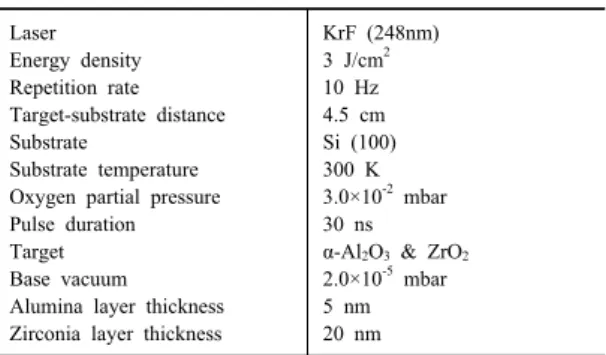
Al2O3 (99.99% purity) and ZrO2 (99.99%) pellets of 25 mm diameter and 3 mm thickness were prepared and sintered at 1673 K for 6 hours and used as targets for PLD. The deposition was performed using a KrF excimer laser and other deposition parameters are given in Table 1.
Table 1 Deposition parameters of multilayer film Laser
Energy density Repetition rate Target-substrate distance Substrate
Substrate temperature Oxygen partial pressure Pulse duration Target Base vacuum Alumina layer thickness Zirconia layer thickness
KrF (248nm) 3 J/cm2 10 Hz 4.5 cm Si (100) 300 K 3.0×10⁻² mbar 30 ns α-Al2O3 & ZrO2
2.0×10⁻⁵ mbar 5 nm 20 nm
Si (100) oriented substrates (N-type phosphorous doped with a resistivity of 20-30 Ω- cm) were used for the thin film deposition. No special preparation was carried out to remove the native oxide present on the Si substrates. Prior to the deposition of Al2O3/ZrO2 multilayer thin films, the chamber was evacuated to 2×10⁻⁵ mbar using a turbo molecular pump backed with a rotary pump. The target was rotated and translated with an electric motor to avoid pitting on the target. Multilayer, which consists of a Al2O3 layer of 5 nm thickness and a ZrO2 layer of 20 nm were deposited at an optimized oxygen partial
pressure of 3×10⁻² mbar at room temperature. A total of 40 bilayers were deposited. Before the deposition of the multilayers, deposition rates of the individual layers were determined accurately by measuring the thickness of each layer using a Dektak profilometer (DEKTAK 6M-stylus profiler). The multilayer sample consists of alternate layer of Al2O3 and ZrO2 with a total thickness of 1.0 µm was in- situ heat-treated upto 1373 K in X-ray diffractometer attached with a curved position sensitive detector and a Buhler 2.4 HDK high temperature camera to study the microstructural and thermal properties.
A heating rate of 10 K/min, cooling rate of 25 K/min and soaking time of 5 minutes were used. The patterns were recorded from 300 to 1373 K in steps of 100 K in a vacuum of the order of ~ 2×10⁻⁵ mbar. All patterns were recorded for 30 minutes. The surface morphology of the film was analysed using a field emission scanning electron microscope (TESCAN, Model:
MIRA II LMH) equipped with a high brightness schottky emitter.
3. Results and discussion
Figure 1 shows the HTXRD pattern of a Al2O3/ZrO2 (5/20 nm) multilayer film with 40 bilayers in the temperature range 300 -1373 K. The broadening of the peak at an angle of 32° occurred due to the overlapping of peaks of monoclinic and tetragonal phases. The films were amorphous at low temperatures. At 873 K, the film showed crystalline nature of zirconia. The peaks (101), (002), (110) (102), (200), (103), (211), (004), (220), (222) and (301) corresponding to the tetragonal phase, and a weak peak of (-111), corresponding to monoclinic zirconia, were observed [14]. As the temperature increased from 873 K to 1373 K, the intensity of the (101) peak increased compared to the intensity of the (-111) of the monoclinic phase, indicating an increase of the tetragonal phase content with increasing annealing temperature. It was interesting to note that the alumina remains in amorphous state throughout the range of annealing temperature. It is believed that when the alumina films are formed with thickness less than the critical thickness, the temperature of crystallization also increases significantly and therefore the films are amorphous when the thickness is about 5 nm[15,16].
It is seen from the Fig.1 that the phase content of tetragonal phase is significantly higher than that of the monoclinic phase and their fractions change slightly at higher annealing temperatures.
There was no complete transformation of monoclinic phase into tetragonal phase or vice-versa in the above temperature range (300-1373 K).
Fig. 1 HTXRD pattern of Al2O3/ZrO2 (5 nm/20 nm) film deposited at 300 K.
Fig. 2 FESEM image shows the surface morphology of the Al2O3/ZrO2
(5/20 nm) film deposited on Si (100) at 300 K.
The phase composition (monoclinic and tetragonal) was calculated as a function of temperature. The weight fraction of the monoclinic and tetragonal phases of zirconia is given by equation (1)[17]:
m
m m t
I 111 V {I 111 I (101)}
(1)
Vt = 1-Vm
where Im is the peak intensity of monoclinic and It is the peak intensity of tetragonal phases. The weight fraction of the monoclinic and tetragonal phases were determined qualitatively using the reflections (-111) of monoclinic and (101) tetragonal phases [18].
Fig. 3 FESEM shows the cross sectional view of Al2O3/ZrO2(5/20 nm) film deposited on Si (100) at 300 K.
Fig. 4 EDAX shows the presence of Al2O3 and ZrO2 in the film.
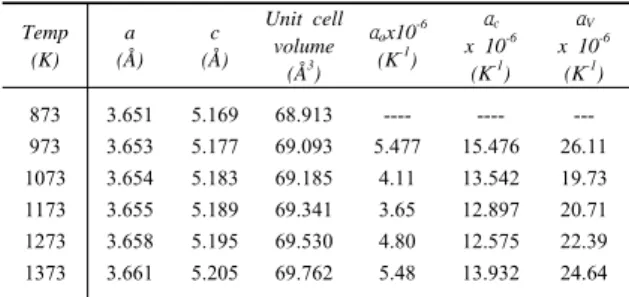
Table 2 Lattice parameters and thermal expansion coefficients of the t-ZrO2 of Al2O3/ZrO2 (5 nm/20 nm) multilayer film annealed at high temperature.
Temp (K)
a (Å)
c (Å)
Unit cell volume
(Å3)
αax10-6 (K-1)
αc
x 10-6 (K-1)
αV
x 10-6 (K-1) 873
973 1073 1173 1273 1373
3.651 3.653 3.654 3.655 3.658 3.661
5.169 5.177 5.183 5.189 5.195 5.205
68.913 69.093 69.185 69.341 69.530 69.762
---- 5.477
4.11 3.65 4.80 5.48
---- 15.476 13.542 12.897 12.575 13.932
--- 26.11 19.73 20.71 22.39 24.64
The tetragonal phase content was in the range of 81-97%
and the monoclinic phase content was 3-19% for 5/20 nm multilayer film. The lattice parameters were calculated for t-ZrO2 in 5/20 nm multilayer film. The lattice parameter a, increased from 3.651 Å to 3.661 Å, while the parameter c, increased from 5.170 Å to 5.205 Å as the temperature increased from 873 K to 1373 K. The lattice parameters, a
and c with respect to temperature are given in Table 2. The percent linear thermal expansion {(Δa/a) x100} along the a and c {(Δc/c) x100} axes and percent lattice (volume) thermal expansion were calculated as a function of temperature using the lattice parameters a and c. The mean linear thermal expansion coefficients were calculated along the a and c axes using equation (2) [19]:
αa = 1 T CT
CT
a a a T CT
αc = 1 T CT CT
c c c T CT
(2)
αv = 1 T CT CT
v v v T CT
where aCT, cCT and vCT are the lattice constants at crystallization temperature along the a, c axes and unit cell volume, respectively, aT, cT and vT are the lattice constants along a, c directions and unit cell volume respectively at temperature T, αa is the thermal expansion coefficient of cell parameter a, αc is the thermal expansion coefficient of cell parameter c, αv is the volume thermal expansion coefficient and CT is the crystallization temperature at which crystallization of the ZrO2 is observed.
The percent thermal expansion along the a and c axes were calculated as a function of temperature for 5/20 nm film of Al2O3/ZrO2. It showed a maximum thermal expansion value of 0.3 % along the a axis and 0.7 % along the c axis at a temperature of 1373 K. The maximum percent lattice thermal expansion was 1.2 % at 1373 K. Table 2 gives a, c values, unit cell volume, and thermal expansion coefficients with respect to temperature. The mean linear thermal expansion coefficient was 4.7×10⁻⁶ K-1 along the a axis, while it was 13.68×10⁻⁶ K-1 along the c axis in the temperature range 873-1373 K. The thermal expansion coefficient along the c axis is around 3 times that of the a axis.
Figure 2 shows the surface morphology of the Al2O3/ZrO2 nanolayers deposited on Si (100) substrate. It shows the dense and uniform formation of the crystallites. Figure 3 shows the cross sectional view of the nanolaminate and formation of island growth of the film. Teixeira et al.[20], deposited ZrO2/Al2O3 nanolayers films by DC reactive magnetron sputtering with O2 and Ar gas mixture, at constant temperature, bias and work pressure. They reported that the high temperature tetragonal phase content increased as the nanolayers get thinner. Multilayers[6]
prepared by DC magnetron sputtering with ZrO2 layer thicknesses
between 8-20 nm showed excellent thermal stability after annealing and the Raman peak position shifts to lower wave numbers with an increase of compressive stress. ZrO2 was combined with other metal oxides in multilayer nanolaminate films such as ZrO2-Al2O3, ZrO2-Y2O3, and ZrO2-TiO2[21]. The films were grown by sequential sputter deposition of individual oxide layers from metal targets using radio-frequency-excitation with O2-bearing discharges. As the thickness of individual layers decreased, interfaces were found to play an increasingly important role in determining the nanolaminate’s overall properties. These nanolaminates had different thermodynamic driving forces for interfacial cation mixing. It is found that thermodynamic considerations strongly influence both phase formation within layers and at interfaces, where deposition are carried out at far from equilibrium[22]. Pseudo binary phase diagrams could be used to predict interfacial cation mixing in the nanolaminates.
However, size effects must be considered to predict specific structures. In the absence of pseudo epitaxy, size effects play a significant role in determining the nanocrystalline phases that form within a layer (e.g. t-ZrO2, tetragonal HfO2, and orthorhombic HfO2) and at interfaces (e.g. monoclinic (Zr, Ti)O2). Their formation is understood in terms of self-assembly into the lowest energy structure in individual critical nuclei.
Barshilia et al. [23] prepared nanolayer thin films of ZrO2/Al2O3
using pulsed sputtering to study the stabilization of various polymorphs of ZrO2. These films were deposited at various substrate temperatures (623-973 K), varying individual layer thicknesses (1.9-25.2 nm) and modulation wavelengths (bilayer thickness) (Λ=9.6-32.7nm). X-ray diffraction data showed monoclinic and amorphous structures for ZrO2 and Al2O3
thin films, respectively. The tetragonal phase of ZrO2 (t-ZrO2) was stabilized for ZrO2/Al2O3 nanolayer thin films prepared with bilayers thickness (Al2O3 layer thickness + ZrO2 layer thickness) of ≤13.8 nm. They demonstrated that a critical ZrO2 thickness (≤10.5 nm at a substrate temperature of 973 K) was required in order to stabilize the t-ZrO2 phase, which was in agreement with thermodynamically derived critical radius for the stabilization of the tetragonal phase.
Pure zirconia films and zirconia-alumina nanolaminate films grown by reactive sputter deposition were studied by high resolution transmission electron microscopy (HRTEM) and electron energy loss spectroscopy (EELS) [24]. The results showed that there was a significant difference between the transformation behaviour of dopant-stabilized and that of undoped nanocrystals of tetragonal zirconia. In the former, the metastable tetragonal phase was shown to transform to the monoclinic phase under application of stress. In contrast, no such transformation was
observed under similar stress conditions in tetragonal zirconia nanocrystallites, when the alumina layers were preserved.
Therefore, the tetragonal zirconia nanocrystallites in zirconia-alumina nanolaminates are less likely to undergo transformation than the dopant-stabilized zirconia microcrystallites in zirconia-alumina composites. Alumina influences the growth of the zirconia layer and provides a template for the stabilization of metastable phase of zirconia. The monoclinic to tetragonal phase transformation depends on physical and chemical factors and the layer thickness is the most important influencing parameter on stabilization of tetragonal zirconia. The critical thickness of the metastable phase depends on a combination of bulk free energy, interfacial energy, and surface energy[19]. When the layers are very thin, the interfacial and surface energies dominate both the bulk and the strain energy terms, which could promote the formation of a metastable phase with a low interfacial energy. If the layers have thickness above a critical thickness, the interfacial energy term becomes less important and bulk formation energies dominate. This kind of multilayer is not only interesting in terms of applications but also provides better understanding in the materials properties when subjected to high temperatures. In the present research work, ZrO2 layer thickness is 20 nm and the Al2O3 layer thickness is 5 nm, so that the very thin layer of Al2O3 (5 nm) is not able to provide the enough compress stress on thicker ZrO2 layer of 20 nm. Hence, the Al2O3 layer (5 nm) is not able to provide the enough local compressive stress to suppress the monoclinic phase. Therefore the tetragonal crystallization occurred only at 873 K. Therefore it is necessary to reduce the ZrO2 layer thickness to less than 20 nm, so that it could be possible to attain the tetragonal phase at lower temperature.
4. Conclusion
A nanolaminate structure consisting of alternate layers of Al2O3 and ZrO2 were fabricated using pulsed laser deposition.
High temperature X-ray diffraction indicated a crystallization temperature of tetragonal zirconia in the Al2O3/ZrO2 multilayers at 873 K. The mean linear thermal expansion coefficient of tetragonal zirconia was 4.7×10⁻⁶ K-1 along a axis, while it was 13.68×10⁻⁶ K-1 along c axis in the temperature range 873-1373 K. The FESEM studies showed a uniform distribution of crystallites and dense surface of the film.
ACKNOWLEDGEMENTS
The authors are thankful for the National Research Foundation of Korea (NRF) grant funded by the Korea Government (MEST) (No.2012-0009455, 2011-0002804) and this research is also financially supported by Changwon National University in 2012-2013.
References
1) Garvie, R.C., “Stabilization of the tetragonal structure in zirconia microcrystals,” Journal of Physical Chemistry, Vol.
82, No. 2, 1978, pp. 218-224.
2) Balakrishnan, G., Sairam, T.N., Kuppusami, P., Thiumurugesan, R., Mohandas, E., Ganesan, V., and Sastikumar, D., “Influence of oxygen partial pressure on the properties of pulsed laser deposited nanocrystalline zirconia thin films,” Applied Surface Science, Vol. 257, No. 20, 2011, pp. 8506-8510.
3) Andritschky, M., Cunha, I., and Alpuim, P., “Thermal stability of zirconia/alumina thin coatings produced by magnetron sputtering,” Surface and Coating Technology, Vol. 94-95, No. 1-3, 1997, pp. 144-148.
4) Aita, C.R., Wiggins, M.D., Whig, R., Scanian, C.M., and Josifovska, M.G., “Thermodynamics of tetragonal zirconia formation in a nanolaminate film,” Journal of Applied Physics, Vol. 79, No. 2, 1996, pp. 1176-1178.
5) Teixeira, V., Andritschky, M., Fischer, W., Buchkremer, H.P., and Stöver, D., ‘‘Effects of deposition temperature and thermal cycling on residual stress state in zirconia-based thermal barrier coatings,” Surface and Coating Technology, Vol. 120-121, No. 3-4, 1999, pp. 103-111.
6) Gao, P., Meng, L.J., Dos Santos, M.P., Teixeira, V., and Andritschky, M., “Study of ZrO2/Al2O3 multilayers,” Vacuum, Vol. 64, No. 3-4, 2002, pp. 267-273.
7) Garvie, R.C., Pascoe, R.T., and Hannink, R.H.J., “Ceramic steel,” Nature, Vol. 258, 1975, pp. 703-704.
8) Dakskobler, A., and Kosmac, T., “The preparation and pro- perties of Al2O3-ZrO2 composites with corrugated micro- structures,” Journal of European Ceramic Society, Vol. 24, No. 12, 2004, pp. 3351-3357.
9) Scanlan, M., Gajdardziska-Josifovska, M., and Aita, C.R.,
“Tetragonal zirconia growth by nanolaminate formation,”
Applied Physics Letters, Vol. 64, No. 26, 1994, pp. 3548- 3550.
10) Cao, X.Q., Vassen, R., and Stoever, D., “Ceramic materials for thermal barrier coatings,” Journal of European Ceramic
Society, Vol. 24, No. 1, 2004, pp. 1-10.
11) Bjormander, C., “CVD deposition and characterization of coloured Al2O3/ZrO2 multilayers,” Surface and Coating Technology, Vol. 201, No. 7, 2006, pp. 4032-4036.
12) Tamura, M., Takahashi, M., Ishii, J.S.K., Sato, M., and Shimomura, K., “Multilayered thermal barrier coating for land-based gas turbines,” Journal of Thermal Spray Technology, Vol. 8, No. 1, 1999, pp. 68-72.
13) Chrisey, D.B., and Hubler, G.B., Pulsed Laser Deposition of Thin Films, Wiley, New York, 1994.
14) Trinh, D.H., Kubart, T., Nyberg, T., Ottosson, M., Hultman, L., and Hogberg, H., “Direct current magnetron sputtering deposition of nanocomposite alumina-zirconia thin films,”
Thin Solid Films, Vol. 516, No. 23, 2008, pp. 8352-8358.
15) Zhao, C., Roebben, G., Bender, H., Young, E., Haukka, S., Houssa, M., Naili, M., De Gendt, S., Heyns, M., and Van Der Biest, O., “In situ crystallisation in ZrO2 thin films during high temperature Xray diffraction,” Micro- electronics Reliability, Vol. 41, 2001, pp. 995-998.
16) Balakrishnan, G., Kuppusami, P., Murugesan, S., Ghosh, C., Divakar, R., Mohandas, E., and Sastikumar, D., “Characteri- zation of Al2O3/ZrO2 nano multilayer thin films prepared by pulsed laser deposition,” Materials Chemistry and Physics, Vol. 133, No. 1, 2012, pp. 299-303.
17) Djurado, E., Bouvier, P., and Lucazeau, G., “Crystallite Size Effect on the Tetragonal-Monoclinic Transition of Undoped Nanocrystalline Zirconia Studied by XRD and
Raman Spectrometry,” Journal of Solid State Chemistry, Vol. 149, No. 2, 2000, pp. 399-407.
18) Lange, F.F., ‘‘Transformation toughening,” Journal of Materials Science, Vol. 17, No. 1, 1982, pp. 225-234.
19) Clemens, B.M., Kung, H., and Barnett, S.A., “Structure and strength of multilayers,” MRS Bulletin., Vol. 24, No.
2, 1999, pp. 20-26.
20) Teixeira, V., Monteiro, J., Duarte, J., and Portinha, A.,
“Deposition of composite and nanolaminate ceramic coatings by sputtering,” Vacuum, Vol. 67, No. 3-4, 2002, pp. 477- 483.
21) Aita, C.R., “Zirconia-metal (Al, Y, Ti) oxide nanolaminate films,” Surface and Coating Technology, Vol. 188-189, 2004, pp. 179-185.
22) Aita, C.R., “Reactive sputter deposition of metal oxide nanolaminates,” Journal of Physics: Condensed Matter, Vol. 20, No. 26, 2008, pp. 264006.
23) Barshilia, H.C., Deepthi, B., and Rajam, K.S., “Stabilization of tetragonal and cubic phases of ZrO2 in pulsed sputter deposited ZrO2/Al2O3 and ZrO2/Y2O3 nanolayered thin films,” Journal of Applied Physics, Vol. 104, 2008, pp.
113532-44.
24) Schofield, M.A., Aita, C.R., Rice, P., Gajdardziska-Josifovska, M., “Transmission electron microscopy study of zirconia- alumina nanolaminates grown by reactive sputters deposition.
Part I: zirconia nanocrystallite growth morphology,” Thin Solid Films, Vol. 326, No. 1-2, 1998, pp. 106-116.