PubMed 검색을 통한 항암화학요법 부작용 관련 침 임상시험 현황 고찰
김종윤, 김진엽, 김남식, 김소정, 뭉흐게렐, 김용석, 최도영, 남상수*
경희대학교 한의과대학 침구의학교실
[Abstract]
Review on Clinical Trials of Chemotherapy Induced Toxicity with Acupuncture in PubMed Database
Jong Yoon Kim, Jin Youp Kim, Nam Sik Kim, So Jung Kim, Munkhgerel Oyungerel, Yong Suk Kim, Do Young Choi and Sang Soo Nam*
Department of Acupuncture & Moxibustion Medicine, College of Korean Medicine, Kyung Hee University
Objectives : The purpose of this study is to review of Clinical trials related to the treatment of chemotherapy induced-toxicity by acupuncture therapy.
Methods : We searched PubMed by using word of "chemotherapy induced, acupuncture" (Limits : Full text available, 10 years, Clinical trials, Humans, English). We analyzed 15 research paper and examined published journals, years, countries, topic, study design, their results, interventions, participants and instruments of assessment.
Results : Eleven journals with fifteen papers were searched. These papers were published in USA, Germany, etc. On the topic of these clinical trials, seven of them were about nausea(vomiting), two about peripheral neuropathy, two about hot flash, two about arthralgia and one about neutropenia, one about fatigue. Six of these studies were single blinded, randomized controlled trial. Twelve studies reported significant effect. The median for number of final participants was 35.5 persons. Assessment for outcomes were versatile questionnaire, nerve conduction studies, WBC, ANC, G-CSF examination, etc.
Conclusions : Their median for impact factor was 3.650 and average modified Jadad score of six RCTs was 4.33. In order to provide appropriate evidence regarding the effectiveness of acupuncture in treatment for chemotherapy-induced toxicity, more rigorous and well-designed studies are necessary.
Key words : Chemotherpy induced;
Clinical trials;
Acupuncture;
PubMed
Received : 2013. 03. 11.
Revised : 2013. 03. 28.
Accepted : 2013. 03. 29.
On-line : 2013. 04. 20.
* Corresponding author : Department of Acupuncture & Moxibustion Medicine, Kangnam Korean Hospital Kyung Hee University, 225, Yeongdong-daero, Gangnam-gu, Seoul, 135-501, Republic of Korea
Tel. +82-2-3457-9011 E-mail : [email protected]
This is an Open-Access article distributed under the terms of the Creative Commons Attribution Non-Commercial License (http://creativecommons.org/licenses/by-nc/3.0) which permits unrestricted non-commercial use, distribution, and reproduction in any medium, provided the original work is properly cited.
Copyright © 2013 KAMMS. Korean Acupuncture & Moxibustion Medicine Society. All rights reserved.
Ⅰ. 서 론
WHO의 World Cancer Report에 의하면 2020년경 에는 지금보다 암 발병률이 50 % 증가하여 무려 1,500만 명의 환자가 생길 것으로 전망하였고, 해마다 590만 암환자들이 생기고 있다. 따라서 암환자가 증가함에 따라 항암화학요법 치료를 받는 숫자가 늘어나고, 항 암제 또한 다른 부작용을 초래하므로, 더 많은 환자들 이 항암제 독성의 영향을 받게 된다1).
1981년에 보고된 바로, 항암제 치료로 생기는 주요 생명 위협적인 장기독성을 빈도순으로 살펴보면, gas- tointestinal(92 %), bone marrow(88 %), hepatic(52 %), cardiovascular(40 %), renal(40 %), neuromuscular(28 %), respiratory(20 %)2)였다. 2008년에 이르러서는 항암치 료로 인한 neurotoxic side effect가 hematological toxicity 에 이어 두 번째로 다발하는 부작용이 되었다고 한다3). 세계 각국에서는 이런 부작용들을 예방하고 치료 하는 기존 방법들보다 대체보완의학을 찾는 사람들이 늘고 있지만4) 항암부작용을 겪는 환자들이 얼마나 한 의학 및 보완대체요법을 사용하는지에 대해서는 정확 히 보고된 바가 없다. 항암부작용 중 말초신경병증을 앓는 77명의 설문조사에 의하면, 50 % 정도가 한 종 류 이상의 보완대체요법을 받고 있으며, 그 중에 절반 이상은 그 치료법들이 효과가 있다고 답하였다5).
이에 본 연구에서는 PubMed에서 항암화학요법으 로 나타나는 부작용에 관련된 침 임상연구 논문을 수 집, 분석, 고찰하여 항암치료 부작용에 대한 한의학 향후 연구에 초보적인 자료를 제공하고자 한다.
Ⅱ. 대상 및 방법
1. 연구대상문헌
PubMed에서 검색어는 ‘chemotherapy induced, acu- puncture’로, 제한 조건에서 full text available, dates 는 published in the last 10 years, type of article은 clinical trials로, species는 humans로, languages는 English로 검색하여 총 26편의 논문이 검색되었으며, 이 중 항암화학요법 부작용 관련이 아닌 논문을 제외 하면 15편의 논문이 검색되었다. 그리고 검색어를 ‘che- motherapy toxicity, acupuncture’로 하고 제한조건은
그대로 하여 다시 논문을 검색했지만, 검색된 2편 중 한 편은 15편 논문 중 하나였고, 나머지 한 편은 radiotherapy 부작용 관련 논문으로 제외되었으며, 추 가적인 논문은 검색되지 않았다.
2. 연구방법
총 15편의 논문을 게재지, 연도 및 국가별 분류, topic 분류, 연구 형태 분류, 연구 결과, intervention, 최종 관찰 대상자 수 및 평가 도구 등에 대해 살펴보 고 관찰하였다.
Ⅲ. 결 과
1. 게재지
PubMed를 통해 검색된 총 15편의 논문은 11종의 저널에 게재되어, 이 중에서 Journal of Alternative
and Complementary Medicine
6,12,17)에 3편으로 가장 많이 게재되었으며, Acupuncture in Medicine7,8), SupportCare Cancer
18,19)에 각 2편, 기타 저널에 각 1편씩 있 었다. 이 중 2011년 기준으로 impact factor가 조사된 저널은 15편 모두였으며 이 중 Journal of ClinicalOncology가 18.970으로 가장 높았으며, Breast Cancer Research and Treatment가 4.859로 두 번째 높았고,
그 이외에 13저널은 3.0 이하였다. 11종 저널 impactor factor의 평균은 3.650이었다(Table 1).2. 발표연도 및 발표국가
저널에 실린 연도별 논문 편수는 2012년 2편6,7)(13.3 %), 2011년 2편8,9)(13.3 %), 2010년 1편(6.7 %)10), 2009년은 4편11-15)(26.7 %)으로 가장 많았으며, 2008년 1편14)(6.7%), 2007년 1편16)(6.7 %), 2006년 3편17-19)(20 %), 2005년 1편20) (6.7 %)이었다. 각 나라별 발표 편수는 미국이 5편9-12,20) (33.3 %)으로 제일 많았으며, 독일 4편7,14,18,19)
(26.7 %), 영국 2편8,16)(13.3 %)이었으며, 대만6)ㆍ중국13)ㆍ노르웨이15)ㆍ 싱가포르17)가 각 1편(6.7 %)씩 발표하였다(Table 1).
3. 증상
항암화학요법으로 인한 부작용 증상에 따라 논문을
Thesis No. and 1st.
author Title of journal(2011 impact factor) Published year
Published country Yeh CH6) J Alternative and Complementary Medicine(1.498) 2012 Taiwan
Schroeder S7) Acupuncture in Medicine(1.381) 2012 Germany
Donald GK8) Acupuncture in Medicine(1.381) 2011 UK
Hani A9) Radiation Oncology(2.409) 2011 USA
Katherine DC10) J Clinical Oncology(18.970) 2010 USA
James JM11) Integrative Cancer Therapies(1.716) 2009 USA
Lu W12) J Alternative and Complementary Medicine(1.498) 2009 USA
You Q13) International J Gynecological Cancer(1.558) 2009 China
Gottschling S14) Klinische Padiatrie(1.583) 2008 Germany
Hervik J15) Breast Cancer Research and Treatment(4.859) 2009 Norway Molassiotis A16) Complementary Therapies in Medicine(1.484) 2007 UK Choo SP17) J Alternative and Complementary Medicine(1.498) 2006 Singapore
Melchart D18) Supportive Care in Cancer(2.058) 2006 Germany
Tobias KR19) Supportive Care in Cancer(2.058) 2006 Germany
Roscoe JA20) J Pain and Symptom Management(2.640) 2005 USA
Table 1. Published Journal, Year and Country
Thesis No. and 1st. author Topic(chemotherapy toxicity symptoms) Study design
Yeh CH6) Nausea and vomiting Randomized, crossover trial
Schroeder S7) Peripheral neuropathy Pilot, non-randomized cotrolled trial
Donald GK8) Peripheral neuropathy Pre-and post-trial
Hani A9) Hot flash Pre-and post-trial
Katherine DC10) Joint symptoms RCT, single blinded
James JM11) Arthralgia Pre-and post-trial
Lu W12) Neutropenia Pilot, RCT, single blinded
You Q13) Nausea and vomiting RCT, single blinded
Gottschling S14) Nausea and vomiting Randomized, crossover, pilot trial
Hervik J15) Hot flash RCT, single blinded
Molassiotis A16) Fatigue RCT, single blinded
Choo SP17) Refractory acute emesis Pre-and post-trial
Melchart D18) Nausea Randomized, crossover, pilot study
Tobias KR19) Nausea and vomiting Randomized, prospective, crossover
Roscoe JA20) Nausea RCT, single blinded
Table 2. Study Topic and Design
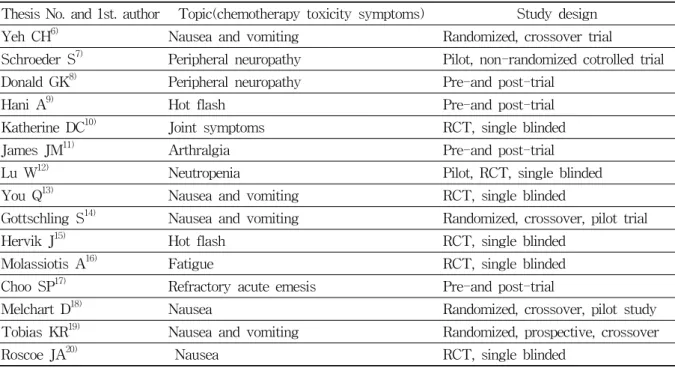
분류해보면 nausea and vomiting이 7편6,13,14,17-20)
(46.7 %)으로 가장 많았으며, peripheral neuropathy7,8), hot flash9,15), arthralgia10,11)가 각 2편씩(13.3 %), neutropenia12), fatigue16)가 각각 1편씩(6.7 %)이었다(Table 2).
4. 연구형태
PubMed에서 검색한 연구 중 대조군에 대해 살펴 본 결과, 대조군 연구를 시행한 7편 중 무작위 대조군 연구는 6편10,12,13,15,16,20)
(40 %)이었으며, 비무작위 대조
Thesis No. and
1st. author Experimental intervention Control intervention Result
Yeh CH6)
Auricular acupressure (shenmen,sympathetic,cardia,
stomach,subcortex) + standard care / sham points auricular acupressure (external knee, eye, point, vision, shoulder) + standard care
No control group No
significant
Schroeder S7)
Acupuncture(ST34, the five extra points EX-LE12, the four extra EX-LE8) bilaterally, 20 min, 10 weeks + best medical care
Best medical care but no specific
treatment Effective
Donald GK8)
Acupuncture points
(based on patient presentation) common points(SP6, ST36, LV3, LI4, BL60, Bafeng, Baxie)
No control group Effective
Hani A9)
Acupuncture 10 bilateral points (GB34, SP6, KI3, ST36, BL15, BL23, Taiyang, HT7, PC6, LI11) +
electrostimulation(4 of 10 points, 2 Hz) 30 min, weeks
No control group Effective
Katherine DC10)
True acupuncture(full body, auricular, joint specific point prescription) 30 min, twice weekly over 6 weeks
Sham acupuncture(superficial insertion,
not recognized as true acupoints) Effective
James JM11)
4 local points around joint, 4 distant points +TENS unit(2 Hz electrostimulation) 20 min, 10 times
No control group Effective
Lu W12)
Acupuncture(LR3, K3, SP6, ST36, SP10, LI4, PC6, LI11, GV20) + ST36, SP6 electro- acupuncture(20~25 Hz) 30 min, 10 times + Infrared 30cm directly
Sham needles(seven sites, away from TCM) depths 0.2 mm
+deactivated electroacupuncture machine +heat lamp 75 cm away
Effective but no significant in G-CSF
You Q13) Acupuncture plus vitamin B6
(PC6 points, 50 mg, 20 min, 10 times)
Acupuncture(bilaterally, PC6, 20 min, 10 times)/vitamin B6(50 mg, intramus- cular)
Effective
Gottschling S14)
Chemotherapy plus acupuncture (acupuncturist’s decisions, PC6, ST36, CV12, LI4) / chemotherapy
No control group Effective
Hervik J15)
Acupuncture 8 unilateral points (LIV3, GB20, LU7, KI3, SP6, REN4, PC7, LIV8) 30 min, twice a week for the first 5 weeks, once a week for the following 5 weeks
Sham acupuncture 2~3 mm deep 4 bilateral points(5, 10, 15 cm proximal to upper border of patella, highest point of trapezius)
Effective
Molassiotis A16)
Acupuncture group(LI4, SP6, ST36) bilaterally 3 times a week for 2 weeks / acupressure group(LI4, SP6, ST36) 1 min each, daily for 2 weeks
Sham acupressure group(LI12, GB33,
BL61) same way in acupressure group Effective
Choo SP17)
PC6, ST36 acupuncture point bilaterally, Acus Ⅱ electrical stimulator(10 Hz, 20 minutes, maximum of 10 mA)
No control group Effective
Table 3. Intervention, Result of Study
Melchart D18)
One cycle with a combination of acu- puncture and acupressure at PC6 / one cycle at a close sham point
No control group No
significant
Tobias KR19)
Antiemetic medication plus acupuncture (acupuncturist's decisions) / antiemetic medication
No control group Effective
Roscoe JA20)
Active acustimulation
(PC6, relief band on the inside of the wrist)
Sham acustimulation(the outside of the wrist)/no acustimulation
No significant
Thesis No. and 1st. author
Number of final
participants Assessment for outcome
Yeh CH6) 10 patients aged 5 to 18 Morrow assessment of nausea and emetics(a self-report questionnaire)
Schroeder S7) 11 patients Nerve conduction studies of the sural nerve Donald GK8) 17 patients questionnaire
Hani A9) 14 men aged 61 to 84 HFS*(the product of hot flash frequency×severity) Katherine DC10) 38 women aged 37 to 77 WOMAC†, M-SACRAH‡, BPI-SF§(questionnaire)
James JM11) 12 women aged 52 to 70 Brief pain inventory, joint stiffness, joint interference PGIC∥ Lu W12) 20 women aged 18 or
older WBC count, ANC¶, G-CSF**
You Q13) 137 patients aged 45 to 65 Rhodes index of nausea, vomiting, and retching scores Gottschling S14) 23 patients aged 6 to 18 The need of antiemetic rescue medicationthe number of
episodes of retching and vomitting
Hervik J15) 59 women Number of hot flashes at day and night, Kupperman Index score
Molassiotis A16) 35 patients MFI††(general fatigue, physical fatigue, activity, motivation, fatigue)
Choo SP17) 27 patients were female, aged 37 to 60
The number of emetic episodes, the severity of nausea(The National Cancer Institute grade)
Melchart D18) 22 patients aged 18 to 75 Nausea score
Tobias KR19) 11 patients aged 6 to 18 Additional antiemetic mediacation, episodes of vomiting, weight loss, nausea score
Roscoe JA20) 96 women aged 18 or older
Acute nausea, delayed nausea, vomitng, QOL, total amount of antiemetic medication used
* : hot flash sc.
†: Western Ontario and McMaster Universities Osteoarthritis Index.
‡: modified score for the assessment and quantification of chronic rheumatoid affections of the hands.
§ : a general pain scale used in cancer patients.
∥: patient global impression of change.
¶ : absolute neutrophil count.
** : plasma granulocyte colony-stimulating factor.
†† : multidimensional fatigue inventory.
Table 4. Number of Participants and Assessment for Outcome
군 연구는 1편7)(6.7 %)이었다. 대조군 연구를 시행하 지 않은 연구 8편 중 교차연구는 4편6,14,18,19)
(26.7 %), 전후연구는 4편8,9,11,17)(26.7 %)이었다. 맹검시행에 대 해서 살펴본 결과, 무작위 대조군 연구 6편 모두 단일 맹검이었다(Table 2).
5. 침치료 방법
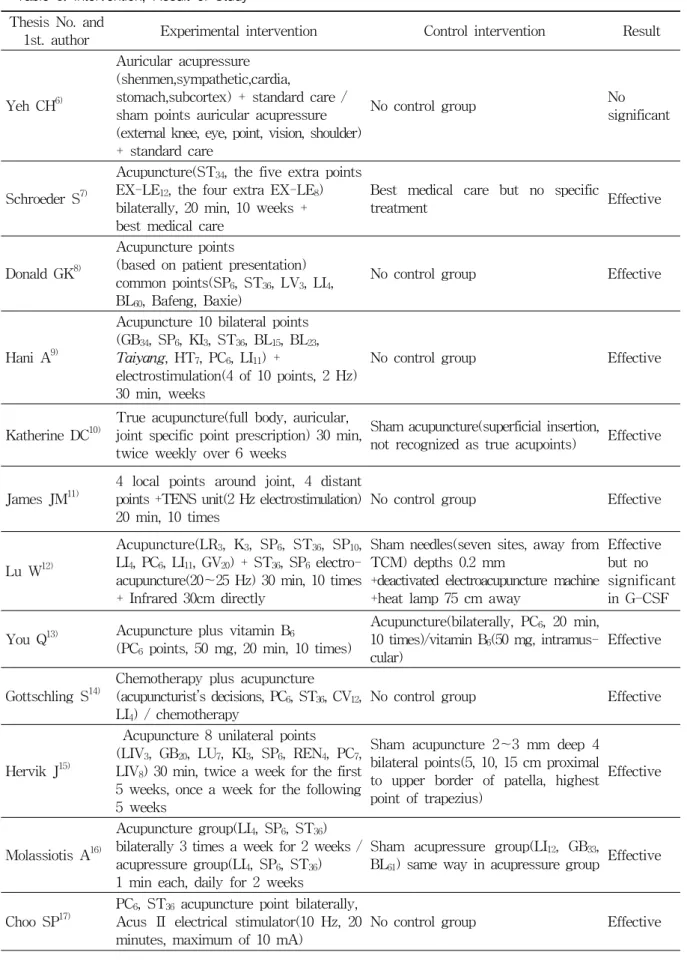
15편의 논문 중 정혈(正穴)을 이용한 논문은 14편7~20) (93.3 %)이며, 정혈(正穴) 외의 혈자리를 이용한 논문 은 auricular point 2편6,10)(13.3 %), the extra point 3 편7-9)이었다. 치료 수단별로 분류해보면 자침(刺鍼)이 13편6~12,14~19)
, electroacupuncture를 이용한 논문은 4
편9,11,12,17)이며, 그 외에 침과 vitamin B6를 결합시킨 논
문 1편13), 손목에 착용하는 밴드 형태로 혈자리에 전기 자극을 가할 수 있는 relief band를 이용한 논문 1편20) 이었다(Table 3).
연구목적에 부합되는 실험군으로 쓰인 정혈(正穴) 은 ST34(梁丘)ㆍST36(足三里)ㆍSP6(三陰交)ㆍLR3(太衝)ㆍ LI4(合谷)ㆍPC6(內關)ㆍKI3(太谿)ㆍBL60(崑崙)ㆍGB34
(陽陵泉)ㆍBL15(心兪)ㆍBL23(腎兪)ㆍHT7(神門)ㆍLI11
(曲池)ㆍSP10(血海)ㆍGV20(百會)ㆍCV12(中脘)ㆍGB20
(風池)ㆍLU7(列缺)ㆍCV4(關元)ㆍPC7(大陵)ㆍLR8(曲 泉)이며, auricular point는 Shenmen(神門)ㆍSympa- thetic(交感)ㆍSubcortex(皮質下)ㆍStomach(胃)ㆍ Sardia(心腸)이고, the extra point는 LE12(Qiduan, 氣 端)ㆍLE8(Bafeng, 八風)ㆍBaxie(八邪)ㆍTaiyang(太陽) 이었다.
6. 연구결과
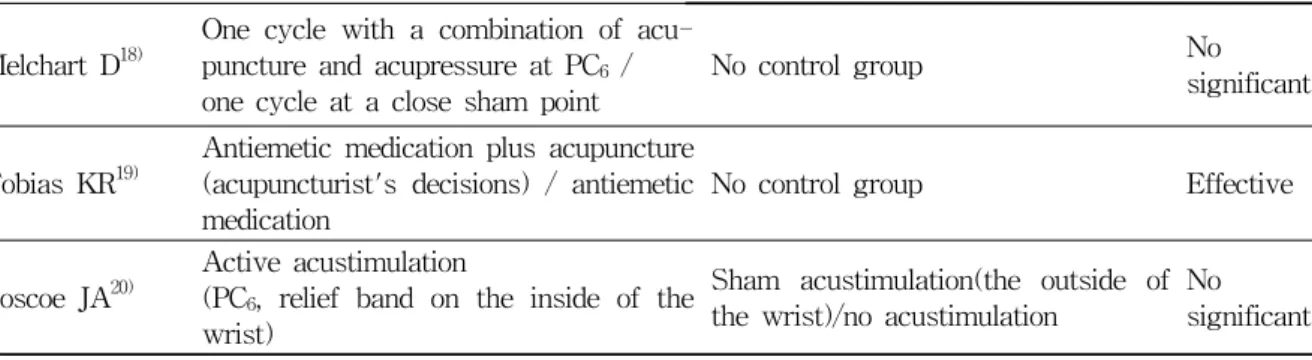
15편의 논문 중 3편6,18,20)(20 %)의 논문들이 유의한 효과가 없었으며, 나머지 12편(80 %)의 논문에서는 유의한 효과가 있는 것으로 평가되었다(Table 3).
7. 대상자 수
총 15편 논문의 최종 관찰 대상자의 수는 10명에서 137명으로 다양하였으며, 평균은 35.5명이었다. 단위 별로 살펴보면 19명 이하가 6편(40 %), 20~50명 이 하가 6편(40 %), 50명 초과가 3편(20 %)이었다(Table 4).
8. 평가도구
Hot flash 혹은 nausea, vomiting 관련 논문 9편6,9,13~
15,17~20)(60 %) 모두 빈도, 강도, 기능평가 등을 점수화
시킨 questionnaire 방법을 통해 평가했다. Peripheral neuropathy 관련 논문 2편 중 1편7)(6.7 %)은 nerve conduction을 통해 평가했고, 1편8)(6.7 %)은 question- naire통해서 평가했다. Arthralgia 관련 논문 2편은10,11) (13.3 %)은 통증 및 관절 상태를 점수화시킨 WOMAC, M-SACRAH, BPI-SF, BPI, PGIC 등의 questionnaire 로 평가했다. Neutropenia 관련 논문 1편12)(6.7 %)은 WBC, ANC, G-CSF 검사를 통해 평가했고, fatigue 관련 논 문 1편16)(6.7 %)은 MFI를 통해 평가했다(Table 4).
Ⅳ. 고 찰
서양의학에서 암 치료 방법은 현재까지도 수술(surgery), 항암화학요법제(chemotherapy) 그리고 방사선(radio- therapy)의 3대 요법이 중심이고 그 밖의 기타 요법으로 크게 분류할 수 있다. 각각의 치료 방법들은 암 치료를 위해 독자적으로 사용하거나, 두 가지 이상의 방법을 병용한다.21)
현재 암 치료에 사용하고 있는 방법 대부분은 항암 화학요법제인데, 항암제도 일정 수의 암세포를 파괴 하기보다는 일정한 비율로 암세포를 없애기 때문에22) 암의 완치보다는 증상완화의 방법으로 사용하고 있어 서, 암의 증상과 증후를 일시적으로 제거해주고 수명 을 연장시켜주는 수준이다. 항암제가 상당히 발전해 왔음은 분명하나, 현재 사용하는 화학요법제인 항암 제는 부작용, 항암제 내성 등의 문제점이 있다.
Anti-cancer medicine의 주된 기능이 fast-growing cancer cells를 공격하는데 주된 기능이 있어서 백혈 구, 적혈구, 혈소판, 점막을 형성하는 세포들(e.g. 구강 내, 인후, 위장), 그리고 모근세포 같이 체내 정상 세 포 중에서 빨리 성장하는 세포들도 함께 손상시킨다.
따라서 항암화학요법은 정상세포를 파괴하거나 성장 속도를 늦추므로 이로 인해 전신에 걸쳐 여러 가지 부작용들이 생길 수밖에 없다23). 항암제로 생길 수 있 는 독성 증상은 각 기관별로 다양하게 발생할 수 있 는데, 이를 한의학적으로 분류하면 Table 5와 같다24). 이 분류를 바탕으로 항암화학요법으로 인한 부작용에 한의학적인 예방과 치료를 응용해볼 수 있다고 생각 한다.
항암제로 인한 다양한 부작용 증상에도 불구하고,
Classification Diseases and symptoms
Oriental internal medicine
Liver system
Anemia, bilirubin blood level, bladder problems, bleeding problems, flushing, gynecomastia, hepatotoxicity, high liver enzymes, irondeficiency, anemia, nail changes, granulocytopenia, leukopenia, neutropenia, pancy- topenia, thrombocytopenia, low blood counts
Heart system
Ataxia, blood pressure changes, cardiotoxicity, balance&mobility changes, deep vein thrombosis, EKG changes, heart failure, heart palpitations, heart problems, heart rhythm changes, hypertension, hypotension, incoordination, hematoma, bruising, chest pain, myocarditis, pericarditis, feeling faint, headache, numbness, vertigo, photophobia, anaphylaxis, asthenia
Spleen system
Abdominal pain, acidindigestion,acid reflux, heart burn, dyspepsia, early satiety, esophagitis, flatulence, gastroesophageal reflux disease, lack of appetite, metallic taste, mouth sores(mucositis), nausea, taste changes, vomiting, xerostomia, hyperamylasemia
Lung system
Alopecia, breathing problems, constipation, cough, diarrhea, dry skin, dyspnea, hypersensitivity skin reactions, injection site reactions, itching, lung problems, nosebleeds, pneumonia, pulmonary embolus, pulmonary fibrosis, pulmonary toxicity, rectal bleeding, rhinitis
Kidney system
Bone pain, cystitis, genital pain, hemorrhagic cystitis, hyperuricemia, impotence, infertility, kidney problems, loss of libido, myelosuppression, nephrotoxicity, proteinuria, urinary tract infection, water retention, hyper- glycemia, hypoglycemia, thyroid hormone levels, hypercalcemia, hypocalcemia, hyperchloremia, hypochloremia, hyperglyceridemia, hyperkalemia, hypokalemia, hypermagnesemia, hypomagnesemia, hypernatremia, hyponatremia, hyperphos- phatemia hypophosphatemia
Oriental neuropsychiatry
Restlessness, anxiety, central neurotoxicity, chemo Brain, cognitive problems, confusion, depression, insomnia, memory loss, nervousness, pain, palmar-plantar erythrodysesthesia, peripheral neruopathy, sadness, tingling Muscle-skeleton Arthralgias, cramp joint pain, musclepain(myalgias)
Oriental obstetrics and
gynecology Menopause, vaginal bleeding, vaginal dryness, vaginal infection Oriental medical
ophthamology &
otolaryngology & dermatology
Cataract, conjunctivitis, dry eye syndrome, dry mouth, glaucoma, hearing loss, hearing problems, ototoxicity, pharyngitis, photosensitivity, post-nasal dripty, inging earsty, unny nose, tinnitustywatery eyes, allergic reactions, rash, hyperpigmentation
Whole body
Azotemia, chills, dehydration, drug reactions, electrolyte imbalance, fatigue, fever, flu-like syndrome, hyperlipasemia, infection, weakness, weight changes
Table 5. Categorization of Cancer Chemotherapy Toxicity Symptoms(by Oriental Medicine Classification)
현재 국내 한의계에서는 관련 연구가 부족하고 치료 근거로 참고할 수 있는 연구 실적이 없는 실정이기에, 저자는 최근 10년간 PubMed에 발표된 항암화학요법 부작용 관련 침 임상시험 논문들을 정리하고 분석하 였다.
PubMed를 통해 검색된 총 15편의 논문은 11종의 저널에 게재되어, 이 중에서 Journal of Alternative
and Complementary Medicine에 3편으로 가장 많이
게재되었으며, Acupuncture in Medicine, SupportCare Cancer에 각 2편씩, 기타 저널에 각 1편씩 있었
다. 이 중 2011년 기준으로 impact factor가 조사된 11종 의 저널에 대해 각각 살펴보면, 이 중 Journal of ClinicalOncology가 18.970으로 가장 높았으며, Breast Cancer
Research and Treatment가 4.859로 두 번째 높았고,
J Pain and Symptom Management 2.640, Radiation Oncology 2.409, Supportive Care in Cancer 2.058, Integrative Cancer Therapies 1.716, Klinische Padiatrie
1.583, International J Gynecological Cancer 1.558, JAlternative and Complementary Medicine 1.498, Com- plementary Therapies in Medicine 1.484, Acupuncture in Medicine 1.381 순으로 나타났다. 국제적으로 알려
져 있는 학술지의 경우 보통 impact factor가 3.0 이상인 데, 위 저널들의 평균 impact factor는 3.650으로 상대 적으로 높은 수치이다. 그러나 두 개 저널이 유독 높 은 수치이며, 나머지 9개는 모두 3.0 이하 저널이었다.저널에 실린 연도별 논문 편수는 2012년 2편(13.3 %), 2011년 2편(13.3 %), 2010년 1편 (6.7 %), 2009년은 4편 (26.7 %)으로 가장 많았으며, 2008년 1편(6.7 %), 2007년 1편(6.7 %), 2006년 3편(20 %), 2005년 1편(6.7 %)으로 지난 10년간 연구는 꾸준히 이루어졌음을 알 수 있다.
각 나라별 발표 편수는 미국이 5편(33.3 %)으로 제 일 많았으며, 독일 4편(26.7 %), 영국 2 편(13.3 %), 대만ㆍ중국ㆍ노르웨이ㆍ싱가포르가 각 1편(6.7 %)씩 발표하였다. 치료 방법을 침으로 제한해서인지 국내 논문은 검색되지 않았다.
연구 형태를 분석한 결과, 15편의 연구에서 대조군 연구를 시행한 7편 중 무작위 대조군 연구는 6편(40 %) 이었으며, 비무작위 대조군 연구는 1편(6.7 %)이었다.
대조군 연구를 시행하지 않은 연구 8편 중 교차연구는 4편(26.7 %), 전후연구는 4편(26.7 %)이었다. 임상연구 는 연구 설계의 종류에 따라 결론의 타당도가 달라지 는데, 증례보고가 설득력이 가장 낮고, 환자군 연구, 관찰연구, 환자-대조군 연구, 코흐트 연구, 무작위배 정 비교임상시험 순으로 설득력의 크기가 증가한다25). 검색 연구 형태 중 결론의 타당성이 높은, 비교적 질 이 높은 무작위 대조군 연구 6편에 대하여 맹검시행 에 대해서 살펴본 결과, 모두 단일맹검이었다. 이는 현실적으로 시술자가 블라인드 되기 어려운 침 관련 연구의 특성 때문으로 보인다.
대조군 설정을 살펴보면, 무작위 대조군 6편 중 5 편에서 sham acupuncture를 대조군으로 설정했으며, 모두 비경혈(非經穴) 자리에 superficial insertion으로 시험하였다. 그리고 나머지 한 편은 acupuncture과 vitamin B6를 결합시킨 실험군으로, 대조군은 acu- puncture군과 vitamin B6군을 각각 설정했다. 이처럼 대조군 설정에 sham acupuncture를 이용한 연구가 주를 이루었다.
각 논문의 최종 관찰 대상자의 수는 10명에서 137
명으로 다양하였으며, 평균은 35.5명이었다. 단위별로 살펴보면 19명 이하가 6편(40 %), 20~50명 이하가 6편 (40 %), 50명 초과가 3편(20 %)이었다.
항암화학요법으로 인한 부작용 증상에 따라 분류 해보면 nausea and vomiting이 7편(46.7 %)으로 가장 많았으며, peripheral neuropathy, hot flash, arthralgia 가 각각 2편(13.3 %), neutropenia, fatigue가 각각 1편 (6.7 %)이었다. 2008년을 기준으로 항암치료로 인한 부작용은 hematological toxicity와 neurotoxic toxicity 가 가장 많은 것으로 알려져 있는데3), 이에 관련된 논 문은 세 편이 검색되어 비교적 적었다.
평가기준에 따라 분석해 본 결과, 총 15편의 논문 중 13편(86.7 %)의 논문에서 빈도, 강도, 기능평가 등의 questionnaire로 평가하였으며, peripheral neuropathy 관련 논문 2편 중 1편(6.7 %)이 nerve conduction을 통해 평가 했고, neutropenia 관련 논문 1편(6.7 %)은 WBC, ANC, G-CSF 검사를 통해 평가했다. Question- naire중에서 타당도가 검증된 기능평가를 갖춘 객관 적인 평가도구는 Morrow Assessment of Nausea and Emetics, WOMAC, M-SACRAH, BPI-SF, Brief Pain Inventory, PGIC, Rhodes Index of Nausea, Vomiting, and Retching scores, Kupperman Index score, MFI, The National Cancer Institute grade, QOL 등으로 다양했다. 이는 침술의 객관화ㆍ체계화 의 노력에 맞물려 환자의 주관성을 최대한 배제하고 bias를 최소화시키기 위한 도구들로 활용가치가 높다 고 생각한다.
치료혈은 소화기계 증상과 관련이 높은 족양명위 경ㆍ수양명대장경ㆍ족태음비경의 혈자리들이 多用되 었고, 기타 경락에서도 PC6(內關)ㆍCV12(中脘)ㆍCV4
(關元), auricular point의 stomach(胃) 등 소화기계 증 상에 특효가 있다고 알려진 혈자리들이 주로 사용되 었다. 이는 15편 중 7편이 nausea and vomiting에 관 한 논문이었다는 것과 연관이 높은 것으로 평가된다.
또한, PC6(內關)ㆍSP6(三陰交)ㆍBL15(心兪)ㆍHT7(神門)ㆍ GV20(百會), auricular point의 shenmen(神門)ㆍsym- pathetic(交感)ㆍcardia(心腸) 등 암환자의 스트레스를 낮추고 정신적인 증상을 완화시키기 위한 혈자리의 사용이 비교적 많았다는 점도 특징적이다.
항암요법의 부작용에 관한 침치료의 효과에 관한 연구결과를 살펴보면 15편의 논문 중 3편의 논문이 침치료가 항암요법의 부작용 증상을 호전시키는데 통 계적으로 유의한 효과가 없는 것으로 보고하였으며, 나머지 12편의 논문에서는 통계적으로 유의한 효과가
A B C D E Total modified Jadad score Katherine DC10) ○ ○ ○ ○ ○ 5 Lu W12) ○ ○ ○ ○ ○ 5 You Q13) ○ ○ ○ × ○ 4 Jill H15) ○ ○ ○ × × 3 Alexander M16) ○ ○ ○ ○ ○ 5 Roscoe JA20) ○ × ○ ○ ○ 4 A : was the study described as randomized?
B : the method of randomization was described in the paper, and that method was appropriate?
C : were the patients blinded to the interventions?
D : were the outcome assessor(evaluator) reported as blinded?
E : was there a description of withdrawals and drop-outs?
Table 6. Quality Assessment of Trials of Acu- puncture for Chemotherapy Induced-side Effect Using Modified Jadad Score
있는 것으로 평가되었다. 통계적으로 의미 있는 호전 을 보인 증상은 말초신경병증7,8), 안면홍조9,15), 관절통
증10,11), 호중구 감소증12), 피로감16) 등으로 다양하였
으며, 이는 항암화학요법으로 야기된 다양한 증상들 에 침치료가 효과적이라는 것을 나타내는 것으로 의의 가 크다.
항암화학요법 후 발생한 惡心과 嘔吐증상에 관하여 4편의 논문13,14,17,19)에서 침치료가 통계적 유의한 호전 을 보였으나 3편의 논문6,18,20)에서는 통계적으로 유의 한 변화가 없는 것으로 보고하였다. 통계적으로 유의 한 호전이 없다고 보고한 논문에 관해 살펴보면, Yeh et al6)은 이침을 이용한 연구를 진행하였고, Melchart et al18)은 PC6(內關)을 이용한 연구를 진행하였으나, 두 연구 모두 사전연구로 대상자 수가 적었다는 한계 가 있었다. Roscoe et al20)은 PC6(內關)에 relief band 를 이용한 연구를 진행하였으나, 이 도구는 비침습적 이고 약한 전기자극만을 가하여 일반적인 침치료의 효과를 평가하기에는 적합하지 않다. 때문에항암화학 요법으로 야기된 惡心과 嘔吐 증상에 침치료가 미치 는 영향에 관하여는 향후에 보다 잘 디자인된 관련연 구나 메타분석과 같은 체계적인 문헌고찰이 필요할 것으로 생각된다.
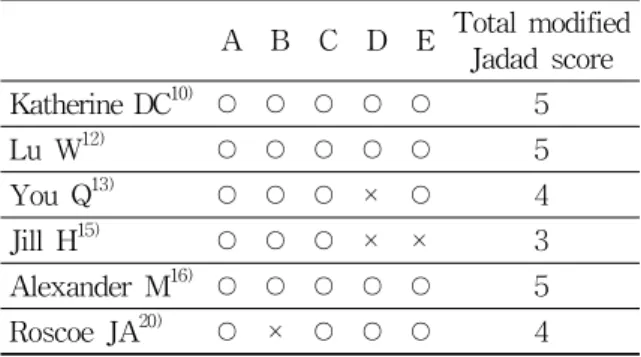
본 연구에 포함된 논문 중 RCT를 대상으로 modified Jadad score26)를 사용하여 연구의 질을 평가해보았다 (Table 6). Modified Jadad score는 침 시술자가 현실 적으로 블라인딩 되기 어렵다는 침 연구 특성을 고려 하여 기존의 Jadad score를 변형한 평가지표다. 기존
의 여섯 편 중 다섯 편이 4점 이상으로 양질의 연구 로 분류되었는데, RCT 논문 6편의 평균 modified Jadad score는 4.33이었고, 4점 이상의 연구는 다섯 편, 3점 이하의 연구는 1편으로 평가되었다.
본 논문에 인용된 RCT 연구는 총 6편으로 논문 수가 부족하다는 점은 한계점으로 평가된다. 또한, 한 데이터베이스에서만 논문을 검색하였고, 논문 형식을 clinical trials로 제한하여 letter형식이나 clinical trial 이지만 publication type에 clinical trial로 분류하지 않은 논문들이 누락되었을 수 있다는 점도 한계점으 로 지적된다. 또한 영어로 작성된 논문만을 검색하였 기 때문에 타 언어로 작성된 연구들을 누락시켰을 가 능성도 있다. 추후 연구에서는 다양한 검색 사이트를 이용하고, 여러 언어로 된 논문을 분석하며, STRICTA 의 권장안이나 Jadad score를 활용하여, 양질의 RCT 논문을 선별한 후, 메타분석을 통해 항암화학요법의 부작용 완화에 관한 침의 효과를 검증하는 시도가 필 요할 것으로 사료된다.
Ⅴ. 결 론
PubMed에서 최근 10년간 항암화학요법의 부작용과 관련된 침 임상시험 현황을 15편의 논문을 통해 고찰 해 보았다. 오심과 구토에 관한 연구가 가장 많았고, 말초신경병증, 안면홍조, 관절통증, 호중구 감소증, 피 로감 등 증상에 관한 연구들도 보고되었다. 이는 항암 요법 부작용으로 발생한 오심과 구토 증상에 침치료를 이용하는 빈도가 높다는 것과 관련이 있다고 생각된 다. 세 편의 연구를 제외한 모든 논문은 침치료가 항암 화학요법으로 인한 부작용들을 호전시키는 것으로 보 고하였으나, 오심과 구토 증상에 관하여는 상반된 결 과들이 제시되었는데, 연구의 방법론적 한계로 해석상 의 주의가 필요하며, 보다 타당한 방법론으로 잘 디자 인된 연구들이 이루어져야 할 것으로 사료된다. 본 논 문이 향후 연구와 임상에 토대가 되기를 기대한다.
Ⅵ. References
1. Powis G, Hacker MP. The toxicity of anticancer
drugs. New York : Pergamon Press. 1990 : 1-8.
2. Rozencweig M, Von Hoff DD, Staquet MJ et al.
Animal toxicology for early clinical trials with anticancer agents. Cancer Clin Trials. 1981 ; 4(1) : 21-8.
3. Windebank AJ, Grisold W. Chemotherapy-induced neuropathy. J Peripher Nerv Syst. 2008 ; 13(1) : 27-46.
4. Nam DW, Lee JD, Choi DY. Study trends on acupuncture treatment of cancer. The Journal of Korean Acupuncture & Moxibustion Society.
2007 ; 24(1) : 209-17.
5. Brunelli B, Gorson KC. The use of comple- mentary and alternative medicines by patients with peripheral neuropathy. J Neurol Sci. 2004 ; 15 ; 218(1-2) : 59-66.
6. Yeh CH, Chien LC, Chiang YC, Lin SW, Huang CK, Ren D. Reduction in nausea and vomiting in children undergoing cancer chemotherapy by either appropriate or sham auricular acupunc- ture points with standard care. Journal of Alternative & Complementary Medicine. 2012 ; 18(4) : 334-40.
7. Schroeder S, Meyer-Hamme G, Epplée S. Acu- puncture for chemotherapy-induced peripheral neuropathy (CIPN): a pilot study using neuro- graphy. Acupunct Med. 2012 ; 30(1) : 4-7.
8. Donald GK, Tobin I, Stringer J. Evaluation of acupuncture in the management of chemo- therapy-induced peripheral neuropathy. Acupunct Med. 2011 ; 29(3) : 230-3.
9. Hani A, Jiang ML, Adel G, Francesco P, Mark A. Acupuncture for the alleviation of hot flashes in men treated with androgen ablation therapy.
Radiation Oncology Biol Phys. 2011 ; 79(5) : 1358-63.
10. Katherine DC, Jillian LC, Heather G et al. Ran- domized, blinded, sham-controlled trial of acupunc- ture for the management of aromatase inhibitor- associated joint symptoms in women with early- stage breast cancer. Journal of Clinical Oncology.
2010 ; 28(7) : 1154-60.
11. James JM, Deborah WB, Carrie S et al. Feasibility trial of electroacupuncture for aromatase inhibitor-
related arthralgia in breast cancer survivors.
Integr Cancer Ther. 2009 ; 8(2) : 123-9.
12. Lu W, Ursula AM, Anne DG et al. Acupuncture for chemotherapy-induced neutropenia in patients with gynecologic malignancies: a pilot randomized, sham-controlled clinical trial. The Journal of Alternative and Complementary Medicine. 2009 ; 15(7) : 745-53.
13. You Q, Yu H, Wu D, Zhang Y, Zheng J, Peng C. Vitamin B6 points PC6 injection during acu- puncture can relieve nausea and vomiting in patients with ovarian cancer. International Journal of Gynecological Cancer. 2009 ; 19(4) : 567-71.
14. Gottschling S, Reindl TK, Meyer S et al. Acu- puncture to alleviate chemotherapy-induced nausea and vomiting in pediatric oncology - a random- ized multicenter crossover pilot trial. Klin Padiatr.
2008 ; 220(6) : 365-70.
15. Hervik J, Mjaland O. Acupuncture for the treat- ment of hot flashes in breast cancer patients, a randomized, controlled trial. Breast Cancer Re- search and Treatment. 2009 ; 116(2) : 311-6.
16. Molassiotis A, Sylt P, Digginst H. The manag- ement of cancer-related fatigue after chemo- therapy with acupuncture and acupressure: a randomised controlled trial. Complement Ther Med.
2007(4) ; 15(4) : 228-37.
17. Choo SP, Kong KH, Lim WT, Gao F, Chua K, Leong SS. Electroacupuncture for refractory acute emesis caused by chemotherapy. The Journal of Alternative and Complementary Medicine.
2006 ; 12(10) : 963-9.
18. Melchart D, Ihbe-Heffinger A, Leps B, von Schilling C, Linde K. Acupuncture and acupressure for the prevention of chemotherapy-induced nausea; a randomised cross- over pilot study.
Support Care Cancer. 2006 ; 14(8) : 878-82.
19. Tobias KR, Wilhelm G, Reinhard H et al.
Acupuncture against chemotherapy-induced nausea and vomiting in pediatric oncology. Interim results of a multicenter crossover study. Support Care Cancer. 2006 ; 14(2) : 172-6.
20. Roscoe JA, Matteson SE, Morrow GR et al.
Acustimulation wrist bands are not effective for
the control of chemotherapy-induced nausea in women with breast cancer. J Pain Symptom Manage. 2005 ; 29(4) : 376-84.
21. Son JG, Kim YI, Lee PS. 2003 Technology industry information analysis ‘Anti Cancer Drugs’. Korea Institute of Science and Technology Information.
2003.
22. Min YD, Park YH, Baek GE, Lee JS. What is cancer. Gwangju : Chosun University Publishing Department. 2003 : 196-250.
23. Kaley TJ, Deangelis LM. Therapy of chemo-
therapy-induced peripheral neuropathy. Br J Haematol. 2009 ; 145(1) : 3-14.
24. Baquiran DC. Lippincott’s cancer chemotherapy handbook 2nd ed. Philadelphia : Lippincott. 2001 : 129.
25. Kim SY, Park BJ. Evidence based healthcare.
Seoul : Korea Medical. 2009 : 37.
26. Jadad AR, Moore RA, Carrol D et al. Assessing
the quality of reports of randomized clinical trials:
is blinding necessary?. Control Clin Trials. 1996 ; 17(1) : 1-12.