RESEARCH ARTICLE
Received: October 24, 2015, Revised: November 24, 2015, Accepted: November 24, 2015 ISSN 1598-4478 (Print) / ISSN 2233-7679 (Online)
†
Correspondence to: Keun-Bae Song
Deparment of Preventive Dentistry, School of Dentistry, Kyungpook National University, 2177 Dalgubeol-daero, Jung-gu, Daegu 41940, Korea Tel: +82-53-660-6870, Fax: +82-53-423-2947, E-mail: [email protected]
Copyright © 2015 by the Korean Society of Dental Hygiene Science
-Gluconsan Calcium이 구강암 세포의 성장에 미치는 영향
김지혜ㆍ정윤숙ㆍ김혜영
1
ㆍ이영균2
ㆍ김재영2
ㆍ최연희ㆍ송근배†
경북대학교 치의학전문대학원 예방치과학교실,
2
구강생화학교실,1
강원대학교 치위생학과The Anti-Cancer Effect of -Gluconsan Calcium on Oral Cancer Cell
Ji-Hye Kim, Yun-Sook Jung, Hye-Young Kim 1 , Young-kyun Lee 2 , Jae-Young Kim 2 , Youn-Hee Choi, and Keun-Bae Song †
Departments of Preventive Dentistry and
2Oral Biochemistry, School of Dentistry, Kyungpook National University, Daegu 41940,
1
Department of Dental Hygiene, Kangwon National University, Samcheok 25913,
In recent years, there has been a global trend toward the importance of natural extracts for the prevention and treatment of human diseases.
-glucan is known to have anti-inflammatory activity, anti-cancer, and improvement of immune system. Polycan is purified -glucan from Aureobasidum pullulans SM-2001. The anti-cancer effects of -gluconsan calcium, polycan and calcium gluconate complex, were evaluated in human oral cancer YD-10B cells. YD-10B cells were cultured in the presence of 0, 0.5, 0.75, 1 mg/ml -gluconsan calcium for 48 hours. MTT assay, cell counting, and observation of cell morphology were conducted. The number of cells decreased and cell morphology changed in the 0.5 mg/ml of -gluconsan calcium. Almost all cells were dead in the 0.75 and 1 mg/ml. MTT assay showed a dose-dependent reduction in cell proliferation (p<0.05). These results indicate that -gluconsan calcium exhibiting anti-cancer effects in YD-10B cells through changes in cell morphology and cell death.
Key Words: Anti-cancer, -gluconsan calcium, Oral cancer cells
서 론
보건복지부 자료에 의하면 우리나라 암 발생률은 꾸준히 증가하고 있으며, 이를 치료하는 데 많은 비용이 소비되고 있다 1) . 그 중에서도 구강암은 다른 부위의 암종에 비해 그 발현 빈도는 낮으나 악성도가 높아 안모의 외관 파괴는 물 론 저작과 발음 등의 기능손상으로 인해 개인의 사회적, 정 서적 허탈을 가져올 뿐만 아니라 막대한 경제적 부담을 준 다 2-4) . 구강암의 발생률은 인종, 지역 및 사회경제적 여건에 따라 많은 차이가 있는데 5,6) , 선진국에서는 구강암이 전체 암의 5%보다 적게 발생하지만 개발도상국가에서는 경부암 과 위암 다음으로 많이 발생하는 것으로 보고되고 있다 7) .
구강암의 치료법으로는 수술, 방사선요법, 항암화학요법
등이 있으나 정상세포의 손상 및 면역력 저하 등 치료 후의 경과나 부작용에서 많은 문제점을 가지고 있으며, 치료로 인한 뚜렷한 생존률 향상도 보이지 않는 것으로 보고되고 있다 8,9) . 따라서 현재는 치료 효능이 뛰어나면서 부작용 및 거부감이 적은 천연소재에 대한 관심이 커지고 있다 10,11) .
-glucan은 1997년 미국 식품의약국(US Food and Drug
Adminstration)으로부터 승인을 받은 이래 건강식품 및 식
품첨가물로 널리 이용되고 있는 물질 중 하나이다 12) . -
glucan은 버섯, 곡물, 효모, 곰팡이, 세균 등의 세포벽에서
유래하는 다당류로 13-15) , 면역증강, 혈당 및 체중 감소 효과,
항콜레스테롤, 피부 재생 효과 등 다양한 효과를 나타내는
것으로 알려져 있다. 또한 이들 물질은 면역조절제와 항암
및 항산화에 대한 생리활성 효과가 있는 것으로 보고되어
다양한 분야에서 활용되고 있다 16-18) . 그 중에서도 -glucan 의 항암 활성에 대한 연구는 효모로부터 추출된 zymosan이 sarcoma-180 고형암의 성장을 억제한다는 보고 이후 현재 까지 계속되고 있다 19) .
상업적으로 유통되는 -glucan은 보통 빵효모나 Saccha-
romyces cerevisiae와 같은 효모로부터 생산되는데, 국내에서 생산되는 대부분의 -glucan은 일반적으로 Phellinus
linteus나 Sparassis crispa와 같은 버섯으로부터 추출된다 15) . 특히 흑효모 중 Aureobasidum pullulans SM-2001에 서 유래한 정제된 -glucan은 polycan이라 명명되며 20) , 면 역증강효과와 골생성 촉진 등의 효능이 검증되고 있다 21-23) . 이에 본 연구에서는 새로운 -glucan 중 하나인 polycan과 항염증활성 효과를 가지는 calcium gluconate 혼합물인
-gluconsan calcium이 구강암 세포의 증식과 사멸에 미치 는 영향을 조사하고자 하며, 이를 통해 새로운 암 치료제로 서 가능성을 제시하고자 한다.
연구대상 및 방법
1. 연구대상
이 실험에 사용된 -gluconsan calcium은 흑효모균 Aur-
eobasidium pullulans SM-2001을 분리, 정제, 가공한 복합다당체인 polycan에 수화율을 높여주기 위해 칼슘글루코네 이트를 1:9로 혼합한 고분자 물질로 (주)아리바이오 (AriBio, Seongnam, Korea)로부터 분말형태로 지원받았으 며, 사용하기 전까지 4 o C에서 보관하였다. -gluconsan calcium은 RPMI 1640 (Corning, Manassas, VA, USA) 배 지에 1 mg/ml 농도로 녹인 후 syringe filter (Sartorius Stedim Biotech, Göettingen, Germany)를 이용하여 여과시킨 다음 0.5, 0.75 mg/ml의 농도로 희석하였다.
2. 세포 배양
한국세포주은행(KCLB, Seoul, Korea)으로부터 분양받 은 YD-10B oral squanmous cell carcinoma cells을 10%
fetal bovine serum (Corning), 1% penicillin streptomycin 이 포함된 RPMI 1640을 이용하여 37 o C, 5% CO 2 의 조건하 에서 배양하였다. 세포가 plate의 80∼90% 증식하면 phosphate buffered saline solution (PBS)로 2회 수세한 후 trypsin-ethylenediaminetetraacetic acid (EDTA; Corning) 를 이용하여 계대 배양하였다.
3. 세포 형태 관찰
96 well plate의 각 well에 세포를 5×10 3 개씩 분주하고,
37 o C, 5% CO 2 incubator에서 하룻밤 배양하여 plate 바닥에 세포들이 부착하도록 하였다. 이후 배지를 -gluconsan calcium이 0.5, 0.75, 1 mg/ml 농도로 함유된 RPMI 1640 배지 200 l로 교체하고 48시간 동안 처리하였다. 처리시간 완료 후 광학 현미경을 이용하여 100배, 200배의 배율로 세 포의 형태 변화를 관찰하고 이를 영상으로 기록하였다. 관 찰 부위는 무작위로 선정하고 각 농도별 3번 반복을 원칙으 로 하였다.
4. 세포수 계수
6 well plate 상에서 1×10 6 개의 세포를 하룻밤 배양한 후,
-gluconsan calcium을 농도별로 48시간 동안 처리하였으 며, PBS로 2회 수세한 후 trypsin-EDTA를 이용하여 well에 부착되어 있는 세포들을 부유시켰다. 부유된 세포들은 hematometer를 이용하여 직접 현미경으로 계수화하였다.
5. MTT
96 well plate의 각 well에 세포를 5×10 3 개씩 하룻밤 배양 한 후 -gluconsan calcium을 농도별로 처리하였다. 48시간 후 5 mg/ml thiazolyl blue tetrazolium bromide (Alfa Aesar, Hheysham, UK)를 37 o C에서 4시간 반응시켰다. 세 포 배양액을 제거한 후 dimethyl sulfoxide (Duksan, Ansan, Korea)를 분주하여 dark blue crystals을 용해시키고, mic- roplate autoreader ELISA를 사용하여 570 nm의 파장에서 흡광도를 측정하였다.
6. 통계 분석
수합된 모든 자료는 통계분석용 소프트웨어인 IBM SPSS Statistics 프로그램 ver. 22.0 (IBM Co., Armonk, NY, USA)을 이용하여 분석하였으며, 통계적 유의성 판정 을 위한 유의수준은 5%로 설정하였다. -gluconsan calcium 농도별 세포수 및 생존률 분석은 Kruskal-Wallis test를 이 용하였으며, 통계적으로 유의한 차이가 인정되는 경우(p<
0.05), 순위변수 생성 후 Tukey test 방법으로 사후검정하였다.
결 과
1. 세포형태 변화
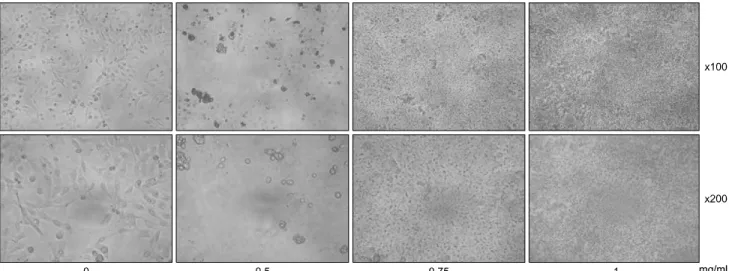
-gluconsan calcium을 농도별로 처리하여 현미경으로 형태 변화를 관찰한 결과, 0.5 mg/ml 처리군에서 세포수가 현저히 줄어들고 남아있는 세포 형태도 변형되어 있는 것을 확인할 수 있었다. 특히 0.5 mg/ml 이상의 농도 0.75, 1 mg/
ml에서는 거의 모든 세포가 사멸하여 세포 찌꺼기들만 관찰
Fig. 1. Morphology changes of human oral cancer YD-10B cells by -gluconsan calcium.
Fig. 2. The effect of -gluconsan calcium on the number of hu- man oral cancer YD-10B cells. The values are presented as mean±standard deviation. Bars with same letter means there are no significant differences among -gluconsan calcium concen- trations by Tukey test using ranks (p>0.05).
Fig. 3. The effect of -gluconsan calcium on the viability of hu- man oral cancer YD-10B cells. The values are presented as mean±standard deviation. Bars with same letter means there are no significant differences among -gluconsan calcium concen- trations by Tukey test using ranks (p>0.05).
되었다(Fig. 1).
2. 세포수 변화
-gluconsan calcium을 농도별로 처리하여 세포수를 직 접 계수화한 결과 농도 의존적으로 세포수가 감소하였다(p<
0.05). 세포 형태 결과와 마찬가지로 -gluconsan calcium 을 처리한 군은 아무것도 처리하지 않은 군에 비해 세포수 가 유의하게 감소하였으며(p<0.05), 모든 군 간 유의한 차 이를 보였다(p<0.05; Fig. 2).
3. MTT에 의한 세포 생존율 분석
-gluconsan calcium 처리에 따른 YD-10B 세포의 활성
도를 측정하기 위하여 MTT 분석을 실시한 결과, -gluconsan calcium을 처리한 군은 아무것도 처리하지 않은 군에 비해 모두 세포 활성이 저하되었다(p<0.05). 특히 -gluconsan calcium 처리군은 농도가 증가함에 따라 세포 활성 저하 역 시 증가하는 양상을 보였으나, 0.5 mg/ml 처리군과 0.75 mg/
ml 처리군 간의 유의한 차이는 보이지 않았다(p>0.05; Fig. 3).
고 찰
식생활의 다양화와 생활양식의 변화로 전 세계적으로 천
연물 유래 생리활성물질에 대한 연구가 활발히 이루어지고
있다 24) . 여러 천연물 중 -glucan은 면역 증강과 항암효과가
비교적 많이 알려져 있으며, 전 세계적으로 기능성 식품 및 화장품 등으로 널리 사용되고 있다 16-18) . -glucan은 포도당 이 -1,3 glycosidic bond를 중심으로 중합되어 있는데, 그 결합의 유형이 다양하며 기원에 따라 물리화학적 특성 및 생체 기능이 다르다 25) .
-glucan을 기원에 따라 분류하면 보리, 귀리와 같은 맥 아류의 식이 섬유에서 추출되는 식물성 -glucan과 버섯, 효 모 등 미생물의 세포벽을 구성하거나 세포외로 분비하는 미 생물성 -glucan으로 나눌 수 있다 13,14) . 보통 식물 유래의
-glucan은 -1,3- 결합의 기본 구조에 -1,4- 결합이 가지 형태를 이루는 분자구조를 가지며, 미생물 유래의 -glucan 은 -1,3- 결합의 기본 구조에 -1,6- 결합이 가지 형태를 이 루는 분자구조를 보이게 되는데 이러한 구조의 차이가
-glucan의 활성에 영향을 주게 된다 13-15,26) . 일반적으로 항 암효과가 우수하다고 알려진 버섯에서 추출한 -glucan은 주로 -1,3/1,6- 구조를 가지고 있으며, -1,3-, 또는 -1,6- 결합구조보다 생리활성 촉진 능력 또한 우수한 것으로 보고 되고 있다 26) . 이번 연구에 사용된 -gluconsan calcium의 성 분 중 하나인 polycan은 Aureobasidum pullulans SM-2001 에서 유래한 정제된 -glucan으로 -1,3- 및 -1,6- 결합이 서로 혼합되어 있는 -1,3/1,6- 구조를 하고 있어 우수한 항 암효과를 나타내리라 예측되었다. 이를 확인하기 위하여 대 표적인 구강암 세포인 YD-10B cell에 polycan의 수화율을 높여주는 calcium gluconate가 혼합된 -gluconsan calcium 을 처리하여 세포 성장에 미치는 영향을 살펴보았다. 그 결 과, -gluconsan calcium 0.5 mg/ml을 처리한 경우 세포수 의 감소와 형태적인 변화가 관찰되었으며, 0.75 mg/ml을 처 리한 경우에는 거의 모든 세포가 사멸하는 것을 확인할 수 있었다. 이러한 결과는 -glucan이 암세포에 대한 직접 공격 보다는 대식세포, 자연살해세포, T-세포 등의 정상적인 면 역세포의 면역기능을 활성화시켜 암세포의 증식을 억제시 킨다고 보고한 기존의 연구들과 다소 차이를 보였다 27) . 그러 나 일부 연구에서는 -glucan이 암세포에 직접 작용하기도 한다고 주장하고 있다. 최근 Choromanska 등 28) 은 귀리에서 추출된 -glucan이 편평세포암종 A431의 성장은 억제시키 고, 대식세포 P388/D1의 성장은 증대시킨다고 보고하여,
-glucan이 면역기능 향상 뿐 아니라 암세포의 직접적인 억 제 기능을 주장한 바 있다. 또한 Yoon 등 21) 은 본 실험에 사 용된 것과 같은 Aureobasidium pullulans SM-2001이 생산 한 polycan이 cyclophosphamide로 면역억제를 유발한 쥐 의 TNF-, CD3+, CD4+, CD8+, IL-1, IL-10을 다시 증가시킴으로써 면역기능을 회복하는 것을 확인하였다. 본 연구진의 예비실험에서도 -gluconsan calcium 처리로 대
식세포 raw 264.7 cell의 성장이 활성화되는 것을 MTT 방 법을 통해 확인하였다(data not shown). 이러한 결과들로 미 루어 봤을 때 Aureobasidium pullulans SM-2001로부터 생 산된 polycan은 암세포의 성장을 직접적으로 억제시킬 뿐 아니라 면역기능의 향상을 통해 암세포 증식에 영향을 미치 는 것으로 생각된다.
이번 연구는 -gluconsan calcium을 이용하여 암세포의 성장에 미치는 영향을 평가한 첫 번째 연구라는 데 의의가 있다. 그러나 실험이 세포 수준에서만 이루어졌기 때문에 사람에게 적용할 수 있는 약물로 사용하기 위해서는 향후 동물실험 및 임상실험이 추가적으로 수행되어야 할 것이다.
또한 면역기능과 관련된 연구 및 다양한 실험기법을 이용하 여 항암효과를 나타내는 정확한 기전을 밝히는 것이 필요하다.
요 약
이번 연구에서는 천연추출물인 -gluconsan calcium이 구강암 세포의 증식과 사멸에 미치는 영향을 평가하고자 하 였으며, 다음과 같은 결론을 얻었다.
-gluconsan calcium 0.5 mg/ml 처리군에서 세포수의 감 소와 형태 변화가 관찰되었으며, 0.75, 1 mg/ml에서는 거의 모든 세포가 사멸하였다. -gluconsan calcium을 농도별로 처리한 결과, YD-10B 세포수가 농도 의존적으로 감소하였 으며(p<0.05), MTT 분석 결과, -gluconsan calcium 처리 한 군은 아무것도 처리하지 않은 군에 비해 모두 세포 활성 이 저하되었다(p<0.05). 이상의 결과들을 종합해 보았을 때, polycan과 calcium gluconate 복합제인 -gluconsan calcium은 구강암 세포의 성장 억제에 효과가 있는 것으로 생각된다.
References