• 검색 결과가 없습니다.

Sensory Profiles of Dairy Products Supplemented with Hibiscus sabdariffa Linnaeus (Roselle) Powder: A Preliminary Study

N/A
N/A
Protected

Academic year: 2021

Share "Sensory Profiles of Dairy Products Supplemented with Hibiscus sabdariffa Linnaeus (Roselle) Powder: A Preliminary Study"

Copied!
9
0
0

로드 중.... (전체 텍스트 보기)

전체 글

(1)

ARTICLE

Received: December 10, 2019 Revised: December 13, 2019 Accepted: December 16, 2019

These authors contributed equally to this study.

*Corresponding author : Kwang-Young Song

Center for KU Food Safety and Department of Public Health, College of Veterinary Medicine, Konkuk University, Seoul 05029, Korea, and Dept. of Biological Engineering, Yanbian University of Science and Technology, Yanji, JL, China.

Tel : +82-2-450-4121 Fax : +82-2-3436-4128 E-mail : [email protected] Copyright © 2019 Korean Society of Milk Science and Biotechnology.

This is an Open Access article distributed under the terms of the Creative Commons Attribution Non-Commercial License (http://

creativecommons.org/licenses/by-nc/3.0) which permits unrestricted non-commercial use, distribution, and reproduction in any medium, provided the original work is properly cited.

ORCID Se-Hyung Kim

https://orcid.org/0000-0003-4747-7394 Hyun-Woo Lim

https://orcid.org/0000-0001-6013-8106 Jung-Whan Chon

https://orcid.org/0000-0003-0758-6115 Kwang-Young Song

https://orcid.org/0000-0002-5619-8381 Kun-Ho Seo

https://orcid.org/0000-0001-5720-0538

Sensory Profiles of Dairy Products Supplemented with Hibiscus sabdariffa Linnaeus (Roselle) Powder:

A Preliminary Study

Se-Hyung Kim

1†

, Hyun-Woo Lim

1

, Jung-Whan Chon

1,2

, Kwang-Young Song

1,3*

, and Kun-Ho Seo

1†

1Center for KU Food Safety and Department of Public Health, College of Veterinary Medicine, Konkuk University, Seoul, Korea

2College of Veterinary Medicine, Oklahoma State University, Stillwater, OK, USA

3Dept. of Biological Engineering, Yanbian University of Science and Technology, Yanji, JL, China

Abstract

The objective of this study was to evaluate the sensory profiles of market milk, yogurt, and kefir, supplemented with the powder of

Hibiscus sabdariffa Linnaeus

(Roselle) in 1%

increments, ranging from 0% (control) to 4%. In this study, there was no statistically significant difference in titratable acidity and pH between the treated groups and the control group. All samples were evaluated in five categories by thirteen appraisers.

Compared to the control group, the best sensory profiles were observed in the market milk sample supplemented with 1.0% of

Hibiscus sabdariffa Linnaeus

(Roselle) powder, in the yogurt samples supplemented with 2.0% and 3.0% of

Hibiscus sabdariffa Linnaeus

(Roselle) powder, and in the Kefir sample supplemented with 3% of

Hibiscus sabdariffa Linnaeus

(Roselle) powder. According to statistical analysis of the sensory profiles obtained in this study, there was a statistical difference in the taste, flavor, color, and overall acceptability of market milk; in the taste, color, texture, and overall acceptability of yogurt; and in the taste, color, and overall acceptability of Kefir, between the treated groups and the control group (p<0.05). In the future, when

Hibiscus sabdariffa Linnaeus

(Roselle) powder is used as a food additive for dairy products, studies on improvement of biofunctionality, as well as of sensory profiles in dairy products must be carried out.

Keywords

Hibiscus sabdariffa

Linnaeus (Roselle) powder, sensory profiles, dairy food, Kefir

Introduction

In general, Hibiscus included over 300 species of annual or perennial herbs, shrubs or

trees [1, 2]. Hibiscus sabdariffa Linnaeus was recognized as Roselle and was an ideal crop

for developing countries because it could be relatively easy to cultivate [1, 2]. Also

Hibiscus sabdariffa Linnaeus (Roselle) could be used as food and fiber, and also cultivated

as part of multi-cropping systems [1]. Until now, Hibiscus sabdariffa Linnaeus (Roselle)

was used as a traditional foods or medicine depending on the region [1, 3]. For example,

in Africa, India and Mexico, the infusions of the leaves or calyces of Hibiscus sabdariffa

Linnaeus (Roselle) were used for having a good effect on cholerectic, diuretic, febrifuge,

hypotension, and so on, and were traditionally used for stimulating the intestinal

peristalsis and for decreasing the blood’s viscosity [1–3]. In North Africa, the preparations

of calyces of Hibiscus sabdariffa Linnaeus (Roselle) were used to treat coughs, genital

problems, sore throats, and so on [1, 3, 4]. And in folk medicine of China, it was used

to treat high blood pressure and liver disorders [1, 5]. Furthermore, the main components

(2)

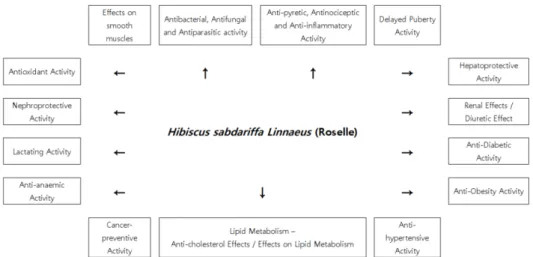
related to the pharmacological effects of Hibiscus sabdariffa Linnaeus (Roselle) were anthocyanins, flavonoids, hibiscus acid, hydrooxycitric acid, organic acids, polysaccharides (carbohydrates, mucilage and pectin), volatile compounds, and so on [1, 3, 6]. The various biofunctional and pharmacological characteristics of Hibiscus sabdariffa Linnaeus (Roselle) was shown in Fig. 1 [1, 3]. Therefore, Hibiscus sabdariffa Linnaeus (Roselle) powder could be added directly to several dairy products because it could improves the sensory profiles and the human health through several bioactive components.

Subsequently, the ultimate objective of this study was to prepare market milk, yoghurt and Kefir added with the powder of Hibiscus sabdariffa Linnaeus (Roselle) for upgrading the sensory profiles with having biofunctional properties.

Materials and Methods

1. The powder of Hibiscus sabdariffa Linnaeus (Roselle)

The organic Roselle Hibiscus extract powder which was made up of 100% Hibiscus sabdariffa Linnaeus (Roselle) as the food-additive grade was grown in Poland (Lilly Super Food, Korea).

2. Production of market milk added with the powder of Hibiscus sabdariffa Linnaeus (Roselle)

According to the method [7], the powder of Hibiscus sabdariffa Linnaeus (Roselle) was added to market milk (Seoul Dairy Co-op, Korea) in 1% increments, from 0% (control) to 4%, respectively,

3. Production of yogurt added with the powder of Hibiscus sabdariffa Linnaeus (Roselle)

According to the modified method [7], the powder of Hibiscus sabdariffa Linnaeus

Fig. 1. The various biofunctional and pharmacological characteristics of Hibiscus sabdariffa Linnaeus

(Roselle).

(3)

(Roselle) was added to yoghurt in 1% increments, from 0% (control) to 4%, respectively.

4. Production of Kefir added with the powder of Hibiscus sabdariffa Linnaeus (Roselle) powder

According to the modified method [7], the powder of Hibiscus sabdariffa Linnaeus (Roselle) was added to Kefir in 1% increments, from 0% (control) to 4%, respectively.

5. The TA and pH of market milk, yogurt and Kefir with Hibiscus sabdariffa Linnaeus (Roselle) powder

According to method [8], the titratable acid (TA) and pH of market milk, yogurt and Kefir added with the powder of Hibiscus sabdariffa Linnaeus (Roselle) was analyzed by titration with 0.1 N NaOH (Sigma-Aldrich Co., USA), and by the pH meter (Orion Star A211, USA), respectively.

6. The sensory profiles of market milk, yogurt and Kefir added with the powder of Hibiscus sabdariffa Linnaeus (Roselle)

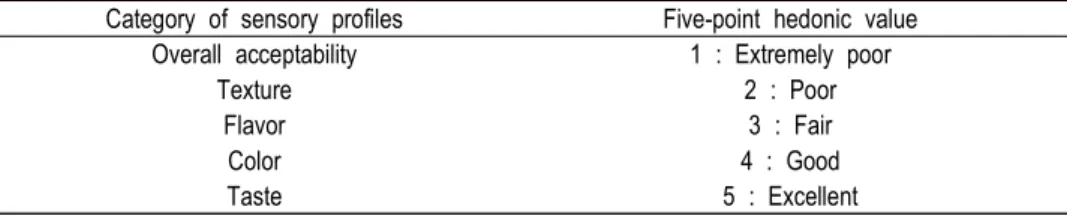
Market milk, yogurt and Kefir added with powder of Hibiscus sabdariffa Linnaeus (Roselle) were manufactured and kept in fridge until they were analyzed. All 13 appraisers participated in this study, and then evaluated the sensory profiles for each sample. In this study, the samples were randomly tested in disposable paper cups (50 mL) at 10℃. The sensory profiles consisted of five different categories (Table 1).

7. Statistical data analysis

In this study, all results were taken from two separate experiments with duplicate assays.

Using the statistical software of GraphPad Prism 5 (GraphPad Softward Inc., USA), results was analyzed. Also, all results were demonstrated as means±SD. There was a statistically significant difference between the groups (p<0.05).

Results and Discussion

1. The TA and pH of market milk, yogurt and Kefir added with the powder of Hibiscus sabdariffa Linnaeus (Roselle)

TA generally affected pH levels [8]. In this study, the pH and TA of market milk was about 6.65 and 0.15%, respectively. And the pH of yogurt and Kefir dropped to 4.35

Table 1. Five different categories of the sensory profiles and 5-point hedonic value

Category of sensory profiles Five-point hedonic value

Overall acceptability 1 : Extremely poor

Texture 2 : Poor

Flavor 3 : Fair

Color 4 : Good

Taste 5 : Excellent
(4)

and 4.50, respectively, whereas the TA of yogurt and Kefir went up to 1.0% and 0.94, respectively (Data not shown).

The level of TA and pH of market milk, yogurt and Kefir added with the powder of Hibiscus sabdariffa Linnaeus (Roselle) in 1% increments (from 1.0% to 4.0%) demon- strated similar to that of market milk, yogurt and Kefir without having the powder of Hibiscus sabdariffa Linnaeus (Roselle) (Data not shown). Therefore, the TA and pH did not represent any statistical significant difference between treated group and control group conducted in this study. This study also showed a similar tendency to various previous studies [8–10].

2. The sensory profiles of market milk added with the powder of Hibiscus sabdariffa Linnaeus (Roselle)

The sensory profiles of market milk were evaluated by thirteen appraisers. Fig. 2 showed the summary of sensory profiles.

The powder of Hibiscus sabdariffa Linnaeus (Roselle) was added to market milk in 1%

increments, from 0% (control) to 4%, respectively. The taste value of market milk added with the powder of Hibiscus sabdariffa Linnaeus (Roselle) in 1% increments (from 1.0%

to 4.0%) was from 3.66 to 2.33, which were lower than 4.16 of control group (addition of 0%). The flavor value of market milk added with the powder of Hibiscus sabdariffa Linnaeus (Roselle) in 1% increments (from 1.0% to 4.0%) was from 3.66 to 3.16, which was lower than 4.16 of control group (addition of 0%). The color value of market milk added with the powder of Hibiscus sabdariffa Linnaeus (Roselle) in 1% increments (from 1.0% to 4.0%) was from 2.5 to 1.66, which was lower than 4.3 of control group (addition of 0%). The texture value of market milk added with the powder of Hibiscus sabdariffa

Fig. 2. The sensory profiles of market milk added with the powder of Hibiscus sabdariffa Linnaeus

(Roselle) in 1% increments, from 0% (control) to 4%, respectively.

(5)

Linnaeus (Roselle) in 1% increments (from 1.0% to 4.0%) was from 3.5 to 3.33, which was similar or lower than 3.5 of control group (addition of 0%). And the overall acceptability value of market milk added with the powder of Hibiscus sabdariffa Linnaeus (Roselle) in 1% increments (from 1.0% to 4.0%) was from 3.79 to 2.62, which was lower than 4.25 of control group (addition of 0%). According to statistical analysis on the sensory profiles of market milk, there was a statistically significant difference in taste, flavor, color, and overall acceptability between treated group and control group (p<0.05). Among the treated group, the market milk added with 1% of Hibiscus sabdariffa Linnaeus (Roselle) powder showed the best results compared with control group.

In a word, as the addition of Hibiscus sabdariffa Linnaeus (Roselle) powder increased, the category of taste, flavor, color, and overall acceptability tended to decrease except texture.

3. The sensory profiles of yogurt added with the powder of Hibiscus sabdariffa Linnaeus (Roselle)

The sensory profiles of yogurt were evaluated by thirteen appraisers. Fig. 3 showed the summary of sensory profiles.

The powder of Hibiscus sabdariffa Linnaeus (Roselle) was added to yogurt in 1%

increments, from 0% (control) to 4%, respectively. The taste value of yogurt added with the powder of Hibiscus sabdariffa Linnaeus (Roselle) in 1% increments (from 1.0% to 4.0%) was from 3.66 to 3.33, which were lower than 3.83 of control group (addition of 0%). The flavor value of yogurt added with the powder of Hibiscus sabdariffa Linnaeus (Roselle) in 1% increments (from 1.0% to 4.0%) was from 4.0 to 3.5, which were higher or lower (or similar) than 3.66 of control group (addition of 0%). The color value of

Fig. 3. The sensory profiles of yogurt added with the powder of Hibiscus sabdariffa Linnaeus

(Roselle) in 1% increments, from 0% (control) to 4%, respectively.

(6)

yogurt added with the powder of Hibiscus sabdariffa Linnaeus (Roselle) in 1% increments (from 1.0% to 4.0%) was from 2.83 to 2.16, which were lower than 3.83 of control group (addition of 0%). The texture value of yogurt added with the powder of Hibiscus sabdariffa Linnaeus (Roselle) in 1% increments (from 1.0% to 4.0%) was from 3.83 to 3.5, which were lower than 4.16 of control group (addition of 0%). And the overall acceptability value of yogurt added with the powder of Hibiscus sabdariffa Linnaeus (Roselle) in 1% increments (from 1.0% to 4.0%) was from 3.79 to 3.5, which were lower than 4.16 of control group (addition of 0%).

According to statistical analysis on the sensory profiles of yogurt, there was a statistically significant difference in taste, color, texture and overall acceptability between treated group and control group (p<0.05). Among the treated group, the yogurt added with 3.0%

(and 2.0%) of Hibiscus sabdariffa Linnaeus (Roselle) powder showed the best results compared with control group.

In a word, as the addition of Hibiscus sabdariffa Linnaeus (Roselle) powder increased, the category of taste, color, texture and overall acceptability tended to decrease except flavor.

4. The sensory profiles of Kefir added with the powder of Hibiscus sabdariffa Linnaeus (Roselle)

The sensory profiles of Kefir were evaluated by thirteen appraisers. Fig. 4 showed the summary of sensory profiles.

The powder of Hibiscus sabdariffa Linnaeus (Roselle) was added to Kefir in 1% increments, from 0% (control) to 4%, respectively. The taste value of Kefir added with the powder of Hibiscus sabdariffa Linnaeus (Roselle) in 1% increments (from 1.0% to 4.0%) was from

Fig. 4. The sensory profiles of Kefir added with the powder of Hibiscus sabdariffa Linnaeus

(Roselle) in 1% increments, from 0% (control) to 4%, respectively.

(7)

3.5 to 2.83, which were lower than 3.84 of control group (addition of 0%). The flavor value of Kefir added with the powder of Hibiscus sabdariffa Linnaeus (Roselle) in 1%

increments (from 1.0% to 4.0%) was from 4.5 to 4.16, which were similar or lower (or similar) than 4.5 of control group (addition of 0%). The color value of Kefir added with the powder of Hibiscus sabdariffa Linnaeus (Roselle) in 1% increments (from 1.0% to 4.0%) was from 2.66 to 2.0, which were lower than 3.84 of control group (addition of 0%). The texture value of Kefir added with the powder of Hibiscus sabdariffa Linnaeus (Roselle) in 1% increments (from 1.0% to 4.0%) was from 4.16 to 3.83, which were lower than 4.17 of control group (addition of 0%). And the overall acceptability value of Kefir added with the powder of Hibiscus sabdariffa Linnaeus (Roselle) in 1% increments (from 1.0% to 4.0%) was from 3.95 to 3.16, which were lower than 4.17 of control group (addition of 0%).

According to statistical analysis on the sensory profiles of Kefir, there was a statistically significant difference in taste, color and overall acceptability between treated group and control group (p<0.05). Among the treated group, the Kefir added with 3.0% of Hibiscus sabdariffa Linnaeus (Roselle) powder showed the best results compared with control group.

In a word, as the addition of Hibiscus sabdariffa Linnaeus (Roselle) powder increased, the category of taste, color, texture and overall acceptability tended to decrease except flavor.

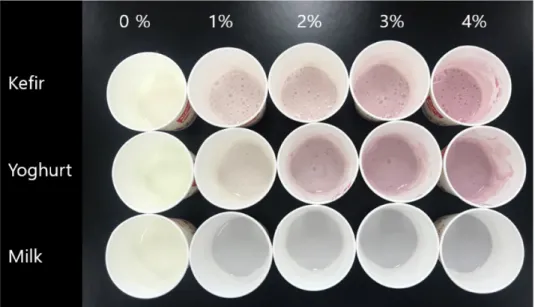
Next, Fig. 5 showed the changes of color in market milk-, yoghurt-, and Kefir-added with the powder of Hibiscus sabdariffa Linnaeus (Roselle) in 1% increments (from 1.0%

to 4.0%). In this study, yogurt and Kefir added with the powder of Hibiscus sabdariffa Linnaeus (Roselle) in 1% increments (from 1.0% to 4.0%) had no red color change, but market milk added with the powder of Hibiscus sabdariffa Linnaeus (Roselle) in 1%

increments (from 1.0% to 4.0%) changed from red to gray (Fig. 5). It may be thought

Fig. 5. The color changes of market milk, yoghurt and Kefir according to the addition of the powder

of Hibiscus sabdariffa Linnaeus (Roselle) in 1% increments, from 0% (control) to 4%, respectively.

(8)

that the color of market milk added with the powder of Hibiscus sabdariffa Linnaeus (Roselle) changed under the influence of pH. And it could be explained in more detail for the following reason. The colorful anthocyanins were known as the flavonoids group of phytochemicals, and also anthocyanins’s molecules were susceptible to degradation.

For example, the stability of colorful anthocyanins’s molecules depended on light, metals, pH, phenolic acids, temperature, the presence of enzyme or other flavonoids, and so on [3]. However, more detailed research will have to be done.

Hibiscus sabdariffa Linnaeus (Roselle) was generally grown for its calyces and fibers, and also was divided into 3 types of genotypes such as dark red, green, and red [11, 12].

Among them, the genotype of red was the most common type used [12]. Especially, anthocyanins were a group of phenolic compounds and could be found in a variety range of fruits and flowers to demonstrate the reddish-purple color [11]. Furthermore, anthocyanins could be used for natural alternatives to replace the artificial synthetic color additives in the food industry [11]. Especially, the calyx of Hibiscus sabdariffa Linnaeus (Roselle) was known to contain the compounds responsible for the red color of this plant, which were delphinidin-3-glucoside, cyaniding-3-glucoside, delphinidin- 3-sambubioside, cyaniding-3-sambubioside, and so on [13].

In conclusion, even though Hibiscus sabdariffa Linnaeus (Roselle) powder may be effective in improving human health according to previous studies [1–4, 11, 13], more future research on the availability of Hibiscus sabdariffa Linnaeus (Roselle) extracts as a natural color ingredients as well as the development of various biofunctioanl dairy products must be carried out.

Conflict of Interest

The authors declare no potential conflict of interest.

Acknowledgements

This research was supported by Basic Science Research Program through the National Research Foundation of Korea (NRF) funded by the Ministry of Education (NRF-2017R1 D1A1B03035427), and this paper was written as part of Konkuk University’s research support program for its faculty on sabbatical leave in 2018.

References

1. Da-Costa-Rocha I, Bonnlaender B, Sievers H, Pischel I, Heinrich M. Hibiscus sabdariffa L. - A phytochemical and pharmacological review. Food Chem. 2014;165:

424-443.

2. Wang ML, Morris B, Tonnis B, Davis J, Pederson GA. Assessment of oil content and fatty acid composition variability in two economically important Hibiscus species. J Agric Food Chem. 2012;60:6620-6626.

3. Riaz G, Chopra R. A review on phytochemistry and therapeutic uses of Hibiscus

(9)

sabdariffa L. Biomed Pharmacother. 2018;102:575-586.

4. Neuwinger HD. African traditional medicine: a dictionary of plant use and appli- cations: search system for diseases. Stuttgart: Medpharm Scientific; 2000.

5. Atta BM, Imaizumi K. Some characteristics of crude oil extracted from roselle (Hibiscus sabdariffa L.) seeds cultivated in Egypt. J Oleo Sci. 2002;51:457-461.

6. Abdel-Moemin AR. Effect of Roselle calyces extract on the chemical and sensory pro- perties of functional cupcakes. Food Sci Hum Wellness. 2016;5:230-237.

7. Lim HW, Song KY, Chon JW, Jeong D, Seo KH. Organoleptic characteristics of dairy products supplemented with Raphanus raphanistrum subsp. sativus (radish) powder:

a preliminary study on efficacy against diabetes. J Milk Sci Biotechnol. 2019;37:

177-186.

8. Kim SH, Chon JW, Song KY, Jeong D, Seo KH. Organoleptic profiles of Kefir and yogurt supplemented with various concentrations of Mentha piperta’s (peppermint) oil: a preliminary study. J Milk Sci Biotechnol. 2019;37:102-107.

9. Jeong D, Kim DH, Chon JW, Song KY, Kim H, Seo KH. Preparation of bioactive Kefir with added flaxseed (Linum usitatissimum L.) extract. J Milk Sci Biotechnol. 2017;35:

176-183.

10. Jeong D, Kim DH, Oh YT, Chon JW, Kim H, Jeong DK, et al. Production of bioactive yoghurt containing Cichorium intybus L. (Chicory) extract: preliminary study. J Milk Sci Biotechnol. 2017;35:9-15.

11. Jabeur I, Pereira E, Barros L, Calhelha RC, Sokovic M, Oliveira MBPP, Ferreira ICFR.

Hibiscus sabdariffa L. as a source of nutrients, bioactive compounds and colouring agents. Food Res Int. 2017;100:717-723.

12. Barhe TA, Tchouya GRF. Comparative study of the anti-oxidant activity of the total polyphenols extracted from Hibiscus sabdariffa L., Glycine max L. Merr., yellow tea and red wine through reaction with DPPH free radicals. Arab J Chem. 2016;9:1-8.

13. Borras-Linares I, Fernandez-Arroyo S, Arraez-Roman D, Palmeros-Suarez PA, Del

Val-Diaz R, Andrade-Gonzales I, et al. Characterization of phenolic compounds,

anthocyanidin, antioxidant and antimicrobial activity of 25 varieties of Mexican

Roselle (Hibiscus sabdariffa). Ind Crops Prod. 2015;69:385-394.

수치

Fig.  1.  The  various  biofunctional  and  pharmacological  characteristics  of  Hibiscus  sabdariffa  Linnaeus  (Roselle).
Table  1.  Five  different  categories  of  the  sensory  profiles  and  5-point  hedonic  value Category  of  sensory  profiles Five-point  hedonic  value
Fig.  2.  The  sensory  profiles  of  market  milk  added  with  the  powder  of  Hibiscus  sabdariffa  Linnaeus  (Roselle)  in  1%  increments,  from  0%  (control)  to  4%,  respectively
Fig.  3.  The  sensory  profiles  of  yogurt  added  with  the  powder  of  Hibiscus  sabdariffa  Linnaeus  (Roselle)  in  1%  increments,  from  0%  (control)  to  4%,  respectively.
+3

참조

관련 문서

The degree of stress in accordance with general characteristics of the subjects showed no signifiant statistical difference, while the degree of physical

Comparison of the groups’ awareness to the herpes zosterin relation to characteristics of the study papulation. † Statistical analysis performed

This study makes use of statistical method in estimating the spread of oil supply disruption, which will be the starting point of analysis on oil

 In the present study, as a preliminary study, a LACC-based Compton CT was developed to estimate the activity of the spot inside the radioactive waste drum. To

Fourth, for the sub-factors of personality traits according to weight lifters’ education, while there was a high difference in neuroticism and agreeableness

At the end of the study, a reevaluation of each study case was performed with the same questionnaire. The result shows there has been a meaningful result in the group

Although there was a trend for a greater decline in quantitative HBsAg titers in the group that achieved HBeAg seroclearance, the difference in the kinetics of qHBsAg

surveillance study of patients with Emergency Department injuries under the control of the Korea Centers for Disease Control and Prevention (KCDC).Statistical