436
pISSN 2288-6575 • eISSN 2288-6796 https://doi.org/10.4174/astr.2017.92.6.436 Annals of Surgical Treatment and Research
CASE REPORT
Ultrasound fusion imaging with real-time navigation for the surveillance after endovascular aortic aneurysm repair
Jin Hyun Joh, Sang-Ah Han, Sang-Hyun Kim, Ho-Chul Park
Department of Surgery, Kyung Hee University Hospital at Gangdong, Kyung Hee University School of Medicine, Seoul, Korea
INTRODUCTION
Endovascular aortic aneurysm repair (EVAR) offers the ad- vantage of lower perioperative morbidity and mortality. But, secondary intervention may be needed due to innate com pli ca- tions of EVAR procedure, such as aneurysm growth, endoleak, device migration, or structural failure [1]. Therefore, life-long surveillance to detect these complications is recommended [2].
Computed tomogram angiography (CTA) remains the most widely used imaging modality for post-EVAR surveillance because of its short examination time, reproducibility, and spa tial and contrast resolution [2,3]. However, multiple CTA exami nations can pose a radiation hazard and potential risk for contrast-induced nephrotoxicity. Ultrasound (US) can be an effective alternative to CTA since it has no risk of radiation and nephrotoxicity. But, inherent disadvantages of US include long examination time, operator dependence, and unfeasibility for obese patients.
Recently, a virtual navigation system that fuses real-time US
with reconstructed CT imaging was introduced [4]. This fusion image enables definitive surveillance after EVAR without the need for new CT imaging by combining the postoperative CT scan with real-time US in a dual image display. Here, we report three cases in whom this real-time US navigation system was used for post-EVAR surveillance.
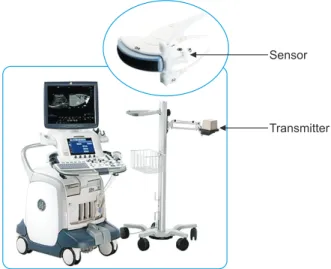
All examinations were performed using the LOGIQ E9 US system (GE Healthcare, Milwaukee, WI, USA) equipped with an electromagnetic tracking system, transmitter, and a small sensor mounted on the US probe. The sensor provides the posi tion and orientation of the transducer in the transmitter’s spatial volume (Fig. 1).
Real-time image fusion was achieved as follows. Three- dimensional CT volume data taken within 1 week after EVAR were stored as Digital Imaging and Communications in Medi- cine files. The data were input into the US system. Spatial coregi stration was achieved to ensure that the pixels from the CT datasets represented approximately the same volume for the completion of imaging fusion. While US and CT images were Ultrasound can be an effective alternative to computed tomography for surveillance following endovascular aneurysm repair (EVAR). Recently, ultrasound fusion imaging with the real-time navigation system was introduced. Here we de- scribed 3 patients who underwent post-EVAR surveillance using this novel technique. Complete coregistration was achieved in all patients. The origin of left renal artery was selected for the target of coregistration. Ultrasound fusion im aging was useful to differentiate the confusing lesion and to evaluate the complete resolution of endoleak and newly developed delayed endoleak. Ultrasound fusion image with real-time navigation system can be a feasible imaging tool for post-EVAR surveillance.
[Ann Surg Treat Res 2017;92(6):436-439]
Key Words: Ultrasonography, X-ray computed tomography, Endovascular procedures, Aneurysm, Surveillance
Reviewed January February March April May June JulyAugust September October November December
Received September 26, 2016, Revised December 10, 2016, Accepted January 16, 2017
Corresponding Author: Jin Hyun Joh
Department of Surgery, Kyung Hee University Hospital at Gangdong, Kyung Hee University School of Medicine, 892 Dongnam-ro, Gangdong- gu, Seoul 05278, Korea
Tel: +82-2-440-6261, Fax: +82-2-440-6296 E-mail: [email protected]
Copyright ⓒ 2017, the Korean Surgical Society
cc Annals of Surgical Treatment and Research is an Open Access Journal. All articles are distributed under the terms of the Creative Commons Attribution Non- Commercial License (http://creativecommons.org/licenses/by-nc/4.0/) which permits unrestricted non-commercial use, distribution, and reproduction in any medium, provided the original work is properly cited.
Annals of Surgical Treatment and Research 437 displayed side-by-side, spatial coregistration was made at the
origin of the left renal artery. After the complete coregistration, US scanning was performed from the level of the superior me- sen teric artery to the iliac artery. Detailed scanning was done to detect the any types of endoleak, device migration, and struc- tural failure of the device. The maximal diameter of aneu rysm sac was measured at the perpendicular axis of aorta. This study was approved by the Institutional Review Board (Kyung Hee University Hospital at Gangdong, KHNMC 2016-08-032).
CASE REPORTS
Case 1
An 89-year-old male patient presented with 5.9-cm-sized, asymptomatic abdominal aortic aneurysm (AAA). EVAR was performed using Zenith (Cook Medical, Bloomington, IN, USA) endograft without any complications. Surveillance using US and CT fusion image was performed for postoperative 15 months. Reference CTA volume data was taken on the third
postoperative day. Image fusion was made using the CT dataset (Fig. 2). There was a filling defect in the reference CT image with white color shown in Fig. 2B. It could not be differentiated with endoleak or aneurysmal sac content. It was revealed as aneurysmal sac content on fusion US image shown in Fig. 2A.
Case 2
A 73-year-old male patient with 5.6-cm-sized AAA was referred. EVAR was performed using Zenith endograft without any complications. Abdominal CTA was performed to evaluate the postprocedural complications on the second postoperative day. Type II endoleak from the inferior mesenteric artery (IMA) was detected. Surveillance using US fusion imaging was done at 10 months postoperatively (Fig. 3). The fusion image completely matched (Fig. 3). The inferior vena cava was in the same posi- tion in the US and CT images. Follow-up US fusion image revealed the resolution of endoleak.
Case 3
A 71-year-old male patient presented with a 9.5-cm-sized, asymptomatic AAA. EVAR was performed using Zenith endograft without any complications. On the second post- opera tive day, CTA was performed to evaluate postproce dural com plications. There was no endoleak on this initial CTA. At 24 months postoperatively, US fusion image surveillance was performed (Fig. 4). US revealed the newly developed type III endoleak (Fig. 4A).
DISCUSSION
In this case series, US fusion imaging was a feasible option for the post-EVAR surveillance. Complete coregistration was achieved in all patients. The origin of left renal artery was selected for the target of coregistration. In the first case, CT scan showed the filling defect between the aneurysm wall and endograft. This could be interpreted as an endoleak or aneurysmal sac content. However, US fusion imaging at the same level of CTA revealed the lesion as aneurysmal sac content Jin Hyun Joh, et al: Ultrasound fusion imaging for post-EVAR surveillance
Sensor
Transmitter
Fig. 1. Ultrasound system. This system was equipped with an electromagnetic tracking system, a transmitter and a small sen sor mounted on the ultrasound probe.
B A
Fig. 2. Ultrasound fusion im- aging can differentiate the con- fusing lesion. It was revealed with aneurysmal sac content on ultrasound fusion image (A; white arrow). A filling defect could not be differentiated with endo- leak or aneurysmal sac con tent in reference CT image (B; open arrow).
438
Annals of Surgical Treatment and Research 2017;92(6):436-439
on the basis of absence of a color signal. In the second case, the US fusion image showed the complete resolution of type II endoleak that was apparent on CTA at the same location.
In the third case, the delayed endoleak was revealed with US fusion imaging. With this imaging technique, it was possible to classify the type of endoleak because the reference CTA showed the exact position of US probe.
The advantages of fusing the different imaging modalities on the same screen in real time include theoretically improved diagnostic accuracy, which is mainly useful for image-guided interventions because biopsy or intervention is more readily performed in real time. It has been used to percutaneous radiofrequency ablation for the hepatocellular carcinoma [5].
This image modality can dramatically improve the feasibility of radiofrequency ablation treatment for hepatocellular carcinoma nodules that are not revealed on sonography [5].
Recently, a virtual needle-tracking system (VirtuTRAX CIVCO Medical Solutions, Kalona, IA, USA) was introduced in which a magnetic sensor is attached in the distal tip of an ablation needle [6]. Because the system is able to virtually visualize the tip of the needle and the needle path on US, it allows targeting
from any angle and makes it easy to monitor and control the procedure. The combined use of real-time image fusion and this needle-tracking system can improve the therapeutic feasibility of ablation. Although this technique has not been used in the treatment of endoleaks, such treatment is feasible with direct injection of embolic material into the aneurysm sac under real- time US fusion image guidance.
Contrast-enhanced US (CEUS) has emerged as an alternative modality for post-EVAR surveillance [7]. It has become an essen tial part of post-EVAR surveillance, with very good diag nostic performance, absence of renal impairment, and no radiation, accompanied by low cost [7]. A comparison of the diagnostic accuracy between CEUS and CTA in detecting changes in AAA size and endoleaks found that CEUS demon- strated significantly more endoleaks, predominantly of type II, com pared with CT angiography (53% vs. 22% of cases) [8]. US was as accurate as CT angiography in the assessment of maxi- mal aneurysm sac diameters. The interobserver variability for AAA size measurement by US was low, given the interclass correlation coefficients of 0.99 and 0.98 for anteroposterior and transverse maximal diameters, respectively. In spite of
A B
Fig. 4. Ultrasound fusion imaging re veals the newly developed endo leak. Follow-up ultrasound fusion im aging showed the newly de veloped type III endo- leak (A, open arrow).There was no endoleak on the initial CT scanning (B).
Inferior vena cava Inferior vena cava
Inferior vena cava
A B
Fig. 3. Ultrasound fusion imaging reveals the complete resolution of endoleak. Follow-up ultrasound fusion imaging reveals the com- plete resolution of endoleak (A) shown in initial CT scanning (B, open arrow). Fusion image was completely matched. Images of inferior vena cava was located in the same position (small arrows).
Annals of Surgical Treatment and Research 439 nonexistent report of the application of contrast in US fusion
image in EVAR surveillance, it seems to be more objective and accurate. The Society for Vascular Surgery recommends that US is an alternative to CTA for annual postoperative surveillance if neither endoleak nor AAA enlargement is documented during first year after EVAR [2]. Therefore, US fusion image might be used for annual postoperative surveillance.
Coregistration is the most important step in US fusion imaging. To fuse medical imaging information obtained from different modalities at different times, spatial coregistration is mandatory to ensure that the pixels from the various datasets represent approximately the same volume. There are several methods to achieve this goal depending on the imaging modality. One method to coregister 2 datasets is to define a series of standard registration points, in which external
material is placed on the patient, such as fiducials or internal structure [9]. When the markers are anatomic, for instance, vessels or specific points in organs, the images have to be in high spatial resolution to assure that the same point is marked on each image [10].
In conclusion, US fusion imaging with real-time navigation system can be used to evaluate procedure-related complications and measure aneurysm diameter after EVAR. This can be a feasible imaging tool for post-EVAR surveillance.
CONFLICTS OF INTEREST
No potential conflict of interest relevant to this article was reported.
Jin Hyun Joh, et al: Ultrasound fusion imaging for post-EVAR surveillance
1. Stroupe KT, Lederle FA, Matsumura JS, Kyriakides TC, Jonk YC, Ge L, et al. Cost- effec tiveness of open versus endovascular re pair of abdominal aortic aneurysm in the OVER trial. J Vasc Surg 2012;56:901- 9.e2.
2. Chaikof EL, Brewster DC, Dalman RL, Makaroun MS, Illig KA, Sicard GA, et al.
The care of patients with an abdominal aortic aneurysm: the Society for Vascular Surgery practice guidelines. J Vasc Surg 2009;50(4 Suppl):S2-49.
3. Walker TG, Kalva SP, Yeddula K, Wicky S, Kundu S, Drescher P, et al. Clinical practice guide lines for endovascular abdominal aortic aneurysm repair: written by the Stan dards of Practice Committee for the So ciety of Interventional Radiology and endorsed by the Cardiovascular and Inter- ven tional Radiological Society of Europe and the Canadian Interventional Radio- logy Association. J Vasc Interv Radiol
2010;21:1632-55.
4. Pfister K, Schierling W, Jung EM, Apfel- beck H, Hennersperger C, Kasprzak PM.
Stan dardized 2D ultrasound versus 3D/4D ultrasound and image fusion for measurement of aortic aneurysm dia meter in follow-up after EVAR. Clin Hemorheol Microcirc 2016;62:249-60.
5. Toshikuni N, Tsutsumi M, Takuma Y, Arisawa T. Real-time image fusion for suc cessful percutaneous radiofrequency abla tion of hepatocellular carcinoma. J Ultrasound Med 2014;33:2005-10.
6. Tomonari A, Tsuji K, Yamazaki H, Aoki H, Kang JH, Kodama Y, et al. Feasibility of the virtual needle tracking system for per cutaneous radiofrequency ablation of hepa tocellular carcinoma. Hepatol Res 2013;43:1352-5.
7. Cantisani V, Grazhdani H, Clevert DA, Iezzi R, Aiani L, Martegani A, et al. EVAR:
Bene fits of CEUS for monitoring stent-
graft status. Eur J Radiol 2015;84:1658-65.
8. Ten Bosch JA, Rouwet EV, Peters CT, Jansen L, Verhagen HJ, Prins MH, et al.
Con trast-enhanced ultrasound versus com puted tomographic angiography for sur veillance of endovascular abdominal aor tic aneurysm repair. J Vasc Interv Radiol 2010;21:638-43.
9. Yu H, Fahrig R, Pelc NJ. Co-registration of x-ray and MR fields of view in a hybrid XMR system. J Magn Reson Imaging 2005;22:291-301.
10. Goerres GW, Schuknecht B, Schmid DT, Stoeckli SJ, Hany TF. Positron emission tomo graphy/computed tomography for staging and restaging of head and neck can cer: comparison with positron emi- ssion tomography read together with con- trast-enhanced computed tomography.
Clin Imaging 2008;32:431-7.