• 검색 결과가 없습니다.

Alteration of Gut Microbiota in Autism Spectrum Disorder: An Overview

N/A
N/A
Protected

Academic year: 2021

Share "Alteration of Gut Microbiota in Autism Spectrum Disorder: An Overview"

Copied!
15
0
0

로드 중.... (전체 텍스트 보기)

전체 글

(1)

INTRODUCTION

The microbiome refers to a community of microbes and the collection of genes contained within these microbes. Microbi- al cells are as abundant as somatic cells and have many more genes than the human genome (1.3:1 cells, 100:1 genes) [1].

The microbiome is affected by several factors, including hu- man genetics, immune responses, diet, antibiotics, body part, lifestyle, and geography [2]. The microbiome is also thought to control gastrointestinal (GI) physiology, metabolism, nutri- tion, brain function, immune function, and even behavior [3].

Furthermore, the human microbiome is known to be corre- lated with diseases including cancer, obesity, irritable bowel disease, arthritis, and various psychiatric and neurological conditions such as major depressive disorder, stroke, Parkin- son’s disease, Alzheimer’s disease, and autism [4]. However, we do not yet understand how variations in the microbiome af- fect health and disease. Furthermore, the mechanism and ex-

tent to which the gut microbiota and treatments based on the microbiome (prebiotic, probiotic, and dietary interventions) influence brain health and behavior are not yet clearly known [5]. The microbiota–gut–brain axis, which refers to the bidi- rectional communication pathway between gut bacteria and the central nervous system (CNS), has important effects on many processes in the brain. These processes include neuro- inflammation; stress axes activation; neurotransmission; for- mation of the blood-brain-barrier; myelination; neurogenesis and microglia maturation; synthesis of neurotransmitters in- cluding gamma-amino-butyric acid (GABA), noradrenalin, and dopamine; and modulation of complex behaviors such as sociability and anxiety [5,6].

Several studies have demonstrated that the gut microbiota actually affects the development of the nervous system. For example, one study showed that neurogenesis in the dorsal hippocampus of adult germ-free (GF) mice was higher than that in conventional mice [7]. These results are consistent with the findings that neurogenesis of the hippocampus and the number of monocytes are reduced in mice treated with antibiotics over a long period [8]. Additionally, the blood–

This is an Open Access article distributed under the terms of the Creative Commons Attribution Non-Commercial License (https://creativecommons.org/licenses/by-nc/4.0) which permits unrestricted non-commercial use, distribution, and reproduction in any medium, provided the original work is properly cited.

Alteration of Gut Microbiota in Autism Spectrum Disorder: An Overview

Donghun Oh 1,2,3 and Keun-Ah Cheon 1,2,3

1

Department of Psychiatry, Yonsei University College of Medicine, Seoul, Korea

2

Division of Child and Adolescent Psychiatry, Severance Children’s Hospital, Seoul, Korea

3
Institute of Behavioral Science in Medicine, Yonsei University College of Medicine, Seoul, Korea

The microbiota-gut-brain axis, which refers to the bidirectional communication pathway between gut bacteria and the central nervous system, has a profound effect on important brain processes, from the synthesis of neurotransmitters to the modulation of complex be- haviors such as sociability and anxiety. Previous studies have revealed that the gut microbiota is potentially related to not only gastroin- testinal disturbances, but also social impairment and repetitive behavior—core symptoms of autism spectrum disorder (ASD). Al- though studies have been conducted to characterize the microbial composition in patients with ASD, the results are heterogeneous.

Nevertheless, it is clear that there is a difference in the composition of the gut microbiota between ASD and typically developed indi- viduals, and animal studies have repeatedly suggested that the gut microbiota plays an important role in ASD pathophysiology. This possibility is supported by abnormalities in metabolites produced by the gut microbiota and the association between altered immune responses and the gut microbiota observed in ASD patients. Based on these findings, various attempts have been made to use the mi- crobiota in ASD treatment. The results reported to date suggest that microbiota-based therapies may be effective for ASD, but large- scale, well-designed studies are needed to confirm this.

Key Words: Gut Microbiota; Microbiota-gut-brain axis; Autism spectrum disorder.

Received: December 3, 2019 / Revision: March 25, 2020 / Accepted: April 16, 2020

Address for correspondence: Keun-Ah Cheon, Department of Psychiatry, Yonsei University College of Medicine, 50-1 Yonse-ro, Seodaemun-gu, Seoul 03722, Korea

Tel: +82-2-2228-1620, Fax: +82-2-313-0891, E-mail: [email protected]

(2)

brain barrier (BBB) is more permeable without the gut mi- crobiota, allowing macromolecules to enter the brain. This has been reported to be the result of reduced expression of the proteins that comprise the tight junction of the brain endo- thelium. The reduced BBB permeability after re-colonization with gut microbiota is clear evidence that the gut microbiota is involved in brain development [9]. Thus, it is rational to suggest that gut bacteria play a role in neurological and psy- chiatric diseases such as autism spectrum disorder (ASD).

ASD constitutes a group of neurodevelopmental disorders, which is characterized by repetitive and stereotyped behavior, with impaired communication and social interaction [10].

ASD has a profound effect on the development of children and on society. In 2014, the overall prevalence of ASD was 16.8 per 1,000 children aged 8 years, and in boys the preva- lence was much higher (26.6 per 1,000 children) than in girls (6.6 per 1,000 children) [11]. The current cost of supporting a child with ASD without intellectual impairment is £0.92 mil- lion in the United Kingdom and $1.4 million in the United States. The main costs of caring for children with ASD are derived from their need for special education and treatment, as well as the resultant reduced parental productivity [12]. Ac- cordingly, there have been a number of efforts to identify bio- markers associated with ASD, including those related to ge- netic causes, immune system abnormalities, inflammation, and exposure to environmental toxic substances. Despite growing evidence that endogenous markers are involved in the pathology of ASD, early detection of these disorders re- mains a major challenge [13]. In addition, there are currently no effective treatments for the core symptoms of ASD, in- cluding social skill deficits. Therefore, understanding the role of microbiota and modulating the microbiota-gut-brain axis could help identify new ways to treat ASD [14].

Indeed, studies suggesting a correlation between multiple aspects of ASD and gut microbiota have been reported. In this article, we reviewed the results of studies investigating changes in the gut microbiota and their role in ASD. Our aim was to assess the value of microbiota as a potential biomarker or therapeutic target for ASD.

GI DISTURBANCE AS A COMMON COMORBIDITY OF ASD

The theory of the connection between ASD and the gut microbiota originated from GI symptoms that are frequently identified early in children with ASD. The GI impairments that are commonly observed in patients with ASD [15] in- clude overproduction of intestinal gasses/flatulence, bloat- ing, abdominal pain, diarrhea, burping/belching, gastro- esophageal reflux symptoms, and constipation [16]. Different

studies have reported that the prevalence of GI disorders in individuals with ASD ranges from 9% to 84%, depending on the assessment method, compared with 9% to 37% for chil- dren without ASD [17,18]. General GI symptoms are report- ed to be five times more common in children with ASD; ab- dominal pain is twice as frequent, and both constipation and diarrhea have a four times higher incidence than that ob- served in typically developing children. The subjective symptoms of GI disorders such as abdominal pain, heart- burn, or nausea are very difficult to evaluate because the clinical manifestation of digestive tract diseases in children with ASD may differ from those in children with typical de- velopment [17]. Functional constipation is a frequent finding in individuals with ASD [19]. The prevalence of constipation in ASD ranges from 20% to 33.9% according to recent stud- ies [20], with findings indicating that moderate to severe constipation is more frequent in individuals with autism than in controls (36% vs. 10%) [19].

Several studies have reported an association between GI disturbances and the behavioral phenotype of ASD. GI symptoms have been reported to have a high incidence and be strongly associated with the severity of ASD [21]. ASD patients with GI disturbances show severe social skill defi- cits and higher anxiety than those without GI disturbances [22]. Children with ASD with GI disturbances have also been reported to have frequent anger outbursts and aggres- sive behavior [23]. One study indicated that such aggressive- ness in children with ASD could be another manifestation of the physical discomfort caused by GI disturbances [24].

MECHANISM OF GI IMPAIRMENT AND THE GUT MICROBIOTA IN ASD

The enteric nervous system (ENS) is a large and complex component of the autonomic nervous system and is uniquely equipped with internal microcircuits that can adjust GI func- tion regardless of CNS input. Because the ENS and CNS share common neurotransmitters, signal pathways, and ana- tomical characteristics, the pathophysiological mechanisms underlying CNS disease are often associated with GI symp- toms [25]. A genetic study reported that mutations in the chromodomain helicase DNA-binding protein 8 (CHD8) gene are associated with a genetically defined ASD subtype.

ASD patients with CHD8 mutations are typified by macro-

cephaly, distinct faces, and GI complaints due to slow transit

constipation. Disruption of the zebrafish CHD8 orthologue

recapitulates features of the human phenotype, including ex-

pansion of the forebrain/midbrain and impairment of GI

motility due to a reduction in postmitotic enteric neurons

[26]. Pitt-Hopkins syndrome, another subtype of ASD, results

(3)

from haploinsufficiency of the transcription factor 4 gene, and patients often suffer from constipation and gastroesoph- ageal reflux [27]. Similarly, another study showed that the au- tism-linked R451C mutation of the neuroligin-3 gene changes the ENS in mice [28]. Enteric glial cells (EGCs) are another population of cells in the ENS emerging as local GI regulators that participate in neuroprotection, gut motility, gut inflam- mation, intestinal epithelial barrier function, and synaptic neurotransmission regulation [29]. Grubišić and Parpura [30]

reported that EGC-linked connexin 43 plays a role in the mechanism contributing to GI problems, based on the altered expression of astrocytic markers in patients with ASD. The underlying mechanism of these phenomena remains elusive, and further studies are warranted to elucidate the involve- ment of EGCs in the ASD process.

Another keyword describing GI symptoms seen in ASD patients is “inflammation.” Although no consistent results have been obtained, some studies have reported changes in inflammation markers in ASD patients with GI symptoms.

For example, the transcriptional profile of intestinal tissue from children with ASD was similar to that of patients with inflammatory bowel diseases such as ulcerative colitis and Crohn’s disease [31]. In addition, infiltration of lymphocytes, eosinophils, and monocytes was observed in the intestinal tissues of ASD patients, similar to that in those with food al- lergies [32].

The “leaky gut” hypothesis is based on the idea that defects in intestinal epithelial barrier permeability lead to inappro- priate signaling by luminal components including bacteria, environmental toxins, and even dietary macromolecules. In- creasing intestinal permeability allows the metabolites secret- ed by bacteria to cross the barrier and enter the blood, and can affect the brain by promoting the secretion of cytokines and triggering an immune response [33]. Inflammatory cyto- kines released by immune activation affect the CNS and in- terfere with normal neural development early in life, which can lead to ASD. Compared to children with typical develop- ment, one study found astrocyte overactivation and increased levels of pro-inflammatory cytokines in the cerebrospinal fluid (CSF) of children with ASD [34]. Another study showed that plasma levels of cytokines, such as interleukin, tumor necrosis factor-α (TNF-α), and transforming growth factor beta were increased in children with ASD. In particular, this altered immune profile was associated with the severity of behavioral problems in ASD [35,36]. These studies suggest that inflammatory processes derived from the intestines may play an important role in the neuronal development that is central to ASD, as well as in the GI symptoms.

The gut microbiota plays an important role in regulating epithelial integrity that affects intestinal permeabillty [37].

For example, decreased expression of barrier-forming pro- teins, and increased expression of pore-forming proteins in tight junctions of intestinal epithelium, have been shown to be associated with Lactobacillus [23,38]. In children with ASD, concentrations of zonulin, a gut permeability modu- lating protein, are higher than those in typically developed children, and increased zonulin levels are associated with the severity of behavioral symptoms in ASD [39]. It was also reported that the expression of zonulin was associated with specific strains of the gut microbiota, such as Faecalibacte- rium and Ruminococcaceae [40]. Taken together, the results suggest that the gut microbiota affects intestinal permeabil- ity, and that the triggered inflammatory processes contrib- ute to the pathogenesis of ASD.

CHANGES IN GUT MICROBIOTA COMPOSITION IN ASD

Many cross-sectional studies have shown alterations in the composition of microbiota in ASD. Common findings in many studies include increased Firmicutes to Bacteroidetes ratio and a higher abundance of Clostridium in ASD.

Metagenomic analysis carried out by Williams et al. [41]

showed compositional dysbiosis manifests as a decrease in Bacteroidetes, an increase in the ratio of Firmicutes to Bacte- roidetes, and an increase in Betaproteobacteria in ASD pa- tients. Tomova et al. [42] reported that children with autism showed a significant increase in the Firmicutes to Bacteroide- tes ratio and elevation of the amount of Lactobacillus spp.

Strati et al. [43] revealed that a significant increase in the Fir- micutes/Bacteroidetes ratio in ASD patients was associated with a decrease in Bacteroidetes. They also found a decrease in the abundance of Alistipes, Bilophila, and Veillonella, but a significant increase in the abundance of Collinsella, Coryne- bacterium, and Lactobacillus in the ASD group. In the case of Clostridium, more species of this genus were found in the feces of children with autism than in normal children, and counts were also higher in children with autism [44]. Clos- tridium boltae and cluster I and XI were found to be several times more abundant in children with autism than in nor- mal children [45]. Recently, Alshammari et al. [46] revealed that the incidence of Clostridium perfringens was signifi- cantly higher in an ASD group than in a control group.

However, these findings are not always consistent between studies. In contrast to the finding that the Firmicutes to Bac- teroidetes ratio increased due to a reduction in Bacteroidetes, De Angelis et al. [47] found that levels of Bacteroidetes and some Alistipes and Akkermansia species were higher in chil- dren with ASD than in normal children.

In addition, heterogeneous results have been reported. Fae-

(4)

calibacterium, Ruminococcus, and Bifidobacterium were rela- tively less abundant, whereas Caloramator, Sarcina, Sutterel- laceae, and Enterobacteriaceae were more abundant in children with ASD than in normal children and children with Pervasive Developmental Disorder Not Otherwise Spec- ified (PDD-NOS) [47]. Kang et al. [48] reported significantly lower abundances of the genera Prevotella, Coprococcus, and unclassified Veillonellaceae in samples from individuals with autism than in samples from neurotypical children. In- creased Bacteroidaceae, Prevotellaceae, and Ruminococcaceae [49], and reduced Prevotella copri, Faecalibacterium prausnit- zii, and Haemophilus parainfluenzae [50] were also found in the ASD population.

There have been several studies using non-autistic siblings as controls. Tomova et al. [42] reported that Desulfovibrio, Bifidobacterium, and Clostridia were more abundant in the ASD group, while Lactobacillus was relatively abundant in siblings. Furthermore, regarding measurements of abun- dance of Bacteriodetes and Firmicutes, the sibling groups tended to fall somewhere between those of normal children with no family history of ASD and those of children with ASD. This finding suggests that the pattern of microbial composition can be an indicator of the disease burden of ASD. However, contradictory results have also been report- ed. Several studies have compared microbial composition between children with ASD and neurotypical siblings and revealed no difference between the two groups [51-53]. These results suggest that the microbial composition was formed only under the influence of shared environmental factors, including eating habits.

There have been associations between abundance of cer- tain microbial strains and the severity of ASD symptoms re- ported. The level of Clostridium abundance has been corre- lated with the disease severity of ASD, as measured using the Childhood Autism Rating score [23], and children with ASD with more severe symptoms have been shown to have higher levels of Desulfovibrio and Clostridia than children with milder symptoms [42]. A recent study also revealed that abundance of Megamonas was positively correlated with Au- tism Behavior Checklist scores [54].

Intestinal tissue obtained through biopsy has been used to confirm the composition of microorganisms present in some cases. Williams et al. [55] found that the genus Sutterella, which is rare in normal individuals, was abundant in ileum and caecum tissues of ASD patients. Kushak et al. [56] com- pared microbial composition between ASD patients and normal groups using duodenal mucosa tissue. The Burkhold- eria genus was more abundant in ASD patients than in nor- mal controls, while levels of bacteria belonging to the Neiser- ria genus were relatively low. No findings in these studies

were found to be consistent with the results obtained from stool sample-based studies. This discrepancy may be because the stool sample reflects the microbial composition in the large intestine, while the duodenal mucosa reflects the mi- crobial composition in the small intestine [57]. Given this discrepancy, some researchers argue that samples represent- ing the entire population of bacteria in the gut are required for further study [58].

As mentioned above, there are several studies showing differences in the intestinal microbial composition between the normal population and ASD patients. However, most of the studies included only a small number of subjects, and variables such as diet were not thoroughly controlled for [59].

As a result, the pattern of microbial composition has not yet been established as an ASD endophenotype. Nevertheless, it is clear that changes in microbial composition occur in the gut of ASD patients. In particular, some studies have found a correlation between symptom severity and specific strains, suggesting that there may be a correlation between ASD de- velopment and the gut microbiota.

ASSOCIATION BETWEEN THE GUT MICROBIOTA AND ASD-RELEVANT BEHAVIORS

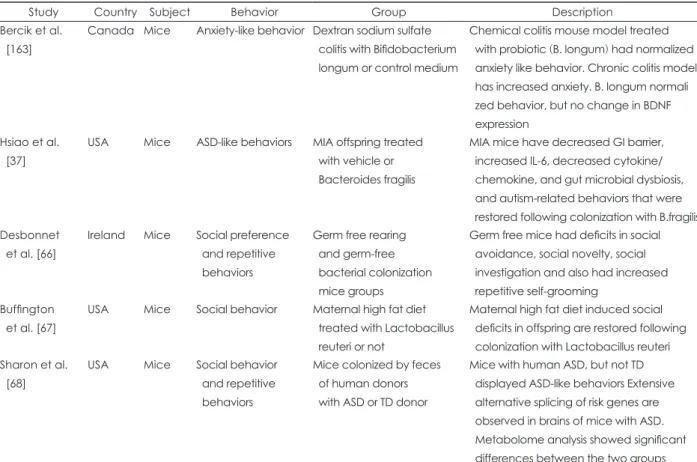
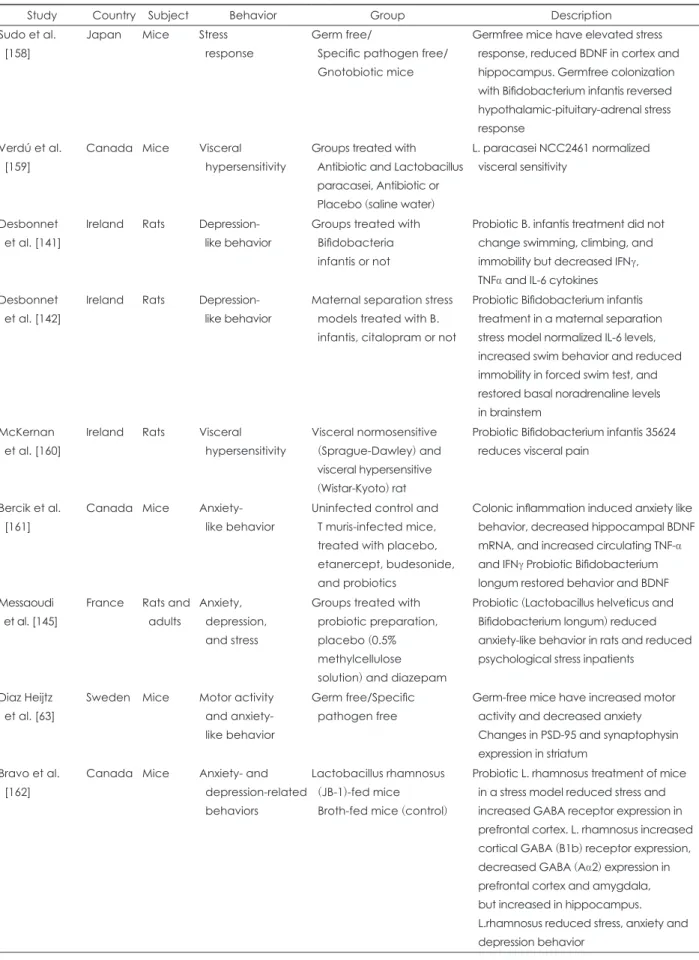
Animal-based research to date has helped us better under- stand the role gut microbiota plays in ASD (Table 1). Lack of social behavior, the most important feature of ASD, has been observed in mice with altered gut microbiota, including GF mice. GF mice show decreased propensity to interact with a novel partner versus a nonsocial object or familiar partner in the three-chambered sociability test, and they spend more time exploring an empty chamber than a chamber with a novel mouse [60]. Stilling et al. [61] reported that a group of GF mice showed significantly lower interaction with other mice than controls and post-weaning colonized mice. In the other study, GF mice were found to spend significantly more time sniffing and interacting with a novel stimulus, due to higher motor activity than that in conventionally raised mice [62]. The results of these studies seem contradictory, but the conclusions are similar in that the role of the gut mi- crobiota in the development of social behavior is important.

In addition, GF mice also show increased stereotyped self-

grooming behavior and mice with an altered gut microbiota

display repetitive burying behavior, as measured by the mar-

ble-burying test [37,60]. In some studies, GF mice have ex-

hibited increased locomotor activity, rearing behaviors [63],

and decreased anxiety-like behavior [62,64,65]. Moreover,

many of these ASD-like behaviors have been reversed upon

colonization with the gut microbiota in healthy mice [63,66].

(5)

Table 1. Animal studies about Microbiota and ASD-like phenotypes

Study Country Subject Behavior Group Description

Sudo et al.

[158]

Japan Mice Stress response

Germ free/

Specific pathogen free/

Gnotobiotic mice

Germfree mice have elevated stress response, reduced BDNF in cortex and hippocampus. Germfree colonization with Bifidobacterium infantis reversed hypothalamic-pituitary-adrenal stress response

Verdú et al.

[159]

Canada Mice Visceral hypersensitivity

Groups treated with Antibiotic and Lactobacillus paracasei, Antibiotic or Placebo (saline water)

L. paracasei NCC2461 normalized visceral sensitivity

Desbonnet et al. [141]

Ireland Rats Depression- like behavior

Groups treated with Bifidobacteria infantis or not

Probiotic B. infantis treatment did not change swimming, climbing, and immobility but decreased IFNγ, TNFα and IL-6 cytokines Desbonnet

et al. [142]

Ireland Rats Depression- like behavior

Maternal separation stress models treated with B.

infantis, citalopram or not

Probiotic Bifidobacterium infantis treatment in a maternal separation stress model normalized IL-6 levels, increased swim behavior and reduced immobility in forced swim test, and restored basal noradrenaline levels in brainstem

McKernan et al. [160]

Ireland Rats Visceral hypersensitivity

Visceral normosensitive (Sprague-Dawley) and visceral hypersensitive (Wistar-Kyoto) rat

Probiotic Bifidobacterium infantis 35624 reduces visceral pain

Bercik et al.

[161]

Canada Mice Anxiety- like behavior

Uninfected control and T muris-infected mice, treated with placebo, etanercept, budesonide, and probiotics

Colonic inflammation induced anxiety like behavior, decreased hippocampal BDNF mRNA, and increased circulating TNF-α and IFNγ Probiotic Bifidobacterium longum restored behavior and BDNF Messaoudi

et al. [145]

France Rats and adults

Anxiety, depression, and stress

Groups treated with probiotic preparation, placebo (0.5%

methylcellulose solution) and diazepam

Probiotic (Lactobacillus helveticus and Bifidobacterium longum) reduced anxiety-like behavior in rats and reduced psychological stress inpatients

Diaz Heijtz et al. [63]

Sweden Mice Motor activity and anxiety- like behavior

Germ free/Specific pathogen free

Germ-free mice have increased motor activity and decreased anxiety Changes in PSD-95 and synaptophysin expression in striatum

Bravo et al.

[162]

Canada Mice Anxiety- and depression-related behaviors

Lactobacillus rhamnosus (JB-1)-fed mice

Broth-fed mice (control)

Probiotic L. rhamnosus treatment of mice in a stress model reduced stress and increased GABA receptor expression in prefrontal cortex. L. rhamnosus increased cortical GABA (B1b) receptor expression, decreased GABA (Aα2) expression in prefrontal cortex and amygdala, but increased in hippocampus.

L.rhamnosus reduced stress, anxiety and

depression behavior

(6)

Hsiao et al. [37] reported that offspring from an immune- activated mother showed changes in gut microbial composi- tion. These offspring were found to not only have GI barrier defects, but also multiple ASD-related endophenotypes in- cluding impairments of social interaction and communica- tion. Treatment with human commensal Bacteroides fragilis ameliorates many of these ASD-related behaviors. Buffington et al. [67] found that offspring from high-fat diet mother rats exhibited social skill deficits, which was associated with gut microbial dysbiosis. They concluded that abnormalities in the gut microbiota cause oxytocin deficiency, resulting in insuffi- cient long-term potentiation (LTP) in the ventral tegmental area and defects in social behavior. Similar to the study of Hsiao et al. [37] this behavioral problem was restored by colo- nization with a single strain of bacteria, Lactobacillus reuteri.

A recent study conducted by Sharon et al. [68] showed that transplanting the gut microbiota from human donors with ASD into GF wild type mice induced behavioral deficits rele- vant to ASD. Mice colonized with samples of ASD donors dis- played more repetitive behavior, less locomotion, and less communication than did mice colonized with samples of typi- cally developed (TD) donors. The study also reported differ-

ential gene expression profiles in the prefrontal cortex and striatum, which is known to mediate social behavior between mice with ASD microbiota and mice with microbiota of TD donors, due to extensive alternative splicing of risk genes in the brains of mice with ASD microbiota. As previous studies have shown that alternative splicing occurs in the brain of hu- mans with ASD, these findings suggest that the gut microbiota plays an important role in the occurrence of ASD, via altering the pattern of brain development. Metagenomic analysis showed that mice with ASD microbiota were relatively defi- cient in 5-aminovaleric acid (5AV) and taurine. BTBR T+Itpr3tf/J mice showing ASD features ingested solutions containing 5AV and taurine, which resulted in an improve- ment in ASD-like behavior.

The amygdala, another key region involved in social in- teraction, has also been repeatedly reported to be affected by microbiota. Examination of the amygdala in GF mice, before and after colonization with microbiota, showed sig- nificant differences in gene expression, exon usage, and RNA editing [69]. This also revealed that different tran- scriptional processes are activated in response to social stimuli in control and GF mice [61].

Table 1. Animal studies about Microbiota and ASD-like phenotypes (continued)

Study Country Subject Behavior Group Description

Bercik et al.

[163]

Canada Mice Anxiety-like behavior Dextran sodium sulfate colitis with Bifidobacterium longum or control medium

Chemical colitis mouse model treated with probiotic (B. longum) had normalized anxiety like behavior. Chronic colitis model has increased anxiety. B. longum normali zed behavior, but no change in BDNF expression

Hsiao et al.

[37]

USA Mice ASD-like behaviors MIA offspring treated with vehicle or Bacteroides fragilis

MIA mice have decreased GI barrier, increased IL-6, decreased cytokine/

chemokine, and gut microbial dysbiosis, and autism-related behaviors that were restored following colonization with B.fragilis Desbonnet

et al. [66]

Ireland Mice Social preference and repetitive behaviors

Germ free rearing and germ-free bacterial colonization mice groups

Germ free mice had deficits in social avoidance, social novelty, social investigation and also had increased repetitive self-grooming

Buffington et al. [67]

USA Mice Social behavior Maternal high fat diet treated with Lactobacillus reuteri or not

Maternal high fat diet induced social deficits in offspring are restored following colonization with Lactobacillus reuteri Sharon et al.

[68]

USA Mice Social behavior and repetitive behaviors

Mice colonized by feces of human donors with ASD or TD donor

Mice with human ASD, but not TD displayed ASD-like behaviors Extensive alternative splicing of risk genes are observed in brains of mice with ASD.

Metabolome analysis showed significant differences between the two groups ASD: autism spectrum disorder, BDNF: brain derived neurotrophic factor, TNF-α: tumor necrosis factor-α, IL: interleukin , GABA:

gamma-amino-butyric acid, MIA: maternal immune activation, GI: gastrointestinal, TD: typically developed

(7)

METABOLITES INDUCED BY THE GUT MICROBIOTA IN ASD

The gut microbiota are known to modulate the CNS by transmitting molecular signals in a variety of ways [2]. Short- chain fatty acids (SCFA), representative signaling molecules, are the product of food fermentation by the gut microbiota [70,71]. SCFA affect the brain by passing through the BBB, entering the brain, and regulating the production of neu- rotransmitters such as serotonin and dopamine [47]. In addi- tion, SCFA are known to be involved in immune action by regulating T-cell cytokine secretion [72]. In ASD patients, the total amount of SCFA is lower than in TD subjects, and the amount positively correlates with Faecalibacterium, Rumino- coccus, and Bifidobacterium. Butyrate, in particular, shows a significant decrease, while propionate is found to be higher than in TD subjects [47]. Although propionate is known to prevent damage to the body from hypertension by inhibiting excessive activity of immune cells [73], elevated levels can have disruptive effects [74]. Case reports have shown that in- creased propionate blood levels can cause behavior problems similar to autism [75], and propionacemia has been identified in children with autism [76]. Propionate can act as a neuro- toxin that inhibits the formation of Nicotinamide adenine dinucleotide (NADH). Since NADH is a major substrate of the electron transport chain, it eventually degrades the ner- vous system [77]. Indeed, male rats injected with propionate into their brains displayed behavioral problems such as social behavior impairments and neuroinflammatory responses similar to those seen in ASD [78]. Peripheral propionate in- jections in rats also induce anxiety-like behavior and impair social interaction [79]. In addition, propionate adminsistered prenatally by maternal injection of sodium propionate solu- tion promotes several behavioral problems associated with ASD in offspring [80]. Patients with Rett syndrome, a repre- sentative genetic cause of ASD, also show higher propionate levels than normal subjects [81]. In addition, Clostridia spe- cies, previously mentioned to be more abundant in ASD pa- tients, are known to be involved in the production of propio- nate [43].

Butyrate, on the other hand, is a major SCFA that has neu- roprotective effects, and is the main source for energy me- tabolism in intestinal epithelial cells, especially colonocytes [82]. As the most potent promoter of intestinal regulatory T cells, it mediates the inflammatory response in the colon, and has the prophylactic and therapeutic potential to prevent ulcerative colitis and colorectal cancer [83]. It also prevents inflammatory reactions by regulating the production of anti- inflammatory cytokines such as interleukin (IL)-10 [84]. The anti-inflammatory action of butyrate also occurs in the

brain [85]. In fact, butyrate is known to attenuate the symp- toms of some neurodegenerative diseases [86]. The role of butyrate in ASD has not been fully studied, but given its neuroprotective function, it is possible that reduced butyrate may affect the pathophysiology of ASD.

Lipopolysaccharide (LPS) is a type of endotoxin produced by gram-negative bacteria, which promotes the secretion of pro-inflammatory cytokines, nitric oxide, and eicosanoids [87]. It can induce disruption of the BBB and increase BBB permeability, allowing exotoxins such as metals to enter the brain, which eventually accumulate in the brain and promote inflammatory responses through the activation of microglia [88]. Some studies showed that prenatal exposure to LPS by gram-negative bacterial infection induces autism-like behav- iors, including social skill deficits [89,90]. Custódio et al. [91]

conducted a study to determine which behavioral problems are caused by LPS exposure during the neonatal period in mice. Male mice injected with LPS solution at postnatal days 5 and 7 exhibited anxiety-like and repetitive behaviors during tasks. LPS-challenged male mice also showed increased im- mune activity, as measured by levels of IL-4 and IL-6 in the prefrontal lobe, hippocampus, and hypothalamus. These findings suggest that ASD features may occur if an immune reaction is triggered by changes in the gut microbiota or bac- terial infection early in life. Similarly, a recent study revealed that early life immune system activation triggered by LPS lead to increased social impairment and repetitive behavior in mice [92]. In both studies, these changes were prominent in male rats, consistent with male predominance in ASD prevalence.

P-cresol is a substance formed by bacteria, which acts as a toxin in various metabolic processes in humans [47], and is associated with abnormalities in the nervous system, such as increased lipid peroxidation in the brain, decreased Na(+)-K+ ATPase activity, and inhibition of noradrenaline formation [93,94]. A representative bacterium known to form p-cresol is Clostridium difficile. C. difficile stimulates the expression of the enzyme p-hydroxyphenylacetate (p- HPA) and consequently induces the fermentation of tyro- sine for the formation of p-cresol. Bacteria such as Clostridi- um scatologenes, Lactobacillus, and Pseudomonas contribute to the conversion of toluene to p-cresol [95], and this was found to be higher in fecal and urine samples of ASD pa- tients than in normal subjects [47,96,97]. Considering that urinary p-cresol is correlated with the severity of autism symptoms [98], it is thought to contribute to the worsening of ASD symptoms and gut dysfunction [99].

In addition, some strains directly affect the brain by being

involved in the formation of neurotransmitters. Serotonin is

known to be involved in critical stages such as neuronal dif-

(8)

ferentiation or migration, myelination, and synaptic forma- tion during the development of the CNS [100]. Serotonin produced by enterochromaffin cells is stored in the epitheli- um and nerve cells of the intestinal barrier [101]. At this time, serotonin reuptake transporter regulates serotonin ac- tivity by transferring secreted serotonin within the synapse back into the cell. Male GF mice have a significant elevation of 5-hydroxytryptamine (5-HT) and 5-hydroxyindoleacetic acid levels (5-HIAA) in the hippocampus [64], which are the main metabolites of the tryptophan metabolic pathway [102].

Another study also found that GF mice had increased 5-HT levels in the hippocampus and increased tryptophan levels in the blood [103]. Given that ASD-relevant endophenotypes such as social skill deficits and cognitive rigidity have been found in rodents with deficits in the 5-HT system [104-106], serotonin may be a neurotransmitter that plays an important role in the pathophysiology of ASD. Indeed, it has been shown that hyperserotoninemia occurs in autism [107]. Data reported by neuroimaging and post-mortem studies also suggest abnormalities in the brain serotonergic system in ASD [108,109]. Clostridia species promote the conversion of tryptophan to 5-HT by increasing the mRNA levels of tryp- tophan hydroxylase 1 in endochromaffin cells [110]. Species involved in serotonin production include Peptostreptococcus russellii, Lactobacillus [111-113], Streptococcus, Escherichia and Enterococcus [114]. Considering this fact, the gut micro- biota may be the link between ASD and serotonin abnor- mality that is not yet fully understood.

ALTERED IMMUNE RESPONSE IN ASD AND THE GUT MICROBIOTA

As mentioned earlier, abnormalities in various immune responses have been observed in ASD patients. In terms of neuroimmunity, extensive microglial activity was observed in the brain tissue of ASD patients, including cortical re- gions, white matter, and cerebellum [34]. It was also found that the density of reactive microglia was increased in the dorsolateral prefrontal cortex of ASD patients [115]. The in- creased expression of microglial marker genes including triggering receptor expressed on myeloid cells 2 (TREM2) and killer cell activating receptor-associated protein (DAP12/

KARAP) in the prefrontal cortex of ASD patients also sug- gests a dysfunction of neuroimmunity in ASD [116]. These neuroimmune abnormalities were also confirmed in animal models, especially in the maternal immune activation (MIA) model, which is known to be associated with the develop- ment of ASD [117,118]. When the maternal immune system was stimulated by the administration of LPS during the ges- tational period, changes in microglial receptor function,

dysregulated immune response, and ASD-relevant behaviors were observed in male offspring mice [37,119].

Various systemic immune abnormalities have been also observed in ASD. Changes in this cytokine network have been reported in the CSF and post-mortem brain tissue of ASD patients [34]. In particular, recent studies support the possibility that abnormalities in pro-inflammatory cyto- kines, including IL-6 and TNF-α, may affect the develop- ment of ASD. IL-6 is a cytokine produced by microglia, as- trocytes, and neurons, and is necessary for neuron survival.

However, prolonged elevation of IL-6 levels may induce sev- eral pathologies in the brain [120]. One study found that overexpression of IL-6 caused problems with adhesion and migration of neuronal cells, and eventually facilitated the formation of excitatory synapses [121]. Animal model stud- ies have confirmed that these changes can lead to ASD-rele- vant behavior [122]. Conversely, administration of anti-in- flammatory agents in autistic mice have been found to reduce IL-6 levels, thereby reducing autism-like behavior [123]. TNF-α is a molecule that is involved in synaptic plas- ticity [124]. Long-term elevation of TNF-α is known to in- hibit LTP of the synapse and induce the learning and memo- ry problems that are observed in ASD [125]. The CSF to serum ratio of TNF-α is increased in ASD patients [126]. As a result of analyzing the brain tissue of ASD patients, it was confirmed that the level of TNF-α was higher than that in TD subjects, specifically in the frontal cortex [127]. In addi- tion, several studies have reported elevation of IL-1β levels, another immunomodulatory molecule involved in the inhi- bition of LTP and the reduction of synaptic strength [128], in peripheral blood of ASD patients [129,130]. These findings in ASD patients suggest that neurotoxicity or inhibition of neu- rodevelopment caused by immune abnormalities could be key pathophysiologies of ASD.

Several studies have shown that immune system abnormali- ties in ASD patients are associated with the gut microbiota.

Higher density and branching complexity of microglia in

multiple brain regions were observed in GF mice than in mice

raised in a specific pathogen free environment. Similar to GF

mice, microglial density was increased in mice colonized with

a less complex composition of the gut microbiota. GF mice

with malformed microglia showed social avoidance and a re-

duced immune response against stimuli such as viral infec-

tion. In the same study, both microglia abnormalities and

ASD-relevant behaviors were corrected after re-colonization

of GF mice with the gut microbiota extracted from TD mice

[131]. Specific bacterial species from the gut microbiota, such

as Bacteroides fragilis and a Clostridia species, are known to

modulate immune reaction by upregulating levels of IL-

10-producing T regulatory cells [132]. Interaction between the

(9)

gut microbiota and the immune system could be relevant to the immune dysregulation found in ASD. For example, regu- latory T-cell and T helper cell abnormalities are observed in ASD patients [127]. Considering that the microbiota is in- volved in the differentiation of myeloid cells, the monocyte and macrophage abnormalities observed in peripheral blood of ASD patients are also thought to be related to the gut mi- crobiota [133,134].

MIA during pregnancy is considered to increase the risk for ASD [117,135]. As mentioned above, Hsiao et al. [37] re- vealed offspring from MIA mice displayed not only ASD- relevant features, such as anxiety-like behavior, stereotypy, and reduced sociability, but also dysbiosis of the gut micro- biota. Moreover, MIA offspring showed a change in gut per- meability when compared to control mice due to decreased expression of tight junction proteins, as well as the altered expression of cytokines such as IL-12. In this study, restora- tion of the gut microbiota by oral treatment with specific bacterial species not only corrected gut permeability, but also improved behavioral problems similar to ASD. A recent study found that less ASD-relevant behaviors were observed in offspring from MIA mice with preconception microbiota transplantation than in offspring born to conventional MIA mice. The authors found that changes in microbial composi- tion caused changes in IL-17a secretion, and also confirmed that inhibition of IL-17a signaling could lead to amelioration of ASD phenotypes, such as social impairment [136]. Collec- tively, these findings clearly indicate that the gut microbiota contributes to the immunological abnormalities observed in ASD. Furthermore, there is a potential for the gut microbiota to act as a link between MIA and the pathogenesis of neuro- developmental disorders, including ASD. Further studies are needed to investigate the effects of microbiota on the im- mune system in order to uncover the pathophysiology of ASD, which is still unclear.

THERAPEUTIC APPROACHES VIA THE GUT MICROBIOTA FOR ASD

Probiotics generally refers to a collection of living microor- ganisms known to provide health benefits by improving or restoring the composition of the intestinal microflora [137].

The mechanism is still unknown, but a predominant role of probiotics is to modulate the immune system [138]. For ex- ample, Lim et al. [139] found that certain strains of Weissella cibaria in kimchi improved the symptoms of atopic dermati- tis by regulating the response of regulatory T cells. In addi- tion, probiotics play a beneficial role in strengthening the barrier, participating in the formation of nutrients such as vi- tamins, and preventing the growth of pathogens [33,137].

Various probiotics have been studied in neurological and psychiatric disorders, among which the most beneficial strains are Bifidobacterium and Lactobacillus [140]. Bifido- bacterium infantis improved not only the behavioral deficit of rat pups separated from their mother, but also physiologic re- sponses including normalizing IL-6 and tryptophan release [141,142]. Innately anxious male mice, which were fed with Bifidobacterium longum and Bifidobacterium breve, showed reduced anxiety in behavioral tasks such as the marble-bury- ing test [143]. Janik et al. [144] used non-invasive magnetic resonance spectroscopy techniques to observe what hap- pened in the brain of mice when Lactobacillus strains were administered. As a result, brain concentrations of biomarkers such as glutamate, N-acetyl aspartate, and GABA were in- creased. In humans, urinary free cortisol was decreased with treatment by probiotics consisting of Lactobacillus helveticus and Bifidobacterium longum [145]. Lactobacillus casei Shirota improves stress-related GI symptoms and psychological dis- tress [146]. As mentioned above, colonization with strains such as Lactobacillus reuteri and Bacteroides fragilis has been shown to improve the behavior of mice showing an ASD phe- notype [37,67]. In addition to these findings, Grossi et al. [147]

reported a case of an ASD child whose symptoms had been improved through the use of probiotics. The subject was a 12 year-old boy with ASD and severe cognitive disability. Taking probiotics containing Bifidobacterium breve, B. longum, B.

infanti, Lactobacillus acidophilus, L. plantarum, L. paracasei, L. bulgaricus, and L. delbrueckii for 3 months led to better so- cial affects, as measured by the Autism Diagnostic Observa- tion Schedule. The improvement lasted up to 9 months after discontinuation of treatment. Niu et al. [148] applied a com- bination of applied behavior analysis (ABA) training and probiotic administration for 4 weeks in children with ASD.

Although it was difficult to distinguish from the effects of ABA, the results showed that the symptoms of ASD patients taking probiotics, as measured by the Autism Treatment Evaluation Checklist, improved. These findings suggest that probiotics could be used to treat ASD, even though it would be too premature to conclude this, due to several limitations.

Fecal microbiota transplantation (FMT) is being actively studied as a new treatment for many diseases in which the gut microbiota is known to contribute to pathophysiology.

Unlike probiotics, which administer to some specific

strains, FMT alters the composition of hundreds of strains

through the transplantation of feces of healthy donors into

the intestines of patient [149]. FMT is recognized as a stan-

dard treatment for repeated infection of Clostridium difficile

[150], and has been studied as a treatment tool for various

diseases such as ulcerative colitis [151], Crohn’s disease [152],

irritable bowel syndrome [153], and epilepsy [154]. Kang et

(10)

al. [155] conducted a study to identify the therapeutic effect of FMT in 18 children with ASD. The treatment protocol was divided into four stages. Children were given vancomy- cin for two weeks and bowel cleansing prior to transplanta- tion. Standardized Human Gut Microbiota was adminis- tered orally and rectally, with a high initial dose for 2 days and a lower maintenance oral dose, alongside a stomach acid suppressant, for 7–8 weeks. Symptoms, as rated by the Gastrointestinal Symptom Rating Scale, were an approxi- mately 80% reduced at the end of treatment, and included significant improvements in constipation, diarrhea, and ab- dominal pain. Overall autism symptoms, as measured by Parental Global Impression III, were also improved, and the effect was maintained for 8 weeks after discontinuation of treatment. Bacterial changes after FMT include increased diversity and altered abundance of three genera, Bifidobac- terium, Prevotella, and Desulfovibrio. Recently, the same au- thors published a follow-up study of 18 FMT patients, which showed improvement in symptoms as long as 2 years after the end of treatment [156]. Although the number of partici- pants was small, these findings suggest that FMT can be a useful therapeutic tool for ASD. The use of whole feces can lead to transferring pathogens from the donor to the pa- tient, causing an unexpected infection. Attempts are made to reduce the possibility of unexpected infections by screen- ing donors using stringent criteria, but there are always risks [157].

CONCLUSION

The microbiota is considered to play an essential role in the development of the normal nervous system and mainte- nance of brain function. Considering the results of various animal studies and human studies, it is clear that ASD and the gut microbiota are closely related.

First, the incidence of GI disturbances is higher in ASD patients than in normal subjects [15]. The results of several studies show a positive correlation between the severity of GI symptoms and core symptoms of ASD including social skill deficits [21,22]. These results suggest that core symp- toms and GI disturbances may share the same pathology.

The gut microbiota is thought to contribute to this process by altering the integrity of barriers, increasing permeability, and consequently inducing inflammation.

Several studies have attempted to confirm changes in mi- crobial compositions in the ASD population. As a result of these efforts, several common findings have emerged, in- cluding a reduction in overall microbial diversity, an increase in Firmicutes to Bacteroidetes ratio [41-43], and a relative abundance of Clostridium [44-46]. However, many of these

studies have limitations. Despite the high likelihood of bias when considering the properties of the gut microbiota that are sensitive to diet, most researchers have not found a way to control the variables of diet. In addition, most studies were carried out with a relatively small number of subjects, making it difficult to generalize the results. Many studies adopted a cross-sectional design, which makes it difficult to determine the causal relationship between alteration of the gut microbiota and disease development or course [59]. Fu- ture work should focus on overcoming these limitations.

Animal studies provide relatively more information about the relationship between ASD and the gut microbiota. In particular, studies showed that behavior is normalized by re-colonization with specific strains in offspring mice with ASD phenotype, suggesting the possibility that the gut mi- crobiota can be used therapeutically [37,67]. Moreover, re- cent studies have shown that mice transplanted with stools of ASD patients exhibit ASD-like behaviors accompanied by changes in gene expression in the brain, unlike mice transplanted with normal stools [68]. These findings bring us a step closer to understanding the role of the gut micro- biota in the development of ASD, which has not been possi- ble through human studies.

Several metabolites produced by the gut microbiota have also been studied. Overall SCFA levels in ASD patients are reduced, while propionate, which could act as an endotoxin, is increased [47]. Animal studies have shown that exposure to propionate and LPS may cause behavioral problems simi- lar to ASD, and changes in immune activity [78,91]. Sero- tonin metabolic abnormalities have been observed in ASD patients [107-109], and there is a possibility that the gut mi- crobiota may be involved in this process [110]. Continuing the search for metabolites will make it possible to identify the missing link between the gut microbiota and ASD.

Immune abnormalities have been considered to play an important role in the pathogenesis of ASD through several recent studies. In the brain tissue of ASD patients, changes in reactivity as well as morphological changes in microglia and astrocytes have been observed. In addition, alteration of various cytokine levels, including IL-6 and TNF-a, has been also observed in ASD patients. It is possible that these abnor- mal immune responses interfere with brain functions such as learning and memory and contribute to the development of ASD. Several studies support the link between changes in the immune response and the gut microbiota in ASD. In particular, studies using the MIA mouse model confirmed that various deficits in the offspring of MIA mice, including ASD-relevant behaviors and changes in gut permeability, were improved through correction of the gut microbiota.

These findings indicate that the interaction between micro-

(11)

biota and the immune system may play an important role in the pathogenesis of ASD.

Based on the results of the studies mentioned, studies were conducted to confirm the effectiveness of the therapeutic tools using microbiota. There have been no large, well-de- signed studies as yet, but some of the findings provide us with a positive impression regarding the therapeutic use of micro- biota. In particular, we should note that the results of the study showed that FMT improved the symptoms in 18 chil- dren with ASD [155,156]. However, it must be recognized that FMT also presents a concurrent risk of infection.

In conclusion, we suggest that the gut microbiota is deeply involved in the development of ASD. However, more research is needed to further explore the development of ASD based on the microbiota-gut-brain axis. Greater control over vari- ables such as diet and drug use will be particularly important for reducing the possibility of bias in human studies. We hope that our review, which encompasses many studies conducted to date, will help guide the direction of future research.

Acknowledgments None.

Conflicts of Interest

The authors have no potential conflicts of interest to disclose.

Author Contributions

Conceptualization: Donghun Oh, Keun-Ah Cheon. Data curation:

Donghun Oh. Formal analysis: Donghun Oh. Investigation: Donghun Oh. Methodology: Donghun Oh. Project administration: Keun-Ah Cheon. Resources: Donghun Oh. Software: Donghun Oh. Supervision:

Keun-Ah Cheon. Validation: Donghun Oh, Keun-Ah Cheon. Visualiza- tion: Donghun Oh. Writing—original draft: Donghun Oh. Writing—re- view & editing: Keun-Ah Cheon.

ORCID iDs

Donghun Oh https://orcid.org/0000-0003-3824-4783 Keun-Ah Cheon https://orcid.org/0000-0001-7113-9286

REFERENCES

1) Gilbert JA, Blaser MJ, Caporaso JG, Jansson JK, Lynch SV, Knight R. Current understanding of the human microbiome. Nat Med 2018;24:392-400.

2) Sharon G, Sampson TR, Geschwind DH, Mazmanian SK. The cen- tral nervous system and the gut microbiome. Cell 2016;167:915-932.

3) Vuong HE, Hsiao EY. Emerging roles for the gut microbiome in autism spectrum disorder. Biol Psychiatry 2017;81:411-423.

4) Vasquez A. Biological plausibility of the gut-brain axis in au- tism. Ann N Y Acad Sci 2017;1408:5-6.

5) Sherwin E, Dinan TG, Cryan JF. Recent developments in under- standing the role of the gut microbiota in brain health and dis- ease. Ann N Y Acad Sci 2018;1420:5-25.

6) Fung TC, Olson CA, Hsiao EY. Interactions between the micro- biota, immune and nervous systems in health and disease. Nat Neurosci 2017;20:145-155.

7) Ogbonnaya ES, Clarke G, Shanahan F, Dinan TG, Cryan JF, O’Leary OF. Adult hippocampal neurogenesis is regulated by the microbiome. Biol Psychiatry 2015;78:e7-e9.

8) Möhle L, Mattei D, Heimesaat MM, Bereswill S, Fischer A, Alutis M, et al. Ly6C

hi

monocytes provide a link between antibiotic-in- duced changes in gut microbiota and adult hippocampal neuro- genesis. Cell Rep 2016;15:1945-1956.

9) Braniste V, Al-Asmakh M, Kowal C, Anuar F, Abbaspour A, Tóth M, et al. The gut microbiota influences blood-brain barrier permeability in mice. Sci Transl Med 2014;6:263ra158.

10) Li Q, Han Y, Dy ABC, Hagerman RJ. The gut microbiota and au- tism spectrum disorders. Front Cell Neurosci 2017;11:120.

11) Baio J, Wiggins L, Christensen DL, Maenner MJ, Daniels J, Warren Z, et al. Prevalence of autism spectrum disorder among children aged 8 years - autism and developmental disabilities monitoring network, 11 sites, United States, 2014. MMWR Surveill Summ 2018;67:1-23.

12) Buescher AV, Cidav Z, Knapp M, Mandell DS. Costs of autism spectrum disorders in the United Kingdom and the United States. JAMA Pediatr 2014;168:721-728.

13) Fakhoury M. Autistic spectrum disorders: a review of clinical fea- tures, theories and diagnosis. Int J Dev Neurosci 2015;43:70-77.

14) Bik EM. The hoops, hopes, and hypes of human microbiome re- search. Yale J Biol Med 2016;89:363-373.

15) Buie T, Campbell DB, Fuchs GJ 3rd, Furuta GT, Levy J, Vandewa- ter J, et al. Evaluation, diagnosis, and treatment of gastrointestinal disorders in individuals with ASDs: a consensus report. Pediatrics 2010;125 Suppl 1:S1-18.

16) Wasilewska J, Klukowski M. Gastrointestinal symptoms and au- tism spectrum disorder: links and risks-a possible new overlap syndrome. Pediatric Health Med Ther 2015;6:153-166.

17) McElhanon BO, McCracken C, Karpen S, Sharp WG. Gastroin- testinal symptoms in autism spectrum disorder: a meta-analysis.

Pediatrics 2014;133:872-883.

18) Niehus R, Lord C. Early medical history of children with autism spectrum disorders. J Dev Behav Pediatr 200;27(2 Suppl):S120- S127.

19) Afzal N, Murch S, Thirrupathy K, Berger L, Fagbemi A, Heusch- kel R. Constipation with acquired megarectum in children with autism. Pediatrics 2003;112:939-942.

20) Peeters B, Noens I, Philips EM, Kuppens S, Benninga MA. Au- tism spectrum disorders in children with functional defecation disorders. J Pediatr 2013;163:873-878.

21) Mayer EA, Padua D, Tillisch K. Altered brain-gut axis in autism:

comorbidity or causative mechanisms? Bioessays 2014;36:933- 939.

22) Fulceri F, Morelli M, Santocchi E, Cena H, Del Bianco T, Narzisi A, et al. Gastrointestinal symptoms and behavioral problems in pre- schoolers with autism spectrum disorder. Dig Liver Dis 2016;48:

248-254.

23) Iovene MR, Bombace F, Maresca R, Sapone A, Iardino P, Picardi A, et al. Intestinal dysbiosis and yeast isolation in stool of sub- jects with autism spectrum disorders. Mycopathologia 2017;182:

349-363.

24) Ding HT, Taur Y, Walkup JT. Gut microbiota and autism: key concepts and findings. J Autism Dev Disord 2017;47:480-489.

25) Rao M, Gershon MD. The bowel and beyond: the enteric nervous system in neurological disorders. Nat Rev Gastroenterol Hepatol 2016;13:517-528.

26) Bernier R, Golzio C, Xiong B, Stessman HA, Coe BP, Penn O, et al. Disruptive CHD8 mutations define a subtype of autism early in development. Cell 2014;158:263-276.

27) Sweatt JD. Pitt-Hopkins syndrome: intellectual disability due to loss of TCF4-regulated gene transcription. Exp Mol Med 2013;

45:e21.

28) Hosie S, Ellis M, Swaminathan M, Ramalhosa F, Seger GO, Bala-

suriya GK, et al. Gastrointestinal dysfunction in patients and

mice expressing the autism-associated R451C mutation in neuro-

ligin-3. Autism Res 2019;12:1043-1056.

(12)

29) Sharkey KA. Emerging roles for enteric glia in gastrointestinal disorders. J Clin Invest 2015;125:918-925

30) Grubišić V, Parpura V. The second brain in autism spectrum dis- order: could connexin 43 expressed in enteric glial cells play a role? Front Cell Neurosci 2015;9:242.

31) Walker SJ, Fortunato J, Gonzalez LG, Krigsman A. Identification of unique gene expression profile in children with regressive autism spectrum disorder (ASD) and ileocolitis. PLoS One 2013;8:e58058.

32) Navarro F, Liu Y, Rhoads JM. Can probiotics benefit children with autism spectrum disorders? World J Gastroenterol 2016;22:10093- 10102.

33) Santocchi E, Guiducci L, Fulceri F, Billeci L, Buzzigoli E, Apicella F, et al. Gut to brain interaction in autism spectrum disorders: a randomized controlled trial on the role of probiotics on clinical, biochemical and neurophysiological parameters. BMC Psychiatry 2016;16:183.

34) Vargas DL, Nascimbene C, Krishnan C, Zimmerman AW, Pardo CA. Neuroglial activation and neuroinflammation in the brain of patients with autism. Ann Neurol 2005;57:67-81.

35) Ashwood P, Krakowiak P, Hertz-Picciotto I, Hansen R, Pessah I, Van de Water J. Elevated plasma cytokines in autism spectrum disorders provide evidence of immune dysfunction and are asso- ciated with impaired behavioral outcome. Brain Behav Immun 2011;25:40-45.

36) Onore C, Careaga M, Ashwood P. The role of immune dysfunction in the pathophysiology of autism. Brain Behav Immun 2012;26:383- 392.

37) Hsiao EY, McBride SW, Hsien S, Sharon G, Hyde ER, McCue T, et al. Microbiota modulate behavioral and physiological abnormalities associated with neurodevelopmental disorders. Cell 2013;155:1451- 1463.

38) Fiorentino M, Sapone A, Senger S, Camhi SS, Kadzielski SM, Buie TM, et al. Blood-brain barrier and intestinal epithelial barrier al- terations in autism spectrum disorders. Mol Autism 2016;7:49.

39) Esnafoglu E, Cırrık S, Ayyıldız SN, Erdil A, Ertürk EY, Daglı A, et al. Increased serum zonulin levels as an intestinal permeabili- ty marker in autistic subjects. J Pediatr 2017;188:240-244.

40) Mörkl S, Lackner S, Meinitzer A, Mangge H, Lehofer M, Halwachs B, et al. Gut microbiota, dietary intakes and intestinal permeability reflected by serum zonulin in women. Eur J Nutr 2018;57:2985- 2997.

41) Williams BL, Hornig M, Buie T, Bauman ML, Cho Paik M, Wick I, et al. Impaired carbohydrate digestion and transport and mucosal dysbiosis in the intestines of children with autism and gastrointes- tinal disturbances. PLoS One 2011;6:e24585.

42) Tomova A, Husarova V, Lakatosova S, Bakos J, Vlkova B, Babins- ka K, et al. Gastrointestinal microbiota in children with autism in Slovakia. Physiol Behav 2015;138:179-187.

43) Strati F, Cavalieri D, Albanese D, De Felice C, Donati C, Hayek J, et al. New evidences on the altered gut microbiota in autism spec- trum disorders. Microbiome 2017;5:24.

44) Finegold SM, Molitoris D, Song Y, Liu C, Vaisanen ML, Bolte E, et al. Gastrointestinal microflora studies in late-onset autism. Clin Infect Dis 2002;35:S6-S16.

45) Song Y, Liu C, Finegold SM. Real-time PCR quantitation of clos- tridia in feces of autistic children. Appl Environ Microbiol 2004;

70:6459-6465.

46) Alshammari MK, AlKhulaifi MM, Al Farraj DA, Somily AM, Albarrag AM. Incidence of Clostridium perfringens and its toxin genes in the gut of children with autism spectrum disorder. An- aerobe 2020;61:102114.

47) De Angelis M, Piccolo M, Vannini L, Siragusa S, De Giacomo A, Serrazzanetti DI, et al. Fecal microbiota and metabolome of chil- dren with autism and pervasive developmental disorder not oth- erwise specified. PLoS One 2013;8:e76993.

48) Kang DW, Park JG, Ilhan ZE, Wallstrom G, Labaer J, Adams JB,

et al. Reduced incidence of Prevotella and other fermenters in in- testinal microflora of autistic children. PLoS One 2013;8:e68322.

49) Rose DR, Yang H, Serena G, Sturgeon C, Ma B, Careaga M, et al.

Differential immune responses and microbiota profiles in chil- dren with autism spectrum disorders and co-morbid gastrointes- tinal symptoms. Brain Behav Immun 2018;70:354-368.

50) Kang DW, Ilhan ZE, Isern NG, Hoyt DW, Howsmon DP, Shaffer M, et al. Differences in fecal microbial metabolites and microbiota of children with autism spectrum disorders. Anaerobe 2018;49:121- 131.

51) Parracho HM, Bingham MO, Gibson GR, McCartney AL. Dif- ferences between the gut microflora of children with autistic spectrum disorders and that of healthy children. J Med Microbiol 2005;54:987-991.

52) Wang L, Christophersen CT, Sorich MJ, Gerber JP, Angley MT, Conlon MA. Low relative abundances of the mucolytic bacteri- um Akkermansia muciniphila and Bifidobacterium spp. in feces of children with autism. Appl Environ Microbiol 2011;77:6718- 6721.

53) Gondalia SV, Palombo EA, Knowles SR, Cox SB, Meyer D, Austin DW. Molecular characterisation of gastrointestinal microbiota of children with autism (with and without gastrointestinal dysfunc- tion) and their neurotypical siblings. Autism Res 2012;5:419-427.

54) Zhao RH, Zheng PY, Liu SM, Tang YC, Li EY, Sun ZY, et al.

[Correlation between gut microbiota and behavior symptoms in children with autism spectrum disorder]. Zhongguo Dang Dai Er Ke Za Zhi 2019;21:663-669.

55) Williams BL, Hornig M, Parekh T, Lipkin WI. Application of novel PCR-based methods for detection, quantitation, and phylo- genetic characterization of Sutterella species in intestinal biopsy samples from children with autism and gastrointestinal distur- bances. mBio 2012;3:e00261-11.

56) Kushak RI, Winter HS, Buie TM, Cox SB, Phillips CD, Ward NL. Analysis of the duodenal microbiome in autistic individuals:

association with carbohydrate digestion. J Pediatr Gastroenterol Nutr 2017;64:e110-e116.

57) Kumar H, Lund R, Laiho A, Lundelin K, Ley RE, Isolauri E, et al. Gut microbiota as an epigenetic regulator: pilot study based on whole-genome methylation analysis. mBio 2014;5:e02113-14.

58) Srikantha P, Mohajeri MH. The possible role of the microbiota- gut-brain-axis in autism spectrum disorder. Int J Mol Sci 2019;20:2115.

59) Cryan JF, O’Riordan KJ, Sandhu K, Peterson V, Dinan TG. The gut microbiome in neurological disorders. Lancet Neurol 2020;19:179-194.

60) Byrne CS, Chambers ES, Morrison DJ, Frost G. The role of short chain fatty acids in appetite regulation and energy homeostasis.

Int J Obes (Lond) 2015;39:1331-1338.

61) Stilling RM, Moloney GM, Ryan FJ, Hoban AE, Bastiaanssen TF, Shanahan F, et al. Social interaction-induced activation of RNA splicing in the amygdala of microbiome-deficient mice.

Elife 2018;7:e33070.

62) Arentsen T, Raith H, Qian Y, Forssberg H, Diaz Heijtz R. Host microbiota modulates development of social preference in mice.

Microb Ecol Health Dis 2015;26:29719.

63) Diaz Heijtz R, Wang S, Anuar F, Qian Y, Björkholm B, Samuels- son A, et al. Normal gut microbiota modulates brain development and behavior. Proc Natl Acad Sci U S A 2011;108:3047-3052.

64) Clarke G, Grenham S, Scully P, Fitzgerald P, Moloney RD, Shana- han F, et al. The microbiome-gut-brain axis during early life regu- lates the hippocampal serotonergic system in a sex-dependent manner. Mol Psychiatry 2013;18:666-673.

65) McVey Neufeld KA, Perez-Burgos A, Mao YK, Bienenstock J,

Kunze WA. The gut microbiome restores intrinsic and extrinsic

nerve function in germ-free mice accompanied by changes in

calbindin. Neurogastroenterol Motil 2015;27:627-636.

수치

Table 1. Animal studies about Microbiota and ASD-like phenotypes
Table 1. Animal studies about Microbiota and ASD-like phenotypes (continued)

참조

관련 문서

The spectrum of an FM wave contains a carrier component and and an infinite set of side frequencies located symmetrically on either side of the carrier at frequency separations of

◦ 전반적 발달장애 (Pervasive Developmental Disorders, PDDs)라는 범주 안에 “유아자폐증”(Early Infantile.. Autism, Diagnostic and Statistical Manual of

단기사용 : severe depression with psychotic features, substance- induced psychosis, aggressiveness & behavioral problems in pervasive developmental disorder

Music therapy was used in this study and participants were diagnosed with de- pressive disorder, according to the Diagnostic and Statistical Manual of Mental disorder 4 th

Radon remediation in homes with levels ≥ 21.6 pCi/L $6,100

자폐성장애는 민족, 문화 경제 및 지리적 경계와 무관하게 발생하 는 장애로 현재 전세계적으로 자폐에 대한 사회적인 이해가 자폐 성장애의 조기발견과 치료, 예후

 J( DDDDDDDDDDDDDDDDDDDDDDDDDDDDDDDDDDDDDDDDDDDDDDDDDDDDDDDDDDDDDDDDDDDDDDDDDDDDDDDDDDDDDDDDDDDDDDDDDDD E

An investigation of adults with Asperger syndrome or high functioning autism, and normal sex differences.. The facilitation of social-emotional understanding