대한임상병리사회지
:제 20권 제
1호
1988세균뇨 검색을 위한 Filtra Check- UTI 의 검토
한양대학병원 임상병리과
·김대근
·박종윤
·이주섭
서 론
요로 감염증은 엄상에서 가장 혼히 경험하는 임상질 환증의 하나로 신장, 수뇨관, 방광및 요도에 발생하는 염
중이다 1)세균의 요로감염 경로는 여러원인으로 알려져 있으며
2)
신우신염둥은 신장 실질부위의 손상까지 초래하기도 하므로 엄상적으로 중요한 위치를 차지하고 었다 3)
요로감염의 결과 신우신염, 방광염둥으로 발전되었을 때 질병의 원인균으로 진단할 수 있는 세굵학적 근거는 배 양결과 그 집 락이
105CFU Iml이 상의 세 균뇨를4) 기 준으로 잡고 균을 동정하여 항생제 감수성 검사동을 실 시한다.
세균뇨의 빠른 검색을 위해 현재 여러가지 검사방법
들이
5-11)널리 이용되고 있으나 그 주된 방법은 현미경
검사, 배양, 화학적분석, 자동화 기기를 위한 방법들이 그대부분이다.
그러나, 각종검사 방법들이 예민도의 저하, 특이도의 문제, 시약의 불안정화, 장시간의 소요, 다량검사시의 업 무량, 고가의 장비 둥 갖고 있는 제한점으로 아직도 보 편화에 애로를 겪고 있다.
본연구는 간단 신속하여 사용시약이 안정되고 특정기 구가 필요없이 높은 예민도를 갖고 있는
Filtracheck -UTISystem( 이하 FC-UTI) 를 재래식의 소변 반정량 배양법 과 비교시험하여 세균뇨 검출율을 검토 하고져 하였다.
재료및 방법
1.실험재료(뇨)
1988 년 6월3 일부터 8월 13 일까지 한양대학병원 외래 및 입원환자로부터 임상병리과 세균검사실에 배양의뢰 된 가검물중 무작위 표본에 의하여
188례를 대상으로 하였다.
FiltraCheck UTI system(Applied
p이ytechnology,
Inc., Houston, Texas) : 30Test KitC여e
No. 11285-KE LntNO.202
2. 실험방법
1) FC -UTI system
검사
멸균용기에 받아온 검체를 배양과 동시에 검사하거나 4 "C에 보관후 1 시간 이내에 검사하고 검사시약은 실온
(15-30"C)에 보존 사용하였다.
@
일회용
FiltraCheck디스크를 Well쪽이 위로 오도 록한다.
@
소변을 잘 섞어 준비되어진 피멧을 사용하여 두방 울을 회석컵에 넣는다. 희석제(시약1) 6 방울을 넣는다.
@
소변
•회석제 혼합물을
FC-UTI디스크의 Well에 붓는다.
@
필터에 충분히 흡수되었을때 염료시약(시약2) 3 방 울을 Well에 떨어 뜨린다.
@
염료가 필터에 충분히 홉수되면 세척용액(시약3) 3방울을 떨어 뜨린다.
@
세척액이 충분히 흡수되면 다시 세척용액(시약3) 을 다시 3방울 떨어뜨려 재 세척한다.
@
디스크의 중심부에 있는 필터표면을 판독표와 비 교한다.
@
흰색필터는 음성, 분홍 또는 붉은색은 양성으로 판 독한다.
@
시험이 끝난
FC-UTI디스크는 멸균 처리한다.
2)
반 정량배양
검체는 접수하여 바로 접종하였다.0.001 떼의 표준
loop를 사용하여
5%혈액한천배지에 심고 35 "C에 24시간 배 양후 관찰하고 계산하였다. 균의 동정은
Edwards및
Ewing (1972), Lennette
동(1 98이의 방법과 기준에 따
랐다.12~13)성 적 1.균의동정
-147-
Fig 1. Components of the FC- UTI test Kit
(filter disk, three reagents bottle, dilution cup, pipet, color guide)
188
검체의 소변 배양검사결과 분리 동정된균은
Esc- herichia coli26주 (13.8%) 로 가장 많이 분리되었으며
Pseudomonas spp.
12주,
Serratia spp.4주,
Klebsiella spp.2주,
Morganella1 주, Ent~robacter
spp.1 주,
Acinetobac- ter spp.2주,
Flavobacterium spp.3주,
Staphy aureus4주,
Coag. Negative Staphylococcus5주,
Enterococcus5주,
Candida spp11 주, 기 타 3주였으며
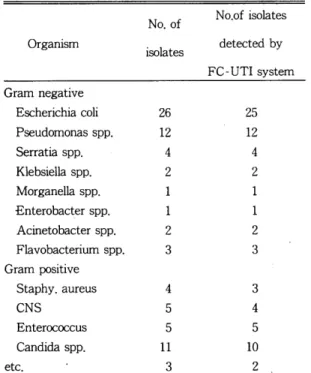
FC -UTI system을 사용한 검사성적은 표 1 과 같다.
2. FiltraCheck-UTI system
검사
배 양볍 검사결과를 기준으로
FC -UTIsystem 의 검사 결과는 표2와 같다.
예민도는
94.1%,특이도
82.5%,예측 가능한 음성치
(Negative Predictive
Value) 는 96.1%였다.
위양성반웅 (FC-UTI
+ ; Culture-)21 예의 내용은 배양음성 11 예와
Candida spp.10 예 였고, 위음성반응
(FC-UTI - ; Culture+)4 예의 내용은
E.coli1 주,
CNS1 주,
S. aureus1 주, 기 타 1주로 나타났다. 또,
FC-UTI음성이었으나 배양 결과는
Candida spp.1 예가 자란것도 볼 수 있었다.
고 찰
요로 감염증은 임상에서 쉽게보는 질환으로 그 감염 경로는다양하다.
요의 정체나 요로폐쇄, 이물질의 존재로 인한 배뇨장 애, 신체저항 능력의 저하둥은 감염의 중요한 요인이다.
입원환자에서는 Catheter의 삽입에 의한 감염이나 기 타 원내 감염으로 인한 요로 감염이 문제가 될 수 있다.
14)
또한 뇨 자체가 좋은 배지가 되어 요로계 감염이 많으 며 1운16) 여자에서 남자보다 요로계 감염이 더욱 빈번하다.
Table 1. Result of organisms detected
No_ of No.of isolates Organism
isolates detected by FC -UTI system Gram negative
Escherichia coli 26 25
Pseudomonas spp. 12 12
Serratia spp. 4 4
Klebsiella spp. 2 2
Morganella spp. 1
Enterobacter spp. 1
Acinetobacter spp. 2 2
Flavobacterium spp. 3 3
Gram positive
Staphy. aureus 4 3
CNS 5 4
En따lte하roc(χcus 5 5
Candida spp. 11 10
etc. 3 2
Table 2. Sensitivity,
S∞cificity,
Negative Predictive value of FC-UTI System_ . _ - - - _ . _ - -
FC-UTI
Positive Negative Total
Positive 64 4 68
Culture
Negative 21 99 120
85 103 188
Sensitivity: 94.1%, Specificity: 82.5%, Negative Predictive Value: 96.1%
요로계 감염의 경우 세균뇨의 분리 주요균종은
E. coli, Klebsiella spp., Serratia spp., Enterobacter spp., Psen- domonar spp., Enterococci,Staphylococcus가 그 대 부분 으로 보고되고 있으며 본 조사에서도 비슷한 성적을 보
였다 17 _20)
FC-UTI는 비색에 의한 박테리아 검출 방식으로 음성 전하를 띤 필터를 사용하고 있으며 필터를/막히게 하거 나 착색시키는 검체들은 양성으로 고려해야‘한다. 많은 수의 박테리아나 백혈구를 함유한 검체는 펼터를 막히 게 하고, 적혈구는 보통 펼터를 착색시키는 경우가 됨으 로 환자의 병리학적 상태를 나타내게 된다.
위 양성 결과 (FC-UTI
+ ;Culture-) 를 종종 보이는
경우는 백혈구, 정자세포, 효모퉁이 원인이 될 수 있으므
-148-£
.Jtl-~oJ]
%Jli5Hol:-o}JlllHoJ~£ ~~~q.
{:JA}7}
~<5~!i]1:::- %~ {:l~j~
T-{J4~~~1:::- .2_'€)~
o] {1~-o] {:jA}i5HoF ~q.
FC-UTit- J.-j]if.h. {:j
~oJl A~ OJ~~ Ad~% Y-11~~
£A~ TI-B~ ~3-~~ tlJ-~~.5!.. ~~t
{:jA}-Q}JlOJ/-J~
7}{:l%!fr llH0J% {J/-]i5Hl-l
if~ %~4
1...)1/-J{:l!-}oJ] CfJ"O}E_lAl ~~]~
0
]~4 {!~ ~~~ :Atli~ CfJ/-J-ojj 1:1}£
~
T-~
1:::-~
01 -2- :AJ-~
0 let}.~
4 !f:1. q. _1±.~
012-~ ~
{:jA}t1J-~~
:j-l(!-§l-1:::- :::::-Tt.£'-t%{!-~.£ 3-7]~
CfJ"'J- J.-j] if {:j A}{J oJl Al 1:::- o] /-J-~ ~ :A]~ A]~ EJ} o] ~ Jl :A}%§}!f:1_ Aj~EJ}% oj%"0}1:::- {:jA}{JoJ]Al£ ~.g_ +~ tlJ-~~oj
~~2} ~74~t:l-.
~
Q} 1.-J] TI{JA}~
oJl llHOJ~~
!f:1. 7}{1 %%lf-3{~ lf.~
~~£ 1887H~ {}~]~ t:llAJ-~£ ;;(Hell~~ :::::~ ~~%1:
llHoJ~4, {JAHJ-~o]
{}ttl-{14f-o}~ A}%A]~o] ~~~
Jl
~~
7]-=r-7}~_e_ ~~~
3't.g_Cl]'il.£~
;!-Jl~1:::-
FC- UTI system%tl]Jl!..A]?fl-o}~
"-l]if.ll. {}*% S:A}i5H q%4
~.g_ ~~% ~~q,
1. FiltraCheck- UTI
System~
Seusitivityt- 94.1%, Spe- cigicity 82.5%, Negative Predictive Valuet-96.1%~
q,
2. "-l]TI-.ll.
{}~% ~~
1§1% Scseening test£Al Z!-B{1~-o}~ A}%7J.::r-~ ~Jl7} ~jl A}%AJ~oj ~~~
~ ~q,
3. OJ/-J {l
~1 ~% ~ if-ot~
if%~~
llHOJ-ot~ ~ ~£
~lf-%1:%
3-lll~~T- ~Jl 7c1~1 ~
0]q,Clinical Laboratory Evaluation OF Filtracheck-UTI Bacteriuria Detection System
Dae-Keun Kim, Jong- Yoon Park, Joo-Sup Lee Dept. of Clinical Pathology, Hanyang University Hospital
Abstract
A total of 188 clean-voided urine specimens were collected randomly from patients at Hanyang University Hospital.
The FiltraCheck-UTI disposable urine screening for bacteriuria was compared to conventional semiquantita- tive culture method.
The sensitivity and specificity of the FiltraCheck- UTI system were 94.t% and 82.5%, respectively, and nega- tive predictive value was 96.1%
The FiltraCheck-UTI system is rapid, high sensitive, easy to perform and cost -effective.
1. Lang GR, Levins : Diagnosis and treatment of Urinary
tract infectin. Med. Clin. North Am. 55: 1439- 1455, 1971.
2. Smith, DR : General Urology, lOth ed. LANGE Med.
publ., California, 1981, pp. 153-155.
3. Wilson, J.R., and Schloss, D.M.: Pathology of Socalled as acute pyelites. Amer.J. Dis. Children, 38:227-231, 1929.
4. Hinton, N.A., and Hoven, E.: The detection of Sig- nifiCant bacteriuria : an assessment of the triphenyl- tetrazolium chloride reduction test, Can. Med. Assoc.
]., 93:639-642, 1965.
5. Bixler- Forell, E., M.A. Bertram, and D.A. Bruckner, 1985.
Clinical evaluation of three rapid methods for the detection of significant bacteriuria. ]. Clin. Microbial.
22:62-67.
6. Jones, C., D.W. Macpherson, and D.L. Stevens.1986.
-149-
Inability of the Chemstrip LN Compared with guan- titative urine Culture to Predict Significant bacteriuria.
]. Clin. Microbial. 23: 160-162.
7. Kolbeck, J.C., R. A. Padgett, E.G. Estevez, and L.
]. Harrell. 1985.
Billuminescence screening for bacteriuria. ]. Clin.
Microbial. 21:527-530.
8. Males, B.M., W.R. Bartholomew, and D.
~msterdam.
1985.
Leukocyte esterase-nitrite aand bioluminescence assays as urine screens.
]. Clin. Microbial. 22:531-534.
9. Pezzlo, M.T., G.L. Tan, E. M. Peterson, and L. M.
de la Maza. 1982.
Screening of urine cultures by three automated sys- tems. ]. Clin. Microbial. 15:468-474.
10. Pez:Zlo, M.T., M.A. Wetkowskl, E. M. Peterson, and L. M. de la Maza. 1983.
Evaluation of a two-minute test for urine screening.
]. Clin. Microbial. 18:697-701.
11. Wright, D. N., B. Saxen, and ]. M. Matsen. 1986. Use of the Bac- Tcreen to predict bacteriuria from Urine specimens held at room temperature.]. Clin. Micro-
bioi. 24:214-217.
12. Edward, P. R., and Ewing, W.H. :Identification of Enterobacteriaceae, 3rd ed. Burgess publ. CO., Min- neapolis, 1972, 1972.
13. Lennette, E.H. :Manual of Clinical microbiology, 4th ed, Arne. Soc. Microbiolo., Washington, D.C., 1985.
14. Sullivan, N.M., Sutter, V.L., Carter, W.T., Attebery, H.R., and Finegold, S.M. : Bacteremia after genitou- rinary fract manipulation. Appl. Microbiolo., 23: 1101 -1106, 1972.
15. Smith DR : Nonspectific infections of the Urinary fract. Urology P. 137-138, 1972.
16. Barry AL : Smith PB, Turck M, Gavan TL : Labo- ratory diagnosis of Urinary tract infections. Curnitech 2:1-3, 1975.
17. Lowsley OS, Kirwin TJ: A textbook of Urology p 629, 1962.
18.
~§1'-3"-:
..B...£{}~~ell {!!-~
<t!T-.rJl~l;ll.b:7lJ1]-~
:§1 ?.1 9:167, 1968.
19. Black W A, HatchLA : Gram Negative Urinary tract isolates in Southern Oriental. ]. Ural. 106:629, 1973.
20. 9-.:C.st!, %rq 71 : ..B...£
{}~~ell {!!-~ ~ ~~
<t! T-,r!l~l;ll.b:7l:i1]-~:§l?.l16:1,
1975.-150-