Association between Hypophosphatemia and
Cardiac Arrhythmias in the Early Stage of Sepsis:
Could Phosphorus Replacement Treatment Reduce the Incidence of Arrhythmias ?
Andrei Schwartz, M.D.1*, Evgeni Brotfain, M.D.1*, Leonid Koyfman, M.D.1, Ruslan Kutz, M.D.1,
Shaun E. Gruenbaum, M.D.2, Moti Klein, M.D.1 and Alexander Zlotnik, M.D.1
1Department of Anesthesiology and Critical Care, General Intensive Care Unit, Soroka Medical Center, Ben-Gurion University of the Negev, Beer Sheva, Israel,
2Department of Anesthesiology, Yale University School of Medicine, New Haven, CT, USA
*Drs. Schwartz and Brotfain contributed equally to the paper.
It is well known that new-onset arrhythmias are common in septic patients. It is thought that hypophosphatemia in the early stages of sepsis may contribute to the development of new arrhythmias. In this study, we hypothesized that intravenous (IV) phosphorus replacement may reduce the incidence of ar- rhythmias in critically ill patients. 34 adult septic patients with hypophosphatemia admitted to the general intensive care unit were treated with IV phosphorus replacement per ICU protocol, and the incidence of new arrhythmias were com- pared with 16 patients from previously published data. IV phosphorus replace- ment was associated with a significantly reduced incidence of arrhythmias (38%
vs. 63%, p=0.04). There were no differences in observed mortality between subgroups, which may be due to the small sample size. This study demon- strated that IV phosphorus replacement might be effective in reducing the in- cidence of new arrhythmias in septic patients.
Key Words: Hypophosphatemia, Cardiac arrhythmias, Phosphorus replacement, Critical care
Received: February 6, 2014 Accepted: June 5, 2014
Corresponding Author: Evgeni Brotfain, M.D.
Department of Anesthesiology and Critical Care Soroka Medical Center, Ben Gurion University of the Negev, Beer Sheva, Israel
Tel: +972546218106 E-mail: [email protected]
This is an Open Access article distributed under the terms of the Creative Commons Attribution Non-Commercial License(http://creativecommons.org/licenses/by-nc/3.0/) which permits unrestricted non-commercial use, distribution, and reproduction in any medium, provided the original work is properly cited.
Introduction
New-onset supraventricular arrhythmias are common in septic patients1-3). Kirpatrick and colleagues first descri- bed the clinical evidence and significance of cardiac arrhy- thmias as an early sign of sepsis in 19734). New-onset episodes of atrial fibrillation were shown to highly corre-
late with mortality in critically ill septic patients com- pared with non-septic patients5-8). Most cardiac arrhy- thmias in sepsis may be secondary to sepsis-induced my- ocardial dysfunction, preexisting cardiac comorbidities, autonomic dysfunction, or electrolyte disturbances1-8). Hypophosphatemia has been postulated as a cause of new cardiac arrhythmias in the intensive care population9-10). It is known that in the early stages of sepsis, there is
a high prevalence of hypophosphatemia in critically ill patients11). Zazzo and colleagues12) demonstrated a strong correlation between hypophosphatemia and mortality in surgical intensive care patients. We previously demon- strated13) a high incidence of new cardiac arrhythmias in critically ill septic patients with low serum phosphate levels. We suspect that phosphorus replacement therapy in the early stages of sepsis may improve patient outcomes.
In this study we investigated whether early hypophos- phatemia correction resulted in a reduced incidence of arrhythmias in critically ill septic patients.
Patients and Methods
The Human Research and Ethics Committee at Soroka Medical Center in Beer-Sheva, Israel approved this study.
1. Sample
Clinical data were prospectively collected from all septic patients who presented with hypophosphatemia (normal range: 0.75-1.44 mmol/L) and were admitted to the General Intensive Care Unit (GICU) of Soroka Medi- cal Center between November 2009 and December 2010.
The diagnostic criteria of Sepsis/SIRS utilized were de- fined by the International consensus of Survival Sepsis Campaign14). We also incorporated data that had been previously collected and published13) with septic patients who presented with hypophosphatemia and were admitted to the General Intensive Care Unit (GICU) of Soroka Me- dical Center between January 2002 and December 2002.
2. Inclusion criteria
All adult (age>18 years) septic patients who presented with hypophosphatemia, and were admitted to our GICU between November 2009 and December 2010, were in- cluded in the study.
3. Exclusion criteria
Patients with previously known coronary artery disease
(history of myocardial infarction or ischemic congestive heart failure), previously documented cardiac arrhythmias, and patients treated with an inotropic agent (i.e. epine- phrine, dopamine >5 mcg/kg/min) were excluded from the study. Also, patients with other electrolyte disturbances (serum potassium level <3 mmol/L or >5 mmol/L, serum magnesium level <0.2 mmol/L or >0.5 mmol/L), calcium serum level <1.7 mmol/L or >2.75 mmol/L), severe hypo- xemia (PaO2 <60 mmHg) or severe acidosis (arterial blood pH <7.2) were excluded. Lastly, patients who devel- oped acute renal failure during their ICU admission were excluded.
4. Variables and measures
Demographic data, reason for hospital admission, oc- currence of new-onset arrhythmia, type of arrhythmia and antiarrhythmic therapy, length and dose of phospho- rus replacement therapy, APACHE and SOFA score, and in-hospital mortality were collected and analyzed from patients’ records. Laboratory data including serum blood phosphorus, potassium, sodium, calcium and magnesium concentrations, PaO2\FiO2 ratio, and blood and sputum, urine, skin and CSF cultures were drawn and analyzed during the first 6 hours after admission and at least twice daily.
5. Patients
All patients were allocated to one of two study groups according to the treatment of hypophosphatemia after admission to the GICU: Group 1 included 34 ICU pa- tients treated with intravenous (IV) Phosphorus Replace- ment ICU Protocol and Group 2 included 16 ICU pa- tients in whom hypophosphatemia was not treated (data extracted from a previously published study [13]). Group 2 patients in this study served as a control group. After the high incidence of new arrhythmias in septic patients with hypophosphatemia was demonstrated13), our ICU began routinely administering IV phosphorous as per the Phosphorus Replacement ICU Protocol. All patients were monitored for the presence of arrhythmias by the Apex
Pro telemetry transmitters system. All telemetry clinical data were stored and recorded continuously by Clinical Information Center (CIC) GE Health Care. An intensive care staff physician examined all patients’ ECG data every 24 hours for the detection of a new arrhythmia episode.
The length and type of arrhythmias were assessed by two intensive care staff physicians blinded to the study groups.
6. The ICU intravenous Phosphorus Replace- ment Protocol
All septic patients with mild (0.67-0.77 mmol/l), mod- erate (0.32-0.64 mmol/l) or severe (<0.32 mmol/l) hypo- phosphatemia were treated with IV sodium phosphate supplementation by Phocytan R solution (Sandoz (Canada)).
The Phocytan R solution contains 0.3 mmol/ml of so- dium phosphate. For patients with mild or moderate hy- pophosphatemia, sodium phosphate was administered at a dose of 9-12 mmol (0.12 mmol/kg) diluted in 150 ml of normal saline (0.9%) over 6 hours. Severe hypophos- phatemia was treated with 15-18 mmol of IV sodium phosphate (0.25 mmol/kg) at the same infusion rate. Repeat serum phosphorus levels were routinely measured 12 hours after administration of IV phosphorus. Doses of phosphorus were calculated according to ideal body weight.
7. Statistical analysis
Statistical comparisons of parametric data between the two study groups were done using the unpaired Student t-test. Non-parametric data were analyzed by the Mann- Whitney U test. P-values less than 0.05 were considered statistically significant.
Results
640 patients were admitted to our GICU during the study period. Of these, 95 patients were diagnosed with sepsis and 61 were excluded from the study based on the exclusion criteria defined above. Thirty-four septic
patients who presented with hypophosphatemia were re- cruited in the study (Group 1) and treated according to the ICU IV Phosphorus Replacement Protocol. Previously published data13) with 44 septic patients admitted to our GICU in 2002 served as a control group. After applying exclusion criteria, twenty-eight patients were excluded from the study and sixteen patients were included in the non-treated hypophosphatemia group (Group 2). There were no differences in age, gender distribution, or me- chanical ventilation support between the two study groups (Table 1). The etiologies of sepsis in patients were similarly distributed between the two groups (Table 1).
There were no significant differences with regards to the microbial pathogens between both study groups (Table 1).
The incidence of new arrhythmias were significantly higher in patients in the non-treated group compared with the groups treated with IV phosphorus replacement (38% vs 63%, p=0.04, Table 1).
Serum electrolyte levels, arterial blood pH, and oxy- genation were similar between patients who developed new-onset arrhythmias and non-arrhythmic patients in both study groups (Table 2).
For patients in group 1, the total IV phosphorus repla- cement dose was higher in patients who did not develop any cardiac arrhythmias compared with septic patients with a new-onset arrhythmia (46.65±30.7 vs. 25.5±12.3, p=0.02, Table 3). However, there was no difference in the length of treatment between both subpopulations (p>0.05, Table 3).
New-onset cardiac arrhythmias included supraventri- cular tachycardia (SVT), ventricular premature beats (VPBs) and atrial fibrillation (a-fib). It should be noted that there was a higher prevalence of a-fib in group 1 (Table 3) and a higher prevalence of SVT and VPBs in group 2. There was significantly less use of antiarrhythmic agents in pa- tients in group 1 (Table 3).
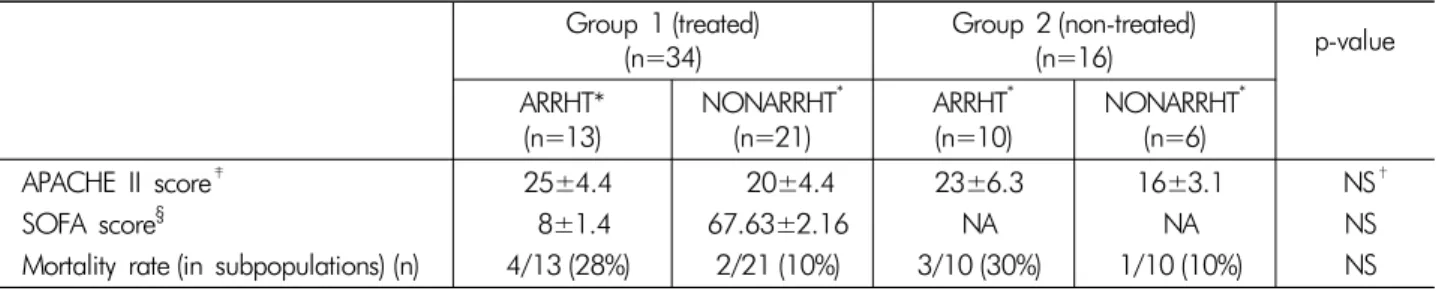
APACHE and SOFA score values were similar in both study groups and unrelated to new cardiac arrhythmia events (Table 4). The survival rate in patients with new arrhythmias and patients without new arrhythmias were similar (Table 4).
Table 2. Laboratory data parameters
Group 1 (Treated)
(N=34) Group 2 (Non-Treated)
(N=16) p-value
Arrht*
(N=13) Nonarrht*
(N=21) Arrht*
(N=10) Nonarrht* (N=6)
Serum Sodium (Meq/L) 140.3±2.1 139.8±2.1 141.2±1.9 137.5±1.6 Ns†
Serum Potassium (Mmol/L) 3.95±0.31 3.89±0.32 4.12±0.36 4.16±0.52‡ Ns Serum Calcium Serum (Mmol/L) 1.07±0.061 0.05±0.061 0.08±0.08 1.06±0.12‡ Ns Serum Magnesium (Mmol/L) 0.24±0.1 0.23±0.09 0.21±0.08 0.22±0.03 Ns
Ph Arterial Blood 7.36±0.03 7.39±0.03 7.4±0.05 7.39±0.08 Ns
Po2/Fio2 Ratio (Arterial Blood) 280±108 266.1±113.4 253±86 89±121.6 Ns (Mean±SD)
*"Arrht" And "Nonarrht" - All Septic Patients With Hypophosphatemia Weresubdivided According To The Presence Of New-Onset Episode Of Arrhythmia Into Two Subgroups: Arrhythmic- "Arrht" And Non-Arrhythmic- "Nonarrht".
†Ns-p value >0.05 (Considered No Significant)
‡Previously Published Clinical Data (From Schwartz Et Al.13)).
Table 1. Demographic data, etiology of sepsis and mechanical ventilation support Group 1 (Treated)
(N=34) Group 2 (Non-Treated)
(N=16) p-value
Age (Mean±SD) 56.9±22.5 59.18±48.5 Ns*
Gender (Male) 20 (59%) 11 (68%) Ns
Etiology (N, %)
Meningitis 0 (0) 1 (6.25%) Ns
Pneumonia 9 (26%) 3 (18.7%) Ns
Wound/Soft Tissue Infection 5 (14%) 4 (25%) Ns
Pyelonephritis 2 (5%) 1 (6.25%) Ns
Necrotizing Pancreatitis 1 (3%) 1( 6.25%) Ns
Cholangitis 2 (5%) 1 (6.25%) Ns
Peritonitis 7 (20%) 5 (31%) Ns
Microbiology (N)‡
Enterococcus 6 (17%) 3 (18.7%) Ns
Acinetobacter 6 (17%) 3 (18.7%) Ns
Staphylococcus Aureus 7 (20%) 4 (25%) Ns
E. Coli 2 (6%) 2 (12%) Ns
Pseudomonas Aeruginosa 9 (26%) 2 (12%) Ns
New Onset Arrhythmia Incidence (N) 13 (38%) 10 (63%) 0.04†
Mechanical Ventilation Support (N) 27 (79%) 12 (75%) Ns
(Mean±SD, %).
*Ns p-value >0.05 (Considered No Significant)
†p-value <0.05 Was Defined As Statistically Significant
‡Presented From Microbiological Data Of Positive Sputum, Urine, Csf And Blood Cultures
Discussion
Hypophosphatemia in the early stage of sepsis is com- mon and is thought to be due to an acute and rapid intra-
cellular shift of phosphorus15). Low phosphorus serum blood levels may worsen hemodynamic instability in se- vere sepsis by resulting in a decrease in myocardial con- tractility16), and are potentially associated with the devel-
Table 4. Patients' clinical outcome values (APACHE score, SOFA score and mortality).
Group 1 (treated)
(n=34) Group 2 (non-treated)
(n=16) p-value
ARRHT*
(n=13) NONARRHT*
(n=21) ARRHT*
(n=10) NONARRHT* (n=6)
APACHE II score‡ 25±4.4 20±4.4 23±6.3 16±3.1 NS†
SOFA score§ 8±1.4 67.63±2.16 NA NA NS
Mortality rate (in subpopulations) (n) 4/13 (28%) 2/21 (10%) 3/10 (30%) 1/10 (10%) NS (Mean±SD, %)
*"ARRHT" and "NONARRHT" - All septic patients with hypophosphatemia weresubdivided according to the presence of new-onset episode of arrhythmia into two subgroups: arrhythmic- "ARRHT" and non-arrhythmic- "NONARRHT".
†NS-p value >0.05 (not significant)
‡APACHE (APACHE II- "Acute Physiology and Chronic Health Evaluation II")score is a severity-of-disease classification system and was estimated on the day of admission to the GICU21).
§SOFA (The Sequential Organ Failure Assessment score, or just SOFA score) is used to track a patient's status during the stay in an intensive care unit score and was estimated on the first day of hypophosphatemia22).
Table 3. Clinical data, serum phosphorus levels, and phosphorus replacement parameters of patients with and without new-onset cardiac arrhythmias
Group 1 (Treated)
(N=34) Group 2 (Non-Treated)
(N=16) p-value
Arrht*
(N=13) Nonarrht*
(N=21) Arrht*
(N=10) Nonarrht* (N=6)
Serum Phosphorus (Mmol/L) 0.51±0.11 0.46±0.09 0.53±0.08 0.79±0.26 Ns†
Phosphorus Replacement (Total Dose In Mmol) 25.5±12.3 46.65±30.7 Na Na 0.02‡
Length Of Therapy (Days) 2.42±1.22 3.55±2.06 Na Na Ns
Type Of Arrhythmia§
Supraventricular Tachycardia (N) 2/13 (14.2%) Na 8/10 (80%) Na 0.01
Ventricular Premature Beats (Vpbs) (N) 6/13 (43%) Na 10/10 (100%) Na <0.001
Atrial Fibrillation (N) 7/13 (50%) Na 2/10 (20%) Na Ns
Antiarrhythmic Therapy∥(N) 6/13 (42%) Na 8/10 (80%) Na 0.04
(Mean±SD)
*"Arrht" And "Nonarrht" - All Septic Patients With Hypophosphatemia Weresubdivided According To The Presence Of New-Onset Episode Of Arrhythmia Into Two Subgroups: Arrhythmic- "Arrht" And Non-Arrhythmic- "Nonarrht".
†Ns-p value >0.05 (Considered No Significant)
‡p value <0.05 Was Defined As Statistically Significant
§Most Patients Suffered From Different Types Of Arrhythmias
∥Antiarrhythmic Therapy Included Amiodarone (A Fib And Svt), Verapamil (Svt And Vpbs), Lidocaine (Svt And Vpbs) And Adenosine (Svt)
opment of new cardiac arrhythmias13). In this study we demonstrated that phosphorus replacement therapy in patients with hypophosphatemia (group 1) in the early stage of sepsis significantly reduced the incidence of ar- rhythmias (38% vs 63%, p=0.04). The prevalence of SVT and VPBs arrhythmias was higher in the non-treated group (Table 3). We demonstrated that routine phospho-
rus administration correlated with a lower percent of an- tiarrhythmic therapy in treated patients (Table 3). Our phosphorus replacement protocol management corre- lated well with previous data17). Moreover, for patients in group 1, the total dose of IV phosphorus was sig- nificantly higher in non-arrhythmic persons (46.6 vs. 25.5 mmol) than in patients who developed new arrhythmia
(Table 3), despite a similar length of treatment (2.42 vs.
3.55 mean days) and serum blood phosphorus level (0.46 vs 0.51 mmol/L) (Table 3). This may reflect a coincidental findings or some resistance to the treatment protocol.
Importantly, regarding to phosphorus replacement ther- apy, Group 1 patients received less antiarrhythmic ther- apy compared to non-treated patients in Group 2 (42%
vs 80%, p=0.04). Other electrolyte disturbances (hypo- kalemia, hypomagnesaemia, hypocalcaemia etc.) may be independent risk factors for the development of new car- diac arrhythmias18-20). In this study there were no signi- ficant differences in serum electrolyte levels, acid-base balance changes, or the incidence of hypoxemic events between patients in both study groups (see Table 2). Des- pite the statistically significant reduction in the inci- dence of new arrhythmias between both study groups, the overall mortality rate and length of hypophosphatemia treatment were similar (Table 3, 4). The lack of a differ- ence observed in mortality and length of treatment may reflect the small sample size of the study.
A major limitation in our study was that we compared patients our treated group with previously published data13). Since it has been shown that hypophosphatemia in septic patients was associated with higher incidence of arrhyth- mias, phosphorus replacement protocol has became a standard of treatment hypophosphatemic septic patients in our department. Considering this fact, we could not recruit non-treated septic patients with hypophosphatemia for ethical considerations. The small sample size is anoth- er limitation of our study, which significantly restricts our conclusions regarding patients’ clinical outcome.
In this study, phosphorus replacement therapy was shown to decrease the incidence of new-onset cardiac ar- rhythmias in septic patients. We demonstrated a trend of decreased antiarrhythmic therapy after aggressive hypo- phosphatemia correction. We believe that a future large, randomized control study should be done to better ana- lyze potential mortality benefits and reduction in the inci- dence of new onset cardiac arrhythmias of critically ill septic patients after IV phosphorus replacement therapy and suggest correcting hypophosphatemia in septic patients.
References
1. Bender JS: Supraventricular tachycarrhythmias in the surgical intensive care unit: an under recognized event.
Am Surg 62:73-75, 1996
2. Goodman S, Weiss Y, Weissman C: A update on cardiac arrhythmias in the ICU. Cur Opinion Crit Care 14:549- 554, 2008
3. Segun P, Signouret T, Laviolle B, Branger B, Mallédant Y:
Incidence and risk factors of atrial fibrillation in a surgi- cal intensive care unit. Crit Care Med 32:722-726, 2004 4. Kirkpatrick JR, Heilbrunn A, Sankaran S: Cardiac arrhy-
thmias: an early sign of sepsis. Am Surg 39:380-382, 1973 5. Christian SA, Schorr C, Ferchau L, Jarbrink ME, Parrillo
JE, Gerber DRJ: Clinical characteristics and outcomes of septic patients with new-onset atrial fibrillation. Crit Care 23:532-536, 2008
6. Meierhenrich R, Steinhilber E, Eggermann C, Weiss M, et al.: Incidence and prognostic impact of new-onset at- rial fibrillation in patients with septic shock: a prospective observational study. Crit Care 14:1-8, 2010
7. Salman S, Bajwa A, Gajic O, Afessa B: Paroxysmal atrial fibrillation in critically ill patients with sepsis. J Intensive Care Med 23:178-183, 2008
8. Annane D, Sébille V, Duboc D, et al.: Incidence and pro- gnosis of sustained arrhythmias in critically ill patients.
Am J Respir Crit Care Med 178:20-25, 2008
9. Brunelli SM, Goldfarb S: Hypophosphatemia; clinical consequences and management. J Am Society Nephrol 18:1999-2003, 2007
10. Barak Y, Schwartz A, Kalichman I, Nisman B, Gurman G, Shoenfeld Y: Prevalence of hypophosphatemia in sepsis and infection; The role of cytokines. AmJ Med 104;40- 47, 1998
11. Shoenfeld Y, Hager S, Berliner S, Gallant LA, Pinkas J:
Hypophosphatemia as diagnostic aid in sepsis. NY State J Med 82:163-165, 1982
12. Zazzo JF, Troche G, Ruel P, Maintenant J: High incidence of hypophophatemia in surgical intensive care patients.
Efficacity of phosphorus treatment on myocardial func- tion. Int Care Med 21:826-831, 1995
13. Schwartz A., Gurman G, Cohen G, Gilutz H, Shenfeld Y:
Association between hypophosphatemia and cardiac ar- rhythmias in the early stage of sepsis. Europ J of Int Med 13:434-438, 2002
14. Dellinger RP, Levy HM, Carlet JM, Bion J, et al.:
Surviving sepsis campaign: International guidelines for management of severe sepsis and septic shock. Crit Care Med 36:1394-1396, 2008
15. Bollaert PE, Levy B, Nace L, Laterre PF, Larcan A:
Haemodynamic and metabolic effects of rapid correction of hypophosphatemia in patients with septic shock. Chest 107:1698-1701, 1995
16. O'Connor LR, Wheeler WS, Bethune JE: Effect of hypo- phosphatemia on myocardial performance in man. N Engl J Med 297:901-903, 1977
17. Geerse D, Bindela A,Kuiper AM: Treatment of hypo- phosphatemia in the intensive care unit. Review. Chest 4:560-568, 2010
18. El-Sherif N, Turitto G: Electrolyte disorders and arrhy- thmogenesis. Cardiol J 18:233-245, 2011
19. Diercks DB, Shumaik GM, Harrigan RA, Brady WJ, Chan TC: Electrocardiographic manifestations: electro- lyte abnormalities. J Emerg Med 27:153-160, 2004 20. Shechter M: Magnesium and cardiovascular system.
Magnes Res 23:60-72, 2010
21. Knaus WA, Draper EA, Wagner DP, Zimmerman JE:
APACHE II: a severity of disease classification system.
Crit Care Med 13:818-829, 1985
22. Vincent JL, de Mendonça A, Cantraine F, et al.: Use of the SOFA score to assess the incidence of organ dys- function/failure in intensive care units: results of a multi- center, prospective study. Working group on “sepsis-re- lated problems” of the European Society of Intensive Care Medicine. Crit Care Med 26:1793-1800, 1998