http://www.esasang.com
사상 체질 처방의 항염증 효능 비교 연구
이진아․하혜경․이호영․정다영․이준경․황대선․신현규
한국한의학연구원 한약EBM연구센터
Abstract
Anti-inflammatory Activities of Herbal Formulas for Sasang Constitutional Medicine
Jin-Ah Lee, Hyekyung Ha, Ho-Young Lee, Da Young Jung, Jun Kyoung Lee, Dae Sun Huang, Hyeun-Kyoo Shin Herbal Medicine EBM Research Center, Korea Institute of Oriental Medicine, Daejeon, 305-811, Korea 1. Objectives
4 herbal formulas (Yanggyeoksanhwa-tang, Yeoldahanso-tang, Cheongsimyeonja-tang and Taeeumjowi-tang) were applied to investigate the anti-inflammatory activities. In many studies, plant-derived anti-inflammatory efficacies have been investigate for their potential inhibitory effects on lipopolysaccharide (LPS)-stimulated macrophages. This study was performed to examine the anti-inflammatory activities of 4 herbal formulas on LPS-stimulated RAW 264.7 cells.
2. Methods
The productions of nitric oxide (NO), prostaglandin (PG)E2, interleukin(IL)-6 and tumor necrosis factor (TNF)-α were examined in the presence of the 4 herbal formulas in RAW 264.7 cells. The cells were incubated with LPS 1 μg/mL and 4 herbal formulas for 18 hrs. The anti-inflammatory activity of 4 herbal formulas were investigate by carrageenin-induced paw edema in rats. The paw volume was measured at 2 and 4 hrs following carrageenin- induced paw edema in rats.
3. Results
Yanggyeoksanhwa-tang and Cheongsimyeonja-tang showed inhibitory effect on PGE2 production in LPS-stimulated RAW 264.7 cells and a reduction in carrageenin-induced paw edema on rats. Yanggyeoksanhwa-tang showed inhibi- tory effect on IL-6 in LPS-stimulated RAW 264.7 cells. 4 herbal formulas not affect on NO and TNF-α inhibition in LPS-stimulated RAW 264.7 cells.
4. Conclusions
These results suggested that Yanggyeoksanhwa-tang and Cheongsimyeonja-tang have anti-inflammatory activity.
Key Words : Yanggyeoksanhwa-tang (Lianggesanhuo-tang), Yeoldahanso-tang (Reduohanshao-tang),
Cheongsimyeonja-tang (Qingxinlianzi-tang), Taeeumjowi-tang (Taiyintiaowei-tang), Anti-inflammation
1)
∙접수일 2010년 06월 07일; 심사일 2010년 06월 09일;
승인일 2010년 08월 06일
∙교신저자 : 신현규
대전시 유성구 엑스포로 483 한국한의학연구원 한약EBM연구센터
Tel : +82-42-868-9464 Fax : +82-42-864-2120 E-mail : [email protected]
* 본 연구는 한국한의학연구원에서 지원하는 ‘표준한방처방 EBM 구축사업’에 의해 수행되었다.
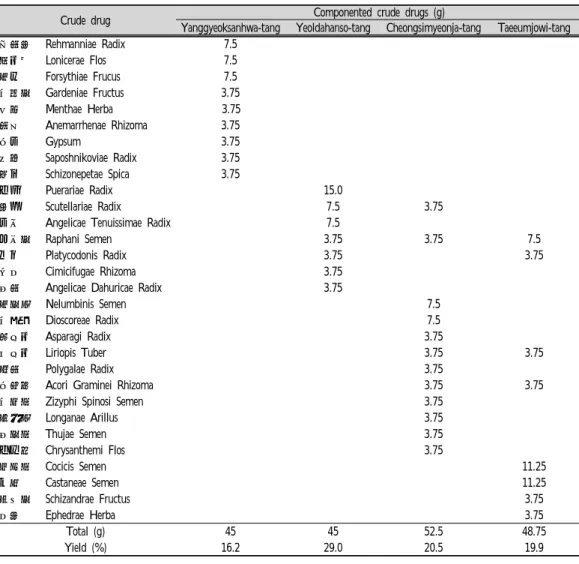
Crude drug Componented crude drugs (g)
Yanggyeoksanhwa-tang Yeoldahanso-tang Cheongsimyeonja-tang Taeeumjowi-tang
생지황 Rehmanniae Radix 7.5
인동등 Lonicerae Flos 7.5
연교 Forsythiae Frucus 7.5
산치자 Gardeniae Fructus 3.75
박하 Menthae Herba 3.75
지모 Anemarrhenae Rhizoma 3.75
석고 Gypsum 3.75
방풍 Saposhnikoviae Radix 3.75
형개 Schizonepetae Spica 3.75
갈근 Puerariae Radix 15.0
황금 Scutellariae Radix 7.5 3.75
고본 Angelicae Tenuissimae Radix 7.5
나복자 Raphani Semen 3.75 3.75 7.5
길경 Platycodonis Radix 3.75 3.75
승마 Cimicifugae Rhizoma 3.75
백지 Angelicae Dahuricae Radix 3.75
연자육 Nelumbinis Semen 7.5
산약 Dioscoreae Radix 7.5
천문동 Asparagi Radix 3.75
맥문동 Liriopis Tuber 3.75 3.75
원지 Polygalae Radix 3.75
석창포 Acori Graminei Rhizoma 3.75 3.75
산조인 Zizyphi Spinosi Semen 3.75
용안육 Longanae Arillus 3.75
백자인 Thujae Semen 3.75
감국화 Chrysanthemi Flos 3.75
의이인 Cocicis Semen 11.25
건율 Castaneae Semen 11.25
오미자 Schizandrae Fructus 3.75
마황 Ephedrae Herba 3.75
Total (g) 45 45 52.5 48.75
Yield (%) 16.2 29.0 20.5 19.9
Table 1. Combinations of Crude Drugs in Herbal Formulas
Ⅰ. 緖 論
사상체질의학에서 四象處方은 본초의 溫熱凉 寒의 구성을 사상체질이란 시각으로 대분류하고 이 들 약물을 體質證과 病證에 따라 재구성하여 이루어 졌으며, 투약시 병증에 맞는 처방을 찾는 것이 최종 목표가 된다1. 모든 病證에는 초기에 염증반응이 일 어나며, 염증은 생체 조직의 외부 자극에 대한 방어 반응의 하나로서 여러 가지 염증인자들이 만들어지는 데 이로 인하여 임상적으로는 발적, 발열, 종창, 동통, 기능장애 등의 증상이 나타난다.
본 연구에서는 소양인 처방인 凉膈散火湯과 태 음인 처방 熱多寒少湯, 淸心蓮子湯, 太陰調胃湯 등 4종의 처방을 대표적인 사상체질 처방으로 선정하 였다. 기존 연구에서 소양인 처방인 凉膈散火湯은 뇌경색2, 중풍환자3의 증상을 호전시키며, 혈당을 조 절하고4 항아토피작용5이 있다고 연구되어있다. 태음 인 처방인 熱多寒少湯은 중풍환자의 치료6 및 간기 능에 미치는 영향7 등이 보고되었으며, 淸心蓮子湯 은 항노화 효과8 및 항알레르기 효과9, 太陰調胃湯 은 소화기계 기능 강화10와 항비만 및 항고지혈증에 효과11가 있다고 알려져 있다.
모든 질병은 초기에 기본적으로 염증반응이 관여 되는데, 이들 처방이 인체의 항염 효과에 대한 연구는 없어, 본 연구에서는 사상체질 처방 중 대표적으로 사용 빈도가 높은 4종 처방을 선정하여 항염증 활성을 비교하였다.
Ⅱ. 材料 및 方法
1. 재료 1) 처방추출
본 실험에 사용된 4종의 처방 구성은 Table 1과 같으 며 처방 구성 약재들은 (주)옴니허브 (Yeongcheon, Korea)와 (주)HMAX (Chungbuk, Korea)에서 각각 구입 하였다. 각각의 처방에 따라 약재를 배합한 후 이의 10배의 물과 함께 100℃에서 2시간 동안 무압 환류 추출법 (추출기: 경서메디텍 COSMOS660)을 이용하여 추출하였다. 추출액은 sieve를 사용하여 거른 후 동결건 조기 (일신 동결건조기 PVTFD100R)를 사용하여 처방 추출물 분말을 얻었으며 수득율은 Table 1과 같다.
2. 실험 방법
1) RAW 264.7 세포주 배양
생쥐 대식세포주인 RAW 264.7 세포주는 American Type Culture Collection (ATCC, USA)에서 분양 받아 사용하였다. RAW 264.7 세포는 5.5% fetal bovine serum (FBS; Gibco, USA), 1% penicillin-streptomycin (Gibco, USA)이 첨가된 Dulbecco's modified eagle's medium (DMEM; Gibco, USA) 배지에 37℃, 5% CO2 조건에서 배양하였다.
2) 세포독성 측정
4종 처방 추출물의 세포 독성을 알아보기 위해 cell counting kit-8 (CCK-8; Dojindo, Japan)을 제조사의 사용 법에 따라 사용하였다. 96 well plate에 5×10³ cells/well 씩 분주한 세포에 4종 처방 추출물을 농도별로 처리하 여 24시간 동안 배양하였다. CCK-8 용액 10 μL를 첨가 하여 4시간 동안 배양한 후 450 nm에서 흡광도를 측정 하고 대조군과의 비교를 통해 상대적인 세포생존율 (% of control)을 계산하였다. 이후의 실험은 세포 독성
이 나타나지 않는 최고 농도를 기준으로 실험하였다.
3) NO, PGE2, IL-6, TNF-α 생성량 측정 2.5×10⁵ cells/well (48 well plate)로 분주한 RAW 264.7 세포를 LPS (1 μg/mL)로 자극하고, 4종 처방 추출 물을 농도별로 처리하여 18시간 동안 배양하였다. 생 성된 NO의 양을 측정하기 위해 배양 상층액의 nitrite 양을 Griess reagent (Promega, USA)를 사용하여 제조사 의 사용법에 따라 측정하였으며 양성대조군으로 NOS inhibitor인 NG-methyl-L-arginine (L-NMMA; Sigma, USA)를 사용하였다. PGE2양을 측정하기 위해 Arachid- onic acid (Sigma, USA)를 최종 30 μM이 되도록 처리해 15분간 반응시킨 후 배양 상층액을 취하여 en- zyme-linked immunosorbent assay (ELISA) kit (Amersha- rm, UK)를 사용하여 제조사의 사용법에 따라 측정하 였으며 양성대조군으로 indomethacin을 사용하였다.
IL-6와 TNF-α 생성량을 측정하기 위해 배양 상층액을 취하여 ELISA kit (R&D, USA)를 사용하여 제조사의 사용법에 따라 IL-6와 TNF-α양을 측정하였다. LPS군 과의 비교를 통해 상대적인 비율 (% of LPS)을 계산하 였다.
4) 실험동물
생후 4주된 수컷 SD 랫트 (오리엔트바이오, 성남)를 분양받아 온도 23±3℃, 상대습도 50±10%, 12시간 간격으로 명암이 조절되는 동물사육실에서 1주일간 환경에 적응하도록 순화시켰다. 순화기간 중 육안적 으로 관찰하여 건강한 동물을 선별하여 실험에 사용 하였다.
5) Carrageenin 유발 족부종 모델
수컷 SD 랫트에게 7일간 4종 처방 추출물 1 g/kg/day 를 경구투여하고, 랫트의 오른쪽 발바닥 피하에 1%
carrageenin (Sigma, USA) 생리식염액을 0.1 mL씩 주사 하여 족부종을 유발하였다. 발생된 족부종을 수용적 법으로 carrageenin 주사 직전과 주사 2시간 및 4시간 후 plethysmometer (Ugo Basile, Italy)를 이용하여 측정 하였다. 측정한 발의 부피를 이용하여 산출법에 의하 여 부종증가율을 계산하였으며 양성대조군으로 in- domethacin (10 mg/kg/day)을 단회 투여하여 사용하였
부종증가율(%) =
족부종유발후발의 부피 − 족부종유발전발의 부피
× 100 족부종유발전발의 부피
Figure 1. Effects of herbal formulas on LPS-stimulated NO production in RAW 264.7 cells.
Cells were treated with herbal formulas and cultured for 18 hr with LPS (1 μg/mL). The NO production in cell culture supernatants were measured as described in Materials and Methods. The units of concentrations of L-NMMA and herbal formulas are μM and μg/mL, respectively.
The data are presented as mean±S.E.M. and are representative of triplicate experiments; # p<.050 compared to LPS-free cultures (NC;
untreated control cell), * p<.050 compared to cells cultured with LPS.
다. 산출법은 다음과 같다.
6) 통계처리
모든 측정 결과는 mean±S.E.M.으로 나타냈으며 실 험군 간의 차이는 ANOVA를 사용하여 통계학적 분석 을 수행하였으며 p<0.050일 경우에 유의성이 있다고 하였다.
Ⅲ. 結 果
1. 대식세포 독성
RAW 264.7 세포에 4종 처방 추출물을 처리하고, 24시간동안 배양한 후, 세포독성을 관찰한 결과, 凉膈 散火湯, 熱多寒少湯은 100 μg/mL까지, 淸心蓮子 湯, 太陰調胃湯 200 μg/mL까지 세포독성이 나타나 지 않았다. 따라서 모든 실험을 세포생존에 영향을 주지 않는 범위 내에서 수행하였다 (do not shown).
2. NO 생성 억제 효과
4종 처방이 대식세포에서 LPS에 의한 NO 생성에
미치는 영향을 확인하고자 RAW 264.7 세포에 LPS를 처리하여 염증반응을 유발시키고, 4종 처방 추출물을 처리하여 NO 생성량을 측정하였다. 양성대조군으로 사용한 NOS inhibitor인 L-NMMA는 농도의존적으로 NO 생성을 억제하는 것으로 나타났다. NO 생성은 凉膈散火湯이 100 μg/mL에서 29.2% (p<.050), 熱多 寒少湯이 100 μg/mL에서 35.9% (p<.050), 淸心蓮子 湯이 200 μg/mL에서 27.6% 억제하였다 (p<.050). 그 러나 太陰調胃湯은 NO 생성 억제 효과를 나타내지 않았다 (Figure. 1).
3. PGE2 생성 억제 효과
4종 처방의 PGE2 생성 억제 효과를 검색하고자 RAW 264.7 세포에 LPS를 처리하여 염증반응을 유발시 키고, 4종 처방 추출물을 처리하여 PGE2 생성량을 측정 하였다. 그 결과, 양성대조군으로 사용한 indomethacin 은 농도의존적으로 PGE2 생성을 억제하는 것으로 나타 났다. 凉膈散火湯은 PGE2 생성을 농도의존적으로 억제하여 50 μg/mL에서 LPS에 비해 27.6% 억제하였으 나 유의하진 않았다. 淸心蓮子湯은 PGE2 생성을 농도 의존적으로 억제하여 200 μg/mL에서 LPS에 비해 32%
억제하였다 (p<.050). 그러나 熱多寒少湯, 太陰調 胃湯은 PGE2 생성 억제 효과가 없었다 (Figure. 2).
Figure 2. Effects of herbal formulas on LPS-stimulated PGE2 production in RAW 264.7 cells.
Cells were treated with herbal formulas and cultured for 18 hr with LPS (1 μg/mL). The PGE2 production in cell culture supernatants were measured as described in Materials and Methods. The units of concentrations of indomethacin and herbal formulas are ng/mL and μg/mL, respectively. The data are presented as mean±S.E.M. and are representative of triplicate experiments; # p<.050 compared to LPS-free cultures (NC; untreated control cell), * p<.050 compared to cells cultured with LPS.
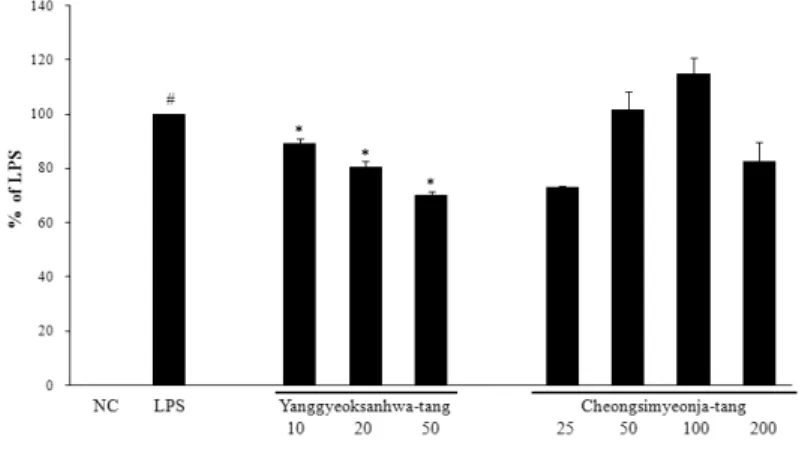
Figure 3. Effects of herbal formulas on LPS-stimulated IL-6 production in RAW 264.7 cells.
Cells were treated with herbal formulas and cultured for 18 hr with LPS (1 μg/mL). The IL-6 production in cell culture supernatants were determined by enzyme-linked immunosorbent assay (ELISA) kit, as described in Materials and Methods. The units of concentrations of indomethacin and herbal formulas are ng/mL and μg/mL, respectively. The data are presented as mean±S.E.M. and are representative of triplicate experiments;
# p<.050 compared to LPS-free cultures (NC; untreated control cell), * p<.050 compared to cells cultured with LPS.
4. IL-6및 TNF-α 생성 억제 효과
NO와 PGE2 생성 억제를 나타낸 凉膈散火湯, 淸 心蓮子湯에 대한 IL-6와 TNF-α 생성 억제 효과를 검색하고자 RAW 264.7 세포에 LPS를 처리하여 염증 반응을 유발시키고, 2종 처방 추출물을 처리하여 IL-6
와 TNF-α 생성량을 측정하였다. 그 결과 凉膈散火湯 은 IL-6 생성을 농도의존적으로 억제하여 50 μg/mL에 서 29.9% 억제하였고 (p<.050), 淸心蓮子湯은 IL-6 생성에 대한 억제효과가 없었다 (Figure. 3). 凉膈散火 湯, 淸心蓮子湯 모두 TNF-α 억제효과가 없었다.
Figure 4. Effects of herbal formulas on carrageenin-stimulated paw edema in rats.
The control group (0.1% Tween 80) and herbal formulas (1 g/kg/day) were orally administered for seven days prior to the inception of carrageenin-stimulated paw edema. The imdomethacin group (10 mg/kg/day) was orally administered for 3 hr prior to the inception of carrageenin-stimulated paw edema. The paw volume was measured as described in Materials and Methods. The data are presented as mean±S.E.M. (5 rats per group).
5. Carrageenin 유발 족부종 모델
NO, PGE2, IL-6 생성 억제를 나타낸 凉膈散火湯, 淸心蓮子湯에 대한 carrageenin 유발 족부종 모델에 서의 항부종 효과를 검색하기 위하여 2종 처방 추출 물을 투여하고 carrageenin으로 족부종을 유발한 후 발의 부피를 측정한 결과 정상상태보다 족부종 유발 후 발의 부피가 2시간, 4시간째 각각 28.5, 31.8% 증가 되었다. 양성대조군으로 사용한 indomethacin 투여군 은 족부종 유발군보다 2시간 및 4시간에 각각 45.8%, 53.6% 감소되었다. 凉膈散火湯 투여군은 족부종 유 발군보다 2시간 후 34% 억제하였으나 4시간 후는 19% 억제하였으나 이는 유의하진 않았다. 淸心蓮子 湯 투여군은 족부종 유발군보다 2시간 및 4시간에 각각 35%, 40.3%로 부종이 감소되었으나 유의하진 않았다 (Figure. 4).
Ⅳ. 考 察
질병은 초기부터 염증 반응이 시작되어 증상을 발 현하기 시작한다. 사상체질의학에서 사용되는 처방들 도 체질에 따라 처방이 분류되기는 하지만 이들 염증 에 대한 항염증 작용이 필요하다고 판단되어 사상체 질처방 중에 대표적인 처방을 4종 선정하여 항염증 효과를 확인하고자 하였다.
대표적인 사상체질처방으로 선정한 凉膈散火湯
은 소양인 처방으로 東醫壽世保元에 처음으로 수 록되었으며 소양인 胃受熱褢熱病의 胸膈熱證에 대한 淸陽上升을 목적으로 사용되었고12, 임상적으 로는 胸悶, 手足痹, 運動障碍, 手足麻木, 火熱證, 口舌疾患, 上焦熱 皮膚疾患 등에 다용되고 있다13. 태음인 처방 중 熱多寒少湯은 肝受熱褢熱病에 사 용되는 처방으로 主治는 肝熱熱症溫 燥熱病 手指 炒黑癍瘡病 虛勞夢泄이다. 淸心蓮子湯은 肝受 熱褢熱病에 사용되는 처방으로 東醫壽世保元
에서는 처방 구성 내용만 제시했을 뿐 主治症이나 治驗例 및 活用法에 대한 언급은 없으며 東醫四 象新編에서 虛勞, 夢泄, 無度, 腹痛, 泄瀉, 舌卷, 中風, 食滯, 胸膈痛 등을 치료한다고 기록되어있다14. 太陰調胃湯은 ‘黃疸 傷寒 時氣頭痛 身痛 無汗 食滯痞滿 腿脚無力’ 등의 太陰人 表寒病에 응용 되는 처방으로 기술되어 있다.12 이들 처방의 항염 효능을 검증하기 위한 기존 연구는 아직 미비한 실정 이다.
염증은 생체 조직의 외부 자극에 대한 방어반응의 하나로서 염증반응이 일어나면 여러 가지 염증인자들 이 만들어지는데 이로 인하여 임상적으로는 발적, 발 열, 종창, 동통, 기능장애 등의 증상이 나타난다. 염증 인자에는 inducible nitric oxide synthase (iNOS)에 의해서 만들어지는 nitric oxide (NO)와 cyclooxygenase-2 (COX-2) 에 의해서 만들어지는 prostaglandin E2 (PGE2) 등이 있 다15. 이러한 염증인자는 염증반응의 전사인자인 nu-
clear factor-κB (NF-κB)를 활성화시켜 NO와 PGE2를 생성하여 염증을 일으킨다16, 17. NOS에 의해 L-argine 으로부터 생성되는 NO는18 혈관투과성, 부종 등의 염 증반응을 촉진시킬 뿐만 아니라 염증매개체의 생합성 을 촉진하여 염증을 심화시킨다19. 특히 대식세포가 LPS로 자극될 때 iNOS가 발현되어 NO를 생성하게 된다20. 본 연구에서 凉膈散火湯은 100 μg/mL, 熱多 寒少湯은 100 μg/mL, 淸心蓮子湯 200 μg/mL에서 LPS 처리군보다 각각 29.2%, 35.9%, 27.6% NO 생성을 억제하였으나 太陰調胃湯는 NO 생성 억제 효과가 없었다.
COX는 arachidonic acid를 PG로 전환하는 효소로 혈소판 형성, 위벽보호 및 신장 기능의 유지 등 정상 적인 생리기능에 작용하는 COX-1과 염증매개물질 인 PGE2를 생성하는 COX-2로 분류된다21. 다수의 항 염증제의 작용기전은 PG 합성을 억제하는 것인데 이 것은 COX-2의 활성 저해에 의한 것이다. PGE2는 면 역관련 세포의 활성을 유도하여 염증반응을 항진시 켜 염증성 사이토카인을 대량 생성하게 한다22. 4종 처방의 PGE2 생성 억제를 검색한 결과 淸心蓮子湯 은 200 μg/mL에서 LPS 처리군보다 PGE2 생성을 32%
억제하였고 (p<0.05) 凉膈散火湯은 50 μg/mL에서 LPS 처리군보다 27.6% 억제하였으나 유의하진 않았 다. 그리고 熱多寒少湯, 太陰調胃湯은 효과를 나 타내지 않았다.
대식세포는 초기 염증반응에 관여하는 대표적인 면역세포로서 염증 자극시 염증성 사이토카인인 IL-6, TNF-α 등을 생성한다23. 이러한 염증성 사이토카인들 은 면역세포를 활성화시켜 여러 가지 염증성 질환에 관여한다. NO와 PGE2 생성 억제 효과를 나타낸 凉膈 散火湯은 농도의존적으로 IL-6 생성을 억제하였으나 淸心蓮子湯는 억제 효과가 없었으며 凉膈散火湯, 淸心蓮子湯 모두 TNF-α의 생성에 대한 억제 효과가 없었다.
생체 내에서의 항염증 활성을 검색하기 위하여 car- rageenin 유발 족부종 모델을 사용하였다. Carrageenin 은 홍조류로부터 얻어진 polysaccharide로서 급성 염증 유발제로 항염증제의 탐색을 위한 실험모델에 빈번하 게 사용되고 있다24, 25. Carrageenin에 의해 발생하는 부종을 억제하는 항염증제의 작용기전은 COX의 활
성 저해와 관련성이 있을 것으로 보고되고 있다26. 대 표적인 항염증제인 indomethacin은 PGs의 합성을 억제 하는 것으로 알려져 있으며27, 본 연구에서도 carra- geenin에 의한 족부종을 감약시켰다. 凉膈散火湯, 淸 心蓮子湯 2종의 처방은 족부종을 감소시켰으나 유 의하진 않았다. 이는 COX의 활성 저해로 인한 PGE2
생성 억제로 인해 감소되었을 것으로 생각된다.
이상의 결과를 종합해보았을 때, 사상체질처방 중 凉膈散火湯은 대식세포의 염증반응에서 NO, PGE2, IL-6 생성량 및 족부종을 억제시켰고, 淸心蓮子湯은 대식세포의 염증반응에서 NO, PGE2 생성량 및 족부 종을 억제시킴으로서 凉膈散火湯, 淸心蓮子湯이 iNOS와 COX에 의한 염증 매개 물질 생성을 억제하는 항염증 활성이 있음을 확인할 수 있었다. 따라서 본 연구 결과는 소양인 처방인 凉膈散火湯과 태음인 처방인 淸心蓮子湯이 앞으로 염증성 질환 등의 치료 에 유용하게 사용될 수 있다는 기초 자료로 활용될 수 있을 것으로 기대된다.
Ⅴ. 結 論
소양인 처방인 凉膈散火湯과 태음인 처방인 熱 多寒少湯, 淸心蓮子湯, 太陰調胃湯 등 4종 처방 의 항염증 활성을 연구한 결론은 다음과 같다.
1. 대식세포에서 LPS로 염증반응을 유발하여 NO를 측정한 결과, 凉膈散火湯, 熱多寒少湯, 淸心蓮 子湯 3종의 처방은 NO 생성을 억제하였으나 太 陰調胃湯는 NO 생성 억제 효과가 없었다.
2. 대식세포에 LPS로 염증반응을 유발하여 PGE2를 측 정한 결과, 凉膈散火湯, 淸心蓮子湯은 PGE2 생 성을 억제하였으나 熱多寒少湯, 太陰調胃湯은 억제 효과가 없었다.
3. 대식세포에 LPS로 염증반응을 유발하여 염증성 사 이토카인인 IL-6와 TNF-α를 측정한 결과, 凉膈散 火湯은 IL-6 생성을 억제하였으나 淸心蓮子湯은 효과가 없었다. 凉膈散火湯, 淸心蓮子湯 모두 TNF-α 생성 억제 효과가 없었다.
4. 凉膈散火湯은 족부종 유발 2시간 후 족부종 유발 군에 비해 족부종이 억제되었고, 淸心蓮子湯은 족부종 유발 2시간 및 4시간 후 족부종 유발군에 비해 족부종이 억제되었다.
이상의 결과로 凉膈散火湯, 淸心蓮子湯은 항염 증 활성이 있는 것으로 판단된다.
Ⅵ. 感謝의 글
본 연구는 한국한의학연구원에서 지원하는 ‘표준 한방처방 EBM 구축사업 (K10030)’에 의해 수행되었 으며, 이에 감사드립니다.
Ⅶ. 參考文獻
1. Dept. of Sasang constitutional medicine. Sasang Constitutional Medicine. Seoul: Gibmundang. 2006.
347, 357, 420 (Korean)
2. Lo HS, Lee SM, Bae YC, Park HS, Lee JS, Song SG, et al. The effect of Yangkyuk-Sanhwa-Tang on cytokine production in the patients with cerebral infarction. J Sasang Constitut Med. 2004;16(1):120-129. (Korean) 3. Choi DJ, Ryu SH, Jung WS, Moon SK, Cho KH, Kim
YS. The Clinical Efficacy of Yangkyuksanwha-tang on acute stroke. J Korean Oriental Med. 2004;25(1):
111-116. (Korean)
4. Jung SI, Kim JW. Clinical Study about the Diabetes Mellitus Patients Administration of Yangkyuksanwha- tang. Korea J Oriental Physiology & Pathology. 2002;
16(6):1308-1313. (Korean)
5. Yun BH, Park SS. Yangkyuksanhwa-tang effected to atopic dermatitis. J Sasang Constitut Med. 2004;
16(2):84-98. (Korean)
6. Choi JS, Kim KY, Kim HM, Ju JC. Studies on the cytokine production regulation in human astrocytes by Yuldahansotang. J Sasang Constitut Med. 2001;
13(1):61-69. (Korean)
7. Kim TH, Hong SY, Han DN, Lim EC. The Effects of constant use of Yeoldahanso-tang on liver function.
J Sasang Constitut Med. 2007;19(3):217-226. (Korean) 8. Lim JP, Ahn TW. The anti-oxidative and immune-re- gluatory effect of Chungsimyeonja-tang in aged rat. J Sasang Constitut Med. 2007;19(3):227-241.(Korean) 9. Park SC. Effects CheongSimYeonJaTang(CSYJT) on
control of immune-function in highly purified mouse B cells and Mast cell. J Sasang Constitut Med. 2003;15 (2):166-179. (Korean)
10. Chou LS, Ahn TW, Lee H. Studies of Chengsimyeonja- tang and Taeumjowi-tang that get change by Wistar rat's aging. J Sasang Constitut Med. 2005;17(2):74-84.
(Korean)
11. Kim KS, Lee DU, Kim YL, Hwang MJ, Kim GW, Koo BS. Anti-obesity and anti-hyperlipidemic effects of Taeyeumjowee-tang and its modified prescription.
J Oriental Neuropsychiatry. 2007;18(2):57-74. (Korean) 12. Lee JM. Dongeuisusebowon. Seoul:Yeogang Publishing
Co. 1992:271-272.(Korean)
13. Yun BH, Park SS. Yangkyuksanhwa-tang effected to atopic dermatitis. J Sasang Constitut Med. 2004;
16(2):84-98. (Korean)
14. Won JS. Dongeuisasangshinpyeon. Seoul:Munw- oosa.
1926:2.
15. Posadas I, Terencio MC, Guillén I, Ferrándiz ML, Coloma J, Payá M et al. Co-regulation between cy- clo-oxygenase-2 and inducible nitric oxide synthase ex- pression in the time-course of murine inflammation.
Naunyn Schmiedebergs Arch Pharmacol. 2000;361(1):
98-106.
16. Lee TH, Kwak HB, Kim HH, Lee ZH, Chung DK, Baek NI et al. Methanol extracts of Stewartia koreana inhibit cyclooxygenase-2 (COX-2) and inducible nitric oxide synthase (iNOS) gene expression by blocking NF-kappa B transactivation in LPS-activated RAW 264.7 cells. Mol Cells. 2007;23(3):398-404.
17. Nishida T, Yabe Y, Fu HY, Hayashi Y, Asahi K, Eguchi H et al. Geranylgeranylacetone induces cyclo- oxygenase-2 expression in cultured rat gastric epithelial cells through NF-kappaB. Dig Dis Sci. 2007;52(8):
1890-1896.
18. Nathan C, Xie QW. Nitric oxide synthases: roles, tolls and controls. Cell 1994;78(6):915-918.
19. McCann SM, Mastronardi C, de Laurentiis A, Rettori V. The nitric oxide theory of aging revisited. Ann N Y Acad Sci. 2005;1057:64-84.
20. Kawamata H, Ochiai H, Mantani N, Terasawa K.
Enhanced expression of inducible nitric oxide synthases by Juzen-taiho-to in LPS-activated RAW264.7 cells, a murine macrophage cell line. Am J Chin Med.
2000;28(2):217-226.
21. Seibert K, Zhang Y, Leahy K, Hauser S, Masferrer J, Perkins W et al. Pharmacological and biochemical demonstration of the role of cyclooxygenase-2 in in- flammation and pain. Proc Natl Acad Sci USA.
1994;91(25):12013-12017.
22. Konturek PC, Kania J, Burnat G, Hahn EG, Konturek SJ. Prostaglandins as mediators of COX-2 derived carci- nogenesis in gastrointestinal tract. J Physiol Pharmacol.
2005;S5:57-73.
23. Calixto JB, Campos MM, Otuki MF, Santos AR. Anti- inflammatory compounds of plant origin. Part Ⅱ. mod- ulation of pro-inflammatory cytokines, chemokines and adhesion molecules. Planta Med. 2004;70(2):92-103.
24. Duncan GS, Peers SH, Carey F, Forder R, Flower RJ.
The local anti-inflammatory action of dexamethasone in the rat carrageenin oedema model is reversed by an antiserum to lipocortin 1. Br J Pharmacol. 1993;108(1):
62-65.
25. Wang JP, Hsu MF, Raung SL, Chen CC, Kuo JS, Teng CM. Anti-inflammatory and analgesic effects of magnolol. Naunyn Schmiedebergs Arch Pharmacol.
1992;346(6):707-712.
26. Boughton-Smith NK, Deakin AM, Follenfant RL, Whittle BJR, Garland LG. Role of oxygen radicals and arachidonic acid metabolites in the reverse passive Arthus reaction and carrageenin paw oedema in the rat. Br J Pharmacol. 1993;110(2):896-902.
27. Goodman LS, Gilman A. The Pharmacological Basis of Therapeutics. 7th ed. New York: MacMillan. 1985:
674.