RESEARCH ARTICLE
Received: April 18, 2018, Revised: June 28, 2018, Accepted: July 9, 2018 ISSN 2233-7679 (Online)
†
Correspondence to: Do-Seon Lim
Department of Dental Hygiene, Graduate School of Public Health Science, Eulji University, 553 Sanseong-daero, Sujeong-gu, Seongnam 13135, Korea Tel: +82-31-740-7229, Fax: +82-31-740-7352, E-mail: [email protected], ORCID: https://orcid.org/0000-0003-4602-3323
*These authors contributed equally to this work.
Copyright © 2018 by Journal of Dental Hygiene Science
Factors Affecting the Turnover Intention of Dental Hygienists: Emotional Labor, Job Satisfaction, and Social Support
Sun-Mi Noh*, Hee-Jung Lim*, Myoung-Hee Kim, Ae-Jung Im, and Do-Seon Lim †
Department of Dental Hygiene, Graduate School of Public Health Science, Eulji University, Seongnam 13135, Korea
This study aims to contribute to managing the human resource of dental hygienists and qualitatively enhancing dental medical services by examining factors that affect their turnover intention. Therefore, it attempted to examine their degrees of emotional labor, job satisfaction, and social support and the effects of each variable on turnover intention. This study administered self-reporting questionnaires to dental hygienists working in dental hospitals, dental clinics, and general or university hospitals in Seoul Metropolis and Gyeonggi-do by conducting convenience sampling, from May 18, 2017 to August 4, 2017. Among a total of 224 copies that were distributed, a total of 223 copies, excluding 1 copy with poor responses, were used in the data analysis. The research tools comprised 12 questions on general characteristics, 24 questions on emotional labor (4-point Likert scale), 16 questions on job satisfaction (5-point Likert scale), 8 questions on social support (4-point Likert scale), and 4 questions on turnover (5-point Likert scale). The scores of dental hygienists were as follows: emotional labor, 2.49 out of 4; job satisfaction, 3.14 out of 5; social support, 3.04 out of 4; and turnover intention, 3.07 out of 5. Their turnover intention has a positive correlation with emotional labor, but a negative correlation with job satisfaction and social support. It was found that some factors that significantly influence turnover intention included the amount of overtime work and job satisfaction. Thus, dental medical institutes should search for measures, including improvement of the working environment, to reduce the amount of overtime work and enhance job satisfaction.
Key Words: Dental hygienists, Emotional labor, Job satisfaction, Social support, Turnover intention
Introduction
Recently, as life expectancy is extended with rapid advances in medical technologies, awareness of oral health has grown, the demand for oral care has increased, and a variety of government oral health policies have changed 1) . In addition, as dental care institutions become larger, more specialized, and specified, they have expanded the work scope of dental hygienists and provided a work environment that could increase their physical and mental stress 2) . In such a work environment, dental hygienists are highly likely to be exposed to emotional labor, which refers to a conflict between the emotions required by the organization and the actual emotions that an individual experiences 3) .
Korea Employment Information Service recently reported
that dental hygienists rank 14th among other emotional
labor occupations and are categorized as a group with a
high level of emotional labor 4) . Studies found that when
emotional labor was repeated or continued, not only did it
harm physical and mental health, but it also increased
negligence, malpractice, lower job satisfaction, and
turnover 5,6) . In 2010, the Korean Health and Medical
Workers’ Union reported that the average number of
dental hygienists’ years of clinical practice was 5.7 7) , and
more than 60% of dental hygienists with 6 to 10 years of
clinical practice, who should play a central role in dental
care services, experienced turnover 8) . Not only does this
consume time and cost for dental care institutions, which
must collaborate to recruit and train new dental hygienists due to repeated turnover, but it can also undermine the quality of dental care services due to a lack of experienced dental hygienists 9) .
Job satisfaction is one of the most important variables related to turnover intention, and it was reported that job satisfaction is affected by satisfaction with one’s job itself, depending on personal attitudes, values, beliefs, and needs, and other very complex factors such as wages, employee benefits, working hours, and relationships with colleagues 10) . Kim et al. 11) revealed that a higher level of job satisfaction increased organizational commitment, lowered the behavior of searching for other workplaces and turnover intention, and reduced the turnover rate.
Yoon et al. 12) reported that a lower level of job satisfaction increased turnover intention, while a better interactive relationship with one’s group lowered turnover intention.
In addition, social support is a positive resource that an individual can gain from an interpersonal relationship, and has been reported to contribute to increasing job satisfaction and decreasing turnover intention 13) . Kim et al. 14) reported that clinical nurses with a higher level of social support perceived a lower level of emotional labor, and their job satisfaction increased 15) . As such, social support has long been reported as a buffer to alleviate a negative psychological state 13) , and presented as another variable related to turnover intention. To date, previous studies on dental hygienists’ turnover intention have been performed actively in relation to job satisfaction 12,16) , job stress 16,17) , emotional burnout 3,17) , organizational communication satisfaction 18) , organizational commitment 19) , intramural marketing 20) , psychological empowerment 21) , verbal abuse and emotional reaction 22) , the Myers-Briggs Type Indicator (MBTI) and Enneagram 23) , and emotional labor 5,8) . The findings of these studies demonstrate that turnover intention is affected by many different variables, and in this respect, it is necessary to approach turnover intention not as a single factor but in a more comprehensive and multi-faceted way.
This study aims to identify the level of dental hygienists’
emotional labor, job satisfaction, social support, and turnover intention, and the extent to which each variable contributes to turnover intention. By so doing, this study intends to provide a basic reference to help operate the
human resources management of dental hygienists and improve the quality of dental care services.
Materials and Methods
1. Subjects
This study explained its purposes to 224 dental hygienists working in dental hospitals, dental clinics, and general or university hospitals located in Seoul and Gyeonggi-do, from May 18, 2017 to August 4, 2017 and administered a self-administered questionnaire on those who provided voluntary consent. The sample size was calculated using the G*Power 3.1 software program, and in a hierarchical multiple regression analysis, this study satisfied the minimum of 204 subjects required to maintain a statistical significance of 0.05, an effect size of 0.15, and a statistical power of 0.95. A total of 223 copies were used in the final analysis, excluding 1 of the retrieved 224 copies, which had incomplete responses. Ethical approval for this study was provided by Eulji University’s Institutional Review Board (IRB approval no. EU17-22).
2. Tools
T h e q u e stio n n a ire u se d in th is stu d y g a th e re d information on general characteristics, emotional labor, job satisfaction, social support, and turnover intention. The general characteristics comprised age (29 or younger, 30∼
34, 35∼39, 40 or older), marital status (married, unmarried, other), education level (college graduation, university graduation, postgraduate course, or graduation), working area (Seoul, Gyeonggi-do), working place (dental clinic, dental hospital, general or university hospital), employment status (regular, contract, part-time), total career (less than 1 year, 1∼3 years, 3∼5 years, 5∼10 years, 10 years or more), duty responsibility (staff, team leader, chief), work position (none, coordinated collaboration throughout dental treatment, preventive treatment and education, reception and counseling), frequency of overtime work (none, 1∼2 times, 3∼4 times, 5 times or more per week), working days (5 days, 6 days, 5 days [including night work], other), and monthly income (Korean won [KRW] 1.5 million or less, KRW 1.5∼2 million, KRW 2∼
2.5 million, KRW 2.5∼3 million, KRW 3 million or
Table 1. Emotional Labor, Job Satisfaction, Social Support, and Turnover Intention
Characteristic Likert scale Value
Emotional labor 4 2.49±0.76
Job satisfaction 5 3.14±0.94
Social support 4 3.04±0.61
Turnover intention 5 3.07±1.16
Values are presented as mean±standard deviation.
more). To examine the level and intensity of the subjects’
emotional labor, this study used 24 questions from the Korean emotional labor measurement tool developed by Chang et al. 24) , while 8 questions developed by Park 13) and adapted by Jeung 25) were used for social support. A 4-point scale ranging from “strongly disagree (1 point)” to
“strongly agree (4 points)” was used for questions on emotional labor and social support, and 7 questions from the emotional labor tool were converted into the scale. To investigate job satisfaction, this study used 16 questions adapted by Rye 26) from the Index of Work Satisfaction developed by Slavitt et al. 27) , and 4 questions adapted by Yoon and Kim 28) from those developed by Lawler (1983) were used for turnover intention. These questions on job satisfaction and turnover intention used the 5-point scale of “strongly disagree (1 point)” to “strongly agree (5 points).” When it came to the questionnaire’s reliability, emotional labor showed a Cronbach’s of 0.829, job satisfaction a Cronbach’s of 0.910, social support a Cronbach’s of 0.859, and turnover intention a Cronbach’s of 0.917.
3. Analytical methods
The collected data were analyzed using IBM SPSS Statistics 22.0 (IBM Co., Armonk, NY, USA), and the p-value was set at less than 0.05 to verify statistical significance. Means and standard deviations were examined based on the median score of 2 for emotional labor and social support, which used the 4-point scale, and that of 2.5 for job satisfaction and turnover intention, which used the 5-point scale. This study performed a t-test and an ANOVA to identify differences in emotional labor, job satisfaction, social support, and turnover intention by the subjects’ general characteristics, and Duncan’s post hoc test to examine differences between groups. Pearson’s correlation coefficient was used to examine correlations between emotional labor, job satisfaction, social support, and turnover intention. A hierarchical multiple regression analysis was performed to investigate the factors that contributed to turnover intention.
Results
1. Score distribution of emotional labor, job satisfaction, social support, and turnover intention
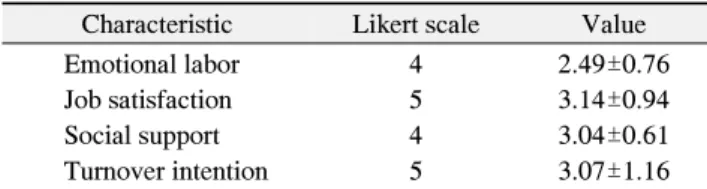
The subjects scored 2.49 and 3.04 out of 4 points in emotional labor and social support, respectively; they scored 3.14 and 3.07 out of 5 points in job satisfaction and turnover intention, respectively (Table 1).
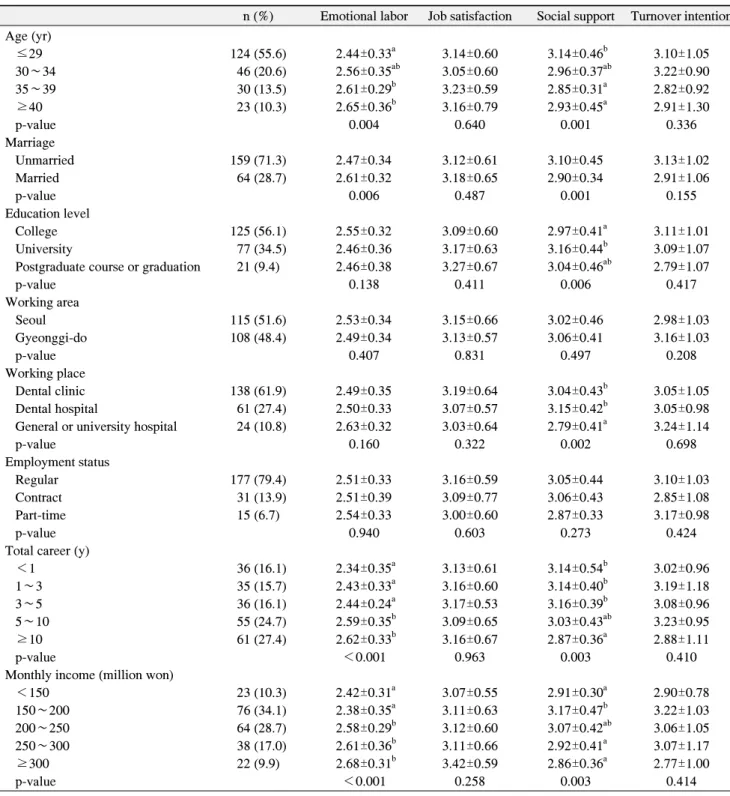
2. Emotional labor, job satisfaction, social support, and turnover intention by general characteristics Emotional labor was high in those aged 40 or older, those who were married, those with 10 years or more of total career experience, and those with a monthly income of KRW 3 million (p<0.01). There was no significant difference for job satisfaction across most questionnaire items. Social support was high in those aged 29 or less, those who were unmarried, those with 3 to 5 years of total career experience, and those with a monthly income of KRW 1.5 to 2 million (p<0.05). In terms of education level, most respondents were university graduates, while dental hospitals were the most common working place (p<
0.05). In terms of working place, general or university hospitals showed the highest turnover intention with 3.24 points; for total career, those with 5 to 10 years of total career experience scored the highest in turnover intention with 3.23, but there was no significant difference (Table 2).
3. Emotional labor, job satisfaction, social support,
and turnover intention by occupational characteristics
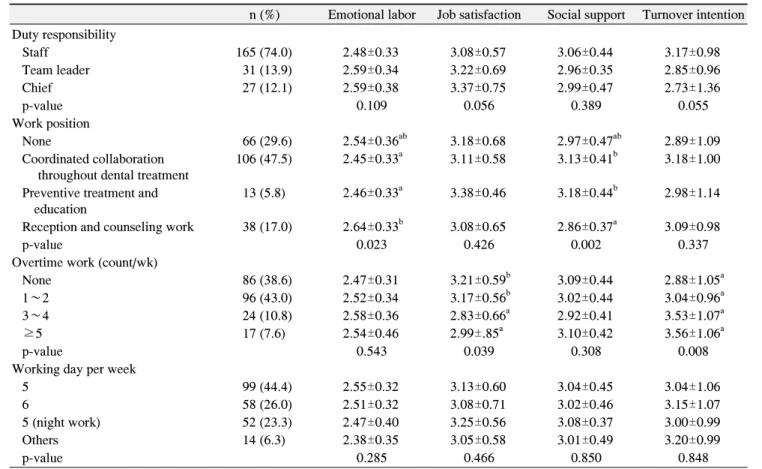
For emotional labor, the group engaged in reception and
counseling showed a high score with 2.64; for job
satisfaction, the group with no overtime work showed a
high score with 3.21. For social support, the group
Table 2. Emotional Labor, Job Satisfaction, Social Support, and Turnover Intention by General Characteristics (n=223)
n (%) Emotional labor Job satisfaction Social support Turnover intention
Age (yr)
≤29 124 (55.6) 2.44±0.33
a3.14±0.60 3.14±0.46
b3.10±1.05
30∼34 46 (20.6) 2.56±0.35
ab3.05±0.60 2.96±0.37
ab3.22±0.90
35∼39 30 (13.5) 2.61±0.29
b3.23±0.59 2.85±0.31
a2.82±0.92
≥40 23 (10.3) 2.65±0.36
b3.16±0.79 2.93±0.45
a2.91±1.30
p-value 0.004 0.640 0.001 0.336
Marriage
Unmarried 159 (71.3) 2.47±0.34 3.12±0.61 3.10±0.45 3.13±1.02
Married 64 (28.7) 2.61±0.32 3.18±0.65 2.90±0.34 2.91±1.06
p-value 0.006 0.487 0.001 0.155
Education level
College 125 (56.1) 2.55±0.32 3.09±0.60 2.97±0.41
a3.11±1.01
University 77 (34.5) 2.46±0.36 3.17±0.63 3.16±0.44
b3.09±1.07
Postgraduate course or graduation 21 (9.4) 2.46±0.38 3.27±0.67 3.04±0.46
ab2.79±1.07
p-value 0.138 0.411 0.006 0.417
Working area
Seoul 115 (51.6) 2.53±0.34 3.15±0.66 3.02±0.46 2.98±1.03
Gyeonggi-do 108 (48.4) 2.49±0.34 3.13±0.57 3.06±0.41 3.16±1.03
p-value 0.407 0.831 0.497 0.208
Working place
Dental clinic 138 (61.9) 2.49±0.35 3.19±0.64 3.04±0.43
b3.05±1.05
Dental hospital 61 (27.4) 2.50±0.33 3.07±0.57 3.15±0.42
b3.05±0.98
General or university hospital 24 (10.8) 2.63±0.32 3.03±0.64 2.79±0.41
a3.24±1.14
p-value 0.160 0.322 0.002 0.698
Employment status
Regular 177 (79.4) 2.51±0.33 3.16±0.59 3.05±0.44 3.10±1.03
Contract 31 (13.9) 2.51±0.39 3.09±0.77 3.06±0.43 2.85±1.08
Part-time 15 (6.7) 2.54±0.33 3.00±0.60 2.87±0.33 3.17±0.98
p-value 0.940 0.603 0.273 0.424
Total career (y)
<1 36 (16.1) 2.34±0.35
a3.13±0.61 3.14±0.54
b3.02±0.96
1∼3 35 (15.7) 2.43±0.33
a3.16±0.60 3.14±0.40
b3.19±1.18
3∼5 36 (16.1) 2.44±0.24
a3.17±0.53 3.16±0.39
b3.08±0.96
5∼10 55 (24.7) 2.59±0.35
b3.09±0.65 3.03±0.43
ab3.23±0.95
≥10 61 (27.4) 2.62±0.33
b3.16±0.67 2.87±0.36
a2.88±1.11
p-value <0.001 0.963 0.003 0.410
Monthly income (million won)
<150 23 (10.3) 2.42±0.31
a3.07±0.55 2.91±0.30
a2.90±0.78
150∼200 76 (34.1) 2.38±0.35
a3.11±0.63 3.17±0.47
b3.22±1.03
200∼250 64 (28.7) 2.58±0.29
b3.12±0.60 3.07±0.42
ab3.06±1.05
250∼300 38 (17.0) 2.61±0.36
b3.11±0.66 2.92±0.41
a3.07±1.17
≥300 22 (9.9) 2.68±0.31
b3.42±0.59 2.86±0.36
a2.77±1.00
p-value <0.001 0.258 0.003 0.414
Values are presented as n (%) or mean±standard deviation.
Likert scale: emotional labor, 4; job satisfaction, 5; social support, 4; turnover intention, 5.
p-value was calculated by t-test or one-way ANOVA.
a,b
Post hoc test was conducted from Duncan test. Different letters denote significant differences between groups.
engaged in patient preventative treatment and education scored high with 3.18; for turnover intention, the group
working overtime 5 times or more per week scored the
highest with 3.56 (p<0.05; Table 3).
Table 3. Emotional Labor, Job Satisfaction, Social Support, and Turnover Intention by Job Characteristics (n=223)
n (%) Emotional labor Job satisfaction Social support Turnover intention
Duty responsibility
Staff 165 (74.0) 2.48±0.33 3.08±0.57 3.06±0.44 3.17±0.98
Team leader 31 (13.9) 2.59±0.34 3.22±0.69 2.96±0.35 2.85±0.96
Chief 27 (12.1) 2.59±0.38 3.37±0.75 2.99±0.47 2.73±1.36
p-value 0.109 0.056 0.389 0.055
Work position
None 66 (29.6) 2.54±0.36
ab3.18±0.68 2.97±0.47
ab2.89±1.09
Coordinated collaboration throughout dental treatment
106 (47.5) 2.45±0.33
a3.11±0.58 3.13±0.41
b3.18±1.00
Preventive treatment and education
13 (5.8) 2.46±0.33
a3.38±0.46 3.18±0.44
b2.98±1.14
Reception and counseling work 38 (17.0) 2.64±0.33
b3.08±0.65 2.86±0.37
a3.09±0.98
p-value 0.023 0.426 0.002 0.337
Overtime work (count/wk)
None 86 (38.6) 2.47±0.31 3.21±0.59
b3.09±0.44 2.88±1.05
a1∼2 96 (43.0) 2.52±0.34 3.17±0.56
b3.02±0.44 3.04±0.96
a3∼4 24 (10.8) 2.58±0.36 2.83±0.66
a2.92±0.41 3.53±1.07
a≥5 17 (7.6) 2.54±0.46 2.99±.85
a3.10±0.42 3.56±1.06
ap-value 0.543 0.039 0.308 0.008
Working day per week
5 99 (44.4) 2.55±0.32 3.13±0.60 3.04±0.45 3.04±1.06
6 58 (26.0) 2.51±0.32 3.08±0.71 3.02±0.46 3.15±1.07
5 (night work) 52 (23.3) 2.47±0.40 3.25±0.56 3.08±0.37 3.00±0.99
Others 14 (6.3) 2.38±0.35 3.05±0.58 3.01±0.49 3.20±0.99
p-value 0.285 0.466 0.850 0.848
Values are presented as n (%) or mean±standard deviation.
Likert scale: emotional labor, 4; job satisfaction, 5; social support, 4; turnover intention, 5.
p-value was calculated by t-test or one-way ANOVA.
a,b