The Effect of Intensive Mobility Training on the Gait Performance of Patients with Parkinson’s Disease
Purpose: The novelty of intensive mobility training (IMT) is its intensive nature. The purpose of this study was to examine the effect of IMT in patients with Parkinson’s disease.
Methods: Subjects participated in 3 hours/day for ten days (30 hours). Gait parameters of interest were the timed up-and-go test, 10-m walk test, and step length and width. Measures were made at baseline before commencement of training (pre-training) and at the end of the two-week training period (post-training).
Results: Seven patients with Parkinson’s disease enrolled in the study. On average, participants are able to tolerate 141 minutes of activity during a 180-minute session. Results showed that, after 10 consecutive days training, subjects significantly improved for all parameters; the timed up-and-go test, 10-m walk test, and stride length and step width.
Conclusion: This study’ s findings show that gait properties in patients with Parkinson’s disease can be improved with IMT.
Key Words:Intensive Mobility Training, Patients with Parkinson’s disease, Gait In-Hee Lee
Department of Physical Medicine and Rehabilitation, Dongsan Medical Center, Keimyung University
The Journal of Korean Society of Physical Therapy Original articles
I. Introduction
Patients with Parkinson’s disease (PWP) have difficulty performing transitional movements in which the center of mass moves outward from the base of support; a common feature in such tasks as sit to stand and gait.1-3 Impairments in the typical anticipatory postural adjustments are considered a major pathophysiological mechanism underlying impaired gait function and balance in PWP.1,4 Previous studies report that PWP exhibit a reduction in propulsive forces, reduced step length and velocity. These impairments can be explained one mechanism multi-factorial including deficits in
Copylight ⓒ 2014 The Korea Society of Physical Therapy
This is an Open Access article distribute under the terms of the Creative Commons Attribution Non-commercial License (Http:// creativecommons.org/license/by-nc/3.0.) which permits unrestricted non-commercial use, distribution,and reproduction in any medium, provided the original work is properly cited.
Received May 14, 2014 Revised Jun 5, 2014 Accepted Jun 9, 2014
Corresponding author In-Hee Lee, [email protected]
neurologic and neuromuscular function.1,3,5 Of note, recently research reported a significant positive correlation between lower extremity strength and gait initiation.6 Thus treatment methods that enhance lower extremity strength may have important therapeutic effects.
Intensive mobility training (IMT) is an intervention concepts for neurological functional recovery engaging in massed practice and intensive training. The novelty of IMT is the intensive nature of the intervention.7 Subjects participate in several hours of therapy, over multiple consecutive days, with limited rest periods. This approach differs greatly from traditional rehabilitation approach in which the therapy is served fewer days per week, and the daily dosage per session is less.8,9
IMT concepts borrows that of repetitive, task-specific training from other therapies that have been successful in engaging in these motor control principles, such as constraint-induced movement therapy.10 Although many
studies have used longer training durations, when intervention time is calculated in terms of hours, the majority offer only between 12 and 30 hours of therapeutic intervention.11,12 Therefore, having the participants perform a shorter, more intense 10-day intervention does not significantly alter the amount of time (in hours) that the participant engages in rehabilitation. Thus, IMT provides similar intensity (30 hours) in a shorter, more intense intervention period. This is consistent with the principle of massed practice, wherein a therapeutic. Intervention is offered in a concentrated, and condensed, manner, with shorter rest breaks between sessions.13 But there are still some problems unsolved, and the key issue is how to define the exact dose, on which patients could acquire the best efficacy. To best promote motor learning, the participant must be active and be provided with opportunities for repetitious task-specific practice.
Recent domestic physical therapy studies on PWP have focused on the balance function by virtual reality training.14 Domestic studies on intensive training have primarily focused on middle-aged women and patients with diabetes, stroke, or orthopedic deficiencies.15-20
A previous study reported that high intensity exercises can be safely performed by PWP and improve muscle force production, reduce bradykinesia, and increase walking speed and quality of life.21 To address body weight–supported treadmill-based locomotor training (BWSTT) additional components of walking mobility, principles of intensive and task-specific training in a massed practice are included in IMT, with a focus on addressing deficits in balance and mobility. Therefore, the purpose of this exploratory pilot investigation was to examine the effects of IMT on gait function in PWP.
II. Methods
1. Subjects
Subjects included 7 PWP who were admitted to rehabilitation centers in the Republic of Korea. Subjects were included if they had been diagnosed within 5 years prior to this study and could walk independently for 10 m. All patients were in a stable cardiovascular condition and functional ambulatory
category ≥1. Inclusion criteria included a Modified Hoehn and Yahr stage of 1-3. Subjects were excluded if they had previously severe orthopedic or other disorders causing gait limitations or if they had severe cognitive deficits such that they could not follow instructions. Participants were enrolled in this study after providing informed consent in accordance with the ethical standards of the Declaration of Helsinki. All enrolled subjects obtained a written prescription from their primary care physician that provided consent to perform exercise. Participants were instructed to take their medications according to the normal regimen and were tested while on medication. None of the participants indicated any wearing off of medication during the test period.
2. Experimental methods 1) Training methods
The IMT was scheduled to be performed 3 hours per day for 10 consecutive weekdays for a total of 30 hours. During each 3-hour session, the initial hour was dedicated to body weight support treadmill training (Litegait®, Mobility Research, AJ, US.), with the remaining 2 hours of therapy focused on interventions intended to improve balance (1 hour) and activities designed to develop coordination and strength within task-specific contexts (1 hour). For example, if a participant was having difficulty with walking due to the inability to eccentrically control knee flexion, then eccentric quadriceps strengthening activities would be incorporated with emphasis on closed kinetic chain functional activities. The intervention was provided and supervised by a physical therapist. The intervention was similar to that of previous study, wherein specific examples of the intervention are described.7,22
The goal was to limit rest time to approximately 30 m / 3h session. To standardize the amount of therapy, the 30 minutes of rest was divided evenly between each hour of therapy, resulting in a target goal of each 50 minutes of gait, balance, strength and coordination activities, for a total goal of 150 minutes/day intervention.
2) Measurement
Subjects were evaluated before commencement of training (pre-training) and at the end of the four-week training
period (post-training). The following tests were performed:
the timed up-and-go test, a 10-m walk test, step length, and step width. The timed up-and-go test records the time to get up from a chair (height, 50 cm), move 3 m away, turn around, move back to the chair, and sit down; this test was repeated three times, and the mean time was recorded.23 In the 10-m walk test, patients were required to walk, wearing shoes that aided their maximum speed, along a 14-m long walkway, with an extra 2 m for acceleration and deceleration.
For step length and step width measurements, pens were attached to the subject’s heels during the 10-m walk test to mark and record heel contact points. Both step length and step width were quantified by calculating the mean distances over the 10-m distance, consisting of at least 15 steps. Measurement and training were performed on separate days to eliminate possible short-term effects of the training programs.
3. Statistical analysis
Statistical analysis was performed using SPSS 18. Descriptive and analytical statistics are presented. Pre- and post- training for all variables were analyzed by Wilcoxon’s signed rank test to determine the effect of training. Descriptions of
the groups are presented as mean and standard deviation.
Statistical significance was set at p < 0.05.
III. Results
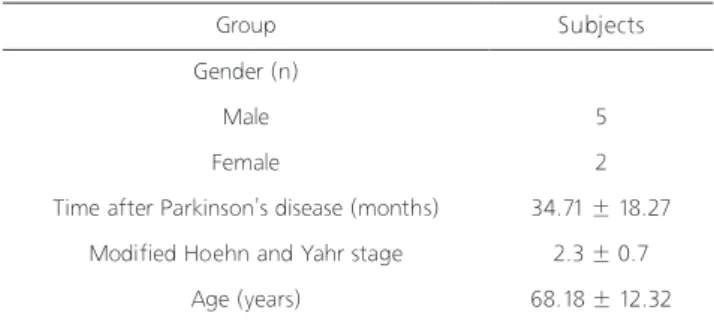
The subjects’ demographic and clinical features are summarized in Table 1. The participants had an average age of 68.2 years, Modified Hoehn and Yahr stage of 2.3, and time since diagnosis of 34.2 months . All enrolled patients completed the training program and their data were analyzed.
All descriptive measurements were summarized in Table 2.
The timed up-and-go test, 10-m walk test, stride length, and step width all improved significantly after training (p <
0.05).
IV. Discussion
Recent researches have reported that exercise is beneficial to PWP with respect to improvement of physical function, health related quality of life, strength, balance, and gait speed.1,22,23 Results of exploratory pilot investigation suggest that IMT may be an effective modality to optimize the gait function. This intensive training may help reduce the risk of falls.7 Further, the PWP in this study successfully completed a ten-day IMT program without complication or injury and demonstrated significant improvements in muscular strength.
Though improved by using levodopa, the output of the postural adjustments remains impaired in PWP relative to controls.1,24 Overall, the improvements in gait outcome measures indicate that all PWP were able to make modest gains in each of the target areas of gait outcomes following 10 days of IMT. Herein, we concluded that IMT can significantly improve the posterior displacement during their gait, potentially secondary to improved neuromuscular activation patterns. The observed improvements in the resulting from IMT are comparable to those reported in the literature resulting from external cueing, levodopa therapy, or deep brain stimulation surgery.21,24,25
As the relearning of motor tasks is dependent on the repetitive practice of specific tasks,26,27 IMT employs various activities to address relearning. With BWSTT,28-30 the goal is to
Group Subjects
Gender (n)
Male 5
Female 2
Time after Parkinson’s disease (months) 34.71 ± 18.27 Modified Hoehn and Yahr stage 2.3 ± 0.7
Age (years) 68.18 ± 12.32
Pre-test Post-test
Time up and go (s) 17.01 ± 2.71 15.23 ± 2.86*
10-m walking test(m/s) 0.17 ± 0.27 0.23 ± 0.63*
Stride length (m) 0.89 ± 0.28 1.01 ± 0.12*
Step width (m) 0.22 ± 0.32 0.18 ± 0.71*
Table 1. General characteristics of subjects
Table 2. Changes of accuracy at the pre- and post-tests in three groups
*p<0.05; Significant difference between pre- and post-test.
provide a safe, task-specific environment to improve the task of walking. However, specificity of practice during BWSTT concentrates primarily on the repetitive practice of linear gait and focuses less on balance, transitional movements, full weight bearing, and nonlinear gait, all of which are essential components of walking mobility.
Stride length and velocity are both reduced in PWP when compared to age-matched healthy adults,1 In this study, IMT resulted in important improvements in both parameters.
These findings are hypothesized to result from a combination of the following mechanisms: the greater propulsive force production by the swing limb and greater ability of the hip flexors to swing the limb. These results are consistent with a previous report which suggested that strength may be associated with postural control.6,31,32
While methodological differences prevent direct comparisons between studies, our results are comparable to the improvements in gait velocity following progressive resistance training and enhanced step length and step velocity resulting from bilateral deep brain surgery.31,33 The subjects in this study improved their gait speed by 0.06 m/s which is consistent with a meta-analysis on improved gait performance in progressive resistance training following a physical therapy intervention as well as resistance training.31,32 Further, this increase are comparable to the proposed threshold for small meaningful change, 0.05 m/s, amongst both healthy older adults and those with mobility limitations.34 Similarly, the increase in stride length observed in our subjects (0.13 m) was exceed to the finding in the meta-analysis (0.06 m).
Step width parameter was improved in this study. One possible reason may be that IMT was closed to the normal foot trajectory of the subjects. Step width is generally regarded to be related to balance control. IMT in the present study was sufficient to improve balance. Further studies are needed to investigate the effectiveness of IMT for improving balance.
Our findings suggest that IMT is a feasible and viable therapeutic option for PWP and that participants are able to tolerate an average of 141 minutes of activity during a 180-minute session. Factors such as pain, fatigue, and required rest were used as indices of the participants’ ability to tolerate this IMT. Rest time was primarily based on
participant’s request for a break, diminished ability to perform tasks due to observed fatigue, or safety issues (e.g., marked rise in blood pressure).
Cross-sectional studies have repeatedly demonstrated reduced trunk and lower extremity strength in PWP.35,36 Exercise training has been shown to be a safe and effective modality to improve both physical functioning and quality of life in these patients.22,23,35,37
The large increases in muscular strength, 57-76%, generally meet or exceed most previous investigations which identified statistically significant improvements in both leg extension and leg flexion.21,35,38
Future investigations should further explore the physiological adaptations, either increased central drive or peripheral neuromuscular efficiency, of strength improvements in PWP.
Another limitation is that the researchers failed to collect data for the 6MWT for PWP, information that would be helpful for creating a full picture of the effect of the intervention.
Furthermore, the findings could be influenced by experimenter bias because the interventionist collected daily self reports of fatigue and pain. Finally, the reported improvements may not represent actual meaningful changes since this was a case series. Despite the limitations, the findings of this study suggest that IMT is feasible for these participants and further investigations are warranted to determine the overall effects of the intervention, optimal schedule intensity, and duration required to support improved gait function through repetitive practice.
References
1. Halliday SE, Winter DA, Frank JS et al. The initiation of gait in young, elderly, and parkinson's disease subjects. Gait Posture.
1998;8(1):8-14.
2. Bloem BR, Grimbergen YA, Cramer M et al. Prospective assessment of falls in parkinson's disease. J Neurol.
2001;248(11):950-8.
3. Martin M, Shinberg M, Kuchibhatla M et al. Gait initiation in community-dwelling adults with parkinson disease:
Comparison with older and younger adults without the disease.
Phys Ther. 2002;82(6):566-77.
4. Hass CJ, Waddell DE, Fleming RP et al. Gait initiation and dynamic balance control in parkinson's disease. Arch Phys Med Rehabil. 2005;86(11):2172-6.
5. Brunt D, Liu SM, Trimble M et al. Principles underlying the organization of movement initiation from quiet stance. Gait Posture. 1999;10(2):121-8.
6. Nocera JR, Buckley T, Waddell D et al. Knee extensor strength, dynamic stability, and functional ambulation: Are they related in parkinson's disease? Arch Phys Med Rehabil. 2010;91(4):589- 95.
7. Fritz S, Merlo-Rains A, Rivers E et al. Feasibility of intensive mobility training to improve gait, balance, and mobility in persons with chronic neurological conditions: A case series. J Neurol Phys Ther. 2011;35(3):141-7.
8. Lang CE, MacDonald JR, Gnip C. Counting repetitions: An observational study of outpatient therapy for people with hemiparesis post-stroke. J Neurol Phys Ther. 2007;31(1):3-10.
9. Kwakkel G. Impact of intensity of practice after stroke: Issues for consideration. Disabil Rehabil. 2006;28(13-14):823-30.
10. Goldstein LB. Effect of constraint-induced movement therapy on upper extremity function 3 to 9 months after stroke: The excite trial. Curr Atheroscler Rep. 2007;9(4):259-60.
11. Mount J, Bolton M, Cesari M et al. Group balance skills class for people with chronic stroke: A case series. J Neurol Phys Ther.
2005;29(1):24-33.
12. Plummer P, Behrman AL, Duncan PW et al. Effects of stroke severity and training duration on locomotor recovery after stroke: A pilot study. Neurorehabil Neural Repair.
2007;21(2):137-51.
13. Schmidt RA, Lee T. Motor control and learning, 5e. Human kinetics. 1988:285-322.
14. Lee DK, Kim EK, Kim YN et al. Effects of a Virtual Reality Training Program on Balance and Lower Muscular Strength of Parkinson’s Disease Patients. J Korean Soc Phys Ther.
2013;25(2):96-102.
15. Lee HS, Lee CH. The Effect of Progressive Resistance Training with Elastic Band on Grip Strength and Balance in Middle Elderly Women. J Korean Soc Phys Ther. 2013;25(2):110-6.
16. Park SY, Kim CS, Nam SH. Effects of Elastic Band Resistance Exercise Program on Body Functions and HbA1c of the Elderly.
J Korean Soc Phys Ther. 2012;24(5):362-9.
17. Nam SH, Kang KW, Kwon JW et al. The Effects of Handrails during treadmill Gait Training in Stroke Patients. J Korean Soc Phys Ther. 2013;25(1):23-8.
18. Choi HJ, Nam KW. The effect of weight-support treadmill training on the balance and activity of daily living of children with spastic diplegia. J Korean Soc Phys Ther. 2012;24(6):398- 404.
19. Kim GW, Hwang R. The effects of circuit weight training programs including aquatic exercises on the body composition and serum lipid components of women with obesity. J Korean Soc Phys Ther. 2011;23(6):61-9.
20. Bae YH, Lee GC. Effect of motor control training with strengthening exercises on pain and muscle strength of patients with shoulder impingement syndrome. J Korean Soc Phys Ther.
2011;23(6):1-7.
21. Dibble LE, Hale TF, Marcus RL et al. High intensity eccentric resistance training decreases bradykinesia and improves quality of life in persons with parkinson's disease: A preliminary study.
Parkinsonism Relat Disord. 2009;15(10):752-7.
22. Goodwin VA, Richards SH, Taylor RS et al. The effectiveness of exercise interventions for people with parkinson's disease:
A systematic review and meta-analysis. Mov Disord.
2008;23(5):631-40.
23. Rodrigues de Paula F, Teixeira‐Salmela LF, Coelho de Morais Faria CD et al. Impact of an exercise program on physical, emotional, and social aspects of quality of life of individuals with parkinson's disease. Mov Disord. 2006;21(8):1073-7.
24. Burleigh‐Jacobs A, Horak FB, Nutt JG et al. Step initiation in parkinson's disease: Influence of levodopa and external sensory triggers. Mov Disord. 1997;12(2):206-15.
25. Liu W, McIntire K, Kim SH et al. Bilateral subthalamic stimulation improves gait initiation in patients with parkinson's disease. Gait Posture. 2006;23(4):492-8.
26. Mark VW, Taub E. Constraint-induced movement therapy for chronic stroke hemiparesis and other disabilities. Restor Neurol Neurosci. 2004;22(3-5):317-36.
27. Dietz V, Harkema SJ. Locomotor activity in spinal cord-injured persons. J Appl Physiol (1985). 2004;96(5):1954-60.
28. Herman T, Giladi N, Gruendlinger L et al. Six weeks of intensive treadmill training improves gait and quality of life in patients with parkinson’s disease: A pilot study. Arch Phys Med Rehabil.
2007;88(9):1154-8.
29. Lam T, Eng JJ, Wolfe DL et al. A systematic review of the efficacy of gait rehabilitation strategies for spinal cord injury.
Top Spinal Cord Inj Rehabil. 2007;13(1):32-57.
30. de Bode S, Mathern GW, Bookheimer S et al. Locomotor training remodels fmri sensorimotor cortical activations in children after cerebral hemispherectomy. Neurorehabilitation and neural repair. 2007;21(6):497-508.
31. Scandalis TA, Bosak A, Berliner JC et al. Resistance training and gait function in patients with parkinson's disease. Am J Phys Med Rehabil. 2001;80(1):38-43.
32. de Goede CJ, Samyra P, Keus H et al. The effects of physical therapy in parkinson's disease: A research synthesis. Arch Phys Med Rehabil. 2001;82(4):509-15.
33. Crenna P, Carpinella I, Rabuffetti M et al. Impact of subthalamic nucleus stimulation on the initiation of gait in parkinson’s disease. Exp Brain Res. 2006;172(4):519-32.
34. Perera S, Mody SH, Woodman RC et al. Meaningful change and responsiveness in common physical performance measures
in older adults. J Am Geriatr Soc. 2006;54(5):743-9.
35. Hass CJ, Collins MA, Juncos JL. Resistance training with creatine monohydrate improves upper-body strength in patients with parkinson disease: A randomized trial. Neurorehabil Neural Repair. 2007;21(2):107-15.
36. Kakinuma S, Nogaki H, Pramanik B et al. Muscle weakness in parkinson's disease: Isokinetic study of the lower limbs. Eur
Neurol. 1998;39(4):218-22.
37. Hackney ME, Earhart GM. Health-related quality of life and alternative forms of exercise in parkinson disease. Parkinsonism Relat Disord. 2009;15(9):644-8.
38. Falvo MJ, Schilling BK, Earhart GM. Parkinson's disease and resistive exercise: Rationale, review, and recommendations. Mov Disord. 2008;23(1):1-11.