• 검색 결과가 없습니다.

Neuroanatomical Predictors of Dysphagia after Stroke:

N/A
N/A
Protected

Academic year: 2021

Share "Neuroanatomical Predictors of Dysphagia after Stroke: "

Copied!
9
0
0

로드 중.... (전체 텍스트 보기)

전체 글

(1)

Received: February 18 2019, Revised: February 18 2019, Accepted: March 21 2019

Corresponding author: Sung-Bom Pyun, Department of Physical Medicine and Rehabilitation, Korea University College of Medicine, 73 Inchon-ro, Seongbuk-Gu, Seoul 02841, Korea

Tel: +82-2-920-6480, Fax: +82-2-929-9951 E-mail: [email protected]

Copyrights ⓒ The Korean Dysphagia Society, 2019.

Neuroanatomical Predictors of Dysphagia after Stroke:

Voxel-Based Lesion Symptom Mapping Study

Sung-Bom Pyun, M.D., Ph.D.

1,2

, Hyun-Joon Yoo, M.D.

1

, Youjin Jung, M.Eng.

2

, Woo-Suk Tae, Ph.D.

2

1

Department of Physical Medicine and Rehabilitation, Korea University College of Medicine,

2

Brain Convergence Research Center, Korea University, Seoul, Korea

Objective: Dysphagia is a common consequence of stroke with a negative effect on the clinical outcome. Given these potential outcomes, it is important to identify the precursors to dysphagia after stroke. The aims of this study were to identify lesions associated with dysphagia after an ischemic supratentorial stroke using voxel-based lesion symp- tom mapping (VLSM) and compare the difference in the lesion pattern between the oral and pharyngeal phase dysphagia.

Methods: Stroke patients who met the following inclusion criteria were screened retrospectively between January 2012 and November 2014: a first-ever stroke, supratentorial lesion and who underwent brain MRI and functional dysphagia scale (FDS) from videofluoroscopic swallowing study (VFSS). Finally, the MRI data of 83 patients were analyzed. Statistical maps of the lesion contribution related to dysphagia were generated using VLSM.

Results: VLSM showed that FDS was associated with damage to the putamen, caudate, insula, frontal precentral gy- rus, and inferior frontal gyrus. The lesions were distributed more widely in the left than right hemisphere. Lesions correlated with the FDS oral score were distributed mainly in the frontal lobe and insula. Otherwise, the associated lesion with the FDS pharyngeal score was mainly the basal ganglia.

Conclusion: In these results, lesions that correlated with dysphagia were distributed more widely in the left hemi- sphere, reflecting the possibility of lateralization of the swallowing function. Oral phase dysphagia was associated with left frontal lobe and insula; the lesion correlated with the cognitive function or apraxia. On the other hand, VLSM revealed the lesions associated with pharyngeal dysphagia to be the basal ganglia, which is a structure that plays a role in the automatic motor control network. (JKDS 2019;9:68-76)

Keywords: Deglutition disorders, Stroke, Brain mapping, Neuroanatomy

INTRODUCTION

Deglutition is a complex process of sensation and movement controlled by the brain. It involves multi- ple nervous systems including the cerebral cortex,

subcortical white matter tract, and infratentorium.

Damage at any levels could cause dysphagia

1

. Post-

stroke dysphagia is a very common problem and the

presence of dysphagia has been associated with an

increased risk for pulmonary complications and even

(2)

mortality

2,3

. Given these potential compromises, it is important to identify the precursors to dysphagia after stroke. Predicting the increased risk of dysphagia following brain lesions might increase our understand- ing of the causes of poststroke dysphagia, leading to improved management and better treatments for stroke survivors.

Even though it is an established fact that cerebral cortical infarction can cause dysphagia, it is still con- troversial which of the two hemispheres has a more important role, and which brain lesion is likely to lead to specific patterns of dysphagia. Traditionally, there were many studies for identification of specific neu- roanatomical areas that may produce specific patterns of swallowing dysfunction. Robbins et al. reported increased disturbances in lingual coordination in pa- tients with left hemispheric damage and suggested that the oral phase of swallowing is predominant function of left hemisphere

4

. However, another study failed to show laterality by lesion location

5

. Previ- ously, brain stem lesions were considered to be a cause of dysphagia

6,7

. However, an association between cerebral cortical lesions and the development of dysphagia has been suggested

8-10

. These reported that some critical areas such as the primary motor cortex, supplementary motor cortex, and anterior cingulate gyrus plays an important role in swallowing function.

Recent lesion-based studies reported that neuroanato- mical regions associated with dysphagia following stroke. These areas include the frontal cortex

11

, inter- nal capsule

12,13

, insula

11,14

, periventricular white matter

15

, thalamus

5

, pons

6,16

, and medulla

17-21

.

One study reported that the incidence of aspiration was correlated with medullary infarction, however, other swallowing parameters, especially oral phase dysphagia, were not related to lesion topology

22

. Steinhagen et al.

7

reported that buccofacial apraxia was predicted by left-sided parietotemporal infarction, and Daniels et al.

23

suggested the lingual discoord- ination during swallowing occurred commonly in patients with the periventricular white matter lesion.

However, there were few study about the dysphagia according to different phase, ie. oral, pharyngeal, and

esophageal phase. Furthermore, many previous studies used the bedside screening or informal clinical assess- ment or videofluoroscopic findings restricted to mea- sures of laryngeal penetration or aspiration. Consider- ing these gaps and limitations in the previous litera- ture, we thought that lesion-symptom mapping with comprehensive assessment of all phase of dysphagia was needed.

Voxel-based lesion symptom mapping (VLSM) is a new lesion symptom analysis technique

24

, and provides information on the association between lesion lo- cations in the brain and patient behavior. VLSM is able to statistically assess the lesion’s effect on be- havioral scores on a voxel-by-voxel basis. In each le- sioned voxel, a statistical test is conducted to deter- mine if a difference in behavioral scores exists be- tween the lesioned and non-lesioned groups. The groups are assigned at each new voxel location based on the presence of the lesion. A t-test produces a statistical map overlaid on the lesioned voxels. This voxel-by-voxel analysis produces high-resolution statis- tical maps (1 mm

3

) rather than large regions of in- terest or lesion categories as seen in prior lesion studies

25

. Furthermore, this VLSM method can be used to predict outcomes after stroke, such as language recovery

26

. This new method of analysis avoids many of the limitations affecting previous studies and can specifically identify the anatomical structures essential for swallowing function following stroke.

The aim of this study was to identify associated le- sions with dysphagia after ischemic stroke with supra- tentorial damage using voxel-based lesion symptom mapping (VLSM) and compare the difference of lesion pattern between oral and pharyngeal phase dysphagia.

MATERIAL AND METHODS

1. Subjects and functional measures

Stroke patients were screened retrospectively from

inpatient medical records of the Department of Physi-

cal Medicine and Rehabilitation, between January

2012 and November 2014. Patients were included ac-

cording to the following criteria: 1) had first-ever

(3)

ischemic stroke with objective lesions observable via brain magnetic resonance imaging (MRI), 2) under- went videofluoroscopic swallowing study (VFSS) in 3 months after stroke, 3) had no prior cognitive or psychiatric illness. Patients with hemorrhagic stroke and infratentorial lesions were excluded. A total of 83 stroke patients (44 male, 39 female) were finally in- cluded in this study. The study protocol was ap- proved by the institutional review board of our in- stitution (2015AN0204).

We collected data from medical records pertaining to functional measures. This included demographic and neurologic characteristics (age, sex, interval be- tween stroke onset and VFSS, lesion side), infor- mation about dysphagia including current feeding status, clinical aspiration sign were collected. Re- corded videos of VFSS were reviewed by experienced single researcher, and functional dysphagia scale (FDS) and penetration-aspiration scale were deter- mined after reviewing the entire swallowing action several times using frame by frame.

FDS is a 100-point scale for evaluating oropha- ryngeal dysphagia

27

. It consists of 11 oral and pha- ryngeal phase parameters and can produce numerical data on the swallowing function of stoke patients through the use of comprehensive VFSS findings. For the oral phase, the examiner assessed lip closure, bolus formation, and residue in oral cavity. Oral transit time was also measured and classified as 2 levels: ≤1.5 s, >1.5 s. In the pharyngeal phase, trig- gering of pharyngeal swallow, laryngeal elevation and epiglottic closure, nasal penetration, residue in val- leculae, residue in pyriform sinus, coating of pha- ryngeal wall after swallow, pharyngeal transit time were checked. The amount of nasal penetration, re- sidue in valleculae and pyriform sinus were classified into 4 levels: none, ≤10%, 10-50%, ≥50%.

2. Lesion identification and VLSM processing Lesion analysis was based on all 83 patients who had an MRI scan suitable for lesion mapping. All lesions were mapped using MRIcron software (http://

www.mccauslandcenter.sc.edu/mricro/mricron/) and

were drawn manually on patients’ individual fluid attenuation inversion recovery (FLAIR) scans by a single researcher. After coregistration and normali- zation using statistical parametric mapping (SPM) 8 (Wellcome Department of Neuroscience, London, UK;

http://www.fil.ion.ucl.ac.uk/spm/software/spm8/), normalized lesions were subjected to statistical map- ping analysis using VLSM algorithms implemented with statistical non-parametric mapping (SnPM) toolbox (http://www2.warwick.ac.uk/fac/sci/statistics/staff/

academic-research/nichols/software/snpm). All individual subject lesion maps were created as binary maps. An overlap map was then generated by summing all of the maps to identify common regions in the stroke subject population. The overlap map was drawn in the same space as the VLSM map, allowing a direct comparison to be made.

Simple comparisons on the continuous FDS oral and pharyngeal scores were performed on a voxel- by-voxel basis to compare performance in patients with and without a lesion in each voxel. The results of t-tests were then color-coded and mapped on the Montreal Neurologic Institute (MNI) template brain.

The resulting statistical measure was used to create a separate map based on each variable.

Color-coded lesions on the MNI template brain were labeled according to anatomical region and Broadmann area, using the xjView 8 toolbox (http://www.alivelearn.

net/xjview8/) in SPM 8 software.

RESULTS

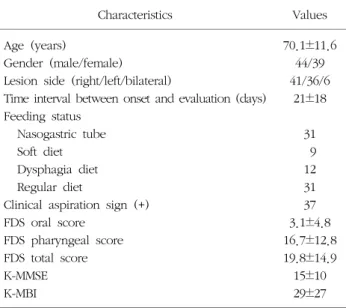
1. Clinical feature and examination of dysphagia Characteristics of the 83 subjects are shown in Table 1. Overall, mean age was 70.1±11.6 years. Time between stroke onset and evaluation was 21±18 days.

Among 83 patients, 41 (49%) had a right hemispheric

stroke, 36 (43%) had a left hemispheric stroke, and

6 (7%) had bilateral lesion. Patients’ current feeding

status were as follows; nasogastric tube 31, dysphagia

diet 12, soft diet 9, and regular diet 31. Patients who

had clinical aspiration sign were 37 (45%).

(4)

Fig. 1. Lesion overlay map of 83 patients. Lesion overlay map of 83 patients, showing coverage of most of the bilateral hemi- spheres. Lesions appear to be more widely distributed in left hemispheres. Numbers refer to z-coordinates of the MNI space, with the patient’s left hemisphere on the left side of the figure. MNI: Montreal neurologic institute.

Table 1. Descriptive statistics and behavioral data of 83 patients.

Characteristics Values

Age (years) 70.1±11.6

Gender (male/female) 44/39

Lesion side (right/left/bilateral) 41/36/6 Time interval between onset and evaluation (days) 21±18 Feeding status

Nasogastric tube 31

Soft diet 9

Dysphagia diet 12

Regular diet 31

Clinical aspiration sign (+) 37

FDS oral score 3.1±4.8

FDS pharyngeal score 16.7±12.8

FDS total score 19.8±14.9

K-MMSE 15±10

K-MBI 29±27

Values are presented as either mean (±SD) or number of subjects.

FDS: functional dysphagia scale, K-MMSE: Korean version of mini-mental status exam, K-MBI: Korean version of modified Barthel index.

2. Lesion overlay map

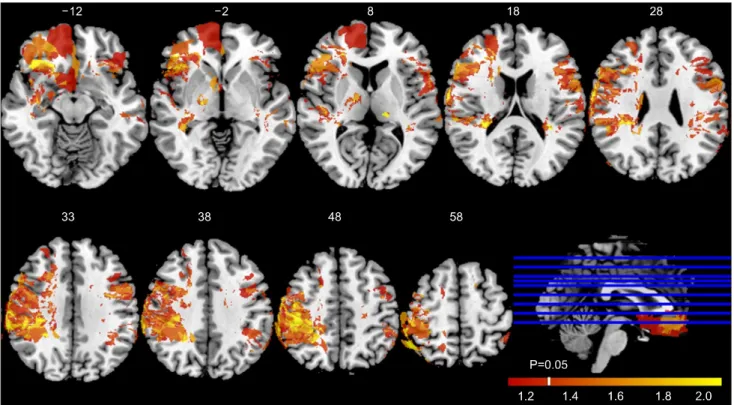
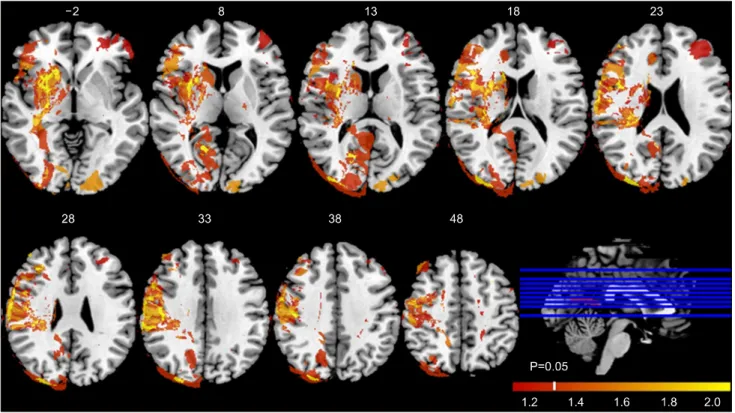
To characterize the lesions from this stroke popu- lation, a lesion overlay map was created.(Fig. 1) The lesion overlay map shows bilateral coverage of most of the hemispheres. The region identified using VLSM (Fig. 2 and 3) does not correspond to the peak level of overlap. The disparity between these two maps may indicate that the overlap mapping method is not an appropriate technique for finding the associated lesion with dysphagia after stroke.

3. VLSM results

Fig. 2 and 3 demonstrates the region that cor-

responds to FDS oral and pharyngeal score following

stroke. The result of VLSM shows positive correlation

between damaged brain lesions and FDS oral and

pharyngeal score. Color bar represents −log10 (un-

corrected non-parametric P-values). Uncorrected re-

sults associated with the FDS oral and pharyngeal

(5)

Fig. 2. Correlation between lesion images and FDS oral score. The result of VLSM shows positive correlation between damaged brain lesions and FDS oral score. Color bar represents −log10 (uncorrected non-parametric P-values). Numbers refer to z-coor- dinates of the MNI space, with the patient’s left hemisphere on the left side of the figure. FDS: functional dysphagia scale, VLSM:

voxel-based lesion-symptom mapping, MNI: Montreal neurologic institute.

score was presented to show which lesioned areas were trending. Although these results did not reach statistical significance, knowing which voxels have a substantially lower association with the experimental variable could provide valuable information, since it would represent statistical evidence for different effect sizes in different parts of the map

28

. Lesions correlated with FDS oral score were mainly distributed in the frontal lobe (medial and inferior frontal gyrus), pre- central gyrus (frontal), postcentral gyrus (parietal), caudate, anterior cingulate and insula. Otherwise, as- sociated lesion with FDS pharyngeal score were mainly basal ganglia (lentiform nucleus, putamen, cau- date), insula, inferior frontal gyrus, postcentral gyrus (parietal), and parahippocampal gyrus.

DISCUSSION

Our investigation revealed two main findings in

supratentorial ischemic stroke patients: (1) The lesion associated with dysphagia were predominantly distri- buted in left hemisphere than right. (2) There were some different lesion patterns according to different phase of swallowing problems. Lesions correlated with oral phase dysphagia were mainly distributed in the left frontal lobe (medial and inferior frontal gyrus), anterior cingulate, pericentral gyrus and insula. Other- wise, associated lesions with pharyngeal phase swal- lowing problems were mainly basal ganglia, insula, and parahippocampal gyrus.

The new aspect of this comprehensive imaging study

is the use of the quantitative and objective swallowing

parameter in VFSS and the focus on the different

lesion pattern of each swallowing phase in patients

with supratentorial ischemic stroke. This provided us

the opportunity for a comparative behavior-lesion map-

ping study to elucidate the swallowing-related brain

region associated with different phase of swallowing,

(6)

Fig. 3. Correlation between lesion images and FDS pharyngeal score. The result of VLSM shows positive correlation between damaged brain lesions and FDS pharyngeal score. Color bar represents −log10 (uncorrected non-parametric P-values). Numbers re- fer to z-coordinates of the MNI space, with the patient’s left hemisphere on the left side of the figure. FDS: functional dysphagia scale, VLSM: voxel-based lesion-symptom mapping, MNI: Montreal neurologic institute.

ie. oral and pharyngeal phase.

Our first finding, lesion distributed predominantly in left hemisphere, suggested the laterality of swal- lowing function. Some investigations found that swal- lowing behavior may be lateralized to the left or right hemispheres

29,30

. Functional imaging studies have been used investigate swallowing laterality. While most studies reported some degree of lateralization, it was varied in regard to hemisphere

9,31,32

. Hamdy et al. re- ported that muscle groups involved in swallowing are represented bilaterally, but asymmetrically in the hu- man motor and premotor cortex areas

33

. And some studies using functional brain imaging have also ob- served asymmetry in the swallowing cortex, and the left hemisphere involvement has been more frequently reported

31,34-36

. Results were inconclusive as to whether swallowing is lateralized. The conflicting results may be because of difference of time post-onset, lack of control of handedness, type of neuroimaging method,

and assessment tool for dysphagia. In present study,

predominant left hemispheric lesions were observed,

especially in left frontal cortex, basal ganglia, insula,

pericentral gyrus (motor and sensory cortex). In fact,

our participants have nearly equal distribution in both

hemisphere (right 41, left 36, bilateral 6). Despite the

overlay map of 83 patients showed more frequently

damaged voxels in left hemisphere than right, it might

have the clinical significance that the statistical map

correlated with both FDS oral and pharyngeal score

showed the deviation in left hemisphere. The exact

mechanism of the functional asymmetry of swallowing

remained unclear. The possible explanation is left

frontal cortex may be the region somewhat associated

with praxis. Swallowing tasks require some motor

planning and preparation of swallowing. Stoke involving

left hemisphere can give rise to apraxia of speech,

further implicating this region in oral movement re-

gulation

37

.

(7)

Additionally, we attempted to find out the different lesion pattern correlated with each different swal- lowing phase in patients with supratentorial ischemic stroke. VLSM results showed some difference be- tween two lesion maps.

Swallowing is a dynamic, complex sensorimotor process which can be initiated volitionally via the cerebral cortex and controlled by the central nervous system. Normal swallowing has both volitional and reflexive components that associated with the multi- dimensional levels of neural control

38

. A previous study about sequential evolution of cortical activity during swallowing according to swallowing phase reported successive activation starting at premotor cortex, supplementary motor area, bilateral thalamus, followed by primary sensorimotor cortex, insula, and cerebellum

39

. Therefore, we hypothesized that there were some difference in brain regions associated with each phase of swallowing process. As we hypothe- sized, some different pattern of brain lesion was ob- served.

Common brain areas correlated with both oral and pharyngeal dysphagia was left insula, which might be because lesions of the insula were common in non- lacunar strokes and often accompanied occlusion of the proximal middle cerebral artery, causing large in- farct volumes and damage to lenticulostriate sub- cortical territory. Previous studies also reported the insula was correlated with dysphagia or higher risk of pneumonia

7,40

. Recently, Li et al. reported that stroke patients with dysphagia exhibited dysfunctional con- nectivity mainly in the sensorimotor-insula-putamen circuits

41

. Also, one previous investigation suggests that the insula is a primary integrative region for volitional swallowing in humans

31

.

The main lesion associated with oral phase dyspha- gia was left frontal lobe and insula. The problems of the oral phase occurred frequently clinically when cognitive dysfunction was severe. One previous study reported oral phase dysphagia was predicted with initial mini mental-status exam (MMSE) score

22

. We interpreted that frontal cortex was associated with oral dysphagia because it might be associated with plan-

ning complex cognitive behavior, decision making, and execution

42

. As mentioned above, left frontal cortex may be the region somewhat associated with praxis. We thought that oral phase dysphagia such as impaired lip closure and bolus formation or pro- longed oral transit time might reflect some apraxic components.

Predominant lesion correlated with pharyngeal phase dysphagia was left basal ganglia. Although several studies demonstrated activation of the basal ganglia during swallowing

8,9

, contributions of these structures have been less notable than other cortical regions. One previous study reported prominent acti- vation was observed in the putamen and globus pallidus during volitional swallowing

43

. The basal ganglia functionally connect the cerebral cortex and the thalamus, being gating of sensory input to achieve motor control

44

. And, it was reported the basal ganglia are responsible for the autonomic execution of learned motor plans

45

. It has long been assumed that automatic behaviors are primarily mediated by sub- cortical structure

46

. We thought the pharyngeal phase was primarily consisted of triggered swallowing reflex and somewhat automatic pharyngeal motor control.

Therefore, the reason that correlated lesion with pha- ryngeal dysphagia was mainly basal ganglia might be the reflexive and automatic component of pharyngeal swallowing.

One limitation of our study was that the VFSS used were retrospectively collected in the subacute stage.

Therefore, many patients had swallowing problems

on VFSS. However, it is recognized that for many

patients, dysphagia is transient and resolves spon-

taneously after stoke

47

. Thus, further studies with a

prospective design are needed to collect serial follow-

up data that allow for the analysis of critical areas in

permanent dysphagia requiring tube-feeding or total

parenteral nutrition. The other shortcoming was rela-

tively small sample size. Therefore, lesion character-

istics, such as location and size, in left and right

hemisphere in our sample might be different. Given

that lack of longitudinal follow up data and small

sample size, present study could give us valuable

(8)

information about the lesion associated with different swallowing phase problems.

CONCLUSION

The use of lesion symptom mapping in conjunction with behavioral measures produced anatomically specific results and data on lesion location derived from MRI facilitate early differentiation of patients with dysphagia after supratentorial ischemic stroke.

Oral phase dysphagia was associated with frontal lobe and insula, the lesion correlated with cognitive func- tion or apraxia. On the other hand, VLSM revealed the lesions associated with pharyngeal dysphagia were basal ganglia, structure that has a role in automatic motor control network.

CONFLICT OF INTEREST

The authors declared no potential conflicts of in- terest with respect to the research, authorship, and/or publication of this article.

ACKNOWLEDGEMENTS

This work was supported by a grant (No.

2019R1A2C2003020) of the National Research Foundation of Korea (NRF) funded by the Korea government.

REFERENCES

1. Malandraki GA, Johnson S, Robbins J. Functional MRI of swallowing: from neurophysiology to neuroplasticity.

Head Neck 2011;33 Suppl 1:S14-20.

2. Marik PE, Kaplan D. Aspiration pneumonia and dyspha- gia in the elderly. Chest 2003;124:328-336.

3. Meng NH, Wang TG, Lien IN. Dysphagia in patients with brainstem stroke: incidence and outcome. Am J Phys Med Rehabil 2000;79:170-175.

4. Robbins J, Levine RL, Maser A, Rosenbek JC, Kempster GB. Swallowing after unilateral stroke of the cerebral cortex. Arch Phys Med Rehabil 1993;74:1295-1300.

5. Alberts MJ, Horner J, Gray L, Brazer SR. Aspiration after stroke: lesion analysis by brain MRI. Dysphagia 1992;7:

170-173.

6. Horner J, Buoyer FG, Alberts MJ, Helms MJ. Dysphagia

following brain-stem stroke. Clinical correlates and out- come. Arch Neurol 1991;48:1170-1173.

7. Steinhagen V, Grossmann A, Benecke R, Walter U.

Swallowing disturbance pattern relates to brain lesion lo- cation in acute stroke patients. Stroke 2009;40:1903-1906.

8. Hamdy S, Mikulis DJ, Crawley A, Xue S, Lau H, Henry S, et al. Cortical activation during human volitional swallowing: an event-related fMRI study. Am J Physiol 1999;277:G219-225.

9. Hamdy S, Rothwell JC, Brooks DJ, Bailey D, Aziz Q, Thompson DG. Identification of the cerebral loci proc- essing human swallowing with H2(15)O PET activation.

J Neurophysiol 1999;81:1917-1926.

10. Martin RE, Goodyear BG, Gati JS, Menon RS. Cerebral cortical representation of automatic and volitional swal- lowing in humans. J Neurophysiol 2001;85:938-950.

11. Broadley S, Croser D, Cottrell J, Creevy M, Teo E, Yiu D, et al. Predictors of prolonged dysphagia following acute stroke. J Clin Neurosci 2003;10:300-305.

12. Gonzalez-Fernandez M, Kleinman JT, Ky PK, Palmer JB, Hillis AE. Supratentorial regions of acute ischemia asso- ciated with clinically important swallowing disorders: a pilot study. Stroke 2008;39:3022-3028.

13. Hamdy S, Aziz Q, Rothwell JC, Power M, Singh KD, Nicholson DA, et al. Recovery of swallowing after dys- phagic stroke relates to functional reorganization in the intact motor cortex. Gastroenterology 1998;115:1104-1112.

14. Daniels SK, Foundas AL. The role of the insular cortex in dysphagia. Dysphagia 1997;12:146-156.

15. Daniels SK, Foundas AL. Lesion localization in acute stroke patients with risk of aspiration. J Neuroimaging 1999;9:

91-98.

16. Schmahmann JD, Ko R, MacMore J. The human basis pon- tis: motor syndromes and topographic organization. Brain 2004;127:1269-1291.

17. Aydogdu I, Ertekin C, Tarlaci S, Turman B, Kiylioglu N, Secil Y. Dysphagia in lateral medullary infarction (Wallen- berg’s syndrome): an acute disconnection syndrome in premotor neurons related to swallowing activity? Stroke 2001;32:2081-2087.

18. Kim H, Chung CS, Lee KH, Robbins J. Aspiration sub- sequent to a pure medullary infarction: lesion sites, clin- ical variables, and outcome. Arch Neurol 2000;57:478-483.

19. Kumral E, Afsar N, Kirbas D, Balkir K, Ozdemirkiran T.

Spectrum of medial medullary infarction: clinical and magnetic resonance imaging findings. J Neurol 2002;249:

85-93.

20. Kurono H, Uesaka Y, Kunimoto M, Imafuku I. [The cor- relation between dysphagia and involvement of the am- biguous nucleus on MRI in acute-phase lateral medullary syndrome]. Rinsho Shinkeigaku 2006;46:461-466.

21. Kwon M, Lee JH, Kim JS. Dysphagia in unilateral me- dullary infarction: lateral vs medial lesions. Neurology 2005;65:714-718.

22. Moon HI, Pyun SB, Kwon HK. Correlation between

(9)

Location of Brain Lesion and Cognitive Function and Findings of Videofluoroscopic Swallowing Study. Ann Rehabil Med 2012;36:347-355.

23. Daniels SK, Brailey K, Foundas AL. Lingual dis- coordination and dysphagia following acute stroke: anal- yses of lesion localization. Dysphagia 1999;14:85-92.

24. Bates E, Wilson SM, Saygin AP, Dick F, Sereno MI, Knight RT, et al. Voxel-based lesion-symptom mapping.

Nat Neurosci 2003;6:448-450.

25. Lo R, Gitelman D, Levy R, Hulvershorn J, Parrish T.

Identification of critical areas for motor function recov- ery in chronic stroke subjects using voxel-based lesion symptom mapping. Neuroimage 2010;49:9-18.

26. Hope TM, Seghier ML, Leff AP, Price CJ. Predicting out- come and recovery after stroke with lesions extracted from MRI images. Neuroimage Clin 2013;2:424-433.

27. Han TR, Paik NJ, Park JW. Quantifying swallowing func- tion after stroke: A functional dysphagia scale based on videofluoroscopic studies. Arch Phys Med Rehabil 2001;

82:677-682.

28. Jernigan TL, Gamst AC, Fennema-Notestine C, Ostergaard AL. More “mapping” in brain mapping: statistical com- parison of effects. Hum Brain Mapp 2003;19:90-95.

29. Daniels SK, Foundas AL, Iglesia GC, Sullivan MA. Lesion site in unilateral stroke patients with dysphagia. J Stroke Cerebrovasc Dis 1996;6:30-34.

30. Mosier KM, Liu WC, Maldjian JA, Shah R, Modi B.

Lateralization of cortical function in swallowing: a func- tional MR imaging study. AJNR Am J Neuroradiol 1999;

20:1520-1526.

31. Lowell SY, Reynolds RC, Chen G, Horwitz B, Ludlow CL. Functional connectivity and laterality of the motor and sensory components in the volitional swallowing network. Exp Brain Res 2012;219:85-96.

32. Daniels SK, Corey DM, Fraychinaud A, DePolo A, Foundas AL. Swallowing lateralization: the effects of modified du- al-task interference. Dysphagia 2006;21:21-27.

33. Hamdy S, Aziz Q, Rothwell JC, Singh KD, Barlow J, Hughes DG, et al. The cortical topography of human swallowing musculature in health and disease. Nat Med 1996;2:1217-1224.

34. Martin R, Barr A, MacIntosh B, Smith R, Stevens T, Taves D, et al. Cerebral cortical processing of swallowing in older adults. Exp Brain Res 2007;176:12-22.

35. Martin RE, MacIntosh BJ, Smith RC, Barr AM, Stevens TK, Gati JS, et al. Cerebral areas processing swallowing and tongue movement are overlapping but distinct: a functional magnetic resonance imaging study. J Neuro- physiol 2004;92:2428-2443.

36. Moon HI JY, Choi SY, Tae WS, Pyun SB. Effect of age on cortical activation during swallowing: an fMRI study.

Journal of Korean Dysphagia Society 2016;6:26-33.

37. Graff-Radford J, Jones DT, Strand EA, Rabinstein AA, Duffy JR, Josephs KA. The neuroanatomy of pure aprax- ia of speech in stroke. Brain Lang 2014;129:43-46.

38. Miller AJ. The neurobiology of swallowing and dysphagia.

Dev Disabil Res Rev 2008;14:77-86.

39. Mihai PG, Otto M, Platz T, Eickhoff SB, Lotze M. Se- quential evolution of cortical activity and effective con- nectivity of swallowing using fMRI. Hum Brain Mapp 2014;35:5962-5973.

40. Galovic M, Leisi N, Muller M, Weber J, Abela E, Kagi G, et al. Lesion location predicts transient and extended risk of aspiration after supratentorial ischemic stroke.

Stroke 2013;44:2760-2767.

41. Li S, Ma Z, Tu S, Zhou M, Chen S, Guo Z, et al. Altered resting-state functional and white matter tract connectivity in stroke patients with dysphagia. Neurorehabil Neural Repair 2014;28:260-272.

42. Yang Y, Raine A. Prefrontal structural and functional brain imaging findings in antisocial, violent, and psycho- pathic individuals: a meta-analysis. Psychiatry Res 2009;

174:81-88.

43. Suzuki M, Asada Y, Ito J, Hayashi K, Inoue H, Kitano H. Activation of cerebellum and basal ganglia on voli- tional swallowing detected by functional magnetic reso- nance imaging. Dysphagia 2003;18:71-77.

44. Kaji R. Basal ganglia as a sensory gating devise for mo- tor control. J Med Invest 2001;48:142-146.

45. Marsden CD. The mysterious motor function of the bas- al ganglia: the Robert Wartenberg Lecture. Neurology 1982;32:514-539.

46. Moors A, De Houwer J. Automaticity: A theoretical and conceptual analysis. Psychological Bulletin 2006;132:297- 326.

47. Smithard DG, O’Neill PA, England RE, Park CL, Wyatt R,

Martin DF, et al. The natural history of dysphagia fol-

lowing a stroke. Dysphagia 1997;12:188-193.

수치

Fig.  1.  Lesion  overlay  map  of  83  patients.  Lesion  overlay  map  of  83  patients,  showing  coverage  of  most  of  the  bilateral  hemi- hemi-spheres
Fig.  2.  Correlation  between  lesion  images  and  FDS  oral  score.  The  result  of  VLSM  shows  positive  correlation  between  damaged  brain  lesions  and  FDS  oral  score
Fig.  3.  Correlation  between  lesion  images  and  FDS  pharyngeal  score.  The  result  of  VLSM  shows  positive  correlation  between  damaged  brain  lesions  and  FDS  pharyngeal  score

참조

관련 문서

In addition, if the patients had a high MPV level (cut-off value of 7.95 fL) without low-dose aspirin therapy, they were at risk for ischemic stroke, especially in

In conclusion, as this study found that Internet addiction was significantly related with eating behaviors even after the influences of other variables

The benefits and harms of intravenous thrombolysis with recombinant tissue plasminogen activator within 6 h of acute ischaemic stroke (the third

Guidelines for the early management of adults with ischemic stroke: a guideline from the American Heart Association/American Stroke Association Stroke Council,

This study aims to identify whether socioeconomic level of parents affects obesity of adolescents and whether the relations between adolescent's obesity

Through an empirical analysis of employability of persons with cerebral palsy this study aims to examine the factors affecting their employability and

Bone transplants, autogenous bones, allogenic bones, xenogenic bones, and synthetic bone substitutes have all been used as bone graft materials.. However,

Emmett Leith, the Schlumberger Professor of Electrical Engineering and Computer Science at the University of Michigan died on December 23 at the age of 78 after suffering a