서 론
간호학은 인문과학, 자연과학, 사회과학을 기초로 하는 응용과 학이며 , 간호학의 교육 목표는 인간의 건강을 유지, 증진하기 위한
기본 요구를 충족시킬 수 있는 전문직 간호사를 배양하는데 있다.
또한 간호학은 실용학문으로서 간호학과 학생은 졸업 후 임상현장 에서 기본 지식을 실제 상황에 적용하고 문제가 되는 상황을 해결 할 수 있는 수행능력을 보유하는 것이 매우 중요하다.
종합병원 임상간호사 실무교육에서의 기초간호학 교육현황
정재심
1·황영희
2·김용범
3·류재금
3·김미경
4·최소은
5·박명숙
6·이향규
7·이경숙
8·최스미
31울산대학교 임상전문간호학, 2울산대학교 간호학과, 3서울대학교 간호대학, 4가톨릭대학교 서울성모병원 간호부, 5국립목포대학교 간호학과,
6건국대학교 간호대학, 7연세대학교 간호대학, 8강릉원주대학교 간호학과
Current Status of Biological Nursing Science Education for Clinical Nurses in General Hospital
Jeong, Jae Sim
1· Hwang, Young Hui
2· Kim, Yongbum
3· Ryu, Jae Geum
3· Kim, Mi Kyung
4· Choi So-Eun
5· Park, Myung Sook
6· Lee, Hyangkyu
7· Lee, Kyung-Sook
8· Choi-Kwon, Smi
31Department of Clinical Nursing, University of Ulsan, Ulsan, 2Department of Nursing, University of Ulsan, Ulsan, 3College of Nursing, Seoul National University, Seoul,
4Department of Nursing, Seoul St. Mary’s Hospital, Seoul, 5Department of Nursing, Mokpo National University, Jeollanam-do, 6Department of Nursing, Konkuk University, Chungju, 7College of Nursing, Yonsei University, Seoul, 8Department of Nursing, Wonju Campus, Gangneung Wonju National University, Wonju, Korea
Purpose: The purpose of this study was to investigate the extent and the nature of biological nursing science education for clinical
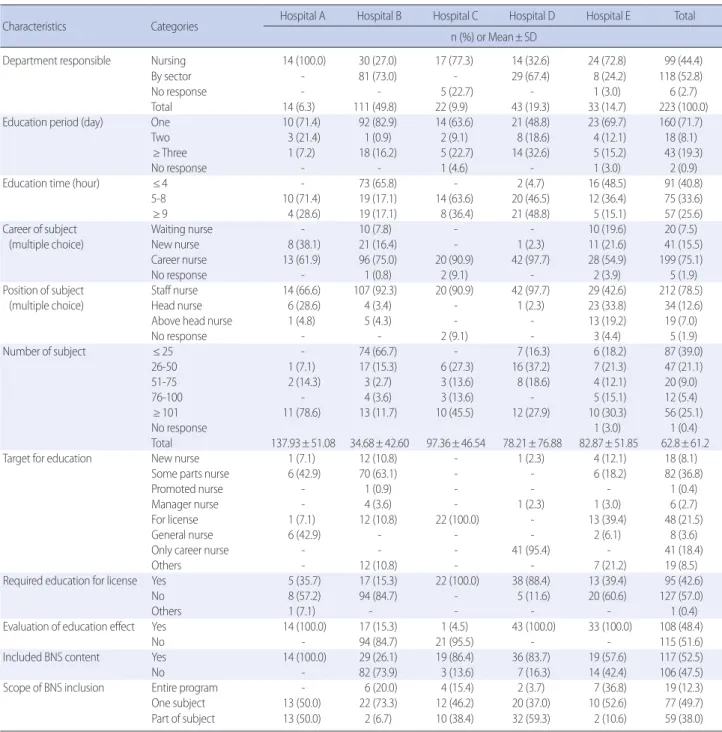
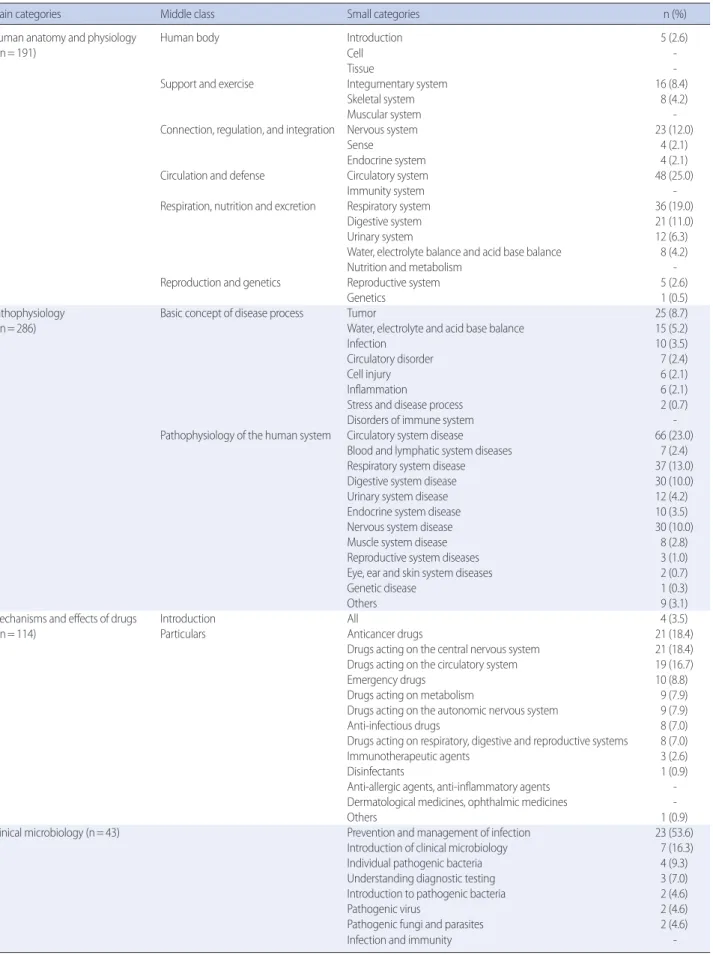
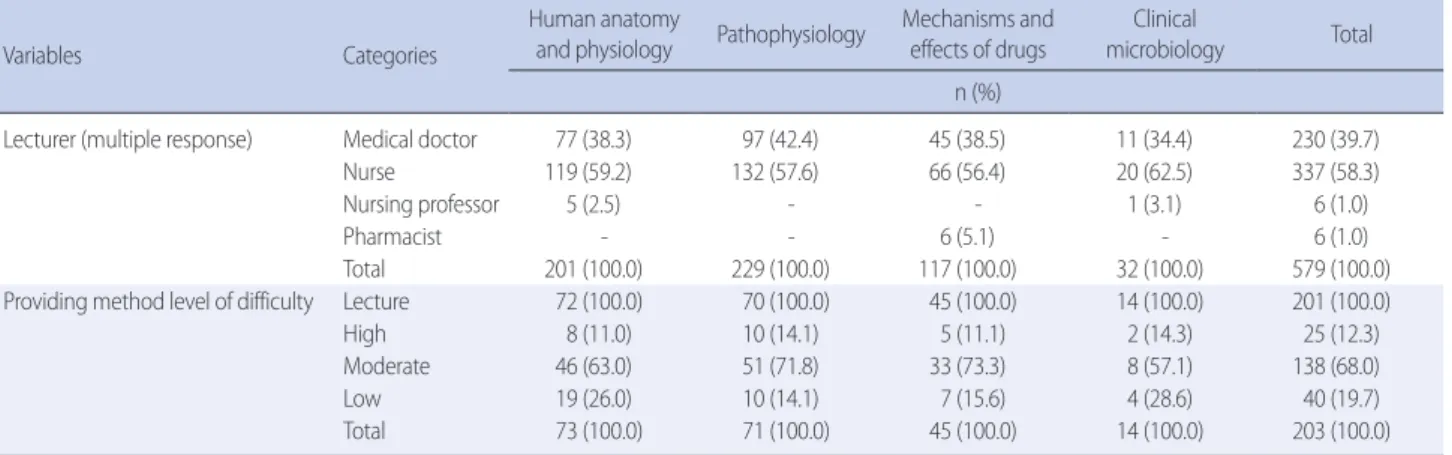
nurses in general hospital. Methods: Five advanced general hospitals located in Seoul and Gyeonggi province were conveniently sampled. Contents of education for nurses conducted by the hospital nursing department from January 1 to December 31 of 2015 were collected. Contents of education included biological nursing science and the scope of inclusion and time of assignment were analyzed. Results: A total of 271 cases of nursing education data were collected and 223 cases were analyzed after excluding 48 cas- es whose contents were not confirmed. Biological nursing science was included in the contents of education for 117 cases (52.5%), but not for 106 cases (47.5%). Regarding the frequency of the biological nursing science education contents, ‘pathophysiology’was the most frequently included (n= 286), followed by ‘structure and function of the human body’ (n= 191), ‘mechanisms and effects of drugs’ (n= 114) and ‘clinical microbiology’ (n= 43). Conclusion: Results of this study confirmed that the education for clinical nurses included a lot of biological nursing science related contents. These results can be used as basis for the development of curriculum and training course for nurses.
Key Words: General hospital; Clinical nurses; Biological nursing science; Education; Training
국문주요어: 종합병원, 임상간호사, 기초간호학, 교육, 연수
Corresponding author:
Hwang, Young Hui
Department of Nursing, University of Ulsan, 93 Daehak-ro, Nam-gu, Ulsan 44610, Korea Tel: +82-52-259-1237 Fax: +82-52-259-1236 E-mail: [email protected]
* 이 연구는 한국기초간호학회의 2014년 정책연구비로 수행되었습니다.
* This study was conducted as a research fund for the 2014 Korean Society ofr Biological Nursing Science.
* 이 연구는 이전에 어느 학회지에도 투고하거나 게재된 적이 없습니다.
* This study has never been published or published in any journals.
Received: February 14, 2018 Revised: February 22, 2018 Accepted: February 22, 2018
This is an Open Access article distributed under the terms of the Creative Commons Attribution Non-Commercial License (http://creativecommons.org/licenses/by-nc/4.0) which permits unrestricted non-commercial use, distribution, and reproduction in any medium, provided the original work is properly cited.
www.bionursingjournal.or.kr https://doi.org/10.7586/jkbns.2018.20.1.47