• 검색 결과가 없습니다.

Isolation of the Left Subclavian Artery with Right Aortic Arch in Association with Bilateral Ductus Arteriosus and Ventricular Septal Defect

N/A
N/A
Protected

Academic year: 2021

Share "Isolation of the Left Subclavian Artery with Right Aortic Arch in Association with Bilateral Ductus Arteriosus and Ventricular Septal Defect"

Copied!
4
0
0

로드 중.... (전체 텍스트 보기)

전체 글

(1)

ISSN: 2233-601X (Print) ISSN: 2093-6516 (Online)

− 415 −

Departments of

1

Thoracic and Cardiovascular Surgery and

2

Radiology and Research Institute of Radiology, Konkuk University Medical Center, Konkuk University School of Medicine

Received: September 22, 2014, Revised: November 7, 2014, Accepted: November 8, 2014, Published online: December 5, 2015

Corresponding author: Dong-Man Seo, Department of Thoracic and Cardiovascular Surgery, Konkuk University Medical Center, 120-1 Neungdong-ro, Gwangjin-gu, Seoul 05030, Korea

(Tel) 82-2-2030-7599 (Fax) 82-2-2030-5009 (E-mail) [email protected]

C

The Korean Society for Thoracic and Cardiovascular Surgery. 2015. All right reserved.

CC
This is an open access article distributed under the terms of the Creative Commons Attribution Non-Commercial License (http://creative- commons.org/licenses/by-nc/4.0) which permits unrestricted non-commercial use, distribution, and reproduction in any medium, provided the original work is properly cited.

Isolation of the Left Subclavian Artery with Right Aortic Arch in Association with Bilateral Ductus Arteriosus and

Ventricular Septal Defect

Ji Seong Lee, M.D.

1

, Ji Young Park, M.D.

1

, Seong Min Ko, M.D.

2

, Dong-Man Seo, M.D.

1

Right aortic arch with isolation of the left subclavian artery is a rare anomaly. The incidence of bilateral ductus ar- teriosus is sporadic, and a right aortic arch with isolation of the left subclavian artery in association with bilateral ductus arteriosus is therefore extremely rare. Since the symptoms and signs of isolation of the left subclavian ar- tery can include the absence or underdevelopment of the left arm, subclavian steal syndrome, or pulmonary artery steal syndrome, the proper therapeutic approach is controversial. We report a case in which surgical reconstruction was used to treat isolation of the left subclavian artery with right aortic arch in association with bilateral ductus arteriosus and a ventricular septal defect.

Key words: 1. Aorta, arch

2. Congenital heart disease 3. Embryology

CASE REPORT

A girl weighing 3,190 g was delivered by a Caesarean sec- tion at 38 weeks and five days of gestation. At the time of birth, a systolic murmur was noted during a physical exami- nation, and transthoracic echocardiography revealed a peri- membranous ventricular septal defect (VSD) with a septal aneurysm, a small patent foramen ovale (PFO), and a small right-sided patent ductus arteriosus (PDA) from the innominate artery. The VSD was measured as having a diameter of 3.5 mm and a shunt flow less than 2.5 m/sec. Due to the presence of neonatal hyperbilirubinemia, echoencephalography was conducted, and no abnormalities were found. Five months later, the pa- tient was referred to Konkuk University Medical Center for

VSD and PDA. Her parents stated that she had shown short- ness of breath while feeding. Her body weight was 6,700 g (25th percentile), and her height was 61.6 cm (10th percentile).

She showed no cyanosis and no underdevelopment of any extremities. Her blood pressure, as measured at both upper extremities, was normal. A chest X-ray showed cardiomegaly.

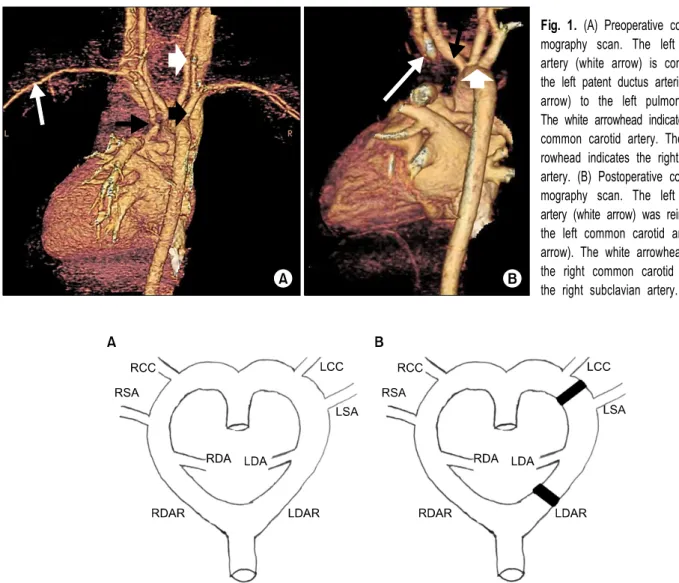
Transthoracic echocardiography revealed a VSD approx- imately 6 mm in size with a minimal aneurysm, a left-sided PDA 3.6 mm in diameter from the right aortic arch and an aberrant left subclavian artery. A subsequent computed tomo- graphic scan demonstrated isolation of the left subclavian ar- tery with a right aortic arch, a left PDA, and a VSD (Fig.

1A). Surgery was performed through median sternotomy. The intraoperative findings were a perimembranous VSD, a PFO,

Korean J Thorac Cardiovasc Surg 2015;48:415-418 □ Case Report □

http://dx.doi.org/10.5090/kjtcs.2015.48.6.415

(2)

Ji Seong Lee, et al

− 416 −

Fig. 1. (A) Preoperative computed to- mography scan. The left subclavian artery (white arrow) is connected via the left patent ductus arteriosus (black arrow) to the left pulmonary artery.

The white arrowhead indicates the right common carotid artery. The black ar- rowhead indicates the right subclavian artery. (B) Postoperative computed to- mography scan. The left subclavian artery (white arrow) was reimplanted to the left common carotid artery (black arrow). The white arrowhead indicates the right common carotid artery and the right subclavian artery.

Fig. 2. (A) Schematic diagram on basic hypothetical aortic arch plan suggested by Edward. (B) Schematic diagram on isolation of left subclavian artery, bilateral ductus arteriosus and right aortic arch. Black shadow indicate the sites of regression. RCC, right common car- otid artery. LCC, left common carotid artery. RSA, right subclavian artery. LSA, left subclavian artery. RDA, right ductus arteriosus. LDA, left ductus arteriosus. RDAR, right descending aortic root. LDAR, left descending aortic root.

a mildly patent right ductus arteriosus, and isolation of the left subclavian artery connected to the left pulmonary artery via a left PDA. Both PDAs were divided and oversewn. The left subclavian artery was disconnected from the left pulmo- nary artery and reimplanted to the left common carotid artery by end-to-side anastomosis with monofilament polypropylene 6-0 sutures (Fig. 1B). Under cardiopulmonary bypass, direct closure of the VSD and the PFO was performed via right atriotomy. The patient was discharged uneventfully.

DISCUSSION

Ductus arteriosus is usually located on the left side, be-

tween the descending aorta and the junction of the main pul-

monary artery and left pulmonary artery. However, ductus ar-

teriosus may also be present on the right side or, very rarely,

may occur bilaterally in association with aortic arch anoma-

lies or conotruncal anomalies [1]. In such aortic arch anoma-

lies, isolation of the left subclavian artery with right aortic

arch is also uncommon. Here, isolation refers to the fact that

the left subclavian artery connects to the pulmonary artery via

(3)

Left Subclavian Artery with Right Aortic Arch

− 417 − either the ligamentum arteriosum or a patent ductus arteriosus without any connection to the aorta. Isolation of the left sub- clavian artery with a right aortic arch is known to be com- monly associated with congenital heart disease [2,3], but may also occur with normal intracardiac anatomy, although few such cases have been described [1,4]. Isolation of the left subclavian artery with a right aortic arch may be related to the 22q11 deletion [3,4]. However, our patient showed a nor- mal genotype in this regard.

Bilateral ductus arteriosus and isolation of the left sub- clavian artery with a right aortic arch can be explained through the hypothetical double aortic arch plan suggested by Edward [5]. Regression takes place on two levels in the dou- ble aortic arch plan: on one level, regression occurs between the left common carotid artery and the left subclavian artery;

and on the other level, regression occurs at the left dorsal aortic root distal to the left ductus arteriosus. And then right ductus arteriosus remains persistent, left ductus arteriosus con- nects the left subclavian artery to the left pulmonary artery (Fig. 2). In our patient, both ductus arteriosi were patent at birth. However, the right ductus arteriosus regressed, and only the left ductus arteriosus remained patent. If the left ductus arteriosus is patent, blood may be supplied to the left sub- clavian artery via the left ductus arteriosus. If the left ductus arteriosus regresses, the blood supply to the left subclavian artery may involve a mediastinal, thoracic anastomosis, or vertebral pathway. Thus, pulmonary steal syndrome and/or subclavian steal syndrome may occur. Isolation of the left subclavian artery usually presents with no apparent symptoms in neonates, but it may present with congenital pulmonary steal syndrome, subclavian steal syndrome, or may even pres- ent in adults with late symptoms due to sporadic progression.

Hayabuchi et al. [6] reported the case of a three-month-old girl with cerebral atrophy and an underdeveloped left arm.

Jesudian et al. [7] reported the case of a 15-year-old boy with an underdeveloped left arm. Due to these symptoms and signs, the therapeutic management of isolation of the left subclavian artery remains controversial, especially when it is associated with complicated congenital heart disease. Some authors have suggested that adequate collateral circulation must be ensured, meaning that reconstruction of the isolated subclavian artery is optional, regardless of the symptoms and signs. Successful

results have been reported after ligation or device closure of the PDA and ligation of the left subclavian artery [1,6]. However, reconstruction of the left subclavian artery due to pulmonary steal syndrome after right PDA closure in bilateral PDA has been reported. In one report, ischemic symptoms in the left arm and vertebrobasilar insufficiency occurred years after li- gation of the left subclavian artery [1]. Hokari et al. [8] re- ported that a man with Peutz-Jeghers syndrome presented with his first vertigo attacks due to subclavian steal syndrome at 29 years of age. Our patient presented with no symptoms and signs related to subclavian or pulmonary steal syndrome, and had shown normal findings on an echoencephalography study conducted at our medical center due to neonatal hyper- bilirubinemia. However, brain computed tomography angiog- raphy performed after surgery revealed hypoplasia of the left vertebral artery. We suggest that this hypoplasia would have led to vertebrobasilar insufficiency or underdevelopment of the left arm without surgical reconstruction. Since surgical re- construction of the isolated left subclavian artery leads to an- tegrade flow in the left subclavian artery, it can prevent hy- poplasia of the left vertebral artery and subclavian/pulmonary steal syndrome. Our case shows that early surgical reconstruction is reasonable, regardless of the symptoms, in cases of isolation of the left subclavian artery.

CONFLICT OF INTEREST

No potential conflict of interest relevant to this article was reported.

REFERENCES

1. Abe M, Isobe T, Atsumi N. Right aortic arch with isolation of the left subclavian artery and bilateral patent ductus arterioses. Pediatr Cardiol 2000;21:497-9.

2. Luetmer PH, Miller GM. Right aortic arch with isolation of the left subclavian artery: case report and review of the literature. Mayo Clin Proc 1990;65:407-13.

3. Lee Y, Hong SW. Abnormal origin of the left subclavian ar- tery from the left pulmonary artery in a patient with double outlet right ventricle. Korean J Thorac Cardiovasc Surg 2014;

47:32-4.

4. Madan N, Schneider DJ, Jacobs ML. Right aortic arch, iso-

lated left subclavian artery and ductus arteriosus with nor-

(4)

Ji Seong Lee, et al

− 418 − mal intracardiac anatomy: rare manifestation of chromosome 22q11 deletion. Pediatr Cardiol 2006;27:781-3.

5. Edwards JE. Anomalies of the derivatives of the aortic arch system. Med Clin North Am 1948;32:925-49.

6. Hayabuchi Y, Inoue M, Sakata M, Ohnishi T, Kagami S.

Subclavian and pulmonary artery steal phenomenon in a pa- tient with isolated left subclavian artery and right aortic arch.

J Clin Ultrasound 2013;41:265-8.

7. Jesudian V, Ravikumar R, Kumar RS. Isolation of the left subclavian artery-origin from the left pulmonary artery by way of ductus arteriosus: multidetector row computed tomo- graphic angiographic imaging. Pediatr Cardiol 2009;30:549-50.

8. Hokari M, Kuroda S, Furukawa K, Houkin K, Iwasaki Y.

Subclavian steal syndrome associated with the right aortic arch in a patient with Peutz-Jeghers syndrome: case report.

No Shinkei Geka 2003;31:281-6.

수치

Fig. 1. (A) Preoperative computed to- to-mography scan. The left subclavian  artery (white arrow) is connected via  the left patent ductus arteriosus (black arrow) to the left pulmonary artery

참조

관련 문서

Osteomyelitis in the right distal femur with surrounding

Post-surgical use of radioiodine (131I) in patients with papillary and follicular thyroid cancer and the issue of remnant ablation: a consensus

core exercise program showed not only increasing peak torque of the right leg, left leg in Hip Extension of exercise group but also increasing peak torque of the right leg, left

Objectives: This study was performed to find the association of job stress with geriatric nursing, coping methods and work environment with turnover intention among nursing

Especially, it was theoretically predicted that x-axis and y-axis polarization states can be obtained with a right-handed TR film and a left-handed

In 4-week group, the group filled with bone graft with decortication revealed larger new bone formation area than shown in the group that had a defect area

Transformed –log 10 p of SNPs from the logistic regression model of association with dementia based on the additive model in male subjects.. P-value on the left Y-axis is

activation(electroencephalolgram: left alpha wave, right alpha wave, left sensory motor rhythm, right sensory motor rhythm, right mid-beta wave, left attention concentration