161
Original Article
Korean College of Clinical PharmacypISSN 1226-6051 eISSN 2508-786X https://doi.org/10.24304/kjcp.2017.27.3.161 Korean journal of clinical pharmacy (Online) URL: http://www.ekjcp.org
알츠하이머병 및 건망증 경도 인지장애의 인슐린 비강투여: 체계적 문헌 고찰 및 메타분석
사라알라자르
1 ·
진혜경2 ·
강지은1,3 ·
박소현1 ·
이정연1*
1
이화여자대학교 대학원 생명 · 약학부 ,
2이화여자대학교 대학원 약학과 ,
3국립중앙의료원 약제부 (2017 년 9 월 20 일 접수 · 2017 년 9 월 24 일 수정 · 2017 년 9 월 24 일 승인 )
Intranasal Insulin for Alzheimer's Disease and Amnestic Mild Cognitive Impairment:
Systematic Review and Meta-analysis
Sarah Alnajjar 1 , Hye Kyung Jin 2 , Ji Eun Kang 1,3 , So Hyun Park 1 , and Sandy Jeong Rhie 1*
1
Division of Life and Pharmaceutical Sciences Graduate School, Ewha Womans University, Seoul 03760, Republic of Korea
2
College of Pharmacy, Ewha Womans University, Seoul 03760, Republic of Korea
3
Department of Pharmacy, National Medical Center, Seoul 04564, Republic of Korea (Received September 20, 2017 · Revised September 24, 2017 · Accepted September 24, 2017)
Alzheimer’s disease (AD) is a devastating, progressive, fatal neuro-degenerative disorder that accounts for most of cases of dementia in old age.1) It works through degeneration of specific neuronal cells in particular areas of the brain, leading to severe neuronal loss which reflects early on patient’s memory and then affects the general cognitive function, rendering affected individual incapable of performing regular daily activities, imposing great burden on the caregivers and health care providers.2)
In people aged between 60 and 64, the estimated worldwide prevalence of dementia is about 0.3-1%, this is dramatically increased at age group above 95 to be 42-68%. This prevalence doubles every five years.3) The postulated mechanism responsible for the neuronal degeneration is thought to be the accumulation of senile plaques (SPs)-widely referred to as amyloid hypothesis- and neuro-fibrillary tangles.4) These abnormal proteins accumulate in the neocortex causing degeneration of the affected neurons and disease manifestations.5)
ABSTRACT
Background: There is recent evidence that insulin resistance is responsible for increasing the risk of developing cognitive
dysfunction. To systematically review the influence of intranasal insulin treatment on the cognitive function in Alzheimer’s disease patients.
Methods: Randomized controlled trials comparing the cognitive effects of intranasal insulin therapy in Alzheimer’s diseasepatients with controlled interventions were retrieved from Pubmed, Medline, Embase and Cochrane library. Meta-analysis was conducted on the cognitive measurements with a subgroup analysis by dose, gender and apolipoprotein E allele 4 (ApoE ε4) status. Results: Seven randomized controlled trials were eligible for inclusion. Intranasal insulin had a positive influence on the cognitive function as compared to placebo without a statistical significance (standardized mean difference; SMD = 0.109; 95%
confidence interval; CI -0.04 to 0.26; P=0.14). In subgroup analysis, a 20 IU dose of intranasal insulin induced a significant improvement in cognitive function (SMD = 0.14; 95% CI 0.05 to 0.24; P=0.004), but 40 IU did not show this effect (SMD = -0.01; 95%
CI -0.11 to 0.09; P=0.82). ApoE ε4 positive patients showed a significant decline in cognitive function as compared to ApoE ε4 positive patients in the control group (SMD = -0.213; 95% CI -0.38 to -0.04; P=0.015). Such an effect was not apparent in ApoE ε4 negative patients. Gender had no influence on the cognitive outcomes. Conclusion: The results indicate that intranasal insulin may have beneficial effect in improving the cognitive function in Alzheimer’s disease patients.
KEY WORDS:
Alzheimer’s disease, intranasal insulin, systematic review, meta-analysis
*Correspondence to: Sandy Jeong Rhie, Division of Life and Pharmaceutical Sciences Graduate School and College of Pharmacy, Ewha Womans University, 52 Ewhayeodae-gil, Seodaemun-gu, Seoul 03760, Republic of Korea
Tel: +82-2-3277-3023, Fax: +82-2-3277-2851, E-mail: [email protected]
There is recent evidence that insulin resistance, is responsible for increasing the risk of developing cognitive dysfunction just like it does increase the risk for metabolic syndrome and type II diabetes mellitus (DM).6) Ever since, the long assumed co- existence of both disorders (DM and AD) with aging is no longer considered a co-incidence, it is rather a pathologically related cascade.7-8)
One striking similarity are from the brains of AD patients which are very similar to those found in brains of DM;
reduced insulin levels, decreased insulin receptor expression as well as insulin resistance.9) Furthermore, the pathology seen in brains of AD patients is greatly similar to those with type II DM that sometimes AD is thought of as “type III DM”.10-11) This puts anti-diabetic agents under investigation as a new option for treating or halting progression of AD.12)
Insulin plays an important role in the central nervous system (CNS). Insulin receptors are densely located within the hippocampus, medial temporal lobes (entorhinal cortex) and in the frontal lobes.13) They are mainly located within synapses where insulin plays a pivotal role in synaptic regulation and synaptogenesis.13) Not to mention its role in regulating glucose consumption, growth, differentiation and survival of brain tissue in the hippocampus and other brain regions that is to say, insulin deficiency or abnormalities in insulin signaling in the CNS, have significant influence on memory and other brain cognitive function, which in turn accelerates development of AD and cognitive dysfunction.14)
Insulin regulates the toxic accumulation of beta-amyloid proteins in brain tissue, especially in synapses and protects against their synaptotoxic effects.15) Insulin also reduces plasma levels of beta-amyloid proteins which is found elevated in early stages of AD. The mechanism by which insulin does this is thought to be through its effect on corticosteroids which in turn affect amyloid-β protein precursor (AβPP) and AβPP enzyme.16)
Therefore, keeping insulin levels in the CNS within normal range is of potentially favorable outcomes for patients with AD, however, its systematic administration for that purpose would raise its levels peripherally, that is not preferred as it might cause life threatening bouts of hypoglycemia.17)
Hence, the use of intranasal insulin is now under investigations to prove its efficiency of normalizing cerebral spinal fluid (CSF) insulin levels without affecting plasma insulin levels.18) This study systematically meta-analyzed using 7 RCTs of previous works on the use of intranasal insulin as a treatment option that prevents deterioration of cognitive function in AD.
METHODS
Literature search, selection of studies, data extraction
Studies were retrieved by electronic search of the literature databases and manual search of the key systematic reviews.The search was conducted using Pubmed, Medline (from 1997), Embase and Cochrane Library. The search terms included; “Alzheimer’s disease” or “Alzheimer’s” or “mild cognitive impairment” or “cognitive impairment” or “cognition”
or “memory” and “intranasal insulin” or “nasal insulin”.
Standard definitions of these terms as per the Medical Subheadings (MeSH) was used. Records of studies measuring the influence of intranasal insulin on cognitive function in patients with Alzheimer’s disease or mild cognitive impairment (MCI) comparing it with placebo were selected.
The titles and abstracts were screened for eligibility. After that, full texts of the selected articles were obtained and reviewed. Finally, the selected articles were included if they were in English, employed a randomized controlled design, used intranasal/nasal insulin as an intervention and measured the cognitive function. Study, patient, intervention, and outcome characteristics for each study was extracted in an excel sheet.
Risk of bias assessment
Cochrane tool was used for risk of bias assessment in the included studies.19) Based on the information provided in the papers, scoring is done for six domains that could introduce the bias in a clinical study. The studies are labeled as either at low, high or at unclear risk of bias. The risk of bias assessment was independently done by two reviewers, and any disagreements were resolved by a third reviewer.
Meta-analysis of the outcomes
The primary measure assessed by meta-analysis was change in cognitive performance in test and control subjects. This was done by calculation of the standardized mean difference in the cognitive assays. Standardized mean difference was used as the studies used different types of tests for measuring cognitive performances.
Publication bias was visualized through funnel plots and quantified with Duval and Tweedie’s trim and fill test.20) This nonparametric test estimates the possible number of missing studies and quantifies the effect these studies could theoretically have on the effect size.
A qualitative estimate of statistical heterogeneity between studies was assessed using Cochrane Q. For the chi2 test, a P value of <0.05 was considered statistically significant. In the presence of significant heterogeneity, I2 statistic was used to quantify the level of heterogeneity. I2 was interpreted based on Higgins and Thompson criteria, were 25%, 50%, and 75%
corresponds respectively to low, medium, and high heterogeneity.21) Statistical heterogeneity, Forest plot, publication bias, and sensitivity analysis were conducted with Comprehensive Meta-analysis (CMA, Version 2). In case of significant heterogeneity, Random effect model was used and in case of insignificant heterogeneity fixed effect model was used.
A subgroup analysis was conducted to reveal the differences in the outcome between genders, dose of insulin and status of apolipoprotein E allele 4 (ApoE ε4) genetic variant.
RESULTS
Search results
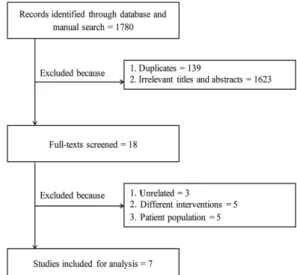
Our search retrieved 1780 unique articles (Figure 1). Following the abstract screening, 139 articles were excluded because of
duplication and 1623 were excluded because of irrelevance. After that, 18 titles were eligible for full-text screening after. Finally, seven RCTs with a total of 360 patients were found to be eligible for the final analysis (PRISMA flow diagram). Of these 360 patients, 214 were found to have MCI and 146 were diagnosed
Fig. 1. PRISMA flow diagram of the study selection stages.
Table 1. Study, patient, and intervention characteristics of the included studies.
Study name Study
design Number and patient’s characteristics Intervention Cognitive tests used
Reger et al,
2006
22)RCT
35 normal adults;
APOE- ε4 negative: 27 adults APOE- ε4 positive: 8 adults Probable/ early AD: 13 patients;
APOE- ε4 negative: 6 patients APOE- ε4 positive: 7 patients MCI: 13 patients
APOE-ε4 negative: 8 patients APOE-ε4 positive: 5 patients
Intranasal insulin; 20, 40 IU
placebo
Verbal declarative memory; story recall and a selective reminding word list task, Visual working memory; Self-Ordered Pointing Task, Selective attention Stroop Colour-Word test, and Visual search
Reger et al, 2008a
23)RCT
33 patients;
probable AD:13 patients
aMCI or multiple domain MCI with amnestic features: 20 patients
Also form the33 patients;
APOE- ε4 negative: 11 patients APOE- ε4 positive: 22 patients 59 normal adults;
APOE-ε4 negative: 48 adults APOE-ε4 positive: 11 adults
Intranasal insulin;
10,20,40,60IU
placebo
Verbal declarative memory measures;
Story recall and Hopkins Verbal Learning Test
Selective attention; Stroop Colour-Word test
Visual working memory measure; Self- Ordered Pointing Task
Test of psychomotor processing speed;
Digit Symbol
Reger et al, 2008b
24)RCT
25 patients’, only 24 completed the study AD: 11 patients
aMCI: 14 patients
Intranasal 20IU twice daily: 13 patients
Placebo: 12 patients
Primary: memory saving score;
immediate and delayed recall
Secondary: Stroop voice onset times,
errors for concordant and discordant
trials and DSRS
with early AD.
Study, patient, and intervention characteristics
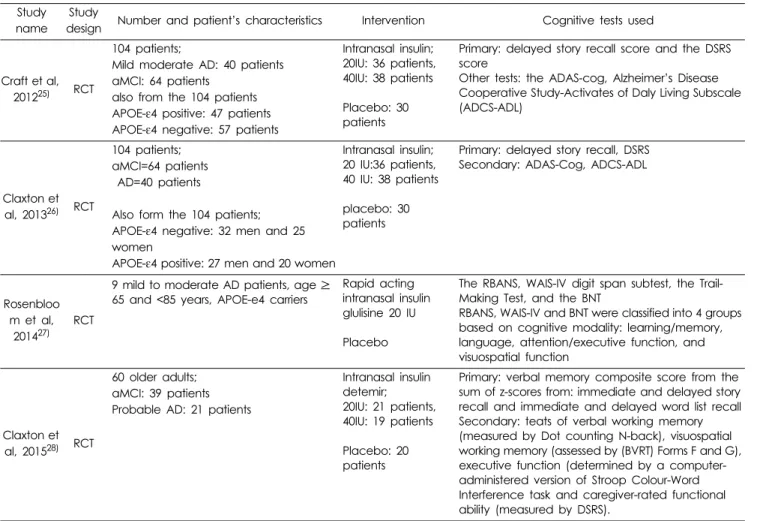
Table 1 summarizes the characteristics of the included studies, subjects and interventions employed. Reger et al, 2006 studied the influence of having the Apo E genotype on response to treatment by intranasal insulin,22) whereas Reger et al, 2008a used the dose and Apo E genotype as modulators and studied their effect on response to treatment by intranasal insulin.23) Reger et al, 2008b compared cognitive function in patients with AD or MCI between patient who received intranasal insulin and those who received placebo (saline).24) Craft et al, 2012 compared the dose dependent effect of intranasal insulin on the improvement of cognitive function of included patients.25) Claxton et al, 2013 examined modulation of the effect of two dose of intranasal insulin on cognition by both sex and Apo E genotype variation.26) Rosenbloom et al, 2014 examined effect of fast acting insulin in elderly AD ApoE ε4 carriers patients.27) Claxton et al, 2015 studied older
mild cognitively impaired patients and probable AD patients with intranasal insulin.28)
Risks of bias
The studies were scored for 7 components of the Cochrane risk of bias tool. Overall, the studies were considered as at low risk of bias.
Random sequence generation
All the other studies provided details of the randomization and were labeled as at low risk of randomization bias.
Concealment of allocation
Two studies were at risk of allocation concealment and five studies did not provide sufficient details for grading.
Blinding bias
Five studies blinded the participants. One study did not blind the participants and one study provided insufficient
Table 1. Study, patient, and intervention characteristics of the included studies(continued).
Study name
Study
design Number and patient’s characteristics Intervention Cognitive tests used
Craft et al, 2012
25)RCT
104 patients;
Mild moderate AD: 40 patients aMCI: 64 patients
also from the 104 patients APOE- ε4 positive: 47 patients APOE-ε4 negative: 57 patients
Intranasal insulin;
20IU: 36 patients, 40IU: 38 patients
Placebo: 30 patients
Primary: delayed story recall score and the DSRS score
Other tests: the ADAS-cog, Alzheimer’s Disease Cooperative Study-Activates of Daly Living Subscale (ADCS-ADL)
Claxton et al, 2013
26)RCT
104 patients;
aMCI=64 patients AD=40 patients
Also form the 104 patients;
APOE-ε4 negative: 32 men and 25 women
APOE- ε4 positive: 27 men and 20 women
Intranasal insulin;
20 IU:36 patients, 40 IU: 38 patients
placebo: 30 patients
Primary: delayed story recall, DSRS Secondary: ADAS-Cog, ADCS-ADL
Rosenbloo m et al, 2014
27)RCT
9 mild to moderate AD patients, age ≥ 65 and <85 years, APOE-e4 carriers
Rapid acting intranasal insulin glulisine 20 IU
Placebo
The RBANS, WAIS-IV digit span subtest, the Trail- Making Test, and the BNT
RBANS, WAIS-IV and BNT were classified into 4 groups based on cognitive modality: learning/memory, language, attention/executive function, and visuospatial function
Claxton et al, 2015
28)RCT
60 older adults;
aMCI: 39 patients Probable AD: 21 patients
Intranasal insulin detemir;
20IU: 21 patients, 40IU: 19 patients
Placebo: 20 patients
Primary: verbal memory composite score from the
sum of z-scores from: immediate and delayed story
recall and immediate and delayed word list recall
Secondary: teats of verbal working memory
(measured by Dot counting N-back), visuospatial
working memory (assessed by (BVRT) Forms F and G),
executive function (determined by a computer-
administered version of Stroop Colour-Word
Interference task and caregiver-rated functional
ability (measured by DSRS).
details on participant blinding. Three studies blinded the researchers involved in conducting the trial. Two studies did not blind the study personnel. Two studies did not provide sufficient details and were labeled as at unclear risk of bias.
Selective reporting and partial outcome data
Except Reger et al, 2008a, all studies provided sufficient details about the follow up and conducted all the analyses that were planned at the beginning of the trial.
Other sources of bias
We could not detect any other sources of bias in any of the studies.
Outcome characteristics
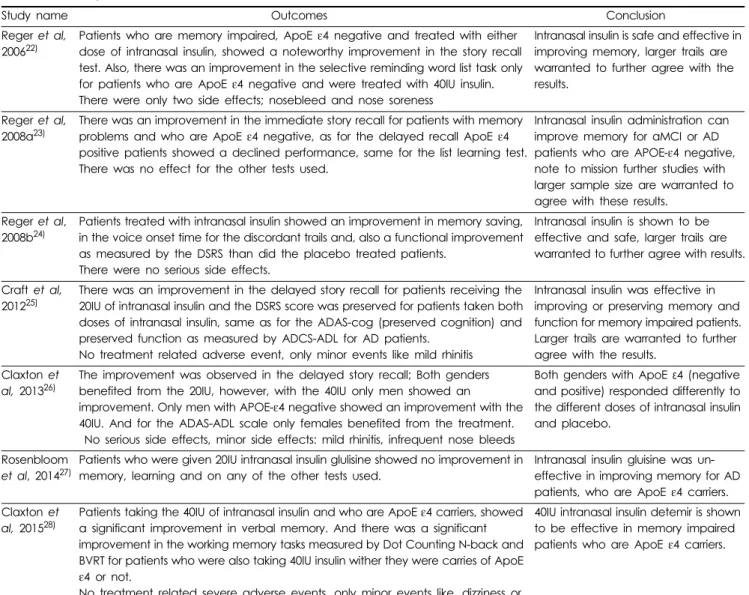
Outcomes of the intervention are presented in Table 2.
Effects of the intervention, meta-analysis
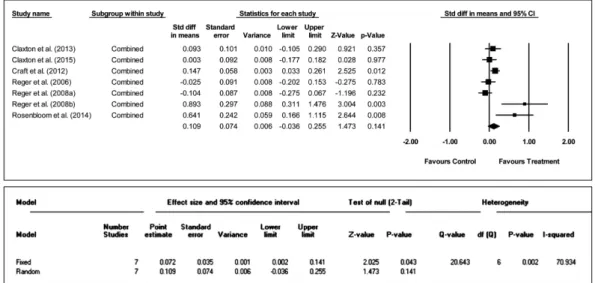
Combined effect sizeThe studies showed a statistically significant level of heterogeneity between studies (Cochran Q=20.64; I2=70.93;
P=0.002). Hence, a random effects meta-analysis model was used to calculate the total effect size for the change in cognitive function after therapy. Based on the 7 included studies, the standard difference in mean was 0.109, indicating that the treatment had a positive influence in improving the cognitive function in treated patients as compared to the control subjects (Figure 2). However, it must be noted that this
Table 2. Summary of the outcomes of the intervention in the included studies.
Study name Outcomes Conclusion
Reger et al, 2006
22)Patients who are memory impaired, ApoE ε4 negative and treated with either dose of intranasal insulin, showed a noteworthy improvement in the story recall test. Also, there was an improvement in the selective reminding word list task only for patients who are ApoE ε4 negative and were treated with 40IU insulin.
There were only two side effects; nosebleed and nose soreness
Intranasal insulin is safe and effective in improving memory, larger trails are warranted to further agree with the results.
Reger et al, 2008a
23)There was an improvement in the immediate story recall for patients with memory problems and who are ApoE ε4 negative, as for the delayed recall ApoE ε4 positive patients showed a declined performance, same for the list learning test.
There was no effect for the other tests used.
Intranasal insulin administration can improve memory for aMCI or AD patients who are APOE-ε4 negative, note to mission further studies with larger sample size are warranted to agree with these results.
Reger et al, 2008b
24)Patients treated with intranasal insulin showed an improvement in memory saving, in the voice onset time for the discordant trails and, also a functional improvement as measured by the DSRS than did the placebo treated patients.
There were no serious side effects.
Intranasal insulin is shown to be effective and safe, larger trails are warranted to further agree with results.
Craft et al, 2012
25)There was an improvement in the delayed story recall for patients receiving the 20IU of intranasal insulin and the DSRS score was preserved for patients taken both doses of intranasal insulin, same as for the ADAS-cog (preserved cognition) and preserved function as measured by ADCS-ADL for AD patients.
No treatment related adverse event, only minor events like mild rhinitis
Intranasal insulin was effective in improving or preserving memory and function for memory impaired patients.
Larger trails are warranted to further agree with the results.
Claxton et al, 2013
26)The improvement was observed in the delayed story recall; Both genders benefited from the 20IU, however, with the 40IU only men showed an
improvement. Only men with APOE-ε4 negative showed an improvement with the 40IU. And for the ADAS-ADL scale only females benefited from the treatment.
No serious side effects, minor side effects: mild rhinitis, infrequent nose bleeds
Both genders with ApoE ε4 (negative and positive) responded differently to the different doses of intranasal insulin and placebo.
Rosenbloom et al, 2014
27)Patients who were given 20IU intranasal insulin glulisine showed no improvement in memory, learning and on any of the other tests used.
Intranasal insulin gluisine was un- effective in improving memory for AD patients, who are ApoE ε4 carriers.
Claxton et al, 2015
28)Patients taking the 40IU of intranasal insulin and who are ApoE ε4 carriers, showed a significant improvement in verbal memory. And there was a significant improvement in the working memory tasks measured by Dot Counting N-back and BVRT for patients who were also taking 40IU insulin wither they were carries of ApoE ε4 or not.
No treatment related severe adverse events, only minor events like, dizziness or mild rhinitis.
40IU intranasal insulin detemir is shown
to be effective in memory impaired
patients who are ApoE ε4 carriers.
difference was not statistically significant (95% CI -0.04 to 0.26; P=0.14).
Visual inspection of the funnel plot showed that the studies were not plotted uniformly on the plot. This could be due to existence of the publication bias. Duval and Tweedie’s trim and fill test was used to assess and adjust for the publication bias statistically. The combined effect size remained unchanged after performing the trim and fill test, indicating that the publication bias is statistically absent.
Subgroup analysis by dose
Two meta-analysis models were constructed one each for 20 IU and 40 IU (Figure 3). For both the doses, the heterogeneity between studies was not statistically significant. Cochran Q
for 20 IU was 36.91 (df=40; I2=0.00; P=0.61). Cochran Q for 40 IU was 24.26 (df=34; I2=0.00; P=0.89). Hence, fixed effect models were used for both the doses. Based on 41 data points, the standard difference in mean at 20 IU was 0.14, indicating that the patients experienced improved cognitive function at this dose. Further, this effect was statistically significant (95%
CI 0.05 to 0.24; P=0.004). However, based on 35 data points, at 40 IU this improvement was not seen as there was almost no difference between the controls and treated patients (SMD=
- 0.01; 95% CI -0.11 to 0.09; P=0.82).
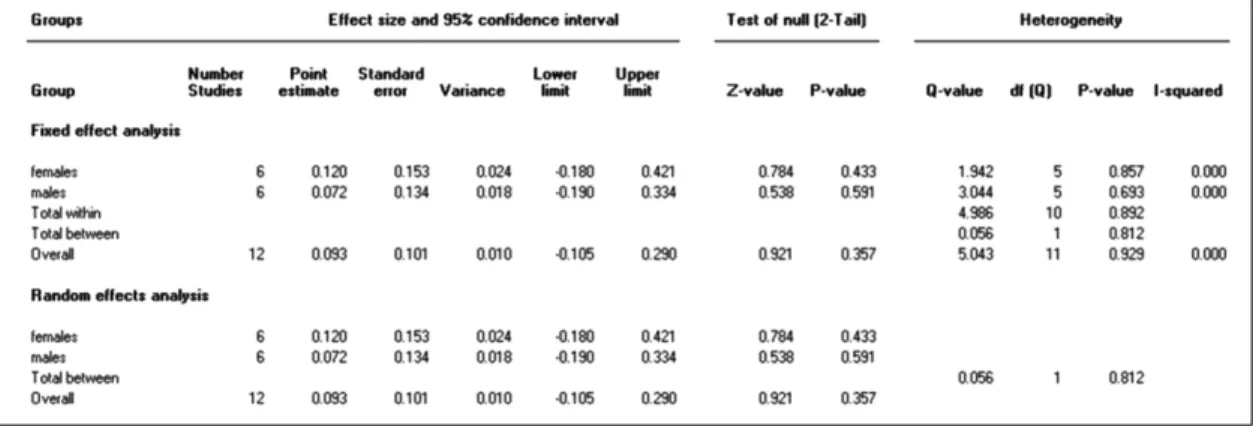
Subgroup analysis by gender
Two meta-analysis models were constructed one each for males and females (Figure 4). For both the genders, the
Fig. 2. Forest plot showing individual studies effect sizes and a combined effect size based on random effects model (upper panel).
Values from the meta-analysis models (lower panel).
Fig. 3. Heterogeneity and effect sizes for subgroup analysis by dose.
heterogeneity between studies was not statistically significant.
Cochran Q for studies on females was 1.94 (df=5; I2=0.00;
P=0.86). Cochran Q for studies on males was 3.04 (df=5;
I2=0.00; P=0.69). Hence, fixed effect models were used for both the genders. Based on 6 data points, the standard difference in mean for female patients was 0.12, indicating that the female patients experienced improved cognitive function with treatment as compared to the female patients in control groups. This effect was not statistically significant (95% CI -0.18 to 0.42; P=0.433). Similarly, based on 6 data points, male patients also did not register cognitive improvements as compared to their control counterparts (SMD= 0.07; 95% CI -0.19 to 0.33; P=0.59).
Subgroup analysis by APOE ε4 status
Two meta-analysis models were constructed one each for subjects’ positive for ApoE ε4 and for subjects negative for ApoE ε4 (Figure 5). For both the models, the heterogeneity between studies was not statistically significant. Cochran Q
for studies on ApoE ε4 negative patients was 6.80 (df=13;
I2=0.00; P=0.91). Cochran Q for studies on ApoE ε4 positive patients was 4.44 (df=13; I2=0.00; P=0.99). Hence, fixed effect models were used for both the analysis. Based on 14 data points, the standard difference in mean for ApoE ε4 negative patients was 0.09, indicating that the ApoE ε4 negative patients experienced a slight improved cognitive function with treatment as compared to the ApoE ε4 negative patients in control groups. This effect was not statistically significant (95% CI -0.12 to 0.29; P=0.41). However, based on 14 data points, ApoE ε4 positive patients showed a significant decline in cognitive function as compared to ApoE ε4 positive patients in control group (SMD= -0.213; 95% CI - 0.38 to -0.04; P=0.015).
Safety outcomes
Intranasal insulin was well tolerated (safe), without reporting of serious adverse events in the reviewed studies.
Fig. 4. Heterogeneity and effect sizes for subgroup analysis by gender.
Fig. 5. Heterogeneity and effect sizes for subgroup analysis by ApoE ε4 status.
DISCUSSION
Major findings
The concept of using intranasal insulin in prevention of progression and sometimes treatment of AD and MCI emerged from the pool of pathological studies which confirmed histopathologic similarities in brains of patients with type II DM and those with AD and MCI .29) This includes; low CSF and brain insulin levels, decrease in number of insulin receptors and development of insulin resistance similar to those with metabolic syndrome.
Even with the potential benefits of intranasal insulin and with reporting of minor side effects; the body of RCTs available so far is not enough to help clinicians start a new protocol using intranasal insulin instead of the many other neuro-modulators used as the main protocol for the past decades.
Studies which compared results of primary outcomes between intranasal insulin and placebo showed noticeable improvement in memory and other brain cognitive function in the group treated by intranasal insulin. Other studies confirmed the modulation of intranasal insulin affected by ApoE ε4. ApoE ε4 is known risk factor for AD. It was shown in two studies23),26), that AD patients who are not carriers of this genetic variant benefited more from the intranasal insulin treatment. Similarly, in my subgroup analysis from 7 RCTs, the results showed better outcomes in APOE-ε4 negative patients especially if they had impaired memory before start of treatment. Both genders receiving different dose of intranasal insulin (either 20 IU or 40 IU) responded differently to the treatment with variable results in the outcomes measured by different scales. Results favored the use of 20 IU; as indicated in the study done by Craft et al, 201225); which indicated an improvement in delayed story recall with the administration of 20 IU of intranasal insulin. Note to mention that memory facilitation is generally peaked at this dose23) which showed similar results with my study. Unfortunately, studies didn’t find significant influence of the gender on the results of the outcome. As shown in the results section; females showed an improved cognitive function, however it was not significant, this improvement in cognition in females may be due to cortisol, which is higher in females than males and it may interact with insulin to influence cognition.30) However, this is still an inconclusive evidence, and the existing literature does not support that females may benefit more than males when
treated with intranasal insulin and more studies are comparing both genders may be needed.
Quality of the findings
This meta-analysis brought very promising evidence in support of intranasal insulin in enhancing cognitive function in AD patients, the specific set if not all. Despite short listing of only 7 studies which could qualify the strict inclusion criteria.
Other studies were excluded due to various reasons like non- randomized study design, different objectives, and lack of complete data.
It is further promising that the overall risk of bias was low.
Biases in this review
Strict inclusion and exclusion criteria which excluded non- English and unpublished work may raise the possibility of reviewer bias. the Cochrane tool was used to assess the risk of bias in the included studies; all the studies provided details of randomization, and therefore were labeled as low risk of bias, however, for allocation concealment 5 studies did not provide detailed information, and thus marked as unclear risk and 2 studies24-25) were at high risk of allocation concealment. For the blinding of outcome assessment; 2 studies24), 26) did not provide detailed information of the blinding, and 2 studies22-
23) did not blind the personnel involved in their study. In overall the 7 RCTs included in my analysis were at low risk of bias.
Where our work stands?
At the time we started this project, no meta-analysis was available in the literature to assess influence of intranasal insulin on brain cognition and memory. Hence our work was conducted to combine the effect size of all the selected RCTs which studied its efficacy, side effects, modulation by age, gender and other genetic variants (Apo E allele), to take the available evidence in the literature a further step in the of evidence-based medicine.
Our review yielded favorable outcomes of memory and brain cognition upon use of intranasal insulin in specific set of AD patients. However, it must be noted that the small number of participants used in each study means that we are still far from extrapolation of these results to the clinical practice.
Further, there is a strong possibility of variation in response with the different factors like dose, gender and genetic status which needs further detailed investigations.
Limitations
Although this study used only seven, RCTs, this available evidence proved noticeable effectiveness of intranasal insulin in treatment of patients with AD and MCI. Despite the fact that each study used small number of participants, the collectively large number of patients in all studies raised the level of evidence.
However, the influence of gender on the outcome is still not clear enough, as the available studies showed insignificant association, with few number of participants and presence of possible confounding factors arising from biological differences between males and females.
Another factor whose influence on the outcomes of treatment was studied is the presence of Apo E allele. Small sample size is still a crippling factor in those studies, however, the statistically significant results favoring the use of intra- nasal insulin among Apo E non-carriers paves the way for clinical significance of its influence.
All studies made a strong point for need of further studies with larger sample size. For instance; the resulting data of the dose, being another issue of concern, which in our review were in favor of using lower doses (20 IU versus 40 IU), however, the presence of positive correlation between better outcomes and higher dose protocol in not to be neglected in the setting of a small sample size. The same goes for gender and Apo E allele.
CONCLUSION
Although the results of this meta-analysis are very promising as regards the concept of using intranasal insulin for cognitive enhancement in AD patients, the clinical applicability of the drug is still not generalized, as studies included used small sample sizes which hindered the proper correlation of drug doses to the effectiveness, and possible side effects of the drug.
However, this review raised the awareness of Apo E allele- negative-patients as good candidates for intranasal insulin intake compared to their positive counterparts. Making genetic analysis for this variant allele will be an important step prior to initiation of treatment to predict the prognosis.
Based on the promising results for the dose and genetic status, we believe that further research on validation and replication of these findings in large scale studies can pave way for bringing the cognitive enhancing effects of intranasal insulin in clinical practice.
CONFLICT OF INTEREST
No conflicts of interest have been declared.
FUNDING
No funding resource was declared.